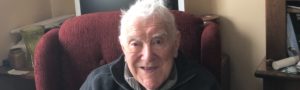
Danny Dowling (1927-2021)
now browsing by tag
Rathinure, Glenmore (1961)

Today, we are going to feature information Danny Dowling (1927-2021) recorded regarding the residents of Rathinure in 1961. Similar to other townlands in Glenmore, Rathinure has been spelled in different ways across the centuries. It was spelled Rathnewre on Sir William Petty’s, Down Survey Map (1656-1658); it was spelled Rathaure in the Tithe Applotment Books (1829); and a popular spelling in late 19th century newspapers was Rathenure.
Background
The Irish for this townland, according to O’Kelly’s, The Place Names of the County of Kilkenny Ireland (1969, p. 114) is Ráth an iubhair, or rath of the yew. The townland of Rathinure is comprised of 575 acres. O’Kelly listed the ancient Kilcolumb church site, Tobar na gcolm (according to Danny the well of the doves), and Cloch Choilm (the Kilcolumb holy water font that was tossed into a field by Cromwellians and is locally known as the headache stone). O’Kelly wrongly noted that the Bóithrin fada “is the by-road running southward from the main road to a number of houses.” The Bóithrin fada is a narrow unpaved farming lane that runs west from the High Road to the old hamlet of Rathinure coming down behinnd Johnny Garvey’s house.

O’Kelly lists a number of fields with Irish names including: Bán riach; Garaí; Cabúis; Cabus’s garden; Garaí glas; Gort ne sidheog or the fairies field a tradition of losing one’s way at night here; the Móineáns; Ocht na grainsí or hill breast of the grange; Sceathánach, sceach lland; Sean-bheitin; Sileáns or rivuets or drains; and Srath lia mhór, or field of the big grey fern. For further Rathinure families and field names see “The Enduring Names of Rathinure”.
Tithe Applotment Books (1829)
Rathanure was owned by S.W. Aylward who split his holding into Rathanure (566 statute acres) and the Hill of Rathanure (29 statute acres).
There were two tenants for the Hill of Rathanure (29 acres) namely, Philip and John Wallice (sic). There were 18 tenants listed for the 566 acres of Rathanure including: [1] James Wall; [2] William Roach; [3] Patt Kennedy [4] Patt Kennedy; [5] William Kennedy; [6] James Kennedy; [7] Michael Kennedy; [8] John Kennedy [9] John Malone; [10] Patt Eade; [11] Edward Murphy; [12] James Murphy; [13] Patt Murphy; [14] James Deighan; [15] Thomas Sullivan; [16] John Roach; [17] Jno Roach; [18] William Roach.
Griffith’s Valuation (1847-1864)
The immediate lessor (landlord) was James C. Aylward, Esq. Tenants included:
[1] Thomas Wall who had 32 acres, a house & offices;
[2] John Freeman who had a house and garden;
[3] John Roche, 46 acres, house and offices;
[4] Margaret Kennedy, 32 acres, house & offices;
[5] Richard Kennedy, 50 acres, house and offices;
[6] Peter Kennedy, 52 acres, house & offices;
[7] John Kennedy (the wall) had no landlord the word “free” appears in the record for immediate lessor. John the Wall Kennedy owned a house worth 10 shillings;
[8] Patrick Kehoe, 44 acres, house & offices;
[9] Thomas Delahunty had a house he leased from Patrick Kehoe worth 10 shillings;
[10] John Kennedy (Khosub), 41 acres, house & offices;
[11] John Malone, 33 acres, house & offices;
[12] John Kennedy (Ogue), 30 acres, house & offices;
[13] Richard Kennedy, jun. leased a house from John Kennedy (Ogue) worth 6 shillings;
[14] Patrick Geehan, 29 acres, house & offices;
[15] William Kennedy, 30 acres, house and offices;
[16] Mary Den leased a house valued at 5 shillings from William Kennedy;
[17] Jeremiah Greene leased a house (value 9s.) and garden (value 3s.) from William Kennedy;
[18] Edmund Murphy 46 acres, house & offices;
[19]Anastatia Kelly leased a house (valued 5 s.) from William Kennedy;
[20] Oliver Neill leased a house and small garden (valued at 8s.) from Edmond Murphy;
[21] Philip Wallace, had a house (valued at £1) and his immediate lessor were “Tenants of the Townland.” [22] Tenants of the Townland held 1.6 acres of land in 3 parcels of commons valued at £2.15.;
[23] John Murphy, 25 acres, house and offices;
[24] Ellen Murphy had a house and garden (valued at 12s.);
[25] John Kehoe and
[26] Lawrence Sullivan together leased 1 acre of land; houses & offices from James C. Aylward;
[27] John Roche (Luke),
[28] John Roche (Anne) and
[29] Bridget Roche, the three Roches [27, 28 & 29] shared 72 acres. They had houses and offices valued at respectively £3.10; £4.5 & £2.15.
1961 Rathinure, Glenmore
In 1961, Danny recorded 14 families or households in the townland of Rathinure. Birthdates or birth years are provided for some of the older residents gleaned from available public records. For some time after drafting his notebook, Danny recorded the dates of death or simply recorded that a resident had died or left the townland.
Danny’s recorded information reveals that in 1961, 52 people resided in the townland of Rathinure with the population comprised of 29 males and 23 females. The largest households was the Maguire family with 8 persons in their household. There were 4 households recorded with a single person living alone in each house. Information under residents of Rathinure not in Danny’s original list has been placed in square brackets [ ].
Recorded Rathinure, Glenmore Residents (1961)
Males= 29
Females= 23
Eldest Recorded Resident
The eldest resident recorded by Danny in Rathinure, Glenmore was Peter Kennedy (5 Nov. 1878-17 March 1962) who was 83 in 1961. Peter Kennedy was the son of Thomas Kennedy and his wife, Anastatia Irish, of Aylwardstown. Peter only had one sibling Bridget who married Peter Foskin of Big Wood, Mullinavat. Peter Kennedy married Elizabeth Walsh (c. 1884 – 1958) of Powerswood, Thomastown. The couple were married on 8 February 1921 at Thomastown. Elizabeth pre-deceased him Peter. Peter Kennedy and his wife had five daughters and the youngest Cissy Kennedy will be 94 on the 5th of January 2024.
Recorded Work
Farmers= 8 (7 Males; 1 Female)
Retired Farmer= 1 (1 Male)
Farm Workers = 11 (11 Males)
Council Worker= 1 (1 Male)
Builder’s Labourer= 1 (1 Male)
Odd Jobs = 1 (1 Female)
Rathinure, Glenmore Residents 1961
[1] KAVANAGH
Kavanagh, Annie (b. 5 May 1901)
[2] ROCHE
Roche, Mary (b. 1918) [née Forristal of the Mill was the widow of Edward “Ned” Roche of the High Road, Rathinure who died 15 August 1957 aged 75. Mary died on 26 January 1984 aged 87].
[3] GRACE
Grace, John (7 Sept. 1893-22 June 1964) Farmer
Grace, Bridget (b. 12 Dec. 1899) wife
Grace, Patrick , son, assisting on farm
Grace, Ellen, daughter-in-law
[4] ROCHE
Roche, Catherine “Katie” (b. 1 Jan. 1912) Farmer [died 9 August 1967, aged 56]
Roche, Mary “May” (b. 4 Aug. 1916) sister [May Roche died 28 September 2001].
Delahunty, Michael (b. 20 Dec. 1906) farm labourer
[5] ROCHE
Roche, John (b. 11 Oct. 1911) Farmer
Roche, Margaret (b. 1917) wife
Roche Michael, son
Nolan, Nicholas, nephew, assisting on farm [died 22 Sept. 2013, aged 69, of Garryduff, Piltown]
[6] KENNEDY
Kennedy, John (10 Feb. 1885-11 Feb. 1962) Farmer [John Sean Og Kennedy]
Kennedy, Mary (b. 13 April 1881) sister [Mary Sean Og Kennedy died 8 February 1971]
Garvey, John, grand-nephew, assisting on farm
For more information on the Sean Og Kennedy’s of Rathinure see our post of 3 October 2021.
[7] KEHOE
Kehoe, Richard [19 July 1914—15 Dec. 1974] Farmer
[Dick Kehoe married Mary Doherty, of Ballinlammy in the late 1960’s. Mary Kehoe née Doherty died 7 December 2016 at the age of 94.]
[8] WALSH
Walsh, Thomas (b. 27 May 1908) Farmer [died 2 April 1992]
Walsh, Stacia (b. 31 March 1922) wife [died 12 Nov. 1984]
Walsh, Robert, son [4 May 1950-14 Aug. 1984]
Walsh, Peter, son
Walsh, Elizabeth “Elsie”, daughter
Kennedy, Peter (5 Nov. 1878-17 March 1962) father-in-law, retired farmer
[9] FITZGERALD
Fitzgerald, Anastasia (b. 14 Feb. 1900) [née Sullivan]
Fitzgerald, Stephen, son, farm labourer [died 8 July 1999, aged 76]
Fitzgerald, Patrick, son, farm labourer [died 28 Oct. 1981, aged 55]
Fitzgerald, John, son, farm labourer
Fitzgerald, Bridget, daughter [died 22 May 1994, aged 66]
[10] DALTON
Dalton, Johanna “Josie” (b. 31 Dec. 1907) odd jobs [died Dec. 1978]
[Josie Dalton’s grandfather, R.I.C. Hearn, arrested Roger Casement in Kerry c. 1914. Danny Dowling said her father was a cobbler from Tullogher and moved to the Railway Cottage in Rathinure. Josie had two sisters and a brother Pat. All her siblings went to England and Josie lived in the isolated Railway Cottage until shortly before she died. Josie broke her leg and was found by a neighbour and taken to the hospital. She lived in a small mobile home where Willie Cummins had lived. Although Josie told friends she was going to return to the Railway House she died at the mobile home.]
[11] KENNEDY
Kennedy, Thomas (b. 26 Aug. 1912) Farmer [died 9 Jan. 1987]
Kennedy, Laurence (b. 12 Aug. 1914) brother, assisting on farm
Kennedy, Richard (b. 5 Oct. 1917) brother, assisting on farm [died 10 Jan. 1994]
Kennedy, Patrick (b. 14 March 1921) brother, assisting on farm [died 19 May 1997]
Kennedy, Bridget (b. 1922) sister
[12] ROCHE
Roche, Edward (b. 4 Nov. 1887) Farmer [died 14 Jan. 1969, aged 81]
Roche, Alice (b. 22 Dec. 1886) [née Heffernan of Aylwardstown died 28 Nov. 1972, aged 86]
Roche, James [2 Nov. 1928-13 Dec. 2018 aged 91]
Roche, Alice “Ciss” (b. 1930) daughter-in-law [née Culleton of Kilbride]
Roche, Eddie, grandson
Roche, Michael, grandson
Roche, Alice, granddaughter
[13] WALSH
Walsh, John “Jack” (b. 5 Feb. 1893) Farm Labourer
Walsh, Anastatia (b. 14 March 1899) wife
Gahan, Michael (b. 10 Feb. 1911) brother-in-law, Council Worker
[14] MAGUIRE
Maguire, John, Builder’s Labourer
Maguire, Catherine, wife
Maguire, James, son
Maguire, Catherine M., daughter
Maguire, Margaret M., daughter
Maguire, Thomas J., son
Maguire, Mary, daughter
Maguire, Anastatia, daughter
(Family moved to Ballinlaw, Slieverue).
XXXXXXXXX
Please send any corrections, further information or photos to glenmore.history@gmail.com.
The featured photo above is Kilcolumb ruins and churchyard. See our post of 22 December 2019 concerning what happened to persons who abused or damaged Cloch Choilm (the Kilcolumb stone for curing headaches).
For a link to a recording of Danny Dowling in 1991 speaking on Kilcolumb click here.
Dr. Kathleen Moore Walsh
Redgap, Glenmore (1961)

Today, we are going to feature information Danny Dowling (1927-2021) recorded regarding the two residents of Redgap in 1961, as well as other information he recorded regarding Redgap, the smallest townland in Glenmore.
Background
The Irish for this townland, according to O’Kelly’s, The Place Names of the County of Kilkenny Ireland (1969, p. 114) is Bearna dhearg, which means “a red gap”. Redgap is the smallest townland in Glenmore and is comprised of only 33 acres. That is the sum total of the information O’Kelly provides. Redgap is located on the edge of Glenmore parish in the civil parish of Kilcolumb. It borders Slieverue on the crescent of the Rochestown/Scart hills.
Tithe Applotment Books 1829
We were unable to find any reference to Redgap, in the Kilcolumb Civil Parish list of townlands in the Tithe Applotment Books. We believe that Redgap was an area within a larger townland. Given its proximity to Slieverue it may be the case that it was once part of the townland of Ballyrowragh and was separated from that townland when the Catholic parish of Glenmore was established in 1846. In the 20th century Redgap was usually identified as being part of Rochestown.
Oral Tradition Regarding Redgap, Glenmore
Philip Wallace (c. 1806-1883)
In 1956, Danny interviewed Matt Aylward of Ballyfacey, Glenmore (DD Notebook 4). Matt stated, “In the last century a man named Philip Wallace who lived in Redgap conducted a hedge school.” Matt recited and Danny recorded the following crude local verse in reference to Philip Wallace’s school—“Philip’s scholars against the wall, A pint of piss would drown them all.”
A couple of sayings Matt shared with Danny that Phillip Wallace used were “go that” pronounced “gow that” and “No moiseac (mozhic) on him” or “No worry on him.”
Phillip Wallis (sic) (c. 1806-1883) schoolmaster, died on 24 November 1883 at his home at Redgap at the age of 77. His wife, Ellen Wallis was present when he died. According to Glenmore Parish records, Phillip Wallace married Ellen Fitzpatrick of Rochestown on 1 March 1870. According to the marriage records, Philip was a bachelor, schoolmaster, and was the son of Luke Wallace, farmer. Ellen was a servant and the daughter of Patrick Fitzpatrick (labourer) of Rochestown. If Philip’s age at his death is correct, he was about 64 when he married.
The John O’Donovan Connection to Redgap, Glenmore

According to Martin Walsh (c. 1918- 1996) of Rochestown, Glenmore there were three “botháns” in the long, narrow, hilly field in Redgap (the field currently owned by John Hoynes). The small houses were at the sheltered side of the north facing ditch where the field is level. May Roche (c. 1918-2001) of Scart, Glenmore said that her father (John “Sal” Roche (c. 1861-1931) and aunt Allie (Alice) Roche (c. 1859 -1933) told her that there was once a small shop in Redgap (May gave this information to Michael Hoynes of Ballybrahee, Glenmore).
Michael Hoynes also recalled this week that May Roche (c. 1918-2001) stated that the great Irish scholar John O’Donovan (c. 1806-1861) was connected to Redgap. Michael went on to research this statement and found a biography of John O’Donovan written by Diarmaid Ó Catháin that provides the connection.
Leased Redgap
John O’Donovan’s father, Edmund, did well during the Napoleonic wars (c. 1803-1815). In 1816, he built a new house but due to circumstances he was forced to move. Edmund leased 33 acres in the adjacent townland of Redgap near where his brother Patrick O’Donovan (1753-1831) had a cornmill. At the same time John O’Donovan’s eldest brother, Michael (bapt. 1789) leased 40 acres in Ballyrowragh, Slieverue. John O’Donovan’s father died in 1817 and John appears to have gone to live with this brother. His uncle, Patrick, was an important influence on John. Patrick went to sea as a young man, was widely read in both English and Irish, and had a great interest in history and tradition. Irish was the primary language in the locality at the time.
Donovan’s Mill, Ballyrowragh, Slieverue
The corn mill at Ballyrowragh still stands, and today it is still called “Donovan’s Mill.” The Tithe Applotment Books, 1829, provides that Patrick Donovan held 9 acres in Ballyrowragh, Slieverue. Given that Redgap, Glenmore is only comprised of 33 acres it appears that Edmund O’Donovan leased the entire townland. See our post of 13 March 2021 for information on John O’Donovan’s work.
Griffith’s Valuation (1847-1864)
Supporting the local oral tradition, Griffith’s Valuation lists three households in Redgap: [1] Philip Wallace (house & 1 acre); [2] John Gahan & Joseph Gahan (house and 13 acres) and [3] John Roche (house, offices and 17 acres). It is assumed that the Gahan’s were uncles or great-uncles of Martin Walsh (his mother was Elly Gahan). It is also assumed that John Roche was May Roche’s grandfather.
1961 Redgap, Glenmore
In 1961, Danny recorded one family or household in the townland of Redgap. In 1961, there was a married couple living in Redgap, Edward “Ned” Baldwin and his wife, Ellen “Elly” Baldwin (1916-1988) née Ryan.
Recorded Redgap, Glenmore Residents (1961)
Male= 1
Female= 1
Eldest Redgap, Glenmore, Resident 1961
Edward “Ned” Baldwin (1903-1991)
The eldest resident recorded by Danny in 1961 in Redgap, Glenmore, was Edward “Neddy” Baldwin (30 May 1903- 26 May 1991). Edward Baldwin was born to John Baldwin (labourer) and his wife, Elizabeth Doyle. The address on the birth cert is Knockroe, Waterford. In his obituary it is stated that Edward was a native of Passage East. As a young man Ned was a member of the Defence forces. He was skilled in all aspects of mechanical farm equipment and worked for years for James Kelly of Aylwardstown. Please see our B Family surname page for Edward’s obituary.
Marriage
Edward Baldwin married Ellen Ryan on 26 April 1937 in the Cathedral of Waterford. Edward was a labourer living in Skeard, Kilmacow. He was the son of John Baldwin (farmer). Ellen was living in Glenmore the daughter of Michael Ryan, labourer. Given the fact that Redgap is often referred to as part of Rochestown we believe that Ned and Ellie moved to Redgap in 1947. According to the Munster Express (Friday 6 June 1947, p. 2) Edward Baldwin, of Ringville, was appointed tenant of cottage 190L, of Rochestown, formerly in the occupation of Martin Connolly.
Ellen “Ellie” Baldwin née Ryan (1916 -1988)
The second resident of Redgap, Glenmore in 1961 was Glenmore native Ellie Baldwin née Ryan. Ellie was born on 17 February 1916 at Kearneybay, Glenmore, the eldest child of Michael Ryan (labourer) and his wife Mary Manning. Her parents were married on the 9th of February 1915 at Glenmore. At the time of their wedding Michael Ryan was 35 years of age and Mary Manning was 30. Both gave their address as Karneybay (sic). Michael was the son of Jermiah Ryan (labourer) and Mary was the daughter of Martin Manning (farmer).
Ellie’s Parents & Grandparents
According to the 1911 Census Michael Ryan had 8 siblings. His father Jeremiah (66) and mother Mary (54) had five children still at home. Jeremiah Ryan (labourer) of Kearneysbay married Mary Prendergast of Scartnamore, Glenmore on 20 November 1878. Jeremia Ryan was the son of Michael Ryan (labourer) and Mary Prendergast was the daughter of Richard Prendergast (farmer).
In 1911, Mary Manning was residing in Rathinure, Glenmore, with her father Martin Manning, a widower. The 1901 Census provides far more information. Her father was 52 and was a navy. Her mother, Ellen, was 48. Mary had three brothers listed: Bartley Manning was 21; Edward Manning was 20 and John Manning was 18. All three of her brothers were also navies we assume with the railway that was being built between New Ross and Waterford.
Ellie’s Siblings

Unfortunately, Irish births after 1916 are generally not available to the public. However, per Ellie’s and other family obituaries we know that Ellie Balldwin née Ryan had at least three brothers and a sister. Her brothers included: Martin “Mattie” Ryan, Patrick Ryan (1917-1973) of Kearneybay and Dermot Ryan of Kilivory, Glenmore, and her sister was Mary Walsh née Ryan of Mary Street, New Ross. See our R family surname page for Ryan obituaries.
Children of Ned and Ellie Baldwin
Ned and Ellie Baldwin had three children: [1] John Baldwin (Newbridge, Co. Kildare) [2] Mary Baldwin Tohill (Aylesbury, England) and [3] Elizabeth “Lizzy” Baldwin Davis (Aylesbury, England).
John Baldwin went into the army as a teenager and at the age of 19 in 1962 was sent to the Congo (Munster Express, Fri. 18 May 1962, p. 9). For further information and Baldwin obituaries please see our B surname page.
XXXXXXXXX
Special thanks to Michael Ryan, of Kearneybay, Glenmore for sharing the photo of his parents Dermie Ryan & Peggy Ryan née O’Neil and to Michael Hoynes of Ballybrahee, Glenmore for his help.
The featured photo above is Donovan’s Mill, Ballyrowragh, Slieverue, on the border of Glenmore Parish.
Please send any corrections, additional information or photos to glenmore.history@gmail.com.
Dr. Kathleen Moore Walsh
Kearneysbay, Glenmore (1961)

Today, we are going to feature information Danny Dowling (1927-2021) recorded regarding the residents of the townland of Kearneysbay, Glenmore, in 1961. This townland has been spelled multiple ways over the past three centuries. Sometimes it is spelled without an “s” as Kearneybay. Sometimes it is spelled as two separate words Kearney’s Bay. Some 19th century newspapers spelled it Carney Bay.
Background
The Irish for this townland, according to O’Kelly’s, The Place Names of the County of Kilkenny Ireland (1969, p. 113) is Trian an ri, or the King’s third. The townland is comprised of 141 acres. “The ‘third’ is an ancient land measure term. There is another townland in the parish [Kilcollumb] far removed from here called Trinaree. James Kearney of Kearneysbay held lands in Parkstown, Ballyvoulera, Luffany and Kearneysbay according to his will registered in the Registry of Deeds Office, Dublin, on 9th May, 1754 —from Abstract of Wills, Vol. II by P. Beryl Eustace.”
Tithe Appotment Books 1829
In 1829, Major Charles Kearney held 139 acres and was the only person listed in the applotment books for Kearneysbay.
Landlord of Kearneysbay, Glenmore, Charles Kearney (c. 1787-1871)
Major Charles Kearney (c. 1787-1871) of the 2d Dragoon Guards, or Queen’s Bays married Mary Anne Massy of Limerick. The bride was the youngest daughter of Hon. George Eyre Massy, of Limerick City (Dublin Weekly Register, Sat. 17 October 1829, p. 8).
Major Kearney was promoted to Lieut.-Col. in 1837 “by purchase” (Dorset County Chronicle, Thur. 2 Nov. 1837). Kearney died on 24 July 1871,”at his residence, 3, Upper Brook street, Grosvenor square, London.” He died in his 85th year (Waterford Standard, Sat. 29 July 1871, p. 3) His widow, Mary Anne died on the 31st of August 1886, at Homburg (Dublin Daily Express, Fri. 10 Sept. 1886, p. 1).
1961 Kearneysbay, Glenmore
In 1961, Danny recorded three families or households in the townland of Kearneysbay. Birthdates or birth years are provided for some of the older residents gleaned from available public records. For some time after drafting his notebook, Danny recorded the dates of death or simply recorded that a resident had died or left the townland.
Danny’s recorded information reveals that in 1961, ten people resided in the townland of Kearneysbay, with the population comprised of 9 males and 1 female. The largest family was the Heffernan family with 8 in the household. There were 2 households recorded with a single person living alone in each house. All information under residents of Kearneysbay not in Danny’s original list has been placed in square brackets [ ].
Recorded Kearneysbay, Glenmore Residents (1961)
Males= 9
Females= 1
Eldest Recorded Resident
The eldest resident recorded by Danny in 1961 in Kearneysbay, Glenmore was Thomas Foran (b. 14 Jan. 1885) who was 76 years of age in 1961. A headstone in St. James’s Cemetery provides that Thomas died 22 June 1973, aged 88. The birth register and parish baptismal records provides that Thomas Foran was born on the 4th of January 1885 the son of John Foran (farmer) of Kearneysbay and his wife Ellen Power. Mary Foran of Robinstown was present at his birth and registered his birth on the 13th of January 1885.
Kearneysbay, Glenmore Residents 1961

[1] HEFFERNAN
Heffernan, Thomas (10 Mar. 1888-12 Jan. 1965) Farmer
Heffernan, Michael (b. 22 Mar. 1916) son, assisting relative [per headstone 1916-1988]
Heffernan, Mary, daughter-in-law [per headstone née Doherty (1931-2015)]
Heffernan, Thomas, grandson [per headstone 1929-2003 buried in Calif.]
Heffernan, John, grandson
Heffernan, Christopher, grandson
Heffernan, Desmond, grandson
Dunphy, Thomas (b. 14 Dec. 1894) employee, farm labourer
[2] FORAN
Foran, Thomas (b. 14 Jan. 1885) Retired Labourer. [See above, Tom Foran died 22 June1973].
[Tom Foran lived in a long thatched house down at the end of Kearneysbay road. He was a big man and spent most of his life in the merchant navy. Tom Foran was in England and came across another Glenmore man reared in Aylwardstown, Foxy Wattie Power’s brother. The Power man was in a fight and was so covered with blood Tom Foran said that his own mother wouldn’t recognise him. “But he stuck it out and beat the other fella.” (Tom Walsh (1908-1992) of Rathinure, Glenmore)] For further information see our F surname page.
[3] RYAN
Ryan, Patrick (b. 1917) Farm Labourer [Per newspaper notice died in July 1973].
[Paddy Ryan collapsed and died as he was about to enter a cot to go fishing on the River Barrow. His brother, Dermot Ryan (Kilmakevogue, Glenmore) was with Paddy when he collapsed and died. For further information see our family R surname page.]
Please send any corrections, additional information or photos to glenmore.history@gmail.com.
Dr. Kathleen Moore Walsh
Glenmore’s Pioneer in First Aid: William C. Gaffney (1868-1929)

Danny Dowling (1927-2021) often spoke of the Gaffney family and how the name, so long associated with Glenmore Village, disappeared from Glenmore before the 1911 Census. Recently, a reader researching a Nicholas Gaffney sought information on the Glenmore family. Today, we are going to highlight one of the last members of the Glenmore family born and reared in Glenmore, William Christopher Gaffney (1868 -1929) who was honoured for his first aid work in his adopted city of London.
Family Background
William Christopher Gaffney was one of seven known children born to Nicholas Gaffney (c. 1834-1893) a miller and farmer, and his wife, Catherine “Kitty” Delahunty (c. 1830 -1902). The family lived in a large dwelling house in the Village that housed both their shop and the Glenmore dispensary. Behind their dwelling house was their mill that had been in operation since before 1798 when William C.’s great-grandfather, William Gaffney (c. 1762-1798), the head of the local United Irishmen, was captured and hanged from the old bridge at New Ross on 6 June 1798. See our previous post of 22 Feb. 2020 for further details.
Children of Nicholas Gaffney and Catherine “Kitty” Delahunty:
[1] Nicholas Gaffney (bapt. 28 Jan.1860- died before 1868);
[2] John Gaffney (b. 17 Sept. 1861- ? );
[3] Maryanne Gaffney (29 Aug. 1862-1865 (Q. 1)];
[4] Bridget Gaffney (14 July 1864- ?);
[5] William Christopher Gaffney (7 Feb. 1868- 27 Dec. 1929);
[6] Mary Gaffney (b. 12 Feb. 1870-1870?); and
[7] Nicholas Gaffney (12 April 1872-23 June 1944)].

According to Danny’s notes of an interview he conducted of Nicholas “Nicky the Miller” Forristal (1888-1979) four of the Gaffney children survived to adulthood: [2] John; [4] Bridget; [5] William; and [7] Nicholas. Nicky the Miller also stated that their mother, Kitty Delahunty was from Ballyfacey where Green’s and Freany’s were located at the time of his interview in 1964. [DD Notebook 26, Interview of Nicholas Forristal, of the Mill, Graiguenakill, Glenmore on 13 March 1964].
Emigration to London
Unfortunately, we do not know where William was educated, but there is little doubt, based upon his correspondence with the Kilkenny People in 1898, that he was educated. His older brother John lived, worked and married in Waterford in 1882. It is assumed that John and William received post primary education in Waterford and emigrated to London securing employment with two different railways.
Boarding With the Huggins Family
It is not known exactly when William emigrated to London, but he was located in the 1891 English Census. He was 23 years of age and was lodging at 17 Macfarlane Road, Hammersmith, London with the Huggins family. Mrs. Harriet E. Huggins was a 38 year old widow. Four of her children were also in the home: [1) Violet A. Huggins (16); [2] Elvina L. Huggins (14); [3] William D. Huggins (7); and [4] Constance I. Huggins.
William was employed as a railway clerk and his future wife Violet Alice was attending “Teacher School.” Two years later William married Violet Alice Huggins (2 Dec. 1874-25 Nov. 1961) at Fulham, London (England & Wales, Civil Registration Index, 1837-1915, vol. 1a, p. 609). Violet Alice was the daughter of William Huggins (1844-1886) and Harriet Elvina Huggins née Goodborn (1851-1916).
Defence of His Great- Grandfather
In 1898, the centeneriary of the 1798 Rising arrived and several articles were published blaming William Gaffney, the head of the United Irishmen for failing to support the rebels during the Battle of New Ross. Some accounts went so far as to brand him a traitor to the cause. William, and in particular his sister Bridget, wrote to editors seeking to set the record straight. Their great-grandfather was captured and hanged in Rosbercon from the old New Ross bridge by the British on the 6th of June 1798. In the letter below that was published in the Kilkenny People (Sat. 11 June 1898, p. 8) William publicly thanked Fr. N. Murphy, P.P. at Queen’s Terrace, for debunking several wild assertions about his great-grandfather.
“133 Percy Road, Shepherd’s Bush, London, W., May 12th, 1898. Reverend and Dear Sir—I have lately received from my sister in Glenmore a copy of the Kilkenny People of March 19th, and write to express my sincere thanks for your defence of our great grandfather in that paper. While defending the fair fame of a Kilkennyman you have conferred a lasting obligation on his descendants by protecting them from an unmerited reproach. Again thanking you for your kind and just action, –I remain, reverend and dear Father, yours obediently, William Gaffney. “
For Danny Dowling’s article on William Gaffney in 1798 see, Daniel Dowling (1983) “South Kilkenny in 1798 and the Role of William Gaffney,” Decies (vol. 24, p. 14).
William C. Gaffney’s Children
The 1911 Census provides that William and his family were residing at 41 King Edward Street, Slough, Buckinhamshire. William was 43 years of age and was employed as a railway clerk. Violet Alice was 36 and four of their children were listed in the census: [1] Dorothy Olive Gaffney (16) (remained single); [2] Leon Arthur Gaffney (15); [3] Kathleen Ivy Gaffney (5); and [4] William Joseph Gaffney (1) (became a priest).
World War I Tragedy
Gifted Scholar
Leon Authur Gaffney (1895-1915) was a gifted student. Although William had resided in England since at least 1891, an article concerning his eldest son’s academic achievements was found in the Waterford News & Star in 1913.
“An Irish Boy at School in England Gains Nearly £800 in Scholarships—The many friends in Waterford and the neighbourhood, of Mr. William Gaffney, will be pleased to hear of the remarkable success obtained by his son while a pupil at Borlase School, Marlow.
The following remarks by the Head Master last “Speech Day,” as reported in the South Bucks Free Press, are worth quoting: “During the past year we have had successes of a type never before attempted, I believe, ion the history of the school. I will mention these first of all, because your late Head Master, who is (I am glad to say) present here today, on hearing the news, sent me this message, ‘Best thing the school has yet done.’
“He was referring ot the fact that Gaffney had obtained an Open Science Scholarship at New College; Oxford. It is indeed a great pleasure ot find that one of our boys was able to compete successfully against the best of four public schools, for the scholarship was obtaed in strong open competition. But while congratulating ourselves on the fact, I must not forget that Gaffney has shown himself a splendid worker, and I feel sure that he has a great career before him.”
“He is only 17. He came to us five years ago at the age of 23, and he has taken in succession the Minor, Intermediate, and Major Scholarships of the County Council. He has been top in the County and top in All England in Science (192 schools being represented). He now goes to College with £170 a year gain in scholarships by his own industry. I wish him every success when he leaves us, as he does at the end of the term, for Oxford.”
“The total value of the scholarships mentioned, including the Mitchell-Riley (School Leaving) Scholarship of £40 a year, which he was also awarded is £790. He passed the Oxford Senior Local Examination with honours at the age of 16; and the following year was placed in the First Division in the Matriculation Examination of the University of London.”
“Perhaps a greater honour than any, he has now been awarded the school gold medal, presented by the Chairman of the Governors (General Sir George Higginson, G.C.B.) “to the boy who irrespective of success in school, shall have proved himself, by his general conduct and bearing during the past year, to be a credit to the school” (Waterford News & Star, Fri. 15 Aug. 1913, p. 7)
Gallipoli 1915
Just two years after winning all the scholarships Leon Arthur was killed in August 1915 at the age of 20 while serving in the British Army. The military records reveal that Leon was buried in the Lala Baba Cemetery Gallipoli, Turkey.
A short article in the Reading Mercury (Sat. 28 Aug. 1915, p. 6) provides:
“Second Lieutenant L.A. Gaffney, 6th Battalion Royal Munster Fusiliers, who died of wounds, at the Dardanelles on August 12th, was the eldest son of Mr. William Gaffney, of Slough. He was born in 1895, and educated at Borlase School, Marlow, and from there obtained an open Science Scholarship at New College, Oxford. During the year he was at the University he passed all the examinations leading to the Final Honours, School of Natural Science, and qualified for an Eweime Exhibition. As a member of the Officers’ Training Corps he obtained his commission in August 1914.”
Employment with Great Western Railway at Paddington Station, London
The UK Railway Employment Records reveal that William commenced working at age 19 on 31 October 1887. The first Department where he was assigned was “Agreements.” His salary in 1887 was £60 per annum. By 1890 William was earning £70 per annum and at the time he married in 1893 he was earning £80 per year. William continued to receive raises and moved to the Audit Department. By 1908 be was earning £150 and in 1921, £330.
Pioneer of First Aid
William retired in early 1928. A short article in the Gloucester Journal (Sat. 11 Feb. 1928, p. 21) provides further detail regarding his work and medals.
“One of the pioneers of first aid work on the Great Western Railway, and for more than ten years secretary of the London Centre—Mr. William Gafney, (sic) of the audit department—retired on Tuesday after 31 years’ service. He has assisted in the treatment of over 1,000 accident cases at Paddington.”
“Mr. Gafney is one of the original gold medallists of the G.W.R. for twenty-five years’ first-aid service, and he also holds the King’s Coronation medal for being selected for special ambulance duty at Westminster Abbey during the Coronation of King George. In November 1919, he was decorated with the Order of Serving Brother of the Hospital of St. John of Jerusalem for his organising work in the London division.”
Interestingly, Johnson & Johnson reported that it was in 1888 that the commercial first aid kit in the US was developed to treat injured railway workers.
Death of William & Violet Alice Gaffney
William Gaffney, of 41 King Edward Street, Slough, Buckinghamshire, died on the 27th of December 1929 (Probate Calendar (Index of Wills & Administration; 1858-1995).
“Mr. William Gaffney, of King Edward Street, Slough, who has died in Windsor Hospital at the age of 61, was in the audit office at Paddington until he retired a short time ago, and he made ambulance work his hobby. He was Superintendent of Paddington or Prince of Wales District of the Ambulance Brigade, and he held the Coronation medal. He also received the G.W.R. gold medals for long service, having completed 25 years in the movement. He was a Serving Brother of the Order, and was held in high esteem by all who knew him (Bucks Advertiser & Aylesbury News, Fri. 10 January 1930, p. 2).
William’s widow probated his estate and his effects were listed as £229 1s. 3d. (Probate Calendar (Index of Wills & Administration; 1858-1995). William Gaffey was buried in Berkshire (England & Wales, Civil Registration Death Index, 1916-2007, vol. 2 c, p. 517).
Violet Alice remained in the family home, 41 King Edward St., Slough, Buckinghamshire, and remained a widow for 32 years. She died on the 25th of November 1961 at Heatherwood Hospital, Ascot Sunninghill, Berkshire. Letters of Probate were given to her children Reverend William Joseph Gaffney (clerk) and Dorothy Olive Gaffney (spinster). Her effects were listed as £2972 19s. 5d.
+++++
Please send any corrections, further information or photos to glenmore.history@gmail.com.
The feature photo above is an old post card from the 1920’s of Paddington Station, London.
Dr. Kathleen Moore Walsh
Gaulestown, Glenmore (1961)

Today, we are going to feature information Danny Dowling (1927-2021) recorded regarding the residents of the townland of Gaulestown, Glenmore, in 1961. Unfortunately Danny did not leave notes as to how he determined the boundaries of this townland, and we note that Danny listed the Reddy’s in Ballyrahan townland, but according to their obituaries their address was given as Gaulestown, Glenmore.
We are fast approaching the last of the Glenmore townlands.
Background
The Irish for this townland, according to O’Kelly’s, The Place Names of the County of Kilkenny Ireland (1969, p. 113) is “Baile na nGall, homestead of the Gaul family. Area 140 acres.” That is all that O’Kelly recorded regarding Gaulestown which is located in the Civil Parish of Kilcolumb.
Tithe Applotment 1829
The Tithe Applotment books, lists David O’Neill Power (c. 1788-1863) as the owner of the townland. David O’Neill Power also owned Ballyrahan & Ballinlammy, Glenmore. See our post of 26 December 2022 concerning the landlord David O’Neill Power.
There were 5 tenants listed in the 1829 Applottment Books for Gaulestown. The tenants include: Plot 51 [1] Edmond & [2] John Power (69 statute acres); Plot 52 [3] Thomas Murphy & [4] John Donovan & [5] William Kennedy (66 statute acres).
1961 Gaulestown Glenmore
In 1961, Danny recorded 4 families or households in the townland of Gaulestown. Birthdates or birth years are provided for some of the older residents gleaned from available public records. For some time after drafting his notebook, Danny recorded the dates of death or simply recorded that a resident had died or left the townland.
Danny’s recorded information reveals that in 1961, 14 people resided in the townland of Gaulestown, with the population comprised of 8 males and 6 females. The largest family was the McDonald family with 7 in the household. There was 1 household recorded with a single person living alone. All information under residents of Gaulestown not in Danny’s original list has been placed in square brackets [ ].
Recorded Gaulestown Residents (1961)
Males= 8
Females= 6
Eldest Recorded Resident
The eldest resident recorded by Danny in 1961 in Gaulestown was James Phelan (22 Jan. 1887—24 Dec. 1964) who was 74 years of age in 1961. Shortly before James died he had to have one of his legs removed. James was born in Robinstown, Glenmore in 1887 the son of Patrick Phelan (farm labourer) and his wife Mary Foran. His wife, Bridgie Phelan (19 May 1891– 5 Sept. 1972) operated a little shop out of their home in Gaulestown as late as the early 1960’s. That part of Gaulestown was known as Ballinamona (town of the turf).
Shortly after James Phelan died in December 1964 (see our P Family Surname Page for his obit), his widow sold their home. “Gaulestown, Glenmore, Co. Kilkenny, sale of vested cottage with .5 acre of land, to be sold by private treaty, by directions of Mrs. Bridget Phelan. The accommodation consists of: kitchen, parlour, pantry, and 2 bedrooms. E.S.B. lighting. The out-offices consists of 3 sheds including fowl house, car house, pig house, tool house, etc. The half acre of land is at present under pasture. For further particulars, apply P.N. O’Gorman,…New Ross.” (New Ross Standard, Sat. 23 Jan. 1965, p. 1)
Recorded Work
Farmer= 2 ( 2 Males)
Farm Worker (retired) = 1 (1 Male)
Clover Meats Employee= 1 (1Male)
Gaulestown, Glenmore Residents 1961
[1] McDONALD
McDonald, Patrick (25 Aug. 1910) Farmer
McDonald, Bridget (b. 1924) wife
McDonald, John, son, child
McDonald, Patrick, son, child
McDonald, Michael, son, child
McDonald, Timothy, son, child
McDonald, Margaret, daughter, child
[2] DOYLE
Doyle, James (b. 1918) Farmer
[3] O’CONNOR
O’Connor, Willam (b. 1921) Clover Meats
O’Connor, Alice, wife
O’Connor, Mary, daughter, child
O’Connor, Johanna, daughter, child
[4] PHELAN
Phelan, James (22 Jan. 1887) Retired (died 24 Dec. 1964)
Phelan, Bridget (19 May 1891) wife
Please send any additional information or corrections to glenmore.history@gmail.com.
Dr. Kathleen Moore Walsh
From Danny’s Files: Prosecution of 4 Glenmore Men

Danny Dowling (1927-2021) spent over 7 decades interviewing people and collecting information concerning Glenmore and nearby areas. Found within Danny’s voluminous files was an article from the Waterford Standard concerning the Kilmacow Petty Sessions court held in August 1903. Two cases were reported in that newspaper that involved the Sunday closing of pubs law and the prosecution of four Glenmore men.
Irish Temperance League
According to the webpage of the Irish Temperance League it was formed in the 1850’s and continues to operate to this day. By the 1870’s across Ireland, Catholic and Protestant Clergy were united in efforts to curb alcohol consumption. In Glenmore all pubs in the Village were closed by the Parish Priest and there was no pub in the Village until 1963. See our previous post of 8 May 2023.
Known as “The Great Social Experiment” Bills were introduced several years in a row in the House of Commons, seeking to control and curtail the sale of alcohol. In 1872, it became a legal requirement to display the proprietor’s name over the front door. (For more interesting facts regarding Irish pubs see the Irish Post, (2016) “A Brief History of the Pub.”) The following year, when a Bill was introduced to close pubs on Sundays the MP for Leeds argued it was a bad idea because the populace would be left without access to alcohol for medicinal uses. It was also argued that the working man lived in poor conditions and needed the comforts of a pub (Irish Post (2016)). Interestingly there was no mention or concern for the wives and children who also lived in poor conditions.
The 1873 police returns revealed that there were 1,586 publicans, beer dealers and spirit grocers in Ireland. By 1880 the number fell to 1,284. The reduction of 302 over 7 years was due mainly to the closure of “the worst case of house” and others were temporarily closed due to the economic decline in that decade that left thousands of labouring men without work (T. W. Russel (1884) A Social Experiment: Five Years Before and After Sunday Closing in Ireland, p. 6).
The Sunday Closure Act 1878
Until 1878 pubs could remain open until 11 p.m. on Sundays. The Sunday Closing Act came into operation on the 13th of October 1878. Under the ACT the hours of sale were reduced to 2 to 7 p.m. and from 2 to 9 p.m. in all places with a population exceeding 5,000. The cities with the longer hours were Dublin, Belfast, Cork, Limerick and Waterford. During the 4.5 years after the enactment Sunday arrests for drunkenness fell by 53% (T.W. Russel (1884) p. 1).
Two interesting aspects of the Act was that the Sunday patrons were limited to bona fide travellers, and the Act was not permanent. A Bill was introduced into the House of Commons in 1882 to make it permanent and to extend its provisions to all Ireland. A bona fide traveller was a patron who traveled a prescribed distance from his home.
Saturday Early Closing Bills
With the deemed success of the Sunday closures the Irish Temperance League and united clergy turned their attention to Saturdays. The Saturday Earlier Closing Bill was introduced year after year commencing in 1879. Eventually, a Committee was formed which had 18 sittings for taking evidence from 40 witnesses. In total 11,091 questions were put to the witnesses.
After two days of discussion the Committee reported that “The witnesses…have given strong evidence in favour of curtailing the hours of sale on Saturdays. The Committee are of opinion that a great deal of excessive drinking which has been proved to take place on Saturday nights, and much of the squandering of the wages of the working classes would be avoided if public-houses were closed earlier on that day, and they are satisfied that such a measure would be supported by public opinion generally throughout Ireland.”
The Committee recommended that the Act of 1878 should be made perpetual and extended to the five cities exempted from the full operation of the Act. That the qualifying distance under the bona fide provisions should be extended to six miles. That all houses for the sale of intoxicating liquors in Ireland should be closed at 9 p.m. on Saturdays (Irish Temperance League (1889) Summary of the History of the Sunday Closing and Saturday Evening Closing Movement ion Ireland, and the Position of the Government in Relation to the present Bill—February, 1889.
Kilmacow Petty Sessions 27 August 1903
The Kilmacow Petty Sessions were held on Thursday the 27th before Ulick Bourke, Resident Magistrate and Major Giles. Mr. Bowers, CPS was also present.
Catherine McDonell, a Mullinavat Publican
Two cases involving pubs were reported in the Waterford Standard newspaper. The first involved Catherine McDonnell a Mullinavat publican who was charged with having permitted drunkenness in her house on Sunday the 5th of July. It was alleged that Mrs. McDonnell had put “everyone out” by 7 p.m., but James Dalton regained entry by climbing over the wall that surrounded the premises.
The police found James Dalton drunk on the licensed premises after 7 p.m. when they visited. Mrs. McDonnell swore that she did not provide Dalton with any drink after 6:30 p.m. Major Giles was strongly in favour of a conviction, but Mr. Bourke did not agree with him. “After a lengthened debate Major Giles gave way on a point of law, and the case was dismissed.” (Waterford Standard, Sat. 29 Aug. 1903, p. 3).
Four Glenmore Men Arrested in Slieverue
The second pub case was entitled, “A Serious Question for Publicans—How long Can a Man Stay in a Publichouse?”

Sergeant Quinn charged Richard Grant, Slieverue, with a breach of the Sunday Closing Act. Head-Constable Keegan prosecuted, and Mr. P. A. Murphy defended.
Sergeant Quinn testified that on Sunday, June 28th, he visited the premises of Richard Grant at twelve o’clock noon and found about 40 people on the premises. Quinn went through the drinker and thought they were all bona fide travellers. Quinn belived that Edward Murphy, Pat McDonald, Robert Walsh and Francis Rielly were from Glenmore.
At 2:30 Quinn again went to the “house” and found the same men drinking. He spoke to them in the presence of the publican and asked Murphy why he was there so long. Murphy replied he could remain from six in the morning until six at night if he liked. “He went away with Rielly. Walsh and McDonald were there also, and they had been there the same time.”
“Mass commenced at eleven and was over about twelve, and these people attended the service. All four men live in the parish of Glenmore, and Glenmore Chapel would be nearer to any of them than going to Slieverue, but they could not get a public house” in Glenmore. Sergeant Quinn noticed Rielly “had the appearance of drink.” Sergeant Quinn went on to testify that Murphy and the publican had been summoned some time previously for similar offences, and the cases had been dismissed.
Mr. P.A. Murphy for the defendant cross examined the sergeant. Quinn testified that “his case was that these men stayed an overlong time in the house, and though bona fide travellers at 12 o’clock they had no right to stay until 2:30.”
“Mr. Murphy said the case would undoubtedly go further, but he would like it clearly understood the case for the Crown was that at 12 o’clock these men were admittedly bona fide travellers, but they were not bona fide travellers at 2:30. He contended that no such offense as the present one against the publican should have been brought. The police could only have brought a case of permitting drunkenness, but there was no such charge in this case. Mr. Murphy then read several recorded cases to prove his contentions. An exactly similar case occurred before, and the magistrates’ decision was reversed by the County Court Judge. “
The magistrates dismissed the case, but allowed a case to be stated, where the matter “will be thoroughly threshed out in the Superior Court. Mr Bourke, R.M. drew up the various points to be submitted for argument. The cases against the four men found on the premises were adjourned.”
Cases Adjourned for the Bona Fide Glenmore Travellers
Thus, it appears that the publican with legal representation had his case dismissed, but the four Glenmore patrons had their cases adjourned until the unnamed Superior Court could rule on various points of law the magistrates sent to it. No further newspapers articles could be located regarding these cases from 1903, so the question of whether a bona fide traveller could lose his status and thus fall foul of the law was not published. However, the reporting of the case clearly illustrates the Sunday Closure Act was still in operation and any Glenmore person seeking a drink on a Sunday when he went beyond Glenmore parish he became a bona fide traveller within the meaning of the Act. As a bona fide traveller Glenmore people were entitled to seek alcohol at pubs more than 6 miles from home.
Whether the men were bona fide travellers is another issue. A quick search of the 1901 Census reveals more then 1 person named Robert Walsh and Edward Murphy in Glenmore parish. Two of this group with the same names lived within 2 or 3 miles of Slieverue. However, there were no persons found named Pat McDonald and Francis Rielly, although a family of Riellys lived in Slieverue parish in Ballyrowagh adjacent to the Glenmore line.
Please send any additional information or corrections to glenmore.history@gmail.com.
The photo of Stapleton’s pub of Slieverue was taken today. It is not known where Richard Grant’s pub was located in 1903 in Slieverue.
Dr. Kathleen Moore Walsh