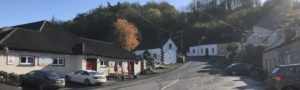
1870’s
now browsing by category
From Danny’s Files: The Register of Infants, Ballyfasey Female National School (1871-1928)

Danny Dowling (1927-2021) for over 7 decades collected a vast amount of information and material regarding Glenmore and other local areas. One large item that Danny collected was a copy of the Register of Infants in Ballyfasey (sic) Female National School. This register consists of 7 pages with student entrances dates from 15 July 1871 to 8 October 1928 of 247 girls (with legible names). There are also 5 students whose names are not legible. The pages are 16 ½ inches (42cm) tall by 11 ½ inches (29 cm) wide. This register is just one of the Ballyfacey School Registers that Danny collected. Today, we are going to focus on page 1 of the Register.
The old Ballyfacey National School was built in 1868 on “Jolla Hill.” Micil Moore, of Knockbrack, Glenmore, built the school building at the cost of £95. Local men drew the stones and sand required and at the end of the building the extra $5 from the grant was spent on a barrel of beer for the men who drew the stones and sand. See our post of 6 September 2020 for further details regarding the building and repairs to the old Ballyfacey National school and early local hedge road schools..
The Register
Page 1 consists of 38 legible names with entrance dates from 15 July 1871 to 6 June 1878 recording 39 students. There are 8 primary columns for recording information including: date of entrance; pupil’s name; age of pupil on last birthday; religion; residence; occupation or means of living of parents; and annual examinations. The column examinations is divided into First, Second and Third perhaps reflecting the division of the academic year. Each of the three examination periods is divided into number of days present and result. No results were provided on this page, but attendance across the three exam periods was recorded and is reflected in the charts below. School attendance was not mandated until the Irish Education Act of 1892.
One of the more interesting aspects of this register reflects that children started school throughout the year. It appears that classes were held all year with no apparent summer break. How teachers coped with students beginning at different times is unknown and attendance for some students was very poor. Some of the girls started school at the age of 3 which seems very young. It also appears that in some entries the name Johanna is misspelled, and on page 1 Ballyfacy is spelled in three different ways.
Below are tables reflecting the information contained on page 1 of the Register. Due to the fact all children were recorded as RC (Roman Catholics) this column was eliminated from the tables. The days of attendance in the table reflects the three exam periods.
1871 Ballyfacy, Glenmore, National School
| Entrance date | Name | Age | Residence | Occupation | Attendance |
| 15 July 1871 | Kate Walsh | 4 | Ballyfacy | Farmer | 37—147—0 |
| 29 July 1871 | Mary Cashin | 5 | Weatherstown | Shoemaker | 26—83—178 |
| 27 May 1871 | Margaret Wallace | 4 | Ballyfacy | Shopkeeper | 62—183—0 |
| 3 July 1871 | Margaret Phelan | 6 | Ballyfacy | Farmer | 0—0—119 |
| 2 Oct. 1871 | Mary Grace | 6 | Kilbride | Farmer | 0—0—161 |
1872
| Entrance date | Name | Age | Residence | Occupation | Attendance |
| 29 May 1872 | Stasia Power | 6 | Kilbride | Labourer | 0—0—85 |
1873
| Entrance date | Name | Age | Residence | Occupation | Attendance |
| 24 April 1873 | Ellen Mullins | 6 | Flemingstown | Farmer | 0—0—47 |
| 5 May 1873 | Johanna Croak | 4 | Kilbride | Labourer | 37—169—126 |
| 2 June 1873 | Bridget Duggan | 5 | Weatherstown | Farmer | 0—20—111 |
| 28 July 1873 | Bridget Hartley | 4 | Weatherstown | Farmer | 0—75—110 |
1874
| Entrance date | Name | Age | Residence | Occupation | Attendance |
| 25 May 1874 | Kate Young | 4 | Ballyfacy | Carpenter | 0—33—0 |
| Not legible | Margaret Ivory | 4 | Kilbride | Cooper | 79—0–183 |
| 1 June 1874 | Johanna Culleton | 4 | Kilbride | Farmer | 10—0—120 |
| 8 June 1874 | Kate Hennessy | 3 | Ballyfacy | Labourer | 25—136—189 |
| 30 June 1874 | Bridget MacDonald | 4 | Ballyfacy | Farmer | 75—0—147 |
1875
| Entrance date | Name | Age | Residence | Occupation | Attendance |
| 6 April1875 | Stasia Malone | 5 | Weatherstown | Farmer | 0—168—0 |
| 21 June 1875 | Kate Mackey | 4 | Weatherstown | Farmer | 0—87—0 |
| 21 July 1875 | Stasia Irish | 4 | Ballinlammy | Farmer | 0—0—142 |
| 21 July 1875 | Stasia Ryan | 6 | Ballycurran (Tullogher) | Farmer | 0—0—0 |
| 27 April 1875 | Alice Donovan | 5 | Haggard | Labourer | 0—0—181 |
1876
| Entrance date | Name | Age | Residence | Occupation | Attendance |
| 28 Feb.1876 | Stasia Phelan | 3 | Ballyfacy | Farmer | 129—0—201 |
| 28 Feb. 1876 | Johanna Grace | 3 | Kilbride | Farmer | 63—172—0 |
| 28 Feb. 1876 | Johanna Hurly | 3 | Ballyfacy | Farmer | 156—0—155 |
| 1 March 1876 | Mary(?) Power | 4 | Kilbride | Labourer | 0—0—131 |
| 27 March 1876 | Kate Dempsey | 4 | Ballyveria | Labourer | 0—0—0 |
| 27 March 1876 | Stasia Grennan | 4 | Moulerstown | Farmer | 0—0—0 |
| 27 March 1876 | Bridget Murphy | 5 | Moulerstown | Labourer | 0—0—0 |
| Not legible | Margaret Purcell | 5 | Moulerstown | Farmer | 0—0—0 |
| 29 March 1876 | Margaret Crowley | 5 | Ballymartin (Tullogher) | Farmer | 0—0—0 |
| 8 May 1876 | Kate Donovan | 4 | Haggard | Dealer | 0—174—0 |
1877
| Entrance date | Name | Age | Residence | Occupation | Attendance |
| 6 Feb.1877 | Bridget Greene | 4 | Ballyfasy | Farmer | 0—0—0 |
| 21 May 1877 | Margaret Power | 5 | Knockbrack | Labourer | 0—0—138 |
| 18 June1877 | Mary Walsh | 5 | Haggard | Labourer | 0—0—74 |
| 18 June 1877 | Joanna Dempsey | 3 | Ballyveria | Labourer | 1—0—84 |
| 8 Oct.1877 | Joanna Berrigan | 5 | Ballyfacy | Labourer | 0—2—6 |
| 11 Oct. 1877 | Stasia Culleton | 3 | Kilbride | Farmer | 5—219—28 |
1878
| Entrance date | Name | Age | Residence | Occupation | Attendance |
| 28 May1878 | Kate Duggan | 5 | Weathetstown | Labourer | 0—41—92 |
| 6 June1878 | Mary Jones | 5 | Ballinlammy | Fowl dealer | 0—49—0 |
| Cut off page | Cut off page | 5 | Weatherstown | Labourer | 0—115—150 |
Most Popular First Names
The most popular first names recorded on page 1 of the Register resulted in several ties. For example, Stasia and Kate tied for first place with each name representing 7 students each. There was also a tie for second most popular name with Margaret and Joanna/Johanna each representing 6 students each. There was another tie for third most popular name with Mary and Bridget representing 5 students each. The least popular names were Alice and Ellen each representing just 1 student each.
Glenmore Townlands Recorded
There are 11 townlands recorded for residency on page 1. Nine of the townlands are within the Parish of Glenmore and two (Ballycurran and Ballymartin) are not. The top three townlands on the page are Ballyfasy (10); Weatherstown (7); and Kilbride (8) or 25 of the 39 students or 64% of the students recorded on page 1. Haggard and Moulerstown each had 3 students; Ballinlammy and Ballyveria had 2 students each and all the rest had 1 student each (ie Ballymartin, Ballycurran, Flemingstown and Knockbrack).
Ages of Students on Starting at Ballyfacey National School
There were 4 ages recorded for admissions on page 1 of the Register of Infants namely: three-year-olds; four-year-olds, five-year-olds and six-year-olds. The largest group was comprised of fifteen 4 year olds (38.5%); the second largest group was comprised of the twelve 5-year-olds (30.7%); there were seven 3-year-olds which represented 17.9 % of the admissions and the five 6-year-olds represented the lowest group (12.8%).
The 3 Year Olds
Given that 3 seems extremely early to start school we attempted to verify the ages of the girls recorded as being 3 on their admission to the Ballyfacy National School from 1874 to 1877.
Kate Hennessy (Catherine Hennessy was born 12 Nov. 1871 at Ballyfacy to Richard Hennessy (labourer) and his wife Anne Doherty. She entered school on 8 June 1874 at the age of 3 years, 7 months.)
Stasia Culleton (Anastatia Culleton was born on 16 Oct. 1873 at Kilbride to John Culleton (farmer) and his wife Bridget Walsh admitted 11 Oct. 1877 just five days before her fourth birthday.)
Stasia Phelan (Anastatia Phelan was born 8 Jan. 1872 at Ballyfacy to John Phelan (farmer) and his wife Catherine Forristal. She entered school on 28 Feb. 1876 at the age of 4 years, 1 month.)
Joanna (sic) Grace (Johanna Grace was born at Kilbride on 2 Feb. 1873 to Patrick Grace (farmer) and his wife Mary McDonald. Johanna entered school on 28 Feb. 1876 and had just turned 3.)
Joanna (sic) Hurley (Johanna Hurley was born 12 Nov. 1871 at Ballyfacy to James Hurley (labourer) and his wife Margaret Shea. She started school on 28 Feb. 1876. Johanna was 4 years 8 months old when she started school.)
Joanna (sic) Dempsey (Johanna Dempsey was born on 15 Oct. 1873 at Ballywairy, Glenmore, to Patrick Dempsey (labourer) and his wife Mary Norris. Johanna entered school on 18 June 1877, thus she was 3 years 8 months old when she started school.)
Subjects Taught
In another register the subjects the girls had in 1872 included reading, spelling, writing, arithmetic, grammar, geography and needlework.
The Old Ballyfacey National School
Ann Grennan wrote a wonderful article “The Story of Ballyfacey School,” that was published in Glenmore Times: Millennium Memories ((2000) Glenmore Millennium Committee) pp. 19-21. The article focuses on the early 20th century but provides some interesting facts concerning the fate of the old school house. She noted 26 years ago that there was no trace left of the old school building. When the new school was built about 1957 the stones of the old school were reused for a pig house. “The only remains were a small bit of a wall belonging to the toilet and also the gate leading into the school.”
Please send any corrections or additional information or photos to glenmore.history @gmail.com .
Dr. Kathleen Moore Walsh
The old photo featured above was taken in front of the old Ballyfacey National School. Special thanks to Jackie Walsh for sharing the old photo.
If you believe that your ancestor may have attended Ballyfacey National School please send on his/her date of birth and townland and we shall check the registers Danny collected for information for you.
Mary Malone (c. 1841- ) A Poignant Letter Home to Glenmore in 1877

Last week we featured the letter written by Edmund Hartley ( 1836-1915) published in the New Ross Standard regarding his trip to Ireland in the summer of 1913. Edmund Hartley was accompanied home to Ireland by two priests, his son, Monsgr. James J. Hartley and his nephew, Father James E. Hartley. Monsgr. Hartley was the President of St. Bernard’s Seminary, Rochester, New York. Hoping that Monsgr. Hartley may have had records or photos of the trip we were disappointed to find that St. Bernard’s Seminary closed in the 1980’s. However, when we checked with the Archives of the Diocese of Rochester New York, Sister Connie Derby, Director of the Archives, located and copied a notebook kept by Monsgr. Hartley of the 1913 trip. Also found in the archive was a transcription of a letter written by a cousin of Monsgr. Hartley, Miss Mary Malone. Sister Connie also graciously forwarded good quality photos of Monsgr. and Father Hartley.
It is not known how Mary Malone’s letter came into Monsgr. Hartley’s possession and ultimately ended up in the archive. It is surmised that it was kept, hopefully cherished by her brother who received it in Glenmore in 1877, and when Monsgr. Hartley brought his father home to Glenmore in 1913 he was given the letter written 26 years earlier. The transcription with spelling errors and little punctuation is copied below as it was provided to us by Sister Connie. For such a short letter it is very poignant.
Mary Malone, Fairport, New York, to her brother, Glenmore, Co. Waterford, 24 January 1877
24 January 1877
Fearport January the 24, 1877
My Dear Brother      I take
the opportunity of writing to you
I hope you will forgive me for
not writing to you be fore this
but I was tost about         I left my
first place that I was in 2 years
and a half      I am now living near
my aunt          I have not but 1 Dolard aweek
this winter        this is a verry severe winter
in america. I got a letter from home about
two weeks after I got yours letter
they told me it was better for him to go now
than any other time but he is a
grate loss to my Father and mother
it is they feel his loss
but they tells me that they are not bad off
[page 2]

That you dont forget them    may
the Lord spare you your health
I do not get to healp them much
my wages is so little and I am not cap[a]ble
of earning big wages like other girls
who can cook and [do] the large washings and
fine ironings   I cannot do this    you know
I was not brought [up] to anny such thing
I was sent away frum my Mother when young
to the farmers to work out in the fields
and I never got much in sight about
house keeping or to be handy to sew
but I don’t have is anny one to blame
for that but my Sellf        I never tried
to lerren    I must onely do the best I can now
I am verry lonseom and down harted
I wish my Sister Margaret was here
if ever I can bring here out    if times
will get better I will try and do my
best for her
[page 3]
Dear brother     I would wish verry
much is you would send me your
picture and I will send you mine
I never had anny of my pictures taken
since I came to america   My aunt and
cussins are all well and my cussin
James Hartley is getting elong
splended with his studies
he expe[c]ts to be dordained in about 1 year
and a half from now.  You asked me
could I reed your writting      I could
with out anny troble   I hope you
will write to me soon again
I have no more to say at
preasant      from your affectionate
Sister      Mary Malone
Unfortunately the name of Mary Malone’s brother is not revealed in the letter. The only clues are that he lived in Glenmore, she lived in Freeport, New York, she had a sister named Margaret and cousin James Hartley who was to be ordained in 1878. It appears that Mary Malone may have emmigrated about 1875 as she was in her first place for 2 ½ years. Monsgr Hartley was not ordained until 1885, but the fact that the letter ended up in his possession suggests that Mary was related although the closeness of the kinship is not apparent.
Given the fact that Mary makes no reference to a husband or children it is assumed that Mary Malone was her maiden name. The 1880 Federal Census of Rochester, Monroe County, New York reveals that there was a Mary Maloney (sic) living in a boarding house on South St. Paul Street. She was born about 1842 and worked as a servant. It is not known whether Mary Malone remained in New York or returned to Ireland. No further obvious census records were found in New York state. In Monsgr. Hartley’s travel journal one evening while in the Glenmore area the men had “supper” with Mary Malone. It is not known if the 1913 referenced Mary Malone was the same woman that wrote the letter home to Glenmore in 1877.
The Glenmore Parish records reveal that there were a number of Mary Malones born in the early 1840’s from Rochestown to Weatherstown. There is no obvious match of a Malone married to a Hartley or Kennedy (maiden name of Edmund Hartley’s mother). Also, there were much fewer baptismal records for a Margaret Malone. The best fit so far is the Michael Malone family of Weatherstown, Glenmore. Michael Malone and his wife, Catherine née Burke had a daughter Mary who was baptized on the 10th of November 1841. Their daughter Ellen was baptized on the 27th of July 1839 and their daughter Catherine was baptized on the 1st of June 1849. However, no sons were discovered in the parish records for this union.
Perhaps a reader who descends from Mary and/or Margaret Malone can point us in the right direction.
As soon as we can transcribe the travel notebook kept by Monsgr. Hartley we will publish excerpts particularly the notes from their time in Glenmore. Monsgr. Hartley throughout his journal refers to his elderly father affectionately as Pa.
Special thanks to Sister Connie for all her help this week copying and sending on information and photos. The featured image is entitled Irish Immigration from Queenstown (Cobh, Cork) (1874 from the Miram & Ira D. Wallach Collection, Digital Public Library of America
__________
Ireland is again in lock down due to COVID 19. We shall attempt to provide more posts as we did last lock down. If anyone has a subject or idea, or has an article for our guest author page please contact us at glenmore.history@gmail.com.
Dr. Kathleen Moore Walsh
The Glenmore Post Office: Its Rise and Demise

Stephen Ferguson, the author of The Post Office in Ireland: An Illustrated History noted that the Irish Post Office was established by an Act of Parliament that separated it from the British Post Office in 1784. At that time there were 145 post towns in Ireland, and by 1814 the number of post towns increased to 379. Ferguson also highlighted the difficulties of transporting the mail. He quoted from the diary of Amhlaoibh Ó Súilleabháin, a hedge-school master from Callan, who wrote in 1829 that the post coach from Dublin to Cork took 21 hours. Ó Súilleabháin found this an improvement because 50 years earlier the post coach from Kilkenny to Dublin took up to 2 days to arrive. However, it would be a further 50 years before Glenmore would obtain its first post office.

Two Post Coach Roads
Although two post coach roads passed through the parish of Glenmore, the Village of Glenmore did not obtain a post office until around 1870. The most prominent post coach road was the Waterford to New Ross road. Part of this route is easily found today if one follows what locals refer to as the “High Road.” The High Road runs through Scartnamore, Rathinure, Aylwaystown to Graiguenakill. The Halfwayhouse in the townland of Aylwardstown still bears the name of the midway point on the Waterford-New Ross post road where coaches stopped to change horses.
In 1989 Danny Dowling interviewed Tom Walsh (1908-1992) of Rathinure, formerly of Davidstown, who noted that the “Mountain Road” was formerly part of the Thomastown-Waterford Post Coach Road. The route was via Mullinarrigle, Ballyfacey, Haggard, Ballinlammy, the Árs Mhor and the Mountain Road to Slieverue where it joined the New Ross to Waterford Road. The cross or connecting road between the Mountain Road and the Main Waterford-New Ross Road at Gaulstown was known as the Grugán.
In 1836, the “New Line” was opened providing a more direct road through the parish from Waterford to New Ross, and today the N25 still follows sections of the “New Line” above the Village of Glenmore. Eventually post coaches were replaced with lighter horse drawn cars and until the post office in Glenmore was established the Waterford and New Ross mail car would stop along the route at points where inhabitants would gather to collect their letters and packages. The speed of delivery was greatly increased with the opening of the Ross-Waterford railway in 1904 with a small station established in Aylwardstown.
In 1977 Danny interviewed Dan Doyle, formerly of Ballyverneen who worked as a ganger on the building of the Ross-Waterford railway. Dan Doyle stated that in 1919 he was working in the New Ross station and the fixed time train table brought 11 trains into New Ross daily. At 10:25 a.m. a train carrying mail from Dublin arrived and at 3:15 p.m. a train carrying mail from Waterford for Dublin arrived in New Ross. Even after the coming of the railway local mail was still collected from and delivered to the railway station in Aylwardstown in horse drawn vehicles or bicycle and delivered to Glenmore inhabitants via bicycle.
The First Glenmore Post Office
The first Glenmore post master was William Powell a retired policeman. He first came to Glenmore as a member of the Royal Irish Constabulary, and was stationed in the Glenmore Barracks. When Powell retired he opened in his dwelling house the first Glenmore post office in about 1870. The first Glenmore post office was situated on the opposite side of the road up the hill from the Barracks. At the time of the first post office the inhabitants of the parish had to collect their mail at the post office. The Powell house no longer exists, but if it did it would be directly opposite Francis O’Brien’s house. William Powell, died on the 1 August 1880, aged 72 and his widow Bridget Powell died in Robinstown on 9 August 1891.
The Second Glenmore Post Office
The second Glenmore post office was located in the shop of Robert Fluskey. While the post office was in Fluskey’s shop the services expanded to include a delivery service and the local telephone exchange was established. Edward “Ned” Kehoe of Aylwardstown was the first man ever appointed to deliver the post in Glenmore. He had a bicycle to travel around and was provided with a whistle to indicate he was in the area. Ned Kehoe would visit various areas of the parish on designated days, stop at a cross roads or group of houses and blow his whistle. The local inhabitants would gather to collect their mail. Ned Kehoe was born about 1875 and was the son of Patrick and Kate Kehoe of Aylwardstown. Ned Kehoe was known as being an industrious fellow. In addition to being a post man he farmed his 10 acre farm and also worked on various projects including the building of the chimney at the Creamery.
The Third Glenmore Post Office
The third Glenmore post office was located in Alice Ryan’s dwelling house which is opposite the pub. It is believed that delivery to each house in the parish on a daily basis began either during the later years of the second post office or at the beginning of the third. Today, many of the older inhabitants recall Foxy Wattie Power and Tommy Power who delivered daily in Glenmore. Each man was responsible for delivering to half of the parish.
The Fourth Glenmore Post Office
The fourth and last post office was Hanrahan’s located opposite and down the hill from the Church. The Glenmore post office closed in November 2018 upon the retirement of Kathleen Hanrahan, thus ending almost 150 years of the Glenmore Post Office. At the time of the closure the range of services provided by the post office was extensive including a variety of savings accounts, social welfare payments and payment of licence fees and utility bills etc.

Today all that remains is the post box outside the Village Shop which is run by Noeleen Fogarty née Hennessey at Hanrahan’s. A post box at the cross roads just above the old Aylwardstown railway station is still visible in the wall. An examination of the old post box reveals that it was made during the reign of Edward the VII (1901-1910) and was later painted green. It was established at the time of opening of the railway station as a convenience for travellers. Today it bears a notice that it is no longer in service.

Special thanks to Jacqueline Walsh for the old photos of the second Glenmore Post Office, and Louise Walsh for the recent photos.
Dr. Kathleen Moore Walsh