Jamestown Glenmore
now browsing by tag
From Danny’s Glenmore Photo Album 6.0 [Updated]
Today, we are featuring a harvest photo Danny Dowling (1927-2021) took at the Dowling Farm in Jamestown, Glenmore.
We believe that the photo was taken in the 1950’s. We believe that the women in the photo were Danny’s sisters. The only person positively identified thus far is the man kneeling in the front row, 2nd person from right, Richie Dunphy (c. 1936-2015) of Ballyverneen, Glenmore.
Can you identify any of the people in the photo? If so please indicate their placement in the photo, their name and townland if known to glenmore.history@gmail.com .
If you would like to view previous posts from Danny’s Photo Album see our,
[5] Post of 8 January 2025;
[4] Post of 4 May 2022;
[3] Post of 10 May 2022;
[2] Post of 24 May 2022;
[1] Post of 9 June 2022.
If you have any photos of Glenmore or Glenmore people you would like to share please send them to glenmore.history@gmail.com.
Dr. Kathleen Moore Walsh
Update: Thanks to Bernard and Jackie Walsh the following people have been identified.
Front row: (left side) (kneeling) First man with hat–Danny Aylward, Ballyfacey; the next man could possibly be Robbie Doherty Haggard.
Front row: (right side) (kneeling) from right Dinny Murphy, Milltown; Richie Dunphy (c. 1936- 2015) Ballyverneen; possibly Neddy Holden, Clune.
Second row: (standing) Mikey Dowling is standing beside his sister (she is holding a bottle); man with hands on his head is old Jack Fitzgerald of Busherstown.
Back row: (standing) from right Pat Fitzgerald, Busherstown; next with flat cap is Seamus Fitzgerald, Ballycroney

Thatched Houses in Glenmore at the End of WWII [Updated]

Danny Dowling (1929-2021) made lists of various local things including: local Irish words, Mass Paths, elderly parish residents and thatched houses in Glenmore at the end of WWII. Thatch was the traditional roof in Glenmore prior to the twentieth century. The Second World War ended in 1945, and it appears that thatch roofs were then in the minority. Below is Danny’s list of the 35 houses identified and their respective townlands. The list is not dated. We note that several townlands are not included. The entire original list with notes from Danny is included. Any comments or additional houses that have been added are is square brackets [ ].
- Jack Forristal, of Cappagh (Bolger’s) [today Frankie Kirwan’s].
- Greene’s, of Jamestown
- Wattie Power, of Jamestown
- Anne Gaule, of Busherstown
- Johanna Closh Walsh, of Busherstown
- Main Gaule, of Busherstown
- Neddie Power, of Busherstown
- Anne Doherty, of Busherstown
- Doherty’s, of Milltown (part of)
- Haberlin’s, of Forristalstown
- Grace’s, of Forristalstown
- Jimmy Doherty’s, of Forristalstown
- Statia Butler, of Ballycroney
- Seamus Fitzgerald, of Ballycroney
- Luke Murphy, of Ballybrahee [See our post of 15 Aug. 2021 for more information on Luke Murphy]
- Dick Power, of Ballybrahee
- Dick Murphy, of Robinstown
- Pat Grant, of Robinstown
- Reddy’s, of Robinstown
- Neddie (Watts) Fitzgerald, of Ballinaraha
- Brophy’s, of Ballinaraha
- Moran’s, of Ballinlammy
- Doherty’s, of Ballinlammy
- Gahan’s, of Rochestown
- Shawn’s, of Rochestown [nickname for 1 of the Forristal families of Rochestown. We believe that this was the home of John Forristal (c. 1838-1915) and his wife Mary née Reddy (c.1851-1917). The couple were married at Glenmore on 31 Aug. 1880 and had five children; Bridget, James, John, Thomas and Patrick.]
- James “Browley” Walsh, of Rochestown
- Larry Walsh, of Rochestown
- Foran’s, of Kearney Bay
- James Phelan “The Walker”, of Ballyhobuck
- Larry Kirwan, of the Shanty [Scartnamore]
- John Kennedy, of Rathinure [Sean Óg where Johnny Garvey lives today]
- Pat Kennedy, of Rathinure [The Faddies]
- John Haberlin, of Aylwardstown
- Jim “Brien” Fitzgerald, of Aylwardstown
- Ryan’s, of Kearney Bay
- Pat Ryan, of Kearney Bay (Cousin of Mike Ryan, went to Ringville)
The following not on Danny’s original list
[37] [Johnny “Billy” Roche, of Rathinure] [Thatched house remained until 1972]
[38] [Holden’s, of Clune, Jamestown]
[39] [Paddy Kennedy, of Newtown]
[40] [John Power, of Newtown]
[41] [Martin Forristal, of Rochestown]
[42] [Paddy Mullally, of Ballyhobuck] [Later Walsh’s of Ballyhobuck]
[43] [Condon’s of Mullinahone (part thatched)]
[44] [Pat & Jimmy McDonald of Ballyfacey]
[45] [Kitty Murphy of Mill Road, Mullinahone (part thatched)]
[46] [John Power, of Newtown, lived in until the mid-1970’s; last coat of thatch by Murty Kearney with rushes.]
[Update of 9 Oct. 2025–Jimmy Roche (1927-2018) of Rathinure often told the story of when he was a young fellow helping to rid the Faddie’s of rats in their thatch roof. A ferret was placed on the roof, and soon rats were attempting to escape by leaping from the roof. Jimmy and a number of young men armed with hurley’s dispatched the rats as they leaped from the thatch.]
Please send any corrections or additional information to glenmore.history@gmail.com
Dr. Kathleen Moore Walsh
More Glenmore Fishing

Fifty years ago this past week, Danny Dowling (1927-2021) interviewed Denis Murphy (1901-1986) of Milltown, Glenmore (DD Notebook 31, Interview 6 March 1974 at Doherty’s of Milltown). Denis Murphy was a lifelong resident of Milltown, never married and worked as a labourer and fisherman. See our earlier post of 18 July 2020 for other information concerning Glenmore fishing and weirs.
Denis “Dinny” Murphy (1901-1986) of Milltown, Glenmore
Denis Murphy was the son of John Murphy (labourer) and Catherine “Kate” Merrigan (1859- ? ) who married on 21 April 1893. Kate was the daughter of Michael Merrigan (c. 1820-1891) and Mary Merrigan née Morrisey (sic) (c. 1823 -1885) of Milltown. See our M family surname page for further information on the Murphy families. See our post of 21 May 2020 regarding the Merrigan family of Milltown.
Denis Murphy was known as Dinny. During his 1974 interview Dinny recalled 26 cot crews salmon fishing on the River Barrow during one season about 58 years before his interview (i.e c. 1916). Dinny explained that there were four men in each crew, thus there were 96 men salmon fishing locally during that particular season.
The 26 cot crews fished from the following locations:
New Ross—15 crews
Ling Voor—3 crews
Gap—4 crews
Shanbogh Stocks—4 crews
Dinny reported that in the early 1930’s “he sold gilíns (pale)” to the locals at Ballygurrim cross. A gilín or pale are terms for young salmon. The price of gilíns was low. The price then went up to 6d. per pound, and Dinny bought some gilíns to sell at this price. The locals bought his supply but told him not to bring anymore at that price because the price was too high.
Local good cot makers were identified by Dinny as Ned Grace of Forristalstown and Patsy Aylward of Shanbogh.
Dissolving a Fishing Partnership
Dinny’s grandfather, Mikey Merrigan (c. 1820-1891) of Millstown, and Bill Roche ( c. 1814-1894) of Jamestown (Main Roche’s father) bought a cot together. “Bill Roche was a most contrary and cantankerous man and a bully.” On one occasion the crew in which Roche and Merrigan were members got into a dispute over a salmon they caught. Roche got contrary and told Merrigan that they would have to dissolve the partnership. As they owned the cot together Merrigan decided that either one or the other should buy out the other’s share.

The cot cost £12. This sum included the timber, fittings, and the making of it. “When it came time to pay the other off, Roche refused to agree to anything except that the cot had to be sawn in half. The cot was thereupon sawn in half.” Mikey Merrigan sold his share, or half of the cot, to “one of the Shivawns in Forristalstown who made a cattle trough out of it.” Does anyone know which family in Forristalstown had the nic-name Shivawns?
In 1979 Danny interviewed Nicky the Miller Forristal (1888-1979) who told a similar story concerning Bil Roche insisting on a jointly owned cot being cut in half. In Nicky the Miller’s version the other party was Patsy Hennebery (Mártín) of Jamestown. They fished together for at least one season and Patsy Henneberry decided to go with another crew. He asked Roche, “How will we settle about the cot? Roche replied “we can do nothing with her except cut her in halves.” No matter what Henneberry suggested, Roche would not agree, in the end Henneberry, rather than see it cut in halves, left it to Roche.
Bill Roche (c. 1814-1894) of Jamestown, Glenmore
William Roche (c. 1814-1894) of Jamestown married Mary Murphy on 27 June 1844. The couple had 8 known children. The oldest four were born at Forristalstown and the last four were born at Jamestown. [1] William Roche (b. 1845); [2] William Roche (b. 1850); [3] John Roche (b. 1854); [4] Mary or Main Roche (b. 1855); [5] Patrick Roche (b. 1858); [6] Patrick Roche (b. 1860); [7] Anastatia Roche (b. 1863) and [8] Ellen Roche (b. 1866).
Main Roche married Thomas Walsh (aged 26) of Haggard on 21 January 1886. Thomas was the son of Edmund Walsh (labourer). There is a section of a Glenmore road still known locally as Main Roche’s hill. If you exit Glenmore on the Cappagh Road the incline you encounter as you pass the turn off to the new Glenmore N25 roundabout is Main Roche’s hill. Main Roche would have travelled along this road coming and going to Glenmore. Does anyone know why this stretch of road became known as Main Roche’s hill?
Please send any corrections or additional information to glenmore.history@gmail.com. The feature print above is a cigarette card depicting a salmon. The drawing of Annagh’s Castle is courtesy of the Dublin Penny Journal (30 Jan. 1836, available at https://www.jstor)org/stable/30003343) and two cots are depicted in the drawing. Annagh’s Castle is located on the River Barrow half way between New Ross and Glenmore.
Dr. Kathleen Moore Walsh
The Interesting Life of Hugh Mahon (1857-1931)

Below is an article written by John Dowling, Danny Dowling’s nephew, concerning the interesting life of Hugh Mahon (1857-1931). Hugh Mahon was the “special reporter” who interviewed the Widow Doolan, of Jamestown, Glenmore, on 8 August 1880 the day that Charles Boyd was murdered. After exposing various abuses perpetrated again the Widow Doolan, and the local men accused of the murder, Mahon also raised funds for their defence. Mahon later emigrated to Australia where he became a politician and to this date is the only MP to be expelled from the Australian Parliament.
For an account of the plight of the Widow Doolan (Bridget Dowling née Cody (1831-1916)) and the murder of Charles Boyd see our post of 7 November 2021 .
Hugh Mahon (1857-1931)
Hugh Mahon was born at Killurin, County Offaly, in 1857, the 13th of 14 children of James and Anna Mahon. At the time James Mahon farmed a sizeable holding in the barony of Geashill owned by Edward St. Vincent Digby. From 1856 onwards there was ever increasing tension between the new Baron Digby and his tenants. James Mahon was caught up in these tensions but increased his lands under rent from 114 acres to 264 acres by 1866. His son Patrick farmed approximately 68 of these acres.
The North American Years
For unknown reasons, James and Anna Mahon and eight of their children emigrated to America in 1869, leaving behind Patrick to continue farming.
The Mahon family arrived in New York in March 1869, but by October they were farming a 50 acre farm close to Toronto, Canada. They lasted less than 4 years in Canada when they moved to Albany, New York.
Albany, at that time, was a thriving rail connection attracting many emigrants looking for work. James Mahon purchased a house for $1900 in May 1873. However, the American dream continued to turn sour for the Mahon family as an economic panic struck America in 1873 with many railroad companies going bankrupt. Also, the construction of rail bridges across the Hudson River reduced rail activity in East Albany.
During this time Hugh Mahon started to learn the printing and newspaper trades, and eventually at the age of 20 started working for himself selling printing materials. However, he was not left with good memories. Later in life he commented in a letter about the long workhours, poor conditions and clients who refused to pay for services rendered.
It is not clear when the Mahon family left Albany but in 1878 their name disappeared from the Albany Directories, and the house they bought for $1900 in 1873 was sold in approximately 1880 for $1000.
Return to Ireland
By 1880, with James Mahon in his 73rd year, he and his wife were facing a very uncertain twilight to their lives. Their fate must also have been experienced by many other emigrants, but the Mahon’s had one option that was not available to others. They still had a son living and farming in Ireland, and at some stage between 1878 and 1880 they decided to return to Ireland with their son Hugh.
In 1880 Hugh Mahon ended up as editor and manager of the New Ross Standard and a reporter for the Wexford People. The owner of both newspapers, Edward Walsh, was an outspoken critic of the local landlords. Walsh served three prison terms for articles that were printed in his newspapers.
The Irish Land league was formed in 1879 and was initially led by Charles Stewart Parnell and Michael Davitt. Hugh Mahon became Assistant Secretary of the New Ross branch of the Land League. Mahon was forced to leave Ireland in late March 1882, but in the two years he spent in New Ross he was a considerable thorn in the side of local landlords.
Mahon Involvement in Boyd Murder Trial
Mahon became acquainted with Walter Phelan of Shanbogh in the summer of 1880. Walter made Mahon aware of the situation of the Widow Doolan (Bridget Dowling) of Jamestown, Glenmore. On the evening of the 7th August, Walter Phelan met with Hugh Mahon in his New Ross office and agreed to go with him the following day to meet the Widow Doolan. Hugh Mahon was interested in publishing her plight in his newspaper.
On the evening of the 8th of August after meeting the Widow Doolan, Charles Boyd, nephew of local landlord Thomas Boyd was shot, and died the morning of the 9th of August.
John and Walter Phelan were identified by Evans Boyd as two of the men in the attack. They were arrested, along with ten others, and remanded first to Rosbercon and then to Kilkenny.
Hugh Mahon organised a defence fund to help the two Phelan brothers, Walter and John, who were charged with the crime. He used his newspaper to criticise the police and prosecution authorities, whom he accused of intimidation and coercive practices. He was also an important witness at the trial, providing an alibi for Walter who accompanied him to visit the Widow Doolan on the day of the assassination. The trial of the Phelan brothers was delayed to June 1881 and moved to Dublin due to the tension in the area.
Various witnesses were also moved to Dublin. These included young girls who were working as servant girls in the area. They were taken against their families wishes and held in Dublin and attempts to coerce them in giving damning evidence against the Phelan brothers was carried out (reported by Mahon in The Wexford People, Oct. 16 1880, p. 6). The girls did not succumb to the Crown coercion, nor to the offer of money.
The two Phelan brothers were acquitted in June 1881, largely based on the alibi provided by Hugh Mahon and a lack of credible evidence.
Hugh Mahon was an instrumental figure in the defence of the Phelan brothers due to
- The report of the killing of Charles Boyd, “one of the most atrocious deeds of blood”, [i] which was published on the 11 August 1880 in the Wexford People, was accompanied, on the same page, by his report of the mistreatment of Evans Boyd towards the Widow Doolan and her orphaned family. The reporting of the Boyd killing throughout Ireland and Great Britain was nearly always accompanied by the reference of mistreatment of the Widow Doolan.
- The continual criticism of local landlords by Mahon in his newspaper reports and organised boycotts of local landlords, in particular Thomas Boyd
- The raising of £765 to cover the costs of legal defence
- Providing an alibi for Walter Phelan on the day of the murder, due to both being together to interview the Widow Doolan.
One can start to think how the accused would have fared without the agitation of Hugh Mahon and his fundraising efforts.
Mahon’s Involvement in New Ross Land League
Mahon used his printing skills to print and post boycott notices around the New Ross area. Thomas Boyd was one of the landlords targeted and in September 1881 Boyd wrote to the Under-Secretary of Ireland calling for Mahon to be arrested under the Protection of Person and Property Act. Mahon was eventually arrested on 27 October 1881 and imprisoned in Naas. Mahon was suffering from tuberculosis and the prison authorities were worried that his delicate health conditions could cause his premature death whilst in their custody. He was offered a release based on his commitment to leave Ireland to move to sunnier climes to help his health condition. Eventually in late March 1882 Mahon left Ireland. He eventually arrived in Melbourne on 22 May 1882.
Australian Journalist, Activist & Politician
Upon landing in Australia Mahon quickly resumed his Land League Activist role amongst the Australian Irish. In 1883 he accompanied William and John Redmond on their 10-month tour of Australia, where he organised many of their events.
However, after the Redmond’s left Australia Mahon quickly parted company with the Land League activities to concentrate on his own journalist career, and in supporting his new wife and family.
Gold was discovered in Western Australia in the early 1890´s. Mahon decided to move there to run a newspaper covering activities in the newly formed gold districts in 1895. Over the next 5 years he would run various newspapers providing news to the local miners, expose corruption in mining and government and actively support the miner’s interests. He ran for local government on various occasions but was only successful when the Australian colonies joined together in 1901 to form the Australian Commonwealth. He was elected as the representative for Coolgardie as the Labour Party´s candidate. Over the next twenty years he would serve as Minister on four occasions, including the Minister for External Affairs during the First World War.
Mahon became active again in Irish affairs and was an ardent support of the Irish Parliamentary Party and Home Rule, but his outlook was changed by the events of 1916. The aftermath of the 1916 Rising, and the executions of the leaders was a moment when “All Changed, Changed Utterly” with “A terrible beauty … born.”[ii]
Over the next few years Mahon moved from Home Ruler to Sinn Fein supporter, and by 1919 was president of the Irish-Ireland League of Victoria. When Terence MacSwiney, Sinn Fein Lord Mayor of Cork, died on 25 October 1920, after 74 days on hunger strike, Mahon attempted to have the Irish situation debated in Australian parliament but was refused. At a meeting on 7 November 1920 in Melbourne, Mahon attacked British policy in Ireland,
“Never in Russia under the worst [rule] of the Czars had there been such an infamous murder as that of the late Alderman McSwiney. They were told in the papers that Alderman McSwiney’s poor widow sobbed over his coffin. If there was a just God in heaven that sob would reach round the world, and one day would shake the foundations of this bloody and accursed Empire.”[iii]
Mahon´s outburst came just four days before the second anniversary of the end of the First World War. Australia was still mourning the deaths of approximately 60,000 of its sons and daughters, and its Empire loyal population was not willing to accept such criticism as expressed by Mahon.

The Prime Minister, Billy Fisher, was one seat short of a majority with Mahon´s Labour party in opposition. Seeing an opportunity to secure a government majority he moved a motion, which was successful, to expel Hugh Mahon from Parliament due to his “seditious and disloyal utterances at a public meeting”[iv] and being “guilty of conduct unfitting him to remain a member of this House.”[v]
Mahon failed to win back his seat in the subsequent by-election in December 1920. To this day he remains the only MP ever to have been expelled from the Australian Parliament.
Outside of politics he continued to run the Catholic Church Property Insurance Co. He died on 28 August 1931, eventually succumbing to the lung disease that had affected him during much of his life.
John Dowling
Further reading:
Jeff Kildea (2017) Hugh Mahon Patriot, Pressman, Politician: Vol. 1 The Years from 1857 to 1901, Anchor Books: Melbourne, Australia
H.J. Gibbney (1986) “Hugh Mahon (1957-1931)” in the Australian Dictionary of Biographies, vol. 10.
Frank Sweeney (ed) (2005) Hanging Crimes: When Ireland Used the Gallows, Mercier Press: Cork
[i] Wexford People, 11 Aug. 1880, p. 4
[ii] William Butler Yeats (1997) “Easter 1916” and Other Poems, Dover Publications
[iii] Jeff Kildea (2020) Hugh Mahon; Patriot, Pressman, Politician: Vol 2 The Years from 1901 to 1931, Anchor Books: Melbourne, Australia
[iv] Kildea (2020) supra n. iii
[v] Kildea (2020) supra n. iii
Pat Green (b.c. 1949) of the Glenmore Cycling Club

Recently Ger Barry shared some photos of the Fermoy Open Sports Day circa 1973. Pat Green, of the Glenmore Cycling Club, was in the final and racing for gold. It was reported in 1973 that Pat Green was not competing that year (Evening Echo, Thurs. 26 July 1973, p. 12). We did, however, find that Pat Green was in the finals at both the 1971 and 1972 Fermoy Open Sports Day.
The early 1970’s were an exciting time for cycling as young men such as Pat Green, Willie Baggott (Limerick) and Pat Walsh (Glenmore) were bursting onto the racing scene. Although all the newspaper articles spelled Pat’s family name as Greene a quick check of the family headstone records the name as Green. To view our previous article regarding The Glenmore Cycling Club, see our post of 22 August 2022.
Commenced Competing
Pat Green, a farmer from Jamestown, Glenmore was a member of the Glenmore Cycling Club. In 1971 at the age of 22 he began to compete in track cycling races with only 12 months experience. Due to the lack of keen track competition in Kilkenny, and surrounding counties, he became a regular rider at Cork fixtures in 1971 (Irish Examiner, Mon. 9 August 1971, p. 11).
In early April 1971 he competed in the 50 kilometre road race, under ICF rules, which was promoted by the Glenmore Cycling Club. This road race was won by Donal Crowley a Ballincollig rider who won in an exciting finish with Pat Hegarty (Fermoy). Donal Crowley won by a wheel. The newspaper reported that “Local rider Pat Green was caught with just 200 yards to go” (Cork Weekly Examiner, Thurs. 8 April 1971, p. 9).
Fermoy Open Sports Day 1971
There were four heats leading to the mile Irish Championship final at Fermoy in early June 1971. Heat 1 was won by Pat Greene (Glenmore) with Peter Hegarty (Fermoy) second. In Heat 4 another Glenmore man competed, D. Walsh who came in third.

In 1971 Willie Baggott, a 24-year-old Limerick motor mechanic “stole a march on more fancied opponents to lift his first Irish cycling championship at Fermoy under BLE and ICF rules.” Baggot was a member of the newly formed Shannon Wheelers club and won the ½ mile and mile races. The former Phoenix Road club rider was not a favourite. More experienced men like Eddie Dunne, Round Towers, Dublin; Mick Kelly of Galway, Mick Kingston of Hilltown’s and the Fermoy representatives were favoured.
Baggott caught Dunne the Round Towers star by surprise in the mile. The final was an anti-climax with Baggott much too strong for Kingston, “Patsey Greene of Glenmore” and Fermoy’s Mick O’Connor (Cork Weekly Examiner, Thurs. 10 June 1971, p. 9).
Doubles at Ballyduff and Ballyhooly
A month after Fermoy Pat raced at Ballyduff Upper and completed a double by winning the one mile and two-mile cycling events. In the mile scratch he easily beat Peter Hegarty (Fermoy) and he came home in similar style against his clubmate, Pat Walsh, in the three mile open handicap (Irish Examiner, Thurs. 8 July 1971, p. 13).
On 2 August 1971 Pat won a silver medal in the national five-mile championship at Youghal. On the 8th Pat won his first Irish senior track cycling championship at Ballyhooley Open Sports Day under BLE and ICF rules. At Ballyhooley he reduced the opposition “to tatters, such was his power on the testing 400 metre circuit in later stages. Youghal’s Gerry Geary forced the pace and had a 50-metre lead with a little over half of a mile remaining.
All eyes were on Willie Baggot, the Limerick winner of three titles earlier in the year, when Pat Green and John Hegarty (Fermoy) broke clear of the pack to chase Geary.” The rest of the field did not react. Six hundred metres from home “the powerful Kilkenny man hit the front. In the final circuit nobody could match his strong pedalling into the wind in the back straight and he flashed across the line the easiest of winners,” Irish Examiner, Mon. 9 August 1971, p. 11).
Fermoy Open Sports Day 1972
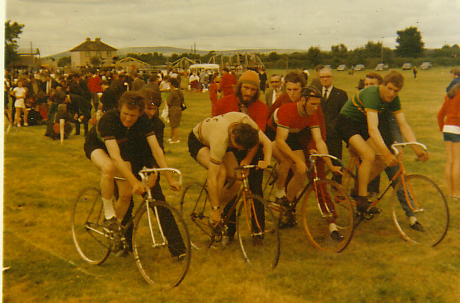
Cycling events took premier position in the 1972 Fermoy Open Sports day although the weather was reported as unfavourable (Corkman, Sat. 17 June 1972, p. 11). After four qualifying heats the line up for the half-mile final was comprised of Willie Baggott (Limerick). Sylvie Murphy (Hilltown), who edged out the fancied Eddie Dunne of Round Towns in the second heat. Pat Green (Glenmore) was the winner of the third heat and local star John Hegarty was the fourth finalist.
Sylvie Murphy took the quarter through the bell and held the advantage until 150 yards from home. Baggot swept by on the outside to go on to win by 1.5 lengths clear. John Hegarty, who had been hemmed in came with a late flurry to pip the gallant Sylvie Murphy at the line for the silver (Irish Examiner, Mon. 12 June 1972, p. 11).
Five Mile National Track Champion 1972
In July 1972, Pat Green as the holder of the 1971 Five Mile National Track Title was the favourite in 1971 (Nationalist & Leinster Times, Fri. 14 July 1972, p. 14). Pat went on to win the five-mile championship for the second successive year (Munster Express, Fri. 24 Nov. 1972, p. 19).
Please send any corrections or further information to glenmore.history.com.
Special thanks to Ger Barry for sharing the photos from the Fermoy Open Sports Meeting. He believes that the photos show Pat Green (Glenmore); Frank O’Sullivan (Fermoy); the third person is unknown but could be Paddy Flanagan (of Midlands Cycling Club) and Willie Baggot (Shannon Wheelers). “All were racing for the Gold All Ireland Championship” at the Fermoy Open Sports Meeting. In the black and white featured photo above Ger identified Pat Green, ?, Mick Kingston and Willie Baggott
Dr. Kathleen Moore Walsh
Jamestown, Glenmore (1961)

Today, we are going to feature information that Danny Dowling (1927-2021) recorded regarding the residents of the townland of Jamestown, Glenmore around 1961.
O’Kelly’s Place Names
Although we usually provide some of the entry for various townlands as reflected in O’Kelly’s, The Place Names of the County of Kilkenny (1969, p. 102) below is the entire entry: “Jamestown, Baile Sheamoc, little James’s homestead. Area 293 acres. Ballyguirrim ruined church is here with its adjoining churchyard. There is a well north of the church called Tobar an tsagairt. Dan Dowling, a local historian who has made tape-recordings of cures, charms and folklore from old residents over a wide area states that it was a custom up to 50 years ago for passers-by to leave a stone at the two sceach bushes growing near the old main road to New Ross. Boithrin sean-Philib is the name of a laneway here. Field names are Drom gabhar, and the Robbers’ field“.
Last Native Irish Speaker in Glenmore
When Danny was about ten years old his family moved from Glenmore Village to the Dowling farm in Jamestown. We previously published an article regarding Danny’s colourful great-grandmother Biddy Neddy Cody (Bridget Dowling née Cody (1831-1916) or often referred to in newspapers as the Widow Dowling.
Jamestown is also the townland where Patrick Power (c. 1856-1942) the last native Irish speaker in the parish resided. The National Folklore Collection, housed at UCD has the recording of Pádraig de Paor, from Jamestown, Glenmore (archival reference NFC 323: 174-183). Patrick was 85 at the time of the recording. It is available to read online, most of the 9 pages are in Irish.
1961
In 1961, Danny recorded eleven families or households in the townland of Jamestown. With respect to Danny’s list of residents’ birthdates or birth years are provided for some of the older residents gleaned from available public records. For some time after drafting his notebook, Danny recorded the dates of death or simply recorded that a resident had died. The recorded information reveals that 46 people resided in Jamestown with the population of 28 males and 18 females. The largest family recorded was the Dowling family comprised of 9 persons and there were 2 households of a single person.
Recorded Residents
Males= 28
Females= 18
Eldest Recorded Resident= Michael Greene (1873-1962). In 1961 Michael was 88 years of age.
Recorded Work
Farmers= 3 ( 2 males; 1 female)
Farm/Agricultural Workers/Labourers= 12 (all males)
Labourers= 1 (male)
Creamery Worker = (male)
Bookkeeper = 1 (female)
JAMESTOWN’S RESIDENTS
[1] POWER
Power, John (10 Feb. 1893) Farm Labourer
[2] POWER
Power, Michael (2 Nov. 1905) Farm Labourer
Power, (no first name recorded) wife
[3] DOWLING
Dowling, Hannah (25 March 1903) Farmer
Dowling, Daniel (15 Feb. 1927) son, health inspector
Dowling, Michael, son, farm worker
Dowling, Bridget, daughter, bookkeeper
Dowling, Edward, son, farm worker
Dowling, Margaret, daughter (married 25 Oct. 1961)
Dowling, Patrick, son, farm worker
Dowling, John, son, farm worker
Dowling, Ellen, daughter
[4] GREENE
Greene, Patrick (18 May 1912) Farmer
Greene, Bridget (14 Aug. 1913) wife
Greene, Michael, son, farm worker
Greene, William, son
Greene, Patrick, son
Greene, Margaret, daughter
Greene, Bridget, daughter
Greene, Michael (12 March 1873) cousin, retired (died 16 March 1962)
[5] WALSH
Walsh, Thomas (5 June 1886) Farmer
Walsh, Catherine (24 Sept. 1898) wife
Walsh, John, son, farm worker
Walsh, Patrick, son, farm worker
Walsh, Mary, daughter
[6] MURPHY
Murphy, Michael, Labourer
Murphy, Bridget, wife
[7] POWER/MALONE
Power, Mary (10 March 1885)
Malone, Michael, son-in-law, farm worker
Malone, Margaret, daughter
Malone, Henry, grandson
[8] MERNAGH
Mernagh, Thomas, Creamery Worker
Mernagh, Catherine, wife
Mernagh, Mary, daughter
[9] MERNAGH
Mernagh, John (19 Dec. 1921) Farm Worker
Mernagh, Johanna, wife
Mernagh, Edward, son, farm worker
Mernagh, Patrick, son
Mernagh, Margaret, daughter
Mernagh, James, son
Mernagh, Liam, son
Mernagh, Kieran, son
[10] POWER
Power, Michael (12 Dec. 1882) Farm Labourer
[11] DOYLE
Doyle, Laurence
Doyle, Johanna, wife
Doyle, Nicholas, son
Please send any corrections or additional information to glenmore.history@gmail.com. The featured photo above is the entrance to Ballygurrim Graveyard of Jamestown. The photo was taken in June 2020.
Dr. Kathleen Moore Walsh