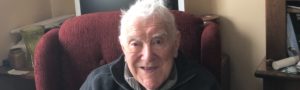
Danny Dowling (1927-2021)
now browsing by tag
The Strange Family of Aylwardstown, Glenmore

Today, as our fifth excerpt from Carrigan’s, The History and Antiquities of the Diocese of Ossory, v. 4 p. 94-95 (1906) we feature what he published concerning the Strange family of Aylwardstown, Glenmore as well as information that Danny Dowling collected and recorded regarding the last of the family to live in Aylwardstown House.
The Strongs, Strangs or Stranges
They were settled at Waterford, from an early period, and held a foremost place among its citizens. Richard Strong was Mayor of the city in 1484 or 1485; Peter Strong in 1560; Paul Strange in 1597; Thomas Strange in 1607; and Richard Strange in 1634. At least two of them represented the city in Parliament, viz. Peter Strong in 1559 and Richard Strange in 1634. To this stock also belonged the Most Rev. Thomas Strong, Bishop of Ossory from 1582 to 1602, and his nephew, Most Rev. Thomas Walsh (son of Robert Walsh and Anastatia Strong), Archbishop of Cashel from 1626 to 1654.
In course of time the family acquired, probably by purchase, considerable estates in South Kilkenny. About 1560 Peter Stronge held lands to the value of £51, of the manor of Grannagh. Richard Strong, of Waterford, probably his son, is found in possession of the manor of Drumdowney, in 1573, and of the manor of Dunkit, in 1585. Edward Strong of Dunkitt, son and heir of Richard, died June 1st, 1621, being then seised of the manor of Dunkit and of the reversion of the manor of Drumdowney after the death of Thomas Strong; he left issue Richard, his son and heir, then but 12 years old, Thomas, Peter, Joan and Margaret.
Thomas Strong just mentioned, who had been seised of the manor of Drumdowney, and who may have been brother of Edward, of Dunkit, died May 28th, 1625, leaving a son and heir, Laurence, then but 10 years of age.
Another member of the family, Paul Strong of Waterford city, held the fee of several townlands in Inistioge and the Rower. He died Nov. 22nd, 1617, leaving Peter, his son and heir, then aged 39 years. Peter was succeeded, in turn, by Richard, his own son and heir. This Richard appears on the list of those who forfeited in 1653, as do also Peter Strong, of Dunkitt, who was transplanted to Connaght, and Richard Strong, the proprietor of Drumdowney.

Lawrene Strong or Strange, of Drundowney, son of Thomas (who died as above in 1625) is mentioned in one of the depositions of 1641. He was still living in 1661, at which date he was 46 years of age. He was probably the father of Richard Strange, who was appointed a Burgess of Inistioge in 1688, and grandfather of Lawrence Strange, of Aylwardstown. The said Lawrence Strange, of Aylwardstown, in his Will, proved in the year 1720, mentions his brothers James and Pierce Strange; his brother (i.e. brother-in-law) Nicholas Aylward; his sisters, Ellen Walsh, alias Strange, and Mary Kealy alias Strange; his wife Mary Strange, alias Aylward; his eldest son and heir Richard, then a minor; and his other sons, Patrick and Pierce Strange. Some of the later members of this family are mentioned on their monument in Kilmokevoge.
His Eminence, Cardinal Wiseman’s mother was a Miss Strange of Aylwardstown, probably a daughter of Peter, who died in 1824; her sister, Harriet Strange, wife of Mr. James Butler, of Kilmogar, Johnswell, died in 1858 aged 68. [Fr. Carrigan was correct. “Marriages–On the 2d instant, James Butler. Esq. of Killmogar, County Kilkenny, to Harriet, youngest daughter of Peter Strange, Esq. of Aylwardstown, in the same county,” (Freeman’s Journal, Thurs. 13 Nov. 1823, p. 3)] [For further information on Cardinal Wiseman and his visit to Glenmore see our guest author page or click here.]
In Irish, Strange or Strong is pronounced Sthraoung (a monosyllable). Strang’s Mill, in the parish of Kilmacow, is called by Irish speakers, Mwillin a Straounga, i.e. Muilleann.
Danny Dowling’s (1927-2021) Strange Research
In the 1970’s Danny was corresponding with Professor John Mannion of Newfoundland. From his research he informed Professor Mannion that he believed that the Strange family came to Aylwardstown about 1690, as tenants of the new Cromwellian owners, the Ponsonby family of Kildalton, Piltown, Co. Kilkenny. Danny stated that it appeared that the first Strange that came married a girl of the Aylward family. The Aylward family previously owned the Aylwardstown property before Cromwell (DD Notebook 4, Copy of letter from DD to Prof. John Mannion, of Newfoundland dated 10 Dec. 1977).
Danny informed Professor Mannion in 1977 that “some 20 years ago all the Strange family papers were stored in Aylwardstown and burned by a Mrs. Connolly.” Her son Thomas told Danny about the burning in 1975 (DD Notebook 4, Copy of letter from DD to Prof. John Mannion, of Newfoundland, dated 25 January 1977).
Thomas Alexander Strange (1856-1907)
The last of the Strange family to live at Aylwardstown appears to have been Thomas A. Strange (1856-1907). In Danny’s voluminous records we found a copy of a newspaper auction notice for February 1883.
“Received instruction from Thomas A. Strange, Esq., who is giving up his dairy to sell by auction on Thursday, 1 February 1883, at his farm at Aylwardstown, 30 prime young dairy cows, in and with calf at foot, served by a highly bred bull; 6 three year old heifers in calf; 5 two year old heifers; 3 well-bred yearling bulls; 2 five year old Hunters, well known with hounds may be inspected by V.S. before sale; 2 capital farm mares; one sow/ 12 forward store pigs, 40 tons of prime mangolds in lots; carts, tackling, plough, harrows, dairy utensils. Sale at twelve o’clock precisely and terms are cash.” The auctioneers were Thomas Walsh and Son, The Mall, Waterford (Waterford News & Star, Fri.19 Jan. 1883, p. 2).
Also in Danny’s files was another article which may help explain the auction. In January 1882, Thomas Strange entered into a wager with Mr. W. Power of Williamstown regarding their horses. Strange’s horse Garsfield was to race Power’s Hawk over a 2.5 mile hunting course. The bet was for £25, a large sum of money in 1882. Mr. JP Kennedy of George’s Street held the money (Munster Express, 14 Jan. 1882, p. 6). We could not locate an article regarding which horse won the race, but there are other articles regarding Strange and his love of fast horses and racing.
Lily Strange née Jones (b.c. 1863)
On Halloween 1973, Danny interviewed Nicky the Miller Forristal (1888-1979) who provided another reason why Thomas A. Strange may have held an auction and eventually left Aylwardstown.
“Thomas A. Strange married a girl who worked in one of the Waterford Hotels either the Adelphie or the Imperial. She was a barmaid. He was not long married before they left Aylwardstown. She was either an English or Welsh girl…When Thomas A. Strange left Aylwardstown he brought with him Tommy Neill and Anty Walsh to Liverpool where he lived on the outskirts. He had a jarvey car for hire. He got broke there and had to leave off Tommy Neill and Anty Walsh. Tommy Neill then emigrated to America, Anty Walsh returned home and went to work in Tramore.”
The Strange Children
The first English census where we could locate Thomas A. Strange was the 1891 Census for Cheshire, Birkenhead. Thomas Strange was 34, reported that he was born in Ireland and was working as a horse dealer. His wife, Lily Strange, was aged 28, working as a pork butcher, and reported being born in Wrexham. The couple had two children. Thomas Strange, aged 4, born in Ireland, and Lily Strange, aged 6, born in Wrexham. Also, present were three of Lily’s siblings (whose family name was Jones) and Jane Dargan a 21 year-old general servant, born in Ireland.
We were unable to find a marriage record for Thomas A. and Lily, but we did find a birth record for their son. In Dublin North on the 15th of January 1886, Thomas Alexander Strange of East Pier, Howth, farmer and his wife Lily née Jones had a son that they named Thomas.
By 1901 the family was living at 80 Mozart St., in Toxeth Park, Lancashire, and the family consisted of three people. Thomas Strange, aged 44, was a cab proprietor. Lily Strange was 40, and their son Thomas Strange was 15, and employed as a van driver.
Death of Thomas Alexander Strange (1857-1907)
Thomas Alexander Strange, died aged 51, in Sept. 1907. At the time of his death he was living in the workhouse and gave his profession as cab driver. He was buried in the Catholic Section of Anfield Cemetery, of Lancanshire, in a public grave.
The following year, on 19th of April, 1908, at the Parish Church of Liverpool, Thomas (1886-1959) at the age of 22 married Mary Louisa Douglass, aged 21. The groom was working as a cab driver and he listed his father as Thomas Alexander Strange (deceased). The bride was the daughter of Albert Edward Douglass, storehouse keeper. Young Thomas died on 15 December 1959 at Mill Lane Hospital.

Six years after her father’s death, at the Parish Church of Liverpool, on 5 May 1913, Lily Strange (aged 26) married Thomas Birney (aged 30) of Clare Street. The bride recorded that she was the daughter of Thomas Strange, car driver.
We were unable to determine what happened to Lily Strange née Jones, but are hopeful a reader might be able to shed some light on this.
Please send any and all corrections, further information or photos to glenmore.history@gmail.com.
The feature photo above is Aylwardstown House taken in 2004 and is courtesy of the National Inventory of Architectural Heritage.
Dr. Kathleen Moore Walsh
The Anglo-Norman Aylward Family of Aylwardstown, Glenmore
Today, as our fourth excerpt from Carrigan’s, The History and Antiquities of the Diocese of Ossory, v. 4 p. 93-94 (1906) we feature what he published concerning the Aylward family that gave its name to the Glenmore townland of Aylwardstown. In an Inquisition of 1637, Glanseline appears as an alias for Aylwardstown, it was probably, the original name of the townland (Carrigan, vol. 4, p. 94). In Irish, Aylward is sometimes called Eye-lurth, and sometimes El-e-wurth; Aylwardstown is always called Ball-an-Eye-lur-tha (Carrigan, vol. 4, p. 94) .
The Aylwards of Aylwardstown
“They were an Anglo-Norman race and, presumably, a branch of the Aylwards of Faithleg, in the County Waterford.”
“William Aylward of Aylwardstown, gent., was pardoned in 1562 and 1571; was a juror, 20th March 1585; and was pardoned, Nov. 18th, 1602. Piers Aylward, of Aylwardstown, probably son of William, was Constable of the Barony of Ida, in 1608, and appears as a juror, in 1623. He married Ellen, daughter of John Fitzgerald, Esq., of Gurteen, and had a son and heir, Nicholas Aylward, of Aylwardstown, who forfeited the ancestral estate, viz., Knockduff, Aylwardstown, Robbinstown, Ballinerahy and Haggard, under Cromwell, and was transplanted to Connaught in 1653″ (Carrigan, v. 4, p. 93).

“In 1677 the said Nicholas Aylward had a royal confirmation of the lands (911 acres), that had been assigned him at his transplantation, in the Baronies of Clonmacnoen and Longford, in the Co. Galway. By his wife, Ellinor, sister of Thomas Kelly, Esq., Portreeve of Gowran, he had a daughter, Ellice, who married Mr. James Frayne, of Browntown; and a son Piers. Piers Aylward was made a burgess of Inistioge, in 1688, and was outlawed, as of Aylwardstown, in 1690. He married Eliza Butler (daughter of Sir Richard Butler, and sister of Sir Walter Butler, of Paulstown), by whom he acquired the house and estate of Shankill, near Gowran. His son and heir, Nicholas Aylward, of Shankill, born in 1686, conformed to Protestantism in 1711; from him descends the present Aylward family of Shankill castle” (Carrigan, vol. 4, p. 94).
Returned to Aylwardstown, Glenmore
In attempting to find out if any of the Aylwards returned to Aylwardstown post Cromwell, we did locate a Will dated 28 May, 1715. The Will of Piers Power of Carriogorontory, Co. Waterford suggests that an Aylward was back in Aylwardstown. In his Will, Power left his lands of Carrigorontory, Knockandull, and Ballygarren, with £500 due him by several persons, to Michael Head of Dublin and Nicholas Aylward of Aylwardstown, as Trustees (Entry 212, John Ainesworth, “Survey of Documents in Private Keeping: Third Series,” Analecta Hibernia (1967) Irish Manuscripts Commission).
See our post of 5 January 2023 regarding the townland of Aylwardstown and Danny Dowling’s (1927-2021) 1961 list of residents. See our post of 17 September 2023 regarding Rev. Carrigan and the publishing of his four volume work.
See, Burtchaell, Jack. “The south Kilkenny farm villages.” Common Ground: essays on the historical geography of Ireland (1988): 110-23. This interesting article discusses farm villages of South Kilkenny including Glenmore’s Aylwardstown, Rathinure and Weatherstown. The author acknowledged Danny Dowling (1927-2021) at the end of his article.
Aylwards from across the globe gathered in Waterford in late August 2023. The gathering was organised by John Aylward, retired Waterford publican and the grandson of John Aylward (1870-1929) of Rochestown, Glenmore. Julian Walton delivered an informative and entertaining account of various Aylwards. See our post of 9 October 2022 regarding John Aylward (1870-1929) of Rochestown, Glenmore.
Please send any corrections or additional information to glenmore.history@gmail.com.
Dr. Kathleen Moore Walsh
The photo of Shankill Castle was transferred from en.wikipedia to Commons by RHaworth. For a concise description of “a Queen Anne home with a medieval tower house at its heart,” see the Shankill Castle webpage.
The feature photo above is Aylwardstown House taken in 2004 and is courtesy of the National Inventory of Architectural Heritage.
Rochestown, Glenmore (1961)

Today, we are going to feature information Danny Dowling (1927-2021) recorded regarding the residents of the townland of Rochestown in 1961. Rochestown is the largest townland in the parish of Glenmore and in some early records it was spelled as Roachestown. Some of the current residents of Rochestown can find their surnames in the earliest records of the townland.
Background
The Irish for this townland, according to O’Kelly’s, The Place Names of the County of Kilkenny Ireland (1969, p. 114) is Baile na cille, place of the church. The townland is comprised of 890 acres. “Ballynakill is now a subdivision; another subdivision is Ballyilogue, i.e. Baile Ui Laodhog, O’Logue’s homestead. The site of Teampall Fhinnin, Finian of Clonard according to the Ordnance Survey Letters, is on the road north of Rochestown village in a field called Garrai Mhichil Dhuibh, black Michael’s garden. The castle site is near the road south of the village and there is also a Rochestown West village or hamlet. There is a hill called Cnoc an roithleain, hill of the wheel (probably a spinning wheel) and open-air Mass was celebrated at a site called Ath an roithleain, ford of the wheel. Other fields are Ban ard; Ban dearg; Carraig mheanach, the middle rock; Culach cisighe, angle land of the improvised road, and Siolfuar (O).” It is believed that Siolfuar is cold seed.
According to Dany Dowling (1927-2021) during the Black Plague some of the people of Rochestown hamlet near Veriker’s Cross (river road from Aylwardstown to Ringville where it intersects with the lane from Rathinure) moved west to Ballylogue. Martin Walsh’s (c. 1918-1996) mother, Ellie Walsh née Gahan (1884-1965) referred to the area around the cross as Shean bhaile (old town) and Ballylogue as new town.
Tithe Applotment Books (1829)
The landlord was Pierce Edmond Forestall, Esq. (the handwriting makes the name look like Pierc C. Forslau). There were 22 tenants recorded on 20 plots of land, but there is no way of knowing the exact number of tenants as the same name appears on different plots. All the acres below are statute acres.
Plot 73 included (1) James Donovan; (2) Tomas Haberlin & (3) Thomas Walsh, with 60 acres; Plot 74 (4) Thomas Walsh, 115 acres; Plot 75 (5) Laurence Forastall, 41 acres; Plot 76 (6) Richard Gahan, 106 acres; Plot 77 (7) John Kelly, 57 acres; Plot 78 (7) John Walsh, 34 acres; Plot 79 (8) Richard Walsh, 2 acres; Plot 80 (9) Thomas Forastall, 20 acres; Plot 81 (10) Patt Gahan, 50 acres; Plot 82 (11) John Forastall, 20 acres; Plot 83 (12) James Forastall, 12 acres; Plot 84 (13) John Vericar, 23 acres; Plot 85 (14) Patt Kelly, 34 acres; Plot 86 (15) James Fitzgerald, 41 acres; Plot 87 (16) Edward Dollard, 36 acres Plot 88 (17) Patt Doyle, 5 acres; Plot 89 (18) Thomas Gahan & (19) Richard Forastall, 7 acres; Plot 90 (20) Martin Denn, 2 acres; Plot 91 (21) Patt Neill, 1 acres; Plot 92 held by the landlord, 19 acres and Plot 93 (22) Laurence Ennis, 37 acres.
See our post of 6 November 2022 regarding the killing of Catherine Hanrahan née Power of Rochestown in July 1822.
Griffith’s Valuation (1847-1864)
The landlord for Rochestown was primarily Benjamin Conn, Esq. Other landlords included Edmund Forstall, Esq. and Miss Julia Sweetman. There are 34 plots recorded for Rochestown. This list provides a fascinating account of how tenancies were often shingled with the landowner leasing or renting to one person who in turn sub-let or rented part of the holding to others. The following tenants are listed and an effort was made in the record to distinguish the various tenants with same or similar names.
- Thomas Walsh (Tom) 41 acres and on this land were Ann Ryan who had a house & small garden (free) house worth 5s; John Ryan who rented from Thomas Walsh (Tom) a house worth 7s. and (3) John Terry who had a house and office free worth 6s.
- Thomas Walsh (Tom) also rented 14 acres from Miss Julia Sweetman and sublet a house and garden to George Young. Young’s house was valued at 2 s.
- Joseph Gahan and John Gahan, Jr. each held 22 acres belonging to Benjamin Conn, Esq. Joseph’s house was valued at 6s. and John Jr. house was valued at 4 s.
- John Gahan, Jr. and Joseph Gahan also rented 56 acres from Miss Sweetman. Sub-tenants for John Gahan Jr. included John Haberlin who had a house valued at 5s.; James Kirby, Sr. who also had a house valued at 5s. and Peter Kirby who had a house valued at 2s. Joseph Gahan leased a house to George Young valued at 5s.
- James Walsh leased 102 acres, a house and offices from Conn. His house was valued at £7. Walsh sub-let to Thomas Neill a house valued at 5s. and to Michael Henneberry a house valued at 8s.
- James Walsh leased 11 acres from Miss Sweetman.
- James Walsh and John Dollard leased 8 acres from Conn.
- John Dollard leased a house, offices, and 34 acres from Conn. The buildings were valued at £3 15s.
- Ellen Kelly leased a house, offices and 44 acres from Conn. Her house was valued at £2. John Haberlin had a forge on plot 9 that he leased from James Walsh. It was valued at 6s.
- John Forrestal (Poer) leased a house, office and 40 acres from Conn. The buildings were valued at £4 15s.
- John Gahan (Waria) and Patrick Gahan leased a house, offices and 43 acres from Conn. They sublet a house and office to Paul Landrigan valued at £1.
- Patrick Gahan and partners leased 2 acres of wasteland from Conn. The land had no recorded value.
- Patrick Henneberry leased a house and 1 acre of land from James Walsh.
- Bridget Forrestal leased 6 acres from Conn.
- Bridget Forrestal leased a house, offices and 14 acres of land from Edmund Forstall, Esq. Her house was valued at £1 15s. Edmund Holden also leased from Forstall a house & garden valued at 9s. and Mary Cashin had a house leased from Forstall valued at 5s.
- Edmund Forstall, Esq. owned plot 16 which consisted of a house, offices and 146 acres of land. His buildings were valued at £20. On plot 16 Forstall leased a house and gardens worth 12s.. to James Forrestal (Dick). He also had another house with offices worth £3 that was vacant. Forstall owned a salmon weir valued at £10 and leased to Richard Malone a house and gardens valued at £1 13s.
- Forstall rented a couple of acres to Thomas Aylward.
- Thomas Aylward leased a house, offices and 24 acres from Forstall. His house was worth £2 10s. James Aylward leased a house worth 8s. from Forstall. Patrick Kelly leased a house and small garden from Thomas Aylward valued at 10s.
- James Forstall, Jr. leased from Edmund Forstall, Esq. a house, offices and 18 acres. The house was valued at £2 10s. Thomas Greene rented a house from James Forstall, Jr. valued at 8s.
- James Forrestal, Jr. leased from Conn 3 acres
- John Vereker leased from Forstall a house, offices and 20 acres. The house was valued at £2 10s.
- John Vereker leased 3 acres from Conn.
- Denis Magrath had a house, offices, and 68 acres. His landlord was Conn. The house was valued at £2.
- Edmund Ryan rented 1 acre from Forstall.
- John Forrestal, Jr. leased a house, offices and 2 acres from Forstall. The house was valued at £1 10s.
- John Fitzgerald rented a house and 2 acres from James Walsh. The house was valued at £1. Michael Kirby rented a house and garden from Forstall valued at 14s.
- Conn held 37 acres in this plot. Richard Walsh leased a house and offices (valued at £2 10s.) Catherine Manion and Mary Donovan leased houses from Conn each were valued at 5s.
- Thomas Walsh (Jack) rented from Conn a house, offices and 29 acres. James Kirby, Jr. rented a house and garden from Joseph Gahan valued at 15s.
- James Costello leased a house, offices and 1 acre. The house was valued at £1.
- Morgan Denn leased a house, office, 2 acres and a salmon weir from Forstall. The house and the weir were valued at £1 1os. each.
- Thomas Gahan leased 3 acres from Joseph and John Gahan, Jr.
- Thomas Gahan rented from Miss Sweetman a house, offices and 6 acres. The house was valued at £1 15s.
- James Duggan rented a house with 1 acre from Miss Sweetman. The house was valued at 10s.
- John Doyle leased a house, office and 5 acres from Miss Sweetman. The house was valued at £1 12s.
For further information on Pierce Edmond Forstall Esq. and the Conn family see, Martin Forristal (2019) “Mount Ida.” See also our post of 7 October 2023, “An Old Anglo-Norman Glenmore Family: The Forrestalls.”
ROCHESTOWN (1961)
In 1961, Danny recorded 16 families or households in the townland of Rochestown. Birth dates or birth years are provided for some of the older residents gleaned from available public records. For some time after drafting his notebook, Danny recorded the dates of death or simply recorded that a resident had died or left the townland.
Danny’s recorded information reveals that in 1961, 62 people resided in the townland of Rochestown with the population comprised of 33 males and 29 females. The largest household was the Heffernan family with 8 persons in their household. There were 2 households recorded with a single person living alone in each house. Information under residents of Rochestown not in Danny’s original list has been placed in square brackets [ ].
Recorded Rochestown, Glenmore Residents (1961)
Males= 33
Females= 29
Eldest Recorded Resident
The eldest resident recorded by Danny in Rochestown, Glenmore was Alice Walsh née Doherty (1875-1962) who was 86 in 1961. Alice was the daughter of Richard Doherty and his wife Mary Merigan of Milltown, Glenmore. Alice was baptised the 3rd of February 1875, yet her birth cert provides that her birthdate was the 15th of April. Her father registered her birth on the 5th of May and obviously gave her birthdate in April to avoid being fined for the late registration. James and Alice were married on 23 August 1904 in Trinity Without, Ballybricken, Waterford. James was living on Morris Road and Alice was resident on Presentation Row. James was the son of James Walsh and his wife Mary Power of Rochestown. Their witnesses were Martin Walsh and Johanna Doherty.
Recorded Work
Farmers= 7 (6 Males; 1 Female)
Farm Workers = 8 ( 8 Males; 0 Females)
Clover Meats 8 = ( 6 Males; 2 Females)
Secondary School Teacher = 1 (0 Males; 1 Female)
Retired Labourer= 1 (1 Male; 0 Females)
Fisherman= 1 (1 Males; 0 Females)
Rochestown, Glenmore Residents 1961
[1] FORRISTAL
Forristal, William (21 Dec. 1915, Clover Meats [Billy Forristal was the first Glenmore person I met in October 1991. He was a fountain of information and for years wrote the Glenmore column for local newspapers.]
Forristal, Bridget (b. 1921) wife
Forristal, Alice, daughter, secondary school teacher
Forristal, John, son
[2] WALSH
Walsh, James (27 July 1877) Farmer dead [died 7 April 1963 in Waterford]
Walsh, Alice [née Doherty] (1 Feb. 1875) wife, died 5 August 1962 [death register reveals her granddaughter Alice Walsh née Wash of Scartnamore, Glenmore was with her]
Walsh, James Patrick, grandson, assisting relative
Walsh, Rosaleen, granddaughter
[3] FORRISTAL
Forristal, John (b. 17 March 1887) Farmer
Forristal, Ellen (b. 1 April 1883) sister
Forristal, Mary (b. 3 April 1881) sister
Ennett, John (b. 1911) nephew-in-law, assisting relative
Ennett, Bridget (b. 1921) niece [née Walsh]
Walsh, Mary (May) (b. 1919) niece

[4] WALSH
Walsh, Ellen (17 Oct. 1883-1965) Farmer
Walsh, Joseph (b. 1914) son, assisting relative
Walsh, Kathleen (b. 1916) daughter
Walsh, Martin [25 Dec. 1918-6 Jan. 1996] son, assisting relative
[5] CONNOLLY
Connolly, Philip (b. 13 Oct. 1891)
Connolly, Edward (b. 14 April 1908) brother, Clover Meats
[These brothers were the last to live in their family home in Ballylogue, Rochestown, Glenmore.] The featured photo above was taken in 2021 when vegetation was removed from around the long house.]
[6] DELAHUNTY
Delahunty, Patrick, (b. 21 June 1911), Farm Labourer
[7] MAGUIRE
Maguire, Catherine (b. 20 April 1890) dead
Maguire, Elizabeth (b. 1925) daughter
Maguire, Patrick, grandson
[8] AYWARD
Aylward, James [Sonny] (4 June 1900-23 April 1962) Farmer
Aylward, Bridget (b. 1902)
Harney, Michael, son-in-law
Harney, Ellen, daughter

[9] DILLON
Dillon, Catherine (b. 28 Oct. 1896)
Dillon, Patrick (b. 1916) son, Clover Meats
Haberlin, Richard, grandson, scholar
[See our post of 27 March 2021 regarding daughter Ciss Dillon (1919-1997) and her WWII work .]
[10] RYAN
Ryan, Philip (b. 17 Oct. 1886) Farm Labourer
[11] KIRWAN
Kirwan, Thomas (b. 7 July 1898) Farm Labourer
Kirwan, Ellen (b. 5 Sept. 1898) wife
Kirwan, William, son, Clover Meats
Kirwan, Alice, daughter, Clover Meats
[12] GRAHAM
Graham, John (b. 1901) Clover Meats
Graham, Mary Ann (b. 1916) wife
Graham, Thomas, son, child
[13] HEFFERNAN
Heffernan, Patrick (b. 1924) Farmer
Heffernan, Anastatia, wife
Heffernan, Mary C., daughter
Heffernan, Catherine, daughter
Heffernan, William, son
Heffernan, Edward, son
Heffernan, Maria Bernadette, daughter
Finn, Patrick, farm labourer
[14] AYLWARD
Aylward, James (b. 1929) Farmer
Aylward, Mary, wife
Aylward, Margaret (b. 1900) mother
Aylward, Mary, sister
Aylward Eileen, sister, Clover Meats
[15] KEOGH
Keogh, John (b. 1916) Farmer
Keogh, Margaret, wife
Keogh, Martin, son
Keogh, Sean, son
Keogh, Eamonn, son
Keogh, Bridget, daughter
Keogh, Margaret, sister
[16] FORRISTAL
Forristal, Michael, Retired Labourer
Forristal, Peter, son, fisherman
Forristal, Michael, son, Clover Meats
XXXXXXXXX
Please send any corrections, further information or photos to glenmore.history@gmail.com.
Dr. Kathleen Moore Walsh
From Danny’s Files : Christmas Baking 1922

Danny Dowling (1927-2021) the Glenmore Village Historian, in addition to interviewing people also spent a substantial amount of time reading and researching in old newspapers. Before local libraries were equipped to provide copies of old newspaper articles Danny often wrote out the articles in one of his notebooks. Sometimes, he just took down notes concerning the prices of produce at fairs etc. he found in a newspaper. Today, we are going to feature recipes that appeared in the New Ross Standard in 1922 (15 Dec. 1922, p. 3). Danny recorded the recipe for Brandy Butter on a piece of paper that he stuck into one of his notebooks with a notation citing where he found it.
In Danny’s voluminous book collection there were several cook books including some very old cookbooks. Danny was interested in how people lived in the past and although he never mentioned cooking or baking himself to me, he did tell me one December that his brother Pat Dowling (1941-2023) of Cappagh, Glenmore enjoyed making Christmas puddings. Pat started his puddings early and gave most of them away to family and friends. We shall check with Danny’s son Pat, to see if he can shed some light on the Brandy Butter recipe that Danny recorded.
In looking up the original Brandy Butter recipe, from Danny’s notation, we found several other Christmas recipes published with it. It is interesting to see how recipes have evolved over the past 100 years. In 1922 the measurements, when provided, are Imperial measurements. Reference is made to kitchen paper which today must mean greaseproof baking paper. The recipes also employ raw eggs that would not be considered safe today due to salmonella concerns. The Christmas Pudding recipe is called “Grannie’s” and if true must have been in use pre-1900. It is not known how many Glenmore households had stoves or cookers in 1922, but it is believed that most households were still cooking over open fires in large kitchen fireplaces.
A Good Christmas Cake
One and half pounds of flour, one pound of butter, one pound of sugar, one pound of currants, one pound of sultanas, half a pound of mixed peel, small teaspoon of mixed spices, a saltspoonful of salt, a tablespoon of golden syrup, two ounces of chopped almonds and eight eggs.
Beat the sugar and butter together until it creams, then add the eggs, one at a time, beating each one well. When four eggs have been beaten, add a little of the flour, then beat the other four, gradually adding the remainder of the flour. Put the golden syrup into half a teaspoon of milk and add to the mixture, then the salt, spice, fruit, and peel. The fruit should be cleaned, but not washed, and the peel chopped finely.
The fruit is best cleaned by placing on a wire sieve, sprinkled with flour, and rubbed with the palm of the hand. A wineglassful of brandy improves the flavour of the cake. When all the ingredients are well mixed, butter some kitchen paper and line a cake tin, putting a double layer at the bottom.
Bake from five to six hours in a slow oven. Leave in the tin when baked tlll cold.
Icing for Cake
Almond Icing

Two pounds of icing sugar, one pound of ground almonds, three eggs. Mix the sugar and almonds together, well beat the eggs, mix into a stiff paste. When the cake is quite cold, level the top and spread with the paste. [Warning this recipe uses uncooked eggs!]
Sugar Icing
To every pound and half of icing sugar add the whites of three eggs and the juice of a lemon. Beat or whisk the whites of eggs, add the sugar and lemon juice, stirring all the time till becomes stiff, spread over the almond icing, using a clean knife, which should be dipped in cold water. If required more ornamental pipes may be used. {Warning this recipe uses uncooked egg whites!]
Christmas Pudding (Grannie’s Recipe)
1 ½ pounds raisins, 1 ½ pounds currants, 1 ½ pounds sultanas, 1 ½ pounds suet (beef), 1 ½ pounds sugar, 1 ½ pounds mixed peel, 2 teaspoonsful mixed spice, 1 large nutmeg, crumbs of one small loaf, 1½ pounds of self-raising flour, 3 new laid eggs, 2 tablespoonsful of treacle, spoonful of salt, 1 lemon, 3 ounces almonds (ground), 1 medium sized carrot, old ale to mix.
Clean and pick the fruit, chop the suet, and peel finely, grate the nutmeg, rub the loaf into fine crumbs, beat the eggs with the treacle, adding the lemon juice slowly, grate the carrot. When all the dry ingredients are well mixed add the eggs, treacle and lemon juice with sufficient old ale to make a fairly stiff mixture. It should drop from the spoon, which should be a wooden one. This quantity will make several good-sized puddings. Butter some pudding basins, fill them, tie down with floured cloths or kitchen paper, steam for twelve hours. When required, reheat and serve with brandy butter.
Brandy Butter
Two ounces of butter, two ounces of sugar, beat well together, then add gradually a tablespoon of brandy. Serve in a sauce boat. If preferred wine sauce makes a good addition to this pudding.
Wine Sauce
One wine glass of sherry, one of water, a teaspoonful of cornflour, one of sugar. Mix the cornflour with the wine and water; add the sugar, put into a saucepan and stir over the fire until it boils.
XXXXXXXXX
The featured photo of the Christmas pudding is an 1897 postcard. The Miriam and Ira D. Wallach Division of Art, Prints and Photographs: Picture Collection, The New York Public Library. “X-mas pudding.” New York Public Library Digital Collections. Accessed November 26, 2023. https://digitalcollections.nypl.org/items/510d47e3-f516-a3d9-e040-e00a18064a99
Are any of these recipes close to your family favourites? Did your Glenmore parents/grandparents/great-grandparents in 1922 have a cooker/cooking stove? Danny recorded the earliest motor cars, bicycles, tractors etc. in Glenmore but did not record the earliest cooker/cooking stove or milk machine etc.
Please comment below and send any additional information or corrections to glenmore.history@gmail.com.
Dr. Kathleen Moore Walsh
Three Ancient Glenmore Churches

As our third instalment of Chapter 4, of volume 4 of Fr. Carrigan’s History & Antiquities of the Diocese of Ossory (1906) (p. 91-93) three ancient Glenmore Churches will be discussed including; Kilcoan (Weatherstown); Kilbride and Kilmakevoge (also called Kilivory). For all three of these ancient churches Carrigan provided not only the dimensions of the churches, important stones he found in the ruins and nearby Holy Wells. While reading the rest of this fascinating volume in the Mullinavat chapter we came across Big Wood Church which we have also included below because it was supported by nearby Glenmore people.
Kilcoan
“Irish speakers call it Kil-choo-ann, that is, the Church of St. Cuan (pronounced Coo-ann, accent on second syllable). Kilcoan church was a rectangle, 18 feet wide internally, and about 37 feet long, the walls being 2 ½ feet thick. The foundations alone now remain. From the amount of very large rough stones lying on and around the site, it must be concluded that the church was rudely built and was of great antiquity. A graveyard of about two acres is believed to have surrounded it in ancient times; but, at present, all appearances of a burial ground have been obliterated, and the site of the church itself is merely a small patch of unprotected commonage beside the public road. About 150 yards to the south, in the wall of a lane-way, is a great, rugged stone, with a basin-shaped artificial hollow, 12 inches in diameter and 3 inches in depth, cut on the surface” (Carrigan, p. 91).
“St. Cuan’s holy well, called Thubber-chooann, is about a quarter of a mile from the site of the church, in the townland of Flemingstown. Beside it is another holy well, enclosed by a wall and called Thubber-Wizzha (Tobar Muire), or the Blessed Virgin’s Well. Both wells are still frequented for devotional purposes by the people” (Carrigan, p. 91).
Previous to the Reformation the parish and church of Kilcoan belonged to the Priory of Inistioge, as appears from the Red Book of Ossory (Carrigan, p. 91)”
[According to Danny Dowling (1927-2021) the site of this ancient church was in the hamlet of Weathertown in a common at the side of the junction of two lanes. Danny recorded that he spoke with Larry Doyle (c. 1933-2021) of Weathertown regarding some stones Larry uncovered on or near the common in Weatherstown. Larry said that he was working for old “Billy Fitz” (Bill Fitzgerald, c. 1905-1983) of Weatherstown in the late 1960’s or early 1970’s. Larry was clearing an area and came across what appeared to be paving stones. From their description and the location Danny concluded that they may have been part of a floor or yard connected to the ancient church of Kilcoan.]
Kilbride
“In Irish, Kyle-vzheedha (Iold Irish Script that looks like, Cill Drugue) or St. Bridget’s Church. The Church was a rectangle, 43 feet long, internally, and 18 ½ feet wide; but the walls, which were 2 feet, 5 inches thick, are now all fallen to a height of one yard from the ground. The entrance door was in the north wall, near the west gable. The graveyard is very large, with portion of a deep fosse at the south-west end. At the east end of the church is an uninscribed head-stone chamfered on both sides, in front, and having carved on it, in relief, an ancient cross patee, [head] inscribed in a circle; it is now deeply sunk in the ground (Carrrigan, p. 91).

“The baptismal font lies in the fosse at the south-west end of the churchyard; it is square on the outside, and quite rough; the basin is 1 foot 7 inches by 1 foot 5 inches; and is 7 inches deep. A holy water stoup, near the west gable of the church, has a round bowl, like a basin, 11 inches in diameter, and 4 ½ inches deep. Another holy water stoup, much resembling this, was taken away out of the churchyard about 1878. A stone, or rather rock, weighing some tons, in the field under the churchyard, has a basin-shaped cavity on the surface, 1 foot in diameter and 6 inches in depth. Besides this rock is a well, supplied with water by a drain from a holy well about 30 or 40 perches distant, called, Thubbervzheedha or St. Bridget’s Well. The drain was made, and the holy well destroyed in the year 1842″ (Carrigan, p. 91).
Kilbride church and parish belonged to the Augustinian Canons of the Congregation of St. Victor, St. Catherine’s Priory, Waterford” (Carrigan, p. 91).
[For further photos of Kilbride ruins and graveyard taken in 2020 click here]
Kilmokevoge
“The church of Kilmokevoge was originally dedicated to St. Mochaevog, or Pulcherius, abbot and patron of Liath-Mochavog, in the Co. Tipperary; but, after the Norman Invasion, it was placed under the patronage of St. James the Apostle (July 25). In Irish it is called Kill—mo-chac-voogue, that is, the Church of St. Mochaemhog or Mochaevog. In English it is often called Kilivory, from a popular notion that mochaemhog means ivory; but this, writes O’Donovan, ‘is truly ridiculous and in every way incorrect’ (O’Donovan’s Ordinance Survey Letters)” (Carrigan, p. 92).
“Kilmokevoge church is rectangular, and, though long a ruin, is still substantially perfect. Internally it measures 42 feet by 18 12 feet. In the west gable, 12 or 14 feet from the ground, are two narrow loops, somewhat damaged and widely apart, each having at top a round arch cut out of a single stone. There is a door in the north side-wall, 3 feet wide below, but all the upper part of the framework is broken away. The wall here 3 feet 2 inches thick. There is a broken window in the same wall, near the east gable, and another window, also ruined, opposite this, in the south side wall. The east window is blocked up by a mural monument of the Stranges of Aylwardstown. There are corbels in the west end for the support of a gallery; and a broken locker in the north side wall, near the east end. Some very large stones may be observed here and there in the walls” (Carrigan, p. 92).
“The church is undoubtedly ancient, but, as its distinguishing features are either entirely destroyed or seriously injured, its age cannot be fixed. Most probably it is older than the middle of the 12th century. In the south east corner beside where the altar stood, rests the Very Rev. Dr. Lower, P.P., on whose monument may be read:
‘Erected by the Revd. Thos. Malley. Doctor of the
Sacred and White Facility of Bordeaux in memory
of the Rev. Stephen Lower, Bachelor of Lovain,
Doctor of Rome, Prothonotary Apostolic, Archdeacon &
Vicar General of Ossory & Parish Priest of Ida,
Who depd. This life the 9th of Janry, 1800, aged 73 years,
Requiescat in pace. Amen.’
Dr. Lower’s grave is hollowed out to a considerable depth by people taking away the clay therefrom, in the firm belief that it possesses virtue to heal their bodily ailments(Carrigan p. 93). Carrigan later in the volume describes Fr. Lower as “one of the grandest characters that figure in the ecclesiastical history of our Diocese. (Carrigan, p. 210).”
“The Strange monument, besides Dr. Lower’s, commemorates Peter Strange of Aylwardstown, who died Dec. 22nd, 1872, aged 67 years; his father Lawrence; his grandfather, Peter, who died at Aylwardstown, Sept. 1824, aged 89 years; and Thomas F. Strange, who was born, May 11th, 1812 and died Feb. 2nd 1897.”
“In the graveyard, at the end of the church, is an altar tomb marking the burial place of the Forrestalls of Rochestown; it has the family arms, and is inscribed to the memory of Mr. Edmund Forrestall, of Rochestown, who died in 1797, aged 45 years” (Carrigan, p. 93).
“A little to the north of the church is St. James holy well, called, in Irish, Thubber San Seeum, or Well of St. James. The church and parish of Kilmokevoge were appropriated by the Nunnery of Kilkilliheen, probably by David fitz Milo, about the year 1240” (Carrigan, p. 93).
[For further information on Fr. Lower, the saviour of Slieverue in 1798, see our post of 11 November 2020.]
[For photos and headstone inscriptions in Kilivory (Kilmakevoge) churchyard click here.]
Bigwood
“The present chapel of Bigwood was built in 1824, by the contributions of the people of the neighbouring townlands in the parishes of Mullinavat, Kilmacow, Slieverue and Glenmore; and to the present day the inhabitants of these same townlands, no matter to which of the four parishes they may belong, look on Bigwood chapel as their own, pay their share of its expenses, and contribute to all parochial collections held here. The old chapel of Bigwood, erected some time after 1787 and discontinued in 1824, stood at the extreme end of the present chapel yard” (Carrigan, p. 179).
[Since Carrigan’s work was published Bigwood has built a newer church in the 1960’s.]
Please send any corrections, further information or photos to glenmore.history@gmail.com.
Dr. Kathleen Moore Walsh
The Interesting Life of Hugh Mahon (1857-1931)

Below is an article written by John Dowling, Danny Dowling’s nephew, concerning the interesting life of Hugh Mahon (1857-1931). Hugh Mahon was the “special reporter” who interviewed the Widow Doolan, of Jamestown, Glenmore, on 8 August 1880 the day that Charles Boyd was murdered. After exposing various abuses perpetrated again the Widow Doolan, and the local men accused of the murder, Mahon also raised funds for their defence. Mahon later emigrated to Australia where he became a politician and to this date is the only MP to be expelled from the Australian Parliament.
For an account of the plight of the Widow Doolan (Bridget Dowling née Cody (1831-1916)) and the murder of Charles Boyd see our post of 7 November 2021 .
Hugh Mahon (1857-1931)
Hugh Mahon was born at Killurin, County Offaly, in 1857, the 13th of 14 children of James and Anna Mahon. At the time James Mahon farmed a sizeable holding in the barony of Geashill owned by Edward St. Vincent Digby. From 1856 onwards there was ever increasing tension between the new Baron Digby and his tenants. James Mahon was caught up in these tensions but increased his lands under rent from 114 acres to 264 acres by 1866. His son Patrick farmed approximately 68 of these acres.
The North American Years
For unknown reasons, James and Anna Mahon and eight of their children emigrated to America in 1869, leaving behind Patrick to continue farming.
The Mahon family arrived in New York in March 1869, but by October they were farming a 50 acre farm close to Toronto, Canada. They lasted less than 4 years in Canada when they moved to Albany, New York.
Albany, at that time, was a thriving rail connection attracting many emigrants looking for work. James Mahon purchased a house for $1900 in May 1873. However, the American dream continued to turn sour for the Mahon family as an economic panic struck America in 1873 with many railroad companies going bankrupt. Also, the construction of rail bridges across the Hudson River reduced rail activity in East Albany.
During this time Hugh Mahon started to learn the printing and newspaper trades, and eventually at the age of 20 started working for himself selling printing materials. However, he was not left with good memories. Later in life he commented in a letter about the long workhours, poor conditions and clients who refused to pay for services rendered.
It is not clear when the Mahon family left Albany but in 1878 their name disappeared from the Albany Directories, and the house they bought for $1900 in 1873 was sold in approximately 1880 for $1000.
Return to Ireland
By 1880, with James Mahon in his 73rd year, he and his wife were facing a very uncertain twilight to their lives. Their fate must also have been experienced by many other emigrants, but the Mahon’s had one option that was not available to others. They still had a son living and farming in Ireland, and at some stage between 1878 and 1880 they decided to return to Ireland with their son Hugh.
In 1880 Hugh Mahon ended up as editor and manager of the New Ross Standard and a reporter for the Wexford People. The owner of both newspapers, Edward Walsh, was an outspoken critic of the local landlords. Walsh served three prison terms for articles that were printed in his newspapers.
The Irish Land league was formed in 1879 and was initially led by Charles Stewart Parnell and Michael Davitt. Hugh Mahon became Assistant Secretary of the New Ross branch of the Land League. Mahon was forced to leave Ireland in late March 1882, but in the two years he spent in New Ross he was a considerable thorn in the side of local landlords.
Mahon Involvement in Boyd Murder Trial
Mahon became acquainted with Walter Phelan of Shanbogh in the summer of 1880. Walter made Mahon aware of the situation of the Widow Doolan (Bridget Dowling) of Jamestown, Glenmore. On the evening of the 7th August, Walter Phelan met with Hugh Mahon in his New Ross office and agreed to go with him the following day to meet the Widow Doolan. Hugh Mahon was interested in publishing her plight in his newspaper.
On the evening of the 8th of August after meeting the Widow Doolan, Charles Boyd, nephew of local landlord Thomas Boyd was shot, and died the morning of the 9th of August.
John and Walter Phelan were identified by Evans Boyd as two of the men in the attack. They were arrested, along with ten others, and remanded first to Rosbercon and then to Kilkenny.
Hugh Mahon organised a defence fund to help the two Phelan brothers, Walter and John, who were charged with the crime. He used his newspaper to criticise the police and prosecution authorities, whom he accused of intimidation and coercive practices. He was also an important witness at the trial, providing an alibi for Walter who accompanied him to visit the Widow Doolan on the day of the assassination. The trial of the Phelan brothers was delayed to June 1881 and moved to Dublin due to the tension in the area.
Various witnesses were also moved to Dublin. These included young girls who were working as servant girls in the area. They were taken against their families wishes and held in Dublin and attempts to coerce them in giving damning evidence against the Phelan brothers was carried out (reported by Mahon in The Wexford People, Oct. 16 1880, p. 6). The girls did not succumb to the Crown coercion, nor to the offer of money.
The two Phelan brothers were acquitted in June 1881, largely based on the alibi provided by Hugh Mahon and a lack of credible evidence.
Hugh Mahon was an instrumental figure in the defence of the Phelan brothers due to
- The report of the killing of Charles Boyd, “one of the most atrocious deeds of blood”, [i] which was published on the 11 August 1880 in the Wexford People, was accompanied, on the same page, by his report of the mistreatment of Evans Boyd towards the Widow Doolan and her orphaned family. The reporting of the Boyd killing throughout Ireland and Great Britain was nearly always accompanied by the reference of mistreatment of the Widow Doolan.
- The continual criticism of local landlords by Mahon in his newspaper reports and organised boycotts of local landlords, in particular Thomas Boyd
- The raising of £765 to cover the costs of legal defence
- Providing an alibi for Walter Phelan on the day of the murder, due to both being together to interview the Widow Doolan.
One can start to think how the accused would have fared without the agitation of Hugh Mahon and his fundraising efforts.
Mahon’s Involvement in New Ross Land League
Mahon used his printing skills to print and post boycott notices around the New Ross area. Thomas Boyd was one of the landlords targeted and in September 1881 Boyd wrote to the Under-Secretary of Ireland calling for Mahon to be arrested under the Protection of Person and Property Act. Mahon was eventually arrested on 27 October 1881 and imprisoned in Naas. Mahon was suffering from tuberculosis and the prison authorities were worried that his delicate health conditions could cause his premature death whilst in their custody. He was offered a release based on his commitment to leave Ireland to move to sunnier climes to help his health condition. Eventually in late March 1882 Mahon left Ireland. He eventually arrived in Melbourne on 22 May 1882.
Australian Journalist, Activist & Politician
Upon landing in Australia Mahon quickly resumed his Land League Activist role amongst the Australian Irish. In 1883 he accompanied William and John Redmond on their 10-month tour of Australia, where he organised many of their events.
However, after the Redmond’s left Australia Mahon quickly parted company with the Land League activities to concentrate on his own journalist career, and in supporting his new wife and family.
Gold was discovered in Western Australia in the early 1890´s. Mahon decided to move there to run a newspaper covering activities in the newly formed gold districts in 1895. Over the next 5 years he would run various newspapers providing news to the local miners, expose corruption in mining and government and actively support the miner’s interests. He ran for local government on various occasions but was only successful when the Australian colonies joined together in 1901 to form the Australian Commonwealth. He was elected as the representative for Coolgardie as the Labour Party´s candidate. Over the next twenty years he would serve as Minister on four occasions, including the Minister for External Affairs during the First World War.
Mahon became active again in Irish affairs and was an ardent support of the Irish Parliamentary Party and Home Rule, but his outlook was changed by the events of 1916. The aftermath of the 1916 Rising, and the executions of the leaders was a moment when “All Changed, Changed Utterly” with “A terrible beauty … born.”[ii]
Over the next few years Mahon moved from Home Ruler to Sinn Fein supporter, and by 1919 was president of the Irish-Ireland League of Victoria. When Terence MacSwiney, Sinn Fein Lord Mayor of Cork, died on 25 October 1920, after 74 days on hunger strike, Mahon attempted to have the Irish situation debated in Australian parliament but was refused. At a meeting on 7 November 1920 in Melbourne, Mahon attacked British policy in Ireland,
“Never in Russia under the worst [rule] of the Czars had there been such an infamous murder as that of the late Alderman McSwiney. They were told in the papers that Alderman McSwiney’s poor widow sobbed over his coffin. If there was a just God in heaven that sob would reach round the world, and one day would shake the foundations of this bloody and accursed Empire.”[iii]
Mahon´s outburst came just four days before the second anniversary of the end of the First World War. Australia was still mourning the deaths of approximately 60,000 of its sons and daughters, and its Empire loyal population was not willing to accept such criticism as expressed by Mahon.

The Prime Minister, Billy Fisher, was one seat short of a majority with Mahon´s Labour party in opposition. Seeing an opportunity to secure a government majority he moved a motion, which was successful, to expel Hugh Mahon from Parliament due to his “seditious and disloyal utterances at a public meeting”[iv] and being “guilty of conduct unfitting him to remain a member of this House.”[v]
Mahon failed to win back his seat in the subsequent by-election in December 1920. To this day he remains the only MP ever to have been expelled from the Australian Parliament.
Outside of politics he continued to run the Catholic Church Property Insurance Co. He died on 28 August 1931, eventually succumbing to the lung disease that had affected him during much of his life.
John Dowling
Further reading:
Jeff Kildea (2017) Hugh Mahon Patriot, Pressman, Politician: Vol. 1 The Years from 1857 to 1901, Anchor Books: Melbourne, Australia
H.J. Gibbney (1986) “Hugh Mahon (1957-1931)” in the Australian Dictionary of Biographies, vol. 10.
Frank Sweeney (ed) (2005) Hanging Crimes: When Ireland Used the Gallows, Mercier Press: Cork
[i] Wexford People, 11 Aug. 1880, p. 4
[ii] William Butler Yeats (1997) “Easter 1916” and Other Poems, Dover Publications
[iii] Jeff Kildea (2020) Hugh Mahon; Patriot, Pressman, Politician: Vol 2 The Years from 1901 to 1931, Anchor Books: Melbourne, Australia
[iv] Kildea (2020) supra n. iii
[v] Kildea (2020) supra n. iii