Uncategorized
now browsing by category
From Danny’s Files: Mr. Justice Gardner Budd (1904-1976)

Our founder Danny Dowling (1927-2021) corresponded with people from all over the world. Some were people doing family research, others were academics researching specific events or industries, and one correspondent was a sitting member of the Irish Supreme Court, Mr. Justice Gardner Budd (1904-1976).
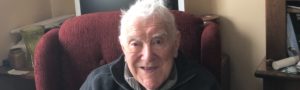
Today, we are going to present a letter Danny wrote in 1969 to Mr. Justice Gardner Budd who was seeking apparently information on the Budd’s of Kilmacow. There were apparently other letters, but they have yet to be uncovered in Danny’s vast collection. Carefully pinned by Danny to a copy of the discovered letter was an obituary for Mr. Justice G. Budd which Danny clipped from the Irish Independent (Tues. 10 Feb. 1976, p. 12). The featured photo above is from that obituary.
The Letter from Glenmore
Below is the letter in full and any additional information has been placed in square brackets. The letter is typed, 2 ½ pages in length on thin paper, measuring 8 inches (20 cm) by 10 inches (25 cm).
Justice Budd, Esq.
73 South Hill
Dartry
Dublin 6
30th May 1969
Dear Mr. Justice Budd,
Thanks very much for your letter of the 1st May which I received but am sorry for the delay in replying which was due to the fact that I was in hospital for three weeks.
The Budd family lived in the townland of Blossomhill, in the parish of Kilmacow Co. Kilkenny, until about the year 1881, when the last male member of the family in the locality left the homestead and went to live for a short time with Mr. William Power, of Christendom, in the parish of Slieverue near Waterford. He was William Joseph Poulter Budd. Whilst with Mr. William Power he became ill and was taken to London by his daughter Florence.
According to a letter from this Miss Florence Budd from London, dated the 30th of October 1881, to Mr. William Power her father had died and was buried in London. In this letter she thanked Mr. Power for his kindness to her father and she also stated that she was leaving her father’s furniture etc. to Mr. Power. This Mr. Budd had no male issue—only two daughters. One was married to an English Army Officer—Colonel Free, and the other daughter Florence to a gentleman named Blake, who was a Deputy Lieutenant for Co. Kilkenny. Mrs. Florence Blake had a son Poulter Charles Blake and they lived in London. According to Mr. Patrick Power, the present owner of the Budd property, two sons of the Blakes are living in Culpeper, Virginia, U.S.A.
The Budd residence at Blossomhill is now in ruins but a fine residence nearby, which the said William Joseph Poulter Budd, built but never actually lived in, still stands. Due to some trouble or other, he never put the finishing touches to this fine house but went to live as already stated with Mr. William Power of Christendom. I enclose herewith photographs which I took of the ruins and the aforesaid house which is now a cattle shed.
[Rev. Joseph Poulter (c. 1738-1789) of Dunkitt]
The Budd family is buried in the old Churchyard at Dunkitt and there is a tomb there with the following inscription which is now almost undecipherable:
“Here lieth the remains of Mary Ann Budd, wife of Tobias Budd of Dunkitt Esq.; who departed this live October 6th 1817, aged 35 years”
This Mary Ann Budd (1781-1817) was the youngest daughter and co-heiress of Rev. Joseph Poulter, Rector of Dunkitt, by his second wife, Margaret, daughter of the Rev. William Dennis D.D. of Waterford, and was born on the 12th of November 1781.
On another monument in the same graveyard is the following inscription:
“Sacred to the memory of Mary, wife of Thomas Lewis Mackesy M.D., a daughter of the Rev. Joseph Poulter, who died 18th October 1818.”
This lady was the eldest daughter of Rev. Joseph Poulter and his wife Margaret Dennis and was born on the 11th June 1776. Mrs. Mary Ann Budd and Mrs. Mary Mackesy (1776-1818) were sisters. The Poulters lived in Dunkitt House which is now occupied by a Mr. Porter. The aforesaid Rev. William Dennis was Rector of Kilculliheen, and he died on the 11th of April 1815 aged 59 years. From what I can ascertain the above Rev. Joseph Poulter had only two daughters in his family, Mrs. Budd and Mrs. Mackesy, and he divided his estate between the two of them. [See generally Wiki Family Tree for Joseph Poulter (c. 1738-1789.]
Attached to the Blossomhill residence of William Joseph Poulter Budd was an estate of about 100 acres at the time of his departure from there. As well as farming he worked a white limestone quarry, situated on the lands. He had about 40 men working for him in this quarry.
[Glenmore Landlords]
As far as the parish of Glenmore is concerned, a Tobias Budd, a minor, owned in 1830 the entire townlands of Flemingstown and Weatherstown. This information is from the Tithe Applotment Books of the old Civil Parish of Kilcoan. According to the same document a Mr. Budd is shown as the occupier of 12 acres and 2 roods in the townland of Flemingstown. Whether or not this Mr. Budd lived there I cannot say. In Griffiths General Valuation or Ireland circa 1850, a Mrs. James Budd is shown as the owner of the entire townland of Ballybraghy containing 160 acres and 2 roods and 32 perches. The family of Mackesy were also extensive landowners in Glenmore Parish. [See our post of 3 March 2025 regarding Glenmore landlord Dr. Mackesy].
As a matter of interest, I will now quote two entries from the Catholic Register of Marriages for Glenmore Parish which is now preserved in the Library of St. Kieran’s College, In Kilkenny:
“14th February 1780. Joyn’d in Wedlock by ye Certificate of Mr. James Budd; Mary Brenon of Ballinlammy unto Rich. Wallice of Mullinahone. Witness ye Rev. James Newman, Mr. James Cody and Mr. Patrick Brennon.”
“12th November 1780. Joyn’d in Wedlock by ye Certificate of Mr. Tobias Budd; Michael Mullally unto Mary Murphy both of Nicholastown. Witnesses Michael O’Naile, James O’Naile and William Murphy.” [During this period landlords sometimes provided certificates to regulate the lives of their tenants, manage their estates by ensuring that unauthorized subletting did not occur, and enforce the moral and behaviour the landlord set.]
With reference to the Budd Estate at Ballybraghy in the old Civil Parish of Kilcoan which is now part of the present Catholic ecclesiastical Parish of Glenmore, I would suggest you look up Record No. S. 4931 in the Records Branch of the Land Commission at 24 Upper Merrison St., Dublin.
Any information which you have on the Budd family and estate would be much appreciated by me as I am collecting material for the history of my area. I would also like to get a copy of said Record No. S.4931 and perhaps you could help me in this as well as copies of any old Estate maps which you may have.
When next you visit the area, please let me know beforehand and I will only be too glad to show you where the Budds lived and are buried etc.
In conclusion, I would like to correct the impression which you possibly got from my previous correspondence. I am not a member of the Garda force but a Health Authority employee—a Health Inspector.
Yours Very Sincerely,
Daniel Dowling.
Mr. Justice Gardner Budd (1904-1976)
Mr. Frederick Gardner Orford Budd was born on 11 April 1904 at Ennis Co. Clare. His father, Samuel Duquid Budd (c. 1864-1934) was employed as a bank manager at the time of his birth. His mother, Fanny Beatrice Orford (c. 1865-1955) was the daughter of Dr. Frederick James Orford of Leicestershire, and she was the second wife of Samuel D. Budd. His parents were married on 12 July 1899 in Surrey, England.
Samuel D. Budd married his first wife, Susan West Stuart (c. 1854-1897) on 30 May 1882 in a Church of Ireland in Galway. His father was recorded as James Budd, a merchant and Susan’s father was John Simson Stuart, a Senior R.I.C. Inspector. Susan West Budd, of Bindon? St., Ennis died on 27 January 1897, of albuminuria at the age of 43. She was the mother of 5 children.
Gardner Budd was educated at the Manor School, Fermoy, Co. Cork; Felsted in England and Trinity College, Dublin. He was a scholar of T.C.D. in history in 1925, the year in which he obtained a B.A. (Mod.) in history in 1925 and political science to be followed two years later with an LLD. He was called to the bar in 1927 and to the Inner Bar in 1940. [He married Oonah Blennerhassett in Sligo in 1931 and the couple had four children.] In 1951 he represented TCD on the university panel in Seanad Eireann. Later that year he was appointed a Judge of the High Court, a position he occupied until 1966 when he was raised to the Supreme Court. He retired from the Supreme Court right before Christmas 1975 and died 9 February 1976 (Irish Examiner, 10 Feb. 1976 p. 14). (For a concise outline of his important decisions see, Pauric J. Dempsey, Dictionary of Irish Biography.)
Waterford City Roots
The obituary of Sanuel D. Budd (c. 1864-1934) (Irish Examiner, Mon. 27 Aug. 1934, p. 4) provides some interesting details regarding Justice Gardner Budd’s Waterford City Roots.
“The death has taken place of Mr. Samuel Duguid Budd, a Waterfordman, who reached a very high position in Irish banking circles. He was son of the late Mr. James Budd, of [Waterford City*], and father of Mr. F. G. O. Budd, the well known barrister on the Waterford circuit. After a distinguished career in the Provincial Bank of Ireland, during which time he was for many years manager in Cork, the late Mr. Samuel Budd became Chief Officer of the bank. He retired from this position [in 1919 per the Southern Star (Sat. 2 Aug. 1930, p. 10)] and, was succeeded by his son-in-law, Mr. D. Bradshaw, the present Chief Officer. The late Mr. Budd was co-opted a member of the Representative Body of the Church of Ireland.” [*per the Munster Express, 31 Aug. 1934, p. 7]
James Budd of Waterford City
Samuel D. Budd (c. 1864-1934) reported in the 1901 Census that he was born in Waterford. Danny in a handwritten note recorded that in the Thomas S. Harvey (1865) Waterford Almanac & Directory for 1866 there were two entries for James Budd in the Directory. The first James Budd was listed as a commercial traveller living on Barker St. A second listing was for James Budd & Company, Guano Merchants on Thomas Street. [Guano was the excrement of seabirds and bats. It was historically prized as a fertilizer and a key ingredient for the production of gunpowder.]
Hopefully further correspondence between Danny and Justice G. Budd is discovered and we shall be able to update this information.
Please send any corrections or additional information to glenmore.history@gmail.com .
Dr. Kathleen Moore Walsh
Glenmore Man Killed 120 Years Ago on the U.S.S. Bennington

Historian, Damian Shiels, on 25 November 2025 posted an interactive map with biographical information and addresses for over 700 people in Ireland who received U.S. pensions. His work is entitled, American Pensioners in Ireland c. 1845-1905. Shiels spent 15 years researching the U.S. pension files. These payments from the U.S. were based on military service rendered between c. 1845 and 1905. About 80 percent of the pensions were the result of participation in the American Civil War.
Many of the pensions were paid to the widows of men who died while serving in the military or to mothers who were dependent on their sons who were killed. Some were paid to the veterans themselves who were wounded or injured while serving. It is a fascinating resource. Thanks to this work, we found a pension made to a Glenmore woman, Mrs. Margaret Quinn, of Rathinure, Glenmore. Her son Michael George Quinn was serving with the U.S. Marines when he died on 21 July 1905 in San Diego harbour. His ship the U.S.S. Bennington’s boiler exploded killing 66 crew (Shiels, 2025).
The 1905 U.S.S. Bennington Disaster
The U.S.S. Bennington (gunboat No. 4) was named for an important battle of the American Revolutionary War fought in Vermont in 1777. She was a 1700-ton gunboat of the Yorktown class. The ship was built at Chester, Pennsylvania, and commissioned in June 1891. Originally the ship served in the Atlantic and Europe, but was transferred to the Pacific in 1894. After the catastrophic boiler explosion on 21 July 1905 the ship was not repaired and sold for scrap in 1910. See the video “Revisiting the U.S.S. Bennington Explosion 120 Years Later” (ABC & San Diego History Center (2025)).
According to the Navy Casualties: Lost and Wrecked Ships, 1801-1941—Explosions 1804-194—Steam Casualties, 1855-1941, on 21 July 1905 when the U.S.S. Bennington exploded 62 service men were killed and 3 officers. “At 10:38 a.m. an explosion occurred in port fireroom compartment of the vessel, listing the ship to starboard. The ship shook violently for several seconds, large volumes of steam and ashes filling most of the living compartments and deck spaces.” A list of the men killed included “Quinn, Michael George, Oiler.”

Contemporary newspaper articles provide graphic details of the condition of some of the bodies found in the engine room. The crew had just finished loading coal and most were in their quarters cleaning up when the boiler exploded. Unfortunately, the crew quarters were over the boilers. The crew killed were buried in Ft. Rosecrans National Cemetery. Quinn was buried in Section Bm site 28. To view his grave see Find-a-grave.
Notwithstanding the 1905 tragedy, the U.S. named an aircraft carrier the U.S.S. Bennington. The aircraft carrier served in the Pacific during World War II. After a refitting the U.S.S. Bennington (aircraft carrier) suffered an explosion in 1954. An old newsreel covering the 1954 disaster revealed that the aircraft carrier also suffered an explosion the year before. Both of these explosions on the aircraft carrier resulted in loss of crew and serious injuries. All three of the Bennington explosions discussed above occurred during peacetime.
Prior to Joining the Marines
According to the concise biography written by Damian Shiels, Michael Quinn was a 29-year-old fireman when he enlisted at Boston, Massachusetts on 24 September 1903. He served aboard U.S.S. Wabash, U.S.S. Cleveland, U.S.S. Straggler, U.S.S. Independence and U.S.S. Bennington. Shiels also noted that Margaret Quinn (née Conway) was 55 when she applied for the pension in 1906. She was married at Glenmore to Thomas Quinn on 28 October 1869. Thomas Quinn died at Glenmore on 10 November 1902. Margaret Quinn (née Conway) died on 5 December 1914 (Shiels, 2025).
Today, it is generally thought that a fireman is a fire fighter. During the age of steam a fireman was the person who maintained the fire needed to produce the steam. Steam engines were used on railways and on ships. Buildings, particularly in cities with cold winters, heated with steam boilers.
The Battle of the Boston Papers

At least two Boston papers printed obituaries of Michael G. Quinn (1874-1905) just three days after his death. It is obvious that the Boston Globe was attempting to locate Quinn family members and published several false statements. For example, the entire Quinn family did not emigrate. There were photos published by each newspaper allegedly of the deceased Michael G. Quinn (1874-1905). The two photographs do not appear to depict the same man. The men do not part their hair on the same side and one has straight hair and the other does not. Given that the Boston Herald actually interviewed the deceased’s brother Patrick Quinn we believe that the photo in the Boston Herald is the correct photo.
Obituary in the Boston Globe (Sun. 23 July 1905, p. 7)
MICHAEL G. QUINN—Bennington victim was a member of Jeffries Point R.A. [Rowing Association], and one of Winning Four at Centennial Grove. Michael G. Quinn one of the victims of Friday’s explosion on the Bennington, was one of the best known young men of East Boston, and one who had figured prominently in athletics.
Quinn was born in the town of Glenmore, County Kilkenny, Ireland, and was 32 years old. At the age of 12 years young Quinn with his parents and brothers and sisters, came to this country and since most of his years had been spent in East Boston.
In September 1903, he enlisted in the U.S. Navy being assigned from the Charlestown Navy Yard to the U.S.S. Cleveland. He served on the Cleveland till April last, when he was transferred to the Bennington. Quinn was a member of Jeffries Point rowing association of East Boston, and two years ago was a member of the four oared crew of the club which won the race at Centennial Grove.
The day before the Boston Globe printed that the deceased Michael G. Quinn had a sister Kate Quinn in East Boston. She formerly lived on Pleasant Street, Winthrop, but she moved to East Boston and could not be located. A brother of was said to live in Somerville (Boston Globe, Sat. 22 July 1905, p. 3).
Obituary in the Boston Herald (Sun. 23 July 1905, p. 4)
Michael G. Quinn, one of the victims of the Bennington disaster, was well known in East Boston, having been a member of the junior four-oared crew of the Jeffries Point Rowing Association which won at Centennial Lake in 1902. His brother, Patrick Quinn, of 88 Marginal Street, East Boston, is a member of the intermediate four of the same association and was to have rowed with that crew in the Metropolitan regatta yesterday, but on receipt of the dispatch from the secretary of the Navy announcing his brother’s death, he retired, and his place was taken by substitute Frank Walsh.
The man killed was born in Waterford, Ireland, about 30 years ago. He came to this country when a lad of 15 years and lived in New York for about a year, when he went to sea finally becoming a member of the British naval reserve. At the break out of the Boer War he volunteered in the Grenadier Guards and served in South Africa under Lord Roberts, taking part in the siege of Kimberly, where although in the thick of the fight, he escaped injury. At the close of his enlistment period, he received a Boer war medal and then returned to this country, making his home with his brother in East Boston. He worked for the Cunard company, and also as a fireman for the Merchants and Miners’ company.
In October 1903, he enlisted in the navy and did duty on board the Wabash, and later at the Brooklyn Navy Yard. Then he was assigned to the Cleveland, when that vessel was accepted by the government, and remained on board her until she was sent to join the European squadron. The last letter his brother received from him came from Florida in April. In it he stated he expected to come north in time to be in Boston for the Fourth of July. Since then he had not been heard from.
His mother and one sister still live in Ireland; a brother lives in Bristol, England; his brother Patrick, as stated, lives in East Boston; a sister Mrs. James Howland, lives at 63 Everett Street, East Boston, and another sister, Nora Quinn, lives in Somerville. [This obituary was also published in the Derry Journal (Wed. 9 Aug. 1905, p. 1) but we were unable to locate it or another obituary in newspapers local to Glenmore.]
The Quinn Families of Rathinure, Glenmore
There were two Quinn brothers, and their families, that resided in Rathinure in the late 19th century. Thomas and Patrick Quinn were sons of Stephen Quinn and his wife Catherine Haberlin. Stephen Quinn and Catherine Haberlin were married on 11 February 1834 at Glenmore. They resided and farmed in Coolnaleen, Glenmore. There were six known children born to this couple: [1] Patrick Quinn (1835-1906); [2] Honor Quinn (b. 1836); [3] Richard Quinn (b. 1839); [4] Mary Quinn (b. 1842); [5] Thomas Quinn (1843-1903); and [6] James Quinn (b. 1846).
Patrick Quinn (1835-1906) of Rathinure, Glenmore
Patrick Quinn (1835-1906) was baptized 16 March 1835 to Stephen Quinn and his wife Catherine Haberlin at Glenmore. Patrick Quinn of Rathanure (sic) married Ellen Tracy of Ballyfacy (sic) on 24 February 1873 at Glenmore. The bride’s father was George Tracy (a smyth (sic)) and her mother was Catherine Conway. George Tracy, of Haggard, married Catherine Conway on 8 February 1843 at Slieverue. Ellen Tracy was baptised at Ballinlammy, Glenmore on 17 March 1847.
Patrick Quinn died at the age of 80 in the Waterford Workhouse Hospital on 29 July 1906 of hemiplegia. In other words, one side of his body was paralyzed. His widow, Ellen Quinn née Tracy (1847-1932) continued to live in their small house until she went to live with a daughter. The small house where Patrick and Ellen lived was to the east of Sean Óg Kennedy’s (c. 1885-1962) house (where Johnny Garvey presently lives). The house in the 1901 Census was described as one room. It was owned by Patrick Quinn. Ellen Quinn née Tracy’s Memory Card is recorded on our Memory Card page.
Children of Patrick Quin and Ellen Tracy of Rathinure, Glenmore
The following children were identified in the parish and civil birth records: [1] Unnamed child (1874); [2] Honor “Nora” Quinn (1875); [3] Stephen Quinn (1876); [4] George Quinn (1878); [5] Catherine Quinn (1880); and [6] Honor Quinn (1883). In the 1911 Census, Ellen Quin née Tracy stated that she had six children and 4 were alive in 1911. Peter Walsh of Rathinure recalls that his mother said that Ellen’s youngest daughter Nora was handicapped and became abusive toward her elderly mother. Nora was placed in a home.
Thomas Quinn (1843-1903) of Rathinure, Glenmore
Thomas Quinn (1843-1903) was baptized on 19 December 1843 at Mullinavat to Stephen Quinn and his wife Catherine Haberlin. Margaret Conway was baptized on 14 July 1843 at Carrigloney the daughter of Michael Conway and Mary Barry. Thomas Quinn (23), of Rathinure, (labourer) married Margaret Conway (22) of Carrigcloney on 28 October 1869. Per the 1901 Census Thomas and Margaret Quinn were renting their 1 room home in Rathinure, Glenmore from John Kennedy. We assume that this was Sean Óg Kennedy (c. 1885-1962).
Children of Thomas Quinn & Margaret Quinn née Conway of Rathinure, Glenmore
[1] Stephen Quinn (bapt 8 May 1871-15 May 1871) Died of convulsions in Carrigcloney
[2] Catherine Quinn (22 July 1872-19 Nov. 1913) emigrated to the US in 1900. She married James M. Howland on 25 July 1904 at Boston. James Howlan was born c. 1876 at Tarrytown, New York, the son of Nicholas Howland and Margaret Cummins. They had a son [2a] George Michael Howland (b. 9 Nov. 1905) just 4 months after her brother Michael was killed. The couple also had two daughters: [2b] Margaret M. Howland (1907-1992) and [2c] Catherine M. Howland (1909-1998). Catherine Howland née Quinn died in 1913 of diabetes. See our H surname page for her short obituary.
[3] Michael Quinn (1874-1905) died in the U.S. Marine Corp on board the U.S.S. Bennington.
[4] Patrick Quinn ( 28 Feb. 1876) emigrated to Boston.
[5] Mary Quinn (b. 15 Feb. 1878) married John Curran (laborer), of Carrigcloney on 28 September 1909 at Glenmore. John was the son of Richard Curran (carpenter). John and Mary had one son [5a] Richard Curran born 13 August 1910.
[6] Stephen Quinn (18 March 1880-5 Feb. 1929) in 1900 married Margaret Dalton of Knockbrack, Glenmore. Margaret was the daughter of Patrick Dalton. The couple had at least 5 children: [6a] Ellen Quinn (1901); [6b] Patrick Quinn (Rathinure); [6c] James Quinn (1908) Knockbrack; [6d] James Quinn (1910) Fahee; and [6e] Johanna Quinn (1913).
[7] James Quinn (bapt. 5 Feb. 1883—22 Aug.1967) emigrated to the U.S. On 28 August 1916 he married Helen Davis (1886-1949) in Detroit, Michigan. His WWI draft Registration (1918) provided that he was 32 years of age, working as a fireman for Detroit Edison, and living at 913 Ellery St., Detroit. He had blue eyes, dark brown hair medium height and medium build. His WWII draft registration showed that he was 56 years of age, born in Waterford and worked for the Detroit Edison Co. He and his wife had six known children. [7a] James Thomas Quinn (1917-1979); [7b] William George Quinn (1919-1998); [7c] Patrick J. Quinn (1922-1994); [7d] Margaret Helen Chaney née Quinn (1924-2022); [7e] Sr. Mary E. Quinn (1925-2008); and [7f] Kathleen C. Quinn (b. 1929).
[8] Thomas Quinn (b. 5 Feb. 1883)
[9] Honor (Nora Theresa) Long née Quinn (30 April 1885—12 Feb. 1957) emigrated 29 July 1903 to Boston via the ship Ivernia. Information gleaned from her Naturalisation Declaration (16 April 1914) provides that she claimed that she was 26 years of age, unmarried, with fair hair, 5’4” tall and weighed 180 pounds. She worked as a cook and lived at 23 Garden St., Cambridge Mass. She gave her birthdate as 1 May 1887. Nora married Alvin Wallace Long (1894-1989) on 1 November 1922, in Detroit Michigan. Nora died in 1957 in Royal Oak, Oakland, Michigan.
Death of Parents
Father, Thomas Quinn (1843-1903) died on 14 November 1903 at the Waterford Union hospital at the age of 60. His cause of death was heart disease and bronchial pneumonia.
Mother, Margaret Quinn (1843-1914) died the 5th of December 1914 at Carrickcloney, aged 71, a widow of a labourer. With no medical attention before her death. John Curran of Carrickcloney was present at her death. The 1911 Census reveals that Margaret was living with her daughter Mary Curran née Quinn and her husband John Curran in Carrickcloney. With Margaret Quinn’s death the pension ended.
**************************
The featured photo of the U.S.S. Bennington was described as “dressed with flags in harbour, probably while serving with the Squadron of Evolution, c. 1891-1892. Courtesy of Donald M. McPherson, 1969. U.S. Naval History and Heritage Command Photograph. Catalog No.: NH 67551.”
The photo of Michael G. Quinn (1874-1905) was published in the Boston Herald (Sun. 23 July 1905, p. 4).
For more information on the U.S.S. Bennington see the webpage entitled U.S.S. Bennington.
Please send any corrections or additional information to glenmore.history@gmail.com
Dr. Kathleen Moore Walsh
November Updates
As 2025 draws to a close–and we acknowledge our sixth anniversary–we wanted to take a few minutes to reflect on how much we have grown since our beginning. This history blog has generated:
Views–331,735
Visitors–125,045
Posts–442
We continue to slowly read, transcribe and archive Danny Dowling’s (1927-2021) vast collection. This past year we answered several dozen queries and settled a bet. We had the pleasure of meeting with visitors. We teamed up with Glenmore Tidy Towns to post 5 gold historical markers around the parish and more recently conducted a walking tour of Glenmore Village. Everyone we have contacted seeking information has been very helpful. We are always looking for ideas for new posts and guest authors. So please send on any ideas you may have.
We have been adding family information to the various surname pages. These pages contain entries from Danny Dowling’s (1927-2021) notebooks and notes, newspaper notices and articles as well as obituaries. Married women are generally listed under their married names with maiden names provided where known.
On our “Lists” page we added yesterday a 1837 Glenmore Subscribers’ List. This was a published list of locals (unfortunately without townlands). In addition to the names (which incidentally included two women) the amount that was donated was recorded. The “subscription” was to support the work of Daniel O’Connell (1775-1847). There are some local extinct names (e.g. Gaffney) and names that still flourish 188 years later in the parish such as Roche, Doherty and Aylward.

Lastly, the lovely wedding photo of Michael Walsh (Haggard) and Margaret Roche (Coolnaleen) is to the right. (Left to Right) John Roche (seated); Michael Walsh (standing); Margaret Walsh née Roche; Mary Dowling née Grace and Fr. John Grace.
Thanks to Tom Roche for sharing the photo of his aunt’s wedding. It has been added to our post of 26 October 2025 regarding the groom’s father Michael “the Mason” Walsh (1874-1948). The family were known locally as “the Mhicils, pronounced Vickles.”
We are still seeking a photo of Fr. Willie Brennan if anyone has one they would share.
If you have any suggestions or photos you would like to share please contact us at glenmore.history@gmail.com
Thank you for your support and looking forward to the coming year.
Dr. Kathleen Moore Walsh
From Danny’s Files: “The Land Grabbers”

While sorting through some of Danny’s vast collection yesterday, I came across the lyrics of a song published in the Kilkenny Journal on Christmas Day 1880. The title of the song is “The Land Grabbers” and it is was sung to the “King O’Toole” air.
When the Land League formed it was determined that in order to put pressure on landlords pressure would be placed also on people not to move into the property where the eviction occurred. It was hoped that if the property was idle a settlement between the evicted tenant and landlord would be reached, and the tenant returned to the property.
If a person moved onto the property he would be identified by the local chapter of the Land League as a “land grabber.” In several local cases houses and farms were idle for three or more years because no one was willing to take up the property for fear of being labelled a “land grabber.” Thus, landlords who believed that they could evict and find a better tenant or secure more rent were risking the property sitting idle for years.
Contemporary newspapers accounts reveal that the “land grabber” when spotted in a town or village would be followed by one or more persons ringing bells to attract attention. People would not deal with a land grabber. For example, merchants and publicans would refuse to sell anything to a land grabber and likewise the land grabber’s cattle, pigs and crops would not be bought on market days. A person who dealt with a land grabber risked the wrath of the members of the Land League and its supporters. (For a concise history of the era see, Joe Pellegrino, Irish History Since 1850.)
Glenmore Branch of the Land League
The Glenmore Branch of the Land League was formed in October 1880. Father Michael Cody, a native of Carrickcloney, Glenmore, and the Curate of Mullinavat, was arrested in December 1880 for making “threats” to a Land Grabber in Mullinavat. Shortly thereafter these lyrics were published in the Dublin Weekly News on Sat., 18 Dec. 1880 (p. 5) and in the Kilkenny Journal on Christmas Day.
See our post of 8 March 2020 regarding the Glenmore Land League and the Ballyfacey Evictions
See also our post of 14 June 2020, Creative Boycotting in Late 19th Century Ireland.
The Land Grabber Verse
“The Land Grabbers” (Air—King O’Toole)
Ring the Bell! Ring the Bell; Ring it up and down!
Ding-a-dong! Ding-a-dong; a Grabber is in town!
His goods are in the market, but there we’ll let them lie,
He’ll have to take them home again, for nobody will buy.
Dong-a-dong! Ding-a-dong! Rattle well the bell;
The Grabber wants to buy things; but nobody will sell,
For his silver or his coppers, no matter how they clink,
He cannot get a bit to eat, or get a drop to drink.
Ring the bell! Ring the bell! What will the Grabber do?
For riding on the highway his horse has lost a shoe,
But not a single blacksmith can anywhere be found,
To hammer in a nail for him, in all the country round.
Ding-a-dong! Ding-a-dong! His servants will not stay,
The men have all deserted him—the women ran away,
He has to make his beds, and wash his bits of delft,
And when he wants his dinner, he must cook it for himself.
Ring the Bell! Ring the Bell!—The landlord oft is bad,
The agent and his bailiffs are enough to drive one mad,
But of all the hateful robbers by whom our land is curst,
Since Cromwell came to plunder us, the grabber is the worst,
In the Nation.
Please send any corrections or further information to glenmore.history@gmail.com
Dr. Kathleen Moore Walsh
Second Glenmore Gold Sign

Glenmore History in partnership with Glenmore Tidy Towns posted a few Glenmore historical signs around the village and parish earlier this spring and summer. Today, we are going to feature the Glenmore Gold Sign posted at the Glenmore barracks at the gate. This building has a long and interesting history in the village.
The Glenmore Barrack Sign
For those who can not easily visit the village to review the sign here are the contents of the sign.
“This building served as a Royal Irish Constabulary (RIC) Barracks until the Irish Free State was established. Danny Dowling (1927-2021), Glenmore’s eminent historian, recorded that an older RIC Barracks was established in the field behind the present pub sometime after 1822 and the building of the current building.”
“During the War of Independence this building was abandoned by the RIC and burned by Company C the ‘Glenmore Company’ of the 6th Battalion of the Kilkenny Brigade of the old Irish Republican Army. After the establishment of the Irish Free State the building was purchased from the Earl of Bessborough and repaired. For a couple of Years the Civil Guardians operated out of a house in Weatherstown. This building re-opened in 1925 and continued as a Garda Siochana station until c. 1995 when it was reduced to an administrative office that opened a couple days a week.”
For further information–
See our post of 11 April 2020 for a history of the barracks including the burning of it during the War of Independence.
See our post of 26 September 2021 for the rebuilding of the barracks and use of it by the Garda Siochana.
Please send any corrections or further information to glenmore.history@gmail.com .
Dr. Kathleen Moore Walsh
Photos from Peoria, Illinois of a Glenmore Native
In our post of the 26th of August 2024 we featured Monsignor Patrick O.’C. Culleton (1877-1960) a native of Kilbride, Glenmore.
Today we have three new photos of Msgr. Culleton. Special thanks to Patrick Kelly who shared these photos with us. In 1950 Msgr. Culleton was celebrating the golden jubilee of his ordination.


We will be adding these photos to the original post thanks to Patrick Kelly sharing these photos. If you have any photos of Glenmore natives please send them to glenmore.history@gmail.com where they will be preserved.
Dr. Kathleen Moore Walsh