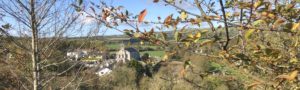
Ballynaraha Glenmore
now browsing by tag
Poet Peter Brophy (1871-1951) a Native of Ballynaraha, Glenmore

A poem entitled “The Rose of Glenmore” was read out at Mary Aylward’s (née Heffernan) funeral earlier this year. We obtained a copy from her daughter-in-law Joan Aylward (née Doherty) and on the copy it was noted that the poem was composed by a grand-uncle of the present Brophy family of Ballynaraha, Glenmore. We visited Michael Brophy and his sister Ann Brophy who indicated that their great-uncle Peter Brophy wrote poetry and lyrics to songs. He worked for a time for the Nightingale newspaper. (See our post of 28 April 2024 regarding the Nightingale publication).
Peter Brophy also worked for the Dunphy Mill in Deerpark, Mullinavat, where the present owner, John Dunphy has several of Peter’s poems on display. John Dunphy listened to a recording of Edward “Ned” Brophy (1924-1996) (Michael and Ann’s father) reciting his uncle’s poems, and John Dunphy wrote out the poems. For further information on the historic Dunphy Deerpark Mill see our post of 13 July 2026. Peter Brophy also wrote “Charlie Linegar’s Ball,” and other poems available on our Guest Author’s page of local verses collected by Dick Claridge.
Unfortunately, it is not known when Peter Brophy authored his many poems, but the titles of some of his poems include: [1] “The Rose of Glenmore,” [2] “Charlie Linegar’s Ball,” [3] The Famous Buckstown Trap,” [4] “The Ship that Sailed from Mullinavat,” [5] “Landmarks of Olden Days,” [6] “Hills of Mullinahone,” [7] “Jack Jepson and His Ass,” [8] “Eucharistic Congress Dublin 1932,” [8] “Mount Mellary,” [9] “The Famous Chicken Gang,” [10] “The Half Past Nine,” [11] “The Slopes of Tory Hill,” and [12] “The Cross on Tory Hill.”
These poems are important as they record local events, people and areas. Today, we are going to feature two of Peter Brophy’s poems, “The Rose of Glenmore,” and “The Famous Buckstown Trap” which celebrates a rat trap made by Richard Dunphy.
The Rose of Glenmore
Some cherish the lakes of Kilarney,
And others Avoca’s green vale,
Give me the home of my childhood,
The fairest around Inis Fáil.
I often hear poets sing the praises
of the beautiful Suir and the Nore,
But where there’s a river could equal,
The Barrow that flows through Glenmore.
The linnet and thrush you’ll hear warbling,
The lark every morning will soar,
Along o’er the banks of the Barrow,
And the green groves surrounding Glenmore.
I have sailed up the Barrow for many a mile,
I have met many friends from New Ross and Campile,
Where the fair sex are pretty along the Wexford shore,
But none could compare to the Rose of Glenmore.
On the banks of the Barrow every evening we’d stroll,
To see the ships pass and hear the ships’ carol,
And pluck the wild bluebells every summertime poured,
Their sweet, scented fragrance on the banks of Glenmore.
But to my old darling I must bid adieu.
It breaks my heart to be parting from you.
Since fate have decreed that I should be tore,
Away from my home and the Rose of Glenmore.
Now Katie I ask one last token,
You’ll promise for me you won’t weep,
But say that you’ll think of me sometimes
If only in dreams through your sleep.
For your sake the high seas I will furrow,
and hope to gain riches in store,
Then I’ll build on the banks of the Barrow,
A home for the Rose of Glenmore.

The Famous Buckstown Trap
We hear about inventions of the Russian’s and the Jap,
But we hear very little of the famous Buckstown Trap.
With the aid of angle grinders and bits of this and that,
By the time the job was finished, all he wanted was the rat.
But the rat will come in his own time and much to his regret,
We must give it up to Dunphy as the best invention yet.
It’s a wonderful invention, yet as good as can be seen,
They claim it is much better than the Singer sewing machine
It consists of wire and metal and bits of iron bars,
Complete with chrome finish and parts of motor cars.
To set this trap is simple; you can set it at your ease,
With Mitchelstown or Three Counties or any type of cheese.
Now if you are interested in any kind of trap,
Support home industry and forget about the Jap.
Now if you are in trouble with mink, mouse or rat,
Just contact Richard Dunphy of Deerpark, Mullinavat.
Peter Brophy (1871-1951) Native of Ballynaraha, Glenmore
Peter Brophy was baptized 16 Oct. 1871 at Ballynaraha, Glenmore to James Brophy (1840-1910) and his wife Mary Barron (c. 1846-1915). His parents were married at Glenmore on 3 May 1869.
Peter Brophy’s Grandparents
When Peter’s parents were married in 1869 his mother Mary Barron (c. 1846-1915) was from Graiguenakill, Glenmore. She was the daughter of James Barron (deceased labourer). Peter Brophy’s father was James Brophy of Ballynaraha, Glenmore. James Brophy was the son of Peter Brophy (tailor) (c. 1805 -1872) and his wife Bridget Sutton.
Children of James Brophy (1840-1910) and Mary Barron (c. 1846-1915)
[1] Margaret Brophy (b. 11 Oct. 1869)
[2] Peter Brophy (bapt. 16 Oct. 1871)
[3] Michael Brophy (b. 20 Dec. 1873). Michael Brophy (1873-1960) married Mary Phelan (1885-1961) at Mullinavat in 1916. Mary was the daughter of Edmund Phelan (labourer) of Bigwood, Mullinavat. Their witnesses were Peter Brophy and Kate Dollard. Their son Edward “Ned” Brophy (1924-1996) was employed at Murphy Motors, Glenmore and recorded his uncle Peter’s poems.
[4] Thomas Brophy (b. 25 Dec. 1875)
[5] John Brophy (b. 1 June 1878)
[6] James Brophy (b. 16 Feb. 1882)
[7] Patrick Brophy (b. 20 Aug. 1884) married in Waterford 23 Feb. 1933. Per his obit (Munster Express, Fri. 31 Jan. 1947, p. 8) he was a member of the R.I.C. until 1921 and retired. He then went to work for Strangman’s Brewery of Waterford.
[8] William Brophy (b. 18 July 1887)
[9] Richard Brophy (b. 10 Feb. 1892)
Marriage and Family
Peter Brophy was still living at home in Ballynaraha, Glenmore in the 1901 Census. He reported his age as 27 and was employed as a servant. His father, James Brophy was 60 and employed as an agricultural labourer. His mother, Mary Brophy (née Barron) was 59. Four of his brothers were also living at home including: John (21); James (19); Patrick (17) and William (14). William was still at school. All the other brothers except James were employed as servants. James was employed as an agricultural labourer.
By the 1911 Census Peter was employed at the Dunphy Mill at Deerpark, Mullinavat. He was living with a farmer and his wife in Killahy, Mullinavat. On 15 October 1917, he married Johanna Watters (b.c. 1887) at Mullinavat. He gave his address as Deerpark, Mullinavat. Johanna’s address was Ballintlea, Mullinavat. Her father was Thomas Watters (labourer). When Peter Brophy married he gave his occupation as labourer, and he was 46 years of age.
Known Children of Peter Brophy (1871-1951)
[1] Mary Brophy was born 24 Feb. 1918 at Ballynooney, Mullinavat. Mary married Edward Lannon, Ballycarron, Ballyraggett in Mullinavat on 23 April 1951 per the baptismal record. In fact, the couple were married 23 April 1941. The bride was a resident of Buckstown at the time of her marriage. At the time of her marriage Mary was residing in Kilkenny City (Munster Express, Fri. 2 May 1941, p. 8).
[2] James Brophy was baptized 24 Feb. 1919 and died 29 March 1919.
[3] Margaret Brophy was born 31 Dec. 1920 at Buckstown. Margaret Brophy married Richard Nugent in Cappoquin on 28 Sept. 1949.
[4] John Brophy was born 24 June 1922 at Buckstown.
[5] Johanna Brophy was born 24 May 1924 at Buckstown
The family in 1926 was living in Inchcarran, Killea, Mullinavat per the 1926 Census.
Death
Peter Brophy died 28 June 1951 at Buckstown, Mullinavat. He was 79, and his profession was listed as labourer. His son John Brophy was present at his death. A newspaper search did not find any articles concerning Peter Brophy or his poems. We are hopeful that readers may be able to provide more information concerning Peter Brophy and his poems.
Please send any corrections, additional information or photos to glenmore.history@gmail.com
We do not know what the Buckstown Trap looked like, but we were able to find a photo of an antique rat trap.
Special thanks to Michael Brophy; Ann Brophy; Joan Aylward (née Doherty); and John Dunphy for their help and information.
Dr. Kathleen Moore Walsh
BALLYNARAHA, GLENMORE (1961) [Update]

Today, we are going to feature information that Danny Dowling (1927-2021) recorded regarding the residents of the townland of Ballynaraha, Glenmore around 1961. Over the years various spellings of this townland have been used, but the two most popular are Ballynaraha or Ballinaraha. The Irish for this townland, according to O’Kelly’s, The Place Names of the County of Ireland (1969, p. 115) is Baile na ratha, or place of the rath. The townland is in the old civil parish of Kilmkevogue and is comprised of 290 acres. The townland is named from the rath and fields are bán riach, a grey bawn; bantá sceachán, the whitethorn bawns.
Tithe Applotment Books 1833
According to the 1833 Applotment Books, the owner of the townland was the Earl of Bessborough. There is a notation in the Applotment Book that Mr. John Walsh “as middle man has let to these tenants, he having the original lease from the Earl of Bessborough.” There were eleven tenants listed including [1] Patrick Sutton, 2 acres; [2] Martin Sutton, 13 acres; [3] John Power, 12 acres; [4] Michael Irish, 31 acres; [5] Patrick Kelly, 17 acres; [6] Thomas Reddy, 17 acres; [7] Patrick Forristal, 17 acres; [8] James Dughan, 8 acres; [9] Richard Dughan, 18 acres; and [10] Fitzgerald & [11] Dooling? 18 acres. [No first names were provided for Fitzgerald and Dooling.
1961
In 1961, Danny recorded 5 families or households in Ballynaraha. Birthdates or birth years are provided for some of the older residents gleaned from available public records. For some time after drafting his notebook, Danny recorded the dates of death or simply recorded that a resident had died or left the townland. The recorded information reveals that in 1961, 12 people resided in Ballynaraha with the population comprised of 6 males and 6 females. The largest family was the Forristal family with 5 in the household. There is one household recorded with a person living alone which was Edward Roche (b. 1905). All information regarding residents of Ballynaraha, not in Danny’s original list, has been placed in brackets[ ].
Recorded Residents
Males= 6
Females= 6
Eldest Recorded Resident
The eldest resident recorded in the townland was Bridget Forristal née Reddy (1884-1969) who was 78 in 1961. Bridget was a native of Gaulestown, Glenmore, the daughter of James Reddy (farmer) and his wife, Johanna Grant. The birth register records Bridget’s birth at Ballinaraha (sic).
On 11 February 1918 Bridget married John Forristal (farmer) of Ballynaraha and her place of residence was listed as Gaulestown, Glenmore. John Forristal (1879-1961) was the son of Patrick Forristal and his wife Mary Phelan. John died, aged 81 on 29 January 1961, and his unmarried brother Edmund died on the 23rd of November 1960, aged 78.

Recorded Work
Farmer = 4 (3 males; 1 female)
Farm labourer = 1 (1 male)
Council Worker = 1 (1 male)
Garage Storeman= 1 (1 male)
BALLYNARAHA RESIDENTS
[1] AYLWARD
Aylward, James (10 April 1904) Farmer
Aylward, Mary (20 April 1909) wife (née Grant)
[2] KNOX
Knox, Patrick (11 March 1913) Farmer
Knox, Margaret (12 April 1896) wife
[3] FORRISTAL
Forristal, Bridget (27 April 1884) Farmer [died 19 Nov. 1969]
Forristal, Patrick, son, assisting relative
Forristal, Mary, daughter
Forristal, Kate, daughter
Forristal, Bridget, daughter
[4] BROPHY
Brophy, James, Council Worker
Brophy, Edward, brother, garage storeman
[5] ROCHE
Roche, Edward (1 June 1905) Farmer
See our blog post of 18 April 2020 regarding Ballynarha native Laurence Duggan (1832-1905) who returned to visit Glenmore decades after emigratig to the US. On his holiday Laurence was tragically drowned in Waterford City.
[Update–One helpful reader stated that a person from the Forristal Ballyranaha family was due to sail on the Titanic in April 1912, but for whatever reason did not. The 1911 Census shows that there were 5 in the Forristal household. Mary Forristal was 68; John Forristal was 32; Patrick Forristal was 31; Edmund Forristal was 28 and James Forristal was 24. This information was once common knowledge in the parish and discussed for years.]
Please send any corrections or additional information to glenmorehstory@gmail.com.
Dr. Kathleen Moore Walsh