Richard “Dick” Dunphy (1878-1908)
now browsing by tag
From Danny’s Files: A 1924 Letter from a Glenmore Native Who Emigrated to New York

In Danny’s voluminous files, stuck between various political documents in an envelope with the name Dunphy on it, was a handwritten 3 page letter dated 23 October 1924. The letter was written four days after the author arrived in New York harbour. It was written in pencil on lined writing paper (9 inches/23 cm by 6 inches/15 cm). Although the writing has faded it is still legible. This 102-year-old letter is of immense importance because it gives a glimpse into emigration after the end of the Irish Civil War by a member of the Glenmore Co. of the old IRA. See our list of members of the Glenmore Co. of the old IRA which reflects that 15 of the 57 local men listed, or 26%, emigrated to the US after the Irish War of Independence.
The Author: William Purcell (1893-1944) of Weatherstown, Glenmore
The author of the letter was William Purcell (1893-1944) of Weatherstown, Glenmore. He was the son of Edmund Purcell (c. 1862-1924) and his wife, Mary Cashin (1866-1943). Edmund Purcell married Mary Cassion (sic) on 4 October 1887 at Glenmore. Mary Cashin (1866-1943) was a native of Weatherstown. Her father, Thomas Cashin was a shoemaker and her mother was Ellen Malone. Edmund/Edward Purcell and Mary Cashin had a large family. In the 1911 Census they reported that they had been married for 24 years and had 11 children but only 9 were living in 1911. Of the 9 children who reached adulthood, 8 of the children emigrated to New York (or 89% of the Purcell children.)
The known Purcell children include:
[1] Edmund/Edward Purcell (1887-1947) Emigrated to US. In 1930 working on the subway.
[2] Thomas Purcell (1889-1950) In the Civil Records his name was recorded as Mary. Emigrated to US in 1926 a few weeks after the Free State Census. In 1930 was working on the subway.
[3] Johanna Purcell (1891-1960) in 1912 married Patrick O’Rourke of Weatherstown and remained in Weatherstown.
[4] James Purcell (1893-1957) Emigrated to US in 1922.
[5] William Purcell (1893-1944) Emigrated to US. Never married. In 1930 working as labourer for a construction company.
[6] Ellen Purcell (1896-1942) Emigrated to US. Never Married.
[7] Richard Purcell (1898-1898) Died twelve days after birth.
[8] Mary Purcell (1899-1902) Died aged 2 ½
[9] John/Sean Purcell (1902-1975) Emigrated to US.
[10] Catherine/Katie Purcell (1904-1976) Emigrated to the US. Married another emigrant Heinrich Sellenies (1907-1970) a seaman. In his WWII draft registration Heinrich noted his wife Katherine worked at Standard Oil Co. of New Jersey at 30 Rockfeller Plaza NY.
[11] Patrick Purcell (1908-1976) Emigrated to US.
See our post of 13 June 2022 regarding the tragic death of Hannah O’Rourke née Purcell in 1960.
Volunteer in the Old IRA
William Purcell, and his two brothers Edward and Thomas, were in the Glenmore Co. of the old IRA during the Irish War of Independence. Their former officers put together a list of the volunteers in the Glenmore Company. In 1935, all three brothers were listed as living at 364 St. Ann’s Avenue in New York City. For a brief account by Michael Heffernan of “Bill” Purcell running and evading the Black and Tans, see our post of 7 July 2025.
Emigration
William’s father, Edward Purcell, died 28 August 1924 of an obstruction of the bowel. He was 56 years of age. His son Sean was present at his death. William Purcell, about six weeks later, departed Cobh, Ireland on board the Adriatic, and arrived at New York on 19 October 1924. William had $23 in his possession and gave the authorities his father Edward as his contact person in old country notwithstanding the fact his father was deceased. The person he listed in the US was his brother James Purcell, of 446 W. 27th St., New York, who emigrated to the US in 1922. William was described in the ship list as being 5’ 6” tall with a fresh complexion, brown hair and blue eyes.
The 1924 Letter Home to Glenmore
Information not contained in the original letter has been placed in square brackets [ ].
446 W. 27th St.
New York City
23 October 1924
Dear John
Just a few lines hoping to find you and all at home in good health as the posting of this leaves me in best. We got a lovely voyage. I arrived here on Sunday afternoon on 19th October. We were kept on the ship until Monday morning then we were brought to Ellis Island on a tender. Ellis Island is only a short distance from the docks in New York at the Jersey City side. We were not kept there very long, three hours or so, just while we
Page 2
were being examined. They were not very strict about the examination. We were examined on the ship by the American doctor on Sunday before we landed, he came out on a tender to meet the ship. What you hear about the Ellis Island is only lies we were treated there as good as could be expected. It is only a matter of form going there atall (sic).
I met Michael Hanrahan here, he is very old looking. He told me that he was bringing some of the footballers out. This is a wonderful place here, the traffic is something terrible, you could scarcely walk the footpath with people, Jimmie [assume this is his twin brother James Purcell] is going well here. He was inquiring about you and your mother. I will be at work in a couple of days. I will be able to tell you more in my next letter about New York. Hoping to hear from you soon, remember me to all in Ballyverneen.
From your old friend,
W. Purcell
[Michael Hanrahan (1888-1968) was a brother to Pat Hanrahan, Glenmore Shop and Jimmy Hanrahan, New Ross; both were officers in the Glenmore Co. of the old IRA. For information on Michael Hanrahan and the GAA in New York see our post of 28 Nov. 2020.]
Later Years in New York
William in 1925 filed an Intention Declaration to seek US citizenship. In 1930 he petitioned to be Naturalised and his petition was granted in 1931. One of his witnesses for Naturalisation was Michael Hanrahan, of 2342 102nd St., E. Elmhurst, New York, and formerly of Glenmore. William was issued a Social Security card in October 1939. Social Security was established in 1935 and began issuing cards in 1936. The first withholdings for the Social Security tax took place in January 1937. For further information concerning Michael Hanrahan (1888-1968) and his brothers see our post of 6 Dec. 2020.

After World War II commenced William registered for the Draft in 1942. At the time he was employed at and living at the Willard Parker Hospital on East 15th St. and East River, in Manhattan. He was 48, and listed his twin brother James Purcell of Flushing, New York, as his next of kin. He was employed as a porter at the hospital. His supervisor was Mr. Horton, the foreman of the porters.
William Purcell died aged 49 on 3 March 1944 at the Willard Parker Hospital, Manhattan. His death was the result of a fractured skull and ribs, and intracranial injury. He was buried on 7 March 1944 at Gates of Heaven Cemetery.
The Glenmore Letter Recipient
There are several clues that support the view that John Dunphy was the recipient of the letter. First, the letter was in an envelope of documents relating to the Dunphy family of Ballyverneen. Secondly, “Jimmy” inquired about John and his mother. Below we will highlight the tragic life of John Dunphy’s mother. Lastly, “remember me to all in Ballyverneen” suggests that the recipient resided in Ballyverneen.
John Dunphy (1880-1956) of Ballyverneen, Glenmore
Background
John Dunphy was the younger son of James Dunphy (1857-1887) of Ballyverneen and his wife Ellen Malone (1857-1941) of Weatherstown, Glenmore. Ellen Dunphy née Malone (1857-1941) married James Dunphy (1857-1887) at Glenmore on 9 May 1877. The groom was the son of Richard Dunphy (farmer) and the bride was the daughter of James Malone (farmer) and his wife Anastatia Kennedy.
According to Nicky “the Miller Forristal” Ellen Malone was 18 when she married and was widowed at 21. (DD Notebook 8, Interview 17 Nov. 1974). Uncharacteristically, Nicky the Miller was off by a few years. James Dunphy died ten years after he was married, thus Ellen was 30 years old when she was widowed.
Ellen’s son, Richard Dunphy (1878-1908) was on the 1906 Glenmore Football Team that won the Co. Kilkenny Championship. In 1908 he died of acute atrophy of the liver. He worked for Customs & Excise. See our post of 23 June 2025 for the obituary of Richard “Dick” Dunphy (1878-1908). See our post of 30 August 2020 regarding the 1906 Glenmore Football County Champions. After Richard’s death in 1908 the household was comprised of Ellen Dunphy née Malone and her youngest son, John Dunphy.
Marriage and Family
John Dunphy (1880-1956) (who we believe received William Purcell’s letter) was also a prominent Glenmore footballer and later became the chairman of the GAA Kilkenny County Board. John Dunphy lived in the home place in Ballyverneen, Glenmore. He married Ellen Forristal (1898-1983) also of Ballyverneen on 20 October 1926 at Glenmore. The bride’s father was Thomas Forristal (farmer). John Dunphy and his wife, Ellen Dunphy née Forristal, had four children.
[1] Seamus Dunphy (1927 -2015)
[2] Margaret “Maudie” Dunphy worked as a bookkeeper at the Glenmore Creamery. ;
[3] Mary “May” Dunphy (c. 1932-2018)
[4] Richard Dunphy
Ellen Dunphy née Malone died in 1941 after suffering a burn. Her son, John Dunphy died in 1956 of gastric cancer. It is not known how long John Dunphy (1880-1956) and William Purcell (1893-1944) corresponded, but we hope other letters may surface as we continue through Danny Dowling’s voluminous files.
Although both families descended from Malone families from Weatherstown there was no apparent link, but time today did not permit further research.
Please send any corrections, additional information or photos to glenmore.history@gmail.com .
Dr. Kathleen Moore Walsh
Special thanks to Ann O’Rourke for her assistance with the Purcell family.
The featured photo above is of Ellis Island courtesy of The New York Public Library Digital Collection, of The Miriam and Ira D. Wallach Division of Art, Prints and Photographs: Photography Collection, The New York Public Library. “Immigrant Station, Ellis Island, with ferry docked at adjacent pier.” New York Public Library Digital Collections. Accessed June 19, 2026. https://digitalcollections.nypl.org/items/2d10a530-c6da-012f-2f4a-58d385a7bc34
The photo of the Willard Parker Hospotal is also courtesy of the New York Public Library Digital Collection of The Miriam and Ira D. Wallach Division of Art, Prints and Photographs: Picture Collection, The New York Public Library. “The Willard Parker Hospital” New York Public Library Digital Collections. Accessed June 19, 2026. https://digitalcollections.nypl.org/items/c437ab60-c55d-012f-83c4-58d385a7bc34
From Danny’s Files: The Obituary of Richard “Dick” Dunphy (1878-1908)

Today, we feature a young Glenmore man whose untimely death resulted in a long, passionate, and detailed obituary in the Munster Express. This long obituary was found in Danny Dowling’s (1927-2021) large collection of obituaries of Glenmore people. The obituary is below in italics. The sub-headings were added and did not appear in the original published obituary.
Background
Richard Dunphy was born on the 26th of March 1878 in Ballyverneen, Glenmore. He was baptized the following day and his parents were James Dunphy (farmer) (1857-1887) and his wife Ellen Malone (1857-1941). James Dunphy of Ballyverneen married Ellen Malone, of Weatherstown, on 9 May 1877 at Glenmore. The groom was the son of Richard Dunphy (farmer) and the bride was the daughter of James Malone (farmer). Another child, John Dunphy (1880-1956) was born on 22 February 1880 to James Dunphy and his wife, Ellen Malone.
James Dunphy (1857-1887) died of pleurisy on 20 February 1887. He was a farmer, and his 10 year old son, Richard Dunphy, was listed in the death register as being present at his death. His, wife, Ellen Dunphy née Malone (1857-1941) died on 1 July 1941 of shock after suffering a burn. She was 85 years of age at the time of her death per the death register. Her son John Dunphy was present at her death. Richard “Dick” Dunphy (1878-1908) died on the first of April 1908 at his home in Ballyverneen, Glenmore, of acute atrophy of the liver. His brother, John Dunphy, was present at his death.
The Obituary
Richard Dunphy’s obituary appeared in the Munster Express (Fri. 18 April 1908, p. 2 ). It is extremely long and appears to have been written by a friend rather than the newspaper.
The Late Mr. Richard Dunphy, Glenmore: A Companion’s Appreciation
“Invidious grave! How dost thou rend in sunder
Whom love has knit and sympathy made one.”
A great gloom hangs heavily on Glenmore. A grand personality has ceased to exist and brighten the big glen. A young, noble, and cheerful heart has ceased to share our joys. The lights have been extinguished from the kindest, merriest eyes. The able scholar, the shapely athlete, the brilliant conversationalist, the big faithful heart, the soul of honour, the tongue of truth, lies among the quiet dead. Glenmore weeps–the glen he loved so well, the people he delighted so often. There is a mournful sadness over all things in his native parish, for our absent one loved the hills and the fields and the flowers. All mourn for him now, for there is none so beautiful to take his place.
It was necessary to spend but one hour in Mr. Dunphy’s company to discover his wonderful abilities and virtues. It was immaterial what topic was discussed–he was the master. The subject may be a subtle theological one; it may be a disputed fact in history; it may be on the drama, a social problem, or a political question; or perhaps on the fine point of a football contest–all were easily and efficiently diagnosed by “Dick.” One marvels at the great memory, the extensive reading, and the vast experience which generated such varied knowledge.
Enjoyed a Good Yarn
He had ever at hand a large supply of the most interesting antidotes, which he told with such with such expression and humour that the dullest loved to hear him. How often we “held our sides” when he passed witty remark or told what he liked to term a good “yarn.” Few possessed to such a degree the power power of creating around him an atmosphere of good cheer and happiness. His bright, happy, easy manner became reflected on all around him, and all were happy.
Unlike many other brilliant conversationalists, he was never offensive but always edifying. His views on all questions ever bespoke an honourable and virtuous soul; his “yarns” ever portrayed intelligent wit and modest simplicity. Seldom have intelligence, wit, virtue and simplicity been so happily blended in one man. He was just the personality we wanted, and his loss is an irreparable one to society.
Love of Glenmore
Our dear departed one loved the place of his birth in an uncommon degree. Nothing could give him greater delight then to spend a holiday roaming round the hills and dales of his native Glenmore. How we shall miss that bright cheering smile, that gay, lightsome, athletic form swinging along over the roads and through the fields.
As himself would say–he loved the simple life. Simplicity in every form attended him, simplicity in amusement (I saw him recently enjoying a game of marbles)–simplicity in manner, simplicity in all things. This is all the more remarkable when we remember his duties as an Excise Officer brought him in touch with many pretentious people and cities in the United Kingdom. He always came back to us the same happy-going, modest, merry soul.
Glenmore Football
His prowess in the football field is known in many an Irish county, but nowhere so well as his native parish. Where ever he happened to be stationed he sought the best Gaelic Club , and immediately became its guide, philosopher, and friend. When the Glenmore Football Club needed help he was home like a streak of lightening. He several times travelled home from England to help the Glenmore boys win the 1906 Championship. He was our guiding star and our idol. It was a sad moment when the captain placed a beautiful wreath on his grave.
Education
The late Mr. Dunphy sowed the first seeds of his learning and great virtue in Glenmore National School, where he was the delight of his teacher Mr. Curran.He next spent some years in Good Counsel College, New Ross. Here his exceptional abilities marked him for many favours. He graduated to Blackrock College, Dublin, where he had a distinguished course. Deciding to become a Civil Servant he next entered the Civil Service Institute, Dublin, where after a few months special tuition he secured fourth place in the dUnited Kingdom at the Excise examinations in 1899. He had recently been promoted to Second Class Officer of Excise in Kilkenny.
Last Illness
Not feeling well for some time past he returned home, and after a few weeks’ illness he died most happily. The last Sacraments were administered by the Rev. Father Crotty, C.C. whose zeal for his spiritual welfare, both before and after death, could not be greater. Deceased was interred on Friday, the 3rd of April and the funeral was of Immense proportions. Requiem Office and High Mass were celebrated for the repose of his soul.
Often in future years when discussing the incidents of our career, out thought will revert to that green spot in Glenmore Cemetery, beneath which lies the truest and noblest comrade we have ever known. To his sorrowing family we offer our deepest sympathy.
Success of a Glenmore Student
We located a 1900 article entitled “Success of a Glenmore Student,” that gives further details regarding Richard “Dick” Dunphy’s success with the Excise exam.
“At the examination held last November for situations in the Excise Department of the Inland Revenue, Richard Dunphy, of Glenmore, obtained 5th place in Ireland and 16th in the United Kingdom, with highest marks, 94 per cent in English Composition. Originally, he was a pupil of Mr. Curran, whose sons gained success lately, he was for some years a student of the College of Good Counsel, New Ross, which he went to University College Blackrock, familiarly known as the “Castle,” to whose fine training his success is so largely due. His final preparation was made at the Civil Service Institute, Rutland Square, Dublin, to the staff of which he is indebted for their careful attention and great knowledge of examinations. 940 candidates competed for 80 vacancies in the examination in which he was successful” (New Ross Standard, Sat, 23 June 1900, p. 4).
We found a head stone in St. James’s Cemetery in Glenmore Village that had inscriptions for Ellen Dunphy née Malone and her youngest son, John Dunphy. We could not locate an inscription for Richard “Dick” Dunphy (1878-1908).
*********************************
For information on the 1906 Glenmore Champion Football Team see our post of 30 August 2020. For a brief history of Blackrock College see the Blackrock College webpage.
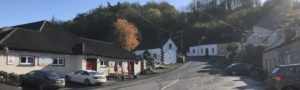
Please send any additional information, corrections or photos etc. to glenmore.history@gmail.com . The featured photo above is Ballyverneen, Glenmore looking out onto the Barrow River.
Dr. Kathleen Moore Walsh