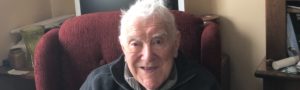
Danny Dowling (1927-2021)
now browsing by tag
A Glenmore Postcard [Updated]

In the early 20th century cameras became smaller and were more affordable. Film was purchased in chemist shops and the exposed film returned to be processed because few people had the chemicals, facilities or training to develop their own photographs. Often photos or copies of photos would be placed on thin cardboard postcards for customers by the chemist with the subject of the photo hand printed on the postcard. These post cards were very popular. However, the Glenmore post card above has “Post Office Glenmore” professionally printed (not hand printed) on the bottom left. Post cards of all descriptions were very popular in the early twentieth century as advertising of businesses or beauty spots and as a means of cheap communication.
Dating the Glenmore Postcard
The exact date of the photo is unknown. However, the photo is of the second Glenmore Post Office at Fluskey’s shop. We believe that Danny Dowling (1927-2021) enlarged the postcard and was able to identify the three people standing in front of the Post Office. Danny identified them as Maggie Holden of Weatherstown; Jim Power, the Postman; and Jim Walsh, Glenmore (uncle of Eamon Walsh). Special thanks to Martin Gahan for sharing the photo and the identification provided to him by Danny.
Dating the photo postcard is difficult because we just have a copy. We can not view the stamp affixed if any, the postmark if any, the other information on the back such as the producer’s name or, whether it was linen etc. The best clues come from what is depicted in the photo.

For example, one of the signs on Fluskey’s references a telegraph. The telegraph came when the railway link from Waterford to New Ross was being built through Glenmore in the first years of the twentieth century. Thus we know it was not taken before circa 1902. There also appears to have been graffiti on the walls of Fluskey’s on both sides of the door. Some of the letters that are still visible when the photo is enlarged appear to be “REPU” perhaps for republic or republican? (None of the other buildings appear to have graffiti.) From 1916 to the mid-1920’s the country was fighting for independence and then engaged in a civil war.
The dress of the people photographed appears to be after the First World War because Maggie Holden’s skirt is knee length. The two standing near the entrance to the other shop appear to be a girl and woman, but unfortunately they are too out of focus to be of much use in terms of their hair and dress. Two chickens in the road were also photographed, but wandering fowl in the Village continued well into the mid-twentieth century.
Glenmore Persons Depicted
The easiest to obtain information on was Jim Power, the postman. James “Jim” Power (1884-1947) was the son of Tommy & Mary “Main” Power née Walsh of Robinstown, Glenmore. James was born on 19 December 1884. In the Robinstown,1911 Census James is 24, single, living at home and employed as a postman. James Power never married and died 1 June 1947 in the County Home at Thomastown.

The man to the far right of the photo was identified as Jim Walsh (uncle of Eamon Walsh). The Eamon Walsh that springs to mind is the son of Bill Walsh (1912-1985) and his wife Peg Roche (c.1918- 2012). Bill Walsh (1912-1985) indeed had a brother Jim Walsh (1898-1958). Jim Walsh was Captain of the Glenmore Company of the old IRA during the War of Independence and was imprisoned. After Independence he joined Garda Siochana and married a Rosbercon Doherty and had several children. Jim Walsh died on 22 February 1958.
Unfortunately, we could not locate a Maggie Holden in Weatherstown. We do not know if Holden was her maiden or married name. If anyone has any information on Maggie Holden of Weatherstown please send it to us.
[Update 25 Jan. 2025: We were provided the following information. Maggie Holden was born on 13 August 1911 to Thomas Holden (c. 1870-1948) and his wife Hannie Duggan (c. 1877-1953). Thomas and Hannie were married in 1895 Thomas was from Gaulestown and Hannie was from Weatherstown. After they married they lived in Weatherstown in the house now occupied by John Murphy. Maggie Holden (b. 1911) was the youngest of the family, she married on 10 June 1942, Patrick Keogh who was from Wexford. Patrick and Maggie had two daughters Mary and Johanna and they both went to school in Ballyfacey. Patrick went to England and sometime later Maggie and the girls followed.]
Glenmore Buildings Depicted
The post office and telegraph were in Fluskey’s shop. This two storey building is now a home in Glenmore. To the left, Danny Dowling’s original and last home is mostly hidden by Fluskey’s. This house was a traditional two up and two down which later was extensively extended.
The next building to the left, which hosts a sign over the door, we believe was the Glenmore Dispensary. The store front to the left was up until circa 1904 Gaffney’s shop. Behind the shop was their mill. After the last Gaffney left Glenmore the premises were bought by P.N. O’Gorman. Eventually the Heffernan’s acquired it and Lizzie Heffernan married James K. Walsh of Ballybrahee. Lizzy JK as they were known built in 1937 a dance hall behind their shop. The Mill, dance hall, the shop and the attached house no longer stand.
Our best guess is that this photo was taken in the turbulent 1920’s.
Update: 23 Jan. 2025 Special thanks to Mick Breen for sending a clearer closeup of the group of three.

****************************
Please send any corrections or further information to glenmore.history@gmail.com.
To learn more about Fluskey’s see our post of 28 May 2020.
See our post of 25 April 2020 for further information on the Glenmore Dispensary.
For further information on Glenmore Post Offices see our post of 24 Nov. 2019.
Dr. Kathleen Moore Walsh
From Danny’s Files: The Rest of the Story of the Murder on Glenmore Hill

In one of his many notebooks, Danny Dowling (1927-2021) recorded contemporary newspaper accounts regarding the executions of three local men for murder in 1834. Patrick Meany, a native of Glenmore, had moved to Rosbercon and was convicted and executed for conspiring to kill his landlord Joseph Anthony Leonard, Esq. Please see our post of 9 February 2020 for the shocking details of how the murder was perpetrated and details of Philip Malone’s trial. Perhaps the biggest surprise Danny discovered and recorded in his notebook concerned Meany’s corpse after his execution. The place of the murder, and two of the executions arising from it, took place at the site of the murder just about a mile east of the N 25 Glenmore roundabout.
Danny found and recorded the following articles from the Waterford Mail newspaper.
Robert Malone (?-1834)
On Saturday the 26th of July 1834 at the Kilkenny County Assizes Robert Malone was convicted of the murder of Joseph Anthony Leonard, Esq. Robert Malone was sentenced to be hanged. The newspaper article noted, “It will be recollected that last Assizes his brother, Philip Malone, suffered for the same murder” (Waterford Mail, Mon. 28 July 1834).
After being found guilty and sentenced when Robert Malone was being taken from the court to the gaol “he exhibited great and disgusting levity. His execution took place in front of the gaol. Among the very great assemblage that witnessed his ignominious end, all seemed to think that he deserved his fate” (Waterford Mail, Wed. 30 July 1834.) [It is not clear why Robert Malone was executed outside the gaol in Kilkenny City after his brother Philip Malone was executed at the place of the murder on the Hill of Glenmore on the old mail coach road between Waterford and New Ross. Later Patrick Meany was also executed at the place of the murder.]
Patrick Meany (c. 1784-1834)
Patrick Meany was tried on Monday the 28th of July 1834 for conspiring to murder his landlord, Joseph Anthony Leonard, Esq. and inciting others to commit the murder. The jury was out for three hours and returned at 8 P.M. The jury returned a guilty verdict “The judge pronounced the culprit’s awful doom—to be hanged on Thursday.” The newspaper noted that Meany was the owner of the goods [cattle] Mr. Leonard had distrained (Waterford Mail, Wed. 30 July 1834).
The execution of Patrick Meany was set to take place on Tuesday the 12th of August at the scene of the murder (Waterford Mail, Sat. 2 Aug. 1834).
The Execution
“Another of the misguided persons concerned in the sanguinary murder of the late estimable Joseph Anthony Leonard, Esq. atoned for his share in the dreadful deed yesterday, at Shanbo (sic), the scene of the consummation, within three miles of New Ross, and 9 of this city. The malefactor upon this occasion was Patrick Meany…”
“An immense concourse of persons assembled yesterday to witness Meany’s ignominious departure from this world. A strong force of cavalry, infantry and police was also collected. The culprit—who seemed a man advanced at least to middle age—appeared to suffer very much from exhaustion, so much so that he was obliged to depute to his Reverend attendant the duty of addressing the immense multitude…”
“Although he expressed his contrition for having uttered denunciation against his prosecutor, he died without acknowledging the justice of the sentence or declaring his innocence. Soon afterwards the culprit was launched into eternity and the motely group of spectators separated. Five children we are informed, witnessed the execution of their guilty parent.”
Since the above was in type we received the following from a correspondent.
New Ross, August 12—Patrick Meany …was executed at the scene of the murder and where Philip Malone, one of the perpetrators of the murder, was executed on last St. Patrick’s Day. Meany was present at Philip Malone’s execution and also travelled to Kilkenny to attend the execution of Robert Malone during the last assizes.
“At half past eleven the cavalcade, consisting principally of the 9th Lancers, passed through New Ross. The unhappy individual who was the object of this mournful procession was seated in a chaise receiving religious consolation from his clergyman. He appeared to be fully sensible of his awful situation. If this could be a criterion to judge by he was fully resigned to meet his fate in a becoming and Christian like manner.”
At New Ross the 32nd Reserve and a large party of constabulary joined the cavalcade as did the Sheriff and Resident Magistrates. When they arrived at the fatal spot Meany descended from the chaise, accompanied by his Clergyman. He kneeled for some time in prayer at the foot of the gallows.
“The grim finisher of the law put the rope about his neck from behind. Meany turned suddenly round, and seemed to shrink from the trial he had to encounter. The Rev. Gentleman interposed his hand to shade his eyes. The man again looked agitated when his arms were being pinioned. When all was ready, he ascended the ladder with a firm step attended by the Rev. Gentleman, who first retired, and then returned again to strengthen the individual about to depart into eternity. He supported him by his back.”
“Meany now seemed weak, and the attentions of his spiritual adviser were continued to the last moment. His cap fell off, but it was quickly readjusted, and the fatal drop having been withdrawn, he died almost instantaneously.”
“Before ascending the gallows, the clergyman told the people that Meany felt sorry for having accused his prosecutor as he did in the Courthouse, that he willingly forgave all men and begged the prayers of all Christians” (Waterford Mail, Wed. 13 Aug. 1834).
The Wake & Burial of Patrick Meany
After having been suspended for some time, the body was taken away in an ass’s car by the family of the criminal, but it was afterwards removed to the Police Station at Rosbercon, to be conveyed back to Kilkenny (Waterford Mail, Wed. 13 Aug. 1834).
The body of Patrick Meany was waked on the night of his execution in the Rosbercon police barracks. His friends were admitted, and the body was interred the next day by the family, in the presence of the police (Waterford Mail, Mon. 18 Aug. 1834).
Generally, by the 19th century executions were public and carried out in front of gaols, and after 1868 executions were required to be held within the confines of the gaols. The corpse of an executed prisoner belonged to the State. Most were buried within the confines of the gaol in an unmarked grave in un-consecrated ground. From the time of Henry VIII authorities provided fresh executed prisoner corpses to doctors for training new doctors in anatomy. Due to religious and other beliefs families sought the bodies of their executed kin. The Meany family is the only family we have found so far that was allowed to wake and bury their father after his execution.
Thirteen years’ later convicted murderer Henry “Bounce” Walsh of Cat’s Rock, Glenmore asked the judge to give his body to his father and the request was refused. See our post of 16 August 2020 regarding the execution of Henry “Bounce” Walsh.
Please send any corrections or additional information to glenmore.history@gmail.com.
Dr. Kathleen Moore Walsh
From Danny’s Photo Album 5.0

Today, we are featuring a winter photo Danny Dowling (1927-2021) took at the top of “the Churns” at its intersection with the “New Line” or Main Road from Waterford to New Ross, currently called the N25.
We believe the photo was taken in the winter of 1963 and snow is visible. The van was owned by Clover Meats. Clover Meats was an important local employer at that time. The driver was a Forristal, but his first name is not known.
Can you identify any of the people in the photo?
Special thanks to Martin Gahan for sharing this photo he received from Danny.
If you would like to view previous posts from Danny’s Photo Album see our,
Post of 4 May 2022;
Post of 10 May 2022;
Post of 24 May 2022;
Post of 9 June 2022.
If you have any photos of Glenmore or Glenmore people you would like to share please send them to glenmore.history@gmail.com.
From Danny’s Files: Glenmore Criminal Injuries Claims 1924

Danny Dowling (1927-2021) copied a large number of newspaper articles into small notebooks. Today we are going to feature an article Danny copied regarding property claims heard in December 1924 involving two Glenmore residents and a New Ross man who tracked his stolen automobile to Glenmore.
The Damage to Property (Compensation) Act 1923
The Damage to Property (Compensation) Act 1923 applied to “injuries” to property committed on or before the 11th day of July 1921. Section 8 excluded Railway companies from applying for compensation. This was probably due to the extensive damage inflicted on the railways during the War of Independence and subsequent Civil War.
Section 7 excluded losses for (i) watches, jewellery or articles of personal ornament kept by the owner otherwise than as part of his stock in trade; (ii) Coins, bank or Government notes or currency of any country; (iii) postage or other adhesive stamps and (iv) postal orders or post office money orders. In other words the things of value most often stolen were not covered.
Section 9 excluded applicants who “connived, assisted in or actively facilitated” the injury. Section 9 also excluded applicants who associated or “were in league” with the person(s) who committed the injury or the applicant was “a member or helper of or active sympathiser with any organisation engaged in armed opposition to the late Provisional Government of Ireland or the Government of Saorstát Eireann.
The Glenmore Related Claims
The Kilkenny People (6 Dec. 1924, p. 9) published a long list of claims heard in Kilkenny by Judge Scally or Sealy. (The name is spelled differently in each article.) The actual wording of the article is in italics.
Claim by Patrick Hanrahan of Robinstown, Glenmore

Patrick Hanrahan, Glenmore, claimed £36 5s for goods taken. Capt. W.A. Redmond, BL, T.D. (instructed by Mr. Kelly, solicitor, New Ross), for applicant. James Hanrahan, brother of the applicant, gave evidence as to the goods being taken by armed Irregulars. Judge Scally reported for £24 6s. Captain William Archer Redmond (1886-1932) was the only son of John Redmond (1856-1918). For information concerning Glenmore support for John Redmond see our post of 4 January 2020.
Claim by Thomas Mullins of Flemingstown, Glenmore
Thomas Mullins claimed £7 17s. 6d. for clothes taken. Same counsel was engaged. Applicant Mullins stated the clothes were taken by armed Irregulars. Judge Scaly said he would report for £5.
Claim by Charles Kavanagh of New Ross
Charles Kavanagh, New Ross, claimed £608 for a motor car. Mr. Matheson, BL (instructed by Mr. Kelly, solicitor) for the applicant. Applicant’s motor driver stated he drove the car with passengers to Kilkenny Feis in 1921. When he went to the yard where he left the car, it was gone and a note was left saying, “Taken by the I.R.A.” The Kilkenny Feis of 1921 was held on Sunday the 9th of October( New Ross Standard, Fri. 7 Oct. 1921, 4). We could not locate any newspaper article regarding the car being taken in Kilkenny in October 1921.
Witness got to know that the car was in Glenmore and he went there and saw the car with the I.R.A. He asked for the return of the car but this was refused.
Applicant stated that the motor car was used by the I.R.A. to drive around a commandant named McDonald, who afterwards became an Irregular. Witness had not got back the car. The Judge reported for £50 for the car; £5 for two overcoats; and £2 for a rug taken away with the car.
There was no McDonald listed in the volunteers of the Glenmore Old IRA see our list including ranks and dates of service.
Appeals
The Kilkenny People (Sat. 27 Dec. 1924, p. 5) reported that the state appealed two of Judge Sealy’s (sic) judgments at the recent special sitting of the criminal injury to property. The State was relying on Section 9 of the Act which barred people who gave active assistance to the enemies of the duly constituted Government from any right to compensation to which they would otherwise be entitled. None of the cases above were reported as appealed.
The newspaper concluded with “it is only fair to say that Mr. Justice Sealy patiently investigated the circumstances of the cases, and his judgments in both cases seemed to be models of fairness, common sense and judicial impartiality.”
The Glenmore Claimants
Patrick Hanrahan (1886-1957) was the eldest child of Michael Hanrahan (1848 -1898) (farmer) of Powerswood, Thomastown and his wife, Hanoria Mullins (1854-1902) of Gaulstown, Glenmore. Patrick was born in Gaulestown, Glenmore. The family moved to Waterford City where they ran a business. Tragedy struck when the parents both died leaving their young sons orphaned. For information on the orphaned Hanrahan Brothers see our post of 6 Dec. 2020.
Patrick Hanrahan (1886-1957) (shop keeper) of Robintown, Glenmore married Mary Duggan of Flemingtown, Glenmore on 12 February 1924. Thus the couple were married 10 months before his claim was heard. For further information on Pat Hanrahan during the War of Independence see our post of 20 June 2021.
Thomas Mullins (1873-1936) of Flemingstown was the son of John Mullins and Mary Mullins née McDonald. Thomas Mullins married Mary Mullins née Walsh (1873 -1948) of Davidstown on 2 March 1897. Mary was the daughter of Patrick Walsh and his wife Margaret “Peggy” Walsh née Kennedy. Thomas Mullin’s funeral in 1936 was the last horse drawn funeral in Glenmore according to Danny Dowling. An inquest was held on 22 August 1936 where his death from a gunshot was ruled an accident.
Charles Kavanagh (b. 1890) of New Ross
There were two men named Charles Kavanagh living in New Ross in 1924 per a newspaper search. One was a Civil Guard and the other was a publican/undertaker. We do not believe that the claimant was a Civil Guard.
On the 15th of September 1922, Charles J. Kavanagh of Cross Lane, New Ross, applied to have a liquor license transferred from Mary Anne Kavanagh to himself (New Ross Standard, Fri. 29 Sept. 1922, p. 1). The 1911 Census shows only one Charles Kavanagh in New Ross. He is 21 and a grocer’s assistant living with his 48 year old widowed mother, Mary Anne Kavanagh, publican and grocer. Interestingly, a boarder in the house is Austin A. Butler, aged 22, a newspaper reporter.
In 1913 Charles Kavanagh began an undertaking business at “Kelly’s (old posting establishment) Cross Lane, New Ross” (New Ross Standard, Fri. 27 June 1913, p. 7). In searching for a birth record we found a Charles Kavanagh, born 25 March 1890 at Balynamcont (?), Wexford to James Kavanagh (farmer) and his wife Marianne Butler.
*****************
Please send any corrections, additional information or photos to glenmore.history@gmail.com .
The photo of Capt. W.A. Redmond (1886-1932) is courtesy of the Imperial War Museum, part of the First World War Portrait Collection, Catalogue number: HU 124788. The featured photo above is the Kilkenny Courthouse.
Dr. Kathleen Moore Walsh
Trial for the Killing of Catherine Hanrahan (c. 1798-1822) of Rochestown,Glenmore

On 6 November 2022 we published newspaper accounts of the manslaughter of Catherine Hanrahan in July 1822 at her home in Rochestown, Glenmore. While transcribing another Danny Dowling (1927-2021) notebook we discovered that Danny recorded articles from the Waterford Mirror that outline the testimony presented during the murder trial. These newspaper accounts provide more detail including the testimony of the landlord Pierse Edward Forristal, Esq. and conflicting testimony of other witnesses. It appears that the testimony of Pierse Edward Forristal, Esq. influenced the jury that only considered the case for a few minutes before returning its manslaughter verdict.
The Arrest
Danny recorded the following from the Waterford Mirror (Sat. 20 Aug. 1822). Thomas Marks was charged with the murder of Catherine Hanrahan, at Rochesstown, in Co. Kilkenny. Thomas Marks was taken without resistance at a house in Kilmacthomas. Marks when arrested stated that he was on his way to surrender. He was transmitted to the County Kilkenny gaol.
The Waterford Mail on Wednesday the 14th of August 1822 provided an account of day three of the Kilkenny Assizes. In this account Thomas Marks was indicted for the murder of Catherine Hanrahan and the assault of Luke Power “by presenting a pistol at him.” Hereafter Marks is described as the prisoner.
The Testimony of Luke Power
Luke Power was sworn and testified. Unfortunately, the newspaper account does not provide his relationship, if any, to the deceased Catherine Hanrahan née Power, his occupation or residence. Later in defence testimony it appears that Luke and Thomas Power are brothers. Luke Power testified that he knows Rochestown and was there the Monday after the fair of Thomastown. He knows Thomas Power who lives at Rochestown. On that Monday, very early in the morning, he saw the prisoner at Rochestown.
Luke Power testified that the dog barked at the prisoner. Luke Power got up and asked who was there. The prisoner responded that he was distraining for Mr. Forristal. Luke Power testified that the prisoner was armed. Witness shut the door and would not let the prisoner in. Luke Power then went down to where the cows were and saw three bailiffs there, but the prisoner was not with them.
Luke Power heard a shot and returned to the house and saw Catherine Hanrahan “kilt” on the floor. She died six days after being shot. Luke Power went out to the road where some of the neighbours were gathered. The prisoner said “here’s the man was going to kill me,” and cocked his pistol at Luke Power. It was an hour before sunrise when the prisoner came with six men.
Cross-Examination of Luke Power
Luke Power testified that Mr. Forristal was his landlord. He stated that he paid some rent to Mr. Sherlock and owed Mr. Forristal one hundred pounds “or that way rent.” His brother was his partner in the land. He first saw the prisoner and his assistants in the yard, it was not then 3 o’clock.
Sherlock distrained Luke Power four weeks earlier, but he did not think there was a reason at that time. He did testify that a horse had been taken away to the bog at that time. The prisoner distrained Luke Power before for Mr. Forristal, but could not say how long before. At the time the shot was fired Luke Power was four or five fields away and had not walked a step with the prisoner that morning.
The Testimony of Alicia Power of Rochestown, Glenmore
Alicia Power testified that she was the daughter of Thomas Power and the sister of the deceased Catherine Hanrahan. She remembered people coming to her father’s on the first of July last before sunrise. She saw the prisoner there. She testified that her sister was driving pigs out of the bawn. The prisoner desired that her sister leave them there. When she refused Alicia Power testified that the prisoner ran over and caught her sister by the neck and “squeezed her.” Her neck was cut by his “iron hand.”
Alicia Power stated that she could hear “all that occurred” between the deceased and the prisoner. The prisoner said, “Come leave the pigs there.” Deceased answered, “How do you know who owns them?” Prisoner then struck the deceased and was choking her. Prisoner lifted his foot on a stone and saying, “by G-d I’ll shoot you,” and then fired his pistol. Deceased was then running away and was shot 6 yards from the prisoner. She fell at the door, the ball entered her back. There was another man there minding the pigs where the deceased left them.
Her sister was “shot on Monday morning and died the Sunday following.”
Cross Examination of Alicia Power of Rochestown, Glenmore
Alicia Powers was driving the pigs with her sister the deceased. “They had been in the cabin and were driving them out of the bawn.” Deceased had a stick in her hand. She usually brought a stick to drive the pigs. The deceased did not strike the prisoner and Alicia Power never saw a stone in the deceased’s hand. Alicia Power testified that she never saw the prisoner fall or see any stone thrown at him. She testified that the deceased could not have thrown a stone without her seeing it. Alicia Power was at the prisoner’s side when he fired.
Alicia Power said that the prisoner had only one pistol. She saw Luke Power come up. But never saw the prisoner “present a pistol at him.” Alicia Power swore information against prisoner before Mr. Snow. She did not swear against any other person except the prisoner. She did not hear the deceased, or any other person calling out, “kill the black protestant,” and firmly stated that she did not say it either.
Examined by the Bench—Alicia Power clarified to the judge that the prisoner had six or seven men in his party, one of whom was present when the shot was fired. Bridget Cashin was present but no boys or men. They were down on the land where the cows were.
The Testimony of Bridget Cashin
Bridget Cashin was present when Catherine Hanrahan was shot. She saw the prisoner that morning and saw him fire a shot at Catherine Hanrahan. The deceased was Bridget Cashin’s cousin. She observed the deceased driving the pigs out of the bawn. Only her sister was with the deceased. None of the men of the house were present. She testified that the prisoner had two men with him. She denied that the deceased struck the prisoner or threw stones at him. “He cursed G-d, he would fire at her in a minute.”
Bridget Cashin testified that the prisoner caught the deceased by her neck and choked her. The prisoner laid the pistol on his left knee and fired. The deceased walked four steps and fell. “She did not get up since.” Deceased was 24 years of age, was married 2.5 years, and had one child. Interestingly the Waterford newspaper did not acknowledge that the deceased was pregnant when she was shot in the back.
Cross Examination of Bridget Cashin
Bridget Cashin could not identify the two men with the prisoner. The house was distrained for Mr. Forristal’s rent, but she could not say whether the men were “keepers.” Deceased refused to leave the pigs and was driving them away. The deceased said she would drive them in spite of the prisoner. Bridget Cashin stated that she did not say anything, and the deceased did not say “kill the bloody or the black protestant.” She did not see Luke Power come up. She went to Mr. Snow’s and swore information about six days after “the business occurred.”
The Testimony of Dr. John Briscoe of Waterford
Dr. Briscoe testified that he attended Catherine Hanrahan at Rochestown on the second of July. She had received a gunshot wound in the lower part of the back “of which she afterwards died.”
Cross Examination of Dr. John Briscoe
The wound was horizontal in the lower part of the spine on the right side near the hip. The doctor did not see a mark of bruises or a cut on the deceased’s neck.
The Crown rested and the defence began.
The Testimony of William Cooney
William Cooney testified that he knew the prisoner and went with him to Rochestown on the first of July to distrain for Mr. Forristal. The distraining party consisted of: Thoman and John Marks; William and Richard Jeffers; —Lonergan and himself. They first went to the fields where they collected three horses and some cows. Three men were left in the field to guard the animals. Prisoner then brought Lonergan and William Cooney to the house and told them to take charge of all the property there both inside and outside. He testified that they never entered the house. The pigs were seized in the lane. Prisoner brought William Cooney down towards the fields and they met Luke Power and his brother Thomas.
Prisoner advised the Powers to get bail to release the cattle. Thomas Power had a wattle and struck at Lonergan. The blow was prevented by Luke Power. Prisoner went down to Mr. Forristal’s which was about a field away. Lonergan and Cooney were left in charge of the house. Whilst prisoner was away the two Powers and a woman (not the deceased) pushed Lonergan out of the yard. Lonergan left to tell the prisoner. Cooney was alone and went out onto the road.
Power’s two daughters and another girl were driving the pigs out of the bawn. Deceased had a wattle in her hand. When Lonergan returned one of the girls said, “Mr. Forristal knew nothing of the pigs and for God’s sake let them go.” Lonergan and Cooney refused and the deceased then said, “she would have them (the pigs) or she would knock one of their brains out sideways with the wattle.”
Cooney testified that the wattle was heavy and two and a half yards in length. Prisoner returned and upon hearing the deceased told her, “for God’s sake go in and be quiet and all will be well.” Cooney stated that deceased advanced toward prisoner and said, “you black protestant are you come again to rob us?” She made a blow of the wattle at him. She said the words in Irish. Prisoner gave the deceased a shove and said, “go in God’s name and don’t be aggravating me.”
The deceased raised the wattle and struck the prisoner two or three times. She called out for someone to come “knock the black protestant’s brains out.” The deceased then took up a stone according to Cooney and struck the prisoner in the knee. The other two women were running with stones in their hands. Cooney and Lonergan went between the women and the prisoner. Cooney saw and heard the shot fired. The deceased when shot was stooping for a stone.
The prisoner when he fired was down, “having dropped down sideways when hit on the knee with the stone.” The prisoner was not flat on the ground. He was supported by his elbow. A quarter of an hour later Luke Power came up. The prisoner only had one pistol and it was re-loaded. Luke Power was very angry and was according to Coney going to injure them if he could. Luke Power called the prisoner a “bloody rogue” and “all of them robbers.”
Cross Examination of William Cooney
Cooney was asked to repeat what the deceased had said in Irish and he did. No men of the Power family were present from the time the pigs were driven out first until after the shot was fired. Cooney admitted that he and Lonergan had sticks, but were not otherwise armed. He continued to assert that the three women were very violent, but admitted that the three men could have defended themselves without a shot.
It was daylight when they came on the ground. They left Waterford at 11 o’clock at night. They stopped at Mackey’s on the way and too refreshment. They remained at Mackey’s until “clear daylight.” Cooney described Mackey’s as 4 or 5 miles from Rochestown. Deceased had not run from the prisoner she was sideways, stooping for a stone, about 6 or 8 yards from prisoner.
When the prisoner fell his pistol went off. Cooney stated that the prisoner had not aimed at the deceased. Cooney stated his belief that the prisoner did not intend to fire at the deceased or to pull the trigger. About an hour after the shooting the prisoner said that the pistol went off by accident. Although Cooney stated that the prisoner’s life was in danger, if Cooney was in the same situation he would not have fired at the deceased. Cooney could not say how the pistol went off.
Dr. Briscoe Recalled
Dr. Briscoe was asked about the wound. He testified that it was horizontal. He stated that if the deceased was stooping he could not conceive how she received such a wound unless she and the shooter were both kneeling. Thus Dr. Briscoe did not find injuries on the deceased’s neck and ruled out that the deceased was stooping when shot.
The Testimony of Pierse Edward Forristal, Esq. of Rochestown, Glenmore
“Recollected the morning when this transaction happened.” He saw the prisoner 6 or 8 minutes after the shooting. Prisoner was distraining for Forristal and had frequently before acted as bailiff on his lands. He had distrained them a short time before. The prisoner had “always behaved himself well, and if he had a bad character, he would not have employed him.” Forristal stated that the prisoner is a pensioner and lost his hand “on service.” He went on to testify that the prisoner “frequently interfered” with Forristal in favour of the tenants by always speaking kindly of them and “procured time for them.”
Cross Examination of Pierse Edward Forristal, Esq.
Forristal testified that he sent for the prisoner to act as bailiff and bring 5 men with him. He also instructed that they should be very early on the land “as the Powers had removed their cattle on a former occasion.” Prisoner called to Forristal about 3 o’clock in the morning and told Forristal he had affected the distress. Forristal ordered his horse to be got ready. Jeffers arrived and said that the Powers had taken away horses and cows. The prisoner returned to Power’s. When Forristal arrived he learned of the shooting.
Forristal asked the prisoner why he fired. Prisoner responded that “he’d rather he had wounded himself than the girl.” Forristal testified that Tom Power said to the prisoner, “you have murdered my daughter.” The prisoner replied, “I did not intend to shoot her, but if I did it was her own fault.” The prisoner then unbuttoned the knee of his breeches and showed a large mark on his knee saying, “See Mr. Forristal, how I have been used.” [Of course he could have injured his knee at any time stumbling around in the dark after leaving Mackey’s where they had “refreshments.”]
The prisoner did not tell Mr. Forristal that the pistol went off by accident and Forristal never heard that it did.
The last witness called was Rev. Francis Reynett who testified that he knew the prisoner for about 18 years. He considered him a well conducted man and never heard anything against his character.
Jury Decision
The Lord Chief Justice charged the jury and they retired, “and in a few minutes they returned with a verdict, acquitting the prisoner of murder, but finding him guilty of manslaughter. They also acquitted the prisoner of presenting the pistol at Luke Power.”
The Chief justice sentenced the prisoner to be burned on the hand and imprisoned for 6 months.
What Happened to the Power Family of Rochestown, Glenmore?
We know that no one by the name of Power or Hanrahan were listed as tenants in Rochestown in the 1829 Tithe Lists. We are currently searching Prof. Mannion’s Newfoundland records of Irish emigrants 1750 to 1850 because several Rochestown families moved there in the early 19th century.
UPDATE–28 June 2026–The one armed killer, Thomas Marks a few years after escaping the noose committed another violent assault. “Committed to the City Gaol, by the Right Worshipful the Mayor, Thomas Marks, a man who has lost a hand and replaced it with an Iron substitute, and who is now charged with having violently assaulted and struck with his iron hand a man called Peter Power (Waterford Mirror, Mon. 10 May 1824, p. 3).
For some information on Rochestown see our post of 3 December 2023.
******************
Please send any corrections or additional information to glenmore.history@gmail.com
Dr. Kathleen Moore Walsh
From Danny’s Files: Glenmore Parish Death Records 1975

In a blue binder Danny Dowling (1927-2021) kept a copy of the Glenmore parish burial records from 1927-2013. While it was initially thought that the records would provide information as to when most deaths occurred in a given year, unfortunately, the records are not as complete as the parish records for baptisms and marriages. Today, we publish the parish burial records for 1975. See our previous post of 23 September 2024 for information regarding available on-line records and 1974 parish death records.
Glenmore Deaths 1975
Sixteen deaths are recorded in the 1975 parish records. For the most part the only information recorded is the deceased’s name, age, and date of death as well as the date of burial. All other information below was been found in newspaper obituaries, census records, Danny’s notes or from asking local residents. If an obituary of a deceased was already on our Glenmore surname pages an abridged obituary is provided below with a link to the surname page.
Average Age at Death
Of the sixteen deaths recorded two were young boys tragically killed in a farmhouse fire. Excluding the two boys 9 men died and 5 women. The average age for the 9 men was 66.6, while the average age for the 5 women was 65.4. In most developed countries 50 years ago the life expectancy for women was greater than that for men. However, this is one year in isolation. This list also contains another set of brothers who died within a few months of each other.
Married Glenmore People Lived Longer
The other interesting fact concerns the marital status of the deceased. Excluding the children, information was found for 8 of the men. Five had been married and 3 never married. The average age of death for the married men was 72.8 and for the never married men 62.3. Information was found for all 5 women. The average age of death for the 2 married women was 69. The average age of death for the three women who never married was 53.
The Glenmore List
[1] Thomas Walsh, aged 47, died 1 March 1975.
Munster Express, Fri. 14 March 1975, p. 20. The death occurred in Ardkeen Hospital, Waterford of Mr. Thomas Walsh (c. 1928-1975) of Davidstown, Glenmore at the comparatively early age of 46. A well-known figure in farming circles, he was the husband of Mrs. Maureen Walsh, who is a member of the Hartley family Half-way House, Co. Waterford; father of Eleanore, Edmund and Marie. The full obituary can be found on our W Surname page.
[2] Michael Tobin, aged 49, died 12 March 1975, Mullinaharigle [no further information could be located]
[3] Rev. M. Brennan, aged 80, died 23 March 1975.
Rev. Michael Brennan was the Parish Priest of Glenmore in 1975. He lived in the Parochial House on Priest Lane, Robinstown, Glenmore and kept greyhounds. He also hunted pheasants. A nice, humble, gentleman. He was only in Glenmore for a short time, but was missed when he died. Shortly before his death he was asked to say a few words at a Creamery Dance. He said that the creameries were set up in hard times by people who did not have much and were stretched. He hoped that they now were getting the benefit of the business they created.
[4] Patrick Jones, aged 78, died 9 April 1975.
Patrick Jones (1897-1975) was born 29 January 1897 at Moulerstown the son of George Jones (c. 1866-1945) and his wife Bridget Murphy (c. 1869-1945). Patrick Jones married Alice Dunne (c.1890-1967) and was the father of Seamus (c. 1932-2016) and Pakie (c. 1932-1006) Jones. The family lived in Glenmore Village near Eily Heffernan’s shop and in 1961 Patrick’s profession was listed as a road worker in Danny Dowling’s list of residents. See our post of 25 April 2021 regarding the “Gallant Glenmore Brothers.”
[5] Ellen Purcell, aged 54, died 6 June 1975.
Kilkenny People, Fri. 20 June 1975, p. 10. Miss E. Purcell—the death took place in the Auxiliary Hospital, Kilkenny, of Miss Ellen Purcell (53) [c. 1921-1975] Moulerstown, Glenmore. A well-known and respected inhabitant of the district, she had been unwell for some time past. She was sister of Mrs. Margaret Greene (c. 1918 -2013) Moulerstown, and the late Mrs. M. Maher, Derrylackey, Ballyhale. Interment took place at Glenmore after Mass celebrated by Rev. P. Madigan, C.C., do.
Luckily her older sister Margaret was born on 22 December 1919, and we were able to obtain information from Margaret’s birth registration. Their father was Peter Purcell (farmer) of Moulerstown, Glenmore. Their mother was Anne Purcell née Long.
[6] Mrs. Mary Dunphy, aged 92, died 18 June 1975
Munster Express, Fri. 27 June 1975, 6. Mrs. Mary Dunphy (c. 1883-1975), Ballyfacey Upper Glenmore, died at her residence at the age of 92 one of the oldest inhabitants of the parish. She was the last surviving member of the Gorey family, Ballyconnacht, Tullogher, and had been residing in Ballyfacey since her marriage over sixty years ago. Her husband, the late Michael Dunphy (c. 1881-1941) died in 1941, and she was the mother of Richard Dunphy, Miss Nora Dunphy, Ballyfacey; the late Eily Dunpphy, do: mother-in-law of Mrs. Eileen Dunphy, and grandmother of Mary, Noreen, Michael, Seamus, Richard, Billy, and twin boys, John and Patrick Dunphy. She was also sister of the late Ellie and Annie Gorey, Ballyconnacht, and the late Mrs. Bridie Walsh, do, and aunt of Denis Walsh, do. and Mrs. Stasia Ryan, do. The remains were removed to Glenmore Parish Church on Thursday evening, and interment took place in the adjoining cemetery on Friday morning after Requiem Mass. Celebrant was Rev. William Dalton, Chaplain, Holy Faith Convent, Killester, Dublin (a native of Ballinaraha, Mullinavat) relative of deceased, who also officiated at the graveside, assisted by Very Rev. J. O’Shea, P.P., Glenmore.
[7] Mary Forristal, aged 52, died 19 July 1975.
Munster Express, Fri. 18 July 1975, p. 5. Death of Miss M. Forristal (c. 1923-175) The death took place in St. Canice’s Hospital, Kilkenny, on Thursday last of Miss Mary Forristal, Robinstown, Glenmore, at the age of 52. Deceased, who had been out of her health for some time past, was in her youth, a shop assistant at McKeon’s, South Street, New Ross, for some years.
She was sister of Messrs. Michael, John and Martin Forristal, Robinstown; Sister M. Bernadette, Sacred Heart of Mary Convent, Montebello, California; Sr. Paschal of the same order Tarrytown, New York; Mrs. Nancy O’Brien, Robinstown; Mrs. Catherine Phelan, Ballyveria, Glenmore; and aunt of Francis O’Brien, Robinstown. The remains were removed to St.. James Parish Church, Glenmore, on Friday evening, and burial took place in the adjoining cemetery on Saturday morning after Requiem Mass. Celebrant was Rev. Madigan, C.C., Glenmore, and the final prayers at the graveside were recited by Very Rev. J. O’Shea, P.P. do. See our post of 13 May 2020 regarding the tragic death of her father Martin Forristal (1879-1931) when she was about eight years old.
[8] Richard Cody, aged 55, died 7 Sept. 1975.
Munster Express, Fri. 19 Sept. 1975, p. 20. Richard Cody (c. 1921-1975) of Ballycroney, Glenmore died at Ardkeen Hospital, Waterford, following a brief illness, at the age of 54. Deceased, who well known in farming circles in the district, was unmarried, and brother of Messrs. John, Walter, and Michael Cody of Ballycroney. The remains were removed to Glenmore Parish Church, and burial took place in the adjoining cemetery following Requiem Mass celebrated by Rev.. Thomas Heneberry, C.C., Glenmore, who also officiated at the graveside.
Their father was Michael Cody (c. 1878-1947) who married their mother Bridget Aylward of Ballyfacey at Glenmore on 4 February 1920. Michael was a farmer and the son of Otho Cody (farmer) of Ballycroney. Bridget was the daughter of John Aylward (farmer) of Ballyfacey. The witnesses to the wedding were James Cody of Ballycroney and Maggie Aylward of Ballyfacey.
[9] Andrew Heffernan, aged 82, died 7 Sept. 1975
Munster Express, Fri. 19 Spt. 1975, p. 20. Death of Mr. A. Heffernan—Mr. Andrew (Andy) Heffernan (1893 -1975) who died suddenly at his daughter’s residence, Rochestown, Glenmore, was a native of Aylwardstown, Glenmore, and a well known figure in farming and sporting circles in the parish. He was captain for some years of the Glenmore team which won a record of nine county senior championships between 1915 and 1924, all in succession with the exception of 1920, when Coolagh were awarded the title as Glenmore took the field after the appointed time.
He also played with Kilkenny in the Leinster Senior Championships in 1915, 1920 and 1922, with a number of colleagues of the Glenmore team. When he was married in 1919, to the former Miss Bridget Roche, of Rathinure Glenmore, he was presented with a Testimonial by the local football club in appreciation for his services and leadership which were an inspiration to the players and club members.
Aged 82, he was husband of Mrs. Bridget Heffernan, and father of Messrs. Mick Hefernan, Maypark, Waterford; Jimmy Heffernan, Ballyneale, Tullogher (former Kilkenny All-Ireland hurlers); Paddy Heffernan, Rockenham, Ferryban; John Hefernan, Aylwardstown; William Heffernan, Newcastle Road, Galway; Peter Heffernan, London; Mrs. Mary Aylward, Rochestown; Mrs. Nellie Doherty, Ballinlammy; and Mrs. Biddy Myles, London.
He was brother of Mr. Nicholas Heffernan, London; Mr. Stephen Heffernan, Chicaggo, and is also survived by over 50 grandchildren. Interment took place at Glenmore on Tuesday of last week after Requiem Mass celebrated by Rev. T. Heneberry, C.C., Glenmore, who also officiated at the graveside, assisted by Very Rev. Delaney, Adm. Tullogher; Rev. Richard Phelan, Castletown, Laois, and Rev. Paul Fitzgerald, Director of Social Services, Kilkenny, and Rev. P. Dalton, C.C. Ferrybank.
The large attendance, both at the removal of the remains and burial, included representatives f Kilkenny County Board GAA, Kilkenny Souther Board, Glenmore Hurling and Football Club, Mount Sion and Tullogher GAA Clubs, Clover Meats Ltd., Ferrybank, a number o surviving members o the old Glenmore and Kilkenny Football teams, as well as many relatives, friends, and sympathisers from Countiies Kilkenny, Waterford and Wexford. His six sons acted as pall bearers. Funeral arrangements were by T. Power and Sons Ferrybank.
Andy was the son of Michael Heffernan (c. 1847-1924) of Aylwardstown and his wife Bridget Kennedy (c. 1854-1947) of Rathinure. Interestingly Andy married his sister Alice Roche’s (née Heffernan) sister-in-law Bridget Roche.
[10] Gerard Kehoe, aged 11, died 1 Oct. 1975 and
[11] Richard Kehoe, aged 7 ½, died 1 Oct. 1975
Munster Express, Fri. 3 Oct. 1975, p. 1—Two young brothers, Gerard and Richard Kehoe lost their lives when fire swept through their home shortly before midnight. They got trapped on a landing in the two-storey old mansion type farmhouse [Mount Ida] at Rochestown, and their badly charred bodies were later found on the ground floor by firemen, both having been thrown down when part of the ceiling collapsed.
Gerard and Richard were the sons of John Kehoe (c. 1916-1991) and Peggy Kehoe née Aylward (c. 1935-2023) of Rochestown. Peggy was Paddy “the Barrister” Walsh’s granddaughter. Peggy’s photo and obituary is available on RIP.ie.
[12] Michael Cody, aged 79, died 29 Oct. 1975.
Munster Express, Fri. 7 Nov. 1975, p. 6 of Weatherstown. Michael Cody’s (c. 1896-1975) full obituary is on our C Glenmore family page.
A former well-known footballer, with his brothers Martin and Paddy won a number of senior County championships with his parish during the period from 1915 to 1924, when with the one exception in 1920, Glenmore took all the titles. He was married to Anne Cody (c. 1909-1989 née Woods) who was a native of Ballymartin, Tullogher and father of Messrs Paddy and Donal Cody, Weatherstown; Michael Cody, Athlone, Co. Westmeath; Nicholas Cody, Ballyveria, Glennmore; and Mrs. Mary Dowling, Tara, Co. Meath.
Michael Cody (1896-1975) was born on 1 April 1896 at Weatherstown to Patrick Cody and his wife Mary Knox. One elderly Glenmore resident today stated that Michael Cody sang in the Glenmore Choir for years until he was an old man.
[13] Catherine Murphy, aged 76, died 2 Nov. 1975
Catherine “Kate” Murphy née Irish (1891-1975) of Davidstown, Glenmore died at Rosario Nursing Home. Her obituary lists her age as 84. She was widow of William Murphy of Davidstown who died in 1954 and mother of Edward Murphy of Davidstown.
Catherine was born 14 August 1891 at Ballinlammy, Glenmore, the daughter of James Irish and his wife Mary Heneberry. It is believed (from Danny Dowling (1927-2021) that James Irish bought the farm where Michael Walsh poisoned two bailiffs. See our post of 6 October 2024. Catherine’s complete obituary can be read on our M Glenmore surname page.
[14] John Cody, aged 52, died 12 Nov. 1975.
Munster Express, Fri. 21 Nov. 1975, p. 19. Death of Mr. J. Cody—Mr. John Cody (c. 1923-1975) Ballycroney, Glenmore, who has died in St. Canice’s Hospital Kilkenny, was a member of a well-known farming Families. Deceased, who has been out of his health for some time past, was brother of Messrs Walter and Michael of Ballycroney, and the late Richard Cody, do, who died last September. The remains were removed to Glenmore Parish Church on Thursday evening last, and burial took place in the adjoining cemetery on Friday morning after Requiem Mass. Celebrant was Rev. T. Heneberry, C.C. Glenmore, who also officiated at the graveside.
[15] Mary Moran, aged 53, died 7 Dec. 1975
Mary Moran proved impossible to locate in newspaper searches etc. The Moran headstone in cemetery attached to St. James provides that Mary may have been called Bridget Moran (4 Nov. 1916—6 Dec. 1975).
Mary/Bridget was the daughter of Hubert Moran (25 April 1886-10 May 1951) and his wife Mary Kate Moran née Irish (15 Aug. 1888-12 Dec. 1935). It is believed that Mary/Bridget resided and worked on a farm in Co. Waterford.
[16] Nicholas Mernagh, aged 78, died 9 Dec. 1975.
Munster Express, Fri.19 Dec. 1975, p. 19—Death of Mr. N. Mernagh—the death occurred at Arkeen Hospital, Waterford, of Mr Nicholas Mernagh (c. 1897-1975), Jamestown, Glenmore. Deceased, who was a well-known and esteemed personality in the district and was husband of Mrs. Margaret Mernagh, do., and father of Mrs. Johanna Doyle and Mrs. Bridie Murphy. He is also survived by a number of grandchildren and other relatives. The remains were removed to St. James’s Parish Church, Glenmore on Wednesday evening of last week an interment took place in the adjoining cemetery on Thursday morning after Requiem Mass. Celebrant was Rev. T. Heneberry, C.C., Glenmore who also recited the prayers at the graveside.
Nicholas Mernagh was born in Wexford. His father, John (Jack) Mernagh (c. 1855-1911) worked for the railway and moved his family to Ballyverneen, Glenmore circa 1906. The 1911 Census reveals that Jack was 53 years of age and had been married to Mary (aged 42) for 26 years. They were both born in Wexford and were the parents of 16 children, but only 12 of the children were alive in 1911. The ten children living with them in 1911 included: Patrick, aged 23; John, aged 21; James, aged 19; Stephen, aged 17; Bartholomew, aged 13; Thomas, aged 10; Adain, aged 8; Nicholas, aged 6; Mary, aged 5 and Lizzie, aged 3. All the children except Mary and Lizzie were born in Wexford. The 1911 census records that there were 12 members of this family living in a three room house owned by the Dublin and South East Railway.
Nicholas married Margaret Mackey (c. 1905-1978) of Weatherstown, Glenmore.
Please send any corrections, additional information or photos to glenmore.history@gmail.com.
Dr. Kathleen Moore Walsh