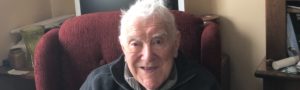
Danny Dowling (1927-2021)
now browsing by tag
More Glenmore Post Cards [Updated]
Jackie Walsh shared two postcards and a photo from her collection. If you have never visited Jackie’s facebook page “Glenmore Memories” it is well worth a visit for the lovely old photos.
Post Card 1

This postcard is from 1912. It provides a good view of the buildings that once stood between the Mullinahone Road and Fluskey’s shop and post office. Today, all that remains is Fluskey’s (which is a private dwelling) and to its left Danny Dowling’s (1927-2021) house. No longer standing: (1) the Dispensary; (2) Gaffney’s house & shop (later Lizzie J.K.’s); and (3) Gaffney’s Mill.
See our post of 25 April 2020 regarding the Glenmore Dispensary. For further information on Gaffney’s Mill see our post of 6 April 2025. See our post of 28 May 2020 regarding the Fluskey family.
Glenmore Photo

It is not known when this photo was taken. Given the car depicted it was likely taken in the 1940’s or 1950’s. The people are gathered in front of Fluskey’s. Do you recognise any of these people?
[Update–James Grace noticed that the wall at the bridge (to the left of the stage) was repaired. He believes the photo was taken after Michael Murphy (1930-1974) of Robinstown, Glenmore, lost control of his experimental tractor, crashed through the wall and ended up in the stream. James was an apprentice at Duggan’s when this occurred. See our post of 27 June 2020 for more information regarding the runaway tractor of June 1953. Thus this photo was taken after June 1953.]
To the right of the photo is the stage house built by landlord Dr. Mackesy, to store corn. The stage allowed for wagons to be loaded easily, and politicians used the stage for addressing local people. This stone building was removed to allow for the construction of the Sallies housing development. The stone building to its left and across the stream is the coach house which still stands in Cappagh townland. See our post of 4 March 2025 regarding landlord Dr. Mackesy.
Post Card 2

This postcard is also undated. Two children are in front of Danny Dowling’s house and someone is standing in the doorway. No graffiti is apparent on Fluskey’s wall. It appears that the Village pump which once stood (in front of the current Glen Bar) is not apparent in this photo. This suggests that the photo was taken after 1931 when the Village pump was removed due to pollution.
See our post of 23 May 2020 regarding the village pumps and water scheme. See our post of 9 April 2020 regarding Glenmore Village in the 1930’s.
Request From Reader
We have a reader who wonders if anyone has photos or a postcard depicting the old bus stop area at the top of the Churns. He recalls that there was a finger sign that had “Glenmore 1/4.”
For other postcards of Glenmore see our posts of 22 January 2025 and 29 January 2025.
Please send any corrections, further information or other old photos or post cards of anywhere in Glenmore to glenmore.history@gmail.com . Special thanks to Jackie Walsh for sharing these postcards and photo.
Dr. Kathleen Moore Walsh
The First Gold Glenmore Sign

On the 17th of March, to commemorate the fourth anniversary of the death of Glenmore historian, Danny Dowling (1927-2021), Glenmore Tidy Towns and glenmore-history.com placed a historical sign at the site where Gaffney’s Mill once stood. This is the first of several planned signs to be posted in the parish. If you stop to look at the sign please look at the stone beneath it. The stone had a date inscribed in it (1810), but the stone when re-used for the pier was placed upside down. Another Glenmore mystery.
Apologies for my tardy posting, but a couple days later my better half and I were off on a cruise to celebrate our 30th wedding anniversary.
Information Provided: Gaffney’s Mill
This mural, painted by artist Graham Carew, represents Gaffney’s Mill that stood behind this wall. Gaffney’s Mill was one of 3 mills shown in Glenmore Parish on the historical survey map of the 1830’s. The mills included: Grace’s Mill in Mullinahone, Forristal’s Mill in Graiguenakill and Gaffney’s Mill here in the Village. The Gaffney family operated the mill until around 1900. The mill had a water wheel which was powered from a supply of water in a mill pond which was located behind the mill. This water was sourced from the stream that flows through the village, partly diverted at Mullinahone into a mill race. A man-made canal ran parallel to what’s known as the Mill Road. The water was released on demand and flowed back to the stream via an underground duct. In addition to a corn mill a linen mill was also operated on this site utilizing flax grown in Ballyverneen.
It is not clear when Gaffney’s Mill began operating, but it was in operation in 1798. The local leader of the United Irishman was William Gaffney (c.1763-1798) of Gaffney’s Mill. He was captured by British soldiers and hanged on the 5th of June 1798. His remains were discovered in an unmarked grave in Rosbercon over a century later with the building of the rail link between New Ross and Waterford. William Gaffney’s remains are now buried in Kilivory Cemetery, Kilmakevoge, Glenmore.
At the bottom of the sign are two GRC codes to direct readers to posts containing further information on glenmore-history.com including local events during 1798 and the discovery of William Gaffney’s remains.
Attendees

Future Glenmore Signs
Plans are underway to post signs marking the carriage house; the Ballyverneen brick pits; the Glenmore Barracks; and the the site of the first St. James’s Church. Please send on any suggestions for additional historical signs to glenmore.history@gmail.com or contact Glenmore Tidy Towns via its facebook page.
Dr. Kathleen Moore Walsh

From Danny’s Files: Glenmore Notes (1968)

Happy St. Patrick’s Day! Today, is the fourth anniversary of our founder Danny Dowling’s (1927-2021) death. At 5 p.m. a sign will be unveiled at the mural in Glenmore Village the site of the historic Gaffney’s Mill to commemorate Danny’s anniversary. The sign was created by Glenmore Tidy Towns and Glenmore-History.com., and over the coming months we hope to mark other historic sites around the parish. The signs will feature the new Glenmore-History.com logo designed by Jamie Kent of Waterford.
Below are a few excerpts from Danny’s 1968 notebook featuring several Glenmore people and local facts.
Kitty Norris née Ryan (1824-1902) of Ballyveria, Glenmore
We are all aware that the last native Irish speaker of Glenmore was Patrick Power (c. 1856-1942) of Jamestown, who died in 1942. However, Danny recorded a rather startling fact regarding a Glenmore woman Kitty Ryan of Ballyveria. “Kitty Ryan, later Mrs. Jimmy Norris of Ballyveria never knew a word of English until she was 20 years of age She became a good English speaker. She died in 1902.” If Kitty Ryan did not have a word of English it seems likely that she never attended a National School because all National Schools taught English. See our post of 23 August 2020 regarding “Glenmore and the Irish Language”.
The Glenmore Parish records provide that James Norris (c. 1835-1908) and Catherine “Kitty” Ryan were married on 13 February 1866 at Glenmore. The townland provided was Ballyveria. The fathers were not recorded, but the witnesses were John Ryan and Mary Connors. Both parties were of age, therefore, they both were over 21. The Civil Records provide more information. The groom was a labourer, and his father was Michael Norris. The bride’s father was William Ryan, (farmer).
Finding Kitty or Catherine’s date of birth was difficult. The 1901 Census revealed that James and Katherine (sic) Norris were living in Ballywairy (sic) Lower. James was a farmer and 66 years of age. Kitty was 50. Both spouses were born in Co. Kilkenny, and both spoke Irish and English. In 1901, their two closest neighbours were the Garrett Hanrick family and the Richard Murphy family.
Kitty died on the 22nd of May 1902, at Ballywairy (sic) at the age of 76. In one year she aged 26 years! The death register records that she was the wife of a labourer, and died of senile decay. Her husband James was present at her death. James himself apparently died aged 73 at the workhouse hospital on 8 March 1908. He was a widower, labourer and died from prostatitis. The register records that he was from “Ballyfacey, Co. Kilkenny.”
Parents & Siblings
Catherine “Kitty” Ryan was baptized 21 September 1824 at Bally-Vereah (sic) Glenmore. She was the daughter of William Ryan and Margaret Cassin. William Ryan married Margaret Cashin at Ballynuna, Kilmacow on 28 October 1809. Kitty had at least four brothers:
[1] Robert Ryan, baptized 14 October 1810;
[2] Patrick Ryan, baptized 9 March 1815;
[3] James Ryan baptized 11 May 1817; and
[4] Thomas Ryan baptized 4 June 1820.
We did not find any records that Kitty and Jimmy had any children. We could not locate a headstone. Without Danny’s note it seems likely that Kitty would have remained unknown.
Kitty may have had another brother William Ryan. We found some baptismal records regarding children William Ryan, of Ballyveria, fathered. James Ryan “Illegitimate” was baptised on 25 February 1843 at Glenmore the son of William Ryan and Mary Malone. Margaret Ryan “bastard” was baptised 7 June 1850 at Ballyweair (sic) to William Ryan and Mary Malone. William Ryan of Ballyveria married Mary Malone on 19 August 1850 at Glenmore. It is not clear what impediment may have stopped the couple from marrying before 1850. However, given the power of local priests in the mid-nineteenth century (for example closing all pubs in Glenmore Village) it is surprising that this situation was not resolved prior to August 1850.
Ballycroney School at Cody’s
“About 90 years ago Paddy Butler used hold classes in Cody’s of Ballycroney. It was attended by the locals.” This would have been around 1878. Danny’s note also provides that Paddy Butler died “about 70 years ago in the Carrick Union, “the master of which was a Glenmore man James Mullins.” See our post of 10 January 2021 regarding James Mullins. This appears to be the same Paddy Butler who was the master of Kilbride who was from Rahora and milked for Mullins of Flemingstown. See our post of 12 January 2025 regarding what was said from the altar regarding Paddy Butler and our post of 6 September 2020 regarding Glenmore Hedge Schools and Early National Schools. From other sources it appears that Paddy’s teaching ended in Kilbride when the Ballyfacey School opened in 1868.
Ballyfacey School at George O’Connor’s
Daniel Galavan was a teacher in a cow house belonging to George O’Connor in Ballyfacey. Charlie Linegar (1839-1923) went to the Daniel Galavan school. See Dick Claridge’s, “Glenmore Versus from the Early Twentieth Century,” including the famous prank recorded in Charlie Linegar’s Ball.
Mowing Machines
Mowing machines were first introduced into the parish over 80 years ago (circa 1888). The first to get one was Hogan of Weatherstown. Other early mowing machines were owned by Greene’s and Cody’s.
Spraying of Spuds
Spuds were first sprayed in Glenmore in 1904. The Creamery had four sprayers. [The Creamery did not open until 1905, so we believe the correct date is probably 1905.]
*****************************
Please send any corrections or additional information to glenmore-history@gmail.com
Dr. Kathleen Moore Walsh

Again special thanks to Jamie Kent for designing our new logo!
From Danny’s Files: 19th Century Abuse of Sons

Unfortunately, our home internet failed six days ago as I was researching the cases below. (Yes, we are finally dumping Eir for what we hope is a more reliable service.) In any event, over the 70 years that our founder Danny Dowling (1927-2021) collected information on Glenmore he often copied non-Glenmore newspaper specific articles that caught his attention. The two articles below were in a file Danny marked “family relations.”
Corporal punishment was a fact of life in the 19th century. Corporal punishment was practiced in public institutions such as prisons, schools, the workplace as well as in the home. The chastisement of wives has been widely discussed such as the “rule of thumb.” Husbands were allowed to “chastise” their wives with implements that did not exceed the circumference of the husband’s thumb. Men were allowed to physically chastise their children, and it was common for daughters to be locked into rooms until such time as they agreed to marry a suitor chosen by their father. However, once a son or daughter married they were emancipated and the father’s duty to chastise ceased. The married daughter now was subject to “chastisement” from her husband. The emancipated son was a man in his own right and was no longer subject to corporal punishment by his father.
The cases below provide a glimpse into 19th century family relationships. These cases were considered controversial at their respective times. Undoubtedly, these sensational cases were discussed across the country including in Glenmore.
Spencer v. Spenser & Spencer
In 1828, the Southern Reporter and Cork Commercial Courier (Thur. 21 Feb. 1828) published an article entitled “Extraordinary Case.” John Spencer, a married man, charged his father Benjamin Spencer, and his step-mother, Catherine Spencer with imprisoning him in their home for three weeks and mal-treating him. Unfortunately, none of the ages of the parties was provided. John Spenser alleged that he was “manacled, fettered and chained down to a bed frame in a garret room without fire or bedding and with little more nutriment than potatoes and water…” He was “stripped of his small clothes, waist-coat, shoes and stockings—and received occasional floggings…”
The Witnesses
John Spenser’s wife stated that the day before the hearing she had taken her husband to Edward Butler, Esq. to show Mr. Butler the condition of her husband. Her husband had a manacle on each hand that were connected by a short chain. There were horse-locks on each ancle and a hook was on one of the horse-locks. A chain ran between the short wrist chain to the hook which kept her husband from standing up straight. She removed the chain from the hook. His hair “was cut closely off.” Although she knew that her husband was in his father’s house she did “venture to go and see him, for fear of ill-treatment to herself.” She learned of her husband’s condition from “old Spencer’s maid, Anne Condran.”
Mr. Edward Butler, Esq. stated that John Spencer “came to him yesterday morning, without any small-clothes, or stockings—that he wore a kind of woollen apron which descended to his knees—that he had all the irons described about him.” Mr. Butler went to the father’s house. The keys to the irons were provided. The irons on John Spencer were then removed and his vest and small clothes were returned to him. John Spencer was at liberty.
Ann Condran stated that she was a servant maid to Benjamin Spencer for the past three months. She saw Benjamin’s son John in a room above stairs—he had bolts his hands and feet, and was chained—he was tied to the bed with other chains. She stated that she thought that John Spenser was mischievous. He once broke a pane of glass in the parlour with his hand. While he was confined, she brought him potatoes and milk, sometimes stirabout, another time meat, and sometimes dry potatoes. She could not state who chained him but she knew his step-mother cut his hair to clean him. She repeatedly stated that the neighbours knew of his confinement perhaps to show that his parents did not think they were doing anything wrong, or perhaps to relieve any guilt she may have had for not informing John Spencer’s wife earlier regarding his mal-treatment.
According to Ann Condran John Spencer got loose himself and escaped from the window. She stated that without the restraints he would have beat and bruised everyone in the household, “and had ill used his father and mother. She noted that he was chained to a bed that had a mattress but no covering on it. John Spencer was forced to eat with his handcuffs on for the entire three weeks. One time when his mother went to clean him John Spencer allegedly threw a hammer at her which was an extraordinary statement given his irons. Unfortunately, it was not reported how he obtained the hammer.
Mr. M’Dowell, governor of the gaol, testified that it is not usual in the gaol to keep the criminals hand-cuffed for three weeks. He stated that such a punishment was greater than what he used. M‘Donnell said that when young Spencer escaped from his father’s home, his head and legs bore marks of violence. He had five plasters on his wounds, and his hair was cut close off.
John Spencer, was sworn and testified that he was confined against his will in his father’s home. He was told not to expect to escape until his father’s death. He described the irons that held him and stated that his mother beat him with lashes. His father did not strike him during the three weeks. For food, he only once got stirabout and milk and potatoes twice a day. He got meat once when his step-mother was absent from the home.
John Spencer stated that he was chained to the bed and could lie on it but it did not have a stitch of covering on it. He asked for covering and it was refused. Once a “lock of straw was left in the room, he took it to lie on, under the bed, and his step-mother then took it away and used it in the shop under her feet.”
The Ruling
“Magistrates having investigated the case, consulted awhile. It was directed that Benjamin Spencer and his wife should be confined for trial Assizes, or find bail for appearance, two persons each in and themselves in £100. each. The husband subsequently, on giving the bail required for himself, was dismissed—but Catherine Spencer, in default of security was sent to prison.” In other words, Benjamin Spencer and his wife were to stand trial when the circuit judge next came to the area and could either await the judge in jail or pay £100 each as bail. Benjamin Spencer, the father, made bail for himself, but his wife was sent to prison to await the trial.
“A Melancholy Domestic Affair in Cashel,” O’Ryan v. O’Ryan
In 1847, during the Great Famine, a “family squabble” in Cashel appeared in newspapers across Ireland and in England. The victim Francis O’Ryan, Jr. was next of kin to the Right Hon. Richard Butler, Earl of Glengall, of the barony of Cahir (Liverpool Daily Post, 1 Sept 1858). The son was shot in the face by his father, Francis O’Ryan, Sr. It was initially thought that the son would die. At the time of the shooting the son was a couple of months from reaching his majority.
The Cork Examiner (Fri. 3 Sept. 1847) after noting that various versions “of the fearful affair in Cashel” appeared in various newspapers “after much deliberation” decided to publish an editorial written by the father from his prison cell to the Tipperary Vindicator. The Cork Examiner went to pains to state that it was “offering no opinion of our own, one way or the other, on this most unfortunate matter.”
Statement of Francis O’Ryan, Sr.
TO THE EDITOR THE TIPPERARY VINDICATOR. Cashel, August 29, 1847- Sir–I beg to set you right relative to a statement of an occurrence that took place in Cashel, and was mentioned your paper of the 28th inst. It is not true that I had any argument or difference with my son in consequence of his refusing to join in making leases or lease. No such circumstance ever occurred. His signature or consent to any lease made or to be made by me is not requisite; neither will entitled any property from his coming of age, or in fact until after my death.
No, Sir, what led to the unfortunate occurrence was the infliction of the greatest wrong one person could do another. I am sorry be obliged to allude to it, but the letter in your paper of yesterday leaves me no alternative. I caught my son in bed with my wife—his step-mother. This, Sir, was what led to the unfortunate affair, and not the foolish and malicious statement furnished in your paper. I am ignorant as to who the writer of the article may be, or his intentions in furnishing you with a statement so totally at variance with truth; but his information is evidently derived from the poisoned source of malicious fool well known here.
I beg also to state, that am not, nor never was, in the habit of carrying fire arms about me; neither am I, or was I, in dread of thieves. I fear more the villain who attacks character through the instrumentality of wanton and malicious lies. His remarks about my mental illness etc., are not worth answering. Requesting a place in your paper for this note, I am, Sir, your obedient servant, Francis O’Ryan.
Readers may wonder why the father would make such a statement to a newspaper. During the 19th century defendants could not testify in their own defence. By getting his version of events out into the public the father hoped to influence potential jurors. If the son had died the father would have faced murder charges, and if convicted he would have hanged. By making this public statement the father was putting forth a provocation defence which if successful would have reduced a conviction to manslaughter. Luckily, for him his son did not die.
Statement of Francis O’Ryan, Jr.
After the ball was removed from Francis O’Ryan Jr.’s head he too wrote a letter to the editor disputing what his father said occurred before the shooting.
The Tipperary Vindicator (Wed. 15 Sept. I847) published the following letter to the editor dated 9 September 1847.
Sir—Now that my medical advisers say I may use so much exertion, after life being despaired of, I hasten to reply to letter my unfortunate father, dated 29th August last (which I am much surprised you inserted in your columns), containing most diabolical charge against me-a charge deeply affecting my character, and impeaching the reputation and fidelity of an innocent woman.
More particularly when his letter was written in prison, where had been committed on a charge the most serious and aggravated, from which he would of necessity exonerate himself whether right or wrong. I totally and distinctly deny his statements; they are at utter variance with truth. I positively assert that I never did, in thought or deed, commit any act that could justify him in such cruel and un-parental violence as he has resorted to. On the night of the melancholy occurrence I repaired to bed about ten o’clock, labouring under intense agony from tooth-ache and swollen jaw, which I have been long time subject. About twelve o’clock Mrs. O’Ryan, her way to procure a drink for one of her children, having heard me complain, came into my room (which is quite near my father’s) and asked me if she would send for anything to allay the pain, when my father, armed with pistols, rushed into the room, drove Mrs. O Ryan out, left the room, and locked the door on the outside.
I got out of my room, and in some time after proceeded to the door of that in which he was, asked him for the key, and the reason for acting as he had done, when he deliberately fired a pistol at me, inflicting a most dangerous wound. His statement that he had no argument with relation to joining him in leases, also untrue, as he did ask me to a short time since, for the purpose of enabling him to raise money for his own purposes, which I refused. Ever since he has been most violent in his conduct and treatment towards me.
A statement which appeared in some papers written by a newly acquired friend of my father’s (who gave the Limerick folk reason to think of him), that he (my father) was recently married, and other insinuations reflecting on me, is equally false, as my father married nine years since, and has got two children by said marriage. I could adduce many and strange circumstances to convince the most incredulous of the motives which actuated him to commit this awful crime, but as the matter must undergo legal investigation at the proper time, I trust the Press in general will, in justice to me, insert this letter, as they have published that of my unfortunate parent, and refrain from publishing any further comments on this very deplorable subject. I am, your very obedient, Francis O’Ryan, Jun.
Junior was referencing some statements that appeared in various newspapers including the Sun (London) (Tues. 31 Aug. 1847). “Mr. O’Ryan having been for some time a widower, recently married a young and interesting lady, who, according to the version of the story on the father’s side, become an object of the son’s passion. That this sentiment was reciprocated by the youth’s stepmother, the father had, as is stated, for some short time back, more and more reason to be suspicious; and on Tuesday evening on entering his bedroom was horrified to beheld his place occupied by his unfortunate son. Maddened with rage, the unhappy father reached a loaded pistol, and fired… The lady made a precipitate retreat, and escaped before her infuriated husband could reload his weapon. An instant alarm was given and Mr. Ryan was taken into custody, and consigned to the gaol at Cashel.”
Before the internet crashed, we were able to learn that Junior went to Australia and returned to Ireland in 1858 to claim a title. At that time it was noted that his father was deceased (Liverpool Daily Post, 1 Sept. 1858). As time permits and the internet is restored we shall update these cases.
Please send any corrections or additional information to glenmore.history@gmail.com and we shall acknowledge and reply as quickly as we are able.
Dr. Kathleen Moore Walsh
Special thanks to Nial and Maeve C. for allowing us to “borrow” their internet to post this.
A Glenmore Landlord: Dr. Mackesy [Updated]

We are teaming up with Glenmore Tidy Towns to develop small informational signs for historical buildings/areas around Glenmore parish. One of the buildings identified for a sign is the coach house. From Danny Dowling’s (1927-2021) notebooks we know that the coach house was owned by the landlord of Graiguenakill and Cappagh, Dr. Mackesy who lived at 22 Lady Lane, Waterford. However, there were several Dr, Mackesy’s who were related and resided on Lady Lane in Waterford.
We know that 13 houses were built on both sides of the Village Stream by “Dr. Mackesy” circa 1855. It is not known when the coach house was constructed. We could find no contemporary newspaper articles regarding the building of the houses in Glenmore Village. However, we did find an interesting letter to the editor in the Waterford News & Star (Fri. 30 June 1854, p. 4) concerning some political issue or appointment at that time. “We find Dr. Mackesy and his party going to Glenmore, on a shocking wet day that would drown an alligator…not of course to vote against Dr. Denn, but to vote for a highly accomplished and qualified young gentleman.” Unfortunately the first name of the doctor is not printed.
Going back to Griffith’s Valuation (1833) it was recorded that George Toie/Ivie(?) of Waterford was the landlord of Cappagh. Sir John Gahan was the landlord of Graiguenakill. Thus, “Dr. Mackesy” obtained the townlands sometime after Griffith’s Valuation.
The First Mackesy Landlord of Glenmore
There are two Dr. Mackesy’s who were alive in the 1850’s and could have been the first of a line of Dr. Mackesy’s who were landlords in Glenmore. The two men were father and son. The father was Dr. Thomas Lewis Mackesy (1790-1869). The son was Dr. Joseph Poulter Mackessy (1815-1866).
Dr. Thomas Lewis Mackesy (1790-1869)
Thomas Lewis Mackesy was born in Waterford to an apothecary [chemist/pharmacist]. It is believed that his father was William Mackesy who had his shop at 4 the Mall. Thomas apprenticed under his father, then in 1809 successfully took the London College of Surgeons. Thomas trained as an assistant surgeon before joining the Royal Artillery. In some accounts of his life it is alleged that he was at the Battle of Waterloo. After approximately 7 years he returned to Waterford and became the surgeon for the Fanning Hospital and Leper Hospital. He married his first wife Mary Poulter (1777–1818) in 1813. She was 13 years older than Thomas.
Dr. Thomas L. Mackesy became interested in civic life. In 1826 he became a Freeman of Waterford City, served as a Poor Law Guardian, a Magistrate and became Mayor in 1841/2. Although other Presidents of the Royal College of Surgeons Ireland were from outside Dublin, Dr. Thomas L. Mackesy, in 1862, was the first President who practiced outside of Dublin. For further information concerning his military and medical work that includes his photo see, Journal of Medical Biography (2025) “Thomas Lewis Mackesy (1790-1869): Eminent Surgeon of Waterford.” In 2018, the Waterford Civic Trust placed a blue plaque at 22 Lady Lane to honour him. For further details see, The Irish Times .
Landlord of Dunkitt
Dunkitt is located about 12 kilometres southwest of Glenmore near Grannagh on the old Waterford to Limerick railway line. Dr. T.L. Mackesy was one of a group of three who owned 79 acres. The other two owners was Joseph Poulter Budd, Esq. [assumed to be nephew] and Rev. William Mackesy [his son].
In September 1850 newspapers across the country reported that “Dr. T. L. Mackesy has, within the last few days, given all his tenants on his Dunkitt estate clear receipts up to the 1st of May last, wiping off all arrears, some of his tenants owing upwards of sixty pounds—Waterford Mail (Cork Examiner, Fri. 27 Sept. 1850, p. 2).
Then in 1855, T.L. Mackesy, Esq., Joseph Poulter Budd, Esq. and the Rev. William Mackesy as owners of a 79 acre estate in Dunkitt petitioned for partition. The solicitor for the Mackesy’s was Henry V. Mackesy, Esq. of 126 Grafton St. Dublin and Waterford (Waterford Mail, Sat. 6 Oct. 1855, p. 7). Henry Vincent Mackesy (c. 1826–1889) was from Dr. Thomas L. Mackesy’s second marriage.
In 1864 the Dublin Evening Mail. (Mon. 4 Jan. 1864, p. 2) reported that His Excellency the Lord Lieutenant presented the Rev. William P. Mackesy, A.M. , eldest son of Dr. Thomas Lewis Mackesy, of Waterford, to the living of Dunkitt, in the diocese of Ossory, vacated by the death of the late Rev. Patrick Rennie with a value of £450 per annum. The Waterford Mirror (Wed. 6 Jan. 1864, p. 2) gave further details. The Reverand’s father, Alderman Mackesy, recently held the honourable position of President of the College of Surgeons, and his brother, Dr. Joseph P. Mackesy, inherited the extensive estates of the Poulter family. Rev. Mackesy’s “appointment to this incumbency must be most gratifying to the family generally.”
Notwithstanding Dr. T.L. Mackesy’s long list of achievements and ownership of lands in Dunkitt there is nothing found in his obituary or other sources to suggest that he was a landlord in Glenmore.
Dr. Joseph Poulter Mackesy (1815-1866)

Joseph was the eldest child of T.L. Mackesy and his first wife Mary Poulter. We did find a published link to Joseph who was also a doctor holding land in Glenmore. For example, in 1863 it was reported in the Dublin Daily Express identified that Dr. Joseph P. Mackesy, Esq. was the landlord of the Ballyverneen or Pink Rock weir. For further details see our post of 18 July 2020. It is not clear if Dr. Joseph Poulter Mackesy acquired lands in Glenmore as part of the Poulter family estates he inherited or whether some of the land was part of his wife’s dowry or more likely an inheritance.
In 1843, Dr. Joseph P. Mackesy married Frances Rosetta Ivie (1816-1891), the daughter of George Ivie, Esq. a Waterford solicitor. The couple had four children, two sons and two daughters. Both daughters died in April 1860 (Waterford News, Fri. 6 April 1860, p. 3). Below is Dr. Joseph P. Mackesy’s obituary which provides details concerning his injury, medical care and death.
Death of Joseph P. Mackesy, Esq, M.D. (The Waterford News, Fri. 6 April 1866, p. 3).
Seldom has it fallen to our lot as journalists to record an event so unexpected, and producing in its train feelings of deeper regret and commiseration, then the demise of Dr. Joseph Poulter, Mackesy, son of Dr. T.L. Mackesy, J.P., which sad event occurred on Tuesday afternoon, whilst he was yet unmissed by any in that community, to almost every one of who he was well known by his personal appearance, kind disposition, and affable demeanour. The few facts which immediately preceded the termination of his useful earthly career, at the age of 51 years, when he appeared only entering late the zenith of his profession, are as follow:–On Monday night, the lamented gentleman having paid his customary evening visit to his father, retired to rest apparently in his usual good health, but had been only one hour asleep when he awoke with a suffusion about the chest, and otherwise feeling so ill that he deemed it advisable to send for his father, who immediately applied the usual remedies in such cases.
The deceased gentleman continued in almost the same state until about ten o’clock on the fatal morning, at which hour a consultation and an examination took place between Dr. W. Carroll and Dr. T.L. Mackesy, when for the first time it became apparent that the deceased was suffering from disease of the heart, but no immediate termination of life was anticipated. He was visited by his uncle, Dr. John Mackesy, and other medical gentlemen, and continued in an unaltered state sitting at a fire in his bedroom until about half past two o’clock, when no one being present but Mrs. J.P. Mackesy, and whilst making some trifling exertion about his toilette, he suddenly dropped upon the hearth rug.
Dr. Carroll, who resides next door, and happened to be within at the moment, was almost instantly upon the spot, but found medical aid of no avail. He applied water to his face, which had the effect of producing the last sigh from his apparently motionless body, and thus the spirit fled from earth.
The immediate cause of Dr. Mackesy’s decease is ascertained to have been disease of the heart which, however, never developed itself until this fatal attack, owing possibly to the even tenor of his life, but was probably Accelerated by unusual exertion which he subjected himself to on the previous day in rendering assistance with his coachman to a horse which had fallen under his carriage, whilst paying a visit to the country. A post mortem examination on yesterday by several medical gentlemen of this city, revealed the facts that the heart of deceased was of usual size but of a very fatty nature, and that death had been caused, by the rupture of the left ventricle, and coating of which, to the extent of about one square inch, had been tenuated (sic) to the finest degree.
When the sad intelligence was first announced, It seemed to be credited by few only, but when the dread reality could no longer be doubted, it cast a gloom over the entire city and brought forth many a tear from the eyes of the poor who knew him well, as their benefactor in the hour of sickness, when either in his capacity as physician and surgeon to that valuable institution, the Leper Hospital, or as the private practitioner, he freely administered to them medical advice; or if the case were beyond his reach, the courteous, kind-hearted manner in which he reluctantly set aside the suppliant, was more calculated to create a feeling of love and veneration than relentlessness or ill will. As a physician and surgeon of about 26 years’ practice in this neighbourhood, he had been successful, and enjoyed a very large practice, from which he derived a handsome income.
To the whole population, it may be said, he was personally known, and by his affability and urbanity he was esteemed and respected by all who enjoyed his acquaintance, and who now deplore his sad and unexpected demise. Dr. Mackesy, apart from his large income from his practice, was possessed of considerable landed property and securities, and died a wealthy man.
He was married to a daughter of the late George Ivey, Esq. a well known solicitor in this city, by whom he had four children—two sons and two daughter—of whom the sons alone survive. One of these young gentlemen has nearly completed his studies for the medical profession, but has, by the will of Providence, been thus bereft of the sure guide in the paths of the profession, in which his father attained so high a standard. [His two daughters died in April 1860, Waterford News, Fri. 6 April 1860, p. 3.]
Much genuine sympathy is felt for his afflicted family, as also his respected father, in their sad bereavement, which again should bring to the mind of all alike—the rich, the poor, the sick man and the robust constitution—the wisdom of remembering the words of solemn caution contained in Holy Writ, that “in the midst of life we are in death.” The remains of deceased will be conveyed from Lady Lane at ten o’clock tomorrow (Saturday) morning, for interment in the family burial ground at Dunkitt, County Kilkenny.
******************************
The citation for the Journal of Medical Biography article on Dr. T.L. Mackesy, see, van Riel-Jameson R, Cooper M., “Thomas Lewis Mackesy (1790–1869): Eminent Surgeon of Waterford”, Journal of Medical Biography (2025) doi:10.1177/09677720241311205.
Special thanks to Veronica who forwarded information on the Dr. T.L. Mackesy as well as other Mackesy’s in 2021 and provided updates in 2025..
The featured photo above is the blue plaque placed on 22 Lady Lane, Waterford commemorating Dr. Thomas L. Mackesy (1790-1869). A portrait of his son, Dr. Joseph P. Mackesy is hanging in the Waterford City and County Offices, and we hope to add a photo of the painting to this post.
[Updated 15 April 2025–the bust of Dr. J.P. Mackesy was originally in the entrance to the Infirmary and now is found in University Hospital Waterford.]
Please send any corrections or additional information or photos to glenmore.history@gmail.com .
Dr. Kathleen Moore Walsh
Two More Glenmore Post Office Postcards

Last Wednesday we posted a postcard of the second Glenmore Post Office in Fluskey’s shop. Two more similar but different postcards of the second Glenmore Post office in Fluskey’s shop were shared this past week. We were very excited to receive postcard 2 below because it is not within Danny’s collection and Pat Dowling noted that he has never seen it before.
Postcard 1– Posted 29 January 2025
The post card above features Danny Dowling’s (1927-2021) mother Hannah Dowling née Murphy (1903-1989) carrying a bucket to the Village pump. The Village pump was removed in 1931, thus we know that the photo was taken before 1931. For information on the Village pump see our post of 23 May 2020. The Village pump was located where the Glenbar is located today.
The house to the left of Fluskey’s is the house where Danny was born in 1927. Previously Mary Hanrahan, née Murphy (1863-1938) (Danny’s great-aunt) married James Hanrahan of Glenmore Village in 1905. They owned the house along with a farm of nearly forty acres. Her husband, Jimmy Hanrahan (c.1876-1920) died aged 44 of TB in 1920. Ten months later her son, John Hanrahan (1906-1921) died of appendicitis at 15 years of age. Mary Hanrahan née Murphy asked her niece Hannah Murphy to come to live with her. Mary Hanrahan née Murphy died in 1938 and Pat Dowling was present when she died. She gave the house and land to her niece Hannie Murphy, who was married to Pat Dowling, of Jamestown.
Special thanks to Mick Breen for sending on these two postcards and providing some close ups. This closeup of the postcard with Danny’s mother is very similar to the postcard we posted last Wednesday. There are three people who appear to be the same 3 people as last week, namely: Maggie Holden (b. 1911) of Weatherstown; James “Jim” Power (1884-1947) postman and Jim Walsh (1898-1958). for further details on these individuals see our post of 22 January 2025.

The graffiti behind the two men depicted looks the same as what was depicted on the postcard we posted on 22 January 2025. The difference between the photos is that the bicycle is gone from in front of the shop; the two men have moved away from the door and Hannah Murphy and the Village pump are visible as well as what appears to be a Model T automobile. Model T Fords were made in England from 1911 to 1927.
Given the three people depicted at Fluskey’s appear to be the same three people, dressed the same we believe that the postcard posted the 22nd of January and this one were taken the same day. It is not clear who owned the depicted automobile. It could have been a patron of Fluskey’s, or belonged or was being used by Jim Walsh or perhaps it belonged to the photographer.
Postcard 2– posted 29 January 2025

To the left is a head on shot of Fluskey’s without other buildings being depicted. There are 3 individuals depicted but all three are men. The post office and telegraph are present, but there is no graffiti on the walls. There is no bicycle leaned against the wall. There are window boxes in the windows and a sign over the door states C? Fluskey. A pony or cob is pulling a two wheel farm cart. The man to the right appears to be a farmer, and we wonder if the man to the left is Robert Fluskey based upon his dress and stance. The younger man in the centre we believe may be Jim Fluskey but this is a guess. We believe that this postcard is older than the postcard above and the postcard posted last Wednesday, 22 January 2025.


Unfortunately, the postcard was not mailed it has no stamp, postmark or written date. Mick Breen acquired it from a man in Scotland who collected post office postcards. The collector did not appear to realize the post card was from Ireland. It appears that Beatrice’s father once lived in Glenmore.
Have you seen this postcard before? Do you have other postcards of Glenmore that you will share? Please comment below or send corrections, thoughts, other postcards to glenmore.history@gmail.com
Dr. Kathleen Moore