Glenmore Co. Kilkenny
now browsing by tag
One Hundred Years Ago: May 1921

The War of Independence continued with no truce in sight. Although most books on the War focus on the big events, that took place in Dublin and elsewhere, we are going to continue to focus on more local events as well as the news Glenmore people received via local censored newspapers. In the first week of May it was reported in the official report from Dublin Castle that “attacks on Crown forces continued unabated.” There were 2,593 internees (Waterford News & Star, Fri. 6 May 1921, p. 5) Not only did the attacks on Crown forces continue there were four more Irishmen executed on the 30th of April at the Cork Detention Barracks. Their names were: Patrick Ronayne (24), and Thomas Mulcahy (18), sentenced in connection with the Mourne Abbey ambush, and Maurice Moore (24), and Patrick Sullivan (22), sentenced in connection with the Clonnult fight. Press representatives were prohibited from reporting anything except the bare announcement of the executions and the history of the cases. It was reporting that since the beginning of 1921 eighteen men were executed. Eleven men were shot in Cork and seven were hanged in Mountjoy Jail (New Ross Standard, Fri. 6 May 1921, p. 3).
Kilkenny man Patrick Walsh, of Dunamaggin, was wounded on the 23th by Crown forces at a battle at Tubrid. He died on the 19th at the Fermoy military hospital after one of legs was amputated due to the gunshot wound to his knee. It was reported that he was recently released from Waterford Jail where he served a term of imprisonment for a political offence. During his wake at Dunamaggin the wake was visited by Crown forces. The attendance at his funeral was limited and the tricolour was removed from his coffin (Munster Express, Sat. 28 May 1921, p. 6).
New Ross
More locally in New Ross, “a town which had hitherto [been] immune from things of a startling nature,” the month started with a bang. On the 4th of May a bomb was thrown at members of the R.I.C. who were patrolling Cherry’s road. The bomb was thrown from an upper road known as Creywells. No police were injured, and they immediately raised the alarm. Military were at once on the street, and issued a command for all civilians to keep indoors. Several civilians were halted and ordered to put up their hands. One man named Murphy, believed to be from Rathgarogue district, was fired at and wounded. Murphy, it is stated, disobeyed the challenge to halt, but complied with the order to put up his hands. Later all lights were ordered extinguished and it was anticipated that a curfew would be introduced. “The place or road where the bomb was landed takes its name from a Waterford gentleman named Cherry, who started and for many years had a controlling interest in Cherry’s Brewery” (Waterford News & Star, Fri. 6 May 1921, p.7).
Before the month ended the military informed New Ross merchant, Joseph McCarthy, that the colour of his shop front had to be altered. The shop front was painted green, white and gold, with margins of black. Following the military order McCarthy employed a painter to alter his colour scheme (New Ross Standard, Fri. 27 May 1921, p. 5).
Waterford
Just down the road in Waterford City the month commenced with a great amount of military activity and several arrests were made. Crown forces visited the licensed premises of Mrs. O’Neill, Sallypark, where her brother Jack Dowling was being waked. Dowling died on the first following a fall from his horse. The people attending the wake were search, but no arrests were made. In Ferrybank two men Grant and Norris were arrested Saturday and later Purcell and Cummins were also arrested. It was believed that several men “on the run” were hiding in the Waterford Lunatic asylum. It was raided by Crown forces and searched for over three hours. Two attendants named Thomas Gallagher and J. Bret were arrested. Tuesday David Grant, of Ferrybank was released (Munster Express, Sat. 7 May 1921, p. 6). James O’Mara, a T.D. from South Kilkenny cabled from the safety of Chicago “expressing gratitude for the opportunities given him to serve the country, and stating that circumstances imperatively prohibited his further candidature, or his acceptance if elected” (Munster Express, Sat. 7 May 1921, p. 5).
On the first of May five simultaneous raids took place in sub-post offices across Waterford city shortly after 6 o’clock. The total amount taken in cash, stamps, and post orders amount to about £250. The raiders were mostly young men and were not disguised. It was reported that the King Street Office [now O’Connell St.] was robbed by five men who were not disguised, and armed with revolvers. Upon entry they immediately cut the telegraph wire to the general Post Office. They took about £100 in stamps and cash. Three men arrived on bicycles and entered the Barrack Street post office where they pretended to buy stamps. When they presented a revolver and the clerk screamed. Mrs. Ryan the sub-post mistress raised the alarm and the three men fled. A child ran in front of one of the men and he slowed to avoid the child and was caught by a plain clothed policeman. The other two men made off with 10 shillings in stamps. Three armed men also entered the Newtown post office. The Postmaster James Kelly, aged 74, when confronted fought with one of the robbers. Kelly was hospitalized after being struck in the forehead. Four armed men entered the Parnell Street post office and Denis Clery, the post-master, was held at gunpoint. His wife and daughter fainted and the four robbers made their escape by bicycle. Two went to the left toward the Mall and two to the right toward the carstand. In less than 5 minutes the military arrived. The amount taken was small. Across the river the Ferrybank post office was entered by four men who were not disguised. Mrs. McCoomb, the postmistress, reported that the men took about £47 in postal orders, stamps and money, but only about £7 of the amount was negotiable (Munster Express, Sat. 7 May 1921, p. 6).
Only two weeks later it was reported that Peter Grant of Belmount Road, Ferrybank and James Cummings, of 66 Sallypark were convicted of robbing the Barrack St. post office and were sentenced to 3 years prison (Munster Express, Sat. 14 May 1921). On the 26th of May two Waterford city postman were held up by masked men as they were cycling with mail from the city to rural areas of Slieverue and Snowhill. The mail was taken from them both (Waterford News & Star, Fri. 27 May 1921, p. 8). In addition to the continued disruption of mail rail transit facilities were also affected, but Guinness hired a special steamer to supply stout to their Waterford clients. The cargo was unloaded near the bridge (Waterford News & Star, Fri. 20 May 1921, p. 5).
Glenmore
Glenmore featured a few times in the news. Road trenching continued to disrupt the military traveling through rural areas. A Dublin Castle report stated that a number of men armed with rifles and shotguns commandeered a number of civilians in Glenmore village, as they were coming from evening prayers. The villagers were marched to Ballinclea, where they were compelled to dig trenches in the public road (Munster Express, Sat. 28 May 1921, p. 6). The military responded by issuing a proclamation that Mullinavat, Glenmore and Glenpipe creameries were to close from the 21st of May until the 21st of June for the trenching of roads and raiding of mails in local areas (Munster Express, Sat. 28 May 1921, p. 6).
[Update 24 May 2022–It was reported in the New Ross Standard, (Sat. 12 June 1971, p. 4) that 50 years ago, ss a result of the closing of Glenmore Creamery by the military, suppliers brought new milk into New Ross and sold it at 2d. per pint.]

It was also reported that a bread van belonging to Mr. Costello, of Mullinavat was stopped by armed masked men on the Glenmore road at Walsh’s mountain. The driver was robbed and the bread van and harness were set on fire and completely burned. An unnamed farmer in the Glenmore district was robbed when a number of masked and armed men forcibly entered his house and searched it. The armed men decamped with an “amount close to £100” (Munster Express, Sat. 28 May 1921, p. 6).
The local IRA responded to the creamery closure on the 21st of May by stopping the last evening train from Waterford to New Ross. The train was stopped at a cutting that the newspaper described as being about two miles from Glenmore. It is believed the train was stopped near Scartnamore, Glenmore. It was reported that masked men held positions at the “tops of the lofty embankments.” All the passengers were commanded by an unspecified number of masked and armed men to alight from the train. The men were ordered to walk up the line, while the women and children were detained at the train. The raiders entered all the carriages and then directed their attention to the guard’s van. The newspaper does not indicate if mail was taken. The women and children were ordered back to their seats. The men were then searched and their papers and other documents examined. “One passenger was particularly questioned, and a bicycle, apparently his property, was commandeered.” The men were ordered to take their seats and the train pulled into the Aylwardstown, Glenmore station about forty minutes late (Munster Express, Sat. 28 May 1921, p. 3).
Dublin, Custom House Attack

On Wednesday the 25th of May 1921 at 1:15 in the afternoon a number of loud explosions were heard in the centre of Dublin. It was reported in the New Ross Standard based upon the Evening Herald that the Estates Office section of the Custom House was attacked by armed men. Almost simultaneously a lorry of Auxillaries drove into Bereford Place from the Eden Quay end. The lorry came under fire and the Auxillaries responded with rifles and a machine gun fire. As it was dinner hour the streets were full of pedestrians and residents who in a blind panic ran into houses. It was reported that the firing was directed at Gardiner and Store streets and one civilian unlucky to be in the area had his head practically blown off. Witnesses reported that as the Auxillaries moved from their lorry flames could be seen billowing from the western section of the Custom House. Numerous loads of auxiliary police, armed military and armoured cars kept racing down the quays to the scenes. Crowds began to gather on O’Connell Bridge and did not seem “the least perturbed at the arrival of Crown forces…” General Headquarters issued a report later that night that stated 100 men rushed the Custom House and set it on fire. Crown forces were immediately on the scene where they were bombed and fired upon from the railway bridge adjoining the Custom Houses. Four cadets were wounded. A small party of rebels ran from the building firing revolvers. Civilians poured out of the burning building with their hands over their heads. Among the civilians a large number of rebels sought to escape.“ Over 100 were civilians whose presence in the building could not be satisfactorily explained, and several of those people had distinct traces of petrol on them.” Seven civilians were killed, ten were wounded and 111 were arrested. (New Ross Standard, Fri. 27 May 1921, p. 5). As reported in an earlier blog one of the men arrested was James Francis “Frank” Freyne (1902-1974) the son of Glenmore native John Freyne (1866-1936).
For futher detailed information on the burning of the Custom House see
John Dorney, Today in Irish History blog.
Paul O’Brien, Operation Ares .
The featured photo above is a May bush in Glenmore Village on May Day 2021.
The photo of the horse drawn bread van was owned by Mr. Faulconbridge, Bedworth in the 1920’s. “Reproduced from the “Our Warwickshire” website © “Bedworth Library.” IMAGE LOCATION: (Bedworth Library), Reference: Bedworth Library, 371, img: 4032.
Dr. Kathleen Moore Walsh
Kilkenny Gaelic Football Team: USA Champions 1920

In October 1920, James Reddy, the Secretary of the Kilkenny Gaelic Football Team of New York, sent the following poem to the Kilkenny People newspaper which published it (Sat. 16 Oct. 1920, p. 6). The poem was written to commemorate the victory of the Kilkenny Gaelic Football team in the 1920 U.S. championship game played on 15 August 1920 between Kilkenny and Cavan exiles in New York. In the run up to the game it was reported that Cavan obtained a number of out of town “stars” for this game (New York Herald, 12 Aug. 1920, p. 11). Glenmore is mentioned twice in the poem along with Hanrahan. It is assumed that Hanrahan may be a reference to Glenmore native Michael J. Hanrahan (1888-1968) Interestingly the colours of the Kilkenny team in the poem are listed as green and black rather than the usual black and amber.
There is a joy tonight in Ossory,
               From Gowran to Glenmore,
From ancient Kells across to where
               Poulnassy waters roar.
From the hurlers of Moondharrig,
               To the banks of the Linaun,
From the storied town of Rebel Ross,
               To the highlands ‘round Faranaun.
Proud are the white-walled villages,
               That claim a gallant son,
Among Ireland’s best in New York town,
               Who have played today and won;
Who have met the north, the south and west,
               In battle fierce and keen,
Who have never lowered their colours yet—
               Kilkenny’s Black and Green.
They have won today far, far away,
               Upon the Yankee shore,
Let their praises ring through mount and glen,
               By Barrow, Suir and Nore;
And let old Slieve-na-man look down,
               And sing their praises too,
For her gallant sons before them fell,
               Across the ocean blue.
Besides the towering turrets,
               Of mighty Gotham Town,
Where monuments to Irish brawn,
               From lowering clouds look down.
To battle for the championship,
               Your gallant sons went forth,
Against Cavan’s famed O’Reilly’s,
               Great champions of the North.
The scattered Gael in thousands came,
`              from the north, south, east and west,
To see his game of boyhood days,
               Played by Old Ireland’s best.
And many a cheer ‘rose ringing there,
               When Cavan took the field,
Prepared to test Kilkenny’s best,
               Who were never known to yield.
Now silence fell upon the field,
               As the ball goes into play,
And like flashing fire from out the sky,
               Jim Reddy broke away.
The leather goes from Whelan now,
               To Duggan, of renown,
And across to Tommy Daly,
               The pride of Cotterstown.
Here Furlong and Jim Farrell,
               Now charged the Cavan back,
With Kilkeasey, Matty Butler,
               In a fierce but grand attack.
Great was that Cavan back defence,
               ‘Gainst the miners from the Nore,
But the white flag fluttered in the breeze,
               For the first Kilkenny score.
Down came the mighty northmen,
               And charged the miners’ ground,
But down upon our half-back line,
               Some fearless men they found;
Here Hanrahan and Dowling,
               From Gowran and Glenmore,
Met and sent back in slashing style,
               Amid a thund’rous roar.
Again the red-clad northmen,
              Came charging down the field,
In fierce determination,
               To make our back men yield.
But Carroll, Dwyer and Aylward,
               Across the goal were drawn,
Sons of Kells and old Knocktopher,
               With Jack Maher from Faranaun.
There goes the final whistle sound—
               Kilkenny wins the day!
There goes the news across the wave,
               To homes far, far away;
To home in verdant Orrorie,
               Which sigh for them in vain,
Saying, “Come back to me, I yet will be
               A nation once again.”

by James P. Veale, New York City, U.S.A., August 15th, 1920.
[Update 7 Dec. 2024. The author James Patrick Veale (1878-1930) was born at Ballyglossom, Templeorum, Kilkenny, the son of Michael Vale (sic) and his wife Margaret Butler. ]
The featured photo is from a 1924 championship senior football match played in Ireland between Wexford and Dublin. Both photos were originally published in the Freeman’s Journal.
Dr. Kathleen Moore Walsh
The Gallant Glenmore Brothers: Seamus & Pakie Jones [Updated]

Today, we are going to highlight a tragic event that took place in Glenmore in 1955 and the gallant actions of two young Glenmore brothers Seamus and Pakie Jones who risked their lives attempting to rescue another.
On Monday the 25th of July 1955 after a long hot day Nicholas “Nick” Hanrahan (c. 1926-1955) cycled from his home in Glenmore Village to Maid’s Quay on the River Barrow in Ballyverneen, Glenmore. Nick was 29 years of age and drowned at about 9:30 p.m. shortly after entering the River Barrow. According to Danny Dowling, Maid’s Quay (sometimes referred to as Ballyverneen Quay) was where the Glenmore Creamery built a coal shed to receive coal shipped by ship from Britain. Although Maid’s Quay was a busy and popular spot it was also said to be very dangerous because of the river currents. In 1955 the main road from Waterford to New Ross ran through Ballyverneen, under the railway line, along the river past Maid’s Quay and the Pink Rock.

At the inquest held on Tuesday the 26th of July at the Glenmore Barracks, Sergeant J.C. Dalton, Glenmore conducted the proceedings on behalf of the Garda. Mr. T.G. Lanigan, solicitor, Kilkenny, Deputy Coroner, heard the evidence without a jury.
Seamus Jones (c. 1932-2016) testified that he was 23 years of age and provided evidence concerning the events leading up to Nick’s death. On the previous evening, Seamus went to Ballyverneen Quay, accompanied by Paddy Griffin, Liam (sic) Griffin, Martin Cass and Walter Walsh. It is believed that the correct name of Paddy Griffin’s brother was Larry. It is also believed that Patrick “Pakie” Jones (c. 1932-2006) was also in the group although he was not named with the others.
Seamus testified that at about 9 p.m., Nick Hanrahan cycled down the lane from the main road to where Seamus and his friends were gathered. Nick undressed and went into the river. He swam along by a rope which was anchoring a pontoon. Seamus noticed Nick drifting away from the rope, and then he began to drift further away as he was being pulled by the tide. Nick gave a shout, and Seamus took off his coat and jumped into the water to save him. It was reported in the newspaper that Nick wasn’t a strong swimmer.
Seamus testified, “When I got to him he gripped me around the waist and I tried to turn him out of the current, but we were being carried away. He slipped away from my grip, and then he caught me by the legs. At this stage, my brother Pakie swam out to me in the river and I caught hold of Pakie by the shoulders.”
When Nick began to lose his grip on Seamus’s leg, Seamus “clutched him by the hair of the head.” Unfortunately, Seamus had a bad grip and was unable to hold onto Nick and stated, “the current swept him away from me. My brother held on to me and helped me in. I would say there were from 18 to 20 feet of water in the place where deceased went down. I did I not see him after I lost my grip on his hair, and at that time we were about seven yards from the pier. The tide was about half full at the time, and there was a strong current at the place. I had my shirt, trousers and shoes on me when I jumped into the water.”
Local gardai and fishermen appeared at first light the following morning and began dragging the river. Philip Connolly, of Rochestown, Glenmore, testified that he arrived at the Quay at about 4 a.m. on Tuesday and he Ned Connolly and Dick Kennedy recovered the body about an hour later in about 15 feet of water. The recovered body was taken to the Glenmore Dispensary where Richard “Dick” Hanrahan (c. 1929-2006) identified his brother. Dick testified at the inquest that he last saw his brother Nick alive at 7:30 p.m. on the date of his death and he was in his usual good health. He testified that Nick was 29, unmarried and was a farmer by occupation.

Dr. Michael J. Keating, the Medical Officer of Kilmakevogue Dispenary District (Mullinavat & Glenmore) performed a post-mortem examination at the Glenmore Dispensary. He found a lacerated wound on Nick’s upper lip and lacerated wounds on his ears which he attributed to the dragging activities. He found that death was caused by asphyxia due to drowning. In his opinion the body had been in the water for 12 to 15 hours when it was recovered.
Returning a verdict of accidental drowning, in accordance with the medical evidence, Deputy Coroner Lanigan referred to the “very gallant action” of Seamus Jones in jumping into the river and attempting to rescue Nick. Lanigan asked the Gardai to have this young man’s “plucky action” brought to the notice of the appropriate authorities with a view to adequate recognition. Sympathy was tendered to the relatives of the deceased.
Although no newspaper article could be discovered concerning any event held to recognise the gallant actions of Seamus & Pakie Jones it was verified that both Seamus and Pakie were recognised with gold watches (Ann Jones, 24 April 2021). [Correction of 9 May 2021–The New Ross Standard (Fri. 27 April 1956, p. 5) published an article entitled, “Brave Rescue Attempt Recalled: Certificate for Bravery Presented—At the New Ross District Court on Tuesday. A Certificate of Bravery from Comhairle na Mire Gaile was presented to Mr. Patrick Jones, Glenmore, who received it on behalf of his son Seumas (sic) in recognition of Mr. Seumas Jones brave attempt to rescue a drowning man from the River Barrow in July 1955. It is believed that the Hanrahan family presented both brothers with the gold watches.]
The local newspapers reported that Nick was the eldest son of Mr. and Mrs. Patrick Hanrahan, merchants and farmers, Glenmore, and brother of Richard and Annie Hanrahan. He was also nephew of Messrs. James and Dick Hanrahan, merchants, New Ross (former Glenmore and Kilkenny inter-county footballers); John and Michael Hanrahan, New York; Richard Duggan, rate collector, Glenmore; Mrs. Connolly, Slieverue and Mrs. F. Quirke, Clerihan, Clonmel. He also played with Glenmore junior hurling team and was also a prominent member of the local F.C.A. Nick was buried in Glenmore. (Munster Express, Fri. 29 July 1955 & Kilkenny People Sat. 30 July 1955).

Pakie and Seamus Jones were the sons of Patrick Jones (c. 1897-1975) and his wife Alice Jones née Dunne (c. 1890-1967). Their father, Patrick Jones (c. 1897-1975) was the second eldest son of their grandparents, George Jones (c. 1874-1945) and Bridget Jones née Murphy (c. 1879-1945). George and Bridget were married at Glenmore on 16 August 1894. At the time of their wedding George was living in Weatherstown, Glenmore and working as a labourer and his father was George Jones (farmer). Bridget was residing in Moulerstown, Glenmore and her father was Pat Murphy (labourer). The 1911 census for Graiguenakill, Glenmore indicates that George and Bridget Jones had 7 children born and all 7 were alive in 1911. Patrick’s siblings included: James (c. 1895); John (c. 1898); George (c. 1901); Thomas (c. 1906); Michael (c. 1908) and Kyran (c. 1910). Patrick Jones (c. 1897-1975) was located in the 1911 census living and working as a servant in Aylwardtown, Glenmore for Patrick Morrissey (aged 74).

A newspaper search revealed that a few months after Nick Hanrahan drowned Seamus Jones left for Britain to take up employment. He went with other Glenmore men: Tom Ryan, of Milltown; H. Walsh [Harry Walsh], Ballybrahee; Wm. Irish, Ballinlammy; and Billy Walsh, Mullinahone (Munster Express, 16 Sept. 1955, p. 9). At some point Seamus returned to Glenmore and spent the rest of his life in the Village living with his brother Pakie. Pakie worked for the Glenmore Creamery and never drove a vehicle. Pakie died on 16 April 2006. Seamus worked for Roadstone as a roller driver and died on 29 September 2016. Although neither of the brothers married an obituary for Seamus noted that he had a lifelong friend Kitty Power. The brothers were both buried in Glenmore.
[Update of 9 May 2021–the newspaper article concerning the Certificate of Bravery (New Ross Standard, 27 April 1956, p. 5 provides a few more details regarding the tragic drowning.
“Jones who was fully dress, discarded his coat and jumped from a height of about five feet into the water, swam through about 18 yards of stiff current to the drowning man, who gripped him around his waist. Despite the hold, and being brought under the surface a few times, Jones succeeded in bring the drowning man with the current for a distance of about 25 yards upstream. By this time the drowning man had lost hold on Jones waist and gripped him by the legs before eventually losing his grip altogether.
Mr. Jones then gripped him by the hair and held him afloat now unconscious. By this time the pair were about six yards, from the upper portion of the jetty and the rescuer’s brother came close to him in the water. Seamus now in a state of exhaustion put his hand on his brother’s shoulders for support and in doing so lost his grip on the unconscious man, who disappeared and was not found until the following day. Jones had to be assisted from the water.”


Dr. Kathleen Moore Walsh
Special thanks to Jacqueline Walsh for the 1942 Glenmore Boys’ School photograph and identifying the boys. In addition to the Jones brothers and Dick Hanrahan, some of the other men mentioned above are also in this photo. Special thanks to Ann Jones, Glenmore Village, for sharing the photos of Pakie and Seamus as adults.

Front row (left to right): Seamus Mullally, Watt Cody, Martin Connolly, Pat Walsh, Dick Cody, Michael Barron, Martin Cody, Jimmy Rochford, John Walsh, Johnny Roche. Second row: Liam Power, Martin Foristal, Richie Mullally, Harry Walsh, Tommy Mullally, Peter Roche, Mikey Murphy, Watty Walsh, Willie Irish. Third row: Paddy Phelan, Pakey Jones, Paddy Power, Kieran Mernagh, Neddie Doyle, Paddy Kennedy, Seamus Jones, Mikey Dowling. Top Row: Dinny Rochford, Billy Walsh, Johnny Cody, Neddie Hennessy, Mick McDonald, Christy Power, Seamus Power, Peter Heffernan, Dick Hanrahan, John Irish.
May Bush Tradition & Update

Last May when I visited Danny Dowling I showed him a photo of a May Bush that was outside his brother Pat’s house in Cappagh, Glenmore. Danny’s face lit up when he saw the May Bush, but he remarked it was a bit small. Danny spoke briefly about the old traditions associated with May. Danny noted that the first of May, or May Day, in the traditional Irish calendar was considered the first day of summer. All the fairies, and their like with malign intent, would be out the first of May. The traditions associated with May Day were rooted in the pagan Bealtaine Festival where people sought protection from supernatural forces. For a concise article on May Day traditions see, http://irisharchaeology.ie/2011/05/mayday-and-bealtaine/.
A lot of piseógs are associated with May Day. Sometimes for a number of factors the cream would be churned and churned and would not form into butter. Often the farmer would believe that the cream had been stolen and replaced by a “neighbor in league with the fairies.” According to Danny this belief was held well into the twentieth century by some Glenmore people. When the Glenmore Creamery was starting Fr. Crotty was very supportive of the creamery. When a local farmer said to Fr. Crotty that he was unable to make the butter and he believed that his neighbours in league with the fairies were stealing the cream on him Fr. Crotty instructed the farmer to “send the cream down to us and we will make butter out of it.”
Danny said that his wife Mollie, being a girl from Wexford, always put out a fine May Bush as did most of the other women in Glenmore Village. Danny also recalled that several years ago in an effort to keep the tradition alive he was asked to judge a May Bush competition in New Ross. We were unable to find any old photos of Glenmore May Bushes, but we did locate a 1994 newspaper account of “the Glenmore folklorist Danny Dowling judged the competition, with SuperValu sponsoring the prizes” (New Ross Standard, 12 May 1994).
In attempting to find a set of instructions for the making of a traditional Glenmore May Bush the only thing that everyone seemed to agree on is that the bush is generally a young sceach (white thorn). Some people insisted that the May Bush had to go up at the stroke of midnight others insisted that it had to be decorated before sundown on the 30th of April. Most people said that they gathered wild flowers and strung them into chains to hang on the sceach. Others added ribbons, bits of bright rags and even the shiny tops from the old milk bottles. Whether you are in Glenmore, or anywhere in the world, we invite you to revive this ancient tradition, which could provide your children with an interesting craft project, and the fairies will pass your house to find an unprotected house. Please post a photo of your May Bush on the glenmore history facebook page. For details concerning the tradition in Wexford see, https://www.rte.ie/culture/2020/0213/1115073-the-wexford-may-bush-festival-keeping-an-irish-tradition-alive/
Update

We are happy to report that Glenmore native Eddy Synnott is our guest author today. His interesting article on Cardinal Wiseman (1802-1865) is entitled “The South Kilkenny and Waterford Connections of the first English Cardinal since the Reformation – Nicholas Wiseman.” The article may be accessed via our homepage by clicking on the guest author button and selecting the article. Cardinal Wiseman’s mother was a member of the Strange family of the Aylwardtown House of Glenmore. To mark the 400th anniversary of the house the Kelly Family in conjunction with the South Kilkenny Historical Society organised an open house on the 8th of August 2009. The photo to the right was taken at the Aylwardstown Open House on 8 August 2009 and features James Kelly (RIP) and his daughter-in-law Mary Kelly. Further photos provided by Eddie Synnott from the day are posted with his article.
Dr. Kathleen Moore Walsh

Month’s Mind

There is a lovely tradition in Ireland, particularly rural Ireland, called the month’s mind. A month after a person’s death a Requiem Mass is celebrated in memory of the deceased. Generally, the family of the deceased and close friends will attend the mass and will then share a meal or refreshments where the life of the deceased is celebrated. What most people today do not realize is that the month’s mind tradition is of ancient origin. In medieval England, the Venerable Bede (672-735) noted that the “minding days” were of great antiquity at that time and originated from the Norse minne, or ceremonial drinking to the dead.
Ireland is the only country where the month’s mind tradition is still widely practiced although there are still a few locations in England where it is said to survive. Further afield efforts have been undertaken to introduce the month’s mind. For example, in January 2015, Monsignor David Cassato, Chaplain of the New York Police Department at St. Athanasius Church, of Bensonhurst, Brooklyn, New York, offered a Month’s Mind Mass to mark the one-month anniversary of the assassination of two local police officers. Monsignor Cassato explained, “In the Roman Catholic Church, a Month’s Mind Mass is really a big deal because it comes a month after the initial shock and grief of death. It is a time to honor the dead with prayers, a time to hope that their lives and deaths will have a lasting meaning…” (The Tablet, 22 January 2015).
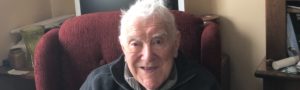
Today, we celebrate and commemorate the life of our local historian, Danny Dowling and commit ourselves to preserve, present and continue his life’s work. For many this might simply involve the oral tradition of the passing down of family information or stories to the next generation, the sharing of local knowledge, or the keeping of local traditions. Pat Dowling shared a number of photos of his father for this pictorial month’s mind. Pat said that there aren’t as many photos of Danny as other family members because Danny was usually the person behind the camera. If readers have any photos or memories of Danny that they would like to share please forward them to glenmore.history@gmail.com.
Further below are photos sent by the East Wall History Group depicting the commemoration ceremony held last Sunday to mark the 100th anniversary of Peter Freyne’s death who was killed in action while attacking the London, North Western Railway Hotel (North Wall) Dublin. I think Danny would have been happy that Peter Freyne’s sacrifice has not been forgotten and was commemorated notwithstanding the scourge of COVID.
Danny Dowling (15 February 1927-17 March 2021)


The Laying of a Wreath in memory of Peter Freyne (1903-1921) by the East Wall History Group on 11 April 2021
Due to COVID the commemoration was small. Four volunteers held a small boat parade. For further information concerning the attack on the L.N.W.R. Hotel on the 11th of April 1921, during the Irish War of Independence, see, https://glenmore-history.com/teenage-volunteers-in-the-war-of-independence-the-freyne-brothers-of-kilcullen-thomastown/.


Please send any corrections or further information to glenmore.history@gmail.com.
Dr. Kathleen Moore Walsh
The Amazing Doctor Powell (c. 1861-1939)

A couple of years ago when Danny Dowling was discussing the Glenmore cemetery (adjoining St. James’s Catholic Church) he identified a famous family buried in the cemetery. The Amazing Doctor Powell, who travelled around Ireland with his circus, and his immediate family are buried in Glenmore. Danny related that the family retuned for at least two generations to bury their dead in the family plot. Danny explained that the only connection the family had with Glenmore was that Doctor Powell’s circus often played Glenmore in the early years of the twentieth century and on one occasion his wife died unexpectantly while they were camped in the field behind Power’s house in the Village. The small house was later removed when Mikey Power built a new house in the field about where Mrs. Powell died. Although Danny was too young to remember having seen Doctor Powell he related that older people around Glenmore spoke about Doctor Powell for years. Today, we are going to highlight the Amazing Doctor Powell, who teamed up with his son-in-law Edward Fossett, and started what would become the Fossett Circus.
The family grave is at the rear of the cemetery on the east side. A large Celtic Cross marks the grave and is flanked by two smaller markers. The inscription provides;
Pray for the soul of George B. Lowe (Doctor Powell)
Who died 26th Dec. 1939 aged 78 years,
And his wife Margaret Bond Lowe who died 15th July 1919, Aged 43 years.
Also their beloved daughter Mona Fossett who died 7th June 1946, aged 41 years,
And her husband Edward Fossett died 7th Sept. 1951, aged 53 years
At the bottom of the stone it states that the monument was erected by Mona Fossett and family. The small stone on the left side of the large Celtic Cross: In loving memory of Johnny Fossett ? [Date is not legible] The small stone on the right side: In loving memory of Susie Fossett wife of Robert of Fossett’s Circus Who Died 16th May 1987, And her husband Bobby Fossett (Bobo The Clown) Died 18th July 2002 aged 77 yrs.

The Amazing Doctor Powell (c. 1861-1939)
Notwithstanding the dates and names provided on the family headstone it was very difficult to locate records to verify the information. For example, the death certificate for Doctor Powell provides that his name was William Powell and he died at his residence on the Quay, in New Ross on 26 December 1939. On the death register his profession is listed as labourer, he was a widower and aged 78. More problematic is his wife, Margaret Bond. No death certificate was found for her in 1919, however in a local newspaper it was reported on 16 April 1921 that Mrs. Frank Powell, wife of the well-known entertainer, Dr. Frank Powell “died recently at Glenmore” (Munster Express, 16 April 1921, p. 6). Given the fact that the headstone was placed and inscribed sometime after Doctor Powell died in late 1939 (and before Mona died in 1946) it is more likely that the correct year of Margaret’s death is 1921 as reflected in the 1921 newspaper.
Various accounts concerning Doctor Powell’s early life have been published. According to his headstone his name at birth was George B. Lowe. Lowe was born in a single story cottage in what is now the entrance to Elm Court in Fair Street, Mallow, Co. Cork, in the 1850’s. In the 1870’s he eloped with Mary Aherne. The newlyweds went to the U.S. where “he took up various jobs before opportunity knocked with an offer of a position with the Buffalo Bill Rodeo Show which travelled all over the States at that time. Lowe adopted the title The Amazing Doctor Powell and performed many rodeo acts, which won him great fame. While on tour in England some years later the troupe performed for Queen Victoria at the Royal Variety Performance Show.” Powell left the troupe and returned to Ireland where he formed his own circus. (Eugene Cosgrove, Irish Independent, 11 July 2020). Other accounts published in 1940 shortly after he died provided that he toured with P.T. Barnum and was on stage with Buffalo Bill (New Ross Standard, Fri, 5 Jan. 1940; Irish Press, 28 Dec. 1939, p. 10). Given the breadth of his skills (listed below) it seems more likely that he toured with P.T. Barnum rather than with a Wild West show.
The Amazing Doctor Powell had one known child, Mona Fossett née Lowe. According to Mona’s death certificate she died on the 8th of June 1946 at the Portobello private nursing home in Rathmines. At the time of her death she was 50 years of age and married. According to the family headstone she was 41 when she died. Based on the conflicting information Mona may have been born between 1896 and 1903. According to Mona, her mother was Margaret Lowe née Bond. If Margaret was 43 years of age when she died she was born around 1877 making her about 16 years younger than her husband. If it is true that the Amazing Doctor Powell married Mary Aherne in the 1870’s it is assumed that Mary died or the couple divorced. Interestingly another purported wife is found in an article published at the time of his death and provides, “During the War of Independence his caustic comments from the ring to audiences about the conduct of the Black and Tans brought him under their notice and his home at Rosslare was burned down. His wife (formerly Miss Heron, of Rathmore) died from the shock” (“Death of Noted Figure in Circus World,” Irish Press, 28 Dec. 1939, p. 10).
No information was found on the Amazing Doctor Powell in the United States in the late 19th century. The first newspaper account in Ireland located regarding the Amazing Doctor Powell was found in the Carlow Sentinel where the newspaper was reporting on local court cases. “Dr Powell, the eminent public entertainer, verified that on the night of the 4th December he was proceeding to give an entertainment at a Schoolhouse in the Ridge district,” (16 Jan. 1915, p. 4). Dr. Powell was the victim of a larceny (a rug was stolen while he was performing). In the court case he used the name Frank Powell.
According to the Fossett Circus webpage Edward Fossett (c. 1896 -1951) the grandson of circus proprietor Sir Robert Fossett moved to Ireland in 1918 and joined the Powell & Clarke circus where he met Mona. In the 1870’s there was a circus in England operating as Powell and Clarke, and later the name was used by the Amazing Doctor Powell and Edward Fossett. It is unlikely that Doctor Powell had anything more than a “stage show” in 1918, but it is not clear when he began using Powell & Clarke. An outline of the development of the Fossett Circus is available at https://www.fossettscircus.com/our-story/ . In any event, Mona and Edward married sometime around 1922-1924 although no record of the marriage was located. The couple had six children and the smaller two markers in the Glenmore cemetery record that two of the sons are buried there, Johnny and Robert (Bobo the Clown) Fossett.
The Circus (1915-1940)
Tom Walsh (1908-1992) related to his son, Peter Walsh, of Rathinure, Glenmore, that the Amazing Doctor Powell was very well received in the area and everyone turned out for his shows. However, Doctor Power had a show interrupted in Big Wood. As part of his act Doctor Powell was answering questions from the audience and couldn’t be stumped until someone asked Doctor Powell who pushed Bridge Ryan into the briars. Everyone was enjoying themselves when suddenly an angry farmer and his comrades rode Doctor Powell’s horses into the tent. Someone had put Doctor Powell’s horses in a field of hay seed. A row commenced and one of the men with the show named O’Connor could box and he put up a good fight until he was hit in the head and knocked out. On another occasion when the Amazing Doctor Powell, had a show in Glenmore, Michael Cody, of Weatherstown, Glenmore, was teasing Mona and O’Connor said, “If you don’t leave Mona alone I’ll spill your blood.” Tom Walsh mistakenly believed that Mona was married to O’Connor, but newspapers throughout the 1920’s and 1930’s refer to a Shaun O’Connor as performing with Powell, and later with the Powell and Clarke Circus as the “original Mrs. Casey” (Irish Press, Thurs. 23 Dec. 1937, p. 13).

After Mona and Edward Fossett married the show or circus was known by several different names. However, it appears evident that Edward Fossett was ready, willing and able to expand Doctor Powell’s original stage show. In June 1925 Powell advertised for circus performers (The Era, Sat. 13 June 1925, p. 2) and the following year “John” Fossett” presented his grand circus to Belfast. The company advertised that it had recently performed at the Royal Agricultural Hall in London. A review stated that “the three Fossett Brothers gave a wonderful riding exhibition and a circus riding school competition was announced. Other acts commented upon were C. Beckett and Partner in the breakaway ladder and Mr. Madison and his educated mule Jenny (Belfast Newsletter, Fri. 5 March 1926, p. 9). The riding school “was the cause of plenty of fun. A safety apparatus which prevented falls, was erected on the stage…” and a number of young people entered the competition and the audience acted as judges. With semi-finals and a final held at the end of the shows (Belfast Newsletter, Tues. 9 March 1926, p. 10) it ensured that patrons returned. At the end of March 1926, the “Fossett Stage Circus” was playing twice nightly at 7 & 9 at the Olympia Late Empire Theatre, and the all star cast included “the Fossett Brothers, May Pilling, Lolo and May trio, horses, ponies, mules and clowns” (Evening Herald, Mon. 29 March 1926, p. 4). In May 1927 the Fossett Circus visited Mullinavat (Munster Express, Fri. 20 May 1927, p. 5).
In the summer of 1929, the Powell & Clark’s A1 Circus was touring in Northern Ireland. “The management of this clever exhibition knows what the public wants…with some fine continental acts” including jugglers, contortionists; Bikela, a splendid trick and comedy cyclist from the London Hippodrome; Athlonas, a troupe of clever athletes; Teddie Fossett, one of the finest circus riders and Doctor Frank Powell the renowned conjuror and ventriloquist; Spider the clown, Eugene the singing fool; Jack Athlease, the champion weight lifter; Wallace the African lion; the Mermaid and 25 beautiful circus horses. (Belfast Telegraph—Thur. 18 July 1929, p. 10). In 1930 it was called the Fossett, Powell and Clarke Circus and featured the Lyton troupe of extraordinary cyclists from winter gardens Berlin. Not only would the troupe play a game of football on bicycles local footballers, using their own bicycles, were invited to compete with the troupe (Kerryman, Sat. 6 June 1931, p. 6).
By 1932, the circus was called the Fossett’s Berlin Tower Circus with many novel and interesting features including exotic animals such as lions, bears, monkeys and the Lynton troupe that played football matches on bicycles (Evening Echo, Sat. 25 June 1932, p. 8). In other places it was advertised as the Fossett’s Circus and Menagerie. It was noted that the transport comprised 28 vans and 55 horses (Drogheda Independent, Sat. 30 July 1932, p. 12). On the front page of the same newspaper the circus was referred to as the Fossett & Heckenberg Berlin Tower Circus & Menagerie. All artists were guaranteed new to Ireland and some of the acts included Captain Pernmane with a troupe of performing teddy bears; a cage of forest bred lions; the Rosalie troupe of lady dancers, clowns and Carmos the wonderful circus band. Admission 3/6, 2/4, 1/6 and 1/3. School children were 6/d at the matinee only.
From the newspapers it appears that in the winter the family performed in traditional stage or variety shows and even showed “talkies” across rural Ireland (Irish Press, Sat. 15 Jan. 1938, p. 15). In the summer they took the circus from town to town. In March 1937 a weekly column was published in the Irish Press newspaper called “Stage” written by “Contorto” to cover show business adverts, news and publicity items. At Christmas of that year the great Heckenberg Berlin Tower Circus via its proprietors Edward Fossett and Sons sent out season’s greetings to patrons, friends and associates. Shaun O’Connor also sent out greeting to all friends on tour with Fossett & Sons Winter Productions. (Irish Press, Thurs. 23 Dec. 1937, p. 13).
By the spring of 1939 the Heckenberg Circus performers included: Chung Lin Sen, the Oriental Illusionist, Morton and his canine wonders; the great Aonele Troupe, sensational rope act; Bukeiko, the Human Pin Cushion; Nica, the elephant; Johnny Quinn, extempore clown; Miss Ella Hannaford Troupe wire and ladder act; Arens and Prince, balancing on a walking cane; the Midnight Jugglers; The Toynox Duo, eccentric comedians; Mick and Mouse, ponies presented by Master Bobbie Fossett; Carton’s Liberty Horses; Flying Westow and Partner, perch act; Performing lions; Los-Fu Mandchu, the fire eater; Bumpa the kicking mule; The Fossett Troupe of Equestrians; Rinso and Co. comedy act… and the Santa Cruz Mexican Swing Band (Irish Press, Fri. 7 April 1939, p. 16).
The addition of exotic performing animals in the 1930’s created risks and injuries. In August 1932, one of the performing “teddy bears” jumped off its chair during a Drogheda performance and grabbed young 8 year old Robert Fossett. Although newspapers alleged that Edward Fossett was in charge of the bears at the time of the “mauling” he denied he was in the tent when it happened (Irish Independent, 17 Aug. 1932, p. 8). Circus performers rushed forward to grab the bear’s chain to pull it away from the child. There was uproar in the audience with women and children screaming. The injured child was rushed to Drogheda Cottage Hospital (Fermanagh Herald, Sat. 13 Aug. 1932, p. 10) where he received stitches and remained for several days.
The following year, Edward Fossett as proprietor of the traveling circus was fined 20s. at Cookstown for cruelty to animals. The Ulster Society for the Prevention of Cruelty to animals brought a case because the 55 square foot cage was deemed to small for the lion. Fossett appealed the magistrate’s decision and he won the appeal (Belfast Newsletter, Sat. 28 Oct. 1933, p. 4). In 1937, in Kells, a lioness reached through the cage bars as the circus was settting up and scratched a boy on the back. The father of the child sued Edward Fossett for £300 although the wounds did not require stitches and the treating doctor said there was no permanent damage done. The court heard the case in 1938 and found Fossett negligent and awarded the child £92 10s with cost and expenses. (Dogheda Independent, Sat. 12 Nov. 1938, p. 10). When the court inquired where Mr. Heckenberg was Edward Fossett testified that he was Heckenberg. Doctor Powell was not named in the case, so it appears that he had no business interest in the circus by 1938.

It isn’t known when Doctor Powell retired to New Ross and stopped traveling with the circus. One newspaper noted that Mona sent her children to school in New Ross (New Ross Standard, Fri. 14 June 1946, p. 8). Perhaps Doctor Powell chose New Ross to retire to be near his grandchildren. In 1934, a newspaper ad appeared “Will Teddy Fossett and Dr. Powell, travelling as Heckenberg’s Berlin Tower Zoo and circus, communicate with Fry, Queenstown” (Irish Press, Sat. 26 May 1934, p. 15). It appears that Doctor Powell was active up to 1935 at least during the summer season. In addition to being a ventriloquist, Doctor Powell was described as a great ringmaster, was an all around performer he was a noted sharp shooter, sword swallower and could play no less than twelve instruments (New Ross Standard, Fri, 5 Jan. 1940). It seems likely that so long as his health held Doctor Powell would be able to continue to be a useful part of the circus.
If anyone has any different or further information or stories concerning the Amazing Doctor Powell please send it to glenmore.history@gmail.com.
Dr Kathleen Moore Walsh
The featured photo is a Fossett Circus poster that depicts the Amazing Doctor Powell’s grandson, Robert Fossett as BoBo the Clown.
For further reading:
For another Irishman who went to the U.S. and joined a circus, see, Johnny Patterson, clown and songwriter, https://www.clarelibrary.ie/eolas/coclare/music/johnny_patterson_bradshaw2.htm
Koehl, Dan (2020). Fossett Brothers Circus (Fossetts Circus), Elephant Encyclopedia. Available online at https://www.elephant.se/location2.php?location_id=732. (archived at the Wayback machine)