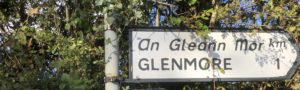
Glenmore Co. Kilkenny
now browsing by tag
Fairs & Markets of New Ross c. 1900

Danny Dowling interviewed Nicholas Forristal, of the Mill, Graiguenakill, Glenmore several times in 1964. Today, we are going to feature Danny’s interview of Friday the 13th of March of that year where Nicky provided information about the New Ross fairs and markets of his youth. “Nicky the Miller” was born on 1 February 1888 and was blessed in that his father, Patrick Forristal (c. 1849-1931) and grandfather lived long lives and shared their knowledge of events and the area with Nicky. Where possible the actual words recorded by Danny of Nicky during the interview are used and marked by quotation marks.
For anyone not familiar with the Parish of Glenmore, Kilkenny lies half way between the City of Waterford, Co. Waterford and the Town of New Ross, Co. Wexford. Until the twentieth century the only market town in Kilkenny close to Glenmore was Thomastown which was further away than both New Ross and Waterford. For information and maps regarding the early main road between New Ross and Waterford see the previous blog post of 14 December 2019. Prior to the earliest bridges being built at New Ross and Waterford people from Kilkenny had to make use of ferries to take their produce to New Ross and Waterford. After bridges spanned the River Barrow at Ross and the River Suir at Waterford tolls were a cost for our Glenmore ancestors when they sought to purchase or sell items in Waterford or New Ross or sought employment in the city or town.
Ancient Fairs and Markets of New Ross
Although the words fairs and markets have come to mean the same thing at one time they were considered distinct occurrences. Generally speaking, market days were set days when sellers and buyers gathered for the buying and selling of a specific commodity e.g. butter, corn etc. The prices agreed in the haggle between the buyers and sellers became the market price. Fairs originally did not occur on a regular basis and were often associated with religious days, where there might be entertainment and a variety of trading e.g. horse and employment fairs. Fairs and markets were vital to the economy of towns and cities and residents relied on food from the countryside. New Ross was no different and several of the early New Ross Corporation books survive and reflect the importance attached to the fairs and markets. The County Wexford Archive has placed some of the surviving books on line with transcriptions.
A fragment from the New Ross Corporation Minute Books for 1634-5 is held in Carlow library. It provides an interesting glimpse into the turbulent 17th century in Ireland. “Most of the entries…concern day-to-day life—keeping the streets clean, securing the water supply, renting out property, protecting the markets and keeping citizens safe.” Control of hucksters at markets was a great concern. (Gráinne Doran & Linda Doran (2020) “A Light on Early Town Governance in New Ross,” 28(1) History Ireland 8-9.) On 17 October 1662 “the toll and customes of the markets and faires of Ross sett and let unto Mr. Barnard White for the ensueing yeare for twenty pound sterling” (New Ross Corporation Minute Book, 1658-1685, vol. 1). In other words, Barnard White for the huge sum in 1662 of £20 became essentially the landlord of the New Ross markets and fairs for a year, and he could set and charge the people engaged in markets and fairs.
Some very ancient customs surround fairs such as the symbol of the glove. In 1710 an order was made in New Ross that no arrests would be made before and after the fair held on the 10th of August. This was not an attempt to encourage or allow criminals to engage in trade. At that time if a person was unable to pay his or her debts that person could be sent to debtor’s prison. Thus, to ensure the success of fairs a sort of safe passage developed. An entry on the 6th of October 1726 ordered that a glove be set up two days before each “faire” day and remain up for two days after the “faire.” The Journal of the Royal Society of Antiquaries of Ireland (30 June 1901, p. 179) in reviewing the entries published extracts of two publications explaining the glove symbol.
“An annual fair is held on Trinity Monday, Tuesday and Wednesday at Southhampton. It is opened by the Mayor and bailiffs with much ceremony on the proceeding Saturday afternoon. The Mayor erects a pole with a large glove fixed to the top of it, near the miller’s house, and the bailiff then takes possession of the fair as chief magistrate in its precinct during the fair, and invites the Mayor and his suite to a collation in his tent…during the fair no person can be arrested for debt within its precincts. On Wednesday at noon the Mayor dissolves the fair by taking down the pole and glove, or rather ordering that it be taken down” (Sir H. Englefield (1805) Wald Through Southhampton, p. 75). At Exeter a similar custom prevailed:–The charter for Exeter Lammas Fair [Aug. 1] is perpetuated by a glove of immense size, stuffed and carried through the city …It is afterwards placed on the top of the Guild hall and then the fair commences (Hone, Every Day Book, ii, 1059).”

As early as 1662, during the reign of Charles II, legislation was enacted that standardised a firkin of butter as weighing 64 pounds comprised of at least 56 pounds of butter and up to 8 pounds for the barrel. Over a century later, the New Ross Corporation books reflect that in 1783 a clerk of the market was appointed at a salary of £10 per year to ensure proper weight and measures were used and to prevent butchers and bakers from committing frauds. As early as 1747 there were complaints that butter and salmon were being sold at the gates and roads leading to New Ross to the detriment of the town’s people and merchants. In an attempt to control and regulate trading a corn market was built in Robert Street in 1818 just twenty years after the 1798 Rebellion. According to Linda Doran the corn market was not altogether successful. Ten years after it was built all tradesmen were required to weigh and sell their corn at the market. In 1832 markets which were deemed street obstructions in New Ross were removed to the corn market. In 1864 a meeting was called to investigate the possibility to free the bridge from tolls (Linda Doran (2011) “Capturing the Quotidian: New Ross Corporation Books,” 1685-1900,” in 19(5) History Ireland 22-25.)
Fairs & Markets of New Ross at the Turn of the 20th Century
Accoring to Nicky “the Miller” Forristal, up until about 1899 New Ross fairs were held on different dates. In about 1899 the second Tuesday of the month was introduced as the fair day of Ross. When he was a boy Nicky recalled fairs being held on Easter Monday, the 10th of February, and on the 3rd of May—the hiring fair. On the hiring fairs the men and women seeking work “used present themselves with a spancil round their wrists so as to indicate their calling. Those spancils were called booracs and búltáins. Used hire for the quarter. The settlement between the parties was made on the fair. The agreement in most cases was adhered to because if not, the labourer was not paid if he left.”
For non-farmers a spancil is a short length of rope used to hobble an animal. The animal could graze but could not wonder off too far. Well into the twentieth century spancils also were used to keep cows from kicking while being milked. It appears that from what Nicky said that different types of spancils were used to indicate the type of work that the prospective employee was able or willing to perform. The employee would work for 3 months before being paid and if the employee left before the end of the 3 months he would not be paid anything. According to Danny Dowling the agreement included wages, room and board and additionally there might be an agreement on the type and amount of ‘grub’ that would be provided to the employee.
“The fat pig market at Ross was always held on the day before the general fair. Small pigs were sold on the general fair. The people used drive the pigs into Ross on a Sunday evening and put them in some of the yards in the Irishtown. Brewer’s, Teehan’s (where Shea’s were) and Campbell’s yards etc. When the pigs were sold they had to be driven to the boat (Ida etc.) early as it left for Waterford at 9 o’clock in the morning. Hence the reason for the very early start of the fairs.”

Nicky recalled that he drove pigs to Kough’s Bacon Factory on the Quay in about 1899. “Good deal of people worked there, men and women. Made sausages, puddings items and every shop in Ross sold offal meats then. Nicky saw cards up in the shops selling meat which read thus ‘Buy Kough’s Bacon well known for its delicious flavour and standard quality.’ ” According to Nicky, Kough’s Bacon Factory went into liquidation long before the first Great War.
Markets were held in Ross every Thursday and Saturday. The spud market was held on the Quay at Fox’s Pub. The weighing scales for the spuds were “opposite beside river.” The butter market ran from “Bridge to Market House.” Salmon sold at Fish House. At Bank of Ireland—vegetables sold. Opposite the Bank of Ireland on the Quay side fresh herrings were sold from dray cars while in season.
The fowl market was held in John and North St. at either side of the Hotel. Asses, jennets and carts full of fowl were lined up. “The man who would buy the lot would chalk his name on the cart. They were then brought to the boat which was moored opposite Foxe’s. Each fowl buyer had a bed on the Quay where the fowl were put after taking them from the carts, before being put on the boat. This market used always start before the break of day. Hardly any men attended it, only women and chaps. Over before 9 o’clock as the fowl had to be on the boat which left at that time. This market was held on a Thursday. This early market finished when the boat ended in 1904.” For information regarding the Ida and the shipping of animals see our previous blog of 29 February 2020.
“The firkin butter market was held in Charles Street. People brought the fresh butter in buckets to the market. It ended about the First War. Glenmore people stopped attending when the creamery started.” Only the larger farmers who kept several cows could produce a firkin or 56 pounds of butter. Before the Glenmore Creamery opened there were not many cows in Glenmore. Prior to the Creamery opening people from the area with butter went mainly to the Waterford Butter Market. People from Tullogher, who were closer to New Ross, used to travel with the firkins of butter on the Ida to Waterford.

Until the 1880’s a lot of wheat was grown in the Glenmore area. “Then the bottom dropped out of the market owing to the imports of foreign wheat. The last wheat Tommy Forristal, of Ballyverneen [Glenmore] ever had, he was forced to bring it to Thomastown by horses and carts. That was in the 1880’s.” “Very few cattle kept by the local people of this area” prior to 1900. Nearly all cattle were sold as yearlings and even younger. Cows were also scarce. “The farmers with the largest cow herds in Glenmore then were Coady’s of Carrigcloney and Tommy Forristal of Ballyverneen with 20 cows each. After introduction of creamery here the farmers increased their herds.” For information concerning the establishment of the Glenmore Creamery see the previous post of 9 May 2020.
At the turn of the twentieth century Nicky recalled the following prices which ‘were got’ at Ross markets:
- “Seed potatoes 3d stone;
- Pig’s heads 2/= for 12 lbs.;
- Danish Pig’s Heads 1 ½ d [per] lb;
- Butter 6d to 8d per lb;
- Barrel of oats 7/6;
- Barrel of barley 13-14/=;
Nicky went on to explain that fowl and turkeys then were never sold by weight. Instead they were sold by the pair. Until about 1894, “people from this area used go to the fowl market of Grannagh. Had to leave the night before… At that time turkey realised by the pair, cocks 18-20/=; hens 8-10/=.”
To illustrate the prices under the Imperial system–which some elderly Glenmore residents today refer to as “old money”– there were pounds £, shillings / and pence d. There were 12 pence in a shilling, and 20 shillings in a pound. Thus, seed potatoes sold for 3 pence per stone (14 pounds) of potatoes. A barrel of oats sold for 7 shillings and 6 pence etc..
In the next couple of weeks we shall highlight some of the other “business” that occurred at and after local fairs as commented upon by Nicky the Miller in 1964 and recorded by Danny Dowling. Please send any errors or corrections to glenmore.history@gmail.com.
Dr. Kathleen Moore Walsh

The photo of the New Ross Corn Market appeared in Linda Doran’s excellent 2011 article “Capturing the Quotidian: New Ross Corporation Books,” 1685-1900,” in 19(5) History Ireland 22-25. The photo of the corn market is from a glass plate belonging to Jimmy Fitzgibbon and was part of the Cavanagh Magic Latern Collection. Prior to cinemas, Magic Laterns were used to entertain people by the showing of projections from early photographic glass plates. William Cavangh had a collection of these early glass plates of the New Ross area. The photo to the right shows Jimmy Fitzgibbon (on left) with his 150 year old Magic Latern. Edward Delany is on the right. (New Ross Standard, 31 August 2015).
The featured photo above is art work from the New Ross Corporation Minute Book, 1658-1687, p. 50. It reads, “Eusebius Cotton, Esquire, Soveraigne of New Ross, Anno D’ni 1662.”
Cycling at the Turn of the 20th Century [Updated]

Danny Dowling recorded the names of local people who were the first to own bicycles as well as information concerning the brands or types of bicycles purchased. Please see our post of 28 December 2019 for the details.
The young men and women of the 1890’s were the first to have access to what were known as the early “safety bicycles.” These bicycles replaced the dangerous penny farthings. By the end of the decade the price of bicycles declined and their popularity in Ireland increased. The fall in the price of bicycles was due to new methods of mass production and fierce international competition resulted in bicycles being made affordable to more people which in turn paved the way for a social revolution in terms of recreation and transport. “Previous distances which may have taken the best part of a day could now be easily done within an hour” (Barry Shepherd, The Irish Story blog, 7 Nov. 2019 “Recycling History: The Bicycle and Protest in Ireland“). One common problem across Ireland was the state of road surfaces.
Shepherd has noted that at the same time cycling was becoming popular in Ireland there was a cultural revolution rapidly spreading across the country, revitalising the Irish language, literature and sport that eventually reached politics. The Gaelic Athletic Association (GAA) was founded in late 1884 and immediately sought to incorporate field sports, athletics and cycling under its control. Earlier in 1884 the Irish Cycling Association (ICA) had been founded. The rivalry between the two groups continued until 1910 when the ICA ceased operating. Irish cycling clubs attached to preservation and language revival groups at the turn of the 20th century became very popular.
The activities of the first generation who took up cycling not only changed their own lives but changed society as a whole. For example, people living in rural areas, such as Glenmore, the bicycle dramatically increased the number of potential spouses as they were able to socialize more frequently and meet others outside the parish. As the price of bicycles decreased in the 1890’s it became increasingly possible for working class women to purchase bicycles. The bicycle was not only a symbol of, but also a means of achieving freedoms for women (William Manners, “The Secret History of 19th Century Cyclists,” The Guardian, 9 June 2015).

One of the liberated ladies who had “a machine” had a bit of a crash in Waterford in 1899 which was reported in the Munster Express (Sat. 2 December 1899, p. 5). On the first of December sometime between one and two in the afternoon an English lady, who was visiting friends in Catherine street, Waterford, had an “exciting and perilous experience.” While riding her bicycle out of Syme’s Lane on to the Waterside she turned in the direction of the park “and something went wrong.” The lady and her machine splashed into John’s Pill “to the utter astonishment of some men in a barge belonging to Messrs Murphy Brothers, who fortunately were working in their boat near at hand. They promptly assisted the lady to terre firma very wet, considerably frightened, but otherwise none the worse for her impromptu bath. Her great anxiety when on land once more was as to the fate of the machine, which was ultimately fished out of the river, and handed to its damp but grateful owner.”
In 1900 the Waterford, Limerick and Western Railway time table (p. 17) advertised special fares for cyclists. The railway would convey the owner’s bicycle at the owner’s risk from or to Limerick and Waterford to enable cyclists to go out by train and return by road or vice versa. The cyclist fares were available for all trains except the first morning train in each direction. The Munster Express in reviewing the advertised fares observed that “the wording of the directions like the sections in an Act of Parliament, are beautifully ambiguous.” Under the terms of the offer the railway charged five pence more for the carrying of a cycle 8 miles than it would charge a passenger (Munster Express, Sat. 7 July 1900, p. 5). Further afield the Cycling newspaper of Britain began publishing articles about cycle tours in Ireland including a run from Kilkenny to Thurles (Cycling, Sat. 26, April 1902, p. 44) and from Dublin to Killarney by Wicklow which directed cyclists through “New Ross, Glenmore and Waterford.” (Cycling, Sat. 20 July 1901, p. 70). Later in the decade other areas, such as Mullinavat, sought the business of cyclists. “A Pleasant Run for Waterford Cyclists—The Pioneer House, Mullinavat, has opened a rustic Tea Room, for cyclists. D.B.C. charges, pot of tea, 3d; roll and butter, 2d.; cake, 2d; barm-brack freshly cut, 2d; cream, 1d; hams, honey etc. Large parties catered for. Tables reserved if postcard stating hour reaches Manageress, Pioneer House, Mullinavat, same morning (Munster Express, Sat. 16 July 1910, p. 5).”
Glenmore was not immune to the cycling craze and by the turn of the 20th century the Glenmore Cyclists Association was founded. Unfortunately, very little information is available regarding the group, but from a newspaper account it is known that both men and women were members. The following article appeared in the Munster Express (16 March 1901, p. 5)
“A meeting of the Glenmore Cyclists Association was held on last Sunday. Several of the lady members kindly graced the meeting by their presence. After some preliminary business being transacted it was unanimously adopted, on the proposition of Mr. J. Dunphy, seconded by Mr. N. Gaffney, and ably supported by Messrs. J. Fluskey and M. Murphy, that –“We, the members of the Glenmore Cyclists Association, shall take our first run for the season on St. Patrick’s Day, our destination being Tramore. All members are requested to meet at the “Churns” at 12 o’clock sharp.”
A review of the 1901 census provides that N. Gaffney was Nicholas Gaffney who lived in Glenmore Village and was 27 years of age. J. Fluskey was James Fluskey who was 19 in 1901. J. Dunphy may refer to John Dunphy, of Ballyverneen, who was 21 in 1901. Attempting to identify M. Murphy is very problematic as 5 young men named Michael Murphy were found in the 1901 census. The townlands and ages are as follows: Ard Beg (Coolnaleen) aged 19; Ballylammy, aged 19; Ballybrahee, aged 20; Cappagh, aged 22; and Rathinure, aged 22.

To cycle in 1901 from Glenmore to Tramore the main road went through Slieverue Village and the cyclists had to pay a toll to cross the Suir at Waterford city. The old Waterford wooden bridge was called Timbertoes. In early 1908 it was reported in Cycling that the old wooden toll bridge, after 50 years efforts, and a large public demonstration attended by cyclists, was freed. The Waterford Corporation obtained the power for compulsory purchase of Timbertoes and paid the owners £63,885, 17s, 9d, as compensation (Cycling, Wed. 8 Jan. 1908, p. 22).
A couple of months after the Glenmore Cyclists Association’s 1901 run to Tramore the Munster Express (Sat. 15 June 1901, p. 5) reported on a “great bicycle race” which took place on the “New Line” in Glenmore on Sunday evening the 9th of June.
“The favourite won on his old “Dunlop” in a canter. “Jem” was a good second; N.G’s tyre got punctured. “Ter,” said he would not think worth his while to race against any of them. I understand the man on the “rotten bundle of sticks” would have a narrow escape only for the starter.” [It is believed that N.G. refers to Nicholas Gaffney and Ter may refer to Terrence Fluskey who was 16 years of age in 1901. Jem may refer to Jim Fluskey aged 19 in 1901.]
However, at the turn of the 20th century, just like today, not everyone liked cyclists. “A case of unexampled blackguardism occurred on the road from Waterford to Tramore on Sunday,” the 27th of April 1901 when four or five Waterford cyclists encountered a road block. “[S]ome fellows of the ‘pot-boy’ class who seemed to have laid in a larger stock of some intoxicating beverage” stood with their arms locked and blocked the public road. They apparently sought to impose a toll on the cyclists who refused to pay. The editor of the Waterford News & Star advised cyclists subjected to similar insult to thrash the blackguards (Waterford News & Star, Fri. 3 May 1901, p. 3).
Update 2 June 2021–while searching for something else the following was discovered regarding some “fancy trick riders” in Glenmore in 1903. “Our wonderful acrobats and fancy trick cyclists continue to vie with each other at ‘the Churns.’ Martin and Tom are certainly famous, but be h—ls Jimmy hasn’t yet appeared. We all anxiously await next Sunday at six when Tom intends managing four bikes at a time. ‘Tatler'” (Munster Express, 5 Sept. 1903, p.1).

The popularity of bicycles continued to grow as the 20th century progressed, and during the War of Independence the bicycle played an important means of transportation and communication. As we have reported in other blog posts the Crown military authorities severely limited the use of bicycles in some areas in an effort to stop attacks on Crown forces and the R.I.C.. See generally, Barry Shepherd, Recycling History: The Bicycle and Protest in Ireland.
The featured photo above is a Player’s Cigarette Card, courtesy of the New York City Library’s digital collection.
Dr. Kathleen Moore Walsh
One Hundred Years Ago: May 1921

The War of Independence continued with no truce in sight. Although most books on the War focus on the big events, that took place in Dublin and elsewhere, we are going to continue to focus on more local events as well as the news Glenmore people received via local censored newspapers. In the first week of May it was reported in the official report from Dublin Castle that “attacks on Crown forces continued unabated.” There were 2,593 internees (Waterford News & Star, Fri. 6 May 1921, p. 5) Not only did the attacks on Crown forces continue there were four more Irishmen executed on the 30th of April at the Cork Detention Barracks. Their names were: Patrick Ronayne (24), and Thomas Mulcahy (18), sentenced in connection with the Mourne Abbey ambush, and Maurice Moore (24), and Patrick Sullivan (22), sentenced in connection with the Clonnult fight. Press representatives were prohibited from reporting anything except the bare announcement of the executions and the history of the cases. It was reporting that since the beginning of 1921 eighteen men were executed. Eleven men were shot in Cork and seven were hanged in Mountjoy Jail (New Ross Standard, Fri. 6 May 1921, p. 3).
Kilkenny man Patrick Walsh, of Dunamaggin, was wounded on the 23th by Crown forces at a battle at Tubrid. He died on the 19th at the Fermoy military hospital after one of legs was amputated due to the gunshot wound to his knee. It was reported that he was recently released from Waterford Jail where he served a term of imprisonment for a political offence. During his wake at Dunamaggin the wake was visited by Crown forces. The attendance at his funeral was limited and the tricolour was removed from his coffin (Munster Express, Sat. 28 May 1921, p. 6).
New Ross
More locally in New Ross, “a town which had hitherto [been] immune from things of a startling nature,” the month started with a bang. On the 4th of May a bomb was thrown at members of the R.I.C. who were patrolling Cherry’s road. The bomb was thrown from an upper road known as Creywells. No police were injured, and they immediately raised the alarm. Military were at once on the street, and issued a command for all civilians to keep indoors. Several civilians were halted and ordered to put up their hands. One man named Murphy, believed to be from Rathgarogue district, was fired at and wounded. Murphy, it is stated, disobeyed the challenge to halt, but complied with the order to put up his hands. Later all lights were ordered extinguished and it was anticipated that a curfew would be introduced. “The place or road where the bomb was landed takes its name from a Waterford gentleman named Cherry, who started and for many years had a controlling interest in Cherry’s Brewery” (Waterford News & Star, Fri. 6 May 1921, p.7).
Before the month ended the military informed New Ross merchant, Joseph McCarthy, that the colour of his shop front had to be altered. The shop front was painted green, white and gold, with margins of black. Following the military order McCarthy employed a painter to alter his colour scheme (New Ross Standard, Fri. 27 May 1921, p. 5).
Waterford
Just down the road in Waterford City the month commenced with a great amount of military activity and several arrests were made. Crown forces visited the licensed premises of Mrs. O’Neill, Sallypark, where her brother Jack Dowling was being waked. Dowling died on the first following a fall from his horse. The people attending the wake were search, but no arrests were made. In Ferrybank two men Grant and Norris were arrested Saturday and later Purcell and Cummins were also arrested. It was believed that several men “on the run” were hiding in the Waterford Lunatic asylum. It was raided by Crown forces and searched for over three hours. Two attendants named Thomas Gallagher and J. Bret were arrested. Tuesday David Grant, of Ferrybank was released (Munster Express, Sat. 7 May 1921, p. 6). James O’Mara, a T.D. from South Kilkenny cabled from the safety of Chicago “expressing gratitude for the opportunities given him to serve the country, and stating that circumstances imperatively prohibited his further candidature, or his acceptance if elected” (Munster Express, Sat. 7 May 1921, p. 5).
On the first of May five simultaneous raids took place in sub-post offices across Waterford city shortly after 6 o’clock. The total amount taken in cash, stamps, and post orders amount to about £250. The raiders were mostly young men and were not disguised. It was reported that the King Street Office [now O’Connell St.] was robbed by five men who were not disguised, and armed with revolvers. Upon entry they immediately cut the telegraph wire to the general Post Office. They took about £100 in stamps and cash. Three men arrived on bicycles and entered the Barrack Street post office where they pretended to buy stamps. When they presented a revolver and the clerk screamed. Mrs. Ryan the sub-post mistress raised the alarm and the three men fled. A child ran in front of one of the men and he slowed to avoid the child and was caught by a plain clothed policeman. The other two men made off with 10 shillings in stamps. Three armed men also entered the Newtown post office. The Postmaster James Kelly, aged 74, when confronted fought with one of the robbers. Kelly was hospitalized after being struck in the forehead. Four armed men entered the Parnell Street post office and Denis Clery, the post-master, was held at gunpoint. His wife and daughter fainted and the four robbers made their escape by bicycle. Two went to the left toward the Mall and two to the right toward the carstand. In less than 5 minutes the military arrived. The amount taken was small. Across the river the Ferrybank post office was entered by four men who were not disguised. Mrs. McCoomb, the postmistress, reported that the men took about £47 in postal orders, stamps and money, but only about £7 of the amount was negotiable (Munster Express, Sat. 7 May 1921, p. 6).
Only two weeks later it was reported that Peter Grant of Belmount Road, Ferrybank and James Cummings, of 66 Sallypark were convicted of robbing the Barrack St. post office and were sentenced to 3 years prison (Munster Express, Sat. 14 May 1921). On the 26th of May two Waterford city postman were held up by masked men as they were cycling with mail from the city to rural areas of Slieverue and Snowhill. The mail was taken from them both (Waterford News & Star, Fri. 27 May 1921, p. 8). In addition to the continued disruption of mail rail transit facilities were also affected, but Guinness hired a special steamer to supply stout to their Waterford clients. The cargo was unloaded near the bridge (Waterford News & Star, Fri. 20 May 1921, p. 5).
Glenmore
Glenmore featured a few times in the news. Road trenching continued to disrupt the military traveling through rural areas. A Dublin Castle report stated that a number of men armed with rifles and shotguns commandeered a number of civilians in Glenmore village, as they were coming from evening prayers. The villagers were marched to Ballinclea, where they were compelled to dig trenches in the public road (Munster Express, Sat. 28 May 1921, p. 6). The military responded by issuing a proclamation that Mullinavat, Glenmore and Glenpipe creameries were to close from the 21st of May until the 21st of June for the trenching of roads and raiding of mails in local areas (Munster Express, Sat. 28 May 1921, p. 6).
[Update 24 May 2022–It was reported in the New Ross Standard, (Sat. 12 June 1971, p. 4) that 50 years ago, ss a result of the closing of Glenmore Creamery by the military, suppliers brought new milk into New Ross and sold it at 2d. per pint.]

It was also reported that a bread van belonging to Mr. Costello, of Mullinavat was stopped by armed masked men on the Glenmore road at Walsh’s mountain. The driver was robbed and the bread van and harness were set on fire and completely burned. An unnamed farmer in the Glenmore district was robbed when a number of masked and armed men forcibly entered his house and searched it. The armed men decamped with an “amount close to £100” (Munster Express, Sat. 28 May 1921, p. 6).
The local IRA responded to the creamery closure on the 21st of May by stopping the last evening train from Waterford to New Ross. The train was stopped at a cutting that the newspaper described as being about two miles from Glenmore. It is believed the train was stopped near Scartnamore, Glenmore. It was reported that masked men held positions at the “tops of the lofty embankments.” All the passengers were commanded by an unspecified number of masked and armed men to alight from the train. The men were ordered to walk up the line, while the women and children were detained at the train. The raiders entered all the carriages and then directed their attention to the guard’s van. The newspaper does not indicate if mail was taken. The women and children were ordered back to their seats. The men were then searched and their papers and other documents examined. “One passenger was particularly questioned, and a bicycle, apparently his property, was commandeered.” The men were ordered to take their seats and the train pulled into the Aylwardstown, Glenmore station about forty minutes late (Munster Express, Sat. 28 May 1921, p. 3).
Dublin, Custom House Attack

On Wednesday the 25th of May 1921 at 1:15 in the afternoon a number of loud explosions were heard in the centre of Dublin. It was reported in the New Ross Standard based upon the Evening Herald that the Estates Office section of the Custom House was attacked by armed men. Almost simultaneously a lorry of Auxillaries drove into Bereford Place from the Eden Quay end. The lorry came under fire and the Auxillaries responded with rifles and a machine gun fire. As it was dinner hour the streets were full of pedestrians and residents who in a blind panic ran into houses. It was reported that the firing was directed at Gardiner and Store streets and one civilian unlucky to be in the area had his head practically blown off. Witnesses reported that as the Auxillaries moved from their lorry flames could be seen billowing from the western section of the Custom House. Numerous loads of auxiliary police, armed military and armoured cars kept racing down the quays to the scenes. Crowds began to gather on O’Connell Bridge and did not seem “the least perturbed at the arrival of Crown forces…” General Headquarters issued a report later that night that stated 100 men rushed the Custom House and set it on fire. Crown forces were immediately on the scene where they were bombed and fired upon from the railway bridge adjoining the Custom Houses. Four cadets were wounded. A small party of rebels ran from the building firing revolvers. Civilians poured out of the burning building with their hands over their heads. Among the civilians a large number of rebels sought to escape.“ Over 100 were civilians whose presence in the building could not be satisfactorily explained, and several of those people had distinct traces of petrol on them.” Seven civilians were killed, ten were wounded and 111 were arrested. (New Ross Standard, Fri. 27 May 1921, p. 5). As reported in an earlier blog one of the men arrested was James Francis “Frank” Freyne (1902-1974) the son of Glenmore native John Freyne (1866-1936).
For futher detailed information on the burning of the Custom House see
John Dorney, Today in Irish History blog.
Paul O’Brien, Operation Ares .
The featured photo above is a May bush in Glenmore Village on May Day 2021.
The photo of the horse drawn bread van was owned by Mr. Faulconbridge, Bedworth in the 1920’s. “Reproduced from the “Our Warwickshire” website © “Bedworth Library.” IMAGE LOCATION: (Bedworth Library), Reference: Bedworth Library, 371, img: 4032.
Dr. Kathleen Moore Walsh
Kilkenny Gaelic Football Team: USA Champions 1920

In October 1920, James Reddy, the Secretary of the Kilkenny Gaelic Football Team of New York, sent the following poem to the Kilkenny People newspaper which published it (Sat. 16 Oct. 1920, p. 6). The poem was written to commemorate the victory of the Kilkenny Gaelic Football team in the 1920 U.S. championship game played on 15 August 1920 between Kilkenny and Cavan exiles in New York. In the run up to the game it was reported that Cavan obtained a number of out of town “stars” for this game (New York Herald, 12 Aug. 1920, p. 11). Glenmore is mentioned twice in the poem along with Hanrahan. It is assumed that Hanrahan may be a reference to Glenmore native Michael J. Hanrahan (1888-1968) Interestingly the colours of the Kilkenny team in the poem are listed as green and black rather than the usual black and amber.
There is a joy tonight in Ossory,
               From Gowran to Glenmore,
From ancient Kells across to where
               Poulnassy waters roar.
From the hurlers of Moondharrig,
               To the banks of the Linaun,
From the storied town of Rebel Ross,
               To the highlands ‘round Faranaun.
Proud are the white-walled villages,
               That claim a gallant son,
Among Ireland’s best in New York town,
               Who have played today and won;
Who have met the north, the south and west,
               In battle fierce and keen,
Who have never lowered their colours yet—
               Kilkenny’s Black and Green.
They have won today far, far away,
               Upon the Yankee shore,
Let their praises ring through mount and glen,
               By Barrow, Suir and Nore;
And let old Slieve-na-man look down,
               And sing their praises too,
For her gallant sons before them fell,
               Across the ocean blue.
Besides the towering turrets,
               Of mighty Gotham Town,
Where monuments to Irish brawn,
               From lowering clouds look down.
To battle for the championship,
               Your gallant sons went forth,
Against Cavan’s famed O’Reilly’s,
               Great champions of the North.
The scattered Gael in thousands came,
`              from the north, south, east and west,
To see his game of boyhood days,
               Played by Old Ireland’s best.
And many a cheer ‘rose ringing there,
               When Cavan took the field,
Prepared to test Kilkenny’s best,
               Who were never known to yield.
Now silence fell upon the field,
               As the ball goes into play,
And like flashing fire from out the sky,
               Jim Reddy broke away.
The leather goes from Whelan now,
               To Duggan, of renown,
And across to Tommy Daly,
               The pride of Cotterstown.
Here Furlong and Jim Farrell,
               Now charged the Cavan back,
With Kilkeasey, Matty Butler,
               In a fierce but grand attack.
Great was that Cavan back defence,
               ‘Gainst the miners from the Nore,
But the white flag fluttered in the breeze,
               For the first Kilkenny score.
Down came the mighty northmen,
               And charged the miners’ ground,
But down upon our half-back line,
               Some fearless men they found;
Here Hanrahan and Dowling,
               From Gowran and Glenmore,
Met and sent back in slashing style,
               Amid a thund’rous roar.
Again the red-clad northmen,
              Came charging down the field,
In fierce determination,
               To make our back men yield.
But Carroll, Dwyer and Aylward,
               Across the goal were drawn,
Sons of Kells and old Knocktopher,
               With Jack Maher from Faranaun.
There goes the final whistle sound—
               Kilkenny wins the day!
There goes the news across the wave,
               To homes far, far away;
To home in verdant Orrorie,
               Which sigh for them in vain,
Saying, “Come back to me, I yet will be
               A nation once again.”

by James P. Veale, New York City, U.S.A., August 15th, 1920.
[Update 7 Dec. 2024. The author James Patrick Veale (1878-1930) was born at Ballyglossom, Templeorum, Kilkenny, the son of Michael Vale (sic) and his wife Margaret Butler. ]
The featured photo is from a 1924 championship senior football match played in Ireland between Wexford and Dublin. Both photos were originally published in the Freeman’s Journal.
Dr. Kathleen Moore Walsh
The Gallant Glenmore Brothers: Seamus & Pakie Jones [Updated]

Today, we are going to highlight a tragic event that took place in Glenmore in 1955 and the gallant actions of two young Glenmore brothers Seamus and Pakie Jones who risked their lives attempting to rescue another.
On Monday the 25th of July 1955 after a long hot day Nicholas “Nick” Hanrahan (c. 1926-1955) cycled from his home in Glenmore Village to Maid’s Quay on the River Barrow in Ballyverneen, Glenmore. Nick was 29 years of age and drowned at about 9:30 p.m. shortly after entering the River Barrow. According to Danny Dowling, Maid’s Quay (sometimes referred to as Ballyverneen Quay) was where the Glenmore Creamery built a coal shed to receive coal shipped by ship from Britain. Although Maid’s Quay was a busy and popular spot it was also said to be very dangerous because of the river currents. In 1955 the main road from Waterford to New Ross ran through Ballyverneen, under the railway line, along the river past Maid’s Quay and the Pink Rock.

At the inquest held on Tuesday the 26th of July at the Glenmore Barracks, Sergeant J.C. Dalton, Glenmore conducted the proceedings on behalf of the Garda. Mr. T.G. Lanigan, solicitor, Kilkenny, Deputy Coroner, heard the evidence without a jury.
Seamus Jones (c. 1932-2016) testified that he was 23 years of age and provided evidence concerning the events leading up to Nick’s death. On the previous evening, Seamus went to Ballyverneen Quay, accompanied by Paddy Griffin, Liam (sic) Griffin, Martin Cass and Walter Walsh. It is believed that the correct name of Paddy Griffin’s brother was Larry. It is also believed that Patrick “Pakie” Jones (c. 1932-2006) was also in the group although he was not named with the others.
Seamus testified that at about 9 p.m., Nick Hanrahan cycled down the lane from the main road to where Seamus and his friends were gathered. Nick undressed and went into the river. He swam along by a rope which was anchoring a pontoon. Seamus noticed Nick drifting away from the rope, and then he began to drift further away as he was being pulled by the tide. Nick gave a shout, and Seamus took off his coat and jumped into the water to save him. It was reported in the newspaper that Nick wasn’t a strong swimmer.
Seamus testified, “When I got to him he gripped me around the waist and I tried to turn him out of the current, but we were being carried away. He slipped away from my grip, and then he caught me by the legs. At this stage, my brother Pakie swam out to me in the river and I caught hold of Pakie by the shoulders.”
When Nick began to lose his grip on Seamus’s leg, Seamus “clutched him by the hair of the head.” Unfortunately, Seamus had a bad grip and was unable to hold onto Nick and stated, “the current swept him away from me. My brother held on to me and helped me in. I would say there were from 18 to 20 feet of water in the place where deceased went down. I did I not see him after I lost my grip on his hair, and at that time we were about seven yards from the pier. The tide was about half full at the time, and there was a strong current at the place. I had my shirt, trousers and shoes on me when I jumped into the water.”
Local gardai and fishermen appeared at first light the following morning and began dragging the river. Philip Connolly, of Rochestown, Glenmore, testified that he arrived at the Quay at about 4 a.m. on Tuesday and he Ned Connolly and Dick Kennedy recovered the body about an hour later in about 15 feet of water. The recovered body was taken to the Glenmore Dispensary where Richard “Dick” Hanrahan (c. 1929-2006) identified his brother. Dick testified at the inquest that he last saw his brother Nick alive at 7:30 p.m. on the date of his death and he was in his usual good health. He testified that Nick was 29, unmarried and was a farmer by occupation.

Dr. Michael J. Keating, the Medical Officer of Kilmakevogue Dispenary District (Mullinavat & Glenmore) performed a post-mortem examination at the Glenmore Dispensary. He found a lacerated wound on Nick’s upper lip and lacerated wounds on his ears which he attributed to the dragging activities. He found that death was caused by asphyxia due to drowning. In his opinion the body had been in the water for 12 to 15 hours when it was recovered.
Returning a verdict of accidental drowning, in accordance with the medical evidence, Deputy Coroner Lanigan referred to the “very gallant action” of Seamus Jones in jumping into the river and attempting to rescue Nick. Lanigan asked the Gardai to have this young man’s “plucky action” brought to the notice of the appropriate authorities with a view to adequate recognition. Sympathy was tendered to the relatives of the deceased.
Although no newspaper article could be discovered concerning any event held to recognise the gallant actions of Seamus & Pakie Jones it was verified that both Seamus and Pakie were recognised with gold watches (Ann Jones, 24 April 2021). [Correction of 9 May 2021–The New Ross Standard (Fri. 27 April 1956, p. 5) published an article entitled, “Brave Rescue Attempt Recalled: Certificate for Bravery Presented—At the New Ross District Court on Tuesday. A Certificate of Bravery from Comhairle na Mire Gaile was presented to Mr. Patrick Jones, Glenmore, who received it on behalf of his son Seumas (sic) in recognition of Mr. Seumas Jones brave attempt to rescue a drowning man from the River Barrow in July 1955. It is believed that the Hanrahan family presented both brothers with the gold watches.]
The local newspapers reported that Nick was the eldest son of Mr. and Mrs. Patrick Hanrahan, merchants and farmers, Glenmore, and brother of Richard and Annie Hanrahan. He was also nephew of Messrs. James and Dick Hanrahan, merchants, New Ross (former Glenmore and Kilkenny inter-county footballers); John and Michael Hanrahan, New York; Richard Duggan, rate collector, Glenmore; Mrs. Connolly, Slieverue and Mrs. F. Quirke, Clerihan, Clonmel. He also played with Glenmore junior hurling team and was also a prominent member of the local F.C.A. Nick was buried in Glenmore. (Munster Express, Fri. 29 July 1955 & Kilkenny People Sat. 30 July 1955).

Pakie and Seamus Jones were the sons of Patrick Jones (c. 1897-1975) and his wife Alice Jones née Dunne (c. 1890-1967). Their father, Patrick Jones (c. 1897-1975) was the second eldest son of their grandparents, George Jones (c. 1874-1945) and Bridget Jones née Murphy (c. 1879-1945). George and Bridget were married at Glenmore on 16 August 1894. At the time of their wedding George was living in Weatherstown, Glenmore and working as a labourer and his father was George Jones (farmer). Bridget was residing in Moulerstown, Glenmore and her father was Pat Murphy (labourer). The 1911 census for Graiguenakill, Glenmore indicates that George and Bridget Jones had 7 children born and all 7 were alive in 1911. Patrick’s siblings included: James (c. 1895); John (c. 1898); George (c. 1901); Thomas (c. 1906); Michael (c. 1908) and Kyran (c. 1910). Patrick Jones (c. 1897-1975) was located in the 1911 census living and working as a servant in Aylwardtown, Glenmore for Patrick Morrissey (aged 74).

A newspaper search revealed that a few months after Nick Hanrahan drowned Seamus Jones left for Britain to take up employment. He went with other Glenmore men: Tom Ryan, of Milltown; H. Walsh [Harry Walsh], Ballybrahee; Wm. Irish, Ballinlammy; and Billy Walsh, Mullinahone (Munster Express, 16 Sept. 1955, p. 9). At some point Seamus returned to Glenmore and spent the rest of his life in the Village living with his brother Pakie. Pakie worked for the Glenmore Creamery and never drove a vehicle. Pakie died on 16 April 2006. Seamus worked for Roadstone as a roller driver and died on 29 September 2016. Although neither of the brothers married an obituary for Seamus noted that he had a lifelong friend Kitty Power. The brothers were both buried in Glenmore.
[Update of 9 May 2021–the newspaper article concerning the Certificate of Bravery (New Ross Standard, 27 April 1956, p. 5 provides a few more details regarding the tragic drowning.
“Jones who was fully dress, discarded his coat and jumped from a height of about five feet into the water, swam through about 18 yards of stiff current to the drowning man, who gripped him around his waist. Despite the hold, and being brought under the surface a few times, Jones succeeded in bring the drowning man with the current for a distance of about 25 yards upstream. By this time the drowning man had lost hold on Jones waist and gripped him by the legs before eventually losing his grip altogether.
Mr. Jones then gripped him by the hair and held him afloat now unconscious. By this time the pair were about six yards, from the upper portion of the jetty and the rescuer’s brother came close to him in the water. Seamus now in a state of exhaustion put his hand on his brother’s shoulders for support and in doing so lost his grip on the unconscious man, who disappeared and was not found until the following day. Jones had to be assisted from the water.”


Dr. Kathleen Moore Walsh
Special thanks to Jacqueline Walsh for the 1942 Glenmore Boys’ School photograph and identifying the boys. In addition to the Jones brothers and Dick Hanrahan, some of the other men mentioned above are also in this photo. Special thanks to Ann Jones, Glenmore Village, for sharing the photos of Pakie and Seamus as adults.

Front row (left to right): Seamus Mullally, Watt Cody, Martin Connolly, Pat Walsh, Dick Cody, Michael Barron, Martin Cody, Jimmy Rochford, John Walsh, Johnny Roche. Second row: Liam Power, Martin Foristal, Richie Mullally, Harry Walsh, Tommy Mullally, Peter Roche, Mikey Murphy, Watty Walsh, Willie Irish. Third row: Paddy Phelan, Pakey Jones, Paddy Power, Kieran Mernagh, Neddie Doyle, Paddy Kennedy, Seamus Jones, Mikey Dowling. Top Row: Dinny Rochford, Billy Walsh, Johnny Cody, Neddie Hennessy, Mick McDonald, Christy Power, Seamus Power, Peter Heffernan, Dick Hanrahan, John Irish.
May Bush Tradition & Update

Last May when I visited Danny Dowling I showed him a photo of a May Bush that was outside his brother Pat’s house in Cappagh, Glenmore. Danny’s face lit up when he saw the May Bush, but he remarked it was a bit small. Danny spoke briefly about the old traditions associated with May. Danny noted that the first of May, or May Day, in the traditional Irish calendar was considered the first day of summer. All the fairies, and their like with malign intent, would be out the first of May. The traditions associated with May Day were rooted in the pagan Bealtaine Festival where people sought protection from supernatural forces. For a concise article on May Day traditions see, http://irisharchaeology.ie/2011/05/mayday-and-bealtaine/.
A lot of piseógs are associated with May Day. Sometimes for a number of factors the cream would be churned and churned and would not form into butter. Often the farmer would believe that the cream had been stolen and replaced by a “neighbor in league with the fairies.” According to Danny this belief was held well into the twentieth century by some Glenmore people. When the Glenmore Creamery was starting Fr. Crotty was very supportive of the creamery. When a local farmer said to Fr. Crotty that he was unable to make the butter and he believed that his neighbours in league with the fairies were stealing the cream on him Fr. Crotty instructed the farmer to “send the cream down to us and we will make butter out of it.”
Danny said that his wife Mollie, being a girl from Wexford, always put out a fine May Bush as did most of the other women in Glenmore Village. Danny also recalled that several years ago in an effort to keep the tradition alive he was asked to judge a May Bush competition in New Ross. We were unable to find any old photos of Glenmore May Bushes, but we did locate a 1994 newspaper account of “the Glenmore folklorist Danny Dowling judged the competition, with SuperValu sponsoring the prizes” (New Ross Standard, 12 May 1994).
In attempting to find a set of instructions for the making of a traditional Glenmore May Bush the only thing that everyone seemed to agree on is that the bush is generally a young sceach (white thorn). Some people insisted that the May Bush had to go up at the stroke of midnight others insisted that it had to be decorated before sundown on the 30th of April. Most people said that they gathered wild flowers and strung them into chains to hang on the sceach. Others added ribbons, bits of bright rags and even the shiny tops from the old milk bottles. Whether you are in Glenmore, or anywhere in the world, we invite you to revive this ancient tradition, which could provide your children with an interesting craft project, and the fairies will pass your house to find an unprotected house. Please post a photo of your May Bush on the glenmore history facebook page. For details concerning the tradition in Wexford see, https://www.rte.ie/culture/2020/0213/1115073-the-wexford-may-bush-festival-keeping-an-irish-tradition-alive/
Update

We are happy to report that Glenmore native Eddy Synnott is our guest author today. His interesting article on Cardinal Wiseman (1802-1865) is entitled “The South Kilkenny and Waterford Connections of the first English Cardinal since the Reformation – Nicholas Wiseman.” The article may be accessed via our homepage by clicking on the guest author button and selecting the article. Cardinal Wiseman’s mother was a member of the Strange family of the Aylwardtown House of Glenmore. To mark the 400th anniversary of the house the Kelly Family in conjunction with the South Kilkenny Historical Society organised an open house on the 8th of August 2009. The photo to the right was taken at the Aylwardstown Open House on 8 August 2009 and features James Kelly (RIP) and his daughter-in-law Mary Kelly. Further photos provided by Eddie Synnott from the day are posted with his article.
Dr. Kathleen Moore Walsh
