Uncategorized
now browsing by category
From Danny’s Files: The Glenmore Co., Local Defence Force, 1940-1946 [updated]

It is no exaggeration to state that Danny Dowling, in 70 years of gathering information and records regarding Glenmore and other local areas, filled over 8 large filing cabinets with records he collected or made. Today, straight from one of Danny’s files we are going to provide an excerpt from the speech given by Bill Roche, a native of Haggard, Glenmore, at the reunion of the Glenmore Co. of the Local Defence Force (LDF) held on 11 December 1997 at the Rhu Glenn. The speech provides a lot of information concerning Glenmore during the Emergency (Second World War). A complete list of the local men who joined the LDF is found on the lists page available at https://glenmore-history.com/glenmore-co-ldf-1940-1946/.
“1939 was a very memorable year for all people living in the western Hemisphere. On 1st September 1939 World War Two broke out in Europe when Germany invaded Poland. On 3rd September 1939 Great Britain, France and other European countries declared war on Germany. Six long dark years of vicious fighting was to follow when a total of over 60 million lost their lives. Russia alone lost 20 million people.
Also on 3rd September 1939 something of greater interest to us Kilkenny people was happening nearer home—in Croke Park to be exact. The All-Ireland Senior Hurling Final between Cork and Kilkenny was being strenuously fought out under a dark, damp overcast sky. The tense game ended in a flurry of thunderclaps, lightning flashes and torrential rain. When the final whistle was blown the score stood Kilkenny 2-7 (13) Cork 3-3 (12). Those of us who had the privilege of listening to the game on the radio will never forget that day. Radios were very scarce then and whatever families were lucky enough to have one made sure that the dry battery was new and that the wet battery was fully charged. For miles around all the neighbours descended on that house with the crowd overflowing into the yard outside. The cheering when Kilkenny scored was deafening. When Cork scored there was total silence…that was Jack Lynch’s first all-Ireland Final and was rated by him as one of the best all-Ireland finals in which he ever played.
In later years I got to know Jimmy Phelan very well. On that day he wore the No. 15 jersey and scored 2-1 of Kilkenny’s 2-7… I had lunch with him today in Carlow. He is the only one of the original 15 players to be still alive and is looking forward to Kilkenny’s next All Ireland win.
With the outbreak of war the Irish Government of the day adopted a policy of neutrality. This was a very brave decision since a neutral Ireland presented our neighbour, Great Britain, with very acute problems concerning the defence of their own country. Our government had to take steps to preserve this neutrality. Their outspoken policy was that the Irish army would repel first invader and by inference would accept the help of the other side in so doing. To implement this policy the government, backed by all opposition political parties launched a massive soldier recruiting drive. In September 1939 the strength of our regular army was only 6,000. By March 1941 the Army and Reserves totalled 56,000. This was boosted, however, by the strength of the Local Defence Force, including our present company…contributed over 200,000 volunteers between 1940 and 1946. Local Defence Force companies were set up in almost every parish, made up of young men totally raw in military matters but with the guts and determination to do what was needed to fight the first invaders.
It did not take long for the war in Europe to impinge on Ireland. Three Wexford women were killed when a German bomber attacked the Campile Co-Operative creamery on 26th August 1940—only 8 miles as the crow flies from where we are here tonight or about 2 ½ -3 minutes flying time. For the first time the Irish people realised that this was not just a far away war in distant places with strange sounding names, like the First World War. Bombs were dropped on Irish soil and Irish people were killed and we hadn’t declared war on anybody, nor nobody had declared war on us. By the end of the Emergency a total of 16 bombing incidents had been recorded on Irish soil, mainly along the Eastern seaboard.

The new LDF volunteers were trained in discipline and in all aspects of modern warfare of that time by Officers and NCO’s of the Irish regular army. Fifty-seven years have now passed since the Glenmore company was established and memories get a bit hazy. However, from the records that are presently filed in the military archives at Cathal Brugha Barracks, Dublin, I extracted the names and addresses of a total of 68 volunteers as being our Company’s strength 1940-1946. From investigations carried out over the past few months we have established that 43 of our colleagues, …are now deceased. May they rest in peace.
Our Company Commander in Glenmore was James Kelly, Aylwardstown…only recently he had had a new knee joint fitted very successfully and I am told it has a guaranteed life of 50 years of 100,000 miles. Neddy Aylward [of Graiguenakill]was Company Adjunct … both of these men helped me in no small way to make tonight possible. Also people like Joe Walsh, Billy Forristal and Danny Dowling were very helpful in locating our members’ present addresses and making contact. Regrettably our other Officers and NCO’s have passed to their rewards.
Just for a few minutes I will try to revive some memories of that period that are long forgotten in the mists of time.
1. Can I bring you all back in memory to the cold, wet, winter nights or else the dry, frosty, moonlit nights when we drilled in full uniforms and hobnailed boots in J.K. Walsh’s Hall in the Village. The grizzly Army Sergeants from Bawn James roared and bellowed and usually used a language that us innocent country boys have never heard before. It was the first time we became exposed to Trooper’s Language. Prior to this the four letter word was never heard in Glenmore.

p. 106
In the summer months we spent our evening training outdoors, covering all aspects of warfare tactics. We were clad in the early years in a light material khaki uniform, with a cheeky cap set at an angle. Later we were issued with a heavy green woolen uniform of tunic, pants, leggings, boots and beret cap. We were also supplied with a waterproof ground sheet and a massive heavy, warm, woolen great-coat. For up to 25 years after disbanding similar great-coats could be seen on men delivering milk to the creamery, or ploughing, or at the fair in Ballybricken which looked very similar to the LDF great-coats in cut and appearance but peculiarly none of them were of army green colour. These great-coats always did take a good dye. Brown and black were the commonest colours and the most practical for farm wear. We were also armed with rifles and bayonets and shotguns; Remington and Lee Enfield being the commonest rifle types. We always carried 50 rounds of live 303 ammunition. Bayonet practice consisted of charging at full speed at a strawman or sand bags and sticking the bayonet into the hilt in it. Throwing of lighted Molatov Cocktails gave us an exhilarating time. Hand grenade throwing was a skill many Glenmore men excelled at.
2. How many of you can remember the summer camps at Pickardstown, Tramore where for 2 weeks every year we lived under canvas—2 men to every bivouac. The sergeants woke us each morning with the banging of a heavy stick on the taut canvas roof. You could hear the shout—“show a leg, show a leg” half-mile away. Shaving was done from a canvas bucket of cold water, drawn from the stream alongside. Breakfasts on the sunburned grass were synonymous with hard-boiled eggs and boiling hot tea. After a strenuous day of training we walked every evening into Tramore. There were two dancing sessions each evening in the Majestic Ballroom. The first session generally had about 80% of green uniformed virile young men in heavy leather boots trying to negotiate their female partners across the polished dance hall floor, in a very adventurous manoeuvre. Girls were heard to comment afterwards—“I will never dance with him again—he has two left legs.”
4. You will remember the Skow Bridge Platform, financed and managed by the Glenmore LDF. We charged 4 pennies, old money, entry fee. What money was left when we had paid the musicians were towards an annual spree in the Village Hall after Christmas each year. We wined, dined and danced all night and it was generally about noon on the following day when many got home to bed. I later years the West of Ireland was attributed with having launched and expended into every town in the West what became known as ‘The Ballroom of Romance.’ If truth be known the real first ‘Ballroom of Romance’ as J.K. Walsh’s Hall in Glenmore. I should add that the word ventilation and sound decibels were not in the vocabulary. The expression that ‘even the walls ere weeping’ was coined about our Village Hall.
5. You will remember the rifle firing sessions we had down in the Grannagh Quarries on hot Sunday afternoons. Remember the meat teas in Londergan’s café on the Quay in Waterford on our way home and then on to the dancing session at the Skow Bridge.
I pity the young men and women of today that have not experienced the feeling of open air dancing on a warm sunny evening with the sun slowly slipping down behind Tory Hill, when the beautiful melodious strains of piano accordion and violin could be heard on a calm evening up to two miles away. The music was generally rendered by Jim Walsh (Jim B) and Mick Gahan. Those not dancing were involved in animated discussion on the progress of Hitler’s armies across Europe, or why Glenmore failed to win the Kilkenny Senior Football Final that afternoon. We thank God for those very happy memories and pray that God has been merciful to all those friends of our youth…Who knows, Jim B, may still be playing the accordion for those ‘tripping the light fantastic’…and Paddy Tyler may still be acting as MC…
You may remember the competition we entered at the New Ross Feiseanna when all the commands were given in Irish.’

A service certificate was printed and provided to each volunteer present by James Kelly. [A copy not issued was found in Danny’s file.] It was also noted at the reunion that service medals were supposed to have been awarded to all LDF members after discharge. This did not occur and after discussion with the Army application forms were provided for medals at the reunion. The speech concluded with the sponsors of the reunion being thanked.
The feature photo is the front cover of the Local Security Force Gazette, Christmas 1940. The Local Security Force Gazette, Christmas 1940 was also located in Danny’s file.
[UPDATE 3 October 2021, for an early photo of the Glenmore LDF marching under the command of Richard Fluskey see, https://glenmore-history.com/francos-glenmore-recruit-richard-dick-fluskey-1907-1942/. This early photo was shared by Michael Hoynes, of Ballybrahee, Glenmore.]
Dr. Kathleen Moore Walsh

Photo of Glenmore Co. of LDF 1944 at Tramore shared by Marion Coady Hendrick
Her father, Bill Walsh, of Cappagh, is middle row 2nd from left.
Her cousin, Jim Mernagh is middle row 4th from left.
Jim B. Walsh, of GLenmore VIllage is middle row far right (no relation).
If you can identify any other members of the Company in the photo please email glenmore.history@gmail.com
[UPDATE 4 May 2021] Joe Walsh, of Ballinlammy, Glenmore has been identified by his nephew Leo Walsh as being in the back row on the far left.
Danny Dowling (1927-2021): The End of an Era
A wonderful gentleman, historian, friend and founder of Glenmore-History.com has passed away at the age of 94 years.
Condolences may be left via the following link https://rip.ie/death-notice/danny-dowling-glenmore-kilkenny/453083
Deepest sympathy to Pat, Orla, Aoife, young Danny and all extended family members.
Ar dheis Dé go raibh sé agus.  (May he be at God's right hand.)
Go neirí on bóthar leis ar neamh. (May the road rise to meet him in heaven.)

Kathleen
The Glenmore Ploughing Association, Est. 1938

Today, we are going to highlight the first two years of the Glenmore Ploughing Association which held its first match on the 16th of February 1938. Ploughing Associations in Ireland began to form early in the 1930’s. According to the National Ploughing Association the first inter-county ploughing contest took place in 1931. Two friends got into an argument over which of their counties had the best ploughmen. However, unlike most arguments, that remain unresolved, Denis Allen, of Gorey, Co. Wexford and J.J. Bergin, of Athy, Co. Kildare determined that a ploughing contest would settle the issue. Thus, the friendly rivalry between two friends gave birth to what would become the National Ploughing Association. On Monday the 16th of February 1931 the first contest took place in W.K. Hosie’s 26 acres field at Coursetown in Athy. For the history and some old photos of the National Ploughing Association see, https://www.npa.ie/historymenu/.
The following description of the first Glenmore Ploughing Match was found in the Munster Express (Fri. 18 Feb. 1938, p. 8) and contains the names of 45 Glenmore men and women. In the early years of Ploughing Associations women were not contestants, but rather were listed for the “catering arrangements.” In reviewing a number of newspaper accounts, of early ploughing associations forming and holding matches, it is very unusual for the names of women who supported the cause to be acknowledged let alone named.
The First Glenmore Ploughing Association Match

On the hillside of Robinstown, with a beautiful panorama of fertile land stretched beneath, the first ploughing fixture in the history of Glenmore parish took place on Wednesday last, being favoured with ideal weather. The number of entries totalled 30, representative of Kilkenny and Wexford and included David O’Connor, Campile, All-Ireland champion; Michael Redmond, former champion, and Pat Walsh, Clogga, Kilkenny senior champion. The judges were Messrs John Walsh, Ballycraddick, Co. Waterford; J. Kinsella, Crosstown, Co. Wexford, and David Egan, Wexford. Interviewed by our representative, the judges stated that the work done was of an exceptionally high standard, particularly in the junior class, the winner of which was notably outstanding. So keen was the competition that a number of
competitors tied for places with equal points. Nothing was left undone to make the initial fixture a success, and the committee deserves the highest credit for the splendid success achieved, and it is almost certain that the fixture will now be an annual event.Those responsible for the arrangements were — Messrs R. Murphy, Robinstown, Chairman; Thos. Mullally, Davidstown, Vice-Chairman; James Kelly, Aylwardstown, Hon. Sec.; Patk. Corcoran, Mullinahone; Hon. Treas., and the following committee — Messrs. J. Phelan, do; Thos. Walsh, Davidstown; John Doherty, do; Nicholas Walsh, do; John Kirwan, Gaulstown; Michael Kirwan, do; John Kirwan, Robinstown; Michael Reddy, do; Thomas Murphy, do; Thos. Roche, do; Thos. Heffernan, Kearney Bay; Ml. Heffernan, do; Ed. Heffernan, do; James Irish, Aylwardstown; Jas. Delahunty, do; John Culleton, Kilbride; Thos. Freyne, do; Wm. Grace, do ; Nicholas Mullins, Flemingstown; Joe Walsh, Rochestown; P. Roche, Rathinure; Luke Roche, Haggard, and John McBride, Newtown.
The catering arrangements were efficiently carried out by the following ladies’ committee —The Misses Molly Culleton, Kilbride; Teresa Freyne, do; Alice Grace, do; Stasia Aylward,Parkstown; Mary Aylward, do; Sarah Kelly, Graignakill; Margaret Kelly, do; Bridget Connors, Ballyfacey; Mary Connolly, Scartnamore; Minnie McDonald, Gaulstown; Margt. McBride, Robinstown; Margt. Sheehy, Ballinclare; Kathleen Walsh, Rochestown; Bridget Roche, Rathinure; Bridie Delahunty, Aylwardstown; Cecilia Heffernan, Kearney Bay; Bessie Murphy, Mullinakill, and Bridie Phelan, Mullinahone.
A number of subscriptions were contributed by Waterford and New Ross traders, as well as locally, a sum of £5 being given by Glenmore Co-operative Creamery. A valuable cup presented by Major McCalmont. M.F.H., Mount Juliet, will be competed for at next year’s fixture. [Notwithstanding this announcement per a statement made by P.N. O’Gorman (New Ross Standard, Fri. 27 Jan. 1939, p. 11) Major McCalmont wasn’t asked to sponsor a cup until December 1938.]
The Awards. The results were as follows —
- Class 1 (senior, open)—1st, W. Kehoe, Boley, Co. Wexford; 2nd, tie between Michael Redmond, Wexford, and David O’Connor, do : 4th. J. Byrne, Oldtown. Best furrow, Pat Walsh, Clogga; best middle and prize for Star plough, D. O’Connor.
- Class 2 (junior, open)—1st, John Golfer, Campile; 2nd, Ml. Murphy, Ballyanne ; 3rd, tie between Thomas Walsh, Davidstown; Wm. Mackey, Mooncoin, and Stephen Curtis, Clongeen, Co. Wexford. Best middle and best furrow, John Colfer.
- Class 3 (novice, confined to Co. Kilkenny) —1st, Joe Walsh, Rochestown; 2nd, tie between John Dunphy, Mooncoin, and John Walsh, Firhouse, Kilkenny; 4th, Michael Reddy, Robinstown. Best middle, tie between Joe Walsh and John Walsh; best furrow, John Dunphy.
The field was kindly placed at the disposal of the committee by Mr. Richard Murphy, Robinstown, and there was an extremely large attendance of spectators, who followed the work of the competitors with keen interest. At the conclusion, Mr. Murphy, on behalf of the committee, thanked the competitors, the judges, the ladies’ committee, the subscribers, those who had kindly lent horses, and all who in any way had contributed to the success of the fixture. He announced, amidst applause, that a cup had been presented for next year’s ploughing match, and added that Wexford would have to fight hard for the honours next time. “The British Government are having a big ploughing fixture in Northern Ireland,” concluded Mr. Murphy, “and have invited representatives from Southern Ireland to compete. The Wexfordmen will go, and the Kilkenny men will go too and they will show the British Government how to plough, the same as they showed them how to fight over a hundred years ago.” (Applause.)
The New Ross Standard (Fri. 18 Feb. 1938, p. 3) also contained a large article on the first Glenmore ploughing match. Unfortunately, the New Ross Standard incorrectly identified Rochestown as the venue and its article did not name the members of the ladies committee. The article does contain several flowery statements concerning the event including, “… it can be truthfully said that this year’s initial one has with one bound placed Glenmore in a lofty place in the map of ploughing importance in the provinces of Leinster and Munster.”
The day following Glenmore’s first match, the 8th National Ploughing Championship was held at Oak Park, Carlow where it was reported that 10,000 people were in attendance. Among the numerous events the award for the best pair of farm horses went to Major McCalmont, of Mount Juliet, Kilkenny (New Ross Standard, Fri. 18 Feb. 1938, p. 3).

In order to fund themselves the Glenmore Ploughing Association began organising dances. The first dance was held on St. Patrick’s night (Munster Express, Fri. 4 March 1938, p. 8). Shortly thereafter an “all night” dance was held by the Association in the Glenmore Creamery on Easter Sunday night. Dancing was from 8 p.m. to 4 a.m. with an admission of 3/- and 2/- including supper. (Munster Express, Fri. 15 Apr. 1938, p. 8). In September 1938 as the Association prepared for its second dance James Kelly, of Aylwardstown House, the Secretary of the Association obtained a dance license for the Glenmore Creamery (New Ross Standard, Fri. 16 Sept 1938, p. 6). The New Ross Standard reported that, “The members are leaving nothing undone to make the social as successful and enjoyable as possible, and the catering arrangements will be in the hands of a capable and experienced committee of local ladies, which is a sufficient criterion that all will be perfect in this important section. The music has been entrusted to the popular New Ross Accordion Band, which is held in high regard by local dance devotees.” (Munster Express, Fri. 23 Sept. 1938, p. 8).
By the time the 1939 Glenmore Ploughing Match was held a number of additional men had joined the Association including: Michael Phelan, John Power, George O’Connor, John O’Connor, P. Walsh, P. Hynes, J. Doherty, Thomas Fitzgerald, T. Hartley, and P. Ennett. (New Ross Standard, Fri 27 Jan. 1939, p. 11).
The Second Annual Glenmore Ploughing Match
The 1939 Glenmore Ploughing Match was held on the 18th of January and a total of 34 teams competed. The match was held in a “splendid field” kindly offered by Mr. John Fitzgerald, of Knockbrack.” “Since the Glenmore Ploughing Association was formed it has been going from record, to record in the successes of their fixtures. When the initial match was organised last year the huge number of teams competed, thus making a record that had scarcely a parallel in history of ploughing matches in any, county in this country, but this year witnessed the enormous number of teams competing. Entries were received from no less than 44 teams, ten being unable to come owing to weather; conditions and other causes. Such outstanding entries establish the immense and the widespread popularity of the Ploughing Association’s fixture. Added evidence of this was also in the fact that, it was attended; by over one thousand people. The competing teams came from the counties of Kilkenny, Wexford and Waterford; amongst the competitors was last year’s All-Ireland champion. Mr. David O’Connor, Knockes, Campile, and some have won the championship for several years, including Mr. Michael Redmond, The Ballagh. In Class 1. Senior open, Mr. Wm. Kehoe, Yoletown, Ballycullane, won first prize again this year.”
Awards won by Glenmore men included:
- Class, I senior (open) (All three places went to Wexford men)
- Class II, senior —3rd place, Joe Walsh, Rochestown
- Class III, junior—1st Thomas Walsh, Davidstown; best furrow (tied) Thomas Walsh, Davidstown & Michael Heffernan, Kearney Bay
- Class IV (novice)—1st Patrick Hogan, Haggard and 4th place, Thomas Freyne, Kilbride. Best middle and best furrow went to Patrick Hogan.
- The Major McCalmont Cup for the best ploughman in the parish of Glenmore was presented by New Ross auctioneer, P.N. O’Gorman due to the death of the Major’s wife in December. The Cup was won by Joe Walsh of Rochestown and Patrick Hogan, of Haggard, was second.
- The Special Prize by the Glenmore Co-op Creamery for ploughmen under 21 went to Nicholas Walsh of Davidstown with James Connolly, of Gaulston, second. Special prize for best turned out team (of horses) 1st James Freyne, Kilbride; 2nd James Cody, Weatherstown and 3rd Patrick Doolan, Jamestown. (New Ross Standard, Fri. 27 Jan. 1939, p. 11).
That same month newspaper accounts of the success of the Glenmore Association members at other matches began to be published. For example, at the Mooncoin Ploughing match Joseph Walsh, of Rochestown, Glenmore was first in the junior class and Thomas Walsh, of Davidstown, Glenmore was awarded a first for best centre in that class. His brother, Nicholas Walsh, of Davidstown, obtained a fourth in the novice class. (New Ross Standard, Fri. 27 Jan. 1939, p. 12).

Although it is not clear from the newspaper accounts whether any Glenmore men competed in the County Kilkenny contest, held three miles from Kilmacow, in January 1939, it was reported that 43 of the best ploughmen of the county vied for the honour of representing Kilkenny in the National Ploughing Contest which was to take place at Killarney on the 8th of February. “They ploughed a sod that was last ploughed by oxen 104 years ago. They acquitted themselves well in a field which, in formation and on top was very difficult.” Mr. Michael Kinsella, Mooncoin, who was only 20 years of age won the senior class and the McCalmont Challenge Cup. It was noted that championship ploughing is comparatively new in Kilkenny, and the majority of entrants were men in their late teens and early twenties. Five years earlier, at a like fixture, although there were very few fixtures, the majority of entrants were men over 40. In the last five years of the decade almost every district began holding annual ploughing matches resulting in young farmers and labourers becoming accomplished ploughmen. (New Ross Standard, Fri. 27 Jan. 1939, p. 11).
Special thanks to Kelvin Johnson Treacy for locating and sharing the 1938 Munster Express article and to other readers who furnished information concerning the Association. We hope to provide further information regarding this group in future blog posts.
Dr. Kathleen Moore Walsh
Some Interesting Events in 1927 (The year Danny Dowling was born)

By 1927 the Roaring Twenties were in full swing with jazz, lively dances, shortened hems and bobbed hair for women. Bill Bryson wrote One Summer: America 1927 where he highlighted several events that impacted and shaped the United States and in some instances the world. For example, in 1927 the world shrank a little when Lindbergh became the first pilot to fly non-stop across the Atlantic from the U.S. to France. Silent movies were soon to become obsolete with the release in 1927of the “talkie” the Jazz Singer. One silent film actor who successfully transitioned to the talkies was Charlie Chaplain. The film industry promoted the age of celebrity with every aspect of a celebrity’s life laid open. In 1927 it was internationally reported “CHAPLAIN COLLAPSES! (New York, Saturday) Charlie Chaplin, the firm star, collapsed at the home of his attorney today. A nerve specialist, who was called in, ordered him to take to his bed, and expressed the opinion that Mr. Chaplin’s nervous system had been affected by the strain he had been going through” (Sunday Independent, Sunday 16 Jan. 1927, p. 1).

In Ireland the young Free State was finding its feet. In 1926 Fianna Fáil was established and two general elections were held in 1927. Kevin O’Higgins was assassinated in Dublin by Anti-Treaty IRA members. Constance Markieviz died of natural causes. The ESB (Electricity Supply Board) was established, and Ernest Bewley opened his Grafton Street café in Dublin.
In 1927 the first automatic telephone exchange opened in Dublin, and it was announced that in the next issue of the Official Telephone Directory the names of all of the subscribers in the Irish Free State would be published in one complete alphabetical list. “The Directors thought that if some local firm were to publish a list of local telephone users it would be a convenience, and that some advertisements would more than cover the expense” (Munster Express, Fri. 18 Feb. 1927, p. 5).
The Spanish Flu pandemic of 1918-1921 was over, but in 1927 influenza continued to take lives and disrupt schooling etc. It was reported in the Kilkenny People on Saturday the 19th of February 1927 (p. 7) that “[t]he flu which has been raging in Kilkenny for the past fortnight has now almost abated. Schools which have been closed as a result of the epidemic have now re-opened and save for some isolated cases the attack may now be said to be on the wane.”
This was the world that Glenmore historian Danny Dowling entered 94 years ago on the 15th of February 1927.
HAPPY BIRTHDAY DANNY!!

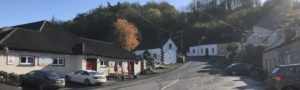
The featured photo above is from an old postcard of Glenmore Village. The house where Danny was born is in the centre of the photo with the two people standing in front. The building to the right in the photo is Fluskey’s shop.
Dr. Kathleen Moore Walsh
Happy Christmas!

Danny Dowling sends a Christmas greeting to all the glenmore-history.com readers across the world. Today, Danny was in good spirts. In response to a query regarding Santa, Danny opined that this year he has avoided Santa’s naughty list.
On behalf of Danny and all the volunteers with Glenmore-History.com we wish you all a happy and safe Christmas and New Year.
Last Christmas Eve we published an article that featured a tradition that was practiced in Glenmore in the late 19th century on New Year’s Eve called “Driving out the Hunger.” See, https://glenmore-history.com/santa-and-driving-out-the-hunger-in-glenmore/. This tradition served an important symbolic role as it reminded the survivors of the Famine of the hardships suffered and taught younger generations regarding the Famine. Given the difficulties of 2020, perhaps the tradition could be revived and amended to “Driving out the Virus.”

Christmas Eve 2020

Christmas Tree & Manger (2020)
Update: Some readers requested access to the blog via facebook so last week a facebook page was established as Glenmore History. Currently we are seeking information or photos from the Glenmore Ploughing Association for an article. Please contact us at glenmore.history@gmail.com if you have any information or photos you would like to share.

Another facebook page with lots of old Glenmore photos is Jacqueline Walsh’s, Glenmore Memories.
Below is the link to a recent YouTube video from Eigse Sliabh Rue: A Ramble on the Railway with lots of historical details regarding the old railway line from Waterford to New Ross which passed through Glenmore parish.
More Old Newspaper Clippings [Updated]

While reading old newspapers looking for particular information often other articles concerning Glenmore are found. Below are 13 short newspaper articles from 1830 to 1969 that were printed in local newspapers concerning various events or people of Glenmore. We are very fortunate that there are several newspapers that covered Glenmore particularly in the twentieth century and that most of the old newspapers are now available on line. Danny Dowling last week spoke of how much time he spent reading old newspapers in libraries. Danny said that he was such a familiar patron that the Waterford City library staff often went to lunch leaving Danny researching happily in the locked library.
Although much has been written concerning the Great Famine 1845-1850 there were other periods of hunger. According to the article below 1830 was a year of hunger for the poor of Glenmore. Although the following article states that women received charity without working on the High Road a few years later in 1836 when the New Line was being constructed Danny Dowling has stated that women and girls were employed in the building of the New Line. For the blog article outlining the early roads see, https://glenmore-history.com/glenmore-between-waterford-and-new-ross/ .
1830 PUBLIC DISTRESS—PARISH OF GLENMORE, COUNTY OF KILKENNY
The Rev. Mr. Foran, Catholic Curate, acknowledges with gratitude the receipt of the following donations for the relief of the poor inhabitants of that Parish:— Corporation of Waterford one ton of oatmeal, value £20; Lady Esmonde £5; Lord Duncannon £5; Sir J. Newport £3; Rev. Mr. Wallis, Rector, Rosbercon £1, 1s; Mr. Wallis, Sir J. Newport’s, steward £1; Mr. A. Doyle, C. H. Waterford 10s. The Rev. Mr. Foran, we are authorised to state, was treated in the kindest and most gentlemanly manner by the Gentlemen of the Corporation when he applied to them for their assistance. The charities of Lady Esmonde, during this time of general distress, have been almost unceasing, no day having passed which she did not relieve at least thirty poor people. The money contributed has been chiefly laid out by the Rev. Mr. Foran, in repairing the high road, and we have been assured by person who saw the work, that for the amount expended by the Rev. Gentleman, there has been more than twice as much work done as would be done county presentment. No man in that parish that was able to work would accept a shilling for charily, a pretty good proof that the poor Irish are not idlers or beggars when they can procure employment. It was only to the aged, infirm, and females who had none to labour for them, that any portion of the fund has been given in charity. (Waterford Chronicle, Saturday, 7 August 1830)
1894 ACTION FOR THE PRICE OF BRICKS

Daniel Cody, of Carrigcloney. Kilkenny, farmer, sued John McCarthy, of Barrack-street. Waterford to recover £2-18s, balance due for the price of bricks sold within the last six years. Mr Dunford appeared for plaintiff, and Mr Allingham for defendant. A decree was granted for the full amount claimed. (Waterford Standard, Saturday 7 April 1894)
[Danny Dowling has written extensively concerning the brick making industry that was conducted in Glenmore for over a century only ending in the early years of the twentieth century.]
1901 RINGVILLE HORSE RACES: A Horse Named Mrs. Kruger
These races came off on Sunday in Ringville lawn of twelve acres. They were witnessed by a large crowd of people, especially the fair sex. The runs were exciting between Mr. M Nolan’s De Wet (1st) Balllyvaring, manned by Master F Haughton, who showed the best attitude, and Mr. F Ryan’s, Mrs Kruger (0) Ringville, manned by Mr. N Murphy. Mr. J Walsh acted as starter, and Mr. John Lawlor as judge. Mrs. Kruger started well. After about forty perches she was overtaken, and De Wet won by one hundred yards. This race was tried twice, but not for the better. Mr Ryan’s splendid young horse, Passion Flower, came to the rescue. De Wet cannot be captured. Other races next Sunday. (New Ross Standard, 2 November 1901)
1902 Disused Quarry Case, Rathinure, Glenmore
APPLICATION TO ENTER A QUARRY Patrick Forristal summoned Mary Kennedy in order to obtain a magistrates’ order to enter a quarry on her lands Rathnure. Mr Jones (L. Thornton and Son. solrs.) appeared for complainant, and Mr HD Keane, (solr., for the defendant. The complainant stated that he was a contractor for three labourers’ cottages, and the quarry on the defendant’s land was the most convenient from which to obtain the stones to build one of them. To Mr Keane—He believed it was more than 25 years since the quarry was used. Mr Keane said his client was willing to allow the complainant to take stone from the face of the quarry, but no place else. After a consolation between the parties settlement was arrived at, the complainant to take the stone from the face of the quarry on payment of £4. (Waterford Standard, Saturday, 30 August 1902)
[Housing was just as big a problem in the twentieth century as it is now. Various schemes were enacted that enabled farm laborers to petition County Councils for a cottage to be built on the land of the farm where they worked.]
1917 Sale of Mount Ida
£4,700 FOR A FARM—On the 7th inst. the freehold residential estate of 154 statute acres, the property of Mr. Philip Conn, Mount Ida, near Glenmore, was put up for sale by public auction by Messrs. Thos. Walsh and Son, auctioneers, Waterford ; poor- law valuation, £135.5s. It was purchased by Mr. Wm. Forrestal, Ballyverneen for £4,700. Messrs. J. Thornton and Son, solicitors, Waterford, had carriage of sale. (Enniscorothy Guardian, Saturday, 17 November 1917)
[For an interesting article on Mount Ida see Martin Forristal’s article at https://glenmore-history.com/mount-ida-2019/ .
1899 Cruelty Case Dismissed

Alleged Cruelty. Constable Breadon summoned a young fellow named Wm Condon, in the employment of Nicholas Gaffney, Glenmore, for working a donkey which had, a sore on its breast. The little fellow and his master pleaded that the donkey had not been gaulded when yoking in the morning. The case was dismissed. (New Ross Standard, Saturday, 7 January 1899)
1900 GLENMORE FLOOD
A short time ago the Glenmore villagers witnessed the greatest flood seen for years. Fortunately, not much damage resulted, save some carpenter’s tools and some fowl being washed away. It is very inconvenient to the villagers to be subjected to such dangerous floods. In fact, the bridge was liable at any moment to give way to the powerful stream. (Munster Express, 24 November 1900)
1921 FARM FIRE NEAR GLENMORE
A fire which caused considerable damage broke out during threshing operations in the haggard of Mr. Daniel Doolan, farmer, residing near The Pink Rock, half-way between New Ross and Glenmore. The drum and elevator of the machine were destroyed by the flames, which also enveloped some ricks of barley and oats and a quantity of straw and burned them. Practically all his corn was destroyed, with the exception of some oats that had been threshed before the fire started. The strenuous and sustained efforts of the men engaged at the threshing, along with Mr. Doolan, succeeded in saving a rick of hay from the flames. It is stated that the corn was insured. (Kilkenny Moderator, Saturday, 24 September 1921)
1937 EMIGRANT’S DEATH IN CHICAGO
Death in Chicago of Mrs. Walsh, wife of Mr. Jas. Walsh, both natives of Glenmore parish and members of highly respected families. (New Ross Standard, Friday, 31 December 1937)
[Unfortunately, newspapers in the past often failed to provide the first names of married women making it very difficult to identify women who died in large urban areas who were married to men with common names like James Walsh. If any reader can identify which Glenmore Walsh family Mr. and Mrs. James Walsh belonged please send it on.]
[UPDATE–23 March 2021, it is believed that the Walsh lady that died in Chicago, Illinois was Mary Walsh née Walsh of Rochestown, Glenmore. Her husband Nicholas Walsh was from Jamestown, Glenmore. Both obits may be found on the “W” family page.]
1950 Glenmore Junior Hurling Championship
Hurling Tie Ends in Brawl—The junior hurling championship tie between Glenmore and St. Leonar’s (Dunamaggin) at Mullinavat on Sunday last came to an abrupt ending in the second half, writes our South Kilkenny Correspondent. An altercation between the opposing players led to an encroachment by spectators resulting in a brawl which only ended after several players had been injured. At the time of the stoppage Glenmore were leading by nine points. (Kilkenny People, Saturday, 29 April 1950)
1953 GLENMORE LAND SOLD
Holding Purchased—Fourteen acres of land at Ballyveria, Glenmore owned by Mr. William Phelan, have been disposed of by public auction to Mr. Fitzgerald, Moulerstown, do., for the sum of £850. The sale was carried out by Messrs. P. N. O’Gorman, auctioneers and valuers, Rosbercon. (Munster Express, Friday, 27 February 1953)
1963 PLANE LANDS IN GLENMORE
Mr. Thomas Kelly of Roadstone Dublin, former Dublin County Engineer paid an unusual visit by aeroplane to his brother’s (Mr. J. Kelly) residence at Aylwardstown, Glenmore last weekend. The plane, a single engine four seater landed perfectly on the lawn at Aylwardstown House and later took off safely for its return flight to Dublin. (Kilkenny People, Friday, 26 April 1963, p. 8)
1969 ESTATE DUTY ON MAJOR McCALMONT’S ESTATE
Left Over Half-a-Milllon—Major Dermot Bingham McCalmont, former master of Kilkenny Hounds, of Mount Juliet, Thomastown who died in Salisbury, Rhodesia, last February, left £569,209, on which estate duty amounting to £414,426 was paid. (Munster Express, Friday 3 January 1969, p. 20)
[For decades Glenmore people followed the hunt. Often the Kilkenny Hounds ran through and near Glenmore with extensive reports of the hunts published in local newspapers. Although Major McCalmont left a substantial estate in 1968, the estate duty was approximately 72% of the value of the estate he left.]
Dr. Kathleen Moore Walsh