1920’s
now browsing by category
Glenmore Native: Peter Gahan (1888-1958) New Ross Publican and Undertaker [updated]

Danny Dowling (1927-2021) spent a lot of time recording information concerning what he termed extinct Glenmore families. These were families who left the parish through emigration, or who did not have children etc. One family that Danny recorded was the Gahan family of Newtown, Kilmakevoge. In 1973, Danny interviewed Nicky “the Miller” Forristal (1888-1979) who provided an account of five of the six sons of Laurence “Larry” Gahan and his wife Bridget Doherty.
In his notebook Danny had a notation “murder?” that caused a bit of searching. Ultimately after reviewing the deaths of Peter Gahan (1888-1958), his siblings, and his wife Mary Teresa “Tess” Sheehy (c.1887-1963), it was discovered that Peter Gahan’s brother-in-law, Sir John Sheehy, was murdered in 1949. Details concerning the murder are at the end as well as some of Peter Gahan’s Glenmore grandparents.
The Gahan’s of Newtown, Glenmore
Laurence “Larry” Gahan (1848-1907) of Newtown, married Bridget Doherty (c. 1848 -1924) of Coolnaleen, on 28 January 1875 at Glenmore. The groom was a 26 year old farmer and the bride was aged 28. The groom’s father was recorded as Michael Gahan (deceased farmer) and the bride’s father was recorded as Richard Doherty (farmer). Witnesses to the wedding were Felix Mullins and Bridget Mullins.
Laurence and Bridget Gahan had six sons:
[1] Michael Gahan (12 June 1876-8 Jan. 1931) was described as “delicate” by Nicky the Miller. Michael Gahan never married. When Michael died in 1931 his brother Peter, of Priory St. New Ross was present. Michael’s death was due to myocardial degeneration.
[2] Richard Gahan (16 Sept. 1877-12 July 1895) was just 16 when he died of consumption or “TB”. This is the son that Nicky the Miller failed to tell Danny about in his 1973 interview.
[3] John Gahan (b. 6 Dec. 1879-2 Oct. 1962); known as Jack, married Mary Haberlin (b.c. 1884) of Aylwardstown, Glenmore on 21 August 1911. John and Mary Gahan, had a farm at Kilurney, Ballpatrick, Tipperary. See our post of 13 Feb. 2023 regarding a threshing accident in 1899.
[4] Patrick Gahan (16 Jan. 1882- 4 May 1929) married Mary Grant of Robinstown, Glenmore. They farmed the home place in Newtown, Glenmore. They had no family and Pat died young of cancer. The farm was later farmed by Pat Grant, of Robinstown, Mary Grant’s nephew. Pat Grant was known as “Cushey”.
[5] James Gahan (12 June 1884-3 June 1904). Jim Gahan drowned at New Ross. According to “Nicky the Miller” Jim worked as a clerk in a shop on North St. New Ross where Flemings were later located. See our G family surname page for further details regarding his death.
[6] Peter Gahan (1 Apr.1888-24 Dec. 1958) was born the same year as Nicky the Miller Forristal. According to Peter’s obit he moved to New Ross about 1908. “In his early youth he played in many inter-county football games with his native Kilkenny. He was also a prominent oarsman, and a valued member of the New Ross Boat Club.”
Early Years in New Ross
In 1911, Peter was residing in New Ross at 11 North Street. James Fleming, aged 26, was a single grocer and Peter’s employer. Mary Grace, married and aged 62 was the domestic servant and cook. Peter was 22 and the eldest of the three assistant grocers. Sylvester Maddock and John Ryan were the other two assistant grocers and were both 18 years of age. Everyone except John Ryan were born in Co. Kilkenny. John Ryan was born in Carlow. Although the household return records that Fleming is a grocer employing assistant grocers the House & Building Return provides that Fleming’s building is a public house.
In the 1901 Census Peter was living at home with his parents and two of his brothers, Michael and John. Sylverster Maddocks was living in Listerin with his parents and 10 siblings. Interestingly James Fleming in 1901 was residing and working as a shop boy at 11 North Street, New Ross. He was working for a couple named Grace.
Earliest Businesses
It isn’t known exactly when Peter Gahan began his own businesses, but we know from Nicky the Miller that he was an undertaker as well as a publican. We also know that it was in 1915 that Peter applied for his first liquor license and had a premise on Priory Street. “Peter Gahan, shopkeeper, of New Ross sought to transfer a liquor license from Bernard Kinsella to sell beer, cider, spirits, wine etc. by retail at his house on Priory St., New Ross” (New Ross Standard, Fri. 17 Sept. 1915, p. 1).
Newspaper articles from that era also suggest that Peter operated a car hire business. For example in 1916, Peter was charged in Waterford for knocking down a labourer named Browne. Peter had been hired to transport a prisoner named Simon Murphy from the Waterford Jail to New Ross Petty Sessions to stand trial for the theft of a gold ring. Browne who worked for the corporation stepped out from the footpath a few yards in front of the vehicle. Quickly reacting Peter swerved and stuck the man with the mud guard of the vehicle. Amazingly the prisoner Murphy, Sergeant O’Sullivan, of New Ross R.I.C. and a Waterford constable on duty in the street at the time all testified for Peter (New Ross Standard, Fri. 8 Dec. 1916, p. 12).
In 1917, Peter Gahan was one of the persons charged with supplying a vehicle for a Glenmore wedding and the case was later dismissed (New Ross Standard, Fri. 14 Dec. 1917, p. 7). See our previous post of 27 Sept. 2020 for details of the infamous case against drivers who attended a 1917 Glenmore wedding.
Similarly, in 1932 Peter lent a lorry to John Quinn. Quinn was responsible for conveying a tug-of-war team from Campile to the Rower Sports Day. The driver did not have a valid license and Peter was fined 10 s. for employing an unlicensed driver and £100 for lending a lorry without a tax for passengers. The judge because Peter had lent the vehicle free of charge reduced the tax fine to £2 (New Ross Standard, Fri. 2 Sept. 1932, p. 6).
Wedding Bells: Peter Gahan and Mary Teresa “Tess” Sheehy
Peter Gahan, merchant, of New Ross, Co. Wexford, married Mary Teresa Sheehy on 24 April 1917. The couple were married at Westport, Mayo by her maternal uncle, Rev. Fr. Edward J. Higgins. At the time of the marriage Peter Gahan was 29 years of age and his bride was 28. They both were residing in New Ross, but it is not known how or why Tess came to live in New Ross. Peter’s father was listed as Laurence Gahan (farmer) and his bride’s father was listed as Thomas Sheehy (Clerk of Petty Sessions, pensioner).
Mary Teresa “Tess” Gahan née Sheehy (c. 1887-1963)
Mary Teresa Sheehy was known as Tessie. The 1901 Census reveals that she was living at home with her parents and siblings. There were 14 children born to Sgt. Thomas Sheehy, R.I.C. (1859- 1918) and his wife Mary Sheehy née Higgins (1865 -1912). Sgt. Sheehy was a native of Kerry and the son of a farmer. Mary Sheehy was a native of Co. Mayo. The following children were born to this marriage: [1] Kathleen Sheehy (b.c. 1885, Co. Mayo); [2] Tessie Sheehy (b.c. 1887, Co. Galway); [3] Evelyn Sheehy (b.c. 1888); [4] Elizabeth Sheehy (b.c. 1888); [5] John Sheehy (12 Oct. 1889-1949); [6] Bridget Sheehy (b.c.. 1893); [7] Joseph Sheehy (b.c. 1895); [8] Frances Sheehy (b.c. 1896); [9] Edward Sheehy (b.c. 1898) and [10] Thomas Sheehy (b.c. 1900).
Mary Sheehy née Higgins died on the 27th of September 1912 (Tuam Herald, Sat. 5 Oct. 1912, p. 2). The year after Peter and Tessie’s marriage in 1917 her father died on 20 July 1918. His obit noted that his brother-in-law was Most Rev. M. Higgins, D.D., Auxillary Bishop of Tuam (Tuam Herald, Sat. 27 July 1918, p. 2). Three months later Tess’s sister, Elizabeth Sheehy died of a weak heart (Tuam Herald, Sat. 9 Nov. 1918, p. 2).
On 18 April 1914, Tess’s sister, Kathleen Sheehy married Thomas Kitt the Mountbellow, Co. Galway, Workhouse Master. Kathleen was a national school teacher. Their eldest child, Michael F. Kitt (13 Sept. 1914-24 Dec. 1974) became a T.D. He was first elected in 1948. Lost his seat in 51 and was not elected again until 1957.
The New Ross Whiskey Case

Peter’s business and home were on Priory St. right around the corner from the courthouse and police station. The New Ross Standard carried several articles regarding petty cases against Peter. The most serious case occurred in 1918 and was dubbed the New Ross Whiskey Case by the New Ross Standard. William Roche, of Bewley Street; Andrew Culleton, of Wexford Street and Peter Gahan, of Priory Street, were charged in January 1918 with breaking into the bonded warehouse of Mrs. Alice Daly and Gahanstealing a hogshead and quarter cask of whiskey worth £400. A publican in Campile, Thomas Shea, and another New Ross man, John Hughes, were also charged.
At the first trial of the New Ross men the judge noted that there was no evidence against John Hughes. The case against the other three New Ross men was circumstancial They were seen in the vicinity of the warehouse on the night of the theft. The case against Thomas Shea was that the stolen whiskey was found on his land.
In the midst of this case, Patrick Gahan applied to have the seven day license held by his brother Peter Gahan, Priory St transferred. Patrick stated that he had taken over the premises and was going to carry on business there. The police did not object and the transfer was granted (New Ross Standard, Fri. 8 March 1918, p. 7). It appeared that Peter who had only been married a year was attempting to protect his most valuable asset.
In a separate trial a jury found Thomas Shea not guilty apparently because the whiskey could have been placed on his land without his knowledge. When the three New Ross men were ready to stand trial the second time in July, the Crown announced that it could not proceed due to the serious illness of its witness Patrick Cousins an employee of Peter Gahan’s. The Crown entered a nolle prosequi (New Ross Standard, Fri. 5 July 1918, p. 5.)

Undertaker

In 1922 the New Ross Standard featured ads proclaiming Peter the newest New Ross undertaker. He carried on this trade from the former premises of Paatrick Power on Priory St. No mention of this business appeared in his obituary. Some of his ads are quite humorous by today’s standards such as stating he carries the latest designs in shrouds. It is not known how long Peter was an undertaker, but in 1942 he placed an ad in the New Ross Standard which stated, “Quantity of manure for sale. Apply Peter Gahan, Undertaker, New Ross” (New Ross Standard, Fri. 27 March 1942, p. 1).
Death of Peter and Tess Gahan
Peter Gahan died on Christmas Eve 1958 at the age of 70 of chronic myocarditis. His daughter Mary Teresa “Trixie” Gahan, a state registered nurse, was present when he died.
Mary Teresa “Tess” Gahan née Sheehy tragically died in a fire on 16 December 1963 at Priory Street. She was found by her son-in-law Paddy Molloy. The fire apparently commenced in the widow’s bedroom when night clothes came into contact with an electric heater (New Ross Standard, Fri. 20 Dec. 1963, p. 9).

The Children of Peter Gahan
Unfortunately, the birth records after 1916 in Ireland are not generally publicly available. From Peter’s obituary and the family marker in Glemore we believe that Peter and Tess had five children. Their daughter, [1] Bridget Mary Gahan (c. 1919-1929) died at the age of 10 of cholera.
Just four years earlier Peter had been fined 10 s. for sending a note to District Judge Fahy explaining his absence from court. Peter was prosecuted for non-compliance with the Vaccination Act, but it was noted that the child had been vaccinated. The Judge testily noted that Peter lived within 50 yards of the court and did not accept the note (New Ross Standard, Fri. 1 May 1925, p. 7).
[2] Mary Teresa “Trixe” Molloy née Gahan ( ? -2009) S.R.N.; (Death notice, Munster Express, Fri. 6 March 2009, p. 15). After her father’s death Trixie married a widower, Patrick Molloy (c. 1925-2000). Paddy was a crane driver in Rosbercon, and his first wife Josephine died at the birth of their daughter Anne in 1957. Trixie is buried in Glenmore in the Gahan family grave and was survived by her son Martin and daughters Anne, Mary and Bridget.
After the death of her mother Trixie, who lived nearby on Cross St., transferred the liquor license to her name (New Ross Standard, Fri. 21 Aug. 1964, p. 2) and continued operating the pub until she transferred the license to William A. Gannon in 1979 (New Ross Standard, Fri. 31 Aug, 1979, p. 15).
[3] Mrs. F. Sayers, Bromley, Kent; Frances Rita Gahan (b. 19 Feb. 1926- ?). It is believed that her husband may have been Douglas Edward Sayers, Bromley, Greater London
[4] Mrs. G. Jones, Bournemouth; Eveleen J. Gahan married Daniel T.G. Jones in Oct. 1947 at Bournemouth, Hampshire, UK.
[5] Mr. L.P. Gahan, Guildford, Surrey; Laurence Gahan (1928-2019) married his wife Kathleen (b. 1934) in Southampton. Kathleen Ann Gahan née Ryan (b. 1934) was from Kilkee, Co. Clare Their eldest son Peter Gahan (b.1957) married Diane Gawley. Peter was a constable with the metropolitan police (Surrey Herald, Thurs. 25 Sept. 1986, p. 23).
Glenmore Connections: Peter Gahan’s Grandparents
Paternal Grandparents
Laurence “Larry” Gahan (1848-1907) was the son of Michael Gahan, of Newtown and Mary Mullins (b. 1814) of Flemingstown, Glenmore. Michael Gahan and Mary Mullins were married at Glenmore on 4 February 1834. The known children of this union include: [1] Richard Gahan (b. 1835); [2] Patrick Gahan (b. 1837); [3] Mary Gahan (b. 1840-1910) married on 5 Feb. 1883, James Walsh, of Rathpatrick, Slieverue son of Simon Walsh (deceased farmer); [4] John Gahan (b. 1844); [5] Laurence Gahan (b. 1846) and [6] Laurence Gahan (b. 1848-1907). Mary Gahan née Mullins was from the Felix Mullins family of Flemingstown, Glenmore.
Maternal Grandparents
Bridget Doherty (b. 1842) was the daughter of Richard Doherty and Ellenor Mullally of Coolnaleen, Glenmore. Richard Doherty married Ellen Mullally, of Davidstown, Glenmore, on the 27th of February 1838. To this union the following known children were born: [1] Mary Doherty (b. 1839); [2] Martin Doherty (b. 1840); [3] Bridget Doherty (b. 1842); [4] John Doherty (b. 1844); [5] Ellen Doherty (b. 1846); [6] James Doherty (b. 1849); [7] Peter Doherty (b. 1852); and [8] Patrick Doherty (b. 1855).
The Murder of Sir John Sheehy (1889-1949)
Peter Gahan’s brother-in-law, John Sheehy, entered the Indian Civil Service in 1914. John’s brother M.J. Sheehy (in 1949 he was in Dublin) followed him into the Indian Civil service and was one of the chief engineers on the Burma Road during World War II. The Sheehy’s were cousins of Rev. Dr. McFadden, Bishop of Cleveland (Tuam Herald, Sat. 21 May 1949, p. 5).
On the 9th of May 1949, Lady Sheehy saw her husband shot and killed by an intruder in their home in Minder, Germany. Sir John threw his slipper at the intruder and was shot in the heart. Sir John was the Assistant Financial Adviser to the British Military Governor in Germany.
With the granting of independence for India, Sir John joined Allied Control Commission on 1 July 1947, as Director of Public Revenue. He was made assistant Financial Advisor to the Military Governor on 3 August 1948. Sir John was 59 years of age at the time of his murder and in addition to his wife he was survived by two daughters and one son who were attending school in England. (Sunderland Daily Echo and Shipping Gazette, Tues. 10 May 1949, p.14).
XXXXXXXXXX
Please send any corrections, photos or further information to glenmore.history@gmail.com.
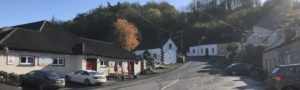
On a recent trip into New Ross we believe that the Bumblebee sign is on the pub that Peter Gahan operated for decades. The feaured ad above is from page 1 of the New Ross Standard, 11 April 1924.
[Update 29 Sept. 2023–Peter Gahan, grandson of Peter Gahan (1888-1958), made contact and noted that his mother Kathleen Ann Gahan née Ryan (b. 1934) of Kilkee, Co. Clare is alive and well. Peter verified that his mother and father (Laurence Gahan) married in Southhampton. Peter’s mother further confirmed that her father-in-law’s pub was later called the Bumblebee. The photo of JFK above graced the pub and Peter’s grandmother, Tess Gahan née Sheehy (c. is in the upper storey window peering down on the street. Special thanks to Peter Gahan for sharing the photo as well as information]
Dr. Kathleen Moore Walsh
One Hundred Years Ago: February 1923

Today, we are going to feature local events as recorded in newspapers local to Glenmore. After years of turmoil and violence, Glenmore residents had to be frustrated. The Irish Civil War entered its 8th month and the death and destruction showed no signs of dissipating. Just taking produce or animals to market was difficult and dangerous. Even fishing brought risks.
Targeting of Civilian Infrastructure
Roads
In February 1923 the Irregulars or Republicans continued to attack, damage and often destroy civilian infrastructure. At the end of January and continuing throughout February there was extensive felling of trees to block roads in both Kilkenny and Wexford. Telegraph wires were also cut in some places. People traveling to New Ross in February often had to pass through fields to avoid blocked roads. Trenches were re-opened in places between New Ross, Campile and Ballycullane (New Ross Standard, Fri. 2 Feb. 1923, p. 5). Several New Ross buyers traveling to Thomastown fair had to return home because the roads between New Ross and Thomastown were blocked (New Ross Standard, 9 February 1923, p. 8).
Kilkenny County Council gave £150 toward temporary repairs to the destroyed timber bridge at the Ferry, Mountgarrett. The bridge was targeted and destroyed in the War of Independence as well as the Civil War (New Ross Standard, Fri. 9 Feb. 1923, p. 5).
Trains
Trains continued to be targeted. The up train to Macmine was delayed nearly two hours because rail chairs were broken between Waterford and Glenmore. The down passenger and goods train was derailed on Wednesday the 31st of January between Glenmore and New Ross. It was run off the line out onto a public road and was badly damaged (New Ross Standard, Fri. 2 Feb. 1923, p. 5).
Water Works
Armed men wrecked the Youghal waterworks, at Boula, Co. Waterford, in reprisal for the execution of two men captured in Co. Waterford. The Council complied with the order of the Irregulars to petition the Government for clemency for the captured men. The Council also passed a resolution condemning the executions, yet the waterworks were destroyed. A limited supply of water was in the Cork Hill reservoir but there were hundreds of patients in St. Raphael Mental Home, the Workhouse and other Institutions. It was predicted that the water supply would only last two days and steps were taken to get some of the old pumps, long disused, in working order (Munster Express, Sat. 3 Feb. 1923, p. 5).
Violence Continued
Battles
At the end of January a large force of Republicans were active on the Walsh Mountains, between the villages of Hugginstown and Templeorum. A “sharp engagement,” took place on Thursday of last week between Republican forces and the National garrison from Mooncoin and Mullinavat. A running fight took place on the hills near Templorum. No casualties were reported from either side (Munster Express, Sat. 3 Feb. 1923, p. 6).
Civilian Killed
Miss Cissie Ryan, aged 16 of William St., Waterford was walking home with her sister and accompanied by two lieutenants of the National Army on the 23rd of January. Armed men attacked the soldiers on Wilkin St. Cissie who was behind her escorts was shot in the abdomen by the attackers. Although “little hope was entertained for her recovery she rallied for more than a week” before she died of her injuries (Munster Express, Sat. 3 Feb. 1923, p. 7).
Threats
Five well known Carrick-on-Suir residents received threatening notices. The notices were allegedly sent by the I.R.A. ordering the men to leave town because the men had allegedly made “statements prejudiced to the Republic and its citizens.” The local National Army authorities notified some leading Republicans that if any harm befell the recipients of the notices there would be serious consequences (Munster Express, Sat. 17 Feb. 1923, p. 4).
Snipers
Firing which became intense took place in Waterford on the night of the 18th. The sniping was directed toward the post office from points on the Kilkenny side of the River Suir. The replying fire of National troops silenced the attackers after about twenty minutes. No casualties were reported (Kilkenny People, Wed. 21 Feb. 1923, p. 7).
Prisoners
Richard Burke, a prisoner in Kilkenny goal was slightly wounded when he refused to withdraw from his cell window. A shot was fired by a guard and a splinter struck the prisoner (Kilkenny People, Wed. 21 Feb. 1923, p. 4).
Criminality Continued
As highlighted in previous months, from the newspaper accounts, it is often difficult to determine if reported activities were done to further the Republican agenda or if people were just taking advantage of the lack of police and the turmoil.
Kilmacow Raid
For example, on 20 February 1923, Ryan’s public house in Kilmacow was raided by armed men and a considerable amount of goods were taken. “The premises, have on many occasions recently received these unwelcome attentions.” The only occupants of the premises were two ladies (Kilkenny People, Wed. 21 Feb. 1923, p. 4).
Civic Guards for New Ross
In early February 1923, it was announced that Civic Guards were coming to New Ross. The National Troops vacated the Tholsel and have taken up residence in the old police barracks (New Ross Standard, 9 February 1923, p. 8).
The Murder of Mrs. Annie Devereaux, in Waterford City
Mrs. Devereaux was killed on the 15th in her home at 28 Slievekeale, Waterford City. At the time of her death, between 1 and 2 p.m., only two of her five children were in the home. Five year old Michael Devereaux ran from the home screaming that his mother was dead and that his uncle Willie killed her with a hatchet. Eleven-month-old Kathleen Devereaux was on the floor beside her mother.
Mrs. Devereaux had a deep wound on her neck that stretched from ear to ear as well as other gashes and died before help arrived. The infant was removed to the County and City Infirmary, but her condition was “nigh hopeless.” The deceased was the wife of James Devereaux, who was away working at the time of the murder. Kathleen Devereaux also died from her wounds (Waterford News & Star, Fri. 16 Feb. 1923, p. 5).
William Devereaux, the deceased’s brother-in-law, was arrested for her murder. At the inquest the doctor who was summoned to the scene believed that Mrs. Devereaux was holding Kathleen when she was attacked by her brother-in-law with a hatchet (Waterford News & Star, Fri. 23 Feb. 1923, p. 2). The death register records Mrs. Devereaux’s first name as Annie and she was 38 when she was killed.
Fishing
It was reported with the opening of the fishing season on 1 February 1923 that “due to flagrant and extensive violation of the laws by professional fishermen the Suir was very poorly stocked with fish.” Major General Proust, when informed of the illegal operations of cot men and others, issued a notice that pending revision by the Dail the existing fishery laws would be strictly enforced.
Major General Proust noted that illegal fishing would result in forfeiture of nets and other equipment and that cot men who refused to come to the bank when summoned by the authorities would be fired upon. It was immediately reported that two or three Clonmel fishermen had their nets seized, but because the fishing season was open the men would have their nets returned when they procured licenses.

While fishing for pike in the Slaney, near Enniscorthy, a local fisherman, named Butler, had his line fouled. When he was attempting to clear the line he found that it was caught in the ring of a Mills bomb, which had apparently been thrown into the river. An ex-British solider, also fishing in the vicinity, removed the grenade (New Ross Standard, Fri. 2 Feb. 1923, p. 5).
Postal News
Not all news regarding the postal service involved shooting or raids in February 1923. J.J. Walsh, the Postmaster General, issued a press release that the building of a G.P.O. on the ruins in O’Connell Street, Dublin, would start as soon as possible. The large ground at the back of Henry Street would be included in the new layout. He stated that work was being done from 20 to 30 out-offices instead of two or three. A new 1 ½ d. stamp was issued on 2 February. The new stamp “was an artistic one of maroon, with a blank map of Ireland in the centre” (Munster Express, Sat. 3 Feb. 1923, p. 3).
Economic Woes
The “old established jute factory” of Denny & Sons, of Waterford, closed because of a shortage of work due to a reduction in “killings in Irish bacon curing establishments.” The jute factory was engaged in making bacon wrappers (Munster Express, Sa. 3 Feb. 1923, p. 6).
Wages
Fifty shillings per week for a 48 hour week was agreed as the standard wage for labourers by Walsh and Dowley, Carrick-on-Suir and by the Carrick Urban Council for its employees (Munster Express, Sat. 10 Feb. 1923, p. 4). What the Munster Express failed to mention was the fact that the 50 shillings per week agreement represented a 4 s. reduction in wages. This reduction was to remain in place until June. The boatmen’s wages were settled by the men accepting the 4 s per week reduction, but getting a penny per ton extra for goods transported in the boats (Waterford News & Star, Fri. 2 Feb. 1923, p. 5).
Recruiting
The National Army made an appeal for recruits in February 1923. Allowances were advertised “in respect of dependents on a liberal scale.” A wife would receive 4s per day; a wife and child, 5s 6d; wife and two children, 6s 6d; and 9d per day extra for every other child under 14 years of age (Munster Express, Sat. 10 Feb. 1923, p. 5).
Glenmore in the News
Death of Mr. Paul Fitzgerald of Knockbrack, Glenmore
“The death of the above highly respected and popular gentleman, which took place on 20th, January at his residence, Knockbrack, is very deeply regretted. The deceased was a member of one of the most respected families in South Kilkenny. He was a man of splendid physique, a fine athlete n his time, a good and generous supporter of every charitable and patriotic movement for the past 30 years, a fond husband and father, and was liked by all with whom he was known for his good qualities of mind and heart, and to his neighbours especially, for his social and hospitable manner. “
“To know Paul was to love him, and his death on the above mentioned date is deeply mourned by his widow and family, relatives, and a large circle of friends. His funeral bore striking testimony to the esteem in which deceased was held, and was the largest seen in Glenmore within living memory. Solemn High Mass was offered up for deceased’s soul at the Parish Church after which the remains were conveyed to the family burial ground for interments. R.I.P.”
Chief Mourners
The chief mourners were—Mrs. Fitzgerald (widow); sons: Michael Fitzgerald; James Fitzgerald; Paul Fitzgerald; Thomas Fitzgerald; John Fitzgerald; daughters: Bridget Fitzgerald ; Ellie Fitzgerald; Mrs. Crowley, Mooncoin; Mrs. Fitzgerald, Mowlerstown; brothers: John Fitzgerald; Patrick Fitzgerald, Raheen; Edward Fitzgerald (do); brothers-in-law: Rev. Thomas Freaney, C.C. Gauthabawn; Rev. Patrick Freaney, C.C., Callan; James Freaney, Kilbride; John Feaney, Cullen Castle, Inistioge; Patrick Byrne, Brownsford, Tullogher ; and nieces: Mrs. O’Brien, New Ross; and Ellen Nolan, Raheen (Munster Express, Sat. 3 Feb. 1923, p. 7).
Vote of Sympathy
At a meeting of the Glenmore Football Club a vote of sympathy was passed for the Fitzgerald brothers, Knockbrack, prominent members of the club, on the death of their father (New Ross Standard, Fri. 9 Feb. 1923, p. 5).
Wife & Parents
Paul Fitzgerald (1854-1923), of Knockbrack, Glenmore, married Johanna Freany (1857-1945) of Kilbride, Glenmore on 14 November 1883 at Glenmore. The witnesses to the wedding were John Murphy and Johanna Knox. We believe that Paul Fitzgerald was born in 1854 to Michael Fitzgerald and his wife Anne Murphy. Johanna Freany Fitzgerald (1857-1945) was the daughter of James Freany, of Kilbride, and his wife Bridget Knox. See our post of 5 April 1921 regarding Johanna’s nephews James Francis “Frank” Freyne (1902-1974) and Peter David Freyne (1903-1921) and their service in the War of Independence.
Arrests at Ballyvaring, Glenmore
Two men named E. Dowley and J. Ryan were arrested on the 23rd of February by National Forces at Ballyvaring, near Ringville, Glenmore. A fully loaded revolver was found close by (Munster Express, Sat. 24 Feb. 1923, p. 2).
Please send any additional information or corrections to glenmore.historu@gmail.com.
Dr. Kathleen Moore Walsh
Glenmore Sportsman: Bill Irish (1899-1976) Native of Aylwardstown [Updated]

Today, we are going to feature a Glenmore sportsman who played both hurling and football at club and county level. Unfortunately, Bill’s sporting days were tragically cut short when he was attacked and injured during a pitch invasion. Bill won a county junior football title with Glenmore in 1919 and went on to win senior football titles in 1921, 1922 and 1923. He was a member of the Glenmore-Kilmacow combined team that won the 1923 junior county hurling title.
The Irish Family of Aylwardstown, Glenmore
William “Bill” Irish was baptized at Glenmore on 11 November 1899. He was the son of Robert “Robin” Irish (1838-1908) (farmer) and his wife Margaret Ribby (sic) (1861-1917) of Aylwardstown, Glenmore. His godparents were John Heffernan and Kate Ribby (sic). Robert Irish did not register his son’s birth until the 8th of May 1900. There was a fine for failing to register, or for failing to register a birth within three months. In order to avoid the fine for registering a late birth it appears that Robert recorded Bill’s birth as 11 February 1900 although we know he was born on or before 11 November 1899 from the baptismal record.
While still in his teens Bill and his siblings were orphaned. Their father died in 1908 (the death register records his first name as Robin) and their mother died in 1917 of TB. The 1901 and 1911 censuses reveal that Bill’s uncle, Thomas Irish (1844-1928) resided with the family in Aylwardstown. Tommy Irish, a bachelor, at the age of 57 took the plunge and married a widow Ellen Roche née Kennedy, of Rathinure on 18 July 1901. This apparently unhappy union may be the subject of a future blog post.
Bill’s Parents and Siblings
Robert “Robin” Irish (1838-1908) and Margaret Rigby (1861-1917) were married on 22 November 1893 at Slieverue. The witnesses to the wedding were Peter Kennedy and Bridget Rigby. The couple had at least six children: John Irish (b. 1894); Mary “Mollie” Irish Doherty (b. 1896); Monsignor Michael Irish (b. 1897); William Irish (b. 1899); James “Skinner” Irish (b. 1902) and Patrick Irish (b. 1905).
Bill’s Grandparents
Bill’s paternal grandparents were John Irish, of Aylwardstown and Mary Irish née Irish, of Nicholastown, Slieverue. Bill’s paternal grandparents were married at Slieverue on 28 February 1832.
On the other side, Bill’s maternal grandparents were William Rigby, of Ballincrea, Slieverue and Bridget Hartley, of Busherstown, Glenmore. His maternal grandparents were married on 23 February 1857 at Glenmore.
Glenmore Football

Middle Row: Bill Irish, Richard Duggan (Flemingstown), Bill Hartley (Captain)(Busherstown), Willie Walsh, Jim Freyne (Kilbride).
Front Row: Tommy Fitzgerald (Moulerstown), Tom Conway, Mikie Murphy, Willie Hartley.
Bill won a county junior football title with Glenmore in 1919, as well as senior championships in 1921, 1922 and 1923. Men on the Glenmore team included: Martin, Paddy and Michael Cody, Weatherstown; Jimmy, Dick and Pat Hanrahan, Glenmore; Andy and Stephen Hefferenan, Aylwardstown; Jim and Johnny Phelan, Clonassey, Mullinavat; Mick Connolly and Peter Kirwan, Knockbrack; John Doherty, Davidstown; Ned Freyne, Ballyfacey; Paddy Murphy, Ballyveria; John Mullins, Flemingstown; and Ned Roche, Rathnure (sic) (Kilkenny People, Fri. 22 Oct. 1976, p. 10).
Bill was also a member of the Kilkenny team that lost to Dublin in the Leinster senior football final at Croke Park in November 1922. This Dublin team went on to beat Kerry in the all-Ireland final. See our previous post of 4 December 2022 detailing the Leinster final, and the fact that this Dublin team went on to beat Kerry in the all-Ireland final. The other players on the Kilkenny team included: Martin Cody (captain), Andy Heffernan, Pat Hartley, Jim Phelan, Bill Irish, John Fitzgerald, Mick Connolly, Paddy Cody, Jimmy Hanrahan (Glenmore); Pat Dalton, goal (Knocktopher), Tom Brennan, Frank Hughes, Andy Brennan (Cloneen), J. McKenna and Wattie Landy (Cotterstown) (Kilkenny People, Fri. 22 Oct. 1976, p. 10).
Glenmore Hurling
In the early part of the 20th century Glenmore was known for its football teams. Although a good football player, Bill Irish was described as being “equally adept at hurling.”
For the 1923 hurling season Glenmore amalgamated with Kilmacow and Bill Irish was the captain of the united team. The other Glenmore players included: Jimmy Hanrahan; Jimmy Fitzgerald, Martin Cody, of Weatherstown; Jimmy, P. & John Murphy, of Ballyveria. The Kilmacow players included: D. Rockett, Jim Quinn, Tom Williams, Tommy O’Neill, Luke Phelan, Peter Phelan, Jimmy Cleere (goal), and Paddy “Bagger” Grant.
The Glenmore-Kilmacow team fought their way to the 1923 junior hurling championship final that was played in 1924. The “southern combination” were the underdogs going into the championship match against Dicksboro, a Kilkenny City based GAA club that formed in 1909. However, the united Glenmore-Kilmacow team “gave a most determined performance, surprising their more fancied rivals and emerged worthy winners of a great game.” (Kilkenny People, Fri. 1 Sept. 1967, p. 7).
Such was the surprise at the result it was dubbed the surprise of the century, and a challenge was issued by Dicksboro. The teams met in the same venue, St. James’s Park in Kilkenny, and the winners were to receive a “beautiful set of medals.” The Glenmore-Kilmacow team journeyed to Kilkenny City and played Dicksboro again and defeated Dicksboro again.
According to a Kilkenny newspaper, published 40 years later, the game was unfinished owing to a disputed score and Glenmore-Kilmacow who were leading at the time were awarded the match (Kilkenny People, Fri. 1 Sept. 1967, p. 7). Other accounts relate that disgruntled Dicksboro supporters invaded the pitch and one supporter attacked the Glenmore-Kilmacow Captain, Bill Irish (Kilkenny People, Fri 22 Oct. 1976, p. 10).
The Injury

According to the account in Bill’s obituary the invasion of the pitch occurred when there was a stoppage of play. Bill was “knocked out completely by a kick in the stomach, which troubled him for years subsequently and ended his playing career,” at the age of 25 (Kilkenny People, Fri. 22 Oct. 1976, p. 10).
The Munster Express reported on Bill’s injury and subsequent 2 day hospitalisation as follows:
Gaels throughout the County in general, and especially in the southern division, will regret very much the injury to Bill Irish, Glenmore’s popular player, on Sunday last in the match against Dicksboro at St. James’s Park. One of the outstanding Gaels of the county either on the hurling or football field, the many followers of the game will wish him a speedy recovery and hope he may soon be capable of donning the popular colours again. He was able to leave the Infirmary for home on Tuesday last.
We learn that he has made good progress towards recovery from the effects of the occurrence. He was one of the Kilkenny men selected to represent Leinster in football in the forthcoming Tailteann trials (Munster Express, Sat. 31 May 1924, p. 5).
Given the severity of the injury it is surmised that the kick landed lower than Bill’s stomach and the newspaper account of the time was being polite in its description. [Update 24 Feb. 2023: Given that Bill is found in team photos of the 1925 and 1929 Glenmore football teams it appears that Bill continued to play at least football after his injury.]
The Medals
In August 1924, after repeated requests for the medals made to Mr. E. Purcell, Mr. M. Heffernan, Glenmore wrote to the Kilkenny County GAA Committee raising the issue. He attached the agreement that had been entered into by the two teams.
Heffernan wrote, “I hope the scrapping of such an agreement will not be tolerated. I would have brought the matter up sooner but I could get no definite answer from Mr. Purcell. I now learn he intends putting the medals up for another object.” In addition to withholding the medals, Heffernan noted that “Dicksboro played five of their senior players, which was contrary to the conditions in the agreement. The referee awarded the match to Glenmore. I cannot understand why Glenmore were not given the medals long ago.”
The enclosed agreement stated that the winners were to be given a set of medals and Glenmore to receive £5 towards travelling expenses. Heffernan did not raise the issue of the £5 in his letter, so it must be assumed that Dicksboro at least honoured that commitment.
The Chairman of the Committee stated, “The rule is that trophies for a friendly tournament must be deposited with the country secretary, and that rule was not enforced in this case.” He stated that he would ask the Secretary to write to Dicksboro and ask for the trophies to be deposited and the committee would deal with the issue at the next meeting (Kilkenny Moderator, Sat. 6 Sept. 1924, p. 6).
After Sports
Bill Irish purchased a farm in the townland of Melville, Mullinavat and married Mary Ennett, of Cappagh, Glenmore. The couple had at least 5 children including: John Irish, Bobby Irish, Marie Irish Fleming, Kathleen Irish Francis and Margaret Irish Easden.
Bill died in October 1976 and his enthusiasm for Gaelic sports did not wane after his pre-mature retirement due to the injury he suffered during the pitch invasion in 1924. It was reported that the day before he died Bill attended a National League hurling game between Cork and Kilkenny in Cork. Bill’s full obituary can be accessed on our obituary page by clicking here.
Please send any corrections, additional information or photos of Bill Irish to glenmore,history@gmail.com.
For further information concerning Glenmore and other Kilkenny hurling and football teams see, The Kilkenny GAA Bible (2028) compiled by Gerry O’Neill.
The featured team photo above is the Kilkenny Jr. Hurling Team of 1922 (Freeman’s Journal, 16 Oct. 1922, p. 3.)
[Update 7 Feb. 2023: Special thanks to Patty Brown and Ann Fitzgerald for supplying Margaret Rigby Irish’s date of birth. We are attempting to verify details concerning Mary Irish through her great-granddaughter who is 93 years of age.]
[Update 15 Feb. 2023: Special thanks to Noeleen Fogarty née Hennessey for sharing a photo of Bill Irish.]
[Update 24 Feb. 2023: Special thanks to Jackie Walsh for sending on two team photos and more importantly for identifying each team members.]
Dr. Kathleen Moore Walsh

Glenmore Footballers (Unbeaten Champions 1914 – 1925). [1925 on football in photo]
Back Row: James Vereker (Davidstown), Jim Murphy, William Irish, Pat Hartley, Andy Heffernan, Richard Hanrahan.
Next Row: Mick Heffernan, John Fitzgerald, John Doherty, Paul Fitzgerald, Michael Connolly, Peter Kirwan, Paddy Cody, James Dunphy.
Next Row: Stephen Heffernan, James Fitzgerald, Martin Cody (Captain), Fr. Richard Vereker, John Phelan, Bill Hartley (Busherstown).
Front Row: Jim Hanrahan, John Mullins, Mick Cody, Paddy Murphy.
One Hundred Years Ago: January 1923

January 1923
Glenmore did not feature in any of the local newspapers in January 1923. Although the Civil War continued January was a quieter month. Fewer clashes were reported between the Free State Army and the Irregulars. The worst phase of the war against the railways had passed with only isolated reports of attacks on the lines or rolling stock (New Ross Standard, Fri. 5 Jan. 1923, p. 4).
However, the damage to infrastructure continued to cause misery and even death. During January the bodies of four young men were pulled from the Suir. On Christmas night they drowned at Kilsheelan while attempting to cross the river to the Waterford side in a cot because the bridge at Kilsheelan was destroyed (Waterford News & Star, Fri. 26 Jan. 1923, p. 8). Today, we will present some of the local Civil War activities as recorded in local newspapers as well as some of the economic difficulties faced locally 100 years ago.
Fighting in Waterford
On Saturday the 30th of December at 10:30 p.m. Irregulars were attacking across Waterford City from “Waterford Jail and the North Station to the Workhouse.” The battle commenced when two bombs were lobbed at the Infantry Barracks, Barrack St., resulting in loud explosions but no material damage. At the same time a “determined” attack took place on the jail, the local headquarters of the National troops, the railway station, and other national posts in the city.
Snipers were directing fire on the jail and the guard room at the railway station. Some snipers were on Mount Misery overlooking the city from the Kilkenny side of the river. Windows in the GPO and the shop, Ledlie, Ferguson & Co. (now Shaw’s) on the quay were shattered by stray bullets. Houses in Ballybricken near the jail also suffered broken windows.
The national troops did not return fire until they located the positions of the Irregulars. Machine guns could be heard across the city. The shooting lasted about 30 minutes. Citizens returning home from the cinema ran for cover. Kilkenny residents who were in the city found themselves marooned. When the firing died down, some took the chance and crossed the river. Others did not attempt to leave the city until Sunday morning. There were no casualties reported (Munster Express, Sat. 6 Jan. 1923, p. 3).
New Year’s Eve
It was reported that New Year’s Eve was quiet in Waterford City. The City was devoid of the usual din of ship and rail whistles, sirens, bands etc. Only the church bells rang in the New Year. One young man was shot dead in the city and another was fatally wounded (Munster Express, Sat. 6 Jan. 1923, p. 5).
Murder of Pierce Murphy
Pierce Murphy, a mason, aged 33, of 70 Barrack Street, was shot and killed as he walked home with friends from a New Year’s Eve dance. Three men in National troop uniforms stopped and searched the deceased and his friends. After the men were released and told to go home; deceased was walking toward his home when he was shot in the back and killed. At his inquest a military officer testified that no National Army patrols were operating in the city at that time. All men were accounted for in the barracks, the jail and the railway station.
Killing of Thomas Cullen
The second man that was shot on New Year’s Eve at about 9 p.m. was Thomas Cullen, aged 33, a married, carpenter. Thomas died the 2nd of January 1923 in the County & City Infirmary from his gunshot wound. From the inquest it appears that Thomas was shot by a stray bullet while he walked with a friend on Barrack’s Hill (Munster Express, Sat. 6 Jan. 1923, p. 6).
The New Ross Standard reported that Thomas was a native of Irishtown, New Ross, and was employed at the Convent of the Good Shepherd, Waterford. He had only been married a short time before his death. Thomas was shot in the abdomen. At his funeral in New Ross, the New Ross Total Abstinence Band attended and played the Dead March. Thomas was a member of the Band (New Ross Standard, Fri, 12 January 1923, p. 7).
Activities near Glenmore
On the night of the 1st of January, at about 8:30 p.m., six or eight shots were fired in New Ross. The shots came from across the river and were apparently directed toward the Tholsel where national troops were quartered. A window frame on the house of Mr. Schekby, jeweller, on the Quay was pierced and his plate glass window cracked. People who were on the streets at the time quickly took shelter (New Ross Standard, Fri, 5 January 1923, p. 5).
Mullinavat
Early in the New Year, National troops arrested four Irregulars named Egan, Mackey, Morrissey and Curran who were from the Mile Bush. The arrests took place in Mullinavat, and the men were armed. Egan escaped from Kilkenny Prison last year (Munster Express, Sat. 6 Jan. 1923, p. 6). Mullinavat was also the place where three other Irregulars were captured about the same time. They included: Richard Brennan, a leader of the Irregulars in the Kilkenny area, together with Patrick and James Walshe, of Kilmacow (Waterford News & Star, Fri 5 Jan. 1923, p. 5).
Road Blocked at Tinneranny
On the 2nd of January a trench was dug across the road leading from New Ross to Tullogher at Tinneranny. A few trees were also cut down. On that morning Father Coughlan and Father Greene, C.C. Rosbercon, were traveling by car when they came to the blockade. They filled part of the trench and removed some of the trees to allow the car to pass (New Ross Standard, Fri. 5 Jan. 1923, p. 4).
Mooncoin
A battle took place on 18th of January near Mooncoin between a column of National troops from Kilkenny and about fifty armed men. Fourteen of the armed men were captured and brought to Kilkenny. The following day in the same area a small party of armed men were fired upon. Two were found and arrested in a farmhouse. One had a wound on his hand that appeared to be a bullet wound (New Ross Standard, Fri, 19 January 1923, p. 6).
Slieverue
On the morning of the 11th the Slieverue sub-post office was visited by armed men who demanded the old age pension money. Not getting the money, they threatened the postmistress and intimated that they were about to damage the premises. The only money they secured was a solitary sixpence, which they contemptuously threw back at the postmistress. Also raided was the Kilmeaden post office where stamps and cash with a value of £25 was stolen and the Kill where £12 was stolen (Waterford News & Star, Fri. 12 Jan. 1923, p. 4). [Any readers know the name of the Slieverue postmistress?]
[Update–6 Feb. 2023–Eilish Sommers immediately identified Statia Aylward as the plucky postmistress. To verify we turned to the 1911 Census and found an Aylward family in Kilmurry, Rathpatrick. Statia Aylward was 42 and the asst. postmistress. She lived with her sister Catherine Aylward who was 50 and listed as a farmer & postmistress. Their brother James Aylward, aged 48 was also in the household. Additionally two servants were present: Eliz. Henneby (aged 40) and Richard Moore (aged 60) was the farm servant.]
Executions in Kilkenny City
Two men were executed in Kilkenny on Friday morning the 5th of January. John Phelan, Thomastown, and John Murphy, of Bishopslough, Co. Kilkenny were arrested on the 13th of December. They were charged with possession of arms and ammunition. They were also charged with raiding Sheastown House, where £180 worth of property was stolen. Both were found guilty of the charges in a military tribunal and sentenced to death Munster Express, Sat. 6 Jan. 1923, p. 3).
The total number of executions by the Free State Government to the 19th of January 1923 was 29 (Waterford News & Star, Fri. 19 Jan. 1923, p. 3).
Economic Difficulties
Unpaid Rates
The Wexford County Council reported that the chaotic state of the country meant the finances of the county were “far from encouraging.” The county required £26,000 to meet commitments, yet £90,000 rates were outstanding. Amazingly knowing that produce prices were quite low, that violence, blocked roads and destroyed bridges made it difficult to sell farm produce, the County Council blamed Wexford farmers for the hole in the County finances. It claimed many farmers did not pay their annuities to the Land Commission, “availing of the condition of the country as an excuse to evade their responsibilities.” This resulted in the Government retaining grant money meant for the county until the farmers redeemed their liabilities (New Ross Standard, Fri. 12 Jan. 1923, p. 4).
Labour Unrest
January 1923 was a time of labour unrest. The grain mill workers were threatening to strike because the mill owners sought to reduce the wages of the workforce. Printers in Kilkenny went on strike the 1st of January to protest against a proposed cut of 5/- a week in their wages. The cut was to take effect the 6th of January. The strike involved the three Kilkenny newspapers (Waterford News & Star, Fri. 5 Jan. 1923, p. 5). The Kilkenny Moderator and the Kilkenny People were not published in January 1923.
It was also reported that Irish publishers in Dublin were operating at a loss. The only profitable book printing was for text books (New Ross Standard, Fri, 5 January 1923, p. 4).
Why Beer is Dear

Toward the end of January as Civil War activities lessened the Munster Express published an interesting article entitled, “Why beer is dear.” In 1913, the British public consumed 36,000,000 barrels of beer, and the combined profits of nine of the most important breweries amounted to £2,200,000. In 1922, the consumption of beer fell to 18,000,000 barrels, but the profits of the nine breweries were £5,280,000 more than double the 1913 figure.
It was explained that while the price of beer remained high the costs of production fell enormously. One of the driving forces behind the high price of beer was the “absurd tax” that made it impossible to lower the price of beer without making a loss. However, the Brewer’s Society themselves benefited from the arrangement, so there was no lobby to alter the tax (Munster Express, Sat. 20 Jan. 1923, p. 4).
Long French Roots
The French Ministry of Agriculture sought to reward families who cultivated the same land for over 100 years. This inquiry led to the discovery that one family had been in continuity of tenure for 800 years. A deed bearing the date 1074 referred to a dispute regarding a right of way, and both the families mentioned in the dispute were still present at the same location in 1922 (New Ross Standard, Fri, 5 January 1923, p. 4).
New Political Party
A new political party formed named Cumann na nGaedheal by pro-treaty supporters to support the Free State Government (New Ross Standard, Fri, 12 January 1923, p. 4). This party was the forerunner of Fine Gael.
The feature photo above is the filling in of a ditch dug across a roadway to stop traffic. Please send any corrections or further information to glenmore.history@gmail.com.
Special thanks to Eilish Sommers for identifying the Slieverue postmistress in January 1923 as Statia Aylward.
For December 1922 see our post of 31 December 2022.
Dr. Kathleen Moore Walsh
One Hundred Years Ago: December 1922

What were our Glenmore ancestors talking about or experiencing 100 years ago? We cannot know for certain but local newspapers can provide some insight. Today, we are going to ignore the big events that happened in Dublin that are covered in most history books, such as the assassination of Dáil members and the State Executions. We will focus on more local events reported in local newspapers concerning the Civil War, crime and Christmas in December 1922.
Attacks on Railways
The Civil War continued and railroads continued to be a favoured target of the Irregulars.
Monday the Waterford up train (GSWR) was held up by armed men in the vicinity of Snowhill. All mail was removed, then passengers were ordered off. A length of track had been removed from the line almost at the mouth of the tunnel. When the driver refused to start the engine the raiders did it causing a derailment. The wrecked train was then burned. The engine, two carriages and the guard’s van were destroyed. The passengers walked the five miles back to Waterford (Munster Express, Sat. 2 Dec., 1922, p. 5).
It was reported on the 15th of December that four New Ross men were arrested for holding up a train of the D & SE Railway at Palace East armed with rifles and revolvers. They allegedly stole stamps worth £2500. Michael Allen, the guard, reported that when the train got to Palace East the armed men ordered him to the far end of the platform. When he was allowed back to the train, he found the mail bags bound for Waterford lying open on the platform. He made it to New Ross but was not able to travel to Waterford until the following day as a bridge between Glenmore and Waterford had been blown up (New Ross Standard, Fri. 15 Dec. 1922, p. 5).
On the morning of the 16th of December, the passenger train from Waterford to New Ross was held up by armed men between Waterford and Glenmore. Five or six bags of mail bound for Glenmore and New Ross were stolen (New Ross Standard, Fri. 22 Dec. 1922, p. 5).
As the damage to infrastructure increased some lines shut down. The G.S.&W. line between Waterford and Wexford was one of the lines to shut down. Lorries were used to bring goods from Wexford and from Waterford via New Ross to Ballycullane. Boats were used to bring goods from Waterford to Campile, Ballyhack, Arthurstown and Duncannon. Just prior to Christmas it was not known when the rail line would be operating again (New Ross Standard, 22 Dec. 1922, p. 5).
On the Kilkenny to Waterford line the Ballyhale goods station was raided at the beginning of the month and a large quantity of goods taken. A goods train was raided and looted between Mullinavat and Ballyhale (Munster Express, Sat. 2 Dec., 1922, p. 5). In Waterford the central cabin at the Great Southern and Western Station at Waterford North was burned by armed men. The 65 lever cabin was considered one of the finest of the system (Munster Express, Sat. 9 Dec., 1922, p. 5).
Attacks in Waterford
On Saturday the 25th of November at 10:45 p.m. shooting commenced in Waterford. It started at the Waterford North Station with shots being fired from the other side of the river and from Larry’s Knock. An attack then took place at the Ballybricken Prison. A bomb also was thrown into the Infantry Barracks in Barracks street. The explosion shattered the Barracks windows as well as private homes in the area. Several people were standing in the street at the time but all escaped injury (Munster Express, Sat. 2 Dec., 1922, p. 5).
When the Waterford Corporation met on the night of the 5th of December precautions were taken. A military guard, consisting of an officer and nine men, with rifles and fixed bayonets, took up positions at the entrances and within Town Hall (Munster Express, Sat. 9 Dec. 1922, p. 2). On the night of the 13th at 8 p.m. a bomb was thrown at the GPO from Keyzier Street. A man and a girl walking on the Quay were hit by splinters of the bomb, but they were not injured (Munster Express, Sat. 16 Dec. 1922, p. 5).
Battle Near Carrickshock
At the end of November a large scale battle which lasted for several hours took place near Carrickshock, Kilkenny. “The intense machine gun fire and rifle fire could be heard for miles around.” Capt. Walsh, of the National Army and one volunteer were wounded. Three Irregulars were wounded and left behind. Capt. Walsh was a native of Hugginstown district and was in command of the National troops in Thomastown. His wounds were described as serious” (Munster Express, Sat. 2 Dec., 1922, p. 5).
Ferry Mountgarret Bridge
The damaged Ferry Mountgarret Bridge continued to provide difficulties for persons attempting to cross it. As the brewery car was crossing the broken bridge on Saturday the 25th of November the planks gave way, and the horse’s legs went down. This caused the car to tilt and two barrels of beer toppled into the river and floated. “The horse was got free” from the broken planks, and a man pursued the barrels in a cot or small, shallow fishing boat. He brought them to land. The barrels were not damaged (New Ross Standard, 1 Dec. 1922, p. 8). Unfortunately, the newspaper did not indicate what happened to the beer after it was rescued.
Criminality & Policing
As in previous months it is often difficult to distinguish between actions of the Irregulars and those of armed criminals.
At the end of November, shortly after the conclusion of the performance, five masked and armed men entered the “Coliseum picture house,” of Waterford. The armed men forced the manager to open the safe. They left with the night’s takings which was between £40 to £50 (Munster Express, Sat. 2 Dec., 1922, p. 5).
As the Cleristown (Wexford) parishioners left Mass they found four young men tied to their church gates. The young men were not natives of the parish, and they wore signs that read “Robbers beware. The I.R.A. are on your track.” The men were captured and court martialled by the local I.R.A. for having robbed several people and having burgled several homes in the Kilmannon district near Cleristown. In addition to being tied to the church gates the young men were ordered to leave the county within 24 hours (New Ross Standard, Fri. 22 Dec. 1922, p. 4).
The unarmed Civic Guards, the forerunner of the Garda Síochána, sent a sergeant and four men to Mullinavat, to be stationed in the old RIC barracks (Munster Express, Sat. 2 Dec., 1922, p. 5). Just before Christmas a small detachment of the Civic Guard also went on duty in Tramore (Munster Express, Sat. 23 Dec. 1922, p. 6).
At the beginning of December the Dublin Metropolitan Police began to advertise in local newspapers for recruits. Here is the information provided:
“Min. Height, 5ft. 10ins.; Min. Chest Measurement 36ins.; Min. Weight 11 stone. Age 20 to 26 Years. A constable on joining will receive 70s. a week, rising to 95s. a week with pay of higher ranks in proportion. Single men provided with Barrack Accommodation, fuel and light free. A rent allowance, up to £30 per annum, payable to men not accommodated in barracks. All appointments to the higher ranks of the Force, up to that of Chief Superintendent (£700 to £800 per annum) filled by promotion of Members of the Force” (Waterford News & Star, Fri. 1 Dec. 1922, p. 7).
Glenmore in the News: A Wedding, a Funeral & a Memorial
Capt. W.F. Carrigan, son of the late Nicholas and Mrs. Carrigan, of Clara, Kilkenny married on 2 November 1922, at St. John’s (Kilkenny) Nora Veronica Barron, daughter of William and Mrs. Baron, of Brownstown, Kilkenny. The groom’s brother Rev. N. Carrigan, C.C. officiated assisted by their uncle the Very Rev. Canon W. Carrigan, P.P. Durrow.

The groom in addition to being a member of “one of the best known and most respect families in Co. Kilkenny” was actively connected with the Volunteer movement since 1916. He received a commission on the establishment of the National Army. The bride “a charming young lady,” was a granddaughter of the late Mr. and Mrs. Michael Cashin, of Shanbogh, New Ross.” The best man was Capt. Hayes, Military Barracks, Kilkenny. The bridesmaid was Miss Mary Butler, of Moulerstown, Glenmore (Kilkenny People, Sat. 9 Dec. 1922, p. 5). Mary Butler (b.c. 1902) was the daughter of James Butler (farmer, Moulerstown) and his wife Bridget Cashin (Shanbogh).
The Rev. Edward Hartley, of New Ross, died on the 27th of November at the age of 57. He was a brother of the late Rev, James Hartley, P.P. Cushingstown and had a sister also in the religious life. At his funeral there were 27 priests in the choir. “The interment took place in Glenmore where his parents are buried” (New Ross Standard, 1 December 1922, p. 5). Rev. Edward Hartley (c. 1865-1922), Rev. James Hartley and Sr. M. Patrick (Presentation Convent, Mooncoin) were some of the children of Philip Hartley (c. 1830-1918) a native of Glenmore. See our post of 18 Oct. 2020 for information regarding Philip’s kin Edmund Hartley (1836-1915) who visited Glenmore and New Ross in 1913.

In a column entitled Fifty Years Ago—the Death of Mr. Peter Strange, of Aylwardstown was recalled from the Waterford News of 28th December 1872. “Mr. Strange was a man of profound learning, and was greatly respected for his genial disposition and his many high qualities of heart and head. At an early age he was called to the Irish Bar, and as a speaker and a writer he displayed remarkable ability. He was a near relative of the late Cardinal Wiseman…His remains were interred on Christmas Day in the family burial place in Kilmacevogue” (sic) (Waterford News & Star, Fri. 29 Dec. 1922, p. 14). The Strange grave marker is in the gable wall of the Kilivory church ruins.
Glenmore GAA
The Southern Branch of the Kilkenny County GAA committee met at Knocktopher on Sunday the 26th of November to discuss restarting games. Only eleven clubs were represented. “There was a difference of opinion as to the advisability of restarting the games in disturbed areas,” but it was decided to proceed with the fixtures. The only Glenmore fixture agreed was Hugginstown v. Glenmore (Junior Football, 2nd round) at Mullinavat on 7 January 1923 (Munster Express, Sat. 2 Dec., 1922, p. 5).
Glenmore Football Club (the 1922 Co. Kilkenny Senior Football Champions) held their annual dance in the Creamery on Sunday night last. There was a large attendance, and the event was most enjoyable and successful ((Munster Express, Sat. 23 Dec. 1922, p. 6).
On Sunday the 10th of December, the Barrow Rovers and Nore Rangers met in the opening round of the Junior Football Co. Kilkenny Championship. The teams did not line up for play until close to five O’clock. Mr. James Hanrahan, Glenmore, (a member of the Glenmore Senior Football Team) was asked at the last moment to referee. He had no option but to stop the match after half time. It was so dark that the ball could only be seen for a few yards. Hanrahan reported that he did not want to be responsible for any accident that might occur if he allowed the play to proceed in the darkness. The Barrow Rovers proved the superior team. The final score when the game was stopped: Rovers 2 goals, 2 points; Rangers NIL (New Ross Standard, Fri. 15 Dec. 1922, p. 6).
Unemployment
Unemployment was serious in Waterford. One building yard paid off 25 men in the first week of December (Munster Express, Sat. 2 Dec., 1922, p. 5). Railway employees that were unemployed due to the Rosslare line being closed left for Dublin the first week of December to take up work with the Labour Corps under the Railway Repair and Maintenance Department. These men were unemployed for sixteen weeks and were not eligible for any relief or assistance from any source (New Ross Standard, Fri. 8 Dec. 1922, p. 8).
Christmas 1922
Christmas shopping in New Ross was brisk particularly on Saturday the 23rd. “Every street was filled with people and cars, and on the whole shops of every kind did a good trade” (New Ross Standard, Fri. 29 Dec. 1922, p. 4). Notwithstanding the brisk Christmas trade, the St. Vincent de Paul Society assisted people in New Ross over Christmas (New Ross Standard, Fri. 29 Dec. 1922, p. 4). Another New Ross comment concerned emigrants. “The love of homeland and the relatives left behind…was exemplified by the large number of American letters, many of them containing cheques; …arrived this Christmas” (New Ross Standard, Fri. 29 Dec. 1922, p. 4).
The Munster Express did not comment on Christmas shopping in Waterford City. However, it did state that Christmas “passed off quietly and uneventful, and the weather during the holidays was excellent for the time of year” (Munster Express, Sat. 30 Dec. 1922, p. 4). No midnight Mass was held in any of the Waterford City Churches on Christmas Eve (Munster Express, Sat. 23 Dec. 1922, p. 4) evidently there were fears of people being on the streets if another attack took place.
Christmas Advertisements
A couple of interesting advertisement were on the front page of the Waterford News & Star (Fri. 8 Dec. 1922, p. 1). The first concerned a pawnbroker offering his services for Christmas money and the second advertises a photographic chemist shop.
“Do you want money for Xmas? Would you like to be happy in dull times? We buy anything in furniture or clothing, miscellaneous goods of every description jewellery and cycles. Highest advances. From 20/ to £1,000 on demand. (A postcard brings our representative) Fireproof safes for the protection of valuables. Write, call or wire John Boyce (Est. 1826) Pawnbroker, Jeweller, and Musical Instrument Importer, 85-25 Michael St., Waterford.” Last month we highlighted the murder of pawnbroker Charles Reginald Boyce see our post of 20 November 2022 for further details.
“A large assortment of cameras, mounts, photographic chemicals and appliances kept in stock. Dark room free to customers. George White and Sons, Ltd. Photographic Chemists.”
Shaw’s Department Store (then known as Robertson Ledlie’s) advertised their “Great Christmas Bazaar and Toy Fair filled with hundreds of pounds worth of dolls, toys, games, scooters, prams, rifles, motor cars and every description of goods for useful Xmas presents. Matchless variety and at easy prices. 53 to 59 Quay, Waterford” (Waterford News & Star, Fri. 8 Dec. 1922, p. 4).
Farming
Just prior to Christmas Mr. M. Russell, of Carrick-on-Suir, slaughtered one of his bullocks and found a sovereign in the animal’s stomach (New Ross Standard, Fri. 22 Dec. 1922, p. 5).
Turkeys featured heavily in the newspapers. Practically all the turkeys in Thomastown district were purchased by Mr. Wm. Hoyne and were delivered on Monday & Tuesday. He bought hundreds of pairs and paid 1s. per lb. Other Thomastown prices included: butter 2s. per lb and eggs 9d. per dozen (New Ross Standard, Fri. 15 Dec. 1922, p. 8).
The largest turkey brought into New Ross for the Christmas market weighed 25 ½ pounds and several other birds “tipped the scales at 24 and 24 ½ pounds (New Ross Standard, Fri. 29 Dec. 1922, p. 4). In Clonroche and Adamstown districts of Wexford turkeys were stolen from several farms. One farmer had 17 birds stolen (New Ross Standard, Fri. 15 Dec. 1922, p. 8.)
Waterford Glass Sold at Sothby’s
Waterford and other Irish manufactured cut glass was sold at Sotheby’s of London “with no diminution of prices.” Notwithstanding the recent War of Independence. Examples included: A rare large Irish water jug, engraved with crown and Irish harp, dated 1782, sold for £34. A rare pair of Waterford candlesticks (amber coloured) sold for £43 (Waterford News & Star, Fri. 1 Dec. 1922, p. 4).
Please send any corrections or additional information to glenmore.history@gmail.com.
The featured photo above was found in Danny Dowling’s voluminous files and depicts how Christmas trees were delivered in 1922 by ass and cart in small barrels. The photo is from the Freeman’s Journal (21 Dec. 1922, p. 3).
Dr. Kathleen Moore Walsh
The Roaring Twenties: Glenmore’s Championship 1922 Senior Football Final

As highlighted in previous articles Glenmore won the 1920 Kilkenny Senior Football Final in February 1922 against their old rivals Cloneen. (Please see our blog post of 20 February 2022 for further details regarding the 1920 final played in February 1922). On the 5th of November 1922, nine of the Glenmore 1920 championship team members played for Kilkenny in the Leinster Final. See our blog post of 4 December 2022 for details regarding the 1922 Leinster Final. This Kilkenny team also contained three players from Cloneen. Seven days after the Leinster Final, Glenmore played Cloneen for the Kilkenny 1922 Senior Football Final. The County Final was played in St. James’s Park, Kilkenny City. Perhaps the most surprising aspect of the 1922 Kilkenny Senior Football Final was that it was played actually in 1922. It also was described as a “… clean game entirely devoid of shady tactics, and the referee had an easy task” (Kilkenny People, Sat. 18 Nov. 1922, p. 4). Most of the following description of the County championship final was gleaned from the Kilkenny People (Sat. 18 Nov. 1922, p. 4).
Kilkenny Senior Football Championship Final 1922
A moderate crowd gathered at St. James’s Park on Sunday the 12th of November 1922 to watch the contest between the old rivals—Glenmore and Cloneen—in the county championship for 1922. “The evening was admirable for the game, the weather being beautifully soft and calm and the pitch in splendid form. Glenmore fielded their championship team, but were without the services of their clever inter-county wing forward—Jimmy Hanrahan.” The Glenmore team included eight of the team which battled for Leinster honours earlier in November. The Glenmore team members “were in splendid form and gave a powerful display of strong and effective football.” Cloneen on the other hand was labelled, disorganised and without training. The newspaper reported that Cloneen had great difficulty and delay in fielding a full team. Notwithstanding these difficulties the Cloneen team members that showed up played in a “spirited manner in which they contested the issue to the final whistle.” The newspaper reported that this “reflects the highest credit on the good spirit of the once famous North Kilkenny team.”
The First Half
“The game, late in starting, was fought at a fairly fast pace both ends being visited in quick succession at the outset, but once settled down Glenmore took the upper hand and fielding in faultless fashion and delivering powerfully and judiciously they stormed their opponents citadel. The Cloneen backs defended in fine style, but despite their best efforts the clever combination of Connolly, Fitzgerald and Cody, ably supported by Doherty, had accounted for a big score at the interval when Glenmore led by 2 goals, 3 points to nil. [9 to 0] A goal had been disallowed Glenmore in this half for an infringement of the “parallelogram” rule, and a second goal was lost as the whistle had just gone for a foul. The efforts of Tommy Brennan, Hughes, Shield and Andy Brennan [Cloneen] were certainly worth a couple of scores in this half but being without their old forwards the chances went abegging.“
The Second Half
“Cloneen made some spirited dashes in the second half and play was of a fairly up and down character, but the rock-like defence of Irish, Cody, the Heffernans and Hartleys was unbeatable, though Cloneen notched a very fine goal and were certainly unlucky to lose a couple of chances. Cloneen are to be congratulated on their fine defece under almost constant pressure, but they had to yield to the inevitable and the Glenmore forwards, who were deadly accurate in their shooting further increased their lead and the final whistle left the score—Glenmore—3 goals, 5 points; Cloneen—1 goal.” [For our international readers a goal is worth 3 points, thus the final score was 14 to 3].
Commentary About the Game
The sports writer for the Kilkenny People (Sat. 18 Nov. 1922, p. 4) opined that Glenmore “gave a splendid exhibition their fielding being superb. Their fine and accurate deliveries played havoc” with Cloneen. Although it was a “very much one sided game” it was stated that it was nevertheless an interesting game with some fine passages of play. The Cloneen players, the Brennans and Hughes, all made a “great effort to save a lost cause, but their work was not sufficiently supported.” “All the Glenmore players lived up to their reputations—the Coadys, Irish, Connolly, Doherty, the Fitzgeralds, Heffernans and Hartleys contributing to the success of the team.” The coverage in the Muster Express (Sat. 18 Nov. 1922, p. 3) consisted of two sentences. “Glenmore defeated Cloneen in the final round of the Kilkenny Football Championships at Kilkenny on Sunday last. CLoneen made a very bad stand, and Glenmore ran out easy winners with a very large score to their credit.”
The sports writer for the Kilkenny People (Sat. 18 Nov. 1922, p. 4) concluded that Glenmore, “as an individual team it can be truly said that they have no equal in the province, not even among the best Dublin teams. Connolly again showed his aptitude for his position as a centre forward, some of his goals being marvellous.” The article then noted that “Many spectators were most anxious to know why Doherty was not given a place on the team which played in the Leinster Final. The selection committee only too well knew his worth and pressed him to take a place on the team, but he was adamant and more’s the pity.” Notwithstanding that the Civil War was still raging it was reported that “the members of the County Committee present were delighted that such a large number of National troops and officers patronised the fixture. It was encouraging to see our own army support our national pastime in such good numbers.”
The players of the 1922 Kilkenny Senior Football Final were:
Glenmore—J. Murphy; Martin Cody (Capt.); Paddy Cody; Andy Heffernan, of Aylwardstown; Stephen Heffernan, of Aylwardstown; J. Doherty; John Fitzgerald; P. Fitzgerald; J. Whelan; W. (Bill) Hartley, of Busherstown; J. Fitzgerald; Pat Hartley, of Busherstown; W. (Bill) Irish of Aylwardstown; Mick Connolly, of Rochestown, and Jimmy Roche, of Rathinure. [First names and townlands have been added to the newspaper list, so please send on corrections.]
Cloneen—M. Healy; T. Brennan (Capt.); P. Hughes; A. Brennan; A. McEvoy; P. Hughs; T. Brennan; J. Brennan; F. O’Grady; M. Langton; J. Shiel; J. Connors; R. Holohan; J. Phillips; P. Kavanagh.
Please send any further information or corrections to glenmore.history@gmail.com.
The featured photo above was taken in 1925 of the Glenmore Senior Football Team and is part of the Poole Collection (POOL_WP_2720a, POOL_K_4144 & POOL_WP_3651) and the photo is Courtesy of the National Library of Ireland.
Dr. Kathleen Moore Walsh