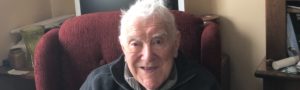
Thomas Walsh (1908-1992) of Rathinure
now browsing by tag
The Tragic Death of John Millea (1870-1935) of Treanaree, Slieverue

There was a tragic farm death in 1935 on the border of the parishes of Glenmore and Slieverue that was reported across Ireland and in the United States. Several newspapers wrongly reported that the death occurred of a Glenmore man. For a generation after the tragic event local parents would warn their children of the dangers of bulls often citing what happened to poor Johnny Millea. The description of the events was found in two Munster Express articles (Fri. 13 Sept. 1935, p. 5 & p. 8). Any additional information gleaned from other publications or sources are cited below. Please be advised that the descriptions of the death of the farmer and the bull are graphic.
The Death of John Millea (1870-1935) of Treanaree, Slieverue
An inquest was held on Wednesday, the 11th of September 1935, by Dr. J.D. Fitzgerald, Coroner for South Kilkenny, regarding the death of John Millea, Treenarea (sic), Slieverue, who was killed the previous day when attacked and gored by a bull.
The foreman of the jury was Thomas Mullally (c. 1897-1951) of Grogan, Glenmore other members of the jury included: Robert Walsh (1872-1951) Davidstown, Glenmore; James Verricker (sic) Grogan, Glenmore; John Kennedy, Ballinclare, Glenmore; John Doherty, Davidstown, Glenmore; William Murphy, Davidstown, Glenmore; and William Walsh, Davidstown, Glenmore. Sergt. Nicholas Garvey (1895-1960) Glenmore, conducted the proceedings on behalf of the Civic Guards. [See our post of 3 October 2021 regarding Sergt. Nicholas Garvey and his time in Glenmore].
Testimony of Mrs. Mary Millea (c. 1865 -1948) of Treanaree, Slieverue
Mary Millea, aged 71, identified herself as the sister-in-law of the deceased John Millea. He was 64 years of age and was single. Together they were owners of the farm. On Tuesday morning about 6 o’clock (old time) John got up and went out for the cows which were in the field at the back of the house. Mary was in the yard at about 6:15 when John came back with the cows. He put the cows in the shed and said that the bull had got out of the shed in which he had been tied. He said he would go look for the bull in Grant’s field. Per the Limerick Leader (Sat. 14 Sept. 1935, p. 12) the owner of the field was Edward Grant of Curraghmore, Slieverue.
Mary started milking the cows. About half an hour later the bull arrived in the yard. The bull was roaring when he arrived, and Mary was afraid of him. Mary went into another shed. She looked out and saw Johnny’s dog in the yard “howling piteously” (The Post, Wed. 18 Sept. 1935, p. 2). Mary became uneasy that her brother-in-law had not returned. Edward Donovan, Slieverue, came to collect the Millea milk. We believe that this Edward Donovan was from the Rathpatrick, Slieverue, Donovan family that sold milk in Waterford.
After telling Edward Donovan of her concerns she went to look for John. She went in the direction from which the bull had come home. She went into Grant’s field. She saw a white thing in the middle of the field and went over to it. She discovered that it was her brother-in-law. Several newspapers incorrectly stated that a number of neighbouring farmers, armed with sprongs [for our international readers a sprong is a long handled pitchfork] and accompanied by dogs, went in search of the deceased. We believe this may have described the men who later sought to find and destroy the bull (Limerick Leader, Sat. 14 Sept. 1935, p. 12).
Finding John Millea
John Millea was lying face down in the field. “Most of his clothes were gone except for his boots and the lower part of his trousers. She knew he was dead when she called to him and got no answer. She testified that she did not stir him because she wasn’t able.
Mary went back to the yard and told Edward Donovan that “Johnny is dead.in the field, the bull killed him.” Edward Donovan said that he would go down and bring back the body. Mary, Edward Donovan and a neighbour named Thomas Power [some newspapers report the name as Thomas Dower] went with a pony car and collected the body. The body was taken to the Millea house. Mary did not notice any wounds on John’s body except the marks on his face.
According to The Post (Wed. 18 Sept. 1935, p. 2) the body was rolled along the field by the bull and there were signs of a terrible struggle as patches of the field were torn up and contained blood. Pieces of the deceased’s clothing were scattered over the ground. As soon as notified Sergeant Nicholas Garvey and a Guard went to the scene.
The Bull
Mary testified that they had owned the bull for about four years. She said she never went near it. Her brother-in-law, the deceased, looked after it. She could not exactly say how long it was housed over the summer. She did not know it was “cross” and had never heard of it attacking anyone before. She discovered that the bull had done a lot of damage escaping from the shed by breaking a few gates and knocking down a churn.
According the Munster Express (Fri. 13 Sept. 1935, p. 8) following the tragedy, search parties sought the bull and found him with other cattle. After several unsuccessful attempts, where the bull charged them, they managed to drive him back to the farm. “Two men then procured shotguns and, not without difficulty, destroyed the bull, which was removed on Wed. morning to Messrs. O’Keeffe’s works at Gracedieu.”
Thomas Walsh (1908-1992) was a native of Davidstown, Glenmore, and son of juror Robert Walsh of the Inquest into the death of John Millea in 1935. Tom told his children about the event. Back in the 1930’s almost all cattle had horns, and bulls were particularly dangerous. He said that after Johnny Millea was killed a group of men gathered to kill the bull. A shotgun was attempted, but failed. The bull was stunned, and eventually the men used a sledgehammer to the forehead of the bull. Jack Donovan was identified as one of the men who killed the bull.
Medical Evidence & Verdict
Dr. Coughlan, Waterford and Dr. Fitzgerald, Rosbercon gave evidence of the injuries sustained by the deceased.
The body was covered with bruises from head to toe. The nose was broken. The right eyebrow and scalp were covered with scratches, ribs were broken on both sides, and there was scarcely a whole rib in the body. There was a big bruise over the heart and a lacerated one over the liver. Both sides of the abdomen were contused and lacerated and the legs were bruised. Both lungs were ruptured and there were other severe internal injuries.
In reply to a juror, Dr. Coughlan said that in his opinion the deceased died within a few minutes of being attacked, very probably as soon as he received the blow over the heart, when a rib was driven into his heart. “The body had been reduced to the state of a ragdoll.” From the spot were some of his clothes were found to where his body was found was about 50 yards.
The Coroner, the Foreman on behalf of the jury, Sergt. Garvey on behalf of the Guards, joined in a vote of sympathy with the relatives of the deceased. The jury after a short retirement returned its verdict. John Millea’s death per the Death Register provides that he died 10 September 1935 at the age of 64. He was a bachelor farmer. His death was caused by “shock as the result of extensive injuries to all the vital organs by having been gored by a bull.” It is noted that an Inquest took place on 11 September 1935.
The Millea Family of Treanaree, Slieverue
The sad tragedy occasioned the deepest regret in the district where the deceased and his sister-in-law were very popular. The funeral to Slieverue was very largely attended. (The Post, 18 Sept. 1935, p. 4). Mary Millea at Johnny’s funeral reportedly stated in praise of her brother-in-law that “Johnny never said a cross word to me” (Thomas Walsh (1908-1992) native of Davidstown, Glenmore).
Parents and Sibling of John Millea
John Millea was born 7 May 1870 at Treanaree, Slieverue the son of John Mallay (sic) and his wife Margaret Donovan. John Malay (sic) (c. 1840 -1900) and Margaret Donovan (c. 1837-1899) were married at Slieverue on 21 November 1865. As a young man John Milea went to America and spent 23 years there. Twenty-two years before his death he returned to Slieverue and worked on his brother’s farm. He took over the management of the farm when his brother died (Munster Express, Fri. 13 Sept. 1935, p. 6). Thus, John left for the U.S. in 1890 and returned to Slieverue about 1913.
John’s eldest brother, James Millea, who was known as Jamesey Millea, was born at Treenarea on or about 8 December 1865. He married Mary Phelan, of Shambo (sic) at Rosbercon on 30 August 1900. Mary was the daughter of Richard Phelan (farmer). James Millea died on 25 November 1924 at Treanaree. He was 58 when he died of chronic nephrites which he suffered with for a year before his death. His brother John was present when he died. James’s widow Mary (née Phelan), died at the age of 83 in the Holy Ghost Hospital in Waterford on 19 October 1948.
Newsworthy Death by Bull?
John Millea’s death was reported in a New York City newspaper, The Advocate (Sat. 5 Oct. 1935, p. 5). Unfortunately, no reference was made to John Milleas’s time in the U.S.
It was rather surprising how many death by bull articles were reported in Irish newspapers in 1935. Such was the appeal of such stories that even rumours were published. For example, the Waterford News & Star (Fri. 31 May 1935, p. 5) reported that “On Monday a strong rumour got about that a man had been attacked and killed by a bull in the vicinity of Waterford. On inquiries it was found that the rumour had absolutely no foundation.”
Coverage of Millea’s Death
In addition to the 5 articles cited above regarding John Millea’s death at least 9 other Irish newspapers reported details of his death. See, New Ross Standard (Fri. 13, 1935 p. 11) “Killed by a Bull”; Irish Independent (Sat. 14 Sept. 1925, p. 5) “County Kilkenny Man’s Shocking Fate”; Irish Examiner (Wed. 11 Sept. 1935, p. 6) “Kilkenny Man’s Tragic Death”; Kilkenny People (Sat. 21 Sept. 1935, p. 5) “Killed by a Bull”; Belfast Newsletter (Fri. 12 Sept. 1934, p. 12, “Killed by a Bull”; Irish Press (Thur. 11 Sept. 1935, p. 1) “Railway, Dock and Farm Tragedies, reported that death occurred in Glenmore”; Meath Chronicle (Sat. 13 July 1935, “Farmer Killed by Bull”; Evening Echo (Thur. 11 Sept. 1935, p. 6) “Kilkenny Man’s Tragic Death”; and Connacht Tribune (Sat. 14 Sept. 1935, p. 20).
Coverage of Others Killed by Bulls
Additionally, there were several other articles in 1935 published in Irish newspapers regarding other men killed by bulls. The Irish Examiner (Tues.19 March 1935, p. 8) reported in March that a Matador in Mexico was killed by a bull. In July, Timothy Humphreys (62) of Cork was killed by his bull (Irish Independent (Mon. 8 July 1935, p. 10). The following month the Ulster Herald (Sat.10 Aug. 1935, p. 2) reported that Wm. Ferneyhough, aged 24, a farm labourer was gored in the throat and died. In September, Simon Hegarty, an elderly farmer was killed at Glenville, near Fermoy (Irish Examiner, Mon. 9 Sept. 1935, p. 6). It was reported in December that a farmer in Donegal, was killed by a bull, which had fatally injured the man’s sister (Irish Examiner, Mon. 23 Dec. 1935, p. 8).
Perhaps one of the more interesting bull related cases in 1935 involved the negligence case brought by the widow of a farmer killed by a neighbour’s bull. Pierce Whelan, Ballyclough, Kilworth, Cork was killed Christmas Eve 1934, by a bull belonging to Margaret and Mary Anne Leonard of Ballyclough. The civil case was heard in July 1935. The judge noted that when he was a young fellow, he had the utmost contempt for women as managers of farms. The care of a farm in the hands of somebody else would not at all be anything like the care and guidance of the master of the farmstead. The jury after that statement awarded £150 to the widow and children of Pierce Whelan (Evening Echo, Fri. 19 July 1935, p. 7).
+++++++++++++++++++++++++++
For some current statistics on deaths caused by livestock and advice regarding bulls see, Teagasc (2025).
Please send any corrections, additional information or photos to glenmore.history@gmail.com
Dr. Kathleen Moore Walsh
The featured photo above is from an old sales brochure and it is not the bull that killed John Millea. The newspapers did not report on the breed of the aggressive bull. Notice that the horns of the featured short horn bull have been blunted, and he is wearing a safety chain from his nose ring up around his horns.
Interviews of Andrew Heffernan (1893-1975) of Aylwardstown, Glenmore

Danny Dowling (1927-2021) for over 7 decades interviewed and recorded various Glenmore residents. We have discovered two short interviews that Danny recorded on 28 February 1964 and 28 August 1964. Both took place in Waterford. These interviews address some queries that we received earlier this year concerning the origin of the Heffernan family of Aylwardstown and the relationship between the Kennedys of Dunganstown and Rathinure. Dates of birth and death have been added, and other information not from the interviews has been placed in square brackets [ ]. Andrew Heffernan was able to provide information back to the early years of the 19th Century.
From Haggard to Aylwardstown
According to Andy Heffernan, the Heffernan family came to Aylwardstown from Haggard, Glenmore. The Heffernan family had been evicted from Haggard. They lived in Haggard where John Byrne (1893-1976) was in 1964.
[John Byrne married Mary Aylward (c. 1898-1983) of Haggard on 8 February 1932. Her father was John Aylward (farmer). John Byrne was a native of Taghmon, Wexford. He was the son of Laurence Byrne (farmer). As an interesting aside, (per Thomas Walsh (1908-1992)) John Byrne during WWII drove his horse to either Slieverue or Ferrybank seeking cigarettes. No cigarettes were available, but he heard that cigarettes were available in Carrick-on-Suir, Co. Tipperary. He drove his horse all the way to Carrick-on-Suir and back. For our international readers Carrick is today (via the N24) about 43 km from Glenmore. However, if John cut across country on smaller lanes the journey would have been shorter. We hope and assume it was a successful mission.]
In Aylwardstown there was a farm of about 100 [Irish] acres at the time the Heffernan family moved. This farm was divided among the Heffernan’s, two Morrissey families and the Delahunty’s. They all came to Aylwardstown together. Each family had 25 [Irish] acres [or 40 statute acres]. Later, Delahunty’s bought the second Morrissey place.
Heffernan Glenmore Burials
The Heffernan’s were buried in Kilivory. Andy told Danny to look for the headstone of Tim Heffernan. [Danny did find the headstone and recorded it as follows:
Erected by Tim Heferin of Haggard
in memory of his father Patrick Heferin
who dep’d this life April 7th 1797 aged 60 yrs
Also the body o Bridget Heferin who dep’d this
life March 17th 1797 aged 34 years]
Andy stated that his brother was the first of the family to be buried in Glenmore Cemetery. His brother died 52 years previously [or in 1912]. He came home from America owing to being delicate. [James Heffernan (1882-1912) died on 2 August 1912 at Aylwardstown. He was single, 30 years of age at the time and worked as a draper’s assistant. He died of heart disease, and his sister Mary O’Connor, of Ballyfacey, was present when he died. In 1908, James Heffernan (25, a draper) traveled with James Delahunty (35,farmer) aboard the Adriactic to New York landing on 1 October. The address in the old country was Glenmore, Waterford and they were going to Chicago, Illinois. Both gave James’s brother Richard Heffernan (1889-1947) as nearest relative or friend. Richard James Heffernan (1889-1947) resided in Chicago. ]
Rathinure Link with Dunganstown, Wexford?
Andy told Danny that he was a first cousin to Peter Kennedy (1878-1962) of Rathinure. [Andy’s mother was Bridget Heffernan née Kennedy (1854-1947) her father was Pierce Kennedy (b. 1809). Bridget Kennedy married Michael Heffernan (1847-1924) on 12 February 1879 at Glenmore. Their photo is above.] Andy often heard his mother say that the Kennedy’s of Dunganstown used to visit Rathinure regularly. She said that they were related. Andy believed that a Kennedy went to Dunganstown from Rathinure originally. Andy also stated that all the Kennedy families in Rathinure were originally the one family. [It is not surprising that Dunganstown came up in this interview. President Kennedy was assassinated just 3 months earlier in November 1963.] For more information on the Heffernan family see our H surname page. For further information on Dunganstown see The Kennedy Homestead webpage.
[Around 1996 an elderly lady named Mrs. Doyle stopped to ask me directions. She said that her grandmother, Hannie Kennedy, came from Rathinure and married her grandfather, Tom Shanahan, of Dunganstown. I took her to Danny who after asking a few questions started searching his copy of the parish records. He found a marriage that took place on 15 February 1843 at Glenmore between Thomas Shannon (sic) and Johanna Kennedy of Rahanure (sic). A notation in the record noted a certificate was provided by Rev. James Cullen, P.P. of Sutton Parish, Wexford for the groom. He explained to Mrs. Doyle that there were a lot of marriages across the Barrow. Before the automobile it was easier to travel by boat than by road.]
Grants of Aylwardstown, Glenmore
Andy stated that the Grants lived where Dick Brien (Fitzgerald) lived. [Per Ann Fitzgerald, Dick Brien was the name Richard Fitzgerald went by. The Fitzgerald family came to Aylwardstown in the early 1800’s from Ballinaraha, Glenmore. They used their mother’s maiden name (Brien) to distinguish themselves from other local Fitzgerald families.]
The last of the Grant’s was a woman. She had a public house there. [We believe that Andy was referring to the Half Way House of Aylwardstown located on the old Stage Coach or High Road.] Jim Dunphy (1855-1943) of Ballyverneen, born over the Rock, gave his life to the Clyde Shipping Company. Jim Dunphy told Andy that a British soldier got a drink in Grant’s public house on one occasion and was leaving without paying for it. The Grant woman told him he would pay or it would be on his soul. The soldier replied, “Will you give me another on my soul?” [Jim Dunphy’s obituary may be read on our D surname page. We are uncertain what “born over the rock” means in this context, but it is likely that he was referring to Jim Dunphy being born on the far side of the Pink Rock.]
The Brien Fitzgerald’s of Aylwardstown, Glenmore
Andy explained to Danny that Dick Brien’s uncle was the present Jim Brien’s father. [We believe that Andy was explaining that Dick Brien and Jim Brien (1896-1979) were first cousins. We were able to verify through parish records every statement made by Andy regarding the Brien Fitzgeralds.] See our F Surname page for further information on the Brien Fitzgerald’s.

Michael Coady of Carrickcloney, Glenmore was married to one of the Brien’s (Fitzgerald’s) of the Half-Way House. [We found in the parish records that Michael Cody married Catherine Fitzgerald of Aylworthstown (sic) on 3 February 1823.]
Pierrie Barron, of Carrigcloney, married into a Mrs. Kirwan née Brien of the Half-Way House. He was her second husband. He came from where Richie Barron had the farm in Carrigcloney. Pierrie Barron was Mikey’s father. [We found where Bridget Fitzgerald, of Aylwardstown, married Michael Kiervan (sic) on 29 February 1848 at Glenmore We also found where Peter Barron married Bridget Cervan (sic) on 22 January 1852. Michael Barron was baptized on 26 May 1855 at Carricklony (sic) to Pierce Barron and his wife Bridget Kerivan.]
Uncles Emigrated to U.S.
Andy told Danny that he had grand uncles who went to America in the early part of the last century [ie early 1800’s]. [See our post of 9 February 2025 regarding his grand-uncle James Heffernan (1825-1891). It is not altogether clear if Andy was also referring to John Dollard (1801-1888) who was married to his great-aunt Bridget Dollard née Heffernan (1811-1891) native of Aylwardstown. See our post of 17 February 2025 regarding John Dollard and Bridget Dollard née Heffernan.
Andy also had two uncles who later went to America. They settled near Stone Wall City on virgin territory and called the settlement Glenmore. They also called the church there St. James’s. When Andy’s uncle John first went out first they could only go to Mass once a year on Christmas Day as they lived 40 miles from the nearest church. This man John on one occasion with a man called Brennan rode 40 miles to the Christmas Mass. Andy said that this took place in South Dakota. [We believe based on contemporary documents that these events actually took place in Glenmore, Wisconsin. We were not able to find a Glenmore in South Dakotas, but we did locate an obituary for Andy’s uncle John Heffernan (1842-1930) who was an early settler of Grant County, South Dakota.]
Grant County Review, Thurs. 19 June 1930
[A VALUED CITIZEN PASSED SATURDAY—Pioneer Settler Near Big Stone Victim of Heart Attack Last Saturday
Big Stone township and Grant county lost one of their most honorable citizens with the sudden death last Saturday evening of John Heffernan, a pioneer of this section. Exactly one month and one day previous to his death Mr. and Mrs. Heffernan celebrated their golden wedding anniversary. At that time and since the deceased appeared to be enjoying ordinary health, was about daily and assisted his sons with work about the farm, taking a lively interest and apparently with many years of life and usefulness before him. Saturday afternoon, accompanied by Mrs. Heffernan, he visited the pastures and looked over the stock, and made no complaint of felling ill until about 8:00 o’clock that evening. He then told Mrs. Heffernan that he had a pain in his chest, and went and laid down for a short rest, which was not an unusual procedure on his part.
When the pain persisted Mrs. Heffernan volunteered to apply a mustard plaster or something of that sort. About that time, however, Mr. Heffernan remarked that it had left his chest and gone into his arm, and then without further word or complaint dropped peacefully into that long, last slumber. Mrs. Heffernan was alone in the house at the time, but despite the shock managed to summon her son James, who was about the place, and also just at that time her son John and daughter Alice, who had been to town trading, arrived home. Aid was immediately procured, but the spark of life had fled and all efforts to rekindle it were unavailing.
John Heffernan was born October 12, 1851, at Glenmore, county Kilkenny, Ireland. In 1874, when 23 years of age, he came to America and located at DePere, Wis. In 1879 he came among the pioneers to this county and filed on a homestead in Big Stone township. The following year he returned to DePere and was united in marriage with Miss Mary Shea, his surviving wife. Together they returned to this county and since that time have resided continuously in Big Stone township. For better than a half century the deceased has commanded the respect, friendship and confidence of his neighbors and acquaintances in this section in a most unusual manner, and never hesitated to lend his support to any worthy project or enterprise. Religiously he was always a devout and faithful practitioner of the Catholic faith, and his home was truly a model husband and father.
Besides his wife the immediate family members are seven sons and two daughters, namely, James, John, Raymond, William and Norbert, all of Big Stone township; Thomas, Omaha, Neb., and Dr. Bernard Heffernan, Milwaukee, Wis.; Miss Alice at home and Mrs. A. H. Flatley, Stockbridge, Wis. All the children and their families were home to attend the funeral.
During his residence in Big Stone township deceased had served as a member of the school and township boards and at the time of his death was president of the Gib Stone Creamery Association, a position he had filled continuously since the association was organized and the creamery built 33 years ago. It will be remembered also that when the Grant County Telephone Co. was organized in this city many years ago, Mr. Heffernan served it for some time as president and in able and praise-worth manner. During the World War he served faithfully in the Liberty loan drive. He was a member of the Milbank Council, Knights of Columbus, and also charter member of Milbank Camp 1887 Modern Woodmen of America.
The funeral services were held at 10:00 o’clock yesterday forenoon at St. Charles Catholic church, Big Stone City, with a solemn Requiem Mass celebrated by the pastor, Rev. Fr. Estergard, with Fr. Joseph O’Neill, of Danvers, Minn., as deacon, and Fr. P. J. Callanan, of Ortonville, Minn., as sub-deacon. A short but very appropriate sermon was preached by Fr. Estergard at the conclusion of the services, and the remains then taken to the church cemetery and laid at rest. Members of Milbank Council, Knights of Columbus, attended in a body. The pallbearers were John Gowan and Dr. O’Donnell, Ortonville, Minn.: Edward Rourk, Big Stone City, and John Huben, C. W. Martens and W. S. Dolan, Milbank. As a mark of respect and the high esteem in which deceased was held in that community, the business places of Big Stone City remained closed yesterday forenoon.
Other relatives from a distance in attendance at the funeral were Mrs. Ellen Daugherty, Medford, Oregon; Mr. and Mrs. Will Daugherty, Brainard, Minn.; Mr. and Mrs. Dennis Calnan and daughter Marguerite, DePere, Wis.; William Calnan and Miss Esther Calnan, Miss Ella Conley and George Peters, all of Green Bay, Wis.; Mrs. Margaret Irish, Stockbridge, Wis., and Mrs. Carl Coe, Minneapolis.] To view John Heffernan’s grave see Find-a-Grave.
*****************************************
Special thanks to Ann Fitzgerald for the information on the Brien Fitzgerald’s and texasceltfirl for posting John Heffernan’s obituary.
The featured photo above his Andy Heffernan’s parents, Michael Heffernan (1847-1924) and Bridget Heffernan née Kennedy (1854-1947) of Aylwardstown, Glenmore. A copy given to me in around 1993 by Nellie Doherty (their granddaughter). Nellie thought the photo was taken around 1920.
Please send any corrections, additional information or photos to glenmore.history@gmail.com .
Dr. Kathleen Moore Walsh