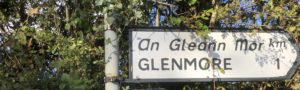
Rochestown Glenmore
now browsing by tag
John L. Conn (1812-1893) of Mount Ida, Rochestown, Glenmore [Updated]

Bigamist John Lamley Conn (1812-1893)
Martin Forristal, of Ballinlammy, Glenmore wrote an excellent article entitled “Mount Ida” which may be found on our guest authors’ page by clicking here. In tracing the history of Mount Ida, Martin revealed that John L. Conn (1812-1893) of Mount Ida was a bigamist keeping his lawful wife in Glenmore and his mistress and children in Dublin.
While searching for other information we came across two articles involving John L. Conn. The first is from May 1859 and involves the attempted burglary of Mount Ida. The second article is from May 1883 and involves a criminal case brought against a Glenmore man named Patrick Walsh for intimidation. Both newspaper accounts provide an interesting glimpse into the state of criminal justice in Glenmore in the mid to late 19th century.
Attempted Burglary of Mount Ida, Glenmore
On Wednesday the 4th of May 1859 men attempted to burgle Mount Ida. The following account was found in the Waterford Mail (Tues. 10 May 1859).

Burglarious Attempt—We regret to hear that on Tuesday night, or rather Wednesday morning last, between the hours of 12 and one o’clock, a party of burglars attacked Mount Ida House, the residence of John L. Conn, Esq., situate at Rochestown, barony of Ida and county of Kilkenny. They forced the shutters of a window in the east wing of the building, and were in the act of breaking open a door, with an iron bar and a wooden bar acting as levers under it, when the noise was heard of one of the maid servants who slept in the apartment over it, and who ran up and called her master. Mr. Conn, with more courage than prudence, sallied out armed with a gun, but the scoundrels heard the opening of the lock and ran off, leaving their implements behind, and the night being very dark, Mr. Conn did not get a shot at them, they were, however, disappointed of their booty.
We are astonished to hear that there is no magistrate in the district, which contains at least 30 square miles, and that the nearest police station is several miles off, and we have no hesitation in saying that the government authorities incur a deep responsibility if this exceptional state of things be not at once rectified. We hear the constable of the nearest police station made an examination of the place the following evening.
This article indicates that in 1859 there was no police barracks in Glenmore Village.
Glenmore Intimitation Case
Nearly 25 years later, a former tenant of John L. Conn was charged and convicted of intimidation concerning the letting of his former 40 acre farm. The account of the trial appeared in the Waterford Standard (Sat. 19 May 1883, p. 3). Patrick Walsh in May 1883 was in the employment of Mr. Cody and was charged with intimidation under the provisions of the Prevention of Crimes Act.
It was alleged that on 3 May 1883 at Rathinure without legal authority, the defendant used intimidation toward Michael Roche, when he advised him through his cousin to abstain from doing what he had a legal right to do—namely, to become tenant of a certain farm on the estate of John Lamley Conn, of Mount Ida. A special petty sessions court was held at Kilmacow on 17 May before Mr. Bodkin R.M. (Resident Magistrate) and H. Thynne, R.M. Mr. Hartford, the Kilkenny Crown Solicitor, prosecuted, and the defendant had no legal representation.
The defendant, Patrick Walsh, and his brother John Walsh, had been in possession of a farm which was the property of John Lamley Conn. Their uncle had the farm before they took possession. They fell into arrears on the rent, but went to John Conn and came to an agreement that in consideration for a sum of money, they agreed to give up the land and not attempt to redeem it. At the time of the trial the farm had been idle for three years.
On the 5th of February 1883, Michael Roche sent a proposal to John Conn that he would rent the farm for £1 per acre. On 3 May 1883 about ten o’clock in the evening the police were on patrol at Glenmore. The police observed the defendant with his brother John Walsh and in the company of James Costello.
The police overheard the defendant speak to John Roche, a cousin of Michael Roche. It was alleged that in a lane of Rathinure, Patrick Walsh said, “That is my land; I had the land before Conn had it. What do I care about Conn, even if he has two bobbies [police] mind him—I will pull the trigger, for I will swing for any person who takes that land.” [At this time murder was a hanging offence. The defendant’s alleged use of the phrase “I will swing” was a threat to kill anyone who took the land.]
Witness 1: John Lamley Conn
The first witness called was John Lamley Conn who was summoned to appear. It appears from the newspaper account that he would not have attended except that he received a summons. Conn testified that he lived at Mount Ida and had some land in Rochestown. He owned the lands in Rochestown for about 40 years. He acquired them by purchase in the Court of Chancery.
Conn stated that he knew the defendant and his brother John Walsh, and the farm that they once occupied was about 40 acres. They fell in arrears and were given every facility to redeem the farm. They came to Conn and asked for money as good will. Conn gave them money in exchange for them voluntarily leaving the farm. Conn testified that he had not seen the defendant since he left the farm voluntarily.
Witness 2: Constable Williiam Broderick
The second witness was Constable William Broderick who testified that he and Sub-Constable Patrick Donohue were patrolling on 3 May 1883. While in Rathinure in a lane off the public road he heard Patrick Walsh say, “That is my land. I had that land before; what do I care if Conn has two bobbies minding him. What do I care about Conn?”
Constable Broderick then testified that he believed the defendant said, he would “pull his finger if any man would take the land.” He testified that the sub-constable said that he heard the defendant say that he would “pull the trigger.” He testified that the defendant said, “advise him, advise him—you know him; for I will swing for any man who takes that land.”
The constables jumped over the ditch into the lane and from John Roche obtained the names and addresses of all the men present. The defendant walked past the constables. When the constables caught up to the defendant the defendant was asked about the language he used concerning Conn. The defendant replied that “they would be all good friends yet.”
The defendant asked Constable Broderick concerning his character and the Constable responded that he only knew the defendant about 8 months, he knew nothing against the defendant and had heard nothing against him. Magistrate Thynne asked if the defendant was “worse of drink that night.” Constable Broderick replied that the defendant had drink taken, and he had been coming from the public house, but he could have been justified in summoning him for drunkenness.
Witness 3: Sub-Constable Donohoe
Sub-constable Donohoe was called and sworn and stated that he did not want to correct the information provided by Constable Broderick. At this point the Magistrates wanted Mr. Hartford to examine Mr. Roche. Mr. Hartford refused and Magistrate Bodkin said that they would examine the man themselves. Mr. Hartford replied, “If you do, you must do it on your own responsibility—I am here on behalf of the Crown.” The defendant then called John Roche, but did not ask him any questions. The Magistrates began to ask Roche questions who merely testified that the defendant told him to tell his cousin, Michael Roche, not to take the land.
At this point from the newspaper account the magistrates appear to have lost patience with the defendant. He had a list of witnesses, but then stated he had no questions for them. The defendant was asked, “Who is John Fitzgerald?” The defendant replied, “He is the man I worked with for the last two years; he is the only man I worked with since I left the farm.”
Mr. Cody then testified, “This man is now in my employment, and I never heard anything against him.” When asked if the defendant drank much, Cody replied that he did not. However, when he did drink “he does not be very steady.” The Magistrates then began to quiz Cody on whether he wanted the land in question. Cody replied that he did not; he had enough land of his own.
The Magistrates
Prior to 1898 defendants could not testify on their own behalf. In this case the Magistrates asked the defendant if he had every been convicted. Thus, while not considered competent to testify concerning what occurred the defendant was considered competent to incriminate himself. The defendant responded, “It was for being drunk; drink is my failing; I was convicted of being drunk 11 years ago.”
Magistrate Bodkin: “You are accused of a very serious offence, which has been very clearly proved against you. The constable says you were not so drunk as not to know what you were about. However, he has taken upon himself to give you a good character so long as he has known you. That has had an influence on our mind, and, therefore, we will let you off with two months’ imprisonment at hard labour.”
Some of our readers might recall that Magistrate Bodkin was present at the Ballyfacey Eviction Riots of August 1885 and was told by Fr. Neary that his wife would be going to bed a widow if he persisted. For our article concerning the Ballyfacey Evictions click here.
Unfortunately, without first names or townlands it is difficult to determine who was the employer, Mr. Cody. Even with first names it is difficult to identify the persons in the newspaper account of the intimidation trial with common names like Walsh and Roche and without townlands or ages. If anyone can provide further information concerning any of these local men please post below or email glenmore.history@gmail.com.
[Update: Ann FItzgerald was able to identify the two Walsh brothers. John Walsh (1835) and Patrick Walsh (1837) were born in Rathpatrick, Slieverue to Nicholas Walsh and Judith Magrath. We were able to locate baptismal records for other children including: Jeremiah Walsh (1833); James Walsh (1840); William Walsh (1843) and Anne Walsh (1847). Patrick Walsh (1837) never married. John Walsh (1835) married Margaret Fitzgerald, of Aylwardstown, on 16 Feb. 1870. Margaret was the daughter of Richard FItzgerald. Two of John & Margaret’s sons emigrated to New York and married two Hanrahan sisters from Glenmore Village.]
Dr. Kathleen Moore Walsh
Edward Walsh (1862-1946)Proprietor & Editor of The Munster Express

In August 2020 while we were researching the Champion 1906 Glenmore Football Team a sports journalist that wrote, under the nom de plume Ned of the Hill, for the Munster Express wrote several articles objecting to the unfair treatment of the Glenmore Football team (click here for the football article). In August 2020 Danny Dowling (1927-2021) stated that he thought that Ned of the Hill may have been Edward Walsh (1862 -1946) the proprietor and editor of The Munster Express in 1907. Glenmore and other areas of South Kilkenny featured heavily in The Munster Express in the early years of the twentieth century under Edward Walsh. A column entitled “Glenmore Notes” appeared regularly in the first decade of the century to be eventually replaced by “Echoes from South Kilkenny.” Ned of the Hill, disappeared and returned, in 1922, when Ned of the Hill authored a column entitled “Summer Rambles in the Walsh Mountains” which are located in South Kilkenny. Today, we are going to feature Edward Walsh (1862-1946), his newspaper, and Ned of the Hill
Ned of the Hill
In August 2020 we contacted John O’Connor of The Munster Express who stated that The Munster Express was originally launched as a farmers’ paper and was particularly popular in South Kilkenny. Its founding editor, Joseph Fisher, was very active in the Land League and was a leading member of the Farmers’ Club. Joseph Fisher died in 1882 and his sons took over the business. In 1889, Joseph’s son William, as editor of The Munster Express was jailed for the newspaper’s support for the Land League and its opposition to rack rents. Edward Walsh (1862-1946) purchased the newspaper from the Fisher family.
John O’Connor identified two individuals who may have been Ned of the Hill at various times during the early twentieth century. The first ‘Ned’ identified by John O’Connor was a schoolteacher or school principal, named Edward Walsh, from the Carrickshock and Hugginstown area. John did not know if the schoolteacher, Edward Walsh, was related to the proprietor, Edward Walsh.
The second ‘Ned’ identified by John O’Connor was a Mr. E.V. Drea, a town councilor in Waterford. E.V. Drea’s daughter in the early 1950’s was the subject of a news item in The Munster Express and within there was reference to her deceased father having been ‘Ned.’ (Email from John O’Connor dated 31 Aug. 2020).
For a tradition of Ned of the Hill see Duchas, Éamonn an Chnoic.
For the Pogue’s rendition of see their You Tube, Young Ned of the Hill.
Glenmore Connection
Danny Dowling recalled that Edward Walsh (1862-1946), although born in Waterford City was related to one or more Glenmore families, but Danny could not recall the details. This past week while going through some of Danny’s voluminous files a copy of an obituary provided one link between Glenmore and Edward Walsh (1862-1946). The Munster Express on 8 February 1908 published an obituary for Mrs. Mary Aylward (c. 1838-1908) of Rochestown, Glenmore. It was reported that in addition to being the wife of James Aylward (c. 1831-1916) “she was the mother to Mr. John Aylward, Arundal Square and to Mr. Bartholmew Aylward, Peter Street, and Michael Street, Waterford, and cousin to Mr. E. Walsh, T.C., Editor and proprietor Munster Express.” Other cousins of the deceased lady listed in her obituary include: John Holden, Edward Cody, John Cody, Thomas Neville, Michael Neville, Thomas O’Meara, Joseph Croke and William O’Neill. “Amongst those who attended the funeral from Waterford included…E.V. Drea…”
It is not known if Edward Walsh (1862-1946) and Mrs. Mary Aylward (1838-1908) were first or more distant cousins, but it appears from the obituary that the proprietor and editor was making a point including their relationship and other cousins that they presumably shared. Mary Aylward married James Aylward on 12 Feb. 1857 at Rosbercon. The only information that is listed is his address is listed as Ballynock. It is assumed that Mary Aylward née Aylward was from Rosbercon or Glenmore parish very near its border with Rosbercon parish. James Aylward and his wife, Mary Aylward née Aylward had at least twelve known children:
[1] Patrick Aylward (bapt. 24 Jan. 1858); [2] Ellen Aylward (b. 22 June 1859) ; [3] Tobias Aylward (b. 30 Nov. 1860); [4] Catherine Aylward (b. 7 May 1862); [5] John Aylward (b. 10 Feb. 1863); [6] Thomas Aylward (b. 25 May 1865); [7] Bridget Aylward (b. 16 Jan. 1867); [8] James Aylward, (b. 25 Oct. 1868); [9] John Aylward (b. 16 Feb. 1870); [10] James Aylward (bapt. 4 Aug 1872; [11] Michael Aylward (14 April 1874); and [12] Bartholomew Aylward (b. 19 April 1876). Four of the Aylward children had Holden godparents including: Bartholomew Holden, Mary Holden, Catherine Holden and John Holden.
Edward Walsh’s (1862-1946) obituary in The Munster Express (Fri. 12 July 1946, p. 4) provides that he was “…born in Waterford on the 23rd November 1862, he had reached the ripe age of over 83 years. He was quite active up to a few months ago and enjoyed perfect health throughout his long and eventful public and business life. The youngest of a large family, in the natural sequence of events, he survived them all. Sprung from good old County Kilkenny business, professional and farming stock on both paternal and maternal sides, he was connected with many of the oldest families in the South of Ireland, extending right down to the confluence of the Suir, Nore and Barrow to within a couple miles of, and in view of, his native City of Waterford.”
Parents & Siblings
Edward Walsh (1862-1946) was the son of Patrick Walsh and Catherine Doherty. His parents were married on 6 March 1848 at Trinity Within, Cathedral, Waterford. Unfortunately, the parish records do not provide any information as to the location of their births, the names of their fathers, or their ages. However, the records do reveal that the couple had at least seven children all baptized at Trinity Within, Cathedral, Waterford including: [1] John Walsh (bapt. 28 May 1850); [2] Joseph Walsh (bapt. 22 Aug. 1851); [3] Joseph Walsh (bapt. 27 Feb. 1853); [4] Ann Walsh (bapt 6 Nov. 1854); [5] Joanna Walsh (bapt. 3 March 1856); [6] Brigid Walsh (bapt. 7 Feb. 1858) and [7] Edward Walsh (bapt. 23 Nov. 1862). In 1854, Ann’s godfather was Joseph Doherty which may aid in discovering the location of Catherine Walsh née Doherty’s birth.
Edward Walsh (1862-1946)
Although his obituary takes up nearly a page of The Munster Express ( Fri. 12 July 1946, p. 4) very little is revealed concerning his early life in Waterford City. From the 1901 Census it is known that he was married to Margaret (c. 1865-1935) (née Power). The couple were living at 15 Peter Street, Waterford in a class 2 house comprised of 9 rooms with 5 windows across the front and one outbuilding. Edward’s profession is listed as Master Cork Manufacturer. It is assumed that he plied his trade from the outbuilding. Edward could read and write Irish. The census records that six children are in the household from 9 to 2 months of age. Also present in the home is his brother-in-law William Power, aged 45, who is married and employed as the clerk of the R.C. Cathedral. All the family except Margaret and her brother William Power were born in Waterford City. Margaret and William Power were born in Co. Waterford. By 1911 the family had moved to 6 Hanover Street, Waterford. Edward is 48 year of age and the proprietor of a newspaper. He and Margaret had been married for 21 years and had 10 children but only 8 were living in 1911. William Power, aged 59 is still with the family and still employed at the Cathedral. Two sons were employed at the newspaper, Patrick (aged 19) as a journalist and Edward (aged 16) as a printer. The house was a 12 room first class house occupied by 10 people.
In addition to losing two children under the age of 2, Edward and Margaret lost two adult sons within a period of three months. William “Willie” Walsh, aged 21, died on 26 October 1921 at 37 The Quay, Waterford of TB. He was under medical care for 18 months and his profession was listed as printer (Waterford Death Register). Three months later on 27 January 1922, John Walsh, aged 22, died of meningitis after a severe attack of influenza. At the time of his death John was employed at the National Bank of Cahir and previously had been in their Wexford Branch (New Ross Standard, 3 Feb. 1922, p. 5).
In addition to running and editing The Munster Express, Edward Walsh was also involved in Waterford politics, was a staunch Nationalist and supported a number of charities. He twice served as Mayor of Waterford and also served as the High Sheriff. It was reported that 30 years prior to his death (c. 1916) he was offered a knighthood, but he declined it because there was not an All Ireland Parliament functioning in Dublin. He was a life master of the Holy Ghost Hospital, Waterford; President of St. Joseph’s Young Priests Society, Waterford and President of the Cathedral Confraternity; Director of the Tourist Association; and served on the Waterford Corporation for 40 years. He also served as a member of the governing bodies of Dublin and Cork University Colleges. In recognition for his services in the cause of Irish Nationalism he was presented with a plaque of Daniel O’Connell by Isaac Butt (Irish Press, Wed. 10 July 1946, p. 4). Resolutions of Sympathy were extended after his death to his family by Glenmore Comhaire Ceanntair, Fianna Fáil (Irish Press, Thurs. 1 Aug. 1946, p. 9.)
We hope that one or more readers may be able to shed some more light on the connections between Edward Walsh and his Glenmore and South Kilkenny connections.
Special thanks to John O’Connor and Liam Murphy for information they provided.
Please send any correction or additional information to glenmore.history@gmail.com.
Dr. Kathleen Moore Walsh
Brother Peter Haberlin, O.F.M. (1845-1934): The Last Franciscan Grey Friar

Last summer Danny Dowling asked me if I could locate information regarding Brother Haberlin, of Rochestown, Glenmore. A death announcement was located in the Munster Express (23 March 1934, p. 8) which revealed that Brother “Peter” Haberlin, a native of Rochestown, South Kilkenny, “the last of the Franciscan Grey Friars who had charge of the mission at Santa Barbara, California,” died at the age of 90. When I told Danny I found “Peter” Haberlin, Danny told me that was not the name of the man.
Marks Haberlin
After further research, Danny was indeed correct. Brother Peter Haberlin was baptized “Marks” Haberlin on 1 June 1845 at Rochestown, the son of John Haberlin and Hanora Laracy. According to Danny the Haberlins were blacksmiths and various generations of Haberlins had forges in Cat’s Rock, Aylwardstown, Rochestown, Rathinure and there was a Laracy forge in Robinstown. Danny noted that Haberlins have been in Rochestown from before the mid-eighteenth century. (Irish scholar John O’Donovan’s mother, Eleanor Haberlin hailed from Rochestown and married his father in 1788.) Danny Dowling recalled that the Laracy’s originated from Slieverue and that is where Brother Haberlin’s parents, John Haberlin, of Rochestown, Glenmore and Catherine Laracy were married on 2 November 1838.
In the pre-famine parish marriage records the fathers’ of the couple were not recorded. At least four children were born to the marriage: [1] Catherine Haberlin, bapt. 8 Jan. 1840; [2] John Haberlin, bapt. 11 March 1842; [3] Marks Haberlin, bapt. 1 June 1845 and [4] Michael Haberlin, bapt. 1849. It is not known when Brother Peter took the name Peter, but the name Marks is found in parish baptismal records going back to the 18th century. For example, a Marks Haberlin was baptized at Rochestown on 2 March 1797 the son of John Haberlin and Mary Forstal.
According to an obituary that appeared in the Santa Barbara newspaper (23 Feb. 1934) Brother Peter Haberlin joined the Franciscans at Santa Barbara, California in January 1870, and was “clothed in the grey habit in 1872.” On census records Brother Haberlin recorded that he emigrated in 1868 (1920 & 1930 Census). New York passenger lists reveal that “Mark” Haberlin entered the US on 28 October 1868 and travelled on a ship named “Nebraska.” Excerpts from various interviews that Brother Peter Haberlin provided have been posted and provide some interesting details of his early years in the US.
Brother Peter Haberlin

According to Brother Haberlin he emigrated to America to work with his brother, John, in California. Both brothers were blacksmiths. While working in his brother’s shop in San Francisco, he met two Franciscans from Cork, Ireland, who had been at the Santa Barbara Mission. Brother Haberlin had been thinking about joining the order. He said that he came from very plain people. He said that he knew he could not become a priest because he did not have sufficient education, but he thought he could serve in other ways as a brother in the order. The two Franciscans encouraged him to join the order. He stated that he was afraid that his brother would discourage him so on the first day of January 1870 he “stole away” to the Franciscan Mission at Santa Barbara.
As a novice he carried water from Mission creek in buckets dangling from a yoke on his shoulders. He also worked as a blacksmith making a lot of the wrought iron work that was used around the Mission and was still present when he died. (Los Angeles Times, 26 Feb. 1934, p. 23). In an interview he admitted that several times during the first few months he was tempted to leave, but old Fr. Sanchez encouraged him to stay. He was told that if he left he would regret it all the rest of his days. As an elderly man looking back Brother Haberlin stated that had he left he would have regretted it.
When Brother Haberlin entered the order, he was a mechanic and blacksmith. As he grew older, he switched to cooking and baking. At various times he also served as porter. One Saturday evening, returning from his garden to the house, he admitted to a colleague that the three hardest things about being a friar were just ahead of him, “A bath, a shave, and Confession.”
Brother Haberlin entered the Mission of Santa Barbara in 1870 and received the grey Franciscan habit in 1872. Thus, he became a member of the Apostolic College of Our Lady of Sorrows which had been founded to accept Franciscan novices to be schooled under Spanish Professors and theologians. Mexico had secularized the mission properties in 1837 with the exception of Mission Santa Barbara. Missionaries no longer came from Spain and Mexico and in time the lack of vocations and death of the aged friars threatened the Franciscan Order in California with extermination. During this period Santa Barbara Mission was isolated and independent of every other convent and province of the order. A small group kept the Santa Barbara Mission open. The Bishops in California needed clergy to care for the spiritual needs of German immigrants. They turned to the Franciscan Province of St. Louis for help. The St. Louis Franciscans had fled to St. Louis to escape the harsh anti-clerical laws of Bismark. In 1885 the remaining Spanish and German friars merged as the Province of the Sacred Heart. The Santa Barbara Mission was finally attached to the Sacred Heart Province of St. Louis in 1885 (Oakland Tribune, 19 May 1965, p. 78).

Brother Haberlin spent over 30 years at the Mission of Santa Barbara. He died at the Mission San Luis Rey (Oceanside, Calif.) on 23 February 1934. He was 88 years of age when he died and had been a friar for 62 years. Brother Haberlin was the last surviving member of the small group that kept the Mission open prior to the merger and his death generated newspaper coverage dubbing him the last “grey friar.”
Brother Haberlin’s Family
Brother Haberlin’s father, John Haberlin died at the age of 87 in Rochestown on 16 November 1887. His widow Honoria Haberlin née Laracy was present when he died. Five months later, Hanoria Haberlin née Laracy died on 6 April 1888 at Graiguenakill, Glenmore at the age of 85. Patrick Walsh was listed as being present when she died, however no relationship was provided. It is not known whether Patrick Walsh was a nephew or son-in-law etc.
It is believed that John Haberlan (1842-1906) went to California and sent for his brother Mark Haberlin. In the 1870 San Francisco census John was 28 years of age and married to Margaret and they had an 8 month old daughter, Anorah Haberlan. Margaret Haberlan née Burke (1845-1899) was a native of County Clare. John and Margaret Haberlan went on to have at least 7 children (5 girls and two boys) including: [1] Anorah F. Gilmartin née Haberlan (1869-1948); [2] Rose Marie Lyons née Haberlan (1871-1959); [3] John Haberlan, Jr. (c. 1873); [4] George Thomas Haberlan (1875-1968); [5] Katty Haberlan (c. 1878); [6] Margaret Haberlan (c. 1880); [7] Alice May Haberlan (1881-1935). (St. Mary’s Cemetery markers).

At some point John Haberlan gave up blacksmithing, became a shipwright for the Harbor Commissioners and moved his family 13 miles from San Francisco to Berkley, Calif. His wife Margaret Theresa Haberlan née Burke died on 11 November 1899. In April 1906 the San Francisco earthquake and resulting fire destroyed 80% of the city and over 3,000 people were killed.
John Haberlan (1842-1906) survived the earthquake but drowned on 11 December 1906 while walking home in a storm. He was living at the family home at 1410 Fifth Street, West Berkley, with his youngest daughter Alice. When he didn’t come home she raised the alarm and his body was not found until the following morning. He had just received a month’s wages and it was thought initially that he met foul play, yet over sixty dollars and a silver watch were found on his person. One newspaper reported that he was drinking heavily, but the others reported that in the heavy rain he fell striking his head and drowned in the storm water which filled the street gutter. John Haberlan was survived by one son and three daughters (Berkley Daily Gazette, 11 Dec. 1906, p. 1 and 12 Dec. 1906, p. 12).
These children of the Great Famine era grew up and emigrated to California, shortly after the American Civil War and began new lives far from Rochestown. They not only witnessed but were involved in California history from the Missions to the San Francisco earthquake.
For anyone attempting to unravel the Haberlin lines, in undated correspondence, Sister Margaret Mary Laughrey, of the Incarnate Word Convent, of San Antonio, Texas noted that her great-grandfather Patrick Haberlin was a brother to John Haberlin (father of Bros. Peter Haberlin). Her grandfather was Thomas Haberlin who married Bridget Murphy and they had 5 girls and 1 boy. One of the daughters of Thomas and Bridget Haberlin, Kate Haberlin, married on 29 August 1905 at Glenmore, Terence Fluskey age 27 of Mile Bush, Rosbercon. The bride was from Forristalstown, Glenmore.
The featured photo above is the chapel of the Santa Barbara Mission taken by Kevin Coles (c) 2009. The photo of Brother Haberlin is courtesy of Eman Bonnic.
Dr. Kathleen Moore Walsh
John O’Donovan (1806-1861) and Genuine Irish Proverbs

As we approach St. Patrick’s Day 2021, we wanted to provide a few Irish proverbs to readers. In our quest for proverbs, we discovered a paper written in 1832 by the well-known Irish scholar John O’Donovan (1806-1861) who was born and reared in the former united Catholic parishes of Slieverue and Glenmore. For a concise biography of O’Donovan and his important work see, https://libraryireland.com/biography/JohnODonovan.php .
As Danny Dowling explained, in some of our earliest posts, the parish of Glenmore did not exist until 1846 when the Catholic parish of Slieverue was split. The old civil parish of Kilcolumb was divided unequally between the Catholic parishes of Slieverue and the new Catholic parish of Glenmore. John O’Donovan’s mother was Elleanor Haberlin, from Rochestown townland, now in Glenmore. She married on 6 October 1788 Edmond O’Donovan, of Atateemore townland, Slieverue. Atateemore was where John O’Donovan was born in 1806. During the 1846 division, Attateemore although in the civil parish of Kilcolumb, and alongside Rochestown, remained in Slieverue Catholic parish.
John O’Donovan is said to have started his education in a hedge school and then attended the Hunt Academy in Waterford City. His father, Edmund O’Donovan died in 1817 and a few years later at the age of 17 O’Donovan went to Dublin. Although a place was secured for him to study at Maynooth he declined it because he did not wish to become a priest. O’Donovan’s first job was in the Public Service Office where he translated and transcribed ancient manuscripts (Munster Express, 10 Nov. 2006, p. 13). From 1830 to 1842 O’Donovan was employed on the first Ordinance Survey researching place names. He was sent into the field and travelled across Ireland. From around Ireland, O’Donovan sent letters to his boss containing descriptions of local lore, tradition and antiquities. These letters were placed in 103 volumes and became known as the “O’Donovan Letters.” “They are not heavy with more erudition, but are enlivened with flashes of humourous anecdotes and many a merry ‘quip and crack and jest.’” (Catholic Encyclopedia, available at https://www.newadvent.org/cathen/11210c.htm ). From 1842 until 1861, from time to time, O’Donovan continued to perform work on the Ordinance Survey when requested.

by Bernard Mulenan (wiki)
In 2014 Professor Michael Herity, presented to the Royal Irish Academy a lecture entitled “John O’Donovan’s Work for the Ordinance Survey 1830-61” the slides are available at Prof. Michael Herity, MRIA, ‘John O’Donovan’s work for the OS’. 29-10… (slideshare.net). In addition to highlighting the work undertaken see, slide 23 which highlights an interesting excerpt from one of O’Donovan’s letters. “There is a tradition here that the Goldsmiths are descended from a foreign friar who came to Ireland about a couple of centuries ago, and who seeing every inducement to embrace the Religion of the state broke his vows of chastity, poverty etc. and became a Minister legens. And hence the family were called by the old Irish in their own language lioct maga laide an tean báta, which I avoid translating for the sake of decency. This may or may not be true, but it is worthy of remark that the family are remarkable for lasciviousness and that almost all of the Goldsmiths now living here are illegitimate…All this has little to do with topography.”
Irish Proverbs
In 1832, while working for the Ordinance Survey, John O’Donovan’s article entitled “Irish Proverbs,” was published in the Dublin Penny Journal (Nov. 1832, p. 158-19 available at URL: https://www.jstor.org/stable/30003762). A proverb is usually a short saying of popular wisdom to provide practical advice or teach a lesson. O’Donovan noted that from ancient times proverbs were recorded by Plato, Aristotole and Plutarch. “Proverbs owe their origin to the sayings of wise men, allusions of ancient poets, the customs and manners of nations, they are adapted to common use as ornaments of speech, set rules of instruction, arguments of wisdom, to which time has given assent, and maxims of undeniable truth. The peculiar veneration which the Irish have for their ancient proverbs, has given rise to a well known assertion: Ni feider an sean-fhocal do sharúghadh. It is impossible to contradict the old word (proverb.)”
O’Donovan lamented that for a people who entertain such a high opinion of proverbs, it should be expected that a trace of wisdom would appear in the printed collections of proverbs. However, he found that “amongst all the nations of the world,” the proverbs attributed to the Irish, were “the most vulgar, awkward, incoherent, and ridiculous, indicating a lowness of sentiment, and a total lack of mental refinement.” O’Donovan expressed disbelief that no one had previously objected to the proverbs attributed to the Irish. He referenced the Ray collection and re-produced a list of seven “modern English-Irish proverbs of the lowest order, and rudest nature” found in the Ray collection. John Ray (1627-1705) in 1670 published a collection of English proverbs. His book continued to be published through the 19th century long after his death. The new editions were updated and expanded to include proverbs from other countries including Ireland. The seven offending proverbs identified by O’Donovan in Ray’s collection include:
- She is like a Mullingar heifer, beef to the heels.
- He is like a Waterford merchant, up to the ___ in business. [Unfortunately, the blank was not filled in.]
- His eyes are like two burnt holes in a blanket.
- Full of fun and foustre, like Mooney’s goose.
- He looks as angry as if he were vexed.
- ‘Tis as bad as cheating the devil in the dark, and two farthing candles for a halfpenny.
- He’d skin a louse, and send the hide and fat to market.
O’Donovan then listed 84 “genuine Irish proverbs, that he translated principally from Hardiman’s Irish Mintrelsy…” Below is a selection of the “genuine Irish proverbs.”
1. An t-scod dofhaghála’s I is áilne. The rare jewel is the most beautiful.
2. Air li ni breíth fear gan suilíbh. A blind man is no judge of colours.
3. Anuair a bhidheann an cat a muigh bidheann na lucha a g rainnceadh. When the cat is out, the mice dance.
5. Bidh ádh air Amadán. Even a fool has luck.
6. Beul eidhin a’s croidhe cuilinn. A mouth of ivy, a heart of holly. [O’Donovan offered the following explanation “The leaves of ivy are soft and smooth, those of holly rough and prickly—a metaphorical proverb.”]
9. Bidh boirbeacht in-geal ghaire. There is often anger in a laugh.
11. Buaine clú na saoghal. Fame is more lasting than life.
13. Bocht an Eaglais bhios gan cheol. The church that has no music is poor indeed.
17. Claoidheann neart ceart. Force overcomes justice.
18. Caomhnann dochas ant-ingreamach. Hope consoles the persecuted.
22. Dearbhrathair leadranachta clachán. Drunkeness is the brother of robbery.
30. Feárr dreoilin in-dorn ‘ná corr air cairde. A wren in the hand is better than a crane out of it.
31. An te Chidheann amiúgh fuaruigheann a chuid. He who is out, his supper cools.
46. Is treise gliocas ‘ná neart. Wisdom exceeds strength.
47. Is milis fion, is searbh a ioc. Wine is sweet; to pay for it bitter.
50. Is Dall an gradh baoth. Foolish love is blind.
61. Ni fhuil gaol ag aon re saoi gan scun. No one is related to a man without prosperity.
64. Ni fhuil ro aosta re foghuim crinachta. Never too old to learn wisdom.
65. Ni fhuil saoi gan locht. There is no one without fault.

69. Righ miofhoghlamtha is asal corónta. An ignorant king is a crowned ass.
70. Saruigheann Eagna gach Saidhbhreas. Wisdom exceeds riches.
71. Soightheach folamh is mo torann. An empty vessel makes most noise. [O’Donovan noted this was applied to a talkative man.]
72. Saidhbhreas sior subhailce. Virtue is eternal wealth
73. Sgeitheann fion firinne. Wine pours out the truth. [O’Donovan noted that this is applied to a drunken man who foolishly “blabs” out his secrets.]
77. Tosach coille a’s deirc móna. The beginning of a wood; the end of a bog.
79. Fion a n-diu, uisge amarach. Wine today, water tomorrow.
82. Dearg anoir is ionann a’s sioc. Red [sky] in the east [dawn] is a sign of frost.
83. Bogha fliuch na maiden, bogha tirm na trathnona. A rainbow in the morning is a sign of rain; in the evening, of dry weather.
When I first visited Glenmore thirty years ago there were two sayings that I heard that were so expressive that I have never forgotten the sayings or the Glenmore people that said them. While the first saying might be labelled a proverb the second would never be recognised by O’Donovan as a genuine proverb .
- You can’t put a old head on young shoulders.
- Fur coat; no knickers. [For our international readers knickers in Ireland refers to underwear/panties.]
Happy St. Patrick’s Day 2021
Dr. Kathleen Moore Walsh
For information concerning John O’Donovan’s family see, Canon Carrigan, “John O’Donovan and His Immediate Relatives: From the Registers of the Formerly United Parishes of Slieverue and Glenmore, in the County Kilkenny,” Journal of the Royal Society of Antiquaries of Ireland (6th series, 30 Sept. 1915, p.167-169). Available at https://www.jstory.org/stable/25514417.