Glenmore Co. Kilkenny
now browsing by tag
More Glenmore Cemetery Fun Facts

After the first set of fun facts regarding the Glenmore Cemetery were published on 10 September, (see, https://glenmore-history.com/fun-facts-regarding-glenmore-cemetery/) Mrs. Griffin, of Indiana emailed that she is going to use the fun facts to teach percentages. Fittingly her students will be studying percentages during the week of Halloween. Mrs. Griffin asked if there were any other fun facts, and Louise Walsh put together lists of place names recorded on Glenmore cemetery headstones. These might prove more useful for geography.
This month Glenmore History volunteers added Kilbride Graveyard to the free Find-a-Grave website, added a few markers from Shanbogh Graveyard and added information regarding Kilcolumb. As time permits all information obtained from these graveyards will be added to the Glenmore-History.com webpage.
LOCAL PLACE NAMES
| Ardbeg |
| Avondale, Glenmore |
| Aylwardstown |
| Ballinclare |
| Ballincol |
| Ballinlammy |
| Ballinraha |
| Ballybrahee |
| Ballycroney |
| Ballyfacey / Ballyfasey / Ballyfacy |
| Ballyfoyle |
| Ballyhobuck |
| Ballyhomaek |
| Ballyreddy |
| Ballyveria |
| Ballyverneen |
| Ballyvoole |
| Bearstown |
| Cappagh |
| Carrigcloney |
| Clune, Glenmore |
| Coolnaleen |
| Davidstown |
| Flemingstown |
| Forristalstown |
| Gathabawn |
| Glenensaw |
| Glenmore |
| Graignakill |
| Haggard |
| Hugginstown |
| Jamestown |
| Jamestown |
| Kearney Bay |
| Kilbrahan |
| Kilbride |
| Kilcollum |
| Kilcrenagh, Davidstown |
| Kilivory |
| Kilmakevoge |
| Knockbrack |
| Milltown / Miltown |
| Moulerstown |
| Mountbellew |
| Mullinahone |
| Newtown |
| Nicholastown |
| Parkstown |
| Rahora |
| Rathenure |
| Rathinure |
| Rickersland |
| Rickersland South |
| Robinstown |
| Rochestown |
| Scartnamore |
| Shambo |
| Shanbough |
| Weatherstown |
| PLACES A LITTLE FURTHER AWAY Aglish, Carrigeen |
| Ballinlaw, Slieverue |
| Ballybaring, Slieverue |
| Hoodsgrove, Rosbercon |
| Rosbeacon |
| Rosbercon |
| New Ross |
| Fethard-on-Sea, New Ross |
| The Quay, New Ross |
| Slievecorig |
| Listrollin Mullinavat |
| Mullinavat |
| Blossom Hill, Kilmacow |
| Fahee, Kilmacow |
| Glynnballyvalley, Tullogher |
| Tullogher |
| Glynnballyvalley, Tullogher |
| Tullogher |
| Ballylogue, The Rower |
| Grange, The Rower |
| Bennettsbridge |
| Inistogue |
| Kileen, Inistioge |
| Kilcurl, Knocktopher |
| Ballyhenebry, Piltown |
| Kilmeaden |
| Passage East, Co. Waterford |
| Waterford |
| Macroom, Co. Cork |
| Moorstown, Cahir Co. Tipperary |
| Laneborough, Co. Longford |
| Scarriff, Co. Clare |
| Dublin |
| Sutton, Dublin |
| RECORDED ADDRESSES IN WATERFORD CITY |
| Thomas St. |
| The Glen |
| Summerville Ave. |
| St. Alphonsus’ Rd. |
| Morrison’s Ave. |
| Manor Lawn |
| Manor St. |
| Glen Tce |
| Ferndale |
| Bridge St. |
| Blackfriars |
| Barrack St. |
| Ballybricken |
| Griffith Place |
| Morgan St. |
| Gracedieu Rd. |
| Presentation Row |
| Upper Yellow Road |
| Costello’s Lane |
| Waterford City |
| Recorded Places Outside of Ireland: |
| America |
| USA |
| N.Y.C. |
| Boston, Mass. |
| Chicago, USA |
| Payette, Idaho USA |
| Santa Barbara, California |
| Chessington, Surrey |
| Birmingham |
| Kentish Town, London |
| London |
| Maidenhead, Berkshire England |
| Manchester |
| Southport |
| Australia |
| Kiama, Sydney |
| Melbourne, Australia |
| Sydney |
| NSW, Australia |
| Wellington, New Zealand |
| India |
| Toronto |
| RECORDED PLACES OF INTERRMENT–this is where a person’s name is recorded on a Glenmore headstone, but it is noted that the person is buried elsewhere. |
| Ballykeeffe cemetary |
| Burma–see, Father Thomas Walsh (1911-1945) posted 27 July 2020 at https://glenmore-history.com/an-unusual-glenmore-memorial-fr-thomas-walsh-1911-1945/ |
| Cork |
| England |
| Faithlegge, Co. Waterford |
| Manchester |
| Rosbercon cemetary |
| Agen, France |
| California |

The Tenacious Glenmore 1915 Football Team: Co. Kilkenny Senior Football Champions

According to the Gerry O’Neill’s Kilkenny GAA Bible (2014, pp. 60-61) http://www.kilkennygaa.ie/Downloads/KK_GAA_BIBLE_2014.pdf Glenmore between 1900 and 1950 won the Ned Langton Cup (county senior football championship) 15 times. Previously we posted information and a photo of the 1906 Glenmore football team that won the senior football championship (available at https://glenmore-history.com/the-glenmore-football-club-the-trials-and-tragedy-of-the-1906-county-kilkenny-gaelic-football-champions/). Today, we are going to highlight the 1915 Glenmore football team that also took the county championship. Although there were several years where no Co. Kilkenny senior football championship was held the senior football championship of 1915 (played in 1916) is unique. This is the only year where the two semi-finalist teams played four championship games because the first three games all resulted in ties.
Interestingly some of the 1915 County Kilkenny senior football matches were played outside of Kilkenny. For example, in February 1916, Glenmore played Tullogher in Barrett’s Park, New Ross in a semi-final match. The New Ross Standard (Fri. 18 Feb. 1916) reported “an enormous amount of interest was centred in the match, and crowds of the followers of both teams came to Ross on bicycles, cars and walking.” Although it was reported that there was a rumour that the game was likely to be rough, it was not. A very large crowd of spectators attended the match and cheered the players. Tullogher had the best of the play for the greater part of the first half hour, as they kept the ball in Glenmore territory. However, they failed to score and Glenmore notched a point. During the second half Glenmore dominated and won the match with a score of 1 goal, 2 points to Tullogher’s 1 point. It was reported that both teams missed several scoring opportunities, but the play was good and “well sustained from start to finish.” Gus Kennedy, of New Ross was the referee. By winning Glenmore qualified for the final against Coolagh.
The Co. Kilkenny GAA Annual Convention was held in April 1916. John Dunphy, Glenmore the outgoing Chairman presided. The delegates from Glenmore were M. Heffernan and P. Hanrahan of the Glenmore Hurling Club. At this meeting it was proposed by Glenmore that county championships for hurling and football should continue on the League system. This was agreed. Also during the Convention, Coolagh Football Club were declared champions for the 1914 senior football championship, as “the other matches to be played having been cancelled” (Kilkenny Moderator, Sat. 17 April 1916). Although the Easter Rising did not take place until the 24th of April the tension between the British authorities and the GAA was noted by the delegates. The British Government was attempting to levy an “entertainment” tax on matches; seeking the GAA pay income tax; agreeing not to interfere with Gaelic sports so long as the gatherings were not political and generally were according to P. Hanahan trying to break the GAA.
On the 19th of March 1916 the reigning senior champions Coolagh were to play Coolroe at St. James’ Park with Glenmore’s M. Heffernan as referee in the second football semi-final. The winner of this semi-final match was to play Glenmore at St. James’ Park on the 2nd of April with John Lalor as referee (Kilkenny Moderator, Sat. 11 March 1916). Coolagh won this semi-final. Due to a number of factors the final match between Coolagh and Glenmore was not played on the 2nd of April.
The senior football final between Glenmore and Coolagh was “re-fixed” for Sunday the 7th of May 1916 at St. James’ Park with referee D. Kennedy. Glenmore and Coolagh tied (Glenmore 1-1; Coolagh 1-1). The New Ross Standard (Friday 14 July 1916) reported that the replay between Glenmore and Coolagh was being “awaited with considerable interest.” Spectators had been buoyed by the unexpected display made by Glenmore during the first championship game when they nearly beat the county champions. “Coolagh can be relied upon to leave nothing to chance too, and when both teams meet there is sure to be a rattling good contest.”
The second championship match between Glenmore and Coolagh was held on Sunday the 16th of July 1916 at St. James’ Park, Kilkenny. “After a most exciting struggle both teams played a drawn game, with each team scoring a single goal. Although the first half of the game was “full of exciting passages” no scores were made. In the second half both teams scored a single goal each. “The general opinion on the match was that Glenmore should have won.” The referee was Mike Byrne of Coolroe Football Club (New Ross Standard, Fri. 21 July 1916).
The third championship match between Glenmore and Coolagh was held on Sunday the 20th of August 1916 at the sports field in Waterford. “After a very closely contested game a draw was the result. A regrettable incident occurred in the first half hour, when a few of the players came to blows. However, the affair quietened down and the match was proceeded with. Mr. Walsh, Waterford, proved a capable referee” (New Ross Standard, Fri. 25 Aug. 1916).
Notwithstanding the statements that the GAA was not political in any manner, shortly before the fourth championship match the Carrickshock Monument committee, applied for the proceeds of the match (Munster Express, Sat. 26 Aug. 1916). See, generally, Glenmore and the Tithe Tax, available at https://glenmore-history.com/glenmore-and-the-tithe-tax/. It is not known whether the Monument Committee received the proceeds, but a monument was erected in 1925.
On Saturday the 18th of October 1916 a very detailed article in “The Whip’s” sporting column of the Kilkenny People covered the fourth championship match between Glenmore and Coolagh. Unfortunately, the author in what might best be described as a “prissy” tone spent a substantial amount of the article exerting his views on punctuality, the weather, and the roughness of the game without actually explaining what happened. It was noted that Glenmore had a “submarine” that torpedoed 6 or 7 Coolagh players, but the name of the Glenmore player was never revealed. The author also noted that the guardians of the law had taken an interest in us of late, “I should, imagine they would find a more profitable (if a little more dangerous) work to do in Flanders. But this ‘small nationality’ is now ruled by a Coercion Government and martial law still prevails…” Excerpts from the article follow.
“MARGIN OF ONLY ONE POINT. A HARD GAME. The senior football final has been finished at last, and Glenmore have won. They got the verdict by the narrowest possible, margin—one point. It took over four hours’ play in the aggregate to decide the tie and of the four matches, three were played in Kilkenny and one in Waterford. Coolagh put up a very good fight, but they were not able for the Glenmore lads on Sunday’s play. The match is now finished, and the series of games played should have a very good effect on football in the county. For a few years past the football championship has been decided on the League system, and this of course necessitated all teams entered playing a number of matches. Under the old order a team, once it, was beaten: in the first round, had perforce to wait until the following season before they could play another official match…”
ABOUT THE GAME.
A most strenuously contested game it was every, inch of the way being fought with a dogged tenacity. The element of roughness was, however, too conspicuous, and scientific football was all too rare. ..From start to finish … it was veritably a case of the survival of the fittest, and it surprised how any man could stand such an hour… On the play Glenmore were the better of the two, and for the greater part of the second half Coolagh were always on the defensive. The backs put up a very stubborn resistance and never allowed the Glenmore men to score. A few dashes to the other end were made by Coolagh, but the finishing power was not there, and, the backs always came out on top. The same teams, it is interesting to note, will meet again in the first round of the coming Championship. Mr. John Lalor, Secretary of the County Board, refereed, and he performed a difficult task very well.
THE TEAMS.
Glenmore—James Murphy, E. Roche, J Roche, T. Doherty, P. Fitzgerald, P. Forristal, M. Connolly, John Phelan, James Phelan, M. Murphy, E. McDonald, W. Walsh. P. Foran, W. Hartley, Thomas Forristal.
Coolagh—W. (Saunders (captain), J. McKenna, W. Fitzgerald, J. Fitzgerald, M. Fitzgerald, Matt Fitzgerald, M. Hoyne, L. Murphy, E. O’Neill, T. Somers, J. Somers, James Leahy, J. Leahy, P. Murray, and M. Moore.
FIRST HALF.
Coolagh got away from the throw in, per Murphy, but the Glenmore backs returned and immediately the southern forward made tracks for the Coolagh posts. From a good kick by Johnnie Phelan an exciting scrimmage took place opposite the Coolagh sticks, and a grand shot by Doherty was only saved at the expense of a “fifty.” Another interest tangle followed, but nothing came of it, and Doherty, got a chance immediately after but sent it wide. Jim Phelan-both himself and his brother played a faultless game—returned the delivery, and another most exciting struggle took place in Coolagh territory. The later’s citadel was in jeopardy and a score seemed imminent, but the defence prevailed, and in a twinkling play was at the other end, thanks to some excellent play by Saunders who did a wonderful amount of work.
They were pressing pretty strongly, and a free to them put them in a very good position to score. Saunders was entrusted with the kick, and he made no mistake in opening Coolagh’s scoring account with a point. Johnnie Phelan and Saunders were most conspicuous in the following exchanges, honours as superiority being about equally divided. A lift off the ground by Phelan gave Coolagh another free, and Saunders centred beautifully. Leahy got possession, and with a very fine effort scored Coolagh’s second point. Saunder’s was again “in the picture” following the delivery, and Doherty then got away on his own, but a free to Coolagh brought relief, and a bad miss by one of the Glenmore half-backs let Coolagh into possession and a bombardment of the Glenmore posts followed. Nothing came of the opportunity thanks to the good defence of the backs.
The game was now very rough and the order apparently was to watch the man and not the ball. Saunders getting the ball after that delivery was tackled by Johnnie Phelan and badly heaved, but he was up in a twinkling; and though challenged by three of his opponents he got through and played the ball. Following this O’Neill sent it wide for Coolagh. Following the kickout Glenmore invaded, per Johnnie Phelan and a free was sent to the right wing.
Here Doherty got possession and with a grand shot landed the ball in the net to the accompaniment of loud cheers. Another attack followed, and a Coolagh. man (Fitzgerald) got hurt and had to retire, his place being taken by Vaughan. Glenmore kept up the pressure and forced a ” fifty,” which was well centred by Doherty, but the backs saved and Saunders, who was exceptionally well watched, was fouled, and the free put Coolagh attacking. Another Coolagh man got hurt but resumed after a short interval, and Glenmore again took up the offensive but a penalty spoiled the chance. Murphy got away on his own after the free kick, and an over by O’Neill followed. Yet another Coolagh man was rendered hors-de-combat but he also- resumed, and Coolagh were-pressing when the half-time whistle went, leaving the scores: Glenmore 1 goal; Coolagh 2 points.
A SCORELESS HALF.
The second and final half of the game opened very roughly. Glenmore, with the aid-of the wind, pressed strongly, and McKenna got knocked out. After some minutes he resumed, and following another over by Glenmore another Coolagh man got injured and had to retire; his place being taken by Peters. This gave rise to a protracted dispute,’ and matters looked dangerous. A bad row was only averted by the efforts of some of the Coolagh men. As usual the spectators went in to investigate, and some of the partisans did not help to throw oil on the troubled waters. After a long delay the teams were got together again, and frees went to both sides in rapid succession.
It was now veritably a case of rough-and-tumble and football in its true meaning was a premium. McDonald who was twice hurt, got a kick in the arm but still kept on, and Glenmore, forcing matters was awarded a “fifty” off a good shot by Doherty. Saunders blocked the kick and the ball was sent wide. Another series of frees followed to both sides and in a struggle Murphy (Coolagh) and, Connolly (Glenmore) both got knocked out. There was another delay, and on resuming Forristal met the delivery as the ball was touching the ground and sent dead for the net, but the goalkeeper saved well and sent out. A few incursions were made by Coolagh, but they always lacked finish and for the most part were on the defensive. Neither side registered in the second half, and the long whistle went leaving Glenmore winners after a total of over four hours’, play. The long score was—Glenmore 1 goal (3 points); Coolagh 2 points (2 points).”
| First Half | ||||
| Team | Overs | Frees | 50’s | Scores |
| Glenmore | 5 | 2 | 3 | 1-0 |
| Coolagh | 6 | 5 | 1 | 0-2 |
| Second Half | ||||
| Glenmore | 6 | 3 | 1 | -o- |
| Coolagh | 0 | 6 | 0 | -0- |
| TOTALS | ||||
| Glenmore | 11 | 5 | 4 | 1-0 |
| Coolagh | 6 | 11 | 1 | 0-2 |
Lastly, Coolagh sent in an objection stating that the Glenmore football team was illegally constituted. However, the players from Mullinavat had early in the season been granted permission by the County Committee to play with Glenmore. At the December 1916 GAA Kilkenny meeting no representative of the Coolagh team appeared and the championship was awarded to Glenmore (Kilkenny People, Sat. 16 December 1916).
The featured photo of the Glenmore 1915 County Kilkenny Champion Senior Football Team is from the Poole Collection of the National Archives of Ireland and published here with its kind permission.
Identification of players in photo is from a 1982 newspaper article in the Kilkenny People marking the death of Peter Forristal the last surviving member of the team.

Back Row: John Phelan, of Clonessy, Mullinavat; Wattie Walsh, of Rochestown, Glenmore; Pat Foran, of Rochestown, Glenmore; Jim Phelan, of Clonessy, Mullinavat
Second Row: Paul Fitzgerald, of Knockbrach, Glenmore; William Hartley, of Busherstown, Glenmore; Richard McDonald, of Ballynooney, Mullinavat; James Murphy, of Ballinlammy, Glenmore (goalie); Tommy Forristal, Rochestown, Glenmore.
Front Row: James Roche, Rathinure, Glenmore; Peter Forristal, Rochestown, Glenmore; Jack Doherty, Davidstown, Glenmore (Captain); Ned Roche, Rathinure, Glenmore; Phil Connolly, Rochestown, Glenmore.
Sitting: Maurice Murphy, Buckstown, Mullinavat & Michael Connolly, of Rochestown, Glenmore.
Club Officials: Maher (on left) and Dunphy (on right).
Dr. Kathleen Moore Walsh
The Prosecution of Glenmore Wedding Guests in 1917

On the 1st of November 1917 the provisions of the Motor Restriction Order came into effect. Britain was engaged in the First World War and the Easter Rising of 1916 was still fresh in the minds of authorities. Twenty-seven days later three persons who drove to a Glenmore wedding were arrested and tried for breaching the Motor Restriction Order of 1917. It is doubtful that when the bride and groom were preparing for their wedding that they had any idea that their wedding would make the news in such a fashion.
Although it was stated in the Order that there was a “need for economy in the use of petrol,” the debates in the House of Commons 7 months earlier, on the 24th of April 1917, revealed that the MP’s were concerned about the number of convictions for driving at excessive speed against drivers going and coming from race meetings. It was noted that a feeling existed in the country against the use of motor cars for purely pleasure purposes at a time of national crisis. The Home Secretary was asked to take immediate steps to prohibit the supply of petrol to owners of motor cars using them for purely pleasure purposes. The Home Secretary responded that the Petrol Control Committee had already ceased issuing licenses for the supply of petrol to private cars not being used for purpose of “national importance.” (HC Deb, 24 April 1917, vol. 92, c. 2223)
The Motor Restriction Order 1917 provided that no petrol or petrol substitute could be used for the purpose of driving any motor vehicle or motor boat except as authorised in the Order within the terms of a motor spirit license issued by the Petrol Control Department of the Board of Trade. Allowed uses included: the conveyance of a person or goods to or from the nearest railway where no other means of conveyance was reasonably available: for the purpose of a profession, trade or business; for necessary household affairs; funerals; and life saving purposes etc.

On the 28th of November 1917 Glenmore Parish Priest, Father Holohan, married Mary Hynes, of Aylwardstown, Glenmore and Edward Whyte, a farmer from Coolnamuck, Inistioge. The best man at the wedding was Thomas Flood and the bridesmaid was Bridget Dreehan. The bride was the daughter of Aylwardstown farmer, Martin Hynes and his wife Anastasia Hynes née Aylward. The bride was born on the 15th of January 1887. The bridegroom was Edward Whyte the son of Thomas Whyte and his wife Catherine Whyte née Meany. The bridegroom was born the 28th of November 1884.
The New Ross Standard reported on Friday the 14th of December 1917 that at the New Ross Petty Sessions three wedding guests were prosecuted for having motor cars at the Whyte-Hynes wedding in Glenmore. The magistrates hearing the cases were Captain D.G. Howlett (presiding) and Arthur J. Doyle and Pat Bolger. The defendants were Joseph Lynch a veterinary surgeon from New Ross, P. A. Jeffares, New Ross, motor and engineering company, Peter Gahan, of Priory-street, of New Ross. All three defendants were represented by Solicitor J.R. Colfer.
Head Constable O’Connell, of Thomastown, prosecuted the cases and Constable Healey, of Glenmore was the arresting officer. Constable Healey testified that on the 28th of November he was on duty at Graiguenakill, Glenmore when he saw Joseph Lynch driving a wedding party from Glenmore Village to Aylwardstown, a distance of about two miles. In Lynch’s car was the bride, bridegroom, best man and bridesmaid. Afterwards he saw Lynch with the car at the house of the bride’s father, Martin Hynes, in Aylwardstown. Constable Healey told Lynch that he had committed an offence. Lynch replied that he was not aware that he had committed an offence. Constable Healey asked for Lynch’s petrol license which Lynch admitted he forgot in another coat. Head Constable O’Connell conceded that prior to the court date Lynch had produced the petrol license. After a lengthy argument concerning the summons being faulty Head Constable O’Connell clarified that the offence was for the defendant “using motor spirit” and asked the magistrates to “inflict a substantial penalty.”
Solicitor Colfer then began a spirited defence arguing that there was no offence. Lynch was a friend of both parties and was an ordinary guest at the wedding. The wedding party hired two motor cars for the wedding, but when they came out of the Glenmore church the hired drivers were not there. The wedding party was standing in front of the church “surrounded by a crowd of beggars wanting gratuities, and the position of the bride and bridegroom and their friends was awkward with this crowd around them.”

Danny Dowling during an interview of Mrs. Alice Power née Curran, of Jamestown, Glenmore recorded the local practice of the “Cee Caw.” School children and beggars would congregate at the Glenmore Church gates at weddings because money would be thrown into the air. When the money was fired into the air it often resulted in abuse and fisticuffs as all the assembled would scramble after the money. This practice continued in Glenmore until the early 1950’s. A review of the Glenmore parish register revealed that there was another wedding held earlier on the 28th of November 1917. John Connolly, a laborer from Rochestown, Glenmore married Bridget Roche of Scartnamore, Glenmore. Thus with two weddings on the same day it is likely there was a large group assembled for the Cee Caw when the Whyte-Hynes wedding party emerged from the church.
Lynch volunteered to drive the wedding party to the Hynes’s home. Solicitor Colfer argued that any reasonable person would have done so including the magistrates. Solicitor Colfer also pointed out that the Order only came out in October, and “a person would want to carry around with him in his car a regular lawyer’s library to try to comply with the regulations.” “Surely the fact of a man taking to himself a wife might reasonably be looked upon as something done in connection with household affairs.”
Solicitor Colfer then drew the magistrates’ attention to a paragraph in the Irish Times on the previous day. The Athlone magistrates had a similar case where a person was charged with violating the Order when he attended a wedding. The Athlone magistrates dismissed the case. Solicitor Colfer also noted a similar case in Bray which also resulted in the magistrates dismissing the case. “In those cases the magistrates had shown common sense in refusing to convict, and refusing to be gulled into turning people into criminals for a breach of those stupid and ill promulgated orders.” With the decisions of two other courts before the New Ross magistrates, he asked the magistrates to exercise common sense and put a reasonable construction on the case. Solicitor Colfer concluded that it would be a disgrace to convict his client, and “under the circumstances of the case the magistrates would be failing in their duty if they did not mark their disapproval of such proceedings by dismissing the case.”
Head Constable O’Connell was not deterred and argued that he had authority that attending a wedding is not a necessary household affair, but upon Solicitor Colfer demanding the legal authority it was not produced. One of the magistrates pointed out to the Head Constable that the Order allowed persons to use petrol to attend funerals. Ultimately the Chairman announced that the case against Defendant Lynch was dismissed on the summons. The Head Constable not taking the hint replied that he would bring the case again on a new summons within a fortnight.

The other cases arising from the same wedding were called and the Chairman said he thought that the best thing to do was to dismiss the other cases. Head Constable O’Connell demanded to know on what grounds the magistrates were dismissing without hearing any evidence. The Chairman replied that the summonses were wrongly stated. The Head Constable O’Connell requested the magistrates to state a case. Solicitor Colfer interjected, “This thing is becoming absurd. You would really think those men were being tried for their lives.”
The Head Constable called Constable Collins, of Glenmore, who testified he was on duty at Graiguenakill on the 28th of November and saw a motor car belonging to the New Ross Motor and Engineering Co., containing 5 ladies driven by the driver. They went in the direction of where the wedding was held. Constable Healy was recalled and gave evidence that on the same date he saw a motor belonging to the New Ross Engineering Co. containing Messrs. John Flood, The Rower; John Hynes, Aylwardstown; Richard Hanrahan, New Ross; and John Meaney, Inistioge. He afterwards saw the car at Mr. Hynes’ house. The explanation the defendants gave was that they didn’t know they were committing an offence. Mr. Colfer said he had very little to say in those eases beyond what he had said in the case of Mr. Lynch. He stated that it was really absurd to accuse people of criminally breaking a law of which they had no knowledge “and it would be a monstrous thing to inflict fines in such cases.”
The Chairman announced that the bench had decided to dismiss the cases. Head Constable asked on what grounds the cases were being dismissed and asked the court to state a case. The magistrates refused to state a case. Undeterred Head Constable O’Connell queried the grounds on which the magistrates refused to state a case. Mr. Bolger, J.P. interjected and reminded the Head Constable that it was not necessary for the magistrates to state their reasons for dismissing the cases. According to the newspaper article the magistrates then dismissed the cases “on the merits” rather than on a defect in the summons, and thereby ensured that the defendants could not be subject to another prosecution from the zealous Head Constable arising from having motor cars at the Whyte-Hynes wedding.
A quick review of newspapers in Britain revealed that in 1917 most of the arrests under the Order reported in the newspapers were for people driving to racing events.
The Irish Petty Sessions Court drawing (c) Illustrated News (1853).
Dr. Kathleen Moore Walsh
A Glenmore Version of the Ballad of Carrickshock [updated]

As outlined in our last post, concerning the tithe tax and tithe war of the 1830’s, a ballad was penned and sung in Glenmore concerning Carrickshock. On the 25th of February 1970, Danny Dowling recorded the Ballad of Carrickshock as told to him by Nicholas Forristal (1888-1979), of the Mill, Griaguenakill, Glenmore. In 1970, Nicky Forristal was 82 years of age and the subject of the ballot had occurred almost 140 years previously. Nicky’s father, Patrick Forristal (1849-1931) was born 18 years after Carrickshock and died on the Carrickshock centenary in 1931. Thus, Carrickshock took place during the lifetime of Nicky Forristal’s grandfather. Thanks to Danny’s work 50 years ago we have a version of the Ballad of Carrickshock that was sung in Glenmore.
According to an online exhibit in the National Archives entitled “Singing Sedition: Ballads and Verse in the Age of O’Connell” ballads are particularly important as a reflection of the interests and opinions of ordinary people of nineteenth century Ireland.
“Arising out of unofficial channels ballad sheets express the opinion and sentiment of the ordinary people of nineteenth century Ireland, often revealing their private attitudes to the great questions of society, politics and religion. As a medium of communication from an otherwise unrepresented class, such verses and songs provide a critical counterbalance to the views of the landed elite. … Certain types of ballads may not be readily accessible to the modern reader, since they can contain cryptic references to local persons or events.”

“Singing Sedition: Ballads and Verse in the Age of O’Connell” is available at https://www.nationalarchives.ie/article/singing-sedition-ballads-verse-age-oconnell.
Within the exhibit is a copy of a ballad entitled “The Downfall of the Tithes,” this ballad makes reference to Carrickshock, and is available at https://www.nationalarchives.ie/wp-content/uploads/2020/02/CSORP_OR_1832_2928_0001.jpg .
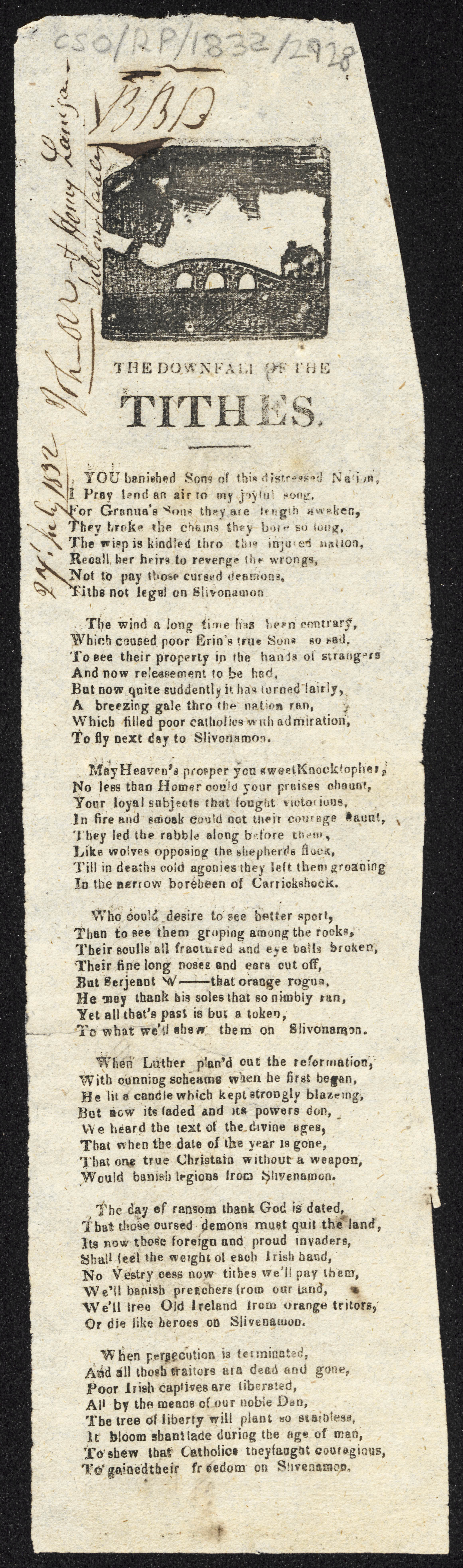

Below is a transcription of the Carrickshock Ballad recorded by Danny in 1970.
Ballad of Carrickshock (Sang in Glenmore)
Those valiant sons of the Irish Nation,
Where is the country that can boast of more?
Through extensive Europe they gained rank and stature,
And for their loyalty great credit bore.

May Britain boast of their fame and glory,
Auld Scotsman too, King William’s name,
But Irish valour won’t lie from story,
While lives a bard to record their fame.

T’was a December on a Wednesday morning,
Strange rumours circled our country round,
And it was confirmed by chief ???
Warning to force the tithes or our cattle pound.

Our chapel bells they were kept sounding,
The people hearing in great number clocked,
Our ??? and ditches with all speed bounding,
To meet the peelers in Carrickshock.

They hired Bert Butler to serve citations,
To force the peasant from home or tithes,
To feed the gluttons of the reformation,
Whom honest Catholics always deride.

The first to start was courageous Power,
He  beat(?) Butler with manly skill,
Saying rally boys for the very hour,
Well pay no tithes but those traitors kill.

And chief Gibbins saw that his dog lay sprawl,
And to his forces did loudly call,
Saying prime and load boys it is appalling,
And he shot brave Power with a pistol ball.

And then commences the bloody slaughter,
For 15 minutes we had but fun,
With pikes and scythes we gave them no quarter,
We stood our ranks without fife or drum.

But 26 and their chief commander,
Was left them lifeless without a groan,
And not to conquer like Alexander,
We left 3 survivors to bring them home.

Sergeant Wylie that orange traitor,
That day he ran with great force and speed,
Tis well he knew if he was overtaken,
His body like the rest would be left to bleed.

If you were to see them of the after ???
Like pigs or ??? they were drown,
Along to standing ??? in Reid’s barn.

In Kilmaganny they all did say,
May providence crown you Tracy and Whelan,
Who fell Tithe victim upon that day,
They stood the brunt without courage failing,
And fought courageously in that bloody fray.

Now my song is ending and all is over,
Come fill your Bumfords and drink brown ale,
And where you’ll meet them in rapture,
Greet them the jovial champions of Ballyhale.

Gary Owen, “The Carrickshock Incident, 1831: Social Memory and Irish Cause Célebre,” 1(1) Culture and Social History (2004) pp 36-64 available at http://www.traceyclann.com/files/carrickshock.pdf
The National Archives also has the correspondence of the Chief Secretary’s Office concerning the “Carrickshock murders” including costs of burials of constables, doctor bills for the treatment of injured constables, the efforts to arrest, and the efforts of two Catholic clergy in raising funds to hire Daniel O’Connell to defend those accused of murder etc. [CSO/PR/OR/1831/1328 et seq]
Update 2 Feb. 2021–while going through the Munster Express newspaper of 27 Dec. 1946 the following poem or ballad concerning Carrickshock was discovered. It appears to have been penned in the 1930’s.

Update: 24 Dec. 2022–
Munster Express (Sat. 11 Nov. 1922, p. 6)–Death of Mr. James Treacy, Ballymagill—it is with much regret we have to record the death of M. James Treacy, who passed away on Friday, 3rd inst. The deceased was one of the famous Carrickshock Treacy’s. The interment took place at Kilcurl. We tender our sympathy to his relatives in their bereavement.
Dr. Kathleen Moore Walsh
The Glenmore Steam Ship (1897-1908)

A reader from Indiana recently came across a turn of the 20th century stern paddle wheel steam ship named Glenmore. He wondered if the original owners or builders may have been natives of Glenmore, Co. Kilkenny.
The Glenmore was built in 1897 in Jeffersonville, Indiana by the Howard shipyard. Jeffersonville, Indiana is on the Ohio river near Paducah, Kentucky. The Howard shipyard was founded by James Howard in 1834. The company was owned by the Howard family until shortly before World War II. After the war, it became known as the Jeffersonville Boat and Machine Company and later it became Jeffboat. The company was the largest inland shipbuilder in the United States and the second-largest builder of river barges in the United States before it closed in 2018.
Built as a packet ship, the Glenmore was originally named the John W. Thomas and she plied the Ohio river carrying mail, passengers and freight between Evansville, Indiana and Paducah, Kentucky for the Louisville and Evansville Packet Co . At some point the John W. Thomas was renamed Glenmore (according to the University of Wisconsin virtual library), and she was named after a popular bourbon. The Glenmore Distillery Company was established by two men named Thompson in 1901 at Owensboro, Kentucky.

In May 1908 the Glenmore was at Paducah, Kentucky and put up for sale. The Messenger-Inquirer of Owensboro, Kentucky reported on 15 May 1908 that Captain George Block, of St. Louis was in Louisville to inspect the 500 ton Glenmore for purchase. On 23 May 1908 the Kansas City Star reported that the Glenmore was sold to Philip McCrory and Booth Baugham who were to bring the ship to Kansas City, Missouri where it would be refitted and operated as an excursion or party boat on the Missouri River. The Glenmore was described as being 160 feet in length with a 26.5 foot beam. She was due to arrive within two weeks and she could carry up to 1,000 persons.
Newspapers of the era in river towns and cities carried commentary concerning her progress up the Mississippi on way to her new home port of Kansas, City. The Kansas City Star of 17 July 1908 reported that the Glenmore left the foot of Main St. carrying a number of important local figures and various civic groups to inspect local flood damage. The Baughham and Pryor Excursions were very popular in 1908. Beer and other liquid refreshments were sold 7 days a week, 7 kinds of gambling were allowed and there was a very popular dance hall on board (Kansas City Star, 3 April 1909). Missouri traditionally did not allow gambling nor did it allow the purchase of alcoholic beverages on Sunday. At St. Louis, and other major centres of population in Missouri, race tracks and other gambling establishments were built in nearby states such as Illinois. It is assumed that the State of Kansas may have also catered for residents in Kansas City, Missouri to engage in drinking and gambling in Kansas. Thus the Glenmore could legally provide gambling and drinking when it operated on the Kansas side of the Missouri river.

In November 1908 it was widely reported that John J. Pryor, one of the Glenmore owners, and an ex-saloon keeper, was charged with operating gambling devices on the Glenmore. John J Pryor, was a colourful character, who was charged with murder in 1907 and his trial collapsed. (Kansas City Star, 7 November 1908). It is assumed that he was charged because he operated the devices within the jurisdiction of the State of Missouri or on the Missouri side of the river. The Glenmore operated for one season as an excursion or party boat on the Missouri River. When the Glenmore was being put up for the winter it was discovered that her hull was unsafe. No newspaper accounts report whether she was purchased in a poor state or whether her excursions on the flooded Missouri may have damaged her hull. She was taken to Harlem, Missouri where $5,000 was spent fitting her with a new hull. She was placed on cribbing and in early March 1909 just as the work on her new hull was being finished high flood water swept away her cribbing. She fell into 12 feet of water stern first. Her boilers fell into her hold causing her upper works to collapse (St. Louis Globe-Democrat, 12 March 1909).
Although it was originally hoped that she might be raised and saved, it soon became apparent that the damage was too extensive. Her estimated value at the time she sank in 1909 was $19,000 (University of Wisconsin, Digital Library, “Glenmore (Packet, 1905-1909)”). Undaunted the newspapers soon carried reports that the Glenmore owners had purchased the Uncle Sam to replace the Glenmore.
No links could be discovered between the builders or owners of the steamer, Glenmore or the owners of the Glenmore Distillery in Kentucky and Glenmore, Co. Kilkenny, Ireland. However, we do know that one of Danny’s great-great uncles, Nicholas Murphy, resided near Kansas City, Kansas in the early 1900’s. Did Nicholas Murphy ever see the Glenmore or take an excursion on her in 1908? We shall never know, but we might ponder what a man who had not seen his native parish of Glenmore for over 50 years may have thought if he saw the Glenmore ship. Thanks John for bringing the steamer Glenmore to our attention.
The featured broadside photo of Steamer Glenmore, Ohio River, photo taken at Madison, Indiana by Flora, Hubert M, (1904) Glenmore. Retrieved from the Digital Public Library of America, http://digital.cincinnatilibrary.org/cdm/ref/collection/p16998coll28/id/10781.
The photo of the docked Glenmore Riverboat was taken about (1904) at Tell, Indiana. Retrieved from the Digital Public Library of America, http://digital.cincinnatilibrary.org/cdm/ref/collection/p16998coll28/id/10782. Original in the Public Library of Cincinnati and Hamilton County
Dr. Kathleen Moore Walsh
Glenmore Hedge Schools and Early National Schools
In 1695 two statutes became the first of the Irish penal laws restricting the rights of Irish Catholics. One of the statutes forbade Catholics, who were not covered by the Treaty of Limerick to keep weapons. The other statute sought to sever the link between Catholics and continental Catholics, by forbidding Catholics going abroad for education, and also banned Catholics from teaching or running schools within Ireland. Eventually the restrictions increased and Catholic priests were not allowed to say Mass. Just as the population found ways to attend Mass they also paid teachers to secretly educate in what became known as hedge schools.
During the most restrictive years the hedge master would meet the children in isolated places to conduct the hedge school. Often if strangers were observed in the vicinity the children and teacher would disperse and meet the following day in another isolated meeting place. Most early hedge schools operated in the summer because they operated in the open or in the shelter of a hedge or wall. Eventually the penal laws were not enforced the hedge schools moved into huts, cabins or empty outbuildings. The majority of penal laws were removed between 1778-1793, however the last penal law was not removed until 1829.
Because of the secrecy associated with the early hedge schools there are very few records concerning the hedge schools of Glenmore. In the 1950’s and 1960’s Danny Dowling interviewed several elderly Glenmore residents who provided information of what their grandparents and others had stated about local hedge schools. It is likely that over the penal law years there were multiple hedge schools operating at various times across all of the townlands in the parish. Below are some of the hedge schools that have been identified.
Coolnaleen, Glenmore
Danny Dowling has stated that Coolnaleen was formerly knowns as Ardbeg. Dick Doherty (1889-1976) of Coolnaleen as interviewed on the 25th of May 1962. Danny recorded that Dick Doherty reported that his grandfather (Richard Doherty, b. 1840) told him there was a schoolhouse in his lower yard. The Schoolmaster who taught in it was a man named John Kinnayr or Kinneir. He was a poor travelling teacher. He was paid 4 d. (old pence) a week. He taught in Coolnaleen for a “good while.” The pupils of the school were local children including Old Charlie Linegar, of Parkstown. The Schoolmaster would march the children in two’s to Glenmore for confirmation and religious exams etc. The boys at that time used to wear flannel waistcoats.
Moulerstown, Glenmore
According to Matt Aylward, of Ballyfacey, an old schoolmaster (Poor Scholar) used to teach school in Doherty’s house in Moulerstown. In his interview of 8 August 1956 Matt identified the schoolmaster as Meeshteh-Zheen (sic) Butler. Matt’s grandmother saw the old schoolmaster.
Kilbride, Glenmore
In an undated interview James Culleton, Sr., of Kilbride revealed to Danny that the Old Hedge School in Kilbride was situated eight perches beyond the Bill Grace’s House, on the other side of the road. It was a thatched structure. The last master in it was Paddy Butler of Rahora. It was closed in 1868, when the National School in Ballyfacey was built. Pupils came to it even from as far as Ballycroney. It was there for about 20 years or more.
There was another old school in Kilbride which was situated at the back of Kennedy’s house, in a house belonging to Micil Culleton. Now gone it was known as the Old College. Daniel Galavan was the school master in it. It was gone before the famine.
Ballyfacey, Glenmore
James Culleton, Sr. also reported that there was an old school in a house in the present George Connor’s farmyard in Ballyfacey about 1850. On the bounce of Bishopsmountain there was another old hedge school in the townland of Ballyfacey. All of the Knockbrack children attended this school.
Rathinure, Glenmore
A hedge school was located in the commons in the townland on the corner of the Kearney Bay Road (running from Aylwardstown to Rochestown) and the steep lane that runs from the Kearney Bay Road to the hamlet of Rathinure. Tom Haberlin’s forge later stood in the commons.
Ballycroney, Glenmore
In January 1955 Pat Coady, of Ballycroney told Danny that Paddy Butler, of Flemingstown was the last master of the old hedge school in Ballycroney.
Ballygurrim, Glenmore
Danny also took notes from the Parliamentary Gazetteer of Ireland (1844) which provided that the population in Ballygurrim civil parish in 1831 was 693 that increased in 1841 to 796 residents in 125 dwelling houses. In 1834 there was a pay day school attended by 45 to 50 children.
Kilmakevogue, Glenmore
The Gazetteer also reveals that the civil parish of Kilmackevogue had a population in 1831 of 1,027 which increased in 1841 to 1239 housed in 187 dwelling houses. The Roman Catholic Chapel at Glenmore had an attendance of 1,000. It was noted that in 1834, there were 2 Protestants in Kilmakevogue and 1,047 Catholics, and there were two pay daily schools that were usually attended in the summer by about 140 children.
Bob Walsh in Glenmore Times (2000) also identified hedge schools in Milltown, Parkstown and Kearney Bay.
If any reader has any information where other hedge schools may have been located in the parish please comment below or email glenmore.history@gmail.com and we will add to the list.
Establishment of National Schools
The Commissioners for National Education (National Education Board) were established in 1831 to administer £30,000 that was provided to the Lord Lieutenant for the education of the poor in Ireland. The powers of the Commissions were based on a set of instructions drawn up by Chief Secretary Stanley rather than by any legislative enactment. The Commissioners were empowered to make grants to existing schools for the payment of teachers and the provision of equipment and also to provide for the building of new schools, to appoint and pay inspectors and to establish a model school for the training of teachers. Originally the Education Offices were located at 30 Merrion Square and in 1840 moved to Marlboro House. This system was brought to an end in 1922 when its functions were taken over by the Minister for Education.
Danny Dowling, with what is now a battered old notebook, visited the Public Records Office in Dublin, reviewed the early records of the Commission, and took notes regarding local schools. Today, these records are available in the National Archives.
Hedge schools, or other fee paying schools, could apply to the Commission for grants for the payment of teachers, improving or building school buildings and provision of equipment. Records are also available as to the location, relation if any to religious house, date of establishment, date school connected with Commission, lease particulars, patrons, dimensions of school, attendance and some inspector reports. Below is the information obtained by Danny. Although not all of the National Schools are in Glenmore parish children from Glenmore may have attended these schools.
Ballyfacy School N.S. [Folio 126, Roll No. 9880; District 49, Ida]
September 10, 1867
£170 to build or expenditure of £255
8 October 1867—a grant provided of £66-13-4 to build the school. An additional £100 provided (exceptional case) for 100 children
13 November 1868—Lease executed
23 March 1869—grant for £15 for the salary to Thomas O’Neill from 4   January 1869.
20 April 1869—grant of £16 for the salary to Kate Brereton as assistant from 4 January 1869.
15 June 1869—Thomas O’Neill dismissed from 30 June 1869.
Danny collected further details. Matt Aylward in 1956 revealed that the hill on which the Ballyfacey school was built was known as the “Jolla Hill.” James Culleton, Sr., of Kilbride, informed Danny that Micil Moore of Knockbrack, built Ballyfacey National School. It cost £95 to build, but £100 was collected for the building. With the extra £5 they bought a barrel of beer for the local people who drew the stones and sand. The School was repaired in 1907 at a cost of £137. The Teachers residence in Ballyfacey was built in 1904. Martin Hynes, of Aylwardstown was awarded the contract for the building of the teacher’s house, and the Malones of Shanbogh built it. George O’Connor drew the first load of sand.

Bigwood School N.S.
Established May 1839
Application to Board—3 January 1841
Taken by Board—31 March 1841
Size 1 room 40 X 16 X 12
School situated in Chapel yard.
Teacher Daniel Sullivan—instructions 9 to 5 in summer; 9 to 3 in winter
Shanbogh School N.S.
Est. 1847 Connected with Board 13 July 1848 Not inspected. No Comments. 1 room 19 X 14 X 7
Ringville N.S., Kilcolumb Civil Parish (Folio 73) Male School
Size: 2 rooms 50 X 14 X 10 and 30 X 18 X 13
Established 1832
Connected with Board 29 October 1852.
Francis Drew teaching there in 10 August 1859.
M.A. Drew teaching there July 1856.
Situated in Ballinlow Townland.
Robinstown N.S.  (Glenmore N.S.) Male School, Folio 13
11 April 1840—application for grant to pay teachers, rent and for supply of books
100 on rolls in 1855 with average daily attendance of 37 pupils
Robinstown N.S. (Glenmore N.S.) Female School
1 apartment 27 X 17 X 18
Teachers Margaret Brereton 18 and  Kate Brereton 20.
Went to Rosbercon Community school.
Attendance in 1867 of Robinstown National Schools = 99 females; 26 males, by James Aylward
In 1834 Father Fielding, the Glenmore Parish Priest applied for a grant for a school to be built. Land for the school was provided by the landlord Lord Bessborough. The school opened in 1835 and thanks to another grant from the Commission it contained 17 desks and a teacher’s desk. The student desks each accommodated 10 students. When the school opened in 1835 two hundred students enrolled.
Slieverue N.S.—Civil parish of Rathpatrick; Townland of Slieverue
Established March 1840
House is 60 feet in length by 22 feet in breadth and 10 feet in height is good repair. Divided into 2 rooms. The boy’s room is 32 feet X 18 feet; girl’s room 20 feet by 18 feet.
Furnished with 22 desks all new.
Thomas Keefe, master aged 37 years. Ellen Halligan mistress aged 17 years.
There are 150 male and 80 female children in daily attendance from 9 until 3 o’clock. Religion instruction morning and evening in the school rooms and in Saturday in the chapel.
There is a present want of books.
Fr Walsh paid male teacher £20 and female £15.
Given the size of the classrooms and the large number of enrolled students these early classrooms must have been very crowded. Certainly no social distancing could take place in these small crowded spaces. The youthful age of some of the teachers is also surprising as is the duration of the school day.
For further detailed reading regarding hedge schools, see, https://www.raggeduniversity.co.uk/2017/01/02/educational-history-the-hedge-schools-of- ireland/
Special thanks to Jacqueline Walsh for the early photograph of Ballyfacey National School.
Dr. Kathleen Moore Walsh