Glenmore Co. Kilkenny
now browsing by tag
Rev. Stephen Lower (c. 1727-1799): The Saviour of Slieverue & His Grave in Glenmore

Last month Danny Dowling made a point of explaining the importance of the grave of Father Lower in Kilivory graveyard. Danny explained during the 19th century and well into the twentieth century people from all over the country visited the grave of Father Lower believing that the soil had healing powers. In fact, as reported in a 1951 newspaper article written by a clearly sceptical author people were still visiting the grave. Danny Dowling also provided two other important contributions that Father Lower made locally. Father Lower was the first priest to record the baptisms and marriages in the old combined parish of Slieverue and Glenmore. Thus, the early church records, commencing in 1766, that we rely heavily upon today in performing family research is due to the efforts of Father Lower. Father Lower is also credited in 1798 with stopping the burning of Slieverue by British soldiers during the uprising.
Today, the graveyard and ruins of the Kilmakevogue Church are locally known as Kilivory. The church originally was dedicated to St. Mochaevog, an Irish saint, an abbot and patron of Liath Mochevog in Co. Tipperary. After Strongbow’s invasion of Ireland in 1170, the church was placed under the patronage of St. James. In about 1240 Kilmakevogue Parish was one of the parishes that came under the control of the Nunnery of Kilculiheen, of Ferrybank. It is believed that local people began to refer to the area as Kilivory because they thought mochaevog meant ivory in Irish. Irish historian and scholar, John O’Donovan (1806-1861) did not believe that the translation was correct. Interestingly, John O’Donovan was born and raised locally in Atateemore, Slieverue. O’Donovan was the son of Edmund O’Donovan, of Atateemore and Eleanor Hoberlin of Rochestown, Glenmore.
The grave of Father Lower is found in the interior of Kilivory church ruins. Thus we know that by 1800 the church was no longer being used as a church but it was the place where Father Lower chose to be buried. His marker is a large slab that does not lie on the ground. The marker is on several large stones ensuring that the marker is several inches above the grave itself. Although the inscription is faint from exposure to the elements the inscription is still legible and reads as follows:
Erected by the Rev’d Tho Malley
Doctor of the Sacred and White Faculty of
Bordeaux in memory of the Rev’d Stephen Lower
Bachelor of Lovain, Doctor of Rome Prothnotary
Apostolic Archdeacon & Vicar General of Ossory
& Parish Priest of Ida who dep’t this life the 9th of
January 1800 aged 73 years.
Jeroen Nilis, in “Irish Students at Leuven University, 1548-1797,” Archivium Hibernicum (Vol. 60 (2006/2007), pp. 1-304, p. 212) listed in entry 831, dated 1750, Lower, Stephanus. “Born of Protestant parents and brought up in that religion until he reached his twenty-third year; then, moved by divine grace, he left his parents and his native land and went to Flanders with the intention of becoming a Catholic; this he did, having renounced the Protestant religion before Abp. Crivelli who preceded Molianari as nuncio.” It is noted that for nearly 30 years Father Lower was the parish priest of Slieverue and Glenmore parish.
On Friday the 20th of July 1951 the following article appeared in the New Ross Standard. Corrections and translations not part of the original newspaper article are in square brackets [ ].

CUSTOM AS REGARDS PRIESTS GRAVE—There is a peculiar custom in one of the old parochial districts, comprising the once united parishes of Glenmore and Slieverue, that, in the old churchyard of Kilmakevogue, people, for many generations, are in the habit of taking away the clay that covers the last resting place of a priest. The writer understands that the custom still prevails and, on questioning an inhabitant of the district that, if this custom continued for so many generations, the coffin of the dead priest must have long ago been exposed. He was informed that this was not so, and that everyone who took away soil replaced it with other clay; so that the grave remains in its way as it originally stood.
Parish Priest of Ida—To ascertain the authenticity of this story, the writer had access to the diocesan history of Ossory, published by the able archaeologist, the Very Rev. Canon Carrigan. He gives a description of the old church of Kilmakevogue and its surrounding graveyard. He states that in the south-east corner, opposite where the altar stood, rests the Very Rev. Dr. Lower, P.P., and that his “grave is hollowed out to a considerable extent by people taking away the clay therefrom in the belief that it possesses virtue to heal their bodily ailments.” This Fr. Lower was the Vicar-General of Ossory in his time, and is described as the ” parish priest of Ida.” In fact, he was pastor of the united parishes of Slieverue and Glenmore, which were divided into separate parochial districts in 1846. He died in the year 1800, aged 73, and as recorded by Father Carrigan, was buried in Kilmakevogue.

Reared a Protestant—Became a Priest—According to Very Rev. E. O’Farrell, P.P., who wrote a paper on the parish of Ida, which appeared in Transactions of the Ossory Archaeological Society, Father Stephen Lower, D.D., was born in the parish of Glenmore, at a place called Trinaree. He goes on to say: His father was commonly called Shaun Lower. It is said of him that he was an expert ploughman, and a great whistler. [Trinaree is in Slieverue parish] He was landlord of Trinaree, where he lived, and of the adjoining townland of Ballarourach. He was, however, a Protestant, and from this fact the lane leading from the high road to where he lived is, up to this day called Boreen-a-Sassanach [translated the English lane]. Dr. Lower was consequently reared a Protestant. In his youth he was taken from his native place, sent to the Continent, and placed in a Protestant College for his education. Young Lower soon began to feel scrupulous with regard to the religious tenets inculcated by the Superior of the establishment, and becoming more uneasy every day, determined to make his escape, and did so after a short time. He made his way to Rome, renounced Protestantism, studied for the priesthood, and in due time became a priest. Having been ordained, he came back to his native country.

Canon Carrigan, who describes Fr. Lower, as one of the grandest characters that figured in the ecclesiastical history of the diocese of Ossory, says his fathers’ name was not Shaun but Richard. He also mentions that Fr. Lower took out the Degree of Doctor of Divinity in Louvain. On May 4th, 1764, he was appointed P.P. of the newly-formed parish of Rosconnell or Ballyouskill, and was translated from thence to Slieverue and Glenmore on November 16th, 1766. He became Vicar- General of the diocese in December, 1773; Canon of Blackrath. January 5th, 1775. and Archdeacon of Ossory, June 14th, 1778, and died on Jan. 9th, 1800.
‘98 incident—Here is an incident recorded of Fr. Lower, quoted by Fr. Carrigan, from the Transactions of the Ossory Archaeological Society— ” During his missionary career he lived in the village of Slieverue. In the troubled times of 1798, it is said that a party of cavalry passing through, were, in their wantonness, about to set fire to the place, having, it is well known, liberty at that time, without the least hindrance, to destroy property of every description, and even to take away life. History relates that the cruel Attila surnamed ‘the Scourge of God,’ when proceeding to sack Rome, was met by the holy Pontiff, Leo the Great, and was persuaded by him to relinquish his impious designs on the city. The barbarian was so terrified by the holy Pontiff, that he commanded his soldiers to cease hostilities, and thus Rome was saved. In like manner, Father Lower boldly approached the ruthless officer of those ruffians, took his horse by the bridle, and led him and party to a considerable distance from the place. Whether, as Attila was frightened into compliance by seeing two venerable personages guarding the person of St. Leo this wicked officer was deterred from resisting the good priest by seeing some similar vision we know not. Certain it is that he allowed himself and party to he led away from the place, and saved the little village from conflagration and the inhabitants, from insult, if not massacre.
Although local tradition makes no comparison to St. Leo, the Great, the memory of Father Lower and his intervention in 1798 at Slieverue is still remembered today among older Glenmore residents.
UPDATE–two death notices were published in December 1799 indicating that Rev. Stephen Lower died a year earlier than the date recorded on his flat grave marker.
In Saunder’s News-Letter on Thursday the 12th of December 1799, the following death notice appeared on page 2. “Died–On Monday last, in the 74th year of his age, the Rev. Stephen Lower, D.D. Titular Vicar General of the Diocese of Ossory, and for nearly thirty years P.P. of Ida, in the county Kilkenny.”
A slightly longer death notice appears in Finns Leinster Journal on Saturday the 14th of December 1799:
“Died. Friday evening in the 74th year of his age, the Rev. Stephen Lower, D.D. titular vicar general of the Diocese of Ossory, and for nearly thirty years P.P. of Ida, in the county of Kilkenny. He was deservedly beloved by his relatives and parishioners, and universally esteemed for the innocent and probity of his life.”
For a brief history of the current parish church of Glenmore, St. James, see, https://glenmore-history.com/st-james-catholic-church-of-glenmore/ .
The featured painting is a fresco painted by Rapheal of Pope Leo the Great (c. 400-461) meeting Attila the Hun in 452. Leo persuaded Atilia not to sack Rome. The Feast day for St. Leo, the Great, is 10 November. The fresco is available at https://commons.wikimedia.org/wiki/File:Leoattila-Raphael.jpg .

Dr. Kathleen Moore Walsh
[Updated] A Deadly Sunday Outing on the River Barrow: James Cassin, of Carrigcloney, Glenmore (c. 1868-1907)

Last summer when we were discussing the disappearance of Peter Forristal in 1916, Danny Dowling spoke about how Forristal and other young men who lived near the River Barrow often rowed across the River Barrow on Sundays to drink in a pub in Ballykelly. Glenmore was a dry parish where no alcohol was legally sold. For many living along the River Barrow the nearest pub was across the river in Wexford.
In about 1870 the then parish priest forced all three pubs in Glenmore Village to close. A pub on the edge of the parish, the Shanty, lost its license shortly after the railway was built in 1904. Glenmore Parish Priest, Father Phelan was instrumental in that pub losing its license. After the pubs in and near Glenmore parish closed Glenmore remained a dry parish until 1963. Danny noted that the failure to allow a pub to operate in Glenmore parish sometimes led to tragedy as Glenmore people travelled to have a couple of pints. Today, we are going to highlight a 1907 tragedy that resulted in the death of a Carrigcloney, Glenmore man.
James Cassin, a married labourer, living in Carrigcloney, Glenmore drowned on the 15th of September 1907 in the River Barrow near Rochestown, Glenmore. The New Ross Standard on Friday the 20th of September published details concerning his death and inquest. The following information was gleaned from this article.

On Sunday the 15th of September 1907 James Cashen (sic) drowned leaving a wife and six children. It was reported that Cassin was employed in Cody’s, brickyards of Glenmore. Although the newspaper reported that the drowning took place at the “Blackrock” on the Wexford shore about midway between Aylwardstown and Rochestown, as reported in a previous blog post, the Blackrock Quay, of Rochestown, is where the ferry for the Ida steamship picked up Kilkenny passengers (see, https://glenmore-history.com/the-ida/).
It also was reported that some Rosbercon chaps were on the river in a “freakish, unreliable cot,” which they abandoned on the Carrigcloney bank of the river. They took a prong and left the cot on the river bank. Cassin, Tom Kelly and Michael Power went to the river and when they discovered that the prong was missing they got into the “freakish” cot and rowed to Ballinlaw. Ballinlaw is on the Kilkenny side of the river south of Carrigcloney. However, given other statements in the newspaper, it is likely that the three men rowed across the river, visited a Wexford pub, and while rowing back across the river the cot capsized.
A “girl” named Hannah Holden, of Fisherstown hillside of Co. Wexford heard the cries of two men clinging to the half sunken cot. She never saw the third man in the river. Hannah Holden ran “for all she was worth to the nearest house, that of James Kinsella, the only man who happened to be about for miles around. Kinsella, a delicate little man, who has to exist on a small out-door relief pittance barely sufficient to keep body and soul together, turned out to the rescue, trying to feel as brave as a lion, though inwardly quaking for fear of being unable to save his poor fellow-mortals from an awful death”
Kinsella and Hannah shouted words of encouragement to the two men. There was no boat in the slip, so Kinsella, Hannah and a young boy dragged a boat from a yard and across forty feet of deep mud to launch it into the river. It was recorded that Kinsella was so overcome with fear of being too late, that he could not “bear to look on the wretched strugglers, whose strength was fast ebbing, as evidenced by the weakening of their terrified appeals.” When the prong was afloat Kinsella took the oars and the young boy acted as his guide. “While he sculled to the wreck near the middle of the river…with great expertness as a river-man, Kinsella got his boat stern on to the drowning men, so as to avoid a second, capsize, and hauled the two exhausted men into the prong.” It was noted that this rescue was not the first time Kinsella saved lives on the river. “Brave Kinsella is sorely grieved that he was not about in time to save all three.”

Cassin’s body was found on Monday evening and the inquest was held on Tuesday afternoon. The South Kilkenny Coroner, Dr. Walsh of Graiguenamanagh held the inquest which returned a verdict of accidental suffocation. The inquest learned that the three men had three pints of beer taken, and “it is some consolation for the poor widow to know that the lost husband was quite sober when death overtook him.” It was reported that the cot was a featherweight racing skiff brought down river that day by three young lads from the New Ross area named Dooley, Fitzgerald and Kavanagh. Cassin could not swim and being unable to grasp the upturned cot, he “could make no fight for life.” It was revealed that Kelly and Power could swim, but they were handicapped by their clothes and boots. They spent nearly an hour hanging on “for dear life” to the cot before Kinsella rescued them.
Lastly, it was reported that the remains of poor Cassin were laid to rest in the Glenmore graveyard on Tuesday evening. He was a son of Andrew Cassin, of Kilmacow, and a relative of the Cashens of Listerlin. His funeral was reported as being one of the largest funeral gatherings ever assembled in Glenmore. Although it was reported that he worked in the brickyards, it also stated that the deceased was esteemed and one of the best and most conscientious farm workers in South Kilkenny.
The Munster Express (“Boating Fatality on the River Barrow,” 21 Sept. 1907) and Kilkenny People (“Young Man Drowned, Heroism of a Young Lady,” 21 Sept. 1907) also reported the drowning, but both credited a Miss Costelloe of hearing the cries of all three men and rowing to them. Miss Costelloe was able to save two of the men but they watched in horror as Cassin sank from sight. No mention is made of James Kinsella or the young boy. The name of the deceased was incorrectly listed as John Cashen rather than James Cassin.
The Widow and Children
The 1901 Census for Carrigcloney, Glenmore provides that James Cassin (aged 33) was married to Ellen (aged 22) and their eldest child James was a year old and their second son John was three months old. A marriage record was then found for James Cassin and Ellen Malone. The couple married on the 13th of September 1899 in Piltown. James was listed as a labourer the son of James Cassin, also a labourer. It appears that the New Ross Standard erroneously listed his father as Andrew Cassin. The bride Ellen Malone, was listed as a farmer in Garryduff and she was the daughter of John Malone, farmer. The following birth certs were located for the six children of the couple all born at Carrigcloney, Glenmore: [1] James Cassin was born on the 23rd of December 1899; [2] John Cassin was born on the 15th December 1900; [3] Michael Cassin was born on the 14th of August 1904; [located by Adam Cashin] [4] Margaret Cassin was born on the 1st of April 1902; [5] Mary Cassin was born on the 7th May 1903; [6] Anastatia Cassin was born 15 November 1906 and [7] Ellen Cassin was born on the 22nd of February 1908 five months after her father’s death.
[UPDATED] The Cassin family could not be located in 1911 Census for Carrigcloney, Glenmore. However, Adam Cashin located the family in the 1911 Census living in Cappagh, Glenmore. Ellen Cashin (sic) was a widow, aged 32. The following children are living with their mother: John, aged 11; Michael, aged 6; Statia, aged 4 and Ellie aged 3. A nine year old named Margaret Cassin was found living as a boarder in the home of Johanna Devine a 60 year old widow, farmer in Old Court, Templeorum, Kilkenny. A ten year old James Cassin was living in Tullagher, Listerlin, Kilkenny in the home of Ellen Cassin a 68 year old widow. James is listed as an undefined “relative.” Also present in the house are Ellen’s sons Michael and Thomas Cassin, aged 40 and 36 respectively. Michael and Thomas Cassin are boot and shoe makers.
[UPDATED] The Cassin headstone was located in Glenmore cemetery. The inscription is as follows:
In loving memory of James Cassin Glenmore
Died 9th Sept 1907 Aged 39 yrs
His wife Ellen Died 31st July 1963 Aged 85 yrs
Their son John Died 7th Nov 1943 Aged 41 yrs
Their daughters Margaret Died 2nd Jan 1926 Aged 24 yrs
Ellen McBride Died 2nd Sept 1976 Aged 68 yrs
Anastasia Doyle Died 1st Oct 1996 Aged 90 yrs
[UPDATED] The death cert for Ellen Cassin née Malone (c. 1879-1963) provides that she was still living in Cappagh, Glenmore when she died in 1963 at the age of 84. Her daughter, Ellen McBride was present when she died.
The Rescuers: James Kinsella (c. 1843-1909) & Hannah Howlen (c. 1879- )
In the 1901 Census of Fishertown, Wexford, James Kinsella, was 43 years old, and employed as a fisherman. The bachelor was living with his 70 year old widowed mother Anne Kinsella. Both James and his mother could not be located in the 1911 census. James Kinsella died on the 10th of March 1909 at the age of 56. His death cert notes that he died of heart disease and had been suffering with it for 3 years. Thus, in September 1907, when he saved the two men clinging to the capsized cot, James Kinsella was suffering from heart disease that caused his death 18 months later.
In the 1901 Census of Fishertown there is no Hannah Holden or a Costelloe family. In the house listed next to the Kinsella home was the Howlen family. Hannah Howlen, aged 22, was the daughter of Michael Howlen, aged 62 and his wife Catherine aged 63. Also in the home were Hannah’s two brothers John (aged 28) and Michael (aged 24). All three men were fishermen. We believe that Hannah Howlen was “the girl” that raised the alarm and helped Kinsella launch the rescue boat.
The Rescued Men: Tom Kelly & Michael Power
In the 1901 Census two Michael Powers were located in Glenmore. The one closest to the river was Michael Power of Rochestown, an agricultural labourer, aged 25, married to Kate Power, aged 25. The couple had two children John, aged 1 year and Patrick, aged 1 month.
In the 1901 Census there were also two Thomas Kelly’s in Glenmore. Both lived near the river, however one was 70. Therefore we believe that Thomas Kelly of Griguenakill, aged 20, a railway labourer, in 1901 may have been one of the rescued men. Thomas was the son of Catherine Kelly, aged 53 in 1901. Also present in the home was her 54 year old brother Michael Breen, a farm labourer.
The 1899 Double Drowning at Rochestown Point
Eight years prior to Cassin drowning two men drowned in the River Barrow also returning on a Sunday from a visit to a pub. In 1899 two men were also rescued while clinging to a capsized boat and ironically their name was Kelly. The 1899 double drowning may be found at https://glenmore-history.com/a-double-drowning-at-rochestown-point-in-1899/ .
Dr. Kathleen Moore Walsh
First Anniversary

It is hard to believe, but today is the first anniversary of the first post of Glenmore-History.com. The first post on 3 November 2019 was “Introducing the Glenmore Historian: Danny Dowling.” https://glenmore-history.com/introducing-the-glenmore-historian-danny-dowling/
Last week I asked Danny if he would like to send a message to his readers on this First Anniversary. Danny thought for a few minutes and said that he enjoys hearing from the readers all over the world who are from Glenmore or have Glenmore connections. He would like to encourage everyone to speak to and write down for their younger family members their experiences and anything they know or heard about their ancestors.
When we started last year, we had no way of knowing that a pandemic would impact on the world and close local libraries and the National Archives. Notwithstanding challenges we were able to publish 70 posts on a variety of subjects and on the website add pages dedicated to family information, obituaries, Irish words and field names, useful links and our biggest project was the recording of all inscriptions on over 500 headstones in Glenmore cemetery. Additionally guest lecturers shared their work for us to publish.

We hope that you have found the posts and pages interesting to date. In the coming year in addition to weekly posts we hope to record more headstone inscriptions and more information on Glenmore’s past and people. If you have any information, wrote an article or come across an article, or have an idea for an article we would appreciate you sending it to us at glenmore.history@gmail.com.
Thanks to everyone who helped and contributed to the success of Glenmore-History.com.
Dr. Kathleen Moore Walsh
James “Jim the Weaver” Walsh (1870- c. 1960) of Glenmore Village: Looking Back

Sixty-one years ago today an article appeared in the Kilkenny People entitled “Glenmore Man Looks Back” written by Peter Roughhan. This 1959 article is packed full of interesting details and names of Glenmore people including early football players and brick makers. Special thanks to Glenmore-History.com reader Kelvin Johnson Treacy who found the article and sent it on so we could share it. At the end of the article information that Danny Dowling collected over the years concerning the Weaver Walsh family is provided.
GLENMORE MAN LOOKS BACK—Often it makes me wonder if one old custom, or pastime, if you like to call it, is dead and gone in the country, for you never hear anyone using the word “cuardeact” now at all, and you scarcely ever hear anyone saying in the heel of the evening, “I’m going ‘cuardeact’ for an hour or two.” Well, I know one place around here where you needn’t wait for the heel of the evening to go and have a chat; you need only ramble into Jim Walsh’s beyond in Glenmore any time of the day and you can sit and listen to Jim ‘until the cows come home, and the last thing he’ll tell you is “don’t be long before you come again.”
When I first heard about Jim Walsh and where I could find him, it put me in mind of the story we used to hear about the lad who was going to New York to a sister of his, and his mother kept reminding of where she lived, “in the first house on the left as you go in,” Well, that’s where I happened to find Jim over in Glenmore — in the first house on the left as I went in! Honest to Goodness, I thought I went to the wrong house for I never expected him to have his coat off, and his sleeves rolled up, chopping up a skeagh tree for firing.
“Hold on a minute ’till I put this hatchet away, I don’t like leaving sharp tools lying about the place, and we’ll sit up in the haggard and have a nice quiet chat for ourselves.” And upon my word, a nice quiet chat it was. I could sit and listen to him all day, and so could anyone that’s fond of a bit of ” cuardeact.” Well, now, no one can tell a fellow’s life story better than himself, but Jim Walsh caps ’em all, for his memory can nearly take him back to the day he was born, and that was November 21, 1870.
“Aye, please God, I’ll be 89 on my next birthday, and there’s plenty of work in me yet.” And, I couldn’t say “no” to that, for he looks as fresh and healthy as a lad half his age, and still able to shave himself. “I worked hard ever since I was a lad,” says he to me, “and thank God, I never had much sickness in my life. Now would you believe it, I was born in this house where I’m living, and my father lived in the same house since he was a lad. God be good to him, Pat Walsh, he was one of the old Glenmore weavers, and my mother was Mary Haberlin of Rochestown, her father was Johnnie Haberlin, the blacksmith.”
MASTER CURRAN
IT was a Father Edward Walsh that baptised me, and Johnnie Cody and Bridget Hanrahan from the village here who stood for me. God be good to them all, sure they’re dead years and years. And so is my old schoolmaster — Master Curran — a great man to handle children, and he turned out some great scholars in the village here.”
Like a lot of the lads in Jim’s young days, he left school early. ” Aye,” says he, ” I was only nine when I had to turn out to work, and the first job I ever got was over at Denis Maher’s of Ballyvarring, I was put minding cows for a bob a week. I was living over there at the farm, and they looked after me in great style. We had plenty of good, wholesome food to eat, oaten stirabout for breakfast, no tea in those days at all, spuds and bacon for our dinner, but Friday was a devil of a day, we used to get red herrings, and then we got spuds and plenty butter, and new milk in the evening”

“I stayed there for about two years, and I can remember the boss going into Waterford one day and bringing me back a pair of boots. Sure I never wore a boot in my life ’till then, always went barefooted, and when I got them on my feet, I couldn’t walk at all in them. I used to come home every Saturday night with my bob to my mother, and as soon as I got out on the road with the new boots on I took ’em off and slung ’em around my neck and trotted the whole of the five miles home. If I kept the boots on, I wouldn’t be home yet!
They nearly made a cripple of me. I got used to ’em, but it took a long time, they were like ton weights on my feet.”
When Jim said good-bye to cowminding, he took to brickmaking in the brickyard beyond at Pill. “My father was working there” says he to me, “and he managed to get me a job over there with him. The bricks were baked in what we called clamps, and there were ten arches in each clamp, and anything between three and four thousand bricks in an arch. We used to set the fires with about five hundredweight of Welsh coal, and a bed of furze, get that going in the evening after sealing up the clamp with blue mud, and then we had to look after the fires all-night until about four in the morning. We’d draw the bricks our about dinner time, and then the whole gamut had to start again.”
MADE BY HAND
“All the bricks were made by hand. We used what they called a breastboard, and ’twas a good lad who could make about twenty bricks in half an hour. Oh, there was a great gang of lads working down there at Pill in my Days, I can remember the most of ’em; Dick Rockett of Slieverue; Dan Cody of Carrickcroney; Tom and Bill Forristal of Ballyverneen; Robin Irish of Ballinalammy; Dick Hennessey of Moulerstown; George Young; Paddy Doherty; Ned and Mick Phelan of Bigwood; Pat Murphy of Killivory, and Mickey Power of Carrickcroney.”
“I couldn’t say which of ’em dug up a full branch of deer’s antlers down below in the clay pit one day, and another of the lads came across a boar’s tusk about half-a-foot long. You’d never know what you might dig up in old places like that, but we never came across any gold at all.”
“The wages in those days making bricks wasn’t too bad. On piecework a good lad could earn about thirty shillings, but you had to keep hard at it all day to earn that. It used to be a long day working from seven in the morn ’till six in the evening, still, we were all happy down there. At dinnertime we used to have many a great hunt doing tricks and giving out riddles to good eight miles from here each other. My father was a great hand at some of the questions. I remember one day, some lad asked him how many pounds in a million farthings, and he gave him the right answer in less than no time.” Jim’s memory, of course, couldn’t go back to the time in Glenmore when the weaving was done there, but he was able to tell me a lot about what he used to hear from his father who worked at the trade. They spun for blankets and sheets in the ould days, and right opposite his door he pointed out to me the spot where the old weaving sheds stood. All the spinning of flax was done there, even for bags and sacks of all sizes.”
“This village was a lively spot in my young days,” he told me, ” we had a couple of tailors working here, and one or two shoemakers as well, there was a lot of firkin making in the village too. I often walked to the sally bogs in Kilfane to cut sallies, and the firkins were made in Furlong’s yard, but that trade is gone out now, you never hear of ’em using a butter firkin now at all.”
“I often walked from here to Coolroe bogs with my father to foot sod turf. We thought nothing of walking nine or ten miles to work then, but when I was over in England at the time of the first war, I thought I was in heaven when I used to get on a bus or a tram to go to work. Aye, I remember the time I was in a shell factory in Sheffield, and we earned great money there too. But I must tell you a good story about that factory. ‘Twas in winter time, and we couldn’t stir for snow, ’twas about four feet thick on the roads, and this Saturday night I couldn’t get back to my lodgings, so I went into a pub, and had a couple of hours there with the boys, back into the factory with me, and got into one of the furnaces where I was nice and warm. They used to let the furnaces cool down every Saturday. ‘Twas the luck of God that I had my billycan with me that night. I woke up the next morn, and I was just after stepping out of the furnace when who should walk up behind me but one of the bosses.” “Now then, Walsh,” says he to me, “what are you doing in there?” “Oh, I was only climbing jn to get my billycan out, I left it in there last night when I was finished working,” says I to him, and he believed me. “If it wasn’t for that billycan. I’d be sacked on the spot. In any case, I didn’t stay long in Sheffield after that, I went to Birmingham, and had a grand job helping a couple of fitters for a few months, I got tired of England and came back home, and got a job on the Co. Council.”
STONE-BREAKING
Well, Jim’s time on the ‘ county’ must have been nearly half his lifetime — a good forty years or so. “You know Jim Robinson, don’t you,” says he to me, “well, the man who had his job then as road surveyor was a man named Bowers, and ’twas he set me on first, and put me stonebreaking over on the side of the road near Carriganurra for fourteen bob a week. I was on that job for a long time, and then I was sent over to the quarries in Christendom to work. I used to walk there, and back every day a good eight miles from here. I went scraping the roads over at The Rower as well, and that was a good ten miles. I did every kind of a job on the roads, cleaning out ditches, cutting gullies, and the last bit of work I did on the ‘county’ was to clean out a drain beyond at the Skough bridge, and I was eighty-one years and one month then. That’s nearly nine years ago, and I had to retire then, even though I was still able to do a good day’s work. I saw some great times on the ‘ county,’ but I can tell you ’twas a devil during the last war to be out on the roads all day without a smoke of a pipe, but, I made my own tobacco, Peter, I used to dry the skin, of a furze bush, and fill my pipe with that, and I didn’t feel so bad at all, I had something to pull at anyway.”

In Jim’s spotless little kitchen he showed me a few old heirlooms, which he thought the world of. “Just look at that clock” he says to me, “do you know that ’tis hanging there for the last seventy years, and ’tis one of the first two clocks — eight-day ones — that came into Glenmore, and before my father bought that clock, he had a wall-wagger that he bought from a travelling German watchmaker for four shillings. There’s a dresser there and as ould as I am, I never remember it to be made, for ’tis over a 100 years ‘ould, and that glass press was made before I was born by a man named Sullivan over in Kearney Bay.” I couldn’t make anything like a good guess at the age of a three-legged skillet, that Jim thought the world of. Honestly, it could either be 40 or 4,000 years old. You don’t see many skillets now, butJim’s is still in good condition. Well, no chat with an old Glenmore man would ever finish without something said about football, and Jim’s not the only one who likes to rake up all the great men who used to kick for the village years ago.
We had some of the best in the country here in Glenmore,” he told me, “lads like Dick Delahunty of Aylwardstown; Ned Hartley of Weatherstown; Ned Roche of Coolnaleen; Jack Morrissey of Aylwardstown; Jack Grant of Ballinahara; Peter Flannery of Ballyhobuck; Jack Power of Robinstown; Andy Freyne of Kilbride; the two Briens from Carriganurra, John and Tom; Dick and Larry Curran from The Rower, they were sons, of old schoolmaster Curran, two great men no doubt, and two powerful lads, Pat and Dick Reddy from Kilbride. I was about 17 or 18 years of age when I saw them play in a match over in Ross, and they fisted the ball from one goal to the other. It never touched the ground, and nearly everyone of them had a clout at it, and then they scored! Sure the men in those days would walk ten or twelve miles on a Sunday to kick a football, and walk it back home again, and think nothing of it, and be up the morn after at cock-crow to do a hard day’s work. But the lads today don’t eat oaten porridge that we used to be reared on. ‘Tis all tea today, but, still, Peter, we’ll have a cup before you go,” and we did, and a good cup it was.
Well, before I leave Jim Walsh, I must say that he is one of the most interesting chaps you could have a chat with, God bless him, he is wonderful for his eighty-nine years, as happy as the day is long, and sure, we all wish him many more long years with us. God be with you, Jim, and ’twas great to sit above in your haggard, and listen to you talking about ould times.
_____
Thanks to the details in the article it was easy to locate the birth records for Jim Walsh. James Walsh was born on the 21st of November 1870 the son of Patrick Walsh, weaver, of Graiguenakill and Mary Walsh née Haberlin. He was baptized at Glenmore and his Godparents were John Cody & Bridget Hanrahan. He was the second son and one of six siblings (two boys and four girls).
His parents were married on the 16th of February 1863 at Glenmore. Witnesses to the marriage were Michael Walsh and Catherine Bolger. Mary Habberlan (sic) was baptized on the 25th of July 1845 at Rochestown and was the daughter of John Habberlan (sic) and Margaret Mackey. No birth cert could be located in the Glenmore Parish records for Patrick Walsh. According to Danny Dowling, Patrick’s father, Old Jack “the Weaver” Walsh came from the Campile are of Co. Wexford to work in Gaffney’s linen mill. The birth of Patrick’s children reveals that he worked as a weaver and sometimes as a labourer.
The known children of Paddy “The Weaver” Walsh and his wife Mary Walsh née Haberlin include:
[1] Anastatia Walsh was born on the 4th of December 1863. Godparents: Martin Kelly & Ellen Bulger. [2] Alice “Ally” Walsh was born and baptized on the 20th of July 1866. Godparents: James Kelly & Bridget Ennett. The child’s grandfather, John Walsh of Gregnakill (sic) registered this birth. The father’s occupation was listed as weaver. [3] John Walsh was born on the 30th of April 1869 and baptized on the 2nd of May 1869. Godparents: Columb Halley & Mary Maher. At the civil registration Patrick Walsh was listed as a labourer. Margaret Wallace, nurse was present at birth and registered it on the 6th of May 1869. [4] James was born in 1870. [5] Margaret Walshe born 20 Nov. 1874, baptized the following day. Godparents James Murphy & Catherine Walsh. Civil registers records father’s occupation as weaver, and Catherine Butler was present at birth and registered it on 1 Dec. 1874. [6] Mary Walshe was born 18 Aug. 1878, and baptized the following day. Godparents: William Walsh & Catherine Dunne. Mary’s birth was registered by her father on the 17th of August and he recorded his occupation as farm labourer.
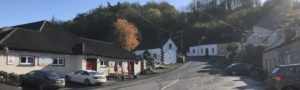
“The Weaver” Walsh family lived in the first house on the left on the Churns hill road when entering the Village. In the featured photo the darker house on the left of the three attached houses is the former home of “The Weaver Walsh” family. For a rough drawing of the Village see, Glenmore Village in the 1930’s https://glenmore-history.com/glenmore-village-in-the-1930s/. Although Jim Walsh did not mention his wife or children we believe that he did marry and did have at least one child Walter Walsh and also raised a couple of step-daughters.
Unfortunately, the public death register ends in 1966. Only one James Walsh died over the age of 89 died between 1959-1966. As lively as James Walsh appeared to be when interviewed on 31 October 1959 it is difficult to believe that he died in less than a year. A 90 year old James Walsh died in the Waterford hospital in January 1960. His address was recorded as 41 Costello Place, Waterford and the Munster Express of 5 February 1960 provided that the deceased who died on that date had a son and daughters. Unfortunately, the names of the son and daughters is not provided. This James Walsh was buried in Ramsgrange, Co Wexford.
We hope that someone can provide the missing information concerning the colourful James “the Weaver” Walsh.
Special thanks to Jacqueline Walsh for the old photo of the Churns hill road in the Village of Glenmore. The photo was taken before the 1960’s when the Glenmore Pub opened. The old Village pump can be seen in the photo now where the pub is located.
Dr. Kathleen Moore Walsh
The Phantom Coach of Glenmore: Inspiration for a Kitty the Hare Tale?

Over the years Danny Dowling recorded the sightings of various Glenmore ghosts. Ghosts of soldiers and others, haunted houses, haunted lanes and fields were commonly experienced around the parish, but there were several sightings of a more unusual apparition, a coach drawn by four big black horses, a headless coachman with two gentry ghosts in the coach. This unusual apparition became known as the Phantom Coach. The Phantom Coach was often encountered in the Carrigcloney and Kilivory areas particularly near the old Kilivory grave yard where it was often said to travel through ditches and fields following a road or lane that no longer existed. Locals believed a sighting of the Phantom Coach was a warning of a forthcoming death.
In June 1977, Nicholas Forristal (1888-1979) of the Mill, Graiguenakill, Glenmore related that Nicky Denn and Jamsey Grant “whilst driving cows on a summer evening, both saw the famous phantom coach come thundering down Ballyverneen Lane, across Main Road and cross Pill and marshes and up Carrigcloney Hill.” (Daniel Dowling, Notebook 5, p. 30).
Nicky Forristal went on to state that Nicky Denn died in the Union Hospital in New Ross in 1922/23. Nicky Denn was about 65 years of age when he died. He was born in Mullinahone, Glenmore and his father was Maurice Denn. Nicky Denn worked for about 20 years with Tommy Forristal, of Ballyverneen, Glenmore. The death registry supports that Nicky Forristal had an excellent memory. Nicholas Denn, of Ballyverneen, died on the 7th of March 1923 in the Auxiliary Hospital, New Ross at the age of 65 from pneumonia. It is recorded that he worked as a labourer. Thus Nicky Denn was born around 1858.
In the adjacent parish of Rosbercon, Thomas Victor O’Donovan Power was born in 1860. Power became a well known writer and died a decade after Nicky Denn in 1933. When Danny Dowling was a boy in the 1930’s the old people of Jamestown, Glenmore told Danny that Power would often call to various houses in Jamestown to visit and he sat with the family at their fireside where stories, particularly ghost stories, were shared. For further inspiration Power often prevailed on Jamestown locals, who played instruments, to meet him after dark in the Ballygurrim graveyard or raths. Power would stretch out on the ground and ask his Jamestown companion to play music while he encouraged ghosts or supernatural beings such as pookahs, fairies and banshees, to speak to his imagination.
Power wrote a number of supernatural short stories in serial publications like Ireland’s Own and later Our Boys. Long after his death Power’s short stories were re-printed for new generations of children. Power’s best known character was “Kitty the Hare: The Famous Travelling Woman of Ireland.” According to Stephanie Rains, of Maynooth University, (https://irishmediahistory.com/tag/kitty-the-hare/) Kitty the Hare was introduced in 1914 in Ireland’s Own and later her tales appeared in Our Boys commencing in 1924. Ireland’s Own is still being published today. Our Boys was a publication that was run by the Christian Brothers as an Irish Catholic alternative to the English Boys’ Own publication. The mission of Our Boys in the beginning was to provide acceptable role models for Irish boys to counterbalance the influence of metropolitan and the glamorisation of the British empire. Our Boys “…encapsulate[d] the spirit of pastoral romanticism which permeated the early years of the Free State. This series [Kitty the Hare] went on to become a highlight of the magazine for the next 65 years though Power died in 1929.” (Flanagan, Irish Times, 2014, available at https://www.irishtimes.com/culture/heritage/an-irishman-s-diary-on-our-boys-1.1863585 0.).

Although there is confusion concerning when Power died, T. Victor O’Donovan Power is buried in Shanbogh graveyard and his marker records his death as occurring on the 30th of December 1933. Obituaries for Power appeared in the New Ross Standard on the 5th of January 1934 noting that his father was Michael Power, and the Waterford Standard on the 6th provided the following information:
WELL-KNOWN WRITER’S DEATH. The death has occurred of Mr. T. Victor O’Donovan-Power, of Chilcomb [House], New Ross, the well-known Irish writer and play-wright. For the past 50 years he was a frequent contributor to magazines, periodicals, and the weekly Press, and he was the author of a number of books. Amongst his plays were “The Peril of Shelia” and “The Banshee’s Cry.” His writings portrayed Irish rural life in a delightfully true-to-life manner. Mr. Power was a gifted musician. He had been ill only a short time.
We will never know for certain if the Phantom Coach of Glenmore parish influenced Power, but a ghostly coach featured in a Kitty the Hare story he wrote. RTE as part of its Twenty Minute Tales series featured Kitty the Hare telling the story of the headless Aughaderry coach on Halloween in 1974. It has been digitalised, so turn down the lights and enjoy an old fashion short ghost story without special effects told by Kitty the Hare at https://www.rte.ie/archives/2019/1001/1079397-the-headless-coach-of-aughaderry/
The feature photo above are headstones in the Shanbogh graveyard taken in September 2020.
Web page update–Some headstone inscriptions from Shanbogh graveyard may be found by clicking on the Roots button on the home page.
Dr. Kathleen Moore Walsh
Mary Malone (c. 1841- ) A Poignant Letter Home to Glenmore in 1877

Last week we featured the letter written by Edmund Hartley ( 1836-1915) published in the New Ross Standard regarding his trip to Ireland in the summer of 1913. Edmund Hartley was accompanied home to Ireland by two priests, his son, Monsgr. James J. Hartley and his nephew, Father James E. Hartley. Monsgr. Hartley was the President of St. Bernard’s Seminary, Rochester, New York. Hoping that Monsgr. Hartley may have had records or photos of the trip we were disappointed to find that St. Bernard’s Seminary closed in the 1980’s. However, when we checked with the Archives of the Diocese of Rochester New York, Sister Connie Derby, Director of the Archives, located and copied a notebook kept by Monsgr. Hartley of the 1913 trip. Also found in the archive was a transcription of a letter written by a cousin of Monsgr. Hartley, Miss Mary Malone. Sister Connie also graciously forwarded good quality photos of Monsgr. and Father Hartley.
It is not known how Mary Malone’s letter came into Monsgr. Hartley’s possession and ultimately ended up in the archive. It is surmised that it was kept, hopefully cherished by her brother who received it in Glenmore in 1877, and when Monsgr. Hartley brought his father home to Glenmore in 1913 he was given the letter written 26 years earlier. The transcription with spelling errors and little punctuation is copied below as it was provided to us by Sister Connie. For such a short letter it is very poignant.
Mary Malone, Fairport, New York, to her brother, Glenmore, Co. Waterford, 24 January 1877
24 January 1877
Fearport January the 24, 1877
My Dear Brother      I take
the opportunity of writing to you
I hope you will forgive me for
not writing to you be fore this
but I was tost about         I left my
first place that I was in 2 years
and a half      I am now living near
my aunt          I have not but 1 Dolard aweek
this winter        this is a verry severe winter
in america. I got a letter from home about
two weeks after I got yours letter
they told me it was better for him to go now
than any other time but he is a
grate loss to my Father and mother
it is they feel his loss
but they tells me that they are not bad off
[page 2]

That you dont forget them    may
the Lord spare you your health
I do not get to healp them much
my wages is so little and I am not cap[a]ble
of earning big wages like other girls
who can cook and [do] the large washings and
fine ironings   I cannot do this    you know
I was not brought [up] to anny such thing
I was sent away frum my Mother when young
to the farmers to work out in the fields
and I never got much in sight about
house keeping or to be handy to sew
but I don’t have is anny one to blame
for that but my Sellf        I never tried
to lerren    I must onely do the best I can now
I am verry lonseom and down harted
I wish my Sister Margaret was here
if ever I can bring here out    if times
will get better I will try and do my
best for her
[page 3]
Dear brother     I would wish verry
much is you would send me your
picture and I will send you mine
I never had anny of my pictures taken
since I came to america   My aunt and
cussins are all well and my cussin
James Hartley is getting elong
splended with his studies
he expe[c]ts to be dordained in about 1 year
and a half from now.  You asked me
could I reed your writting      I could
with out anny troble   I hope you
will write to me soon again
I have no more to say at
preasant      from your affectionate
Sister      Mary Malone
Unfortunately the name of Mary Malone’s brother is not revealed in the letter. The only clues are that he lived in Glenmore, she lived in Freeport, New York, she had a sister named Margaret and cousin James Hartley who was to be ordained in 1878. It appears that Mary Malone may have emmigrated about 1875 as she was in her first place for 2 ½ years. Monsgr Hartley was not ordained until 1885, but the fact that the letter ended up in his possession suggests that Mary was related although the closeness of the kinship is not apparent.
Given the fact that Mary makes no reference to a husband or children it is assumed that Mary Malone was her maiden name. The 1880 Federal Census of Rochester, Monroe County, New York reveals that there was a Mary Maloney (sic) living in a boarding house on South St. Paul Street. She was born about 1842 and worked as a servant. It is not known whether Mary Malone remained in New York or returned to Ireland. No further obvious census records were found in New York state. In Monsgr. Hartley’s travel journal one evening while in the Glenmore area the men had “supper” with Mary Malone. It is not known if the 1913 referenced Mary Malone was the same woman that wrote the letter home to Glenmore in 1877.
The Glenmore Parish records reveal that there were a number of Mary Malones born in the early 1840’s from Rochestown to Weatherstown. There is no obvious match of a Malone married to a Hartley or Kennedy (maiden name of Edmund Hartley’s mother). Also, there were much fewer baptismal records for a Margaret Malone. The best fit so far is the Michael Malone family of Weatherstown, Glenmore. Michael Malone and his wife, Catherine née Burke had a daughter Mary who was baptized on the 10th of November 1841. Their daughter Ellen was baptized on the 27th of July 1839 and their daughter Catherine was baptized on the 1st of June 1849. However, no sons were discovered in the parish records for this union.
Perhaps a reader who descends from Mary and/or Margaret Malone can point us in the right direction.
As soon as we can transcribe the travel notebook kept by Monsgr. Hartley we will publish excerpts particularly the notes from their time in Glenmore. Monsgr. Hartley throughout his journal refers to his elderly father affectionately as Pa.
Special thanks to Sister Connie for all her help this week copying and sending on information and photos. The featured image is entitled Irish Immigration from Queenstown (Cobh, Cork) (1874 from the Miram & Ira D. Wallach Collection, Digital Public Library of America
__________
Ireland is again in lock down due to COVID 19. We shall attempt to provide more posts as we did last lock down. If anyone has a subject or idea, or has an article for our guest author page please contact us at glenmore.history@gmail.com.
Dr. Kathleen Moore Walsh