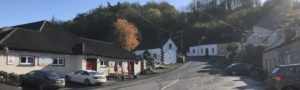
Glenmore Co. Kilkenny
now browsing by tag
More Glenmore Post Cards [Updated]
Jackie Walsh shared two postcards and a photo from her collection. If you have never visited Jackie’s facebook page “Glenmore Memories” it is well worth a visit for the lovely old photos.
Post Card 1

This postcard is from 1912. It provides a good view of the buildings that once stood between the Mullinahone Road and Fluskey’s shop and post office. Today, all that remains is Fluskey’s (which is a private dwelling) and to its left Danny Dowling’s (1927-2021) house. No longer standing: (1) the Dispensary; (2) Gaffney’s house & shop (later Lizzie J.K.’s); and (3) Gaffney’s Mill.
See our post of 25 April 2020 regarding the Glenmore Dispensary. For further information on Gaffney’s Mill see our post of 6 April 2025. See our post of 28 May 2020 regarding the Fluskey family.
Glenmore Photo

It is not known when this photo was taken. Given the car depicted it was likely taken in the 1940’s or 1950’s. The people are gathered in front of Fluskey’s. Do you recognise any of these people?
[Update–James Grace noticed that the wall at the bridge (to the left of the stage) was repaired. He believes the photo was taken after Michael Murphy (1930-1974) of Robinstown, Glenmore, lost control of his experimental tractor, crashed through the wall and ended up in the stream. James was an apprentice at Duggan’s when this occurred. See our post of 27 June 2020 for more information regarding the runaway tractor of June 1953. Thus this photo was taken after June 1953.]
To the right of the photo is the stage house built by landlord Dr. Mackesy, to store corn. The stage allowed for wagons to be loaded easily, and politicians used the stage for addressing local people. This stone building was removed to allow for the construction of the Sallies housing development. The stone building to its left and across the stream is the coach house which still stands in Cappagh townland. See our post of 4 March 2025 regarding landlord Dr. Mackesy.
Post Card 2

This postcard is also undated. Two children are in front of Danny Dowling’s house and someone is standing in the doorway. No graffiti is apparent on Fluskey’s wall. It appears that the Village pump which once stood (in front of the current Glen Bar) is not apparent in this photo. This suggests that the photo was taken after 1931 when the Village pump was removed due to pollution.
See our post of 23 May 2020 regarding the village pumps and water scheme. See our post of 9 April 2020 regarding Glenmore Village in the 1930’s.
Request From Reader
We have a reader who wonders if anyone has photos or a postcard depicting the old bus stop area at the top of the Churns. He recalls that there was a finger sign that had “Glenmore 1/4.”
For other postcards of Glenmore see our posts of 22 January 2025 and 29 January 2025.
Please send any corrections, further information or other old photos or post cards of anywhere in Glenmore to glenmore.history@gmail.com . Special thanks to Jackie Walsh for sharing these postcards and photo.
Dr. Kathleen Moore Walsh
The First Gold Glenmore Sign

On the 17th of March, to commemorate the fourth anniversary of the death of Glenmore historian, Danny Dowling (1927-2021), Glenmore Tidy Towns and glenmore-history.com placed a historical sign at the site where Gaffney’s Mill once stood. This is the first of several planned signs to be posted in the parish. If you stop to look at the sign please look at the stone beneath it. The stone had a date inscribed in it (1810), but the stone when re-used for the pier was placed upside down. Another Glenmore mystery.
Apologies for my tardy posting, but a couple days later my better half and I were off on a cruise to celebrate our 30th wedding anniversary.
Information Provided: Gaffney’s Mill
This mural, painted by artist Graham Carew, represents Gaffney’s Mill that stood behind this wall. Gaffney’s Mill was one of 3 mills shown in Glenmore Parish on the historical survey map of the 1830’s. The mills included: Grace’s Mill in Mullinahone, Forristal’s Mill in Graiguenakill and Gaffney’s Mill here in the Village. The Gaffney family operated the mill until around 1900. The mill had a water wheel which was powered from a supply of water in a mill pond which was located behind the mill. This water was sourced from the stream that flows through the village, partly diverted at Mullinahone into a mill race. A man-made canal ran parallel to what’s known as the Mill Road. The water was released on demand and flowed back to the stream via an underground duct. In addition to a corn mill a linen mill was also operated on this site utilizing flax grown in Ballyverneen.
It is not clear when Gaffney’s Mill began operating, but it was in operation in 1798. The local leader of the United Irishman was William Gaffney (c.1763-1798) of Gaffney’s Mill. He was captured by British soldiers and hanged on the 5th of June 1798. His remains were discovered in an unmarked grave in Rosbercon over a century later with the building of the rail link between New Ross and Waterford. William Gaffney’s remains are now buried in Kilivory Cemetery, Kilmakevoge, Glenmore.
At the bottom of the sign are two GRC codes to direct readers to posts containing further information on glenmore-history.com including local events during 1798 and the discovery of William Gaffney’s remains.
Attendees

Future Glenmore Signs
Plans are underway to post signs marking the carriage house; the Ballyverneen brick pits; the Glenmore Barracks; and the the site of the first St. James’s Church. Please send on any suggestions for additional historical signs to glenmore.history@gmail.com or contact Glenmore Tidy Towns via its facebook page.
Dr. Kathleen Moore Walsh

From Danny’s Files: Glenmore Notes (1968)

Happy St. Patrick’s Day! Today, is the fourth anniversary of our founder Danny Dowling’s (1927-2021) death. At 5 p.m. a sign will be unveiled at the mural in Glenmore Village the site of the historic Gaffney’s Mill to commemorate Danny’s anniversary. The sign was created by Glenmore Tidy Towns and Glenmore-History.com., and over the coming months we hope to mark other historic sites around the parish. The signs will feature the new Glenmore-History.com logo designed by Jamie Kent of Waterford.
Below are a few excerpts from Danny’s 1968 notebook featuring several Glenmore people and local facts.
Kitty Norris née Ryan (1824-1902) of Ballyveria, Glenmore
We are all aware that the last native Irish speaker of Glenmore was Patrick Power (c. 1856-1942) of Jamestown, who died in 1942. However, Danny recorded a rather startling fact regarding a Glenmore woman Kitty Ryan of Ballyveria. “Kitty Ryan, later Mrs. Jimmy Norris of Ballyveria never knew a word of English until she was 20 years of age She became a good English speaker. She died in 1902.” If Kitty Ryan did not have a word of English it seems likely that she never attended a National School because all National Schools taught English. See our post of 23 August 2020 regarding “Glenmore and the Irish Language”.
The Glenmore Parish records provide that James Norris (c. 1835-1908) and Catherine “Kitty” Ryan were married on 13 February 1866 at Glenmore. The townland provided was Ballyveria. The fathers were not recorded, but the witnesses were John Ryan and Mary Connors. Both parties were of age, therefore, they both were over 21. The Civil Records provide more information. The groom was a labourer, and his father was Michael Norris. The bride’s father was William Ryan, (farmer).
Finding Kitty or Catherine’s date of birth was difficult. The 1901 Census revealed that James and Katherine (sic) Norris were living in Ballywairy (sic) Lower. James was a farmer and 66 years of age. Kitty was 50. Both spouses were born in Co. Kilkenny, and both spoke Irish and English. In 1901, their two closest neighbours were the Garrett Hanrick family and the Richard Murphy family.
Kitty died on the 22nd of May 1902, at Ballywairy (sic) at the age of 76. In one year she aged 26 years! The death register records that she was the wife of a labourer, and died of senile decay. Her husband James was present at her death. James himself apparently died aged 73 at the workhouse hospital on 8 March 1908. He was a widower, labourer and died from prostatitis. The register records that he was from “Ballyfacey, Co. Kilkenny.”
Parents & Siblings
Catherine “Kitty” Ryan was baptized 21 September 1824 at Bally-Vereah (sic) Glenmore. She was the daughter of William Ryan and Margaret Cassin. William Ryan married Margaret Cashin at Ballynuna, Kilmacow on 28 October 1809. Kitty had at least four brothers:
[1] Robert Ryan, baptized 14 October 1810;
[2] Patrick Ryan, baptized 9 March 1815;
[3] James Ryan baptized 11 May 1817; and
[4] Thomas Ryan baptized 4 June 1820.
We did not find any records that Kitty and Jimmy had any children. We could not locate a headstone. Without Danny’s note it seems likely that Kitty would have remained unknown.
Kitty may have had another brother William Ryan. We found some baptismal records regarding children William Ryan, of Ballyveria, fathered. James Ryan “Illegitimate” was baptised on 25 February 1843 at Glenmore the son of William Ryan and Mary Malone. Margaret Ryan “bastard” was baptised 7 June 1850 at Ballyweair (sic) to William Ryan and Mary Malone. William Ryan of Ballyveria married Mary Malone on 19 August 1850 at Glenmore. It is not clear what impediment may have stopped the couple from marrying before 1850. However, given the power of local priests in the mid-nineteenth century (for example closing all pubs in Glenmore Village) it is surprising that this situation was not resolved prior to August 1850.
Ballycroney School at Cody’s
“About 90 years ago Paddy Butler used hold classes in Cody’s of Ballycroney. It was attended by the locals.” This would have been around 1878. Danny’s note also provides that Paddy Butler died “about 70 years ago in the Carrick Union, “the master of which was a Glenmore man James Mullins.” See our post of 10 January 2021 regarding James Mullins. This appears to be the same Paddy Butler who was the master of Kilbride who was from Rahora and milked for Mullins of Flemingstown. See our post of 12 January 2025 regarding what was said from the altar regarding Paddy Butler and our post of 6 September 2020 regarding Glenmore Hedge Schools and Early National Schools. From other sources it appears that Paddy’s teaching ended in Kilbride when the Ballyfacey School opened in 1868.
Ballyfacey School at George O’Connor’s
Daniel Galavan was a teacher in a cow house belonging to George O’Connor in Ballyfacey. Charlie Linegar (1839-1923) went to the Daniel Galavan school. See Dick Claridge’s, “Glenmore Versus from the Early Twentieth Century,” including the famous prank recorded in Charlie Linegar’s Ball.
Mowing Machines
Mowing machines were first introduced into the parish over 80 years ago (circa 1888). The first to get one was Hogan of Weatherstown. Other early mowing machines were owned by Greene’s and Cody’s.
Spraying of Spuds
Spuds were first sprayed in Glenmore in 1904. The Creamery had four sprayers. [The Creamery did not open until 1905, so we believe the correct date is probably 1905.]
*****************************
Please send any corrections or additional information to glenmore-history@gmail.com
Dr. Kathleen Moore Walsh

Again special thanks to Jamie Kent for designing our new logo!
A Glenmore Landlord: Dr. Mackesy [Updated]

We are teaming up with Glenmore Tidy Towns to develop small informational signs for historical buildings/areas around Glenmore parish. One of the buildings identified for a sign is the coach house. From Danny Dowling’s (1927-2021) notebooks we know that the coach house was owned by the landlord of Graiguenakill and Cappagh, Dr. Mackesy who lived at 22 Lady Lane, Waterford. However, there were several Dr, Mackesy’s who were related and resided on Lady Lane in Waterford.
We know that 13 houses were built on both sides of the Village Stream by “Dr. Mackesy” circa 1855. It is not known when the coach house was constructed. We could find no contemporary newspaper articles regarding the building of the houses in Glenmore Village. However, we did find an interesting letter to the editor in the Waterford News & Star (Fri. 30 June 1854, p. 4) concerning some political issue or appointment at that time. “We find Dr. Mackesy and his party going to Glenmore, on a shocking wet day that would drown an alligator…not of course to vote against Dr. Denn, but to vote for a highly accomplished and qualified young gentleman.” Unfortunately the first name of the doctor is not printed.
Going back to Griffith’s Valuation (1833) it was recorded that George Toie/Ivie(?) of Waterford was the landlord of Cappagh. Sir John Gahan was the landlord of Graiguenakill. Thus, “Dr. Mackesy” obtained the townlands sometime after Griffith’s Valuation.
The First Mackesy Landlord of Glenmore
There are two Dr. Mackesy’s who were alive in the 1850’s and could have been the first of a line of Dr. Mackesy’s who were landlords in Glenmore. The two men were father and son. The father was Dr. Thomas Lewis Mackesy (1790-1869). The son was Dr. Joseph Poulter Mackessy (1815-1866).
Dr. Thomas Lewis Mackesy (1790-1869)
Thomas Lewis Mackesy was born in Waterford to an apothecary [chemist/pharmacist]. It is believed that his father was William Mackesy who had his shop at 4 the Mall. Thomas apprenticed under his father, then in 1809 successfully took the London College of Surgeons. Thomas trained as an assistant surgeon before joining the Royal Artillery. In some accounts of his life it is alleged that he was at the Battle of Waterloo. After approximately 7 years he returned to Waterford and became the surgeon for the Fanning Hospital and Leper Hospital. He married his first wife Mary Poulter (1777–1818) in 1813. She was 13 years older than Thomas.
Dr. Thomas L. Mackesy became interested in civic life. In 1826 he became a Freeman of Waterford City, served as a Poor Law Guardian, a Magistrate and became Mayor in 1841/2. Although other Presidents of the Royal College of Surgeons Ireland were from outside Dublin, Dr. Thomas L. Mackesy, in 1862, was the first President who practiced outside of Dublin. For further information concerning his military and medical work that includes his photo see, Journal of Medical Biography (2025) “Thomas Lewis Mackesy (1790-1869): Eminent Surgeon of Waterford.” In 2018, the Waterford Civic Trust placed a blue plaque at 22 Lady Lane to honour him. For further details see, The Irish Times .
Landlord of Dunkitt
Dunkitt is located about 12 kilometres southwest of Glenmore near Grannagh on the old Waterford to Limerick railway line. Dr. T.L. Mackesy was one of a group of three who owned 79 acres. The other two owners was Joseph Poulter Budd, Esq. [assumed to be nephew] and Rev. William Mackesy [his son].
In September 1850 newspapers across the country reported that “Dr. T. L. Mackesy has, within the last few days, given all his tenants on his Dunkitt estate clear receipts up to the 1st of May last, wiping off all arrears, some of his tenants owing upwards of sixty pounds—Waterford Mail (Cork Examiner, Fri. 27 Sept. 1850, p. 2).
Then in 1855, T.L. Mackesy, Esq., Joseph Poulter Budd, Esq. and the Rev. William Mackesy as owners of a 79 acre estate in Dunkitt petitioned for partition. The solicitor for the Mackesy’s was Henry V. Mackesy, Esq. of 126 Grafton St. Dublin and Waterford (Waterford Mail, Sat. 6 Oct. 1855, p. 7). Henry Vincent Mackesy (c. 1826–1889) was from Dr. Thomas L. Mackesy’s second marriage.
In 1864 the Dublin Evening Mail. (Mon. 4 Jan. 1864, p. 2) reported that His Excellency the Lord Lieutenant presented the Rev. William P. Mackesy, A.M. , eldest son of Dr. Thomas Lewis Mackesy, of Waterford, to the living of Dunkitt, in the diocese of Ossory, vacated by the death of the late Rev. Patrick Rennie with a value of £450 per annum. The Waterford Mirror (Wed. 6 Jan. 1864, p. 2) gave further details. The Reverand’s father, Alderman Mackesy, recently held the honourable position of President of the College of Surgeons, and his brother, Dr. Joseph P. Mackesy, inherited the extensive estates of the Poulter family. Rev. Mackesy’s “appointment to this incumbency must be most gratifying to the family generally.”
Notwithstanding Dr. T.L. Mackesy’s long list of achievements and ownership of lands in Dunkitt there is nothing found in his obituary or other sources to suggest that he was a landlord in Glenmore.
Dr. Joseph Poulter Mackesy (1815-1866)

Joseph was the eldest child of T.L. Mackesy and his first wife Mary Poulter. We did find a published link to Joseph who was also a doctor holding land in Glenmore. For example, in 1863 it was reported in the Dublin Daily Express identified that Dr. Joseph P. Mackesy, Esq. was the landlord of the Ballyverneen or Pink Rock weir. For further details see our post of 18 July 2020. It is not clear if Dr. Joseph Poulter Mackesy acquired lands in Glenmore as part of the Poulter family estates he inherited or whether some of the land was part of his wife’s dowry or more likely an inheritance.
In 1843, Dr. Joseph P. Mackesy married Frances Rosetta Ivie (1816-1891), the daughter of George Ivie, Esq. a Waterford solicitor. The couple had four children, two sons and two daughters. Both daughters died in April 1860 (Waterford News, Fri. 6 April 1860, p. 3). Below is Dr. Joseph P. Mackesy’s obituary which provides details concerning his injury, medical care and death.
Death of Joseph P. Mackesy, Esq, M.D. (The Waterford News, Fri. 6 April 1866, p. 3).
Seldom has it fallen to our lot as journalists to record an event so unexpected, and producing in its train feelings of deeper regret and commiseration, then the demise of Dr. Joseph Poulter, Mackesy, son of Dr. T.L. Mackesy, J.P., which sad event occurred on Tuesday afternoon, whilst he was yet unmissed by any in that community, to almost every one of who he was well known by his personal appearance, kind disposition, and affable demeanour. The few facts which immediately preceded the termination of his useful earthly career, at the age of 51 years, when he appeared only entering late the zenith of his profession, are as follow:–On Monday night, the lamented gentleman having paid his customary evening visit to his father, retired to rest apparently in his usual good health, but had been only one hour asleep when he awoke with a suffusion about the chest, and otherwise feeling so ill that he deemed it advisable to send for his father, who immediately applied the usual remedies in such cases.
The deceased gentleman continued in almost the same state until about ten o’clock on the fatal morning, at which hour a consultation and an examination took place between Dr. W. Carroll and Dr. T.L. Mackesy, when for the first time it became apparent that the deceased was suffering from disease of the heart, but no immediate termination of life was anticipated. He was visited by his uncle, Dr. John Mackesy, and other medical gentlemen, and continued in an unaltered state sitting at a fire in his bedroom until about half past two o’clock, when no one being present but Mrs. J.P. Mackesy, and whilst making some trifling exertion about his toilette, he suddenly dropped upon the hearth rug.
Dr. Carroll, who resides next door, and happened to be within at the moment, was almost instantly upon the spot, but found medical aid of no avail. He applied water to his face, which had the effect of producing the last sigh from his apparently motionless body, and thus the spirit fled from earth.
The immediate cause of Dr. Mackesy’s decease is ascertained to have been disease of the heart which, however, never developed itself until this fatal attack, owing possibly to the even tenor of his life, but was probably Accelerated by unusual exertion which he subjected himself to on the previous day in rendering assistance with his coachman to a horse which had fallen under his carriage, whilst paying a visit to the country. A post mortem examination on yesterday by several medical gentlemen of this city, revealed the facts that the heart of deceased was of usual size but of a very fatty nature, and that death had been caused, by the rupture of the left ventricle, and coating of which, to the extent of about one square inch, had been tenuated (sic) to the finest degree.
When the sad intelligence was first announced, It seemed to be credited by few only, but when the dread reality could no longer be doubted, it cast a gloom over the entire city and brought forth many a tear from the eyes of the poor who knew him well, as their benefactor in the hour of sickness, when either in his capacity as physician and surgeon to that valuable institution, the Leper Hospital, or as the private practitioner, he freely administered to them medical advice; or if the case were beyond his reach, the courteous, kind-hearted manner in which he reluctantly set aside the suppliant, was more calculated to create a feeling of love and veneration than relentlessness or ill will. As a physician and surgeon of about 26 years’ practice in this neighbourhood, he had been successful, and enjoyed a very large practice, from which he derived a handsome income.
To the whole population, it may be said, he was personally known, and by his affability and urbanity he was esteemed and respected by all who enjoyed his acquaintance, and who now deplore his sad and unexpected demise. Dr. Mackesy, apart from his large income from his practice, was possessed of considerable landed property and securities, and died a wealthy man.
He was married to a daughter of the late George Ivey, Esq. a well known solicitor in this city, by whom he had four children—two sons and two daughter—of whom the sons alone survive. One of these young gentlemen has nearly completed his studies for the medical profession, but has, by the will of Providence, been thus bereft of the sure guide in the paths of the profession, in which his father attained so high a standard. [His two daughters died in April 1860, Waterford News, Fri. 6 April 1860, p. 3.]
Much genuine sympathy is felt for his afflicted family, as also his respected father, in their sad bereavement, which again should bring to the mind of all alike—the rich, the poor, the sick man and the robust constitution—the wisdom of remembering the words of solemn caution contained in Holy Writ, that “in the midst of life we are in death.” The remains of deceased will be conveyed from Lady Lane at ten o’clock tomorrow (Saturday) morning, for interment in the family burial ground at Dunkitt, County Kilkenny.
******************************
The citation for the Journal of Medical Biography article on Dr. T.L. Mackesy, see, van Riel-Jameson R, Cooper M., “Thomas Lewis Mackesy (1790–1869): Eminent Surgeon of Waterford”, Journal of Medical Biography (2025) doi:10.1177/09677720241311205.
Special thanks to Veronica who forwarded information on the Dr. T.L. Mackesy as well as other Mackesy’s in 2021 and provided updates in 2025..
The featured photo above is the blue plaque placed on 22 Lady Lane, Waterford commemorating Dr. Thomas L. Mackesy (1790-1869). A portrait of his son, Dr. Joseph P. Mackesy is hanging in the Waterford City and County Offices, and we hope to add a photo of the painting to this post.
[Updated 15 April 2025–the bust of Dr. J.P. Mackesy was originally in the entrance to the Infirmary and now is found in University Hospital Waterford.]
Please send any corrections or additional information or photos to glenmore.history@gmail.com .
Dr. Kathleen Moore Walsh
Rev. Patrick Dollard (1804-1868) a Native of Rochestown, Glenmore

Today, we are going to feature the Very Rev. Patrick Dollard (1 March 1804-12 Feb. 1868) a native of Rochestown, Glenmore. Patrick was the younger brother of John Dollard (1801-1888) who was featured last week as the man who named Glenmore, Wisconsin. Fr. Patrick Dollard built St. Mary’s Cathedral of Kingston, Ontario, Canada and became its first rector. The painting to the left of Fr. Dollard hangs in the Cathedral’s Rectory and was graciously sent to us by Angela Gambin, the Office Manager of St. Mary’s.
Unfortunately, the Arch-Diocese of Kingston closed its archives in 2023 as a new building to house the collection was planned. When we queried when the archives will re-open we were informed that the new building has not yet commenced. Undoubtedly at some point in the future we will update this post and share whatever other information we can find regarding Fr. Dollard. Until then we have relied heavily on newspaper searches that revealed a detailed obituary and interesting description of his funeral.
Early Life
According to his obituary, Fr. Dollard was born in Glaumore (sic) County Kilkenny, Ireland, in March 1804. Over the years Glenmore has been spelled in a variety ways, but Glaumore is most unusual. Fr. Dollard was educated at an ecclesiastical seminary in Waterford. We believe that Fr. Dollard probably attended St. John’s Seminary in Waterford City. St. John’s was established c. 1807 for the Diocese of Waterford and Lismore. Per Danny’s notes St. John’s was established from the merger of a classical school and an academy. St. John’s was originally on Manor Hill and in 1868 relocated to John’s Hill. In the 1830’s, St. John’s established a mission to Newfoundland, Canada.
Emigration to Canada
After “finishing his collegiate course” Fr. Dollard sailed to Canada. “having from an early period of his life devoted himself to the Church, began and completed his theological studies at Montreal.” Fr. Dollard was ordained by Bishop Lartique, on the Feast of the Ascension, 1836. Fr. Dollard was appointed to the Diocese of Kingston. Montreal is about 800 miles southwest of Newfoundland. Kingston is about 280 miles further west and almost half way between Montreal and Toronto (The Weekly British Whig, Thu. 20 Feb. 1868, p. 1). It is not clear why Fr. Dollard went further west than Newfoundland if he was sent by the seminary in Waterford.
At Kingston Fr. Dollard cared for his brother John’s young family when they emigrated around 1850. John Dollard left his wife and children in Kingston while he crossed into the United States and travelled west to Wisconsin where he obtained land and cleared the wilderness to establish a farm. See our post of 17 February 2025 for further details of John Dollard’s trip and life in Wisconsin.
Although a great distance separated the Dollard brothers, we were able to ascertain that they kept in contact. In fact, Fr. Dollard, in September 1863 was the Vicar General of Kingston. It was reported that he was in Brown County, Wisconsin “visiting relatives.” He celebrated the last Mass at St. Ignatius. A week or so later the church was destroyed by fire. See, Mary Kay & Dan Milquet (2006) De Pere of Yesteryear, vol. 1, Zander Press, Brillion (Wisconsin) p. 43.
Priest of the People
According to contemporary newspaper accounts Fr. Dollard often rolled up his sleeves to help care for the sick and dying particularly during epidemics that swept through Canada in the 19th century. “He was instrumental in caring for typhus victims when they arrived after the Famine,” (Angela Gambin, email of 18 Feb. 2025). Fr. Dollard served in Kingston for 32 years and is credited with building St. Mary’s Cathedral , being its first rector, becoming the Vicar General and working tirelessly on improving education.
The Kingston Whig-Standard (Mon. 10 Feb. 1868, p. 3) reported two days before his death, “We regret to say that the Very Revd. Mr. Dollard, so long Vicar General and Parish Priest of Kingston, is very ill, and may probably be no more when this sees the eye of the reader. Father Dollard is truly a good man.” For a concise biography of Fr. Patrick Dollard see, B. J. Price, “DOLLARD, PATRICK,” in Dictionary of Canadian Biography, vol. 9, University of Toronto/Université Laval, 2003–, accessed February 15, 2025. .
The Weekly British Whig (Thu. 20 Feb. 1868, p. 1) published the following editorial after his death.
Kingston has lost in the death of Very Rev. Father Dollard one of the best men that ever lived in it. For a long time (upwards of thirty years) he was Parish Priest, and in the performance of that arduous duty gained the love and good will of all his many Parishioners. On two occasions he administered the affairs of the Diocese when the See became vacant, to the great satisfaction of his superiors, and it was at the time greatly regretted that he had not been promoted to the vacancy. He was in every sense of the word an exemplary priest.
However, it is from his obituary that we found the most details regarding Fr. Dollard’s work. The Weekly British Whig (Thu. 20 Feb. 1868, p. 1) published a lengthy detailed obituary that was republished in the Weekly Register & Catholic Standard (London) (Sat. 14 March 1868, p. 5). The obituary is below and the sub-headings are not part of the original obituary.
Obituary of the Very Rev. Patrick Dollard (1804-1868)
It is with profound regret we record the death of the Very Rev. P. Dollard, V.G., at the Bishop’s residence, after a severe illness of four weeks. He was a truly good and pious Priest, and dies deeply lamented by all classes of the community.
Zealous Priest
How many varied acts of kindness he performed in that long period are known only to those for whom they were done. During the trying scenes of the Rebellion—the epidemics of cholera and typhus fever, he laboured unceasingly for the benefit of the people, and nobly performed the part of zealous priest, a loyal subject, and a good and charitable citizen. In alluding to his conduct during the dread ship fever, Mr. Maguire, in his recent book on “The Irish in America,” pays the following tribute to him:
‘Father Dollard, an Irish Clergyman, had to bear the chief share of the priestly duty, and from the first moment that the fever broke out, until the earth was beaten down on top of the grave mound, he was in the midst of the danger.’
Building of St. Mary’s Cathedral, Kingston, Ontario, Canada

He was entrusted with the entire management of the building of the Cathedral, a task, it is needless to say, he performed with singular prudence and economy. He also laboured strenuously in the struggle of Roman Catholics of Upper Canada for their educational rights begun in 1841. He took the liveliest interest in the working of the schools, and for the last year and several years previous was chairman of the Catholic School Board.
By the amiability of his character, but above all, by the purity of his life, he won the esteem and admiration of his fellow citizens of all denominations—and they particularly the old ones, will regret the departure from amongst them of one, whoa after so long a residence, leaves a record unsullied by the slightest suspicion. To almost every Catholic family he was endeared by the strongest ties, and they regarded him with most filial affection. His loss leaves a large blank in their ranks, and one very difficult to fill.
Death
His death was befitting his character—calm and tranquil—and his last days on earth were made as pleasing as possible by the unvaried kindness of the Bishop and the unceasing attention of his many friends (The Weekly British Whig, Thu. 20 Feb. 1868, p. 1).
Funeral Services
The following interesting article describes in detail the funeral services for Fr. Dollard (The Kingston-Whig Standard, Mon 17 Feb. 1868, p. 2).
On Saturday morning the last rights of the Catholic Church were accorded to the remains of the late Father Dollard. St. Mary’s Cathedral was tastefully draped, the altars, pulpit, ornaments, windows, pillars, etc. being covered with black, festoons and draperies falling from the roof.

The chancel window was hidden by a black curtain, bearing on it a large white cross. The whole Church bore a sombre appearance. The body was laying on a platform erected within the rails of the Sanctuary while the ceremony was being performed. A Grand Requiem Mass was sung by the Right Rev. Bishop Horan, assisted by the Rev. Mr. Rooney, of Toronto, as Archdeacon, with the Rev. Mr. Brown, of Napanee, as Deacon, and the Rev. Mr. O’Kean, of Port Hope, as Sub-deacon, the Rev. Mr. Gothier, of Regiopolis College officiating as Master of Ceremonies.
The funeral sermon was preached by the Right Rev. Dr. Farrell, Bishop of Hamilton, who from the time of his ordination as a Priest until his elevation to the Bishoprie (sic), served under the direction of Father Dollard. During the Mass the Choir, mostly composed of male voices, sung the solemn music incident to the service in a very fine style.
After Mass a procession was formed, headed by the crucifix and censor bearers, composed of the students of Regiopolis College, wearing surplices and soutanes, and all the clergy present, each person carrying in his hand a lighted candle and being bare-headed, preceding the body, which was borne on the shoulders of Messrs. James Harty, Michael Flanagan, Michal Macnamara, James Bermingham, Maurice Dinn and Wm. Hartey, four aged Priests acting as pall bearers.

The procession proceeded from the Sanctuary out of the Cathredral, and passed around to the side of the building, where it entered the passage leading to the vault underneath. Here the ceremony was brought to a close by a reading of prayers for the dead and sprinkling the coffin with Holy Water and incensing it. The vault is built immediately under the grand altar, and directly opposite that contains the remains of the late Bishops McDonell, Goulin and Phalin.
To say that the Cathedral was crowded throughout the ceremony would give no adequate idea of the numbers present, and the many tears shed by both Priests and people, as they followed his remains to their last resting place, spoke most eloquently of the worth of the late Father Dollard. He is gone from among us, and it is much to be hoped that whoever succeeds him as a Parish Priest of Kingston, will exhibit that same spirit of religious toleration and uprightness of character that have won for him the high esteem of all good men. [The article ends with a long list of priests who attended the funeral.]
***********************************************************
The photo of Fr. Dollard’s tomb was provided by Angela Gambin. For further photos of the tomb and nearby tombs in the crypt see Find a Grave. The photos on Find a Grave were taken by Callan Murphy.
Please send any corrections or further information to glenmore.history@gmail.com .
Special thanks to Angela Gambin, the Office Manager of St. Mary’s Cathedral of Kingston, Ontario, Canada, for sharing a photo of Fr. Dollard’s portrait, the photo of his tomb and other information.
The photos of St. Mary’s Cathedral exterior and interior are from old post cards.
Dr. Kathleen Moore Walsh
James Heffernan (1825-1891) from Aylwardstown, Glenmore to Glenmore, Wisconsin

Recently a reader in the US, Lucy Neale Duke, found glenmore-history.com and we were able to provide some information on her ancestor’s family the Heffernan’s of Aylwardstown, Glenmore and she shared an amazing letter that was written on 1 February 1874 to her ancestor James Heffernan. James Heffernan emigrated to Glenmore, Wisconsin in 1850. We have attempted to determine whether James had a hand in the naming of Glenmore, Wisconsin or whether he was attracted to the name and settled there. We reached out to the city clerk as well as the local Brown County library but are still searching for an answer to that question. We were provided with a copy of a photo on the left of the Church of the Immaculate Conception of Glenmore, Brown Co., Wisconsin that James Heffernan helped to establish.
James Heffernan (1825-1891) of Glenmore
It was difficult to find a baptismal record for James Heffernan. However, his death cert in 1891 (information was usually provided by the widow) provided several important facts and dates. James Heffernan was the son of Mary Delaney and John Heffernan. He was a farmer with a date of birth listed as 20 March 1829. He was born at Glenmore, Kilkenny, Ireland. He married Bridget O’Leary. He died on 14 November 1891 at his home in Glenmore, Brown Co., Wisconsin and was buried in St. Mary’s cemetery. (Wisconsin US Death Records, 1872-2004 for James Heffernan, Brown Co. , Vol 1-Vol 2 NO. 1744). See, Find Grave to view his headstone.
Slieverue/Glenmore Parish Records
For whatever reason no Heffernan baptism could be located in 1829 for James. However, utilizing his mother’s name on 13 September 1825 at Aylwardstown, Glenmore, a James was baptized the son of Mary Delaney and John //. The sponsors were Michael Delany and Ellen//.
John Heffernan and his wife Mary Delaney married 17 February 1808. Their eldest child was Patrick Heffernan was baptized 1 April 1809. Thus, at the time of his birth James’s eldest brother was 16 years older than James.
Aylwardstown Glenmore Farm
Patrick Heffernan married Alicia “Ally” Irish on 7 February 1842. Alicia “Ally” was from Nicholastown, Slieverue. The witnesses were Patrick Delaney and Catherine Hickey. The couple had at least 5 children. [1] John Heffernan (bapt 22 Dec. 1842); [2] Mary Heffernan (bapt 23 Nov. 1844); [3] Michael Heffernan (bapt. 2 Sept. 1847); [4] James Heffernan (bapt 22 Dec. 1852); and [5] Thomas Heffernan (bapt 1855).
It is not clear what happened to John Heffernan (bapt 1842), but Michael Heffernan (1847-1924) got the Aylwardstown farm. He married on 13 February 1879, Bridget Kennedy (1854-1947) of the Pierce Kennedy family of Rathinure, Glenmore. The couple had at least 14 children. There was an awful blizzard that winter of ‘47 when Bridgie died. According to Danny Dowling (1927-2021) Bridgie was the last deceased person in Glenmore carried across the fields to the Church in Glenmore for Mass and burial. The trek was over 2 miles and she was carried by her sons, grandsons and neighbours through the drifted fields.
The Children of Michael Heffernan and Bridgie Kennedy
[1] Patrick Heffernan (bapt 18 Jan. 1880) (Lived in London when his mother died in 1947).
[2] John Heffernan (b. 13 June 1881) married and moved to Chicago. His wife tragically died and he brought his two small children home. His parents reared them until they were teenagers and he remarried and brought them back to Chicago. His son Raymond was shortly after returning to Chicago hit and killed by a car.
[3] James Heffernan (b. 10 July 1882)
[4] Peter Heffernan (b. 31 Dec. 1883-1966) was Garda Superintendent
[5] Mary Heffernan (b. 10 May 1855] married an O’Connor from Ballyfacey.
[6] Alice Heffernan (bapt. 21 Nov. 1886) married Ned Roche of Rathinure.
[7] Thomas Heffernan (b. 28 March 1888) married into a farm in Kearneybay, Glenmore.
[8] Richard Heffernan (b. 12 June 1889)
[9] Michael Heffernan (b. 7 Oct. 1890-1974) lived in Kilkenny City. See our post of 22 October 2023.
[10] Bridget Heffernan (22 May 1892)
[11] Andrew Heffernan (20 Nov. 1893-1975) married Bridget Roche (1896-1987). He farmed
the Aylwardstown farm.
[12] Nicholas Heffernan (b. 27 June 1896) (lived in Dublin when his mother died in 1947).
[13] Mon. William Heffernan (1893-1973) ministered and died in Australia. See our post of 15 October 2023 and family photo at his ordination.
[14] Stephan Heffernan (b. 15 Jan. 1898) Baby of the family. After the War of Independence, Stephen moved to Chicago, married and had two daughters. See guest author Brian Forristal, “A Place to Hide” & “The Tans are Coming.“
Quite a lot of information can be found on our H Glenmore Surnames regarding the Heffernan’s https://glenmore-history.com/families/h-surnames/
The Early Years of Glenmore, Brown Co., Wisconsin
From a brief history provided by Glenmore, Wisconsin it appears that forests originally covered Glenmore. As the forests were removed the land was sold to settlers who established farms. James Heffernan was one of the early settlers who established a farm. See, The Story of Glenmore, by David Koenig (1976). We know from James Heffernan’s 1891 obituaries that he emigrated in 1850 and settled in Glenmore on a farm he farmed for the rest of his life.
“The first settlers to come to Glenmore, or in that vicinity, are said to have located there as early as 1850. Those who were Catholic among that number were provided with no particular place of worship at that time, but were attended by visiting priests.” Mass was said in private homes The first Mass is said to have been held in the residence of Mr. O’Leary. [We believe this was James’s father-in-law’s home]. This continued until 1874 when a church was erected. It was torn down in 1886 and entirely rebuilt (The Catholic Church in Wisconsin: A History of the Catholic Church in Wisconsin from the Earliest Time to the Present Day, Catholic Historical Publishing Co., Milwaukee, WI. (1895-1898) p. 640).
The 1873 Letter
On 1 February 1873, Thomas Heffernan (1856-1876) of Aylwardstown wrote to his Uncle James Heffernan in Glenmore, Brown Co., Wisconsin. The letter is below and provides some fascinating details regarding the death of Peter Strange as well as the terrible weather. Tragically, Thomas died of TB at Aylwardstown at the age of 21 of TB. The death register (online) provides Thomas died 29 Oct. 1876 and his brother, James Heffernan (bapt. 1852) was present when he died. Thomas was employed as a draper’s assistant.
Aylwardstown Glenmore
Ferrybank
Ireland
February 1st, 1873
My dear uncle James,
It is under my fathers fond directions and kind permission I now take the opportunity of sending to you this little messenger of inquiry hoping to learn by it that you and all your family and friends are in quite as perfect a state of health as this leaves me and all our family in at present thank God.
Though there are numbers of people here in Ireland dying around us with all sorts of sickness in consequence of the most unwholesome air which nearly overspread the whole land all caused by a continual fall of rain for the past two years without scarcely getting one month together fine. You may easily guess how the people stand here and what a position they hold when you hear that there is no less than Nine families living in one of our neighboring Parish Chapels all driven from their homes by the immence torrents of rain and floods of water that knocked and swept away their houses and far worse still, there is no prospect of cultivation whatsoever.
It is thought by all here that there will be a famine amongst us and even the priests are of the same opinion though they are nearly tired from praying for fine weather but now we have nothing more to do than to hope for better days to come which I am personally looking out for in my new career of life which I must suppose it is totally unknown to you as there was no communication between you and my father for the past few years with the exception of a few words The Rev. P. Dollan told of you and also a newspaper came from your sister Mary immediately after the burning of Chicago [the Great Chicago fire burned 8-10 October 1871] and even then she but merely wrote her name without any address then we could even return thanks for her persevering remembrance of the dear people and land that gave her birth. We would have written to you long before this time but for anxiously waiting daily for a letter from some of you as an answer to one my father sent some time long previous to this and then by not receiving it we were more than astonished why you could be so ungreatful (sic) as not even to drop us a line no matter how trifeling the news may be anything from you is interesting to us.
I am the youngest of the family and I am serving my Apprenticeship in one of the oldest and largest Drapery houses in Waterford Walter O’Donnell and company Quay and have about eighteen months more to serve. There is three more brothers in Aylwardstown still and one sister all of which are too old to fill any situation respectable enough to live in Ireland. Some of them say they will follow your footsteps and fly to that land where there is freedom and plenty for all.
I am sorry for having to relate to you a sad tale of Mr. Peter Strange who was interred in Kilmacavogue on Christmas day last and deplorable it is, to explain that he did not receive the blessed Sacraments since his confirmation and for the past six years did not even go to Church or Chapel but used to ride on one of his horses off to Rochestown on Sundays when the public join in union to go to Mass so that Rochestown proved fatal to him in the end and Mr. Conn invited. him to Supper on the very Sunday night before Christmas and at ten O’clock that night he walked out of Mr. Conn’s parlour and breathed his last in the Hall. The inquest was held in his own house and the verdict was he died with the disease of the heart some of his own friends begged of the Parish priest to pray for him but the application was in vain the priest’s reply was, he was a man that broke the Commandments and died as he lived and it was not his duty to pray or even bless the clay for such a man!
Dear uncle James I suppose you will think it very strange when you get this letter from me, a person that you never saw and though I never saw you there is still within me a fatherly love for you in consequence of hearing you so often praised and spoken of among all our friends and surrounding neighbors. Here as a small token of my affection I enclose my likeness which I hope you will accept not for its value but as a memorial of your own boyhood among all your dearly loved friends here in Ireland though I may be somewhat changed contrary to the picture as it is more than two years taken but in any case it will give you an idea of the person who is now communicating with you and sincerely hoping you will send your likeness also at your earliest convenience and you will bring much happiness to the mind of my father not alone to him but all the members of the family.
Dear Uncle – my father and mother are quite as strong as ever and met with but very little sickness I may say while I remember and we are fighting hard through life which is very difficult on account of the climate being so very much changed so much so that if you were to return here again I don’t suppose you would know the dear old spot, as for the people there is none of them here to be found unless a few that would be no good elsewhere. They are leaving this country in thousands daily and now wonder when they would not get freedom which is so long due to them, but left in Slavery that which the Christ Heart could not go through.
Dear Uncle – I have nothing more of any importance to communicate at present as it is my first time in addressing you but that my father and all the family join me in sending their tenderest love to you and wishing you all the compliments the present season can afford. Sincerely hoping will send a letter soon and let us know all particulars of yourself and my Aunts position in life you and state of health.
I am
Yours Sincerely affectionate Nephew
Thomas Heffernan
Obituaries of James Heffernan (1825-1891) of Glenmore
We have included two obituaries for James Heffernan as they provide additional information including that James was 6 feet 3 inches tall considered a very tall height in the 19th century.
Death of Another Old Settler–De Pere News, 21 Nov. 1891, p. 1
James Heffernan died at his home in Glenmore Saturday, the outcome of a severe attack of grip last winter. He was 63 years of age. James Heffernan was born in Ireland, and removed to this country in 1850, making his home at Glenmore, in this country, up to the time of his death. He was a public spirited citizen, and a good neighhour and a man not found wanting in any of the relations of life. His wife and eight children are left to mourn his loss. The funeral was held at the Glenmore Catholic Church, Monday morning, Rev Pellegrin, assisted by Revs. Rice and Masschelein, officiating.
An Old Settler Gone–Green Bay Advocate, 26 Nov. 1891, p. 3
An Old Settler Gone—On Saturday, November 14th, Mr. James Heffernan passed away at his home in the town of Glenmore after an illness of several months duration, his suffering having caused by a complication of diseases.
Mr. Heffernan was an Irishman by birth, and at death was about sixty-five years of age. He left his native land in 1850 and came to the United States. Soon after arriving in America, he came to Wisconsin and settled on a farm in the town of Glenmore, Brown Co. where he has since resided. He was a splendid specimen of old Irish stock, standing about 6 ft. 3 inches in height, and fashioned in a strong and robust mould. He was a man of broad character and in all walks of life was a true type of manhood. He was a very popular man and took deep interest in the affairs of his town.
The funeral occurred from the Glenmore Catholic Church Monday and was a very large one. Deceased leaves a wife, six daughters and two sons to mourn the demise of a kind and indulgent husband and parent. One of his daughters, Miss Stella Heffernan, is a teacher in one of the public schools of this city.
*************************************
Please send any additional information or corrections to glenmore.history@gmail.com
Dr. Kathleen Moore Walsh
Special thanks to Lucy Neale Duke for reaching out and sharing the 1873 letter.
We also would like to thank Jeff Gilderson-Duwe, Local History Specialist of the Brown County Library for locating and sending on the obituaries as well as the excerpt regarding the church and photo of the Immaculate Conception of Glenmore, Brown Co., Wisconsin.
Also thanks to Cindy Ossmann, Glenmore, WI. City Clerk for forwarding, The Story of Glenmore, by David Koenig (1976).