Sport
now browsing by category
The Glenmore 12: Leinster Senior Football Semi-Final 1923

On Sunday the 8th of July, 1923, at Croke Park, Kilkenny played Meath in one of the Leinster Senior Football Semi-Finals. Of the fifteen players selected to play for Kilkenny a dozen were from Glenmore. In 1922 only nine Glenmore players were selected for the 1922 senior football team. See, our post of 17 December 2022 and 4 December 2022 for details regarding Glenmore’s representation in the Leinster Senior Football Championship in 1922.
The 1923 Kilkenny team was comprised of the following players [information not from the newspaper is in square brackets]: P. Dalton* (goal); J. Fitzgerald; M. Connolly [Mick Connolly, Rochestown]; J. Hanrahan [Jimmy Hanrahan, Glenmore Village]; Matt Flannelly*; P. Cody [Paddy Cody, Weatherstown]; M. Brennan; M. Cody [Michael Cody, Weatherstown]; L. Murphy; J. Phelan; W. Hartley [Bill Hartley, Bushertstown], W. Irish [Bill Irish, Rochestown]; P. Hartley; J. McKenna* and A. Heffernan [Andy Heffernan, Aylwardstown]. The three players that were not from Glenmore we have marked with an asterisk.* We know from the newspaper account below that John Doherty [Davidstown] replaced the injured Jimmy Hanrahan. For further details regarding Glenmore players from this era see our post of 6 February 2023.
The Munster Express and the Kilkenny People both published articles regarding the match. Both newspapers commenced their coverage with a short editorial of the match then the remainder of both articles published the exact same description of “the play.” The perhaps more objective Munster Express labelled the game a “dissappointing exhibition of football.”
Munster Express
“The game was to a great extent marred by fouling, the referee being kept pretty busy all through. Luck was against Kilkenny, who, in addition to losing two of their players through injuries, had another relegated to the side line early for a breach of the rules…There were periods of high-class play, but on the whole it was a disappointing exhibition of football…” (Munster Express, Sat. 14 July 1923, p. 3).
Kilkenny People
Sweltering conditions prevailed in Croke Park on Sunday, and the attendance during the first match was rather small, but it improved when the semi-final was in progress. Fan crowds came on the special trains, but it would scarcely appear that all found their way to the matches, which local followers were not strongly represented.
The main encounter of the day—Kilkenny and Meath—proved a strong one from the very outset, and was prolonged by frequent stoppages. It was also characterised by many penalties, but the spirit of the contest was good throughout. The back divisions of both teams were the outstanding feature, and scoring in the first half was a difficult matter for Kilkenny, playing a hard short practical from the outset, were unable to make full use of their elemental advantages in the opening period and turned over level points to a goal for Meath.
Meath improved considerable in the second half, mostly, and though erratic enough at time, succeeded in effecting a couple of major scores, to which, by lack of efficient forward work, Kilkenny could make no response though they had several favourable opportunities. Irish was the outstanding player on the field, putting in a vast amount of splendid work. The Meath backs were clever and cleared fouls. The winners will now meet Dublin for the final, but will need to improve considerably if they hope to once more bring premier hours to Royal Meath.
Details: Meath 3-1; Kilkenny 0-3 ( Kilkenny People, Sat. 14 July 1923, p. 9).
The Play
Kilkenny forced the play early and were rewarded with two “50’s” which, though well taken by McKenna, went for nought. Three frees brought Meath forward to find the Kilkenny Defence sound. Kilkenny going away spoiled by fouling close in, and a little later L. Murphy (Kilkenny) was sent off by the referee for a breach of the rules. Kilkenny went attacking, a free from the left wing was well placed by Flannelly for Fitzgerald to box over for a point.
Kilkenny backs were good against a Meath assault, in which Tuite met with hard luck in a try for a score. Andy Heffernan (Kilkenny) retired injured and was replaced by J. Shiels (Kilkenny) worked away from a free, and the Meath custodian in saving a trying shot from P. Cody, conceded a point.
Strong play ruled, Meath dashing away and over Kilkenny backs were again reliable in a renewed Meath offensive. Midfield play followed, the exchanges being pretty evenly divided. Kilkenny were something the better, but were meeting with sterling opposition from the Meath backs. Two frees aided Kilkenny, but the Meath line was crossed without result.
At this stage play showed improvement, and some good football was witnessed. Kilkenny kept up the pressure and M. Cody scored a fine point from far out. Meath backs were still kept moving and did very well against persistent Kilkenny onslaughts.
A brilliant run brought Meath into the Kilkenny ground, exchanges between Keoghan and Ratty (sic) being secured by Hickey, who levelled up with a goal for Meath. Working back Meath forced a “50,” and there was an exiting struggle close up to the Kilkenny citadel. Meath were pressing at the interval, when the scores were level, as follows: Kilkenny, 0-3; Meath 1-0.
Second Half
J. Hanrahan (Kilkenny) went off injured, and John Doherty took his place. On again getting to work Kilkenny broke away, but were held up by a free, and Meath, going in, went ahead by a point from Farrelly, Kilkenny attacking, sent wide, as did Meath soon after.
Meath were now playing up strongly, but the Kilkenny backs were equal to all effort to go through. Kilkenny spoiled by fouling in good position, and Meath were attacking, to register two wides (one from a free) before Kilkenny worked back, to be repulsed by a sound Meath defence.
Irish beat off a Meath offensive, and the ensuring play provided a few brilliant passages, both sides displaying great dash and determination. Irish who had been playing a great game for Kilkenny, was injured, but resumed, amidst applause. Meath attacked with vigour, but were obliged to retire before an admirable Kilkenny defence. Coming on again for a free, Hickey dashed in for a goal for Meath, Dalton the Kilkenny custodian, failing in an effort to save a low shot. Nothing daunted, Kilkenny bounded away, but a free, close-up, brought relief to Meath, who were being hotly tested. Meath again went attacking, to go wide from a free.
Unusual vigour was being introduced into the play and frees were frequent, Meath getting most. Keelan kicked a great goal for Meath from a free. Kilkenny still going strong, made no impression on the Meath line of defence. A succession of frees again brought Meath forward, but the Kilkenny defence prevailed. Kilkenny attacking made no headway against the Meath backs who were reliable all through. Meath had the better of the closing stages and were good winners at the end.
Referee & Meath Team
Mr. P. McCullagh, Wexford, refereed.
The Meath team: B. Carey; P. Keelan; W. Dillon; J. Newman; C. Cudden; P. Reilly; J. Ledwidge; M. Keoghan; P. Tuite; C. Meade; J. Curtis; C. Carolan; P. Ratty; J. Hickey; M. Farrelly.
XXXXXXXXXXXXX
For further information concerning Glenmore and other Kilkenny hurling and football teams see, The Kilkenny GAA Bible (2018) compiled by Gerry O’Neill.
Please send any corrections, additional information or photos to glenmore.history@gmail,com.
Special thanks to Jackie Walsh for sending the team photo featured above as well as identifying each player.
The feature photo Glenmore Footballers (Unbeaten Champions 1914 – 1925). [1925 on football in photo]
Back Row: James Vereker (Davidstown), Jim Murphy, William Irish, Pat Hartley, Andy Heffernan, Richard Hanrahan.
Next Row: Mick Heffernan, John Fitzgerald, John Doherty, Paul Fitzgerald, Michael Connolly, Peter Kirwan, Paddy Cody, James Dunphy.
Next Row: Stephen Heffernan, James Fitzgerald, Martin Cody (Captain), Fr. Richard Vereker, John Phelan, Bill Hartley (Busherstown).
Front Row: Jim Hanrahan, John Mullins, Mick Cody, Paddy Murphy.
Dr. Kathleen Moore Walsh
Founding of Glenmore GAA in 1887


Subscribe to continue reading
Subscribe to get access to the rest of this post and other subscriber-only content.
Glenmore Skittles Teams & Tournaments

A few months ago a reader asked if we have any information on a Glenmore skittles team. The reader’s grandfather mentioned that he played skittles before he emigrated to the UK. We were able to locate quite a few articles regarding local skittle tournaments held from 1938 -c. 1949. Apparently different areas of the country employed different rules and some tournaments were for teams and some were for individual contestants.
The local tournaments were played in the summer and were impacted by weather, so the games were played outdoors. We did find that there is an indoor skittles game which is often played in pubs. We could not find an article referencing a tournament being played in Glenmore Village, but it would be difficult to find a flat area for the game in the village. Ballycroney and Moulerstown were the two Glenmore townlands that were mentioned regularly as having skittle teams competing in local skittles tournaments.
Skittle Rules
It is widely accepted that skittles are played in various countries using various rules and equipment. For our American readers skittles is said to be the forerunner of bowling or ten pin bowling as it is often called here.
A brief description of how the local children played the game was recorded in the 1930’s by a Ballyfacey school child. See our post of 27 November 2022. This description is consistent with the RTE Archives (1979). Donncha Ó Dúlaing had a series entitled “Donncha’s Travelling Roadshow” where he travelled across Ireland highlighting the people, music and traditions of rural Ireland. On 4 April 1979 he featured a Cavan skittles match.
“Five skittles with values 1,2,3,4 and 10 are placed in a ring in a cross shape. Each player takes his turn at a throw line and attempts to knock all of the skittles with four throwers made from cylindrical blocks of wood.” To view the wonderful RTE archived 1979 footage click here.
1938 Glenmore Teams
Skittles may have been played in Glenmore long before 1938, but local newspapers only began reporting on and advertising skittles tournaments around this time. Several teams from Glenmore and nearby parishes/townslands were identified. Unfortunately the number of players on a team was not revealed in any newspaper article.
Shambo-Rosbercon Tournament
The New Ross Standard (Fri. 2 Sept. 1938, p. 12) reported that the Shambo (sic) Rosbercon Skittles Tournament began on Sunday the 27th of August 1938 “with players from Shambo, Ballycroney, Ballygurran (sic), New Ross, Glenmore, Waterford, Pink Rock and Moulerstown.” The games were described as very interesting to the large crowd of spectators.
“The ‘Butler’ Moulerstown team were very unlucky to go over the game number in the semi-finals after a grand display, but for being the most consistent players all round, the Egan team Ballycroney highly deserved their victory in the initial round. Saunders’ team, of Shambo, being runners up. The Committee thanked Mr. Daniel Whelan for seating and all other facilities provided during the game. The tournament will be continued on next Sunday.”
The second round of the tournament took place on Sunday the 11th of September 1938. Ten teams made it through the semi-finals and the third day of the tournament was scheduled for the 18th where the newspaper predicted “an exciting finish is anticipated.” (New Ross Standard, Fri. 16 Sept. 1938, p. 12).
Final Between Two Ballycroney, Glenmore Teams
The Shambo skittle tournament was played on the 18th and was proclaimed “an outstanding success.” The full ten team took part “in the final issues. Ballycroney, Moulerstown and Shambo teams proved their skill to enter the semi-final after very keenly contested games with excitement at its highest. Moulerstown and Shambo had to admit defeat, leaving the final issue, which was only decided by the best hand, between the two Ballycroney teams, the winners being D. Cahill, B. Hogan, J. Hennessy and W. Walsh, the Runners-up, Pat Egan, and the Holden Brothers, being very unlucky to be only beaten by the small margin of four. The teams are beginning another challenge game on next Sunday” (New Ross Standard, Fri. 23 Sept. 1938, p. 12.)
The Emergency Years
The Second World War is often referred to as the Emergency in Ireland. On 2 September 1939 the Emergency Powers Act was passed into law the day after Germany invaded Poland. Hardships prevailed as commodities such as coal, medicines and foodstuffs were difficult to import. Skittles remained a popular pastime in this area during the War.
A South Kilkenny Committee was established to run tournaments in the summer months with most of the parishes in South Kilkenny represented. For this league teams were grouped to allow draws and fixtures to be made “locally to suit players and the committee” (Munster Express, Fri. 28 June 1940, p. 8 and Fri. 8 May 1942, p. 66). However, teams were not limited to parishes, townlands or villages. Clover Meats had a skittles teams. Its July 1944 contest against Dangan, fixed for Ballykeohan Crossn had to be postponed “owing to unfavourable weather conditions” (Munster Express, Fri. 21 July 1944, p. 4).
One of the new features of skittles during the Emergency were concrete rings. An individual skittles contest was advertised for Tullahought (near Piltown) where a “new concrete ring” was built. “It is sure to attract a big entry from members of the skittles teams.” The entry was 10s. and first prize £1. “It is hoped to have all the contests in the one day” (Munster Express, Fri. 3 July 1942, p. 6). In early July 1942, it was reported that Jamestown (assumed to be Jamestown, Glenmore) “formed a new team and a newly painted ring” was announced (Munster Express, Fri. 8 May 1942, p. 6).
Ballycroney, Glennmore 1945 Team
The skittles tournament organised by the Listerlin Club attracted an entry of nineteen teams to the local venue on Sunday the 22nd of July 1945. It “provided a nice afternoon’s sport for a record attendance. After keen competition, in which some interesting play was witnessed, Ballycroney and Acres (Mullinavat) qualified for the final, which was won by the former after a great contest. The teams were as follows: Ballycroney—W. Holden, B. Holden, M. Holden, P. Hogan, J. Hennessy¸ J. Cody, T. Fitzgerald. Acres—Thomas Holden, Ed. Holden, Hames Holden, J. Holden, Jas. Farrell, Wm. Fitzpatrick, E. Kelly, Pat Anderson. Sergt. Conlon was judge and Mr. P. O’Connor marker.” (Munster Express, Fri. 27 July 1945, p. 5).
Moulerstown, Glenmore Tournaments
Tullogher’s tournament was played in early August 1945, and 18 teams competed (Munster Express, Fri. 10 Aug. 1945, p. 5).
Twelve teams entered for the skittle tournament held at Moulerstown, Glenmore, on the 12th of August, “which attracted a large attendance of spectators. After an interesting series of games, first prize went to the Moulerstown team, who defeated Smithstown in the final after an exciting contest” (Munster Express, Fri. 17 Aug. 1945, p. 5). The newspaper did not indicate where in Moulestown the 1945 tournament was held.
The following week the Moulerstown team competed in the Ballyanne (Wexford) tournament. “There was a large attendance at the … tournament held on Sunday, [the 19th] and great interest was centred in the games. Seventeen teams competed and Rathgarogue team were the winners of the tournament. Moulerstown came second and Rathnure were third. The prize for the best throw was won by J. Breen of Ballintubber, and gate prize by M. Fitzpatrick of Carranoure (New Ross Standard, Fri. 24 August 1945, p. 6).
In 1946, the Moulerstown tournament was held at the Moulerstown Dance Board on Saturday the 19th of June “commencing at 1:30 p.m. (old time) with £14 in prizes advertised (Munster Express, Fri. 21 June 1946, p. 5). A tournament held in an enclosed yard in the Borris & Graig district raised £29 7s. at the entrance gate “which goes to prove the interest taken in such contests” (New Ross Standard, Fri. 10 August 1945, p. 6).
Local Decline of Skittles
After 1949 fewer articles appeared in local newspapers concerning skittles. In the summer of 1949 it was announced that a “monster” skittles tournament was to be held in Mooncoin the first Sunday in August “in conjunction with the local sports. A number of new teams [were] also being organised in the area for the competition” (Munster Express, Fri.29 July 1949, p 8).

Stand alone skittles tournaments were no longer reported, however, skittles continued to be played in conjunction with sports days and sometimes with dances. For example, in the summer of 1952 a “Monster Skittles Tournament was held at the Glenmore Skow Bridge Dance Board on Sunday the 27th of July at 1 p.m. (old time). The entry fee was 16/- for a team of eight and £12 in prizes were on offer. A “big dance” was to be held the same night (Munster Express, Fri. 18 July 1952, p. 10).
Request
If you played skittles for a Glenmore team, or you recall hearing someone speak of their experiences, we would love to hear from you. If you have any old skittles trophies, medals or photos of skittle players or games please send a photo of them to glenmore.history@gmail.com. Please also contact via the email provided regarding any errors, omissions, or additional information.
The drawing featured above is courtesy of the New York Public Library and is a cigarette card issued in 1938; available at George Arents Collection, The New York Public Library. “Skittles.” New York Public Library Digital Collections. Accessed May 28, 2023. https://digitalcollections.nypl.org/items/7d20cdeb-e40d-4a73-e040-e00a18060ccc.
Dr. Kathleen Moore Walsh
Pat Green (b.c. 1949) of the Glenmore Cycling Club

Recently Ger Barry shared some photos of the Fermoy Open Sports Day circa 1973. Pat Green, of the Glenmore Cycling Club, was in the final and racing for gold. It was reported in 1973 that Pat Green was not competing that year (Evening Echo, Thurs. 26 July 1973, p. 12). We did, however, find that Pat Green was in the finals at both the 1971 and 1972 Fermoy Open Sports Day.
The early 1970’s were an exciting time for cycling as young men such as Pat Green, Willie Baggott (Limerick) and Pat Walsh (Glenmore) were bursting onto the racing scene. Although all the newspaper articles spelled Pat’s family name as Greene a quick check of the family headstone records the name as Green. To view our previous article regarding The Glenmore Cycling Club, see our post of 22 August 2022.
Commenced Competing
Pat Green, a farmer from Jamestown, Glenmore was a member of the Glenmore Cycling Club. In 1971 at the age of 22 he began to compete in track cycling races with only 12 months experience. Due to the lack of keen track competition in Kilkenny, and surrounding counties, he became a regular rider at Cork fixtures in 1971 (Irish Examiner, Mon. 9 August 1971, p. 11).
In early April 1971 he competed in the 50 kilometre road race, under ICF rules, which was promoted by the Glenmore Cycling Club. This road race was won by Donal Crowley a Ballincollig rider who won in an exciting finish with Pat Hegarty (Fermoy). Donal Crowley won by a wheel. The newspaper reported that “Local rider Pat Green was caught with just 200 yards to go” (Cork Weekly Examiner, Thurs. 8 April 1971, p. 9).
Fermoy Open Sports Day 1971
There were four heats leading to the mile Irish Championship final at Fermoy in early June 1971. Heat 1 was won by Pat Greene (Glenmore) with Peter Hegarty (Fermoy) second. In Heat 4 another Glenmore man competed, D. Walsh who came in third.

In 1971 Willie Baggott, a 24-year-old Limerick motor mechanic “stole a march on more fancied opponents to lift his first Irish cycling championship at Fermoy under BLE and ICF rules.” Baggot was a member of the newly formed Shannon Wheelers club and won the ½ mile and mile races. The former Phoenix Road club rider was not a favourite. More experienced men like Eddie Dunne, Round Towers, Dublin; Mick Kelly of Galway, Mick Kingston of Hilltown’s and the Fermoy representatives were favoured.
Baggott caught Dunne the Round Towers star by surprise in the mile. The final was an anti-climax with Baggott much too strong for Kingston, “Patsey Greene of Glenmore” and Fermoy’s Mick O’Connor (Cork Weekly Examiner, Thurs. 10 June 1971, p. 9).
Doubles at Ballyduff and Ballyhooly
A month after Fermoy Pat raced at Ballyduff Upper and completed a double by winning the one mile and two-mile cycling events. In the mile scratch he easily beat Peter Hegarty (Fermoy) and he came home in similar style against his clubmate, Pat Walsh, in the three mile open handicap (Irish Examiner, Thurs. 8 July 1971, p. 13).
On 2 August 1971 Pat won a silver medal in the national five-mile championship at Youghal. On the 8th Pat won his first Irish senior track cycling championship at Ballyhooley Open Sports Day under BLE and ICF rules. At Ballyhooley he reduced the opposition “to tatters, such was his power on the testing 400 metre circuit in later stages. Youghal’s Gerry Geary forced the pace and had a 50-metre lead with a little over half of a mile remaining.
All eyes were on Willie Baggot, the Limerick winner of three titles earlier in the year, when Pat Green and John Hegarty (Fermoy) broke clear of the pack to chase Geary.” The rest of the field did not react. Six hundred metres from home “the powerful Kilkenny man hit the front. In the final circuit nobody could match his strong pedalling into the wind in the back straight and he flashed across the line the easiest of winners,” Irish Examiner, Mon. 9 August 1971, p. 11).
Fermoy Open Sports Day 1972
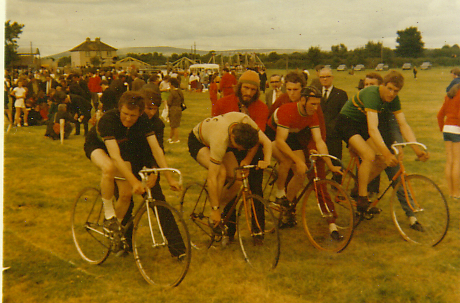
Cycling events took premier position in the 1972 Fermoy Open Sports day although the weather was reported as unfavourable (Corkman, Sat. 17 June 1972, p. 11). After four qualifying heats the line up for the half-mile final was comprised of Willie Baggott (Limerick). Sylvie Murphy (Hilltown), who edged out the fancied Eddie Dunne of Round Towns in the second heat. Pat Green (Glenmore) was the winner of the third heat and local star John Hegarty was the fourth finalist.
Sylvie Murphy took the quarter through the bell and held the advantage until 150 yards from home. Baggot swept by on the outside to go on to win by 1.5 lengths clear. John Hegarty, who had been hemmed in came with a late flurry to pip the gallant Sylvie Murphy at the line for the silver (Irish Examiner, Mon. 12 June 1972, p. 11).
Five Mile National Track Champion 1972
In July 1972, Pat Green as the holder of the 1971 Five Mile National Track Title was the favourite in 1971 (Nationalist & Leinster Times, Fri. 14 July 1972, p. 14). Pat went on to win the five-mile championship for the second successive year (Munster Express, Fri. 24 Nov. 1972, p. 19).
Please send any corrections or further information to glenmore.history.com.
Special thanks to Ger Barry for sharing the photos from the Fermoy Open Sports Meeting. He believes that the photos show Pat Green (Glenmore); Frank O’Sullivan (Fermoy); the third person is unknown but could be Paddy Flanagan (of Midlands Cycling Club) and Willie Baggot (Shannon Wheelers). “All were racing for the Gold All Ireland Championship” at the Fermoy Open Sports Meeting. In the black and white featured photo above Ger identified Pat Green, ?, Mick Kingston and Willie Baggott
Dr. Kathleen Moore Walsh
Glenmore Sportsman: Bill Irish (1899-1976) Native of Aylwardstown [Updated]

Today, we are going to feature a Glenmore sportsman who played both hurling and football at club and county level. Unfortunately, Bill’s sporting days were tragically cut short when he was attacked and injured during a pitch invasion. Bill won a county junior football title with Glenmore in 1919 and went on to win senior football titles in 1921, 1922 and 1923. He was a member of the Glenmore-Kilmacow combined team that won the 1923 junior county hurling title.
The Irish Family of Aylwardstown, Glenmore
William “Bill” Irish was baptized at Glenmore on 11 November 1899. He was the son of Robert “Robin” Irish (1838-1908) (farmer) and his wife Margaret Ribby (sic) (1861-1917) of Aylwardstown, Glenmore. His godparents were John Heffernan and Kate Ribby (sic). Robert Irish did not register his son’s birth until the 8th of May 1900. There was a fine for failing to register, or for failing to register a birth within three months. In order to avoid the fine for registering a late birth it appears that Robert recorded Bill’s birth as 11 February 1900 although we know he was born on or before 11 November 1899 from the baptismal record.
While still in his teens Bill and his siblings were orphaned. Their father died in 1908 (the death register records his first name as Robin) and their mother died in 1917 of TB. The 1901 and 1911 censuses reveal that Bill’s uncle, Thomas Irish (1844-1928) resided with the family in Aylwardstown. Tommy Irish, a bachelor, at the age of 57 took the plunge and married a widow Ellen Roche née Kennedy, of Rathinure on 18 July 1901. This apparently unhappy union may be the subject of a future blog post.
Bill’s Parents and Siblings
Robert “Robin” Irish (1838-1908) and Margaret Rigby (1861-1917) were married on 22 November 1893 at Slieverue. The witnesses to the wedding were Peter Kennedy and Bridget Rigby. The couple had at least six children: John Irish (b. 1894); Mary “Mollie” Irish Doherty (b. 1896); Monsignor Michael Irish (b. 1897); William Irish (b. 1899); James “Skinner” Irish (b. 1902) and Patrick Irish (b. 1905).
Bill’s Grandparents
Bill’s paternal grandparents were John Irish, of Aylwardstown and Mary Irish née Irish, of Nicholastown, Slieverue. Bill’s paternal grandparents were married at Slieverue on 28 February 1832.
On the other side, Bill’s maternal grandparents were William Rigby, of Ballincrea, Slieverue and Bridget Hartley, of Busherstown, Glenmore. His maternal grandparents were married on 23 February 1857 at Glenmore.
Glenmore Football

Middle Row: Bill Irish, Richard Duggan (Flemingstown), Bill Hartley (Captain)(Busherstown), Willie Walsh, Jim Freyne (Kilbride).
Front Row: Tommy Fitzgerald (Moulerstown), Tom Conway, Mikie Murphy, Willie Hartley.
Bill won a county junior football title with Glenmore in 1919, as well as senior championships in 1921, 1922 and 1923. Men on the Glenmore team included: Martin, Paddy and Michael Cody, Weatherstown; Jimmy, Dick and Pat Hanrahan, Glenmore; Andy and Stephen Hefferenan, Aylwardstown; Jim and Johnny Phelan, Clonassey, Mullinavat; Mick Connolly and Peter Kirwan, Knockbrack; John Doherty, Davidstown; Ned Freyne, Ballyfacey; Paddy Murphy, Ballyveria; John Mullins, Flemingstown; and Ned Roche, Rathnure (sic) (Kilkenny People, Fri. 22 Oct. 1976, p. 10).
Bill was also a member of the Kilkenny team that lost to Dublin in the Leinster senior football final at Croke Park in November 1922. This Dublin team went on to beat Kerry in the all-Ireland final. See our previous post of 4 December 2022 detailing the Leinster final, and the fact that this Dublin team went on to beat Kerry in the all-Ireland final. The other players on the Kilkenny team included: Martin Cody (captain), Andy Heffernan, Pat Hartley, Jim Phelan, Bill Irish, John Fitzgerald, Mick Connolly, Paddy Cody, Jimmy Hanrahan (Glenmore); Pat Dalton, goal (Knocktopher), Tom Brennan, Frank Hughes, Andy Brennan (Cloneen), J. McKenna and Wattie Landy (Cotterstown) (Kilkenny People, Fri. 22 Oct. 1976, p. 10).
Glenmore Hurling
In the early part of the 20th century Glenmore was known for its football teams. Although a good football player, Bill Irish was described as being “equally adept at hurling.”
For the 1923 hurling season Glenmore amalgamated with Kilmacow and Bill Irish was the captain of the united team. The other Glenmore players included: Jimmy Hanrahan; Jimmy Fitzgerald, Martin Cody, of Weatherstown; Jimmy, P. & John Murphy, of Ballyveria. The Kilmacow players included: D. Rockett, Jim Quinn, Tom Williams, Tommy O’Neill, Luke Phelan, Peter Phelan, Jimmy Cleere (goal), and Paddy “Bagger” Grant.
The Glenmore-Kilmacow team fought their way to the 1923 junior hurling championship final that was played in 1924. The “southern combination” were the underdogs going into the championship match against Dicksboro, a Kilkenny City based GAA club that formed in 1909. However, the united Glenmore-Kilmacow team “gave a most determined performance, surprising their more fancied rivals and emerged worthy winners of a great game.” (Kilkenny People, Fri. 1 Sept. 1967, p. 7).
Such was the surprise at the result it was dubbed the surprise of the century, and a challenge was issued by Dicksboro. The teams met in the same venue, St. James’s Park in Kilkenny, and the winners were to receive a “beautiful set of medals.” The Glenmore-Kilmacow team journeyed to Kilkenny City and played Dicksboro again and defeated Dicksboro again.
According to a Kilkenny newspaper, published 40 years later, the game was unfinished owing to a disputed score and Glenmore-Kilmacow who were leading at the time were awarded the match (Kilkenny People, Fri. 1 Sept. 1967, p. 7). Other accounts relate that disgruntled Dicksboro supporters invaded the pitch and one supporter attacked the Glenmore-Kilmacow Captain, Bill Irish (Kilkenny People, Fri 22 Oct. 1976, p. 10).
The Injury

According to the account in Bill’s obituary the invasion of the pitch occurred when there was a stoppage of play. Bill was “knocked out completely by a kick in the stomach, which troubled him for years subsequently and ended his playing career,” at the age of 25 (Kilkenny People, Fri. 22 Oct. 1976, p. 10).
The Munster Express reported on Bill’s injury and subsequent 2 day hospitalisation as follows:
Gaels throughout the County in general, and especially in the southern division, will regret very much the injury to Bill Irish, Glenmore’s popular player, on Sunday last in the match against Dicksboro at St. James’s Park. One of the outstanding Gaels of the county either on the hurling or football field, the many followers of the game will wish him a speedy recovery and hope he may soon be capable of donning the popular colours again. He was able to leave the Infirmary for home on Tuesday last.
We learn that he has made good progress towards recovery from the effects of the occurrence. He was one of the Kilkenny men selected to represent Leinster in football in the forthcoming Tailteann trials (Munster Express, Sat. 31 May 1924, p. 5).
Given the severity of the injury it is surmised that the kick landed lower than Bill’s stomach and the newspaper account of the time was being polite in its description. [Update 24 Feb. 2023: Given that Bill is found in team photos of the 1925 and 1929 Glenmore football teams it appears that Bill continued to play at least football after his injury.]
The Medals
In August 1924, after repeated requests for the medals made to Mr. E. Purcell, Mr. M. Heffernan, Glenmore wrote to the Kilkenny County GAA Committee raising the issue. He attached the agreement that had been entered into by the two teams.
Heffernan wrote, “I hope the scrapping of such an agreement will not be tolerated. I would have brought the matter up sooner but I could get no definite answer from Mr. Purcell. I now learn he intends putting the medals up for another object.” In addition to withholding the medals, Heffernan noted that “Dicksboro played five of their senior players, which was contrary to the conditions in the agreement. The referee awarded the match to Glenmore. I cannot understand why Glenmore were not given the medals long ago.”
The enclosed agreement stated that the winners were to be given a set of medals and Glenmore to receive £5 towards travelling expenses. Heffernan did not raise the issue of the £5 in his letter, so it must be assumed that Dicksboro at least honoured that commitment.
The Chairman of the Committee stated, “The rule is that trophies for a friendly tournament must be deposited with the country secretary, and that rule was not enforced in this case.” He stated that he would ask the Secretary to write to Dicksboro and ask for the trophies to be deposited and the committee would deal with the issue at the next meeting (Kilkenny Moderator, Sat. 6 Sept. 1924, p. 6).
After Sports
Bill Irish purchased a farm in the townland of Melville, Mullinavat and married Mary Ennett, of Cappagh, Glenmore. The couple had at least 5 children including: John Irish, Bobby Irish, Marie Irish Fleming, Kathleen Irish Francis and Margaret Irish Easden.
Bill died in October 1976 and his enthusiasm for Gaelic sports did not wane after his pre-mature retirement due to the injury he suffered during the pitch invasion in 1924. It was reported that the day before he died Bill attended a National League hurling game between Cork and Kilkenny in Cork. Bill’s full obituary can be accessed on our obituary page by clicking here.
Please send any corrections, additional information or photos of Bill Irish to glenmore,history@gmail.com.
For further information concerning Glenmore and other Kilkenny hurling and football teams see, The Kilkenny GAA Bible (2028) compiled by Gerry O’Neill.
The featured team photo above is the Kilkenny Jr. Hurling Team of 1922 (Freeman’s Journal, 16 Oct. 1922, p. 3.)
[Update 7 Feb. 2023: Special thanks to Patty Brown and Ann Fitzgerald for supplying Margaret Rigby Irish’s date of birth. We are attempting to verify details concerning Mary Irish through her great-granddaughter who is 93 years of age.]
[Update 15 Feb. 2023: Special thanks to Noeleen Fogarty née Hennessey for sharing a photo of Bill Irish.]
[Update 24 Feb. 2023: Special thanks to Jackie Walsh for sending on two team photos and more importantly for identifying each team members.]
Dr. Kathleen Moore Walsh

Glenmore Footballers (Unbeaten Champions 1914 – 1925). [1925 on football in photo]
Back Row: James Vereker (Davidstown), Jim Murphy, William Irish, Pat Hartley, Andy Heffernan, Richard Hanrahan.
Next Row: Mick Heffernan, John Fitzgerald, John Doherty, Paul Fitzgerald, Michael Connolly, Peter Kirwan, Paddy Cody, James Dunphy.
Next Row: Stephen Heffernan, James Fitzgerald, Martin Cody (Captain), Fr. Richard Vereker, John Phelan, Bill Hartley (Busherstown).
Front Row: Jim Hanrahan, John Mullins, Mick Cody, Paddy Murphy.
The Roaring Twenties: Glenmore’s Championship 1922 Senior Football Final

As highlighted in previous articles Glenmore won the 1920 Kilkenny Senior Football Final in February 1922 against their old rivals Cloneen. (Please see our blog post of 20 February 2022 for further details regarding the 1920 final played in February 1922). On the 5th of November 1922, nine of the Glenmore 1920 championship team members played for Kilkenny in the Leinster Final. See our blog post of 4 December 2022 for details regarding the 1922 Leinster Final. This Kilkenny team also contained three players from Cloneen. Seven days after the Leinster Final, Glenmore played Cloneen for the Kilkenny 1922 Senior Football Final. The County Final was played in St. James’s Park, Kilkenny City. Perhaps the most surprising aspect of the 1922 Kilkenny Senior Football Final was that it was played actually in 1922. It also was described as a “… clean game entirely devoid of shady tactics, and the referee had an easy task” (Kilkenny People, Sat. 18 Nov. 1922, p. 4). Most of the following description of the County championship final was gleaned from the Kilkenny People (Sat. 18 Nov. 1922, p. 4).
Kilkenny Senior Football Championship Final 1922
A moderate crowd gathered at St. James’s Park on Sunday the 12th of November 1922 to watch the contest between the old rivals—Glenmore and Cloneen—in the county championship for 1922. “The evening was admirable for the game, the weather being beautifully soft and calm and the pitch in splendid form. Glenmore fielded their championship team, but were without the services of their clever inter-county wing forward—Jimmy Hanrahan.” The Glenmore team included eight of the team which battled for Leinster honours earlier in November. The Glenmore team members “were in splendid form and gave a powerful display of strong and effective football.” Cloneen on the other hand was labelled, disorganised and without training. The newspaper reported that Cloneen had great difficulty and delay in fielding a full team. Notwithstanding these difficulties the Cloneen team members that showed up played in a “spirited manner in which they contested the issue to the final whistle.” The newspaper reported that this “reflects the highest credit on the good spirit of the once famous North Kilkenny team.”
The First Half
“The game, late in starting, was fought at a fairly fast pace both ends being visited in quick succession at the outset, but once settled down Glenmore took the upper hand and fielding in faultless fashion and delivering powerfully and judiciously they stormed their opponents citadel. The Cloneen backs defended in fine style, but despite their best efforts the clever combination of Connolly, Fitzgerald and Cody, ably supported by Doherty, had accounted for a big score at the interval when Glenmore led by 2 goals, 3 points to nil. [9 to 0] A goal had been disallowed Glenmore in this half for an infringement of the “parallelogram” rule, and a second goal was lost as the whistle had just gone for a foul. The efforts of Tommy Brennan, Hughes, Shield and Andy Brennan [Cloneen] were certainly worth a couple of scores in this half but being without their old forwards the chances went abegging.“
The Second Half
“Cloneen made some spirited dashes in the second half and play was of a fairly up and down character, but the rock-like defence of Irish, Cody, the Heffernans and Hartleys was unbeatable, though Cloneen notched a very fine goal and were certainly unlucky to lose a couple of chances. Cloneen are to be congratulated on their fine defece under almost constant pressure, but they had to yield to the inevitable and the Glenmore forwards, who were deadly accurate in their shooting further increased their lead and the final whistle left the score—Glenmore—3 goals, 5 points; Cloneen—1 goal.” [For our international readers a goal is worth 3 points, thus the final score was 14 to 3].
Commentary About the Game
The sports writer for the Kilkenny People (Sat. 18 Nov. 1922, p. 4) opined that Glenmore “gave a splendid exhibition their fielding being superb. Their fine and accurate deliveries played havoc” with Cloneen. Although it was a “very much one sided game” it was stated that it was nevertheless an interesting game with some fine passages of play. The Cloneen players, the Brennans and Hughes, all made a “great effort to save a lost cause, but their work was not sufficiently supported.” “All the Glenmore players lived up to their reputations—the Coadys, Irish, Connolly, Doherty, the Fitzgeralds, Heffernans and Hartleys contributing to the success of the team.” The coverage in the Muster Express (Sat. 18 Nov. 1922, p. 3) consisted of two sentences. “Glenmore defeated Cloneen in the final round of the Kilkenny Football Championships at Kilkenny on Sunday last. CLoneen made a very bad stand, and Glenmore ran out easy winners with a very large score to their credit.”
The sports writer for the Kilkenny People (Sat. 18 Nov. 1922, p. 4) concluded that Glenmore, “as an individual team it can be truly said that they have no equal in the province, not even among the best Dublin teams. Connolly again showed his aptitude for his position as a centre forward, some of his goals being marvellous.” The article then noted that “Many spectators were most anxious to know why Doherty was not given a place on the team which played in the Leinster Final. The selection committee only too well knew his worth and pressed him to take a place on the team, but he was adamant and more’s the pity.” Notwithstanding that the Civil War was still raging it was reported that “the members of the County Committee present were delighted that such a large number of National troops and officers patronised the fixture. It was encouraging to see our own army support our national pastime in such good numbers.”
The players of the 1922 Kilkenny Senior Football Final were:
Glenmore—J. Murphy; Martin Cody (Capt.); Paddy Cody; Andy Heffernan, of Aylwardstown; Stephen Heffernan, of Aylwardstown; J. Doherty; John Fitzgerald; P. Fitzgerald; J. Whelan; W. (Bill) Hartley, of Busherstown; J. Fitzgerald; Pat Hartley, of Busherstown; W. (Bill) Irish of Aylwardstown; Mick Connolly, of Rochestown, and Jimmy Roche, of Rathinure. [First names and townlands have been added to the newspaper list, so please send on corrections.]
Cloneen—M. Healy; T. Brennan (Capt.); P. Hughes; A. Brennan; A. McEvoy; P. Hughs; T. Brennan; J. Brennan; F. O’Grady; M. Langton; J. Shiel; J. Connors; R. Holohan; J. Phillips; P. Kavanagh.
Please send any further information or corrections to glenmore.history@gmail.com.
The featured photo above was taken in 1925 of the Glenmore Senior Football Team and is part of the Poole Collection (POOL_WP_2720a, POOL_K_4144 & POOL_WP_3651) and the photo is Courtesy of the National Library of Ireland.
Dr. Kathleen Moore Walsh