Crimes
now browsing by category
The Murder Trial of Patrick Donovan, of Ballyveria, Glenmore

In our last blog post we outlined the information that Danny Dowling recorded regarding the murder of Michael Rigby in Kilbride, Glenmore on 14 May 1841. In addition to the oral tradition that passed from one generation to the next, we are very fortunate that the details of the murder trial held in August of 1841 were reported extensively in the Kilkenny Moderator on 11 August 1841 (p. 2-3). From a legal history standpoint, one aspect of the reported trial that is interesting is the extensive exchange the judge had with the accused Patrick Donovan prior to sentencing. It was not until 1898, that an accused was allowed to testify in his criminal trial. It was believed that whether the accused was guilty or innocent, the fear of punishment would cause an accused to commit perjury, so no criminal defendant was allowed to testify. In Patrick Donovan’s trial for the murder of Micheal Rigby the judge was Baron Richard Pennefather (1773-1859). The prosecutor was Mr. Scott, Q.C. It is not stated that Patrick Donovan was represented by counsel, but there is a reference to Mr. Rolleston, cross-examining Crown witnesses. Excerpts of the newspaper account are provided below and where possible the actual language reported is utilized. The account was provided by a newspaper reporter and is not a verbatim transcript of the testimony.
Mr. Scott, Q.C. gave the jury a brief outline of the case. He contended that Patrick Donovan, aged 28, wilfully murdered Michael Rigby, aged 50, by “giving him a mortal wound on the head with a stone.” “The case was one which could only be presented as one of murder, and the only question was as to the identity of the perpetrator.” He set forth the motive, opportunity, dying declaration of the victim naming his killer, an eyewitness, as well as “so many circumstances…as to leave no doubt of the result.”
The first witness to testify was Captain Benjamin Bunbury who was the agent for Mrs. Caulfield the landlord of Ballyvara (sic). Captain Bunbury revealed to the jury the motive for the murder. “The prisoner married a widow woman, and so became tenant of four acres of the land; he was removed in June, 1840, for non-payment of rent, and for alienating two of them by sale…” In other words, Patrick Donovan as a tenant failed to pay the rent on the land and then alienated, or induced others to take part of the land, collected rent and kept the rent or rent in kind he collected. Before Captain Bunbury learned of the alienation of the two acres he had agreed that Donovan could return if he paid part of the rent owed. When Captain Bunbury found out about the “alienation” of the two acres he refused to allow Donovan to return to the land. Donovan then asked, “who will you get to take it?” Banbury replied, “many, no doubt.”

The next witness was Thomas Rigby one of the sons of the murder victim. He provided the jury among other things, that the defendant had opportunity. Although it was not reported in the newspaper account the age of this witness, (thanks to the Rigby research of Patty Brown & Ann Fitzgerald) we know that Thomas was 19 years of age. Thomas testified, “my father is dead; I remember the day he died; we left home that morning in company at about the hour of eight o’clock; I was going to the land which Donovan formerly held; my father had been about eight months in possession of the land; the prisoner asked me would we give up possession of the ground if Captain Bunbury allowed him, and I said we would; on the morning of the murder I saw the prisoner coming up a lane from the village of Ballyvara; he was about a perch (16.5 feet) off; he shook his head at me, and I was alarmed and told my father what had been done by the prisoner; I looked back once more, and the prisoner again shook his head; I and my father then went on our land, and my father parted me and went off along a path in the direction of Glenmore, a man named Hanrahan was ploughing about three fields off, and my father stopped to speak to him; I here observed the prisoner and a man named Walsh coming from a lane and making towards the path on which my father was; they got on the path and went off in the direction of Glenmore; the deceased had only gone a few yards out of Hanrahan’s field when the prisoner and Walsh left it too, going the same way; after this I saw the three in company going off, and this was about four perches from the place where I lost sight of them; the next time I saw my father was about one o’clock; he was then beaten; I and two of my brothers and two girls remained working in the field, when Hanrahan brought the news that the deceased was killed; my brothers ran before me, and I knew where the deceased lay by hearing their cries; when I came up he was lying in my brother’s arms, and moaning; he died in an hour.”
The cross examination of Thomas Rigby was by Mr. Rolleston. From the answers reported in the newspaper it appears that the counsel was attempting to show that Walsh also had motive and opportunity to commit the murder. Thomas Rigby stated, “l knew Walsh’s brother; he held one of the four acres from which Donovan had been ejected.” He was also questioned about the distance from which he observed his father near Donovan and Walsh, “there were eleven stone fences between me and Hanrahan’s field, and four ditches between me and the place where I saw my father last.” It also appears that he was challenged regarding the alleged head shaking by the accused and replied, “I stated to several persons and to the coroner, that the prisoner shook his head at me that morning.”
The next to testify was another son of the victim 25 year-old James Rigby. He provided further information regarding the land and his father’s dying declaration. “I know the four acres of ground which Donovan held, and my father got it about last Christmas; I was on the ground in last Spring digging potatoes, when the prisoner came up, and holding a little bit of earth in his hand, said, ‘I know that I will be burning in hell, where brimstone will be going through my nose and my belly, and I don’t care as much for my soul as for this bit of clay, and the first of you I catch on my ground I will settle him…’”
James Rigby went on to testify that on the day his father was murdered he saw his father going towards Hanrahan’s field and later “about one or two o’clock” Hanrahan came and told him that his father was at the top of Kilbride. “I ran off and found him lying partly in the ditch, and snorting, he was in very poor state; I asked him was he killed, and he replied ‘I am not killed, but as all as one’; I asked who killed him, and he said ‘Paddy Donovan.’” James Rigby then “threw off” his coat, and ran to the village of Glenmore for the priest, but by the time he returned his father was dead. As he was running for the priest, he met Richard Grace and Denis Lacy; on the path. “Grace asked me what happened.”
At this point the newspaper reported that accused Donovan interjected, “My Lord, if you won’t hang me he will go mad.”
During the cross-examination of James Rigby, he admitted that he had been in jail, “I was in the county gaol about “arguing” with some boys from Kilbrahan; I hit some of them; I cannot tell when it was I was in goal; one night in Ross they put me in gaol.” He denied that his father “turned him out of the house, but I used to go away for work and returned when wanted.” Rigby was apparently questioned about making a statement to John Walsh on the evening of the murder that his father was not able to speak when he found him. James Rigby acknowledged seeing John Walsh, but stated, “my father spoke quite plain when I raised him up; … I never said to any person that my father was not able to speak when I came up to him.”
“Baron Pennefather—When you came up to your father did he seem very much hurt?
Witness—He did.
[Baron Pennefather]—What was the first word you said to him?
[Witness]—I asked him was he killed, and he said ‘I am not, but am all as one;’ I then asked him who killed him, and he said, ‘Paddy Donovan.’
[Baron Pennefather]—Did he speak distinctly?
[Witness]—Not very, but I could swear to those words.”
The next two witnesses were Mary Brophy, of Ballyveria and Edward Hanrahan. Mary Brophy testified that on the day of the murder she went to Stations in Glenmore. She was returning to Ballyveria about dinner time by the pathway when she saw the body of a man lying in the ditch. He was “snorting and lay stretched out; I left him and told Ned Hanrahan, who was ploughing, about the finding of the body.” Edward Hanrahan testified that on the day of the murder at about eight that morning he was plowing and the murder victim came into his field and they had a conversation. Hanrahan observed John Walsh and “another man” come into the field. The victim left and went toward the path and the other two men were about eight perches from the path. “I was afterwards told by Mrs. Brophy that a man was lying stretched, and I went off and found the deceased about three fields off, lying on the other side of the ditch farthest from the path.”

When cross-examined Edward Hanrahan admitted that he told the children of the victim that their father was killed. “When I came up the second time the eldest son had his father in his arms. To Baron Pennefather—When I first saw the body I cannot tell if the man was alive.” He stated that it was Dan [Rigby] (b. 1811) who he saw holding his father in his arms. Hanrahan stated that he knew Donovan, but did not identify him because he did not have “as good an opportunity of seeing the man with Walsh as he [Walsh] came in first.”
The sixth witness was the eye witness John Walsh. He testified that he had lived in Ballyveria for thirty years and he knew the victim Michael Rigby and the accused Patrick Donovan. On the day of the murder, he met Donovan in the village of Ballyveria and they were walking to Glenmore for Stations. “We went by a path towards Glenmore, and the path went by Hanrahan’s field; I saw Hanrahan in the field sowing potatoes; I saw the deceased speaking to Hanrahan, and he then went on the path towards the chapel; I went on a little in advance of the prisoner, and when in Collattin’s field I heard a cry, “Oh don’t Paddy,” and turned round, when I saw Rigby lying on the ground in a corner of the field; I saw the prisoner strike him down on the head with a stone, and then I ran off for fear of my life; the prisoner overtook me some time afterwards, and told me he had thrown Rigby over the ditch; he came with me to the chapel, where we remained a good while; Donovan told me not to swear against him; I left the chapel first, and the prisoner followed me; I came to my own house at Ballyvara, and the prisoner went by the road; the same evening I told my neighbours what occurred.”
On cross-examination Walsh admitted that his brother “had a crop off of one acre of the four acres from which Donovan had been ejected.” In other words, Walsh’s brother was one of the men who alienated or rented part of the property from Donovan. Walsh stated that he was afraid to call out to Hanrahan when he saw Donovan striking the victim. Walsh stated that he was arrested in his own garden, and “told in one day what I knew.” He asserted that he was only arrested because he was with Donovan when the murder took place.
The next two witnesses were Denis Lacey and Richard Grace. Denis Lacey testified that Hanrahan’s house is situated between the Villages of Ballyveria and Glenmore and his own house was close to the pathway. He saw Walsh and Donovan together in the morning and after dinner returning from Glenmore. “James Rigby passed me during the day going for the priest, and he called out aloud to Richard Grace that his father was killed; in about five minutes after this the prisoner came up; I told him that Rigby was struck, and he made no reply.” Richard Grace corroborated that Walsh and Donovan were together in the morning and after dinner “saw the prisoner in Lacey’s house.”
The last two witnesses in the newspaper coverage were Mr. George White, Inspector of Police and Dr. Cummins. White testified that he went to the murder scene and found blood on the ground. He found a stone near the spot with blood and human hair on it. On the night after the murder he arrested Donovan between 11 and 12 o’clock, “at the distance of about two miles from his residence; he was in bed in a barn with two men, and a man who was dressed appeared acting as a sentry.” Dr. Cummins testified that he examined the victim’s body and found twelve wounds and contusions on his head. Two stones were shown to the doctor and he identified that one corresponded with several of the bruises. In his opinion the victim’s death was “produced by these wounds and bruises.” On cross examination he stated that it was possible a man might, “although thus injured, speak some intelligible words.”
“Baron Pennefather charged the jury in a most lucid address, and remarked on the many dreadful crimes that disgraced the country, in connection with the taking of land. The jury, however, were not, because the crime was great, to impute guilt to any individual, unless the evidence established his crimination ‘beyond any rational doubt.’ The learned judge, then, with extreme care, recapitulated the evidence. The jury retired at half past eight o’clock, and at half past ten brought in a verdict of guilty. The foreman said some of the jury wished to recommend the prisoner to mercy. Baron Pennyfather—On what ground? The jury could not assign a reason, and his lordship said he saw no ground for extending mercy. The prisoner, who was rather unmoved, was then taken back to prison.” It is assumed that the entire trial was heard in one day and the jury deliberated from 8:30 to 10:30 that night.
In our next blog we will provide details of the sentencing and Patrick Donovan’s exchange with the judge, as well as personal details concerning Patrick Donovan and Michael Rigby.
Special thanks to Patty Brown and Ann Fitzgerald for sharing their Rigby family research and to all who helped us today in locating some of the 1841 murder related landmarks. Any and all corrections greatly appreciated. Please send any information, corrections, etc. to glenmore.history@gmail.com.
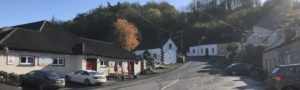
The featured photo above is the old Hogan house in Haggard, Glenmore identified by James “Jimmy Mac” McDonald as the place were Patrick Donovan was arrested on 15 May 1841. The old stone gate pillars are still standing as well as the house behind the trees.
Dr. Kathleen Moore Walsh
The 1841 “Savage” Murder in Kilbride, Glenmore

On 11 June 1970 Danny Dowling interviewed James “Jimmy Mac” McDonald (c. 1909-1990) of Ballyfacey, Glenmore. James McDonald provided the following information concerning a murder. Donovan of Ballyveria, Glenmore killed Rigby over two fields which Rigby “had from him.” The two fields involved were the ones opposite Katie Leary’s house and shop on the other side of the road. Donovan had a wife, two sons and a daughter. Before the murder was committed, the parish priest of Glenmore, and a missionary, went to Rigby, and implored him to return the fields to Donovan, but he wouldn’t. On the morning of the killing, Rigby was riding on an ass on his way to the Stations in Glenmore. Dick Young’s grandfather was working in a field and Donovan asked him to kill Rigby, but Young refused. A man named Cathoir was with Donovan when he killed Rigby. He killed him by battering in his head with a stone. Donovan didn’t intend to kill Rigby. All he wanted was to leave him enough life for the priest to attend. Cathoir then said to him that if Donovan didn’t finish him off the two of them would be hanged. Donovan then finished him off.
After the killing, Donovan and his wife fled and hid around the Englishman’s on the Mountain and from there went to Haggard where they were arrested the next day where Hogan’s are now. That night whilst hiding he had his head resting on his wife’s lap he had a vision of his dead mother he said to his wife “here is my mother coming for me.” Cathoir swore against him at the trial, and when it was over Cathoir was never seen again. He had a wife and two sons. The sons later went to America. Jimmy McDonald’s father Patsy was in Peoria, Illinois in his early days and he saw the Cathoir men there. At that time when a man gave evidence for the Crown he was usually shipped away to England or further afield for safety.
James McDonald did not indicate where the murder took place, but Mary Stapleton on 5 March 1980 when providing some Irish field names to Danny stated that “Knockaburdish” was the name of the field that once belonged to Felix Mullins. It was located at the top of the Kilbride hills and it was where “Donovan killed Rigby. The mark of Rigby’s head is still there. It is now owned by Jim Culleton.”

Yesterday, Paschal Roche, of Kilbride, a nephew of Jim Culleton (c. 1922-2012) showed us the field at the top of the Kilbride hills that is now called “Dead Man’s Field.” There in the upper eastern corner of the field is the spot where Rigby was murdered 180 years ago. The Culleton headstone in Glenmore cemetery reveals that Jim Culleton’s grandfather, James Culleton (c. 1845-1912) was born only a few years after the murder. The photo to the right shows the location in Dead Man’s Field where the murder took place. Today, it is not possible to pinpoint how the old path to Glemore proceeded from this point crossing the field or running along the ditches.
Ireland in 1841
From 1821 to 1841 the Census Commissioners concluded that Ireland’s population increased from 6.8 million to 8.2 million. There was an average of 700 people per square mile in Ireland making it the second most populated country in Europe. However, unlike England and Scotland the people living in rural Ireland had shorter life expectancy than the people living in Irish cities. This was discovered by Oscar Wilde’s father, surgeon William Wilde. Wilde examined the record of the deaths of family members who died after 1831 and calculated mortality rates employing records such as hospital returns and cemetery returns. It is thought that the poverty and poor living conditions in rural areas with a sizable proportion of the population living in “mud huts” contributed to the shorter life expectancy (Helene O’Keefe, (2021) “Ireland before the Great Famine” ).
In 1841 Glenmore was not yet a parish. Although the present church in Glenmore Village was built in 1813 it was not until 1846 that Slieverue and Glenmore were divided and the parish of Glenmore was established. The townlands of Ballyfacey, and Ballyveria where both Rigby and Donovan lived in 1841, were on the edge of what would become Glenmore parish. The faithful would walk from these outlying areas in the most direct route to the Chapel in Glenmore by crossing fields and following what were known as mass paths. It was on a mass path in the townland of Kilbride that Rigby was murdered while walking to Stations being held in Glenmore on Friday morning on the 14th of May 1841. Today, Holy Week is generally associated with Stations, but in 1841 Easter Sunday fell on 11 April 1841.
Just eight years earlier the murder in Shanbogh, of Catholic landlord Joseph Leonard, generated vast newspaper coverage and resulted in the men held responsible for his murder being hanged at the place of the murder “near the hill of Glenmore.” It was reported that these hangings were witnessed by thousands from the area. It is likely that the crowd that attended the hangings may have included both Rigby and his killer Donovan.
Contemporary Newspaper Controversy
The Kilkenny Moderator, on Wednesday the 19th of May 1841 (p. 3) published the following account of the murder.
“SAVAGE MURDER. We deeply regret to state that another and a most horribly revolting murder was perpetrated in this County on the morning of Friday last, at Kilbride, within a few miles of Rosbercon. It appears that on the morning stated, as Michael Ribby (sic), of Ballyvarra (sic), was on his way to attend a Station,” which was held in the Chapel of Glenmore, about a mile from his own house, he was overtaken by two men named Patrick Donovan and John Walshe, both residing on the lands of Ballyvarra, who walked beside him for a few yards until they came to a “style.” At this spot Donovan took up a stone with which he knocked down his unsuspecting victim, poor Ribby, and continued to strike him about the head in the most savage manner until life was nearly extinct, inflicting no less than thirteen wounds, beside one on the back of his left hand with which he ineffectually attempted to save his head while vainly crying out for mercy to his relentless assailant.
After the perpetration of this horrid deed we have been assured that Donovan and Walshe both went to the ” Station,” where we suppose they got absolution! The unfortunate Ribby was discovered by his sons a few moments before he expired, and when spoken to by them he merely uttered the words—”I’m not quite killed—it was Donovan did it,” soon after which he breathed his last. He was about 50 years of age and has left a large family to mourn over his untimely fate. The only cause assigned for this foul murder is, that Ribby had been, a few months since, put in possession of about four acres of land from which Donovan had been previously ejected by the Agent, Captain Bunbury, for non-payment of rent. This gentleman, on being informed of the transaction, instantly started for Kilbride, in order to render any assistance in his power for the apprehension of the guilty parties.

Donovan, we understand, is a fellow of notoriously bad character, and has been more than once an inmate of a gaol. An Inquest was subsequently held on the body of the deceased by Thomas Izod , Esq., one of our County Coroners, when a verdict of ” Wilful Murder” was returned by the Jury against Patrick Donovan and John Walsh. We are happy to add that, owing to the active and unceasing exertions of George White, Esq., C.C., and the Constabulary under his command, Donovan (who had absconded,) and Walshe, were both arrested and brought into Ross, while the Inquest was sitting. They have been since transmitted to our County Gaol charged with the offence.”
The Kilkenny Journal, and Leinster Commercial & Literary Advertiser, of Saturday the 22nd of May 1841 (p. 3) provided further details of the inquest and arrests.
“Murder—Coroner’s Inquest—On Saturday, Thomas Izod, Esq., one of the coroners for the county Kilkenny, was called on to proceed to Ballyvera, near Listerlin, in the barony of Ida, to hold an inquest on the body of a farmer named Micheal Rigby, who was murdered at between eight and nine o’clock on the morning of Friday, on his way to the chapel in Glenmore. The finding of the inquest was “wilful murder against Patrick Donovan of Ballyvera, aided and assisted by John Walsh of the same place.” Donovan absconded shortly after committing the murder, and was, during the sitting of the Court, apprehended at Haggart, near Glenmore, by that efficient officer, Sub-inspector White, and the police, whose vigilance and activity were unremitting to bring him to justice. Walsh did not abscond; the deceased had ten or twelve severe cuts on the head, and the scull severely fractured; the ill will towards him was in consequence of his having taken ground which Donovan was dispossessed of; Walsh’s brother was an under-tenant of Donovan’s to part of the land, which in extent, was not more than 4 acres.”
On page 2, of the same edition of the Kilkenny Journal, the editor asserted that there was an “infamous calumny” in the article published by the Kilkenny Moderator on the 19th concerning the murder. Although the meaning of calumny is to make a false, malicious, defamatory statement about a person in order to damage that person’s reputation, the editor was not referring to what was said about the accused Patrick O’Donovan being a fellow of notorious bad character. The editor asserted, ‘If the Catholics of Ireland did not possess a degree of patience allied to servility, they would not permit the insolent conduct of those infamous calumniators who hourly assail their claims to political right, and make the most laborious pains to misrepresent their [Catholics] religious principles.’ The editor was challenging the remark concerning the accused men after the murder attended Stations where it was “supposed” that they obtained absolution for the murder. The editor argued that the purpose of the two accused men to attend the Stations was to avert suspicion. “…[W]e think, very likely, for how could they better avert suspicion than by appearing to comply with their religious duties? –but the other dark insinuation, (concerning receiving absolution) ‘the lying scribe knew in his heart, could not be credited even by the most blinded of his bigoted readers.’” Thus the “savage” murder was not only widely reported in newspapers across Britain and Ireland, but it (or more correctly its reporting in the Kilkenny Moderator) generated controversy and became politicalised because of the remark concerning absolution.
Next Blog: The Murder Trial of Patrick Donovan
In August of 1841 Patrick Donovan stood trial in Kilkenny for the murder of Michael Rigby. Details of the testimony of nine prosecution witnesses provide a fuller account of the murder and provides some personal information about Rigby and Donovan. We shall cover the murder trial in our next blog post.
The featured photo above is one of the panoramic views from the lower ditch of Dead Man’s Field, Kilbride, Glenmore.
Special thanks to Patty Brown for kickstarting this research by providing a newspaper excerpt that provided the date of the murder and the names of Michael Rigby’s wife and children. Also special thanks to Pasqual Roche for taking us yesterday to Dead Man’s Field with its wonderful views of Glenmore.
If there are any corrections, omissions, or readers have further or different information please email glenmore.history@gmail.com.
Dr. Kathleen Moore Walsh
The Prologue: Henry “Bounce” Walsh, of Catsrock, Glenmore

As previously published Henry “Bounce” Walsh was hanged on 1 September 1847 for the murder of John Walsh near Bishop’s Hall, in what was sometimes referred to as the Black Corner murder. Notwithstanding the circumstantial evidence presented in the court, Henry “Bounce” Walsh asserted to the very end that he was not guilty of the murder. Thanks to Beth Tykodi who shared the article on the “Bouncer” Walshes, which was published on 20 January 1846, as it led to locating other pre-murder newspaper articles with information concerning Henry “Bounce” Walsh as well as the name of his father and a brother. These newspaper accounts are often contradictory and confusing. Unfortunately this was common in newspaper accounts from the mid-nineteenth century. For the previous blog posts concerning the murder trial see; https://glenmore-history.com/the-murder-trial-of-henry-bounce-walsh-of-knockbrach-glenmore/ and for the execution see: https://glenmore-history.com/the-public-execution-of-henry-bounce-walsh-in-1847/ .
Convicted of Assault
In July 1845, Henry “Bounce” Walsh was arrested and charged with assaulting Mr. Gregory Lymbery. The following article appeared in the Waterford Chronicle and reveals that Bounce and another defendant both committed assaults and received similar sentences with one distinction. The other defendant assaulted a constable and was sentenced to hard labour.
“COUNTY COURT-Tuesday…Chief Justice Doherty” heard the following: “Daniel Maher, stood charged with an assault of a policeman at Abbeyside, while in the discharge of his duty. The prisoner pleaded guilty, and said, that but for being drunk on the night in question, he would not have interfered. Six months imprisonment, with bard labour. Henry Walsh was next put forward for an assault on Mr. Gregory Lymbery. He also pleaded as an excuse, that he was drunk on the night he committed the assault, and could not recollect, whether he committed the assault or not, but supposed he did. Six months imprisonment.” (Waterford Chronicle, Wed. 16 July 1845, p. 3)
Release from Jail & Victim of an Assault
On the day Henry “Bounce” Walsh was released from jail, the 15th of January 1846, having served his time for the assault on Mr. Lymbery, his brother John and his father Walter brought him some clothes. (Waterford Mail, 3 March 1846, p. 2) Thereafter, Bounce, John and Walter Walsh went drinking. On their way home “Bounce,” his father and brother were the victims of serious assaults. The article from Saunder’s New Letter (Dublin) (20 January 1846, p. 3) provides:

“DESPERATE ASSAULT—An assault, which, we regret to say, is in one instance likely to prove fatal, was committed Thursday night, about ten o’clock, on the persons of Walter Walsh, John Walsh, and Henry Walsh, the father and two sons, better known by the nickname of “The Bouncers,” and famous for their pugnacious propensities. They are residents of a place called Catsrock, about six miles from this city, in the County of Kilkenny. The occurrence took place at the county Kilkenny side of the bridge, near Alderman Forristal’s residence, and the parties by whom the injuries were inflicted are named Thomas Grant, John Halligan, James Power and James Brien. The weapon used was a bar of iron about three and a half feet long by two inches broad. Those parties are also natives of the county Kilkenny, and it appears the affray arose from a dispute of long standing. The Walshes are desperately wounded. Henry’s life is almost despaired of, and it is strange fact that he was only after being discharged from gaol on the same day, where he was confined for a wanton assault on Gregory Lymbery, Esq. Intimation of the circumstances having been given to Sergeant M’Coy, who was on duty on the Quay, he immediately proceeded to the opposite side of the bridge, and aided by his party, removed the wounded man to the police barrack, and then pursued the other parties, whom he succeeded in arresting. Grant was identified as the person who had used the bar of iron. The Walshes were removed to the Leper Hospital, and the others were on yesterday brought before the magistrates at petty sessions, and committed until the result of the injuries will be known.—Waterford Mail”
The Waterford Chronicle provided a slightly different account and falsely reported that Walter Walsh died of his injuries. This account provides that Grant, Bryan, Halligan or Hannigan and Power resided in Curraghmore, Slieverue.
“MURDER. On Thursday night about 10 o’clock four men named Thomas Grant, John Halligan, James Bryan, James Power, were proceeding from Waterford to Curraghmore, in the County Kilkenny, their residence, they had not proceeded far beyond the bridge when they overtook three men named John Walsh, Henry Walsh, and Walter Walsh. On coming up with the Walshes the attack commenced, and is stated that one the persons now in custody named Thomas Grant committed fearful havoc on the Walshes, whom he strewed about the road, with a heavy piece of new iron he had in his car. As soon as the alarm was given, Constable M’Coy and some of his men pursued the assailants, whom they succeeded in capturing, and conveyed them hack to the police barracks at Ferrybank, and also the sufferers whom they found bleeding on the road. After arriving at the barracks the sufferers identified prisoners as the persons who assaulted them. On seeing one the prisoners (Thomas Grant), Walter in identifying him said, “oh, it was you who slaughtered all with the bar of iron.” On yesterday, the prisoners were brought before the magistrates, they were identified by constable M’Coy, whose evidence corresponds with what we have stated. The prisoners were remanded. One of the Walsh’s an old man, died yesterday evening in the Leper Hospital, where his fellow sufferers are lying in a hopeless state. (Waterford Chronicle, Sat. 17, 1846, p. 3)
The trial of Thomas Grant and James Brien was held on Friday the 27th of February 1846 in the City Court of Waterford. Although the previous accounts implied that there were three Walsh victims and four defendants only two men stood trial for a “felonious assault, with intent to do some bodily injury, on the person of Walter Walsh.” The following account is from the Waterford Mail (3 March 1846, p. 2).
“Spring Assizes (City Court—Friday, before Honourable Justice Ball). Thomas Grant and James Brien were indicted for a felonious assault, with intent to do some bodily injury, on the person of Walter Walsh.
Walter Walsh examined—Is a farmer; lives at Cat’s Rock; has six sons; was in Waterford on the 15th January last; went to bring his son some clothes, as he was coming that day out of jail for having committed an assault on Mr. Lymbery; left Waterford about 8 o’clock that evening in company with two sons, Henry and John; when he came to the bridge; at the end where Mr. Forristal lives, witness was beaten on the head with a bar of iron by four men whom he met there; believes he got but one blow; when witness got the blow; Henry was struck and knocked down; he saw his sons that night in the police barrack, and they were sent to the hospital.
Henry Walsh examined—Is son to Watt Walsh; was coming from Waterford with his father and brother, and went over the bridge; when opposite Forristal’s house, witness was struck on the head with a bar of iron by Thomas Grant; Brien was with Grant, and was the first person who caught witness by the coat—[witness here identified the prisoners]—after witness was struck down with the bar of iron he became insensible, and did not speak until the morning after.
John Walsh deposed that he was with his father and brother going over the bridge on the evening in question; when at the other side of the bridge he saw three men together, the two prisoner and John Hannigan; witness caught hold of the bar of iron to defend himself when Tom Grant was about striking him with it; immediately he let go the iron bar, and was struck on the head with it and knocked down; his father and brother were down before himself; he was waiting for his father and brother at the old hotel of Mr. Forristal, when, thinking his father and brother were delaying too long, witness turned back and saw five men together his father, brother, the two traversers, and Hannigan; his father and brother were struck down, and witness was knocked down afterwards.
James Power examined—Saw Hannigan and Henry Walsh coming over the bridge staggering; they handled each other when they came over the bridge opposite Forristal’s door; Tom Grant and Jimmy Brien stood by; saw a bar of iron in Tom Grant’s hand; saw Hannigan strike John Walsh with the iron bar; he was the last man knocked down; all the parties had been drinking; heard nothing of a quarrel between them.
Laurence Sullivan examined—Remembers the night when the Walshs were beaten; accompanied the traversers over the bridge; was shaking hands with Henry Walsh and bidding him goodbye, when Hannigan struck Henry Walsh two blows with his fist; saw a bar of iron in the hands of Grant, but did not see him use it; witness was trying to make peace; was going away when Kennedy pulled him back; witness turned round and saw a man fall; saw Grant and Brien before—they were all tipsey that night—able to walk and no more.
Constable M’Coy proved the arrest of the prisoners and two others at the Mile post, in the County Kilkenny; they had a car, in which were two bars of iron [one was produced with which the injuries seemed to be inflicted]—Grant said the iron was his; when brought to the police station the prisoners were identified by the Walshes, and John Walsh stated that Grant was the man who slaughtered them all with the bar of iron.
Dr. J. Mackesy deposed to the nature and extent of the injuries inflicted, which were of so serious a nature that their lives were endangered. Mr. Rollestone addressed the jury for the prisoners. Henry Bolton, Esq., gave the prisoner Brien a character for quiet, orderly conduct. Nicholas Henneberry, a farmer, gave a good character of Grant. The Judge charged the jury at much length, who retired, and after a considerable delay, acquitted the prisoners of all the counts.”
It is not clear what defence the defendants employed, but given the acquittal it is likely that self-defence may have been plead. It is not clear, what role, if any, the life threatening head injury Henry “Bounce” Walsh suffered in 1846 played in his alleged killing of John Walsh in 1847.
Siblings of Henry “Bounce” Walsh
A quick review of the early parish records and we were able to locate six children of Walter Walsh and Mary Baldwin, of Catsrock, Glenmore. Unfortunately, we could not locate a baptism for Henry although we believe he may have been born between 1823 to 1830.
[1] John Walsh, was baptized on 11 July 1823 at Glenmore the son of Walter Walsh and Mary Beldon (sic). [2] Patrick Walsh, was baptized on 29 March 1830 at Glenmore. [3] Michael Walsh, was baptized on 17 May 1832 at Glenmore. [4] Mary Walsh, was baptized on 17 April 1834 at Glenmore. [5] Mary Walsh, was baptized on 16 July 1836 at Glenmore. [6] Anastatia Walsh, was baptized on 12 Aug. 1839 at Glenmore.
Dr. Kathleen Moore Walsh
Accused Fenian: Master John Fitzgerald, of Knockbrack, Glenmore

Over a month ago one of our readers in Indiana queried if there were many Glenmore Fenians who were forced to flee Ireland for their activities. Danny Dowling related that he was only aware of one person from Glenmore identified as a fenian, John Fitzgerald of Knockbrack, Glenmore. Danny on the first of June 1973 interviewed Mick Gaule, of Killaspy, Slieverue who told Danny that a man known as Master John Fitzgerald, of Knockbrack, Glenmore, was a member of the Fenian Movement in 1867. For his association with this organisation he had to flee the country and never returned. Master John Fitzgerald had the place where Paul Fitzgerald lived in 1974. Master John Fitzgerald was a cousin of old Micil Fitzgerald who lived where the late John Fitzgerald of the interviewer’s time lived.
The Fenians
The term fenian or feniasm was “… used indiscriminately to refer to the upsurge of popular ‘nationalist’ expectation among Irish Catholics…” (Comerford, R.V., The Fenians in Context: Irish Politics and Society 1848–82 (Kindle Locations 2970-2973). R.V. Comerford. Kindle Edition.) The Fenians of the 1860’s were inspired by the Young Irelanders and rebellion of 1848. The two most prominent Fenian organisations were established by two of the Young Irelanders involved in the rebellion of 1848. Both fled Ireland and sought safety in France. John O’Mahony (1815-1877) and James Stephens (1825-1901) would work together and separately to form oranisations that would actively promote Irish independence.

NYCity Library
John O’Mahony (1815-1877) was a native of Cork and was the founder of the Fenian Brotherhood in America. O’Mahony left France and settled in the US in 1853. He named his group after the Fianna the legendary warriors of Ancient Ireland. James Stephens (1825-1901) was a native of Kilkenny City. It has been noted that his early political influence was Dr. Robert Cane (1807-1858), a former Mayor of Kilkenny, a physician, a moderate Young Irelander who was jailed for several months in 1848 without charges ever having been made against him. From a Glenmore link perspective, Dr. Robert Cane was the father of the Kilmakevogue Dispensary doctor appointed in 1867, James Butler Norris Cane (c. 1804-1906) https://glenmore-history.com/dr-james-butler-norris-cane-c-1840-1906/.
Stephens remained in France until 1856 when he returned to Ireland and began what he described as a three thousand mile walk around Ireland to meet former Young Irelanders and other nationalists. In 1857 O’Mahony corresponded with Stephens who established on St. Patrick’s Day 1858 the secret Irish Republican Brotherhood in Ireland. Rivalry soon caused friction between the two groups as by 1865 the Fenian Brotherhood had became large and could afford to send arms to Ireland while the Irish Republican Brotherhood struggled. With the financial backing of the American Fenians Stephens published a newspaper called The Irish People commencing in 1863. This newspaper attracted a new generation of nationalists including Jeremiah O’Donovan Rossa, Charles Kickham, Thomas Clarke Luby and John O’Leary.
In the US the Fenian Brotherhood, although a secret society, had a public profile and for the most part engaged in fund raising and other activities without interference from the US government. While the American Civil War (1861-1865) raged Fenian rallies were held in several northern cities. The US Government’s ambivalence toward the American Fenians may have been due to the fact that the British, although professing to condemn slavery, had openly attempted to run the Union blockade of Confederate ports. In exchange for the slave produced cotton of the Confederacy the British sold munitions and other supplies to the South. Additionally, British controlled Canada became a haven for Confederate sympathisers and agents who attempted to burn New York City in November 1864. Some battle hardened Irish American Civil War Union Army veterans splintered from Stephens and led several unsuccessful invasions into Canada. The US Government did little to stop the veterans. The British newspapers in hysterical tones reported on Fenian conspiracies on both sides of the Atlantic.
An uprising was planned in Ireland for the summer of 1865. The plans were discovered and Irish Republican Brother members were arrested and sentenced to prison or transportation to penal colonies in Australia. Immediately, the Irish People newspaper was raided and Luby, one of the editors, and O’Donovan Rossa, the manager, were arrested. O’Donovan Rossa was convicted and sentenced to prison where he defied the prison authorities and was subject to abuse. Stephens was arrested and imprisoned but escaped and again fled to France. The Habeas Corpus Suspension Act was enacted on 17 February 1866 and allowed for the arrest and detention of citizens without trial.
Immediately a large number of persons were arrested and detained without charge or trial. Reports of the abuse of persons arrested and jailed for being involved in the Fenian conspiracy began to be raised in the House of Commons. For questions raised regarding Waterford prisoners see, https://api.parliament.uk/historic-hansard/commons/1866/mar/16/ireland-fenian-prisoners-at-waterford#S3V0182P0_18660316_HOC_40.

In searching for newspapers articles concerning the arrest of Master John Fitzgerald, of Knockbrack, Glenmore a list of other County Kilkenny arrestees was compiled. It is not an exhaustive list.

(1) Kilkenny Moderator, Sat. 10 March 1866: John Kavanagh, relieving officer of Kilkenny, Walkin St.; James Holland, a mason, upper Patrick St.; Wm. Dunphy, housepainter, Walkin St.

(2) Kilkenny Moderator, Wed. 21 March 1866: John Lynch, of Callan; and Patrick Comerford, of Lady’s-well, near Danesfort; Thomas Phelan, Sergeant Tailor of the Kilkenny Fusilier Regiment of Militia, was liberated from custody as he was wrongly arrested for being Thomas Whelan, of Kilkenny.

(3) Kilkenny Moderator, Sat. 30 March 1867: Richard Power and Patrick Murphy, living near Glenmore were arrested by Constable Powell, of Glenmore (who upon retirement became the first postmaster of Glenmore see, https://glenmore-history.com/the-glenmore-post-office-its-rise-and-demise/.)
(4) The Evening Freeman, Wed. 4 April 1866: Mr. Grace, of Thomastown, held in Mountjoy.

(5) Kilkenny Moderator, 1 August 1866: Edmond Coyne, of Callan (released & deported); James Cody, of Callan (released & deported); John Lynch, of Callan, released on surety; Michael Heffernan Dunne (still in prison).

(6) Kilkenny Moderator, 1 June 1866: Loche of Callan; and Downey, formerly of Goresbridge were still detained in Kilkenny gaol.
The Arrest of Master John Fitzgerald, of Knockbrack, Glenmore
On Friday the 15th of March 1867 the Waterford Mail reported that Head Constable Brereton, with a party of nine policemen, arrested the previous week a respectable farmer, named John Fitzgerald, of Knockbrack, under his Excellency’s warrant. Mr. Fitzgerald was recently a member of the Waterford Board of Guardians, and at the same time filled the office of chairman of the Kilmackevogue Dispensary committee, and was a man of considerable means. The Kilkenny Journal & Leinster Commercial & Literary Advertiser (20 March 1867) reported that on Monday, Head Constable Breton and a body constabulary, of Rosbercon arrested Fitzgerald. The Waterford News and Star, of Friday the 22nd of March 1867 described Fitzgerald as an intelligent well-educated man “holding a large farm.”
In contrast the Kilkenny Moderator of Saturday the 30th of March 1867 reported that Constable Ward, of Kilmacow and Constable Powell, of Glenmore arrested Mr. John Fitzgerald, a comfortable farmer, living at Ballybrack (sic), near Glenmore and three labourers who worked for him. It was rumoured that Fitzgerald was charged with having acted as a Fenian paymaster. Upon his arrest he was sent to the Thomastown Bridewell “pending further orders from Dublin Castle.” The three labourers, were not named in the article and brought before a special sessions at Kilmacow. James Cody, a prisoner previously arrested was also brought to Kilmacow. While Cody was transferred to Waterford gaol the three farm labourers were released. On the 21st Fitzgerald was transferred from Thomastown to the Kilkenny gaol under a warrant from the Lord Lieutenant, under the Habeas Corpus Suspension Act.
On Saturday the 1st of June 1867 it was reported by the Kilkenny Moderator that Fitzgerald was released from custody by his Excellency’s order after entering into recognizance and post £100 along with £50 each from two unnamed sureties. The terms of his release required him to the peace and orderly conduct for the next two years. It is not known whether Fitzgerald stayed in Knockbrack or went to America as reported by Mick Gaule in 1973.
Just before Fitzgerald was released a clemency meeting was held in Kilkenny City for the “unfortunate men” who were sentenced to death for high treason. The Mayor stated that no man should suffer death except for wilful murder. He hoped that the Queen would not blight her reign by the hanging, beheading and quartering of men “whose folly and whose crimes are traceable to the misgovernment of the country, and the persistent refusal of redress.” (Tablet, Sat. 11 May 1867)
By late July 1868 the last of those detained without trial under the Habeas Corpus Suspension Act were released, but there were about 100 Fenian convicts (including twenty– four soldiers sentenced by military tribunals) in jails in Britain and in Western Australia. (Comerford, R.V., The Fenians in Context: Irish Politics and Society 1848–82 (Kindle Locations 3209-3211). R.V. Comerford. Kindle Edition.) O’Donovan Rossa was released and deported to the US in 1870.
The Fenian Photographs
British authorities began taking “mug shots” of convicts in the late 1850’s. After 1865 persons arrested as Fenians were photographed. Two large collections of Fenian photographs survive. The larger, of 600 photographs taken between 1867 and 1872, is held in the National Archives of Ireland. A ‘Form K’ is attached to most of these photographs, to provide a description of the prisoner. Information recorded includes the particulars for arrest or conviction, the detainee’s physical description, age, literacy, religion, marital status, occupation and place of birth and residence.
A second, smaller collection of Fenian photographs, ‘The convicted and untried political prisoners in Mountjoy’, compiled in 1866, is now held in the NYC Public Library digital collections on-line. This album contains 86 portraits (4in.x3in.), mounted four to a page. The photos of all the political prisoners are identified by name. Fiona Fitzsimmons has noted that, 31% of the Fenian prisoners are recorded as having served in the American Civil War. Despite the endorsement on the title-page, that the photos are of Mountjoy prisoners, Fiona Fitzsimmons has discovered that many of these prisoners were actually held in Kilmainham and elsewhere. See, Fitzsimmons, “Kindred Lines: Prison Photographs,” available at https://www.historyireland.com/volume-24/kindred-lines-prison-photographs/.
The two photograph albums held by the New York City Library originally belonged to Sir Thomas Aiskew Larcom (1801-1879), the permanent Under Secretary for Ireland from 1853 to 1869. Harriet Fyffe Richardson (b.1872), author of Pioneer Quakers (1940), provided the albums to Stanford University at an unknown date; the New York City Library acquired them in 1953.The contents of the two albums were digitalized and made accessible online in 2016. To view the collection Mountjoy “mugshots” of the Fenian political prisoners held by the New York City Library see, https://digitalcollections.nypl.org/search/index?utf8=%E2%9C%93&keywords=fenians.

Without being able to view the records held by the Irish Archives (closed again due to COVID 19) it is not known if this photo is Master John Fitzgerald, of Knockbrack, Glenmore. Given his dress, compared to the other Fenian political prisoners, it seems likely that this is the correct photo.
For a concise account of the importance of the Fenians in inspiring the 1916 Rising see, McNamara, Robert. (2020, August 26). The Fenian Movement and the Inspiring Irish Rebels. Retrieved from https://www.thoughtco.com/fenian-movement-4049929.
Dr. Kathleen Moore Walsh
The Prosecution of Glenmore Wedding Guests in 1917

On the 1st of November 1917 the provisions of the Motor Restriction Order came into effect. Britain was engaged in the First World War and the Easter Rising of 1916 was still fresh in the minds of authorities. Twenty-seven days later three persons who drove to a Glenmore wedding were arrested and tried for breaching the Motor Restriction Order of 1917. It is doubtful that when the bride and groom were preparing for their wedding that they had any idea that their wedding would make the news in such a fashion.
Although it was stated in the Order that there was a “need for economy in the use of petrol,” the debates in the House of Commons 7 months earlier, on the 24th of April 1917, revealed that the MP’s were concerned about the number of convictions for driving at excessive speed against drivers going and coming from race meetings. It was noted that a feeling existed in the country against the use of motor cars for purely pleasure purposes at a time of national crisis. The Home Secretary was asked to take immediate steps to prohibit the supply of petrol to owners of motor cars using them for purely pleasure purposes. The Home Secretary responded that the Petrol Control Committee had already ceased issuing licenses for the supply of petrol to private cars not being used for purpose of “national importance.” (HC Deb, 24 April 1917, vol. 92, c. 2223)
The Motor Restriction Order 1917 provided that no petrol or petrol substitute could be used for the purpose of driving any motor vehicle or motor boat except as authorised in the Order within the terms of a motor spirit license issued by the Petrol Control Department of the Board of Trade. Allowed uses included: the conveyance of a person or goods to or from the nearest railway where no other means of conveyance was reasonably available: for the purpose of a profession, trade or business; for necessary household affairs; funerals; and life saving purposes etc.

On the 28th of November 1917 Glenmore Parish Priest, Father Holohan, married Mary Hynes, of Aylwardstown, Glenmore and Edward Whyte, a farmer from Coolnamuck, Inistioge. The best man at the wedding was Thomas Flood and the bridesmaid was Bridget Dreehan. The bride was the daughter of Aylwardstown farmer, Martin Hynes and his wife Anastasia Hynes née Aylward. The bride was born on the 15th of January 1887. The bridegroom was Edward Whyte the son of Thomas Whyte and his wife Catherine Whyte née Meany. The bridegroom was born the 28th of November 1884.
The New Ross Standard reported on Friday the 14th of December 1917 that at the New Ross Petty Sessions three wedding guests were prosecuted for having motor cars at the Whyte-Hynes wedding in Glenmore. The magistrates hearing the cases were Captain D.G. Howlett (presiding) and Arthur J. Doyle and Pat Bolger. The defendants were Joseph Lynch a veterinary surgeon from New Ross, P. A. Jeffares, New Ross, motor and engineering company, Peter Gahan, of Priory-street, of New Ross. All three defendants were represented by Solicitor J.R. Colfer.
Head Constable O’Connell, of Thomastown, prosecuted the cases and Constable Healey, of Glenmore was the arresting officer. Constable Healey testified that on the 28th of November he was on duty at Graiguenakill, Glenmore when he saw Joseph Lynch driving a wedding party from Glenmore Village to Aylwardstown, a distance of about two miles. In Lynch’s car was the bride, bridegroom, best man and bridesmaid. Afterwards he saw Lynch with the car at the house of the bride’s father, Martin Hynes, in Aylwardstown. Constable Healey told Lynch that he had committed an offence. Lynch replied that he was not aware that he had committed an offence. Constable Healey asked for Lynch’s petrol license which Lynch admitted he forgot in another coat. Head Constable O’Connell conceded that prior to the court date Lynch had produced the petrol license. After a lengthy argument concerning the summons being faulty Head Constable O’Connell clarified that the offence was for the defendant “using motor spirit” and asked the magistrates to “inflict a substantial penalty.”
Solicitor Colfer then began a spirited defence arguing that there was no offence. Lynch was a friend of both parties and was an ordinary guest at the wedding. The wedding party hired two motor cars for the wedding, but when they came out of the Glenmore church the hired drivers were not there. The wedding party was standing in front of the church “surrounded by a crowd of beggars wanting gratuities, and the position of the bride and bridegroom and their friends was awkward with this crowd around them.”

Danny Dowling during an interview of Mrs. Alice Power née Curran, of Jamestown, Glenmore recorded the local practice of the “Cee Caw.” School children and beggars would congregate at the Glenmore Church gates at weddings because money would be thrown into the air. When the money was fired into the air it often resulted in abuse and fisticuffs as all the assembled would scramble after the money. This practice continued in Glenmore until the early 1950’s. A review of the Glenmore parish register revealed that there was another wedding held earlier on the 28th of November 1917. John Connolly, a laborer from Rochestown, Glenmore married Bridget Roche of Scartnamore, Glenmore. Thus with two weddings on the same day it is likely there was a large group assembled for the Cee Caw when the Whyte-Hynes wedding party emerged from the church.
Lynch volunteered to drive the wedding party to the Hynes’s home. Solicitor Colfer argued that any reasonable person would have done so including the magistrates. Solicitor Colfer also pointed out that the Order only came out in October, and “a person would want to carry around with him in his car a regular lawyer’s library to try to comply with the regulations.” “Surely the fact of a man taking to himself a wife might reasonably be looked upon as something done in connection with household affairs.”
Solicitor Colfer then drew the magistrates’ attention to a paragraph in the Irish Times on the previous day. The Athlone magistrates had a similar case where a person was charged with violating the Order when he attended a wedding. The Athlone magistrates dismissed the case. Solicitor Colfer also noted a similar case in Bray which also resulted in the magistrates dismissing the case. “In those cases the magistrates had shown common sense in refusing to convict, and refusing to be gulled into turning people into criminals for a breach of those stupid and ill promulgated orders.” With the decisions of two other courts before the New Ross magistrates, he asked the magistrates to exercise common sense and put a reasonable construction on the case. Solicitor Colfer concluded that it would be a disgrace to convict his client, and “under the circumstances of the case the magistrates would be failing in their duty if they did not mark their disapproval of such proceedings by dismissing the case.”
Head Constable O’Connell was not deterred and argued that he had authority that attending a wedding is not a necessary household affair, but upon Solicitor Colfer demanding the legal authority it was not produced. One of the magistrates pointed out to the Head Constable that the Order allowed persons to use petrol to attend funerals. Ultimately the Chairman announced that the case against Defendant Lynch was dismissed on the summons. The Head Constable not taking the hint replied that he would bring the case again on a new summons within a fortnight.

The other cases arising from the same wedding were called and the Chairman said he thought that the best thing to do was to dismiss the other cases. Head Constable O’Connell demanded to know on what grounds the magistrates were dismissing without hearing any evidence. The Chairman replied that the summonses were wrongly stated. The Head Constable O’Connell requested the magistrates to state a case. Solicitor Colfer interjected, “This thing is becoming absurd. You would really think those men were being tried for their lives.”
The Head Constable called Constable Collins, of Glenmore, who testified he was on duty at Graiguenakill on the 28th of November and saw a motor car belonging to the New Ross Motor and Engineering Co., containing 5 ladies driven by the driver. They went in the direction of where the wedding was held. Constable Healy was recalled and gave evidence that on the same date he saw a motor belonging to the New Ross Engineering Co. containing Messrs. John Flood, The Rower; John Hynes, Aylwardstown; Richard Hanrahan, New Ross; and John Meaney, Inistioge. He afterwards saw the car at Mr. Hynes’ house. The explanation the defendants gave was that they didn’t know they were committing an offence. Mr. Colfer said he had very little to say in those eases beyond what he had said in the case of Mr. Lynch. He stated that it was really absurd to accuse people of criminally breaking a law of which they had no knowledge “and it would be a monstrous thing to inflict fines in such cases.”
The Chairman announced that the bench had decided to dismiss the cases. Head Constable asked on what grounds the cases were being dismissed and asked the court to state a case. The magistrates refused to state a case. Undeterred Head Constable O’Connell queried the grounds on which the magistrates refused to state a case. Mr. Bolger, J.P. interjected and reminded the Head Constable that it was not necessary for the magistrates to state their reasons for dismissing the cases. According to the newspaper article the magistrates then dismissed the cases “on the merits” rather than on a defect in the summons, and thereby ensured that the defendants could not be subject to another prosecution from the zealous Head Constable arising from having motor cars at the Whyte-Hynes wedding.
A quick review of newspapers in Britain revealed that in 1917 most of the arrests under the Order reported in the newspapers were for people driving to racing events.
The Irish Petty Sessions Court drawing (c) Illustrated News (1853).
Dr. Kathleen Moore Walsh
The Public Execution of Henry “Bounce” Walsh in 1847

In our last blog we outlined the local story passed down in Glenmore concerning Henry “Bounce” Walsh, of Knockbrack, Glenmore, as well as the contemporary newspapers accounts of his 1847 murder trial. Today, we will outline the circumstances concerning his execution.
Henry “Bounce” Walsh was convicted of murdering John Walsh in July 1847. The Kilkenny Journal, and Leinster Commercial and Literary Advertiser, of Saturday the 31st of July 1847 on its front page, covered the murder trial. The judge charged the jury, who retired and returned in less than half hour with verdict of guilty. The prisoner heard the verdict with apparent indifference, and was removed from the bar to await his sentence at the end of the assizes. Throughout the trial it was reported that the accused seemed quite indifferent to the proceedings.
On Friday the 30th of July 1847, Henry “Bounce” Walsh appeared for his sentencing with two others, James Daniel and James Larkin, who were convicted during the assizes of the murder of Arthur William Prim. The trial judge addressed all three convicted men together and told them, “I cannot hold out to any of you prisoners, the slightest hope of a change in the sentences that the law obliges me to pronounce. I have no discretion whatsoever…I would conjure then to employ the short time that remains between the present moment and that in which they are to leave this world, in making their peace with God—repent for the crime that they have committed—and in the hope of that mercy which, through the merits of our Saviour, the Almighty, will show the repentant—in endeavouring to obtain the peace in the next world which they have forfeited in this one…” The convicted man Larkin requested of the judge, “The longest day you can give my lord.” The judge replied that he would provide sufficient time for the convicted murders to seek God’s forgiveness.
Upon hearing his sentence of death, Henry “Bounce” Walsh asked the judge if his father could have his body. The judge replied that was not possible as the law required that he be buried in the gaol yard. Henry “Bounce” Walsh then stated that Jones and another man in the courtroom that he pointed at were responsible for his death. It is not clear who Henry “Bounce” Walsh indicated were responsible for his death sentence. In the newspaper accounts there is no mention of a juror, witness or prosecutor named Jones.

The date of execution for Larkin and Daniel was set for the 25th of August and Henry “Bounce” Walsh was to be executed on the 1st of September. The Kerry Evening Post on Wednesday the 8th of September 1847 reported that Henry “Bounce” Walsh and the other two condemned men, Larkin and Daniel, had on “Monday week” attempted a daring escape from the jail. Given the fact that Larkin and Daniel were hanged on Wednesday the 25th of August the unsuccessful jail break involving the three convicted men, if it occurred, must have occurred at that time or prior to the 25th of August. It was also reported that after the unsuccessful jail break Henry “Bounce” Walsh was exemplary and penitent. “His attention to his religious duties has been intense and unwavering.” It was reported that he regretted involvement in the failed jail break and stated that Larkin had enticed his involvement. When he heard that the other two convicted men had been executed he is alleged to have stated that his mind was at ease and he could devote himself to “making peace with an offended Deity.”
In addition to the alleged jail break another unusual aspect of the newspaper account provides that as he was being prepared for his execution the condemned man joined in the prayers with “great fervency” his “knowledge of English was very imperfect.” An article in the Waterford Mail on the 8th of September stated that when he entered gaol he did not know the Lord’s Prayer, but by the time of his execution he recited it with fervor. It is not clear how much English Henry “Bounce” Walsh understood. For a fascinating account of the impact of the failure to provide interpretation and translation services to Irish speakers see, Margaret Kelleher, The Maamtrasna Murders: Language, Life & Death in Nineteenth Century Ireland (2018).
Henry “Bounce” Walsh was publicly executed on the 1st of September 1847 in front of the Kilkenny gaol in what was described as a mis-managed hanging. His hanging was covered in a number of newspapers across Ireland and England. The below account is taken from the front page of The Waterford Mail, published on Wednesday, the 8th of September 1847.
Execution of HENRY WALSH, (alias BOUNCE), for the MURDER at BISHOP’S HALL
On Wednesday another of those disgusting and barbarous exhibitions, a public execution, took place in front of our [Kilkenny] county prison. Walsh the unfortunate convict let under sentence of death at our last assizes for the murder of a man, also named Walsh, at Bishop’s Hall, expiated that fearful crime by the hands of the executioner. . .
About half-past one o’clock on Wednesday, the unfortunate criminal made his appearance in the corridor, preceded by the High and Under Sheriffs, and the governor of the prison—gentlemen who, we understand exhibited the greatest humanity and kindness to the unfortunate culprit, and throughout were most anxious that all the wretched men who suffered the extreme punishment of the law, should have every comfort and attention consistent with the duty and discipline of the prison, and the miserable condition of the criminals.
His step was firm and unshaken, and his countenance, serene, the colour remaining in his cheeks, and his eyes bright and steady. He joined with his two attending clergymen, the Rev. Messrs. Maher and Hennessy, in prayer, with great fervency, though his knowledge of English was very imperfect. On reaching the press room he prayed with them for a length of time, repeating the responses to the several litanies and penitential psalms with apparent devotion, particularly such portions as from the greater simplicity of the language he appeared to understand. The by-standers, who had heard that on his first entering the prison he did not know the Lord’s prayer, were much surprised at the decency, fervour, and firmness which he displayed all through. When told by the hangman to get up, he did so with readiness, displaying no weakness whatsoever; and he gave that functionary every facility in his power whilst pinioning his arms. He then walked forward boldly on the drop, having the usual white cap over his face, and being placed in the proper position, after standing a moment or two, the unhappy culprit turned his head half round to the pressroom, and exclaimed—“Will I be let spake (sic) a few words? There was no answer, as his meaning was not at once caught. He then repeated firmly—“Will I be let spake a few words, gentlemen?” It was at once intimated to him that he might do so; when he said in a satisfied voice, “that’s right.”
After obtaining permission to speak, the prisoner remained for some time beating his breast, and exclaiming in a low tone, “Lord have mercy upon me. He then in a loud and distinct voice, and leaning forward over the drop, exclaimed in Irish, “Wilshiev-in-shin?” (Are you there?) There being no answer he said in English—“Boys, are ye all there?” More than one voice from outside exclaimed, “we are, we are.” The unhappy man then continued as follows:–“Now, I’m goin’ to die, an’ I’m innocent. An’ I hope I haven’t a lie in my mouth goin’ before my God, bringing my poor soul before him. I wasn’t there, or hadn’t hand, act or part in it. I came up after—if I had been five minutes sooner I’d have saved his life and my own. I forgive all that swore against me,” (here he mentioned various persons by soubriquets, “living,” he said, “in Sliev-rhu,” and “father and brothers,” he continued, “don’t have any revenge in your hearts against them—I forgive them all. An’ boys, let ye all keep from bad company and drinkin’—and iv I was said by me true love I wouldn’t be here today. Let ye all pray for my poor soul (murmurs outside.) “An’ God be wid ye all now, neighbours.” According to other newspaper accounts the crowd cried out, “Lord, have mercy on your soul.”
Here the fatal bolt was drawn, but from the mismanagement the poor culprit, instead of being thrown off, fell on his back upon the board, so that the hangman was obliged to push him out from behind; and from the short and gradual fall the wretched man struggled very hard for some moments, appearing to suffer most poignant agony. During his struggles his father and two brothers who were on the green, beneath the drop, vented their grief in loud cries and exclamations. We were sorry to perceive that a large crowd had assembled to witness this brutalising exhibition, and that women formed a considerable proportion of the multitude, and some of those of a class which though humble, we had hoped did not contain the depraved or indelicate.
We are not advocates for the total abolition of capital punishments—in murder cases alone we think it necessary, but we agree with those who contend for private executions. Should such a barbarous “treat” we again offered to our citisens (sic) a more efficient apparatus of death should be provided than the strangling process which disgraced the execution on Wednesday. Kilkenny Moderator
It is not clear how much of the above account is accurate. For example, a condemned man’s arms were generally pinioned behind his back, yet in the account it is alleged that he beat his chest after his arms were tied. Almost every newspaper that covered the execution in detail condemned public executions. However, it was not until the Capital Punishment (Amendment) Act 1868 that executions were restricted to take place within the confines of prison walls. Shortly before this execution a short article appeared in the Kilkenny Journal and Leinster Commercial Advertiser (18 August 1847) concerning the number of capital convictions and death sentences imposed as reported in the House of Commons. For ease a chart of the information is provided below.
| Years Covered | Persons Convicted of Capital Crimes | Persons Executed |
| 5 yrs prior to 1826 | 5,286 | 307 |
| Next 5 years | 7,077 | 304 |
| Next 5 years | 3,877 | 175 |
| Next 5 years | 707 | 44 |
| 5 years ending in 1846 | 304 | 56 |
It is difficult to believe today that under the common law in the 19th century capital offences included a number of crimes in addition to murder such as rape and even some thefts. For an online list of Irish executions from 1831 to 1899 please see, Richard Clark. From this list persons executed in Tipperary after 1847 were reviewed but there is no apparent link to the Glenmore oral tradition that the real killer was discovered and executed in Tipperary.
Over the past week we received several queries concerning the victim, the executed Henry “Bounce” Walsh and possible links to local Walsh families.
The Victim—John Walsh
Danny Dowling yesterday was not able to shed any light on the murder victim John Walsh. Because the witnesses stated that he turned off the road near the Black Corner it is assumed that he was a resident of Kilmacow parish. There is nothing contained in any newspaper account regarding the age of the victim, whether he was married, had children, or was supporting a widow mother etc. John Walsh was a common name and without a townland or other information we have no way of determining which John Walsh was the murder victim.
The Link—Ned “the Mason” Walsh & Henry “Bounce” Walsh?
Danny stated that he believed that Henry “Bounce” Walsh lived in Knockbrack based upon what he was told over the years by Glenmore residents. Danny believes that this Walsh family, or part of this family, eventually moved to Haggard as this is where Ned “the Mason” Walsh and his brother Michael were born and raised.
The 1901 Census provides that Ned was 21(c. 1880) and Michael was 25 (c. 1876). Thus the men claiming kinship to Henry “Bounce” Walsh were born about 30 years after his execution. The parents of these two brothers were Michael Walsh (bapt. 9 Apr. 1841 at Haggard) and Margaret Walsh née Moore (c. 1849). Michael Walsh and Margaret Moore were married at Glenmore on 1 August 1870. Michael’s father is listed as Michael Walsh, deceased. Michael Walsh (1841) was the son of Michael Walsh and Mary Walsh née Aylward. Michael Walsh and Mary Walsh née Aylward were married at Glenmore on 12 October 1832 and the record indicates that they were both from Hagard (sic). Unfortunately the parents of the bride and groom are not recorded. The only Walsh listed in the 1833 Griffith’s Valuation in “Higgart” (sic) was Michael Walsh who had 21 acres. Thus, it appears that “the Mason” Walshes were in Haggard at least fifteen years before the hanging. We have not ruled out a family relationship, but we have yet to uncover the relationship link. It could be that Michael Walsh married into Haggard and was a brother, uncle or cousin etc. to Henry “Bounce” Walsh.
Other Possible Family Links?
Griffith’s Valuation was conducted in Knockbrach in 1829, and there were no Walshes recorded there. There is no Walsh listed in Coolnaleen, but there is a Michael Walsh in Ardbeg who had 42 acres. Also, in nearby Cat’s Rock, Walter and John Walsh had a joint holding of 120 acres. Danny explained that Ardbeg was the old name for Coolnaleen and just as the Catholic parishes changed in Ossory in 1842 the names of various areas have changed. Unfortunately, there is no obvious baptismal record for a Henry “Bounce” Walsh. No clues are provided in the newspapers as to his age. With respect to his family the newspapers reported that his father and two brothers attended his execution, but no further information was provided.
Lastly, an inquest into the death of a Henry Walsh, aged about 31, was held in Parkstown, Glenmore in December 1864. (Kilkenny Journal and Leinster Commercial Advertiser, 17 December 1864). The jury ruled that this Henry Walsh died of natural causes. It appears that he was born about 1833 and thus was about 14 when Henry “Bounce” Walsh was executed. Could this man who died in 1864 be a cousin or nephew? There are two potential baptismal records for the Henry Walsh that died in 1864. [1] Henry Walsh, baptized 11 March 1831 in Glenmore, the son of John Walsh and Antice Gill. [2] Henry Walsh, baptized 4 June 1835, at Rochestown, Mooncoin, son of Philip Walsh and Mary Smith.
Hopefully a reader will be able to provide further or different information concerning Henry “Bounce” Walsh.
Blog update—Long obituaries are being moved onto their own page which is located under the “Roots” button on the home page. Short obituaries and death notices will remain on the relevant family pages.
Dr. Kathleen Moore Walsh