20th Century
now browsing by category
Parkstown, Glenmore (1961)

Today, we are going to feature information Danny Dowling (1927-2021) recorded regarding the residents of the townland of Parkstown, Glenmore, around 1961.
Background
The Irish for this townland, according to O’Kelly’s, The Place Names of the County of Kilkenny Ireland (1969, p. 116) is Baile Phaircéir, Park’s or Parker’s homestead. The townland is divided into Upper and Lower Parkstown with a total acreage of 357 acres.
The following is the oldest newspaper account located regarding Parkstown. It was published in 1824.
Hampshire Chronicle (Mon. 14 June 1824, p. 1)–Several tons of Irish iron ore have been entered at Waterford, for export, for Cardiff. T is of excellent quality, and this commencement bids fair to open the way to an extensive and highly profitable branch of commerce, of very peculiar interest at this moment that the public attention is so decidedly turned towards the discovery of mineral riches in Ireland. This ore is from Parkstown, in the county of Kilkenny, about midway between Waterford and Innistogue (sic), It is from a plentiful and very rich bed, and other valuable minerals are supposed to be in the immediate neighbourhood.
An earlier version of this article appeared in the Droheda Journal (Wed. 2 June 1824, p. 3) citing the Waterford Paper and providing a few more details. For example, the ore was loaded onto the Janet, of Kincardine. James Scotland, the master of the ship was sailing for Cardiff.
The Tithe Applotment Books 1833
The Applotment Books of 1833 list two areas: [1] Parkstown, Kearneytown and [2] Parkstown.
Parkstown, Kearneytown
Five tenants were listed in Parkstown Kearneystown: Michael Walsh (24 acres); Charles Linegar (19 acres); Pat Henesy (19 acres); William Butler (13 acres); Thomas Linegar (28 acres). “These lands are held from Major Kearney by lease.”
Parkstown
Seven tenants were listed in Parkstown and three were recorded for “Glebe Land.” Edmund Hanway (5 acres); Willam Doyle (11 acres); John Aylward (18 acres); Thomas Aylward (18 acres); Charles Linegar (46 acres); Widow Walsh (10 acres) and Carlisle (1 acres). A notation on the record reads that “these lands are held from Mr. Careau by the present occupiers by lease).
Glebe Lands
Three tenants of Parkstown were listed on Glebe Lands: John Enid (10 acres); Laurence Murphy (3 acres); and Thomas Howell(?) (1 acre). “The Glebe is held from the Vicar the Rev. Thomas Wallis.”
“Extermination” in Parkstown, Glenmore
A decade after Griffith’s Valuation, on the eve of the Great Famine, the following newspaper article was published about Thomas Linegar, of Parkstown, Glenmore in the Vindicator (Wed. 12 June 1844, p. 4).
Extermination in the County Kilkenny—Another Job for Lord Devon—We have just heard of another horrible case of extermination which, we are told, took place a few days since at a locality about six miles from this city. The facts which have been related to us are briefly as follows: A poor man, named Thomas Linegar (or Linegan), who held a small farm (about twenty acres) at Parkstown, parish of Glenmore, county Kilkenny, having been served with an ejectment for a sum amounting to only £4-6s-4d arrears, was, some short time since, driven from his little holding, though perfectly inclined to pay the alleged debt.
But this is not all—we have yet to state the most frightful, the most heart rending(sic) part of our narrative. He (Linegar) happened to be at the fair of Mulliavat the day on which the ruthless exterminators settled on besieging his comfortless domicile; but, on his return home, the first scene that came before his eyes (and oh! How awful it must have been!) was, his wife and her six little ones lying beside a ditch on the road-side, with all his scanty furniture thrown over the ditch and broken in pieces!
He then begged to be admitted, for a day or two, under his own roof (where his countless ancestors lived before him), until he would look out for some place for his family—But to no avail. All would not do—the heartless landlord, or his fiends of the law, were inexorable! The poor creatures, it appears, are now trying to live in a cabin adjacent to this city, in the most deplorable condition! Oh! What a painful case have we not here?
When shall the people’s condition be bettered? Will the “landocracy” ever happen to have hearts that can feel for their fellow beings? We have heard that one or two kind hearted gentlemen are about taking this poor family’s case into consideration. A more charitable act could not be performed. For the present we shall forbear giving the landlord’s name, though we almost think it a pity. However, he may rest assured we shall not lose sight of him.—Waterford Chronicle. (The same article appeared in the Dublin Weekly Register, Sat. 8 June 1824, p. 4).
1961 Parkstown, Glenmore
In 1961, Danny recorded 3 families or households in the townland of Parkstown. One family lived in Parkstown Lower and two families in Parkstown Upper. Birthdates or birth years are provided for some of the older residents gleaned from available public records. For some time after drafting his notebook, Danny recorded the dates of death or simply recorded that a resident had died or left the townland. Amazingly all the surnames found in Parkstown in 1961 were also present in 1833.
The recorded information reveals that in 1961, 14 people resided in the townland of Parkstown (Lower= 4; Upper= 10) with the population comprised of 5 males and 9 females. The largest family was the Butler family with 6 in the household. There was no household recorded with a single person living alone. All information under residents of Parkstown not in Danny’s original list has been placed in square brackets[ ].
Recorded Parkstown Residents
Males= 5
Females= 9
Eldest Recorded Resident
The eldest resident recorded by Danny in 1961 in Parkstown was Bridget Aylward (15 May 1875-2 Feb. 1963) of Parkstown Lower. The death register provides that Bridget Aylward was 87 years of age when she died in 1963. She was listed as a single farmer. Her nephew John Aylward was present at her death. For further details on Bridget’s family see our post of 21 June 2020 concerning her brother who made headlines in 1909 when he died on his honeymoon.
Recorded Work
Farmer= 3 (2 Males; 1 Female)
Farm Workers = 2 (2 Males)
PARKSTOWN LOWER
[1] AYLWARD
Aylward, Bridget (23 Dec. 1890) Farmer
Aylward, Bridget (15 May 1875) sister-in-law “died 2 Feb. 1963”
Aylward, Mary, daughter
Aylward, Margaret, daughter
PARKSTOWN UPPER
[2] LINEGAR
Linegar, Michael (18 March 1887) Farmer “died 11 Jan. 1963”
Linegar, Bridget (11 Feb. 1881) wife “died 17 April 1964”
Linegar, Charles, son, assisting relative
Linegar, Bertie, son, assisting relative
[3] BUTLER
Butler, Thomas (21 April 1906) Farmer
Butler, Mary (4 May 1910) wife
Butler, Patrick, son, at school
Butler, Mary, daughter, child
Butler, Statia, daughter, child
Butler, Bridget, daughter, child

Dick Claridge collected some local poems and one is entitled “Charlie Linegar’s Ball” regarding a prank. See our guest author’s page to read “Charlie Linegar’s Ball” by clicking here. Danny Dowling (1927-2021) thought that the Linegars were French Huguenots. Huguenots were French protestants who fled France to avoid persecution in the 16th and 17th centuries.
Please send any additional information, corrections or photos to glenmore.history@gmail.com.
Dr. Kathleen Moore Walsh
When Glenmore Lost Its Distinction

It is hard to believe today that Glenmore was once heralded the only Village in the country that did not have a pub. In previous posts we identified some of the early pubs in the Village and ultimately the entire parish was dry from 1906 to 1963. For information on early Village pubs, see our post of 31 March 2020. The lack of a pub led to some unusual cases where locals were charged with operating shebeens. This law was generally enforced against the poor. It was presumed alcohol was being sold when the police deemed the person in possession could otherwise not afford the alcohol. For further details on Glenmore people charged with operating shebeens see our post of 5 April 2020. Today, we are going to feature the newspaper accounts from 1963 when Glenmore lost its distinction as the only Village in the country without a pub.
Front Page Kilkenny People
On Friday the 5th of April 1963, Glenmore was splashed across the front page of the Kilkenny People under a headline “Dry Village May Get Two Pubs.” The first sentence of the article shows the lack of knowledge the jounalist had regarding Glenmore. “Glenmore’s traditional boast it never had a pub or a police-barracks may end as far as the pub aspect is concerned.” Over three years ago when we were doing the shebeen research I read this first sentence of this Kilkenny People article to Danny. I can still recall Danny’s reaction. He moved swiftly from amazement, visited annoyance and settled on dismissal. “The author,” he concluded with a smiled “hasn’t a clue.”
Just Plain Got It Wrong
Danny identified the field where the Sallies now stands as the site of the first RIC Barracks in Glenmore. The old people often spoke about its location when he was a young chap. He was not certain of the date it moved to its present location, but he noted it was before the mid-19th century. He also stated that he knew of no Glenmore man who boasted that there was no pub in the Village or Parish. Danny explained that there was a belief that many people were killed returning to Glenmore from distant pubs. It was believed that it would have been safer to have a local pub. When I queried whether the article was correct that “two pubs” were on the cards for Glenmore, Danny nodded and said that much was true.
Other Front Page Kilkenny People Articles
We then spent some time laughing at other stories on the same front page. One was entitled “Should Women Be in Public Life,” and another that caught Danny’s attention was simply entitled “A Papal Bull.” (For our non-Catholic readers a papal bull is an edict or official document issued by the Pope.) The papal bull on the front page was in reference to the fact that Ireland was presenting an Aberdeen Angus bull to the Papal Farm at Castle Gandolfo. That short article really tickled Danny.
Glenmore’s Two Applications
[1] Anastatia Walsh
Getting back to the two pubs proposed for Glenmore, the article relates that Mrs. Anastatia Walsh, of Graiguenakill, Glenmore was granted an application by Judge McD. Fawsitt for a declaration that premises she proposed to build in Glenmore Village were suitable for a pub. The application for the actual license had to go before the Circuit Court at a later date.
Getting a license to operate a pub was an expensive undertaking. Mrs. Walsh was represented by a barrister in the circuit court, various notices had to be placed in newspapers and the number of licenses across the country was limited. An existing license had to “be extinguished” before a new license could be issued. Needless to say a person with a license willing to extinguish did it for a fee.
[2] Richard “Dick” Hanrahan
At the Kilkenny Circuit Court in April 1963, a similar application was made by Richard Hanrahan of the Village. His application was adjourned to be heard in Carlow Circuit Court the following week. We did find that Richard Hanrahan placed a notice in the Munster Express (Fri. 25 Jan. 1963, p. 12) advising that on the 2nd of April he would seek a certificate from the Circuit Court allowing him to apply for an intoxicating liquor licence for premises in Glenmore. We were unable to find what happened at Carlow Circuit Court, but Dick Hanrahan never opened a pub in Glenmore.
Midleton’s Loss Was Glenmore’s Gain
Mrs. Walsh’s application was brought under Section 15 of the Intoxicating Liquor Act of 1960. Although it was stated in the article that the Village had a population of 1,250 it was the entire parish that had that population not the Village. The article noted that Mrs. Walsh had procured the consent of two existing license holders in Midleton, Co. Cork, to the extinguishment of their licenses (Kilkenny People, Fri. 5 April 1963, p. 1).
Michael Keohan, Main Street, Midleton, testified that he was the holder of a license in Midleton and he was prepared to extinguish his license if Mrs. Walsh’s application was granted. Miss Johanna Kavanagh, Main Street, Midleton also testified that she was prepared to extinguish her license if Mrs. Walsh’s application was granted. The Judge then stated, “I hope they have not given up drinking in Midleton.” Miss Kavanagh replied that there “were still a good number of public houses there.”
Other Witnesses
Supt. W. Coonan, Thomastown, testified that the gardai had no objection to Mrs. Walsh’s application. The plans for the proposed premises had been submitted to him, and he considered they were satisfactory.
Michael J. Shalloe, a Waterford architect, testified that Glenmore was ten miles from Waterford and as far as he could judge the nearest licensed premises would be four and a half to five miles away in Slieverue.
Mrs. Walsh told the court that if her application was granted she would run the business herself.
Munster Express
The journalist from the Munster Express was a bit more knowledgeable concerning Glenmore, but still managed to confuse the Village with the Parish. On the same date of publication, the Munster Express placed its article on page 16 while the Kilkenny People placed it on the front page. In its article entitled “Glenmore Loses Its Distinction,” the Munster Express explained that “after a lapse of just over 100 years, the parish reputed to be the only one in Ireland without a “pub” is again to have a licensed premises. The Village was without a pub, but the parish had a licensed pub until 1906. Citing the Licensed Vintner’s March issue, the Munster Express noted “the last pub in Glenmore was closed just over a hundred years ago by a decree of the then parish priest” (Munster Express, Fri. 5 April 1963, p. 16). The article ironically ended with the fact that the Glenmore district was renowned for its malting barley contracts for Guinness, Smithwicks and other breweries and distilleries.
Correction by Kilkenny People
After its front page article of 5 April 1963 the Kilkenny People on 26 April 1963 attempted to correct its earlier article. Ignoring the fact that it got the information concerning the police barracks incorrect, it did attempt to address the widely held belief that Mrs. Walsh’s establishment would be the first licensed premises in Glenmore Village. “However, this is not the case as a seven day licence was held by the late Mr. J. Kirwan, of Scartnamore, Glenmore. The licence was withdrawn 57 years ago in 1906,” when an RIC sergeant caught a housewife leaving the premises with a “can” of beer, before opening time on a Sunday morning.” (Fri. 26 April 1963, p. 8). Needless to say Scartnamore is not in the Village of Glenmore, cans of beer were not available in 1906, and there were pubs in the Village of Glenmore prior to c. 1870 when Masses were disrupted and the parish priest caused the pubs to close their doors.
Grand Opening
The long awaited Glenmore Village pub opened in November 1963. Notwithstanding its popularity in the press earlier in the year, very little was written about its opening. The Waterford News & Star in its Clover Meats Column wrote that “during opening night at the new local pub at Glenmore last Friday, Mick Morrissey, Bacon Dept, was the first to tap out a hornpipe on the new floor” (Fri. 15 Nov. 1963, p. 12).
The Munster Express also published a few lines. “New pub opened for the first time in many years—a new licensed premises opened in Glenmore village on Friday night last and good patronage is being accorded the new enterprise. The proprietoress (sic) is Mrs. Anastasia Walsh” (Munster Express, Fri. 15 Nov. 1963, p. 10).
Distinctive Glenmore Discussed in New York
Perhaps the most unusual article appeared in the Evening Herald written by a correspondent in New York in May 1964 just six months after the grand opening. The correspondent stated that he had the pleasure of meeting a young hurler, Mike Duggan, of Glenmore ”which he described as a “fair sized town” near New Ross. “Mike who hurls for Kilkenny, told me an interesting fact about Glenmore. The fair sized town never had a pub until last year. Mike is a Pioneer” (7 May 1964, p. 12).
Anastatia Walsh née Doherty (c. 1907-1972)
Anastatia Walsh continued to operate the pub from 1963 until her death in June 1972 at the age of 65. She was a native of Rosbercon and was the widow of James Walsh (c. 1901-1958). James Walsh was a native of Glenmore and was the Captain of the Glenmore Company of the old IRA. In 1933 he joined An Garda Siochana and was serving in Limerick where he died in 1958. He was survived by Anastatia and two sons and two daughters. James’s obituary can be viewed on our W Family page by clicking here.
After Anastatia’s death the pub was operated by her son Sean Walsh (c. 1936-1995) for a time, and Sean sold the pub to Mickey Barron. We are happy to report that the Glen Bar has survived COVID and continues to operate in Glenmore Village and is run by Pat Barron.
See our post of 7 April 2022 featuring a recording made by John Ennett entitled, “Dancing at Sean Walsh’s.”
Please send any photos, corrections or additional information to glenmore.history@gmail.com. For anyone who hasn’t visited Glenmore in a while I did not crop the photo of the pub because it shows the recent addition of road and parking lines as well as the patio area in the front of the pub.
Update 8 May 2023: A reader contacted me to state that the village of Annestown, Co. Waterford has never had a pub. However according to Annestown Heritage Trail From Battles to Tranquility (p. 5) Annestown once had 5 pubs! A local magistrate in the early 1800’s ordered all the pubs closed because they were used as meeting places for local gangs.
Dr. Kathleen Moore Walsh
Mullinahone, Glenmore (1961)

Today, we are going to feature information Danny Dowling (1927-2021) recorded regarding the residents of the townland of Mullinahone, Glenmore, around 1961. Over the years the spelling of Mullinahone, similar to other townlands, has varied and included Mullenahone. Mullinahone is located in the Civil Parish of Kilmakevoge.
Background
The Irish for this townland, according to O’Kelly’s, The Place Names of the County of Kilkenny Ireland (1969, p. 116) is Mullan na h-uamhan, or hillock of the cave. The townland is comprised of 295 acres. O’Kelly notes that “there was a mill on the Glenmore river which rises in Ballynaraha and flows into the Barrow at Ballyverneen. The site of a castle which was levelled circa 1800 is in the Castle field a few fields west of Glenmore chapel. Another field is Moin fhluich.” Danny recorded that Muínlucs was the area of Mullinahone near the Ballybrahee bridge. For further information on Glenmore Castles see our previous post of 8 July 2021.
The Tithe Applotment Books 1833
The Applotment Books record 5 tenants in the townland. The Mullinahone tenants listed in the 1833 Applotment Book include: [1] Richard Phelan, 119 acres; [2] Kyran Mullins, 29 acres; [3] Pat Grace, 6 acres; [4] James Aylward, 16 acres and [5] Thomas Aylward & [6] James Aylward, 21 acres. “These lands are held from the Earl of Bessorough by Mr. Richard Phelan.”
1961 Mullinahone, Glenmore
In 1961, Danny recorded 4 families or households in the townland of Mullinahone. The only surname recorded in Griffith’s in 1833 that was recorded in 1961 (and is still present today) is the Phelan family. Birthdates or birth years are provided for some of the older residents gleaned from available public records. For some time after drafting his notebook, Danny recorded the dates of death or simply recorded that a resident had died or left the townland.
The recorded information reveals that in 1961, 13 people resided in the townland of Mullinahone with the population comprised of 7 males and 6 females. The largest families were the Walsh/Murphy and Phelan families which each had 4 members in the two households. There was no household recorded with a single person living alone. All information under residents of Mullinahone not in Danny’s original list has been placed in square brackets[ ].
Recorded Residents
Males = 7
Females= 6
Eldest Recorded Resident
Walsh, Patrick (31 Oct. 1899-30 July 1965) who was only 62 in 1961 was the oldest resident recorded in Mullinahone, Glenmore. Update: Patrick was buried with his in-laws the Condons. The inscription on the stone states that he died on 30 July 1965 at the age of 53 or it might be 63. Special thanks to Patty Brown for locating the information on the Condon stone. Patrick’s wife, Catherine “Kate” Walsh née Condon died on 9 December 1971 at the age of 71. The death register reveals that Patrick Walsh was 65 when he died in 1965. His daughter Kathleen Murphy was present at his death.
Recorded Work
Farmer= 2 (2 males)
Farm Labourer= 1 (1 male)
Creamery worker = 1 (1 male)
Builder= 1 (1 male)
MULLINAHONE RESIDENTS (1961)
[1] MACKEY
Mackey, John (28 Oct. 1908) Farm Labourer
Mackey, Bridget (28 Nov. 1908) wife
Mackey, Patrick, son
[2] WALSH/MURPHY

Walsh, Patrick (31 Oct. 1899) Retired Creamery Worker “dead” [died 1965]
Walsh, Catherine (4 June 1900) wife [died 1971]
Murphy, Walter, son-in-law, builder [c. 1918-1995]
Murphy, Kitty, daughter [c. 1929-2011]
[3] CORCORAN
Corcoran, Patrick (24 April 1911) Farmer [died 6 Jan. 1970, aged 58]
Corcoran, Catherine (b. 1919) wife [née McDonald died 30 March 2013, aged 94]
[4] PHELAN
Phelan, Michael (b. 1920) Farmer
Phelan, Mary (b. 1923) wife
Phelan, Bridget, daughter, child
Phelan, John Joseph, son, child
Further Information
“South Kilkenny Hot Rod Motor Racing Club, ” (Munster Express, Fri. 6 Feb. 1976, p.1)
Paddy Mackey, of Mullinahone, Glennmore was the Founder and later Hon. Secretary of the of the South Kilkenny Hot Rod Motor Racing Club. In 1976, Paddy was elected Hon. Secretary of the Irish Hot Rod Racing Federation, the governing body of the sport, at its annual general meeting, held in Cahir House Hotel, Cahir, Co. Tipperary.
Paddy was educated at the Glenmore National School and C.B.S., New Ross. He was married, the father of three children, and employed at the Sunraised Fruit Co. Ltd., Waterford.
See our post of 12 September 2021 regarding Mullinahone native, Patrick Condon (1898-1989).
The carved stone head featured above was found in Mullinahone, Glenmore and is in Danny Dowling’s collection.
Please send corrections and additional information or photos to glenmore.history@gmail.com.
Dr. Kathleen Moore Walsh
Pat Green (b.c. 1949) of the Glenmore Cycling Club

Recently Ger Barry shared some photos of the Fermoy Open Sports Day circa 1973. Pat Green, of the Glenmore Cycling Club, was in the final and racing for gold. It was reported in 1973 that Pat Green was not competing that year (Evening Echo, Thurs. 26 July 1973, p. 12). We did, however, find that Pat Green was in the finals at both the 1971 and 1972 Fermoy Open Sports Day.
The early 1970’s were an exciting time for cycling as young men such as Pat Green, Willie Baggott (Limerick) and Pat Walsh (Glenmore) were bursting onto the racing scene. Although all the newspaper articles spelled Pat’s family name as Greene a quick check of the family headstone records the name as Green. To view our previous article regarding The Glenmore Cycling Club, see our post of 22 August 2022.
Commenced Competing
Pat Green, a farmer from Jamestown, Glenmore was a member of the Glenmore Cycling Club. In 1971 at the age of 22 he began to compete in track cycling races with only 12 months experience. Due to the lack of keen track competition in Kilkenny, and surrounding counties, he became a regular rider at Cork fixtures in 1971 (Irish Examiner, Mon. 9 August 1971, p. 11).
In early April 1971 he competed in the 50 kilometre road race, under ICF rules, which was promoted by the Glenmore Cycling Club. This road race was won by Donal Crowley a Ballincollig rider who won in an exciting finish with Pat Hegarty (Fermoy). Donal Crowley won by a wheel. The newspaper reported that “Local rider Pat Green was caught with just 200 yards to go” (Cork Weekly Examiner, Thurs. 8 April 1971, p. 9).
Fermoy Open Sports Day 1971
There were four heats leading to the mile Irish Championship final at Fermoy in early June 1971. Heat 1 was won by Pat Greene (Glenmore) with Peter Hegarty (Fermoy) second. In Heat 4 another Glenmore man competed, D. Walsh who came in third.

In 1971 Willie Baggott, a 24-year-old Limerick motor mechanic “stole a march on more fancied opponents to lift his first Irish cycling championship at Fermoy under BLE and ICF rules.” Baggot was a member of the newly formed Shannon Wheelers club and won the ½ mile and mile races. The former Phoenix Road club rider was not a favourite. More experienced men like Eddie Dunne, Round Towers, Dublin; Mick Kelly of Galway, Mick Kingston of Hilltown’s and the Fermoy representatives were favoured.
Baggott caught Dunne the Round Towers star by surprise in the mile. The final was an anti-climax with Baggott much too strong for Kingston, “Patsey Greene of Glenmore” and Fermoy’s Mick O’Connor (Cork Weekly Examiner, Thurs. 10 June 1971, p. 9).
Doubles at Ballyduff and Ballyhooly
A month after Fermoy Pat raced at Ballyduff Upper and completed a double by winning the one mile and two-mile cycling events. In the mile scratch he easily beat Peter Hegarty (Fermoy) and he came home in similar style against his clubmate, Pat Walsh, in the three mile open handicap (Irish Examiner, Thurs. 8 July 1971, p. 13).
On 2 August 1971 Pat won a silver medal in the national five-mile championship at Youghal. On the 8th Pat won his first Irish senior track cycling championship at Ballyhooley Open Sports Day under BLE and ICF rules. At Ballyhooley he reduced the opposition “to tatters, such was his power on the testing 400 metre circuit in later stages. Youghal’s Gerry Geary forced the pace and had a 50-metre lead with a little over half of a mile remaining.
All eyes were on Willie Baggot, the Limerick winner of three titles earlier in the year, when Pat Green and John Hegarty (Fermoy) broke clear of the pack to chase Geary.” The rest of the field did not react. Six hundred metres from home “the powerful Kilkenny man hit the front. In the final circuit nobody could match his strong pedalling into the wind in the back straight and he flashed across the line the easiest of winners,” Irish Examiner, Mon. 9 August 1971, p. 11).
Fermoy Open Sports Day 1972
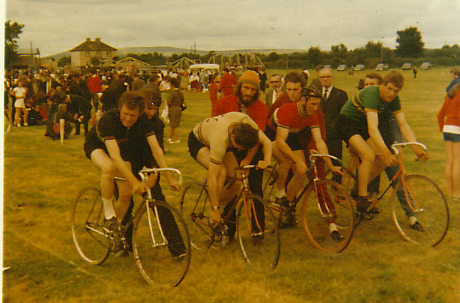
Cycling events took premier position in the 1972 Fermoy Open Sports day although the weather was reported as unfavourable (Corkman, Sat. 17 June 1972, p. 11). After four qualifying heats the line up for the half-mile final was comprised of Willie Baggott (Limerick). Sylvie Murphy (Hilltown), who edged out the fancied Eddie Dunne of Round Towns in the second heat. Pat Green (Glenmore) was the winner of the third heat and local star John Hegarty was the fourth finalist.
Sylvie Murphy took the quarter through the bell and held the advantage until 150 yards from home. Baggot swept by on the outside to go on to win by 1.5 lengths clear. John Hegarty, who had been hemmed in came with a late flurry to pip the gallant Sylvie Murphy at the line for the silver (Irish Examiner, Mon. 12 June 1972, p. 11).
Five Mile National Track Champion 1972
In July 1972, Pat Green as the holder of the 1971 Five Mile National Track Title was the favourite in 1971 (Nationalist & Leinster Times, Fri. 14 July 1972, p. 14). Pat went on to win the five-mile championship for the second successive year (Munster Express, Fri. 24 Nov. 1972, p. 19).
Please send any corrections or further information to glenmore.history.com.
Special thanks to Ger Barry for sharing the photos from the Fermoy Open Sports Meeting. He believes that the photos show Pat Green (Glenmore); Frank O’Sullivan (Fermoy); the third person is unknown but could be Paddy Flanagan (of Midlands Cycling Club) and Willie Baggot (Shannon Wheelers). “All were racing for the Gold All Ireland Championship” at the Fermoy Open Sports Meeting. In the black and white featured photo above Ger identified Pat Green, ?, Mick Kingston and Willie Baggott
Dr. Kathleen Moore Walsh
Sr. Mary Theresa “Nellie” Moran (1925-2005) of Ballinlammy, Glenmore

The term miracle is often bandied about, but one Glenmore woman received a miraculous cure in 1946. Her miraculous cure was attributed to the foundress of the Sisters of St. Joseph of the Apparation, Emilie de Vialar (1797-1856). The cure was investigated by the Catholic Church and became one of the miracles leading to the canonization of Saint Emilie. Saint Emilie founded her congregation at Christmas 1832 in the South of France. For further information on Saint Emilie and her congregation click here.
Sr. Theresa’s Glenmore Family
Although Sr. Theresa was born in Waterford City in 1925 her maternal line came from Glenmore, and her family moved to Ballinlammy, Glenmore. Her name at birth was Ellen Theresa Moran, but her family called her “Nellie.” Her mother, Mary Catherine Irish (1885-1935) was born in Ballinlammy, Glenmore, the daughter of Robert Irish (c. 1840-1909) and Mary Kiely (c. 1841-1923).
Mary Catherine Irish married Hubert “Hughie” Moran (1886-1951) on the 31st of January 1916 at the Cathedral in Waterford. The bride was residing at 15 the Quay and the groom was residing at 22 Bridge St. The couple were both working in Waterford and met (Interview of Robbie Doherty, of Haggard, Glenmore on 5 March 2023.)
Hughie and Mary Catherine Moran had seven known children: (1) Bridget Moran (1916-1969); (2) Kathleen Moran (1919-1999) (Sr. Huberte); (3) Thomas Moran (1920-1987); (4) Hubert J. Moran (1921-1985); (5) Robert A. Moran (1921-1990); (6) Michael Moran (1923-1941); (7) Ellen Theresa “Nellie” Moran (1925-2005). Hubert J. and Robert were twins. All the children were born at 22 Bridge St., Waterford City. For further information on the Moran family see our Glenmore Family M surname page.
The Irish Farm of Ballinlammy, Glenmore
When the lease on 22 Bridge St. expired the family moved to the Irish farm in Ballinlammy (Interview of Robbie Doherty on 5 March 2023). The 1901 census indicates that Mary Catherine’s parents, Robert and Mary Irish, were living on the farm with three of their children: John Irish (c. 1881-1949), Ellen Irish (c. 1870-1940) and Stasia Irish (c. 1878-c. 1941). By the time of the 1911 Census Robert was dead and Mary was still residing with John Irish (c. 1881-1949); Ellen Irish (c. 1870-1940) and Stasia Irish (c. 1878-c.1941). In filling out the 1911 Census Mary noted that she had been married for 43 years, she bore nine children and six were alive in 1911. It appears from the census records that Mary Catherine Irish was away from home working by 1901.
The farm was 110 acres and after his mother died John Irish (c. 1881-1949) ended up in St. Canice Hospital and never returned home. At St. Canice John did all the ploughing and tilling for the hospital. Notwithstanding the work John performed a “hold” was put on the farm by the hospital (Robbie Doherty interview of 5 March 2023).

After John went into St. Canice, his sister Ellen kept a couple of cows, and she went to the creamery with an ass and car with a ten gallon can. Ellen and Stasia Irish used to sleep in chairs. When Ellen Irish died in her chair, there was difficulty straightening her corpse (Interview of Robbie Doherty on 5 March 2023).
For further information concerning the Irish family see our Glenmore Family I surname page.
The Miracle
Most of the following information is from an article in the Munster Express (Fri. 22 June 1956, p.3.) In about 1942 Nellie joined the Sisters of St. Joseph of the Apparition. She took the name Mary Theresa. Two years later while still a novice and training as a nurse at Withington Hospital, in Manchester, she developed a condition that worsened. In March 1946, a Manchester specialist diagnosed Nellie as suffering from Disseminated Sclerosis, or what is called today Multiple Sclerosis.
Another specialist was called in to review her case. The second specialist was the European authority on the disease. He confirmed the diagnosis and said that it was incurable and she would never walk again. Nellie was paralysed in her legs, arms and body and described herself at the time of being “a handful of rubbish.”
According to the Munster Express Nellie’s superior arranged a novena desiring two things. She wanted Sr. Theresa’s recovery and a miracle to help the canonisation of Blessed Emilie de Vialer, Foundress of the Sisters of St. Joseph of the Apparition. On the third day of the novena while the Community was in the chapel praying for a cure, Sr. Theresa “jumped out of bed, danced around the sickroom crying, ‘I am cured’” and in the words of a priest nearly gave the community hysterics.”
Medical Exam of the Miracle
The two specialists were summoned. After a detailed examination they declared Sr. Theresa “cured beyond the reach and knowledge of medical science.” The newspaper noted that the two specialists were not Catholics. At the same time a second miraculous cure of another Novice of the Order took place in Manchester. Unfortunately, the Munster Express did not reveal any details of the second miracle.
Luckily another newspaper identified Sister Maria Brendan McConville, of St. Joseph’s Hospital, Whalley Range as the other novice (Manchester Evening News, Tues. 19 June 1951, p. 7). Sister Brendan suffered from Potts Disease where her spine began to waste away due to tuberculosis.
The Investigation of the Miracle

A report was sent to Rome. After a considerable lapse of time, and without any notice, a commission arrived in Manchester to investigate. Archbishop Masterson was then the Diocese’s Vicar-General, was appointed scrutineer. A long enquiry took place. Once all the evidence was gathered the Commission returned to Rome to assess it. The resulting report was sent to 13 specialists of disseminated sclerosis. None of the specialists could explain the cure on medical grounds. “Rome gave its judgment: God had worked a miracle for the glory of His Servant Blessed Emilie” (Munster Express (Fri. 22 June 1956, p.3.).
The Canonisation of St. Emilie
Blessed Emilie was canonised in 1951. Thirty-six Sisters of St. Joseph of the Apparition journeyed to Rome to witness the canonisation ceremony of their founder. The two sisters who were cured of diseases because of the intercession of Saint Emilie were present (Manchester Evening News, Tues. 19 June 1951, p. 7).
In 1956 the Parish Priest of Blackley, Manchester, Fr. Frederick Kershaw presented to the John Rylands Library all the documents collected and issued by the Sacred Congregation of Rites in the canonisation cause of St. Emilie. Prior to his death Pope Pius XII (1876-1958) gave Sr. Theresa a relic of St. Emilie. By 1966 Sr. Theresa was working as a pathologist at St. Joseph’s Hospital, of Manchester (Munster Express, Fri. 29 April 1966, p. 8.)
The Relic
Robbie Doherty related that every summer Sr. Theresa came home with her sister Kathleen who was also a nun, Sister Huberte, of the Community of the Perpetual Adoration at Chelsea. The two sisters were usually always accompanied by another nun. The nuns would stay in Ballinlammy for a month in the Irish farmhouse. Tommy Moran and his brother Hughie would go out and sleep in the barn loft to make room for the nuns.
During these visits a party would be arranged for all persons who had sought the relic since their previous visit. The relic remained and continues to remain in Glenmore. In turn the attendees of the first party would invite the nuns to their homes. Bill and Alice Mackey, of Jamestown, acted as the drivers of the visiting nuns..
On one particular evening Robbie Doherty came into the yard and saw his brother Paddy peering into the window. The nuns had come for tea and were still present because their lift had been delayed. The young men did not want to go into the house. It was best to remain outside than to risk saying or doing the wrong thing.
Mysterious Ways
Although two of his sisters entered religious life, Tommy Moran (1920-1987) was in the process of becoming a priest when the Church authorities became aware that his sister Maureen was with child. Tommy was dismissed from his vocation. Maureen went into Waterford to have her baby and while there met Mrs. Lynch who farmed near Kilmeaden, Co. Waterford. Mrs. Lynch took Maureen and her son, Don Moran, home with her. Maureen raised her son on the Lynch farm. Don Moran went on to university and ironically became a priest and served in the U.K. Fr. Moran often said Mass for his Glenmore kin.
Special thanks to Robbie Doherty for the lovely visit, chat and information.
Please send corrections, additional informaton or photos to glenmore.history@gmail.com.
Dr. Kathleen Moore Walsh
HAGGARD, GLENMORE (1961)

Today, we are going to feature information Danny Dowling (1927-2021) recorded regarding the residents of the townland of Haggard, Glenmore, around 1961.
Background
The Irish for this townland, according to O’Kelly’s, The Place Names of the County of Kilkenny Ireland (1969, p. 116) is An Iothla, the haggard. This is one of the shortest entries in O’Kelly’s book. According to Danny, the word derived from a Norse word for the area near the dwelling house where crops were brought in for storage. The area of the townland is 543 acres.
The following is the oldest newspaper account located regarding Haggard from 220 years ago.
On Wednesday night last, a most melancholy and deplorable accident occurred at Higgart (sic) near Glenmore, in the county of Kilkenny, about six miles from Waterford:–The cabin of a poor labouring man, one Patrick Keefe, unfortunately took fire, when, dreadful to relate, the unhappy man and his wife, both of whom had been at Waterford on that day, and who, it is supposed, slept too soundly from fatigue, together with their five children (their entire family) were burned to ashes. As there was a quantity of straw and turf in the cabbin (sic) it is probably that a spark from the fire place occasioned the distressing event (Belfast Newsletter, Fri. 14 Oct. 1803, p. 2).
Tithe Appotment Books 1833
The Applotment Books record the townland as Higgert, in the Civil Parish of Kilmacanoge (sic). These lands held from the Earl of Bessborough by lease. There are 8 tenants listed in Higgert (sic) and 6 are listed in Higgert Mountain. Listed tenants include: (1) Walter Grant, 65 acres; (2) Robert Grant, 33 acres; (3) James Grant, 33 acres; (4) Richard Grant, 22 acres; (5) William Grant, 3 acres; (6) John Roache, 21 acres; (7) Michael Walsh, 21 acres; (8) Martin Walsh, 21 acres; (9) Walter & (10) Richard Grant, Higgert Mountain, 89 acres; (11) John Kenedy (sic) Higgert Mountain, 2 acres; (12) Richard Dunne, Higgart Mountain, 4 acres; (13) ___ Mangin,* Higgard Mountain, 1 acre; and (14) ____Whyte, Haggard Mountain, 1 acre.
*Update: For further information concerning the Manning Family of Haggard see our family M surname page. Special thanks to David A. McTamaney for sharing his Glenmore family research.
1961 Haggard, Glenmore
In 1961, Danny recorded 10 families or households in the townland of Haggard. Birthdates or birth years are provided for some of the older residents gleaned from available public records. For some time after drafting his notebook, Danny recorded the dates of death or simply recorded that a resident had died or left the townland.
The recorded information reveals that in 1961, 35 people resided in the townland of Haggard with the population comprised of 19 males and 16 females. The largest family was the Byrne family with 6 in the household. There was 1 household recorded with a single person living alone. All information under residents of Haggard not in Danny’s original list has been placed in square brackets[ ].
Given the number of Grants present in 1833, it is somewhat surprising that by 1961 the surname had disappeared from the townland.
Recorded Residents
Males= 19
Females= 16
Eldest Recorded Resident
The eldest resident recorded by Danny in 1961 in Haggard was Hannah McDonald (16 Sept. 1885-before 1976). Johanna McDonald née Reddy was born baptized on 6 Sept. 1885 the daughter of Michael Reddy and his wife Mary Hoynes of Rahard, Mullinavat. Johanna or Hannah as she was generally known, married William McDonald and the couple farmed at Haggard. Unfortunately very little information could be recorded regarding Hannah McDonald.
Recorded Work
Farmer= 5 (4 males; 1 female)
Farm Labourer= 7 (7 males)
Lorry driver=1 (1 Male)
Block Layer=1 (1 Male)
Mill Worker=1 (1 male)
Clover Meats=1 (1 male)
Retired= 2 (2 Males)
HAGGARD RESIDENTS 1961
[1] HOGAN
Hogan, Patrick (16 July 1894) Farmer [died at the age of 83 in April 1980 per obit]
Hogan, Bartley (11 Oct. 1902) brother, assisting brother
[2] McDONALD
McDonald, Hannah (16 Sept. 1885)
McDonald, William, son, farm labourer
McDonald, Michael, son, lorry driver “got married” [Moved to Robinstown]
McDonald, John, grandson, block layer
[3] DWYER
Dwyer, Mary Anastasia (6 Jan. 1903) Farmer
Grennan, James (27 May 1950) nephew, child
[4] ROCHE
Roche, John (8 Oct. 1908) Farmer
Roche, Laurence (25 Oct. 1909) brother, assisting relative
Roche, Patrick (1911) brother, assisting relative
Roche, Matthew, brother, assisting relative
[5] ROCHE/FITZGERALD
Roche, Mary (20 Nov. 1886)
Fitzgerald, Johanna, daughter
Fitzgerald, Eileen, granddaughter, at school
Fitzgerald, Mary, granddaughter, child
Walsh, William (23 Aug. 1892) brother, retired disabled “Residing in Slieverue.”
[6] ROCHE
Roche, James (c. 1921) Mill Worker
Roche, Mary (c. 1918) wife
Roche, Mary, daughter, child
Roche, Ann, daughter, child
Roche, Kathleen, daughter, child
[7] O’SHEA
O’Shea, Michael, Farmer “Left on marriage”
O’Shea, John, brother, assisting relative
[8] BYRNE

Byrne, John (20 Jan. 1895) Farmer
Byrne, Mary (22 May 1899) wife
Byrne, Mary, daughter
Byrne, Laurence, son, assisting relative
Byrne, Alice, daughter
Byrne, Elizabeth, niece, child
[9] POWER
Power, Michael (27 Feb. 1900) Retired
Power, Ellie (17 July 1912) wife
Power, Michael, son, Clover Meats
Power, Eileen, daughter, at school
[10] ROCHE
Roche, Martin (12 April 1911) Farmer
Please send any corrections, additional information or photos to glenmore.history@gmail.com.
Dr. Kathleen Moore Walsh