19th Century
now browsing by category
The 1841 “Savage” Murder in Kilbride, Glenmore

On 11 June 1970 Danny Dowling interviewed James “Jimmy Mac” McDonald (c. 1909-1990) of Ballyfacey, Glenmore. James McDonald provided the following information concerning a murder. Donovan of Ballyveria, Glenmore killed Rigby over two fields which Rigby “had from him.” The two fields involved were the ones opposite Katie Leary’s house and shop on the other side of the road. Donovan had a wife, two sons and a daughter. Before the murder was committed, the parish priest of Glenmore, and a missionary, went to Rigby, and implored him to return the fields to Donovan, but he wouldn’t. On the morning of the killing, Rigby was riding on an ass on his way to the Stations in Glenmore. Dick Young’s grandfather was working in a field and Donovan asked him to kill Rigby, but Young refused. A man named Cathoir was with Donovan when he killed Rigby. He killed him by battering in his head with a stone. Donovan didn’t intend to kill Rigby. All he wanted was to leave him enough life for the priest to attend. Cathoir then said to him that if Donovan didn’t finish him off the two of them would be hanged. Donovan then finished him off.
After the killing, Donovan and his wife fled and hid around the Englishman’s on the Mountain and from there went to Haggard where they were arrested the next day where Hogan’s are now. That night whilst hiding he had his head resting on his wife’s lap he had a vision of his dead mother he said to his wife “here is my mother coming for me.” Cathoir swore against him at the trial, and when it was over Cathoir was never seen again. He had a wife and two sons. The sons later went to America. Jimmy McDonald’s father Patsy was in Peoria, Illinois in his early days and he saw the Cathoir men there. At that time when a man gave evidence for the Crown he was usually shipped away to England or further afield for safety.
James McDonald did not indicate where the murder took place, but Mary Stapleton on 5 March 1980 when providing some Irish field names to Danny stated that “Knockaburdish” was the name of the field that once belonged to Felix Mullins. It was located at the top of the Kilbride hills and it was where “Donovan killed Rigby. The mark of Rigby’s head is still there. It is now owned by Jim Culleton.”

Yesterday, Paschal Roche, of Kilbride, a nephew of Jim Culleton (c. 1922-2012) showed us the field at the top of the Kilbride hills that is now called “Dead Man’s Field.” There in the upper eastern corner of the field is the spot where Rigby was murdered 180 years ago. The Culleton headstone in Glenmore cemetery reveals that Jim Culleton’s grandfather, James Culleton (c. 1845-1912) was born only a few years after the murder. The photo to the right shows the location in Dead Man’s Field where the murder took place. Today, it is not possible to pinpoint how the old path to Glemore proceeded from this point crossing the field or running along the ditches.
Ireland in 1841
From 1821 to 1841 the Census Commissioners concluded that Ireland’s population increased from 6.8 million to 8.2 million. There was an average of 700 people per square mile in Ireland making it the second most populated country in Europe. However, unlike England and Scotland the people living in rural Ireland had shorter life expectancy than the people living in Irish cities. This was discovered by Oscar Wilde’s father, surgeon William Wilde. Wilde examined the record of the deaths of family members who died after 1831 and calculated mortality rates employing records such as hospital returns and cemetery returns. It is thought that the poverty and poor living conditions in rural areas with a sizable proportion of the population living in “mud huts” contributed to the shorter life expectancy (Helene O’Keefe, (2021) “Ireland before the Great Famine” ).
In 1841 Glenmore was not yet a parish. Although the present church in Glenmore Village was built in 1813 it was not until 1846 that Slieverue and Glenmore were divided and the parish of Glenmore was established. The townlands of Ballyfacey, and Ballyveria where both Rigby and Donovan lived in 1841, were on the edge of what would become Glenmore parish. The faithful would walk from these outlying areas in the most direct route to the Chapel in Glenmore by crossing fields and following what were known as mass paths. It was on a mass path in the townland of Kilbride that Rigby was murdered while walking to Stations being held in Glenmore on Friday morning on the 14th of May 1841. Today, Holy Week is generally associated with Stations, but in 1841 Easter Sunday fell on 11 April 1841.
Just eight years earlier the murder in Shanbogh, of Catholic landlord Joseph Leonard, generated vast newspaper coverage and resulted in the men held responsible for his murder being hanged at the place of the murder “near the hill of Glenmore.” It was reported that these hangings were witnessed by thousands from the area. It is likely that the crowd that attended the hangings may have included both Rigby and his killer Donovan.
Contemporary Newspaper Controversy
The Kilkenny Moderator, on Wednesday the 19th of May 1841 (p. 3) published the following account of the murder.
“SAVAGE MURDER. We deeply regret to state that another and a most horribly revolting murder was perpetrated in this County on the morning of Friday last, at Kilbride, within a few miles of Rosbercon. It appears that on the morning stated, as Michael Ribby (sic), of Ballyvarra (sic), was on his way to attend a Station,” which was held in the Chapel of Glenmore, about a mile from his own house, he was overtaken by two men named Patrick Donovan and John Walshe, both residing on the lands of Ballyvarra, who walked beside him for a few yards until they came to a “style.” At this spot Donovan took up a stone with which he knocked down his unsuspecting victim, poor Ribby, and continued to strike him about the head in the most savage manner until life was nearly extinct, inflicting no less than thirteen wounds, beside one on the back of his left hand with which he ineffectually attempted to save his head while vainly crying out for mercy to his relentless assailant.
After the perpetration of this horrid deed we have been assured that Donovan and Walshe both went to the ” Station,” where we suppose they got absolution! The unfortunate Ribby was discovered by his sons a few moments before he expired, and when spoken to by them he merely uttered the words—”I’m not quite killed—it was Donovan did it,” soon after which he breathed his last. He was about 50 years of age and has left a large family to mourn over his untimely fate. The only cause assigned for this foul murder is, that Ribby had been, a few months since, put in possession of about four acres of land from which Donovan had been previously ejected by the Agent, Captain Bunbury, for non-payment of rent. This gentleman, on being informed of the transaction, instantly started for Kilbride, in order to render any assistance in his power for the apprehension of the guilty parties.

Donovan, we understand, is a fellow of notoriously bad character, and has been more than once an inmate of a gaol. An Inquest was subsequently held on the body of the deceased by Thomas Izod , Esq., one of our County Coroners, when a verdict of ” Wilful Murder” was returned by the Jury against Patrick Donovan and John Walsh. We are happy to add that, owing to the active and unceasing exertions of George White, Esq., C.C., and the Constabulary under his command, Donovan (who had absconded,) and Walshe, were both arrested and brought into Ross, while the Inquest was sitting. They have been since transmitted to our County Gaol charged with the offence.”
The Kilkenny Journal, and Leinster Commercial & Literary Advertiser, of Saturday the 22nd of May 1841 (p. 3) provided further details of the inquest and arrests.
“Murder—Coroner’s Inquest—On Saturday, Thomas Izod, Esq., one of the coroners for the county Kilkenny, was called on to proceed to Ballyvera, near Listerlin, in the barony of Ida, to hold an inquest on the body of a farmer named Micheal Rigby, who was murdered at between eight and nine o’clock on the morning of Friday, on his way to the chapel in Glenmore. The finding of the inquest was “wilful murder against Patrick Donovan of Ballyvera, aided and assisted by John Walsh of the same place.” Donovan absconded shortly after committing the murder, and was, during the sitting of the Court, apprehended at Haggart, near Glenmore, by that efficient officer, Sub-inspector White, and the police, whose vigilance and activity were unremitting to bring him to justice. Walsh did not abscond; the deceased had ten or twelve severe cuts on the head, and the scull severely fractured; the ill will towards him was in consequence of his having taken ground which Donovan was dispossessed of; Walsh’s brother was an under-tenant of Donovan’s to part of the land, which in extent, was not more than 4 acres.”
On page 2, of the same edition of the Kilkenny Journal, the editor asserted that there was an “infamous calumny” in the article published by the Kilkenny Moderator on the 19th concerning the murder. Although the meaning of calumny is to make a false, malicious, defamatory statement about a person in order to damage that person’s reputation, the editor was not referring to what was said about the accused Patrick O’Donovan being a fellow of notorious bad character. The editor asserted, ‘If the Catholics of Ireland did not possess a degree of patience allied to servility, they would not permit the insolent conduct of those infamous calumniators who hourly assail their claims to political right, and make the most laborious pains to misrepresent their [Catholics] religious principles.’ The editor was challenging the remark concerning the accused men after the murder attended Stations where it was “supposed” that they obtained absolution for the murder. The editor argued that the purpose of the two accused men to attend the Stations was to avert suspicion. “…[W]e think, very likely, for how could they better avert suspicion than by appearing to comply with their religious duties? –but the other dark insinuation, (concerning receiving absolution) ‘the lying scribe knew in his heart, could not be credited even by the most blinded of his bigoted readers.’” Thus the “savage” murder was not only widely reported in newspapers across Britain and Ireland, but it (or more correctly its reporting in the Kilkenny Moderator) generated controversy and became politicalised because of the remark concerning absolution.
Next Blog: The Murder Trial of Patrick Donovan
In August of 1841 Patrick Donovan stood trial in Kilkenny for the murder of Michael Rigby. Details of the testimony of nine prosecution witnesses provide a fuller account of the murder and provides some personal information about Rigby and Donovan. We shall cover the murder trial in our next blog post.
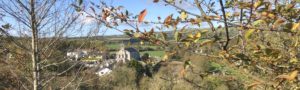
The featured photo above is one of the panoramic views from the lower ditch of Dead Man’s Field, Kilbride, Glenmore.
Special thanks to Patty Brown for kickstarting this research by providing a newspaper excerpt that provided the date of the murder and the names of Michael Rigby’s wife and children. Also special thanks to Pasqual Roche for taking us yesterday to Dead Man’s Field with its wonderful views of Glenmore.
If there are any corrections, omissions, or readers have further or different information please email glenmore.history@gmail.com.
Dr. Kathleen Moore Walsh
The Waterford By-Election 1891

On the 23rd of October 1964 Danny Dowling interviewed and recorded several interesting stories provided by Nicholas Forristal (1888-1979) of the Mill, Graiguenakill, Glenmore. After a little research we were able to verify and expand on the information provided almost 60 years ago by Nicky the Miller. It is believed that the story recorded below by Danny in 1964 concerned Sunday the 13th of December in 1891 during the hotly contested Waterford by-election.
“Nicky said that there was a lot of McCarthyites in Ross. On one occasion they travelled down to Waterford to interrupt a Redmondite meeting which was being held there. On arrival there was a melee and the instruments of their band were all thrown over the bridge into the river when they were carted out of the City. Whilst passing the Mill some of them came into the yard and threw a stone through the window into the kitchen. They were attacked over Glenmore by stones and sods, sticks etc. At the Pink Rock the local men and women did the same and also threw [the contents of their chamber pots] into their wagonettes. They got a terrible fright and never ventured again to Waterford.”
Background

To put this into context, the Irish Parliamentary Party was led by Charles Stewart Parnell (1846-1891). When Parnell became embroiled in a divorce scandal in 1890 he refused to step down as leader. This led to the Irish Parliamentary Party splitting. Justin McCarthy (1830-1912) became leader of the anti-Parnellite group or the Irish National Federation until 1896. Interestingly it was reported in the Munster Express on 31 January 1891 (p. 4) that previously McCarthy had stated that he would not give up their leader [Parnell] for “an inferior and less capable man,” and “in a strange irony of fate” McCarthy became the “inferior and less capable man.”
On 6 October 1891, Parnell died and John Redmond (1856-1918), his supporter and an MP from Wexford, gave up his North Wexford seat to contest the Cork by-election for Parnell’s seat. Redmond lost the Cork bi-election and found himself with no seat. On 29 November 1891, the MP for Waterford City, Richard Power (1856-1891) of the Irish Nationalist Party died at the age of 40. Redmond announced that he would run as an independent for the Waterford seat during the late 1891 by-election. It appeared that Redmond might run un-opposed, but Michael Davitt (1846-1906) on Sunday the 13th of December 1891 officially declared his candidacy. In the terminology employed in 1891, Davitt was a McCarthyite and Redmond a Parnellite.
Sunday 13 December 1891
Redmond was already holding meetings and canvassing when Davitt came to Waterford on Sunday the 13th of December 1891. It was alleged that Davitt was present to seek to end the divisions and support Keane as the candidate to oppose Redmond. It was apparently well known by local people that special trains had been hired to bring McCarthyite supporters to Waterford City to alledgely “intimidate” the Waterford city voters (Waterford Standard, Wed. 16 Dec. 1891, p. 3).
The following account was gleaned from the Freeman’s Journal (14 Dec. 1891, p. 5)
Davitt proceeded to the railway station with supporters, and they walked along the quay quietly. No one interfered with them in any way until they got to the Toll Bridge, which crossed the River Suir. The train station was on the Kilkenny side of the bridge and a Redmondite crowd had already gathered on the Waterford side of the bridge. The crowd groaned and hissed as Davitt and his supporters passed over the bridge to the railway station. Davitt stood at the toll gate, smiling at the hostile demonstration as his supporters marched past, and Davitt then proceeded behind them across the bridge. A small crowd of the Redmondites followed, and they did not do more than indulge in some “harmless chaff,” which was treated with good humoured indifference by Davitt and his followers. The Davitt party arrived at the railway stations at one o’clock. The special train from Carrick did not reach the station until half-past one. A couple of hundred men with a band came down from Carrick and Piltown. At the same time some horse drawn cars arrived with a brass band from New Ross. Another couple hundred arrived from Dungarvan and Kilmacthomas…

It was reported that there were 400 police present in Waterford City in anticipation of trouble. Some police were armed with batons and others with rifles. Although the Freeman’s Journal alleged that the police with batons charged and beat McCarthyites, as they sought to march into the city to a meeting, other newspapers concluded that the police did the best they could to stop the opposing supporters from clashing (Waterford Standard, Wed. 16 Dec. 1891, p. 4). A considerable crowd of Waterford residents, armed with bludgeons, assembled on the Waterford quay to repel the so-called “invaders.” Luckily rain was heavily falling and this caused a lot of people to abandon the quay and seek shelter. As the rain continued Davitt supporters at the train station marched to the bridge and the New Ross band struck up the “Boys of Wexford.” It was reported that the Redmondites joined in the singing of this song that commemorates the 1798 Rebellion.
At the toll gate Davitt insisted that the gate should be opened, and “after a sharp tussle” the gates were forced open and the Davitt supporters marched right into the thick of the Redmond supporters. The Redmond supporters initially moved aside. From the bridge to Gladstone Street, a distance of half of a mile, a steady skirmish continued. About a hundred yards from the bridge, a man rushed forward and struck Davitt on the temple with a stick. Davitt’s face was covered with blood. When they finally reached their committee rooms on Gladstone Street, Davitt announced while holding his handkerchief to his head, “This blow has determined me to stand for Waterford.” John Redmond witnessed the scenes from the windows of the Commins’ Hotel, his party’s headquarters, and when he heard that Davitt was injured he called at the Adelphi Hotel to inquire about Davitt’s condition and express his regret at “the outrage.”
Unfortunately, there is no newspaper account of the New Ross Band’s exit from the city and journey back to New Ross through Glenmore. Nicky the Miller was not quite four years old when the kitchen window in his home was broken and local Parnell supporters clashed with the New Ross McCarthyite band members on their return to New Ross. Undoubtedly, Nicky heard the story from his parents and older siblings.
The Election
In the days following that fateful Sunday, Redmond tirelessly campaigned. It was reported that Davitt did not have many workers within Waterford City and the Catholic Clergy performed most of the canvasing on his behalf. In a local speech reported in the Waterford Standard (16 December 1891, p. 3) Redmond called Davitt a liar for saying that he had come to Waterford to support Keane’s candidature, but after being struck he decided to run himself. Redmond “considered that it would be unreasonable to suppose that a candidate would be deposed in that way without being in anyway consulted.” Redmond went on to accuse a man named Quinn “of buying clothes from a hang-me-down shops in New Ross, in order to enable his staunch supporters to come to Waterford with their sticks…” Newspapers accounts are full of accusations from both sides concerning the class, intelligence, and weaponry of the opposing supporters.
An unnamed political correspondent for the Waterford Standard in his column “Political Jottings,” (Wed. 16, December 1891, p. 4) noted that very few people expected Sunday to pass without much noise, but most people hoped that the disturbance would not reach the length of the riot which occurred on the Quay. “The people in the two crowds looked more like demons that human beings.” He stated that the extent of feeling in the city was best gauged by the fact of Mr. Davitt being assaulted. “The fact that he has lost one arm would in itself be enough to make an assault upon him an act of the coarsest brutality, but when this is coupled with what he has undergone on behalf of these people, whether he was right in his views or not, it should have been sufficient protection with men now that he happens to be opposed to them.” Various newspapers also referenced the riots at Castlecomer during the 1890 Kilkenny elections. Parnell while speaking had lime thrown in his face and Davitt was “giving as good as he got” in fighting with Parnell supporters. Politics was a rough businsess.

In London it was reported that “[t]he Parnellites have been greatly cheered and encouraged by the triumph at Waterford of Mr. Redmond over Mr. Michael Davitt, perhaps the strongest candidate whom the anti-Parnellites could have brought forward. Mr. Redmond’s majority was a decisive one, 546 in a constituency of some 4,000” (The Graphic, 2 Jan. 1892, p. 7). In 1892 Redmond again stood in the General Election for the Waterford City constituency. The Munster Express, (Sat. 2 July 1892, p. 5) reported that Father Flynn, P.P., of Ballybricken, publicly vowed that he would get a man to run against John Redmond. It was reported in the 1892 General Election that “Redmon canvassed Waterford City without a bodyguard of police, while Father Furlong and Father Flynn held indoor meetings at the ‘Carty Club under the protection of a force of fifty police.” Redmond went on to win the 1892 General Election beating David Sheehy, the father of Hannah Sheehy Skeffington.
Glenmore Support for Parnell Continued
“Nicky the Miller” during the same interview also told Danny an interesting story that illustrates the passionate support that Parnell enjoyed among some Glenmore residents after his death.
“For the Parnellite commemorative ceremony in Dublin each year people used to go from Glenmore to attend it. Old Johnny Hanrahan of the Village (1843-1921) used go every year. On one occasion Tom Mullins (c. 1873-1936) of Flemingstown, was with him and on the train on their return journey when it stopped, Johnny went to the window of the train and adderssed the multitude on the platform on the greatness of Parnell. He spoke at great length was thunderously cheered and Tom Mullins later said, “It was as good a speech as I ever heard. No doubt the people thought him to be some M.P. or famous personage.”
The conversation then turned to Old Johnny Hanrahan, and Nicky the Miller revealed that old Johnny Hanrahan was a cooper by trade and the son of Denis Hanrahan (b. 1811) of Powerswood, and his wife Bridget Gaffney (b. 1813) of Glenmore Village. The parish records reveal that the couple were married 6 February 1837 at Glenmore, but we will save the details concerning these Glenmore families to future post.
If there are any errors or omissions please contact glenmore.history@gmail. com. The featured photo is of John Redmond in 1917 (The Irish Times). The photo of Michael Davitt is available at https://commons.wikimedia.org/wiki/File:Michael_davitt.jpg.

Dr. Kathleen Moore Walsh
Previous blog posts that provide further information on local politics of the time include;
“Glenmore and Mr. Parnell,” blog post of 17 March 2020.
“Glenmore Land League Split,” blog post of 29 March 2020.
“Glenmore Redmond Volunteers and the Fife & Drum Band,” blog post of 4 Jan. 2020.
Brother Peter Haberlin, O.F.M. (1845-1934): The Last Franciscan Grey Friar

Last summer Danny Dowling asked me if I could locate information regarding Brother Haberlin, of Rochestown, Glenmore. A death announcement was located in the Munster Express (23 March 1934, p. 8) which revealed that Brother “Peter” Haberlin, a native of Rochestown, South Kilkenny, “the last of the Franciscan Grey Friars who had charge of the mission at Santa Barbara, California,” died at the age of 90. When I told Danny I found “Peter” Haberlin, Danny told me that was not the name of the man.
Marks Haberlin
After further research, Danny was indeed correct. Brother Peter Haberlin was baptized “Marks” Haberlin on 1 June 1845 at Rochestown, the son of John Haberlin and Hanora Laracy. According to Danny the Haberlins were blacksmiths and various generations of Haberlins had forges in Cat’s Rock, Aylwardstown, Rochestown, Rathinure and there was a Laracy forge in Robinstown. Danny noted that Haberlins have been in Rochestown from before the mid-eighteenth century. (Irish scholar John O’Donovan’s mother, Eleanor Haberlin hailed from Rochestown and married his father in 1788.) Danny Dowling recalled that the Laracy’s originated from Slieverue and that is where Brother Haberlin’s parents, John Haberlin, of Rochestown, Glenmore and Catherine Laracy were married on 2 November 1838.
In the pre-famine parish marriage records the fathers’ of the couple were not recorded. At least four children were born to the marriage: [1] Catherine Haberlin, bapt. 8 Jan. 1840; [2] John Haberlin, bapt. 11 March 1842; [3] Marks Haberlin, bapt. 1 June 1845 and [4] Michael Haberlin, bapt. 1849. It is not known when Brother Peter took the name Peter, but the name Marks is found in parish baptismal records going back to the 18th century. For example, a Marks Haberlin was baptized at Rochestown on 2 March 1797 the son of John Haberlin and Mary Forstal.
According to an obituary that appeared in the Santa Barbara newspaper (23 Feb. 1934) Brother Peter Haberlin joined the Franciscans at Santa Barbara, California in January 1870, and was “clothed in the grey habit in 1872.” On census records Brother Haberlin recorded that he emigrated in 1868 (1920 & 1930 Census). New York passenger lists reveal that “Mark” Haberlin entered the US on 28 October 1868 and travelled on a ship named “Nebraska.” Excerpts from various interviews that Brother Peter Haberlin provided have been posted and provide some interesting details of his early years in the US.
Brother Peter Haberlin

According to Brother Haberlin he emigrated to America to work with his brother, John, in California. Both brothers were blacksmiths. While working in his brother’s shop in San Francisco, he met two Franciscans from Cork, Ireland, who had been at the Santa Barbara Mission. Brother Haberlin had been thinking about joining the order. He said that he came from very plain people. He said that he knew he could not become a priest because he did not have sufficient education, but he thought he could serve in other ways as a brother in the order. The two Franciscans encouraged him to join the order. He stated that he was afraid that his brother would discourage him so on the first day of January 1870 he “stole away” to the Franciscan Mission at Santa Barbara.
As a novice he carried water from Mission creek in buckets dangling from a yoke on his shoulders. He also worked as a blacksmith making a lot of the wrought iron work that was used around the Mission and was still present when he died. (Los Angeles Times, 26 Feb. 1934, p. 23). In an interview he admitted that several times during the first few months he was tempted to leave, but old Fr. Sanchez encouraged him to stay. He was told that if he left he would regret it all the rest of his days. As an elderly man looking back Brother Haberlin stated that had he left he would have regretted it.
When Brother Haberlin entered the order, he was a mechanic and blacksmith. As he grew older, he switched to cooking and baking. At various times he also served as porter. One Saturday evening, returning from his garden to the house, he admitted to a colleague that the three hardest things about being a friar were just ahead of him, “A bath, a shave, and Confession.”
Brother Haberlin entered the Mission of Santa Barbara in 1870 and received the grey Franciscan habit in 1872. Thus, he became a member of the Apostolic College of Our Lady of Sorrows which had been founded to accept Franciscan novices to be schooled under Spanish Professors and theologians. Mexico had secularized the mission properties in 1837 with the exception of Mission Santa Barbara. Missionaries no longer came from Spain and Mexico and in time the lack of vocations and death of the aged friars threatened the Franciscan Order in California with extermination. During this period Santa Barbara Mission was isolated and independent of every other convent and province of the order. A small group kept the Santa Barbara Mission open. The Bishops in California needed clergy to care for the spiritual needs of German immigrants. They turned to the Franciscan Province of St. Louis for help. The St. Louis Franciscans had fled to St. Louis to escape the harsh anti-clerical laws of Bismark. In 1885 the remaining Spanish and German friars merged as the Province of the Sacred Heart. The Santa Barbara Mission was finally attached to the Sacred Heart Province of St. Louis in 1885 (Oakland Tribune, 19 May 1965, p. 78).

Brother Haberlin spent over 30 years at the Mission of Santa Barbara. He died at the Mission San Luis Rey (Oceanside, Calif.) on 23 February 1934. He was 88 years of age when he died and had been a friar for 62 years. Brother Haberlin was the last surviving member of the small group that kept the Mission open prior to the merger and his death generated newspaper coverage dubbing him the last “grey friar.”
Brother Haberlin’s Family
Brother Haberlin’s father, John Haberlin died at the age of 87 in Rochestown on 16 November 1887. His widow Honoria Haberlin née Laracy was present when he died. Five months later, Hanoria Haberlin née Laracy died on 6 April 1888 at Graiguenakill, Glenmore at the age of 85. Patrick Walsh was listed as being present when she died, however no relationship was provided. It is not known whether Patrick Walsh was a nephew or son-in-law etc.
It is believed that John Haberlan (1842-1906) went to California and sent for his brother Mark Haberlin. In the 1870 San Francisco census John was 28 years of age and married to Margaret and they had an 8 month old daughter, Anorah Haberlan. Margaret Haberlan née Burke (1845-1899) was a native of County Clare. John and Margaret Haberlan went on to have at least 7 children (5 girls and two boys) including: [1] Anorah F. Gilmartin née Haberlan (1869-1948); [2] Rose Marie Lyons née Haberlan (1871-1959); [3] John Haberlan, Jr. (c. 1873); [4] George Thomas Haberlan (1875-1968); [5] Katty Haberlan (c. 1878); [6] Margaret Haberlan (c. 1880); [7] Alice May Haberlan (1881-1935). (St. Mary’s Cemetery markers).

At some point John Haberlan gave up blacksmithing, became a shipwright for the Harbor Commissioners and moved his family 13 miles from San Francisco to Berkley, Calif. His wife Margaret Theresa Haberlan née Burke died on 11 November 1899. In April 1906 the San Francisco earthquake and resulting fire destroyed 80% of the city and over 3,000 people were killed.
John Haberlan (1842-1906) survived the earthquake but drowned on 11 December 1906 while walking home in a storm. He was living at the family home at 1410 Fifth Street, West Berkley, with his youngest daughter Alice. When he didn’t come home she raised the alarm and his body was not found until the following morning. He had just received a month’s wages and it was thought initially that he met foul play, yet over sixty dollars and a silver watch were found on his person. One newspaper reported that he was drinking heavily, but the others reported that in the heavy rain he fell striking his head and drowned in the storm water which filled the street gutter. John Haberlan was survived by one son and three daughters (Berkley Daily Gazette, 11 Dec. 1906, p. 1 and 12 Dec. 1906, p. 12).
These children of the Great Famine era grew up and emigrated to California, shortly after the American Civil War and began new lives far from Rochestown. They not only witnessed but were involved in California history from the Missions to the San Francisco earthquake.
For anyone attempting to unravel the Haberlin lines, in undated correspondence, Sister Margaret Mary Laughrey, of the Incarnate Word Convent, of San Antonio, Texas noted that her great-grandfather Patrick Haberlin was a brother to John Haberlin (father of Bros. Peter Haberlin). Her grandfather was Thomas Haberlin who married Bridget Murphy and they had 5 girls and 1 boy. One of the daughters of Thomas and Bridget Haberlin, Kate Haberlin, married on 29 August 1905 at Glenmore, Terence Fluskey age 27 of Mile Bush, Rosbercon. The bride was from Forristalstown, Glenmore.
The featured photo above is the chapel of the Santa Barbara Mission taken by Kevin Coles (c) 2009. The photo of Brother Haberlin is courtesy of Eman Bonnic.
Dr. Kathleen Moore Walsh
Glenmore Weddings in the late 19th Century

Danny Dowling when he interviewed local people would usually note the date of the interview and often the place, time of day and weather conditions. The following information concerning late 19th century Glenmore weddings was obtained from one of Danny’s favourite interviewees and friend, Nicholas Forristal, (1888-1979) of the Mill, Graiguenakill, Glenmore. Danny interviewed “Nicky the Miller” on 23 October 1964 in Nicky’s home in Graiguenakill; it was a “coolish, showery” evening.
Nicky the Miller said that Dick Phelan (c. 1825-1923), of Shanbogh married Johanna Conry (c. 1827-1911), a niece of Fr. Conry who was then the parish priest of Glenmore. Nicky believed that the marriage took place in the Glenmore Chapel in the 1850’s because his father Paddy “the Miller” Forristal (1849-1931) when a boy saw the cavalcade of the wedding passing by the Mill after the marriage. “Paddy the Miller” was born in 1849. The custom in those days was for the wedding parties and guests to travel to the Glenmore church on horseback. No carriages or drivers were used at that time. “Before the wedding and before either the bride or bridegroom set out for the church,” all the wedding guests first went to the home of the bride or the bridegroom and “drank plenty of whiskey.” What makes this unusual is the fact that the weddings usually took place at 8 a.m.
The bride and bridegroom, from their respective homes, would set off for the church with their guests “in a procession on horseback.” After the ceremony led by the bride and groom all the guests went in a cavalcade to the marriage feast which was usually held in the barn of the bride’s father or family. “Paddy the Miller” told his son that when Dick Phelan and Johanna Conry were married they led the wedding cavalcade riding together on a single horse. She sat before him on the horse.
Nicky the Miller went on to relate that James Phelan, a son of Dick Phelan and Johanna Phelan née Conry, of Shanbogh, married Peggie Forristal, of Ballyverneen, Glenmore around 1896. Nicky attended the wedding and the “wedding feast.” The bride and bridegroom travelled from the Glenmore chapel where they were married to Ballyverneen, where the wedding feast was held, in “a two horse carriage followed by a procession of drivers and horsemen.” About 150 people were in the wedding procession.

The wedding feast took place in the barn. A long table of planks the whole length of the barn was made on stands with seating to match. The meal consisted of “plenty of spuds in their jackets placed in heaps all along the table with large dishes of pig’s heads that had been cooked in a boiler and cabbage etc. placed at short distances all along the long table. Large quantities of milk, whiskey and beer were available.” The whiskey was served in glasses and the beer in mugs. No note was recorded how the milk was served. Two or three meals were provided as the feast lasted until about midnight. Music was supplied by fiddlers. “It was a wonderful day of eating and drinking and merriment.” Nicky remarked that he well remembered that at about midnight old Paddy Forristal, father of the bride stood up and said “Everybody to their own homes now men.” Immediately everyone commenced to get ready to leave.
Contemporary Records
Although a lot of historians once discounted the value of the oral tradition, or the passing of information from one generation to the next through spoken word, people like Nicky the Miller prove the value of the oral tradition. From parish records it was found that Richard Whelan married Johanna Conry, of Robinstown, Glenmore on the 17th of February 1860. Although no further information was provided such as their respective fathers’ names there is a notation of a disposition being granted by Wm. W. Walsh, the P.P. of Rosbercon regarding the banns. Thus, it appears that the groom’s home parish was Rosbercon, and Nicky the Miller’s father was 12 years old when he saw the wedding cavalcade. These records also highlight the difficulty often encountered. Some records record the family name as Phelan and other records record the family name as Whelan. There are similar difficulties with Dowlings, Doolings and Doolans.
The parish records of Rosbercon provide that at least six children were born to the Phelan and Conry union: James Phelan was baptized 15 August 1861 (his Godparents were John Phelan and Bridget Conry); Mary (b. 9 April 1864); John Phelan (b. 8 June 1866); Jeremiah (b. 10 June 1867); and John (b. 12 Dec. 1869). [It is assumed the child born in 1866 died and a younger sibling was also given the name John.]
Glenmore parish records provide that James Phelan and Margaret Forestall were married 12 June 1895. Nicky the Miller 68 years later was able to provide the approximate year of the wedding as “around 1896.” The bridegroom, James Phelan, was a farmer and the son Richard Phelan of Shanbogh and the bride was the daughter of Pat Forrestal, of Ballyverneen, Glenmore, a farmer. The best man was Jerimiah Phelan, and the maid of honour Mary Forrestal. A review of the 1901 census provides that James Phelan and his wife Margaret Phelan née Forristal were living in Shanbogh Upper with his parents. Per the 1901 census Margaret was born about 1861. Parish records provide that a Margaret Forristal was born on 4 July 1858 the daughter of Patrick Forristal and Ellen Forristal née Kennedy. Although it is not in the interview notes it appears that Margaret Forristal was Nicky the Miller’s aunt. It does not appear that James and Margaret Phelan had any children.
One of the most surprising aspects of this research is the longevity found at a time before antibiotics, through the Great Famine, later when TB was rampant and in the 20th century when the Spanish flu killed millions, some of the above mentioned people lived very long lives. Richard Whelan, of Shanbogh, died on 20 April 1923 at the age of 98. Johanna Phelan née Conry died at the age of 84 on 29 January 1911. Margaret Phelan née Forristal of Shanbogh, a widow died 28 March 1940 at Ballyverneen, Glenmore at the age of 81. Her nephew Laurence Forristal was present at her death. Paddy the Miller Forristal died at the age of 82 in 1931 and Nicky the Miller died at the age of 91 in 1979.
Other Glenmore Weddings
Nicky the Miller also stated that in the late 19th century, in Glenmore, the wedding of the more well to do farmers were held in the mornings, but the weddings of the poor were held in the evenings near nightfall. About 70 years ago prior to his interview Nicky the Miller stated he saw two men without overcoats and two women in shawls (bride, bridegroom, bestman and girl) walking past the Mill at dusk to Glenmore Chapel to get married. They were from Forristalstown. All the poorer people walked to the ceremony. They married with no festivities “and possibly only the ordinary daily meal as the wedding breakfast as we call it now.”
No stories told before the fire on a coolish, wet night would be complete without a ghost story. Before the interview ended that night in October 1964, Nicky the Miller related the following. Dan Doolan, of the Pink, Shanbogh, often told Nicky that when he got married to Anty Mullally, of Forristalstown, both of them walked to Glenmore Chapel at night to be married. Whilst walking back after the ceremony, from the Churns down the New Line, the bride and bridegroom walked with their bestman and woman. All four noticed that a fifth man was walking with them. They recognised that the man who had joined them was Neddy Doolan, of Busherstown, who was dead. He was killed jumping on a horse in Rosbercon one evening after a fair some time previously. He was to have been best man at the wedding and he told Dan that he would be at his wedding dead or alive. It appears that he kept his word.

Although we cannot vouch for what the wedding party saw, a review of Glenmore parish records provides that Daniel Dooling, of Shanbogh, a 26 year old farmer married Anastatia Mulally on 30 August 1886. At the time of her wedding the bride was 28 and her father was Thomas Mulally (farmer) of Forristalstown. Daniel’s father was Edward Dooling, of Shanbogh. A year prior to this on 26 August 1885, Edward Dooling, of Busherstown, Glenmore, a 26 unmarried farmer’s son, died of a “fractured brain” that he sustained 3 days earlier. His sister Maggie Dooling was present when he died at Busherstown.
For information concerning other Glenmore weddings that have been featured in blog posts please see the 1937 wedding of Etta Walsh posted 22 December 2020 or the 1917 prosecution of Glenmore wedding guests from our post of 27 September 2020. For a practical example of a long successful marriage see Enduring Love posted 14 February 2021.
The featured photo is a print of the Jerome Robbins Dance Division, The New York Public Library. “The penny wedding” The New York Public Library Digital Collections. 1848. https://digitalcollections.nypl.org/items/50f9c000-8cb8-0134-43b3-00505686a51c
Please send any corrections or any ideas for future articles to glenmore.history@gmail.com.
Dr. Kathleen Moore Walsh
Old Rural Recreation: Faction Fighting

Danny Dowling interviewed and recorded some interesting information from elderly residents of Glenmore concerning some of the other business transacted during and after fairs and markets–faction fights. To try to put this information in context some general information on faction fighting is first provided.
Faction Fighting
Faction fighting was where large groups of rural men, and sometimes women, would meet to engage in fighting. The faction could be comprised of extended or allied families or persons from the same parish or townland. It is commonly understood that the practice continued until shortly before the Famine when reforms to the police and judicial systems and Father Theobald Matthew’s temperance crusade impacted on it. This pacification movement was also endorsed by Daniel O’Connell and the Catholic Association (Owens, p. 537). Expressions of concern over faction fighting at this time usually had more to do with the image projected than with injuries or deaths resulting from the fights. As long as the Irish could be portrayed as drunken barbarians bashing each other for fun all economic or political hardships could be blamed on the Irish character. However, “even at its worst the level of violence in Ireland was less than that of England” (Conly, p. 67).
Notwithstanding the efforts to stop faction fighting it re-surged after the Famine. Nineteenth century fiction and materials in the folklore archives at UCD suggest that faction fighting was an immensely popular and violent pastime (Thuente, p. 136) and its legend lived on in oral histories recorded in the twentieth century. Faction fighting was often viewed as a sort of release valve that prevented less controlled kinds of violence, and there were not many actual deaths relative to the enormous number of participants (Thuente, p. 137).
Carolyn Conley conducted a study based upon a Return of Outrages prepared by the R.I.C which listed the 1,932 reported homicides between 1866 and 1892 (occurring outside of the metropolitan area of Dublin), newspaper accounts of the killings and court documents. The author concluded that there was tolerance for recreational violence as displayed in faction fights among judges, jurors, police and journalists, witnesses and even victims. Recreational violence was not a form of misplaced resistance by an oppressed rural population, but a form of sport (Conley, p. 60). After the famine with more prosperity more assaults took place. “It was in the most prosperous areas of the countryside that the violent traditions were longest lived” (Conley, p. 58). The goal was not to injure or kill but to participate in a mutual display of skill and strength. Forty-one percent of all Irish homicides (outside of Dublin) between 1866 and 1892 were recreational in origin (Conley, p. 59).
“A formal faction fight, which might involve hundreds of men on each side, usually began with the ritual of wheeling which included chants, stylized gestures and insults. The traditional wheel included the name of the person(s) issuing the challenge as well as the intended opponent” (Conley, p. 60). There were two recognised acts that signified consent to the fight. The wheel and the removal of one’s coat (Conley, p. 61). While wheels might include insults or references to past grievances, a challenge to see who was the better man would suffice for consent. Women who engaged in “the sport” took the same pride in their prowess as their men (Conley, p. 62).
“In keeping with the recreational aspect of fighting there were rules. Though supporting one’s comrades was expected, in most cases justice required roughly even sides…ganging up was not acceptable…nor was continuing to pummel a defeated opponent” (Conley, p. 61). Due to the fact that the participants had to consent to engage in the fight there were numerous instances where onlookers and witnesses expressed to the authorities that they were not in fear when a faction fight commenced, thus making a conviction for riot impossible. Acceptable weapons included: fists, feet, teeth, stones and sticks. Two and a half percent of the homicide victims in Conley’s study died from kicks and five from infected bites (Conley, p. 62).

The most popular venues for recreational fighting were fairs, markets, and races. “One hundred people died as a result of brawls in these settings, but only a third of the killers served any jail time and only nine served more than two years” (Conley, p. 65). “Brawls were such an integral part of wakes” that even deaths did not make the incidents serious to authorities. Not one person was convicted in any of the fourteen homicides that occurred at wakes and funerals (p. 65). Even in twenty-one cases in which innocent bystanders were killed, deaths from brawls were considered regrettable but not serious. Twenty-six children were killed from injuries sustained in brawls. Only seven of the killers served any jail time at all. Only four people were sentenced to more than two years for the death of a bystander. The brawling tradition began so early in life that a quarter of the children less than sixteen years of age (killed by non-relatives) were killed by another child under the age of sixteen.
Danny Dowling Interviews
On the 22nd of May 1964 Danny Dowling interviewed Nicholas Forristal (1888-1979) of Graiguenakill, Glenmore. Nicky the Miller recalled hearing that the fair or market held at Nash in Wexford had two families that were great faction fighters, the Gunnups and Quigleys. In one of the factions was a family with eleven brothers and one sister. On one of the fair days the sister said—“There is twelve o’clock and not a stroke struck yet. She had a stone in her stocking and she started the melee by striking one of the opposition.” Nicky informed Danny that a stone in the stocking was a dangerous weapon.
Nicky stated that there were various Glenmore factions during nineteenth century at about the time his father was born in 1849 “Grants had upper side of parish, and Paddy Merrigan of Milltown, was the leader of another from the Jamestown side.” A member of the Merrigan faction was Paddy “the Weaver” Walsh from Glenmore Village. Paddy “the Weaver” Walsh cut, prepared, and seasoned the sticks used as weapons by the Merrigan faction.
“On a certain occasion in Glenmore Village before the pubs were out of it, there was a wake in Hanrahan’s house in the Village (alongside Fluskey’s). As the pub was closing members of the rival factions started drifting into the wake. It was a lovely night. Paddy the Weaver was at the wake and someone said to him it was a fine night and he replied, ‘It is a fine night but I think it will be a bloody morning.’ He was anticipating a big row.” Danny Dowling noted that the Glenmore parish priest in about 1870 caused the three Glenmore pubs to close and Glenmore parish remained dry for nearly 100 years making it a very unique Village. Hanrahan’s house in the Village where the wake was being held was the house where Danny Dowling was born in 1927.
Nicky said people were very crude and backward then, and when they got a few pints they deliberately set out to create rows. “The order of the day then was to return home from fairs and hooleys with blood all over you. That was held to be a sign that you were a good man.” Nicky stated that “Watt Power, of Jamestown, was an awful man for rising rows.” He always believed in having blood on him before returning home. He and his wife had a shebeen for awhile where Dick Whelan was living in 1964. “Watt used tell sometime that he had been fighting with Phil Dyháwdin from around Ross. Phil DyhAwdin was renowned as a fierce fighter. Watt, of course, never had anything to do with him.”
James McDonald, of Ballyfacey, Glenmore was interviewed by Danny Dowling on the 11th of June 1970. James reported that Big Jack Ryan of Knockhouse, Kilmacow, was the first of the Ryans to come to Guilcogh, Tullogher to where Richie Ryan was located in 1970. It was due to faction fighting that Big Jack Ryan went to Guilcogh. The Norris family, of Guiclogh, “were the leaders of a great faction fighting team and always won their combats. As they were getting on a bit, they felt that they could not last much longer at the top. Jack Ryan was a great big man and was a renowned faction fighter, so Norris said that if he could get Ryan, he would continue to win the faction fights. Norris therefore got Ryan, brought him to Guilcogh and got him married to his daughter. Ryan had three sons with this Norris girl. She died on the birth of the fourth child. After Ryan joined the Norris faction team it continued to win fights for a long period.
James McDonald stated that after his first wife died Ryan married a girl named Long and had more children. Ryan was said to have divided the farm to each of his four children from his first wife. Each of the four children received ten acres of land. The land allocated to each was too small to support a family. The four children asked their father to give them each four pounds in order for them all to go to America. Ryan gave the four children the money. The four children emigrated to America. The land reverted to Ryan and he divided it among the children he had by his second wife. Unfortunately, in reviewing early parish records the only marriage that could be located between a Ryan and Norris was in 1860 where Thomas Ryan married Margaret Norris in Guilcogh on 12 June 1860.
On the 16th of January 1956, Walter Power (c. 1888-1961) of Jamestown, Glenmore shared with Danny Dowling a poem that the elderly residents of Glenmore recited when he was a lad. It alleges that the first faction fight in Old Ireland was “all on account of St. Patrick’s Day.”
Some fought for the eighth,
For the ninth some would die,
And whoever said wrong,
They would blacken his eye,
Until Father Mulcahy, he told them their sin,
He said boys don’t be fighting but sometimes combine,
Don’t be always disputing about 8 and 9,
Combine 8 and 9, 17 is the mark,
And let that be his birthday,
Amen said the Clerk.
Ironically, the last known faction fight involving Glenmore participants, that Danny Dowling identified, was reported in the New Ross Standard, just a day after St. Patrick’s day in 1893. Fourteen persons, including a woman, were arrested for the faction fight that occurred in Rosbercon after the New Ross fair. According to the newspaper account the court was packed with spectators for the trial of the faction fighters.
If anyone has any corrections or additional information please send it to glenmore.history@gmail.com.
[Additional information from Peter Walsh of Rathinure, Glenmore 20 May 2021–Maths and Irish Teacher, at Good Counsel College of New Ross, Mr. Toby Kavanagh, collected Irish folklore and told his students in 1969/1970 that the shillelagh black thorn sticks used in faction fights were coated in goose greese and put up the chimney for the smoke to harden them.]
The featured drawing is entitled “The Kilkenny Election,” published in the Graphic on 17 Dec. 1890 (p. 723) and depicts a scene at Castlecomer where Parnell was present when “a regular good old fashion faction fight began.” (c) The British Library Board.
Dr. Kathleen Moore Walsh
Carolyn Conley (1999) “The Agreeable Recreation of Fighting,” 33(1) Journal of Social History 57-72.
Gary Owens, (1997) “A Moral Insurrection: Faction Fighters, Public Demonstrations and the O’Connellite Campaign, 1828” 30(12) Irish Historical Studies 513-541.
Mary Helen Thuente (1985) “Violence in Pre-Famine Ireland: The Testimony of Irish Folklore and Fiction Author(s),” 15(2) Irish University Review 129-147.
Fairs & Markets of New Ross c. 1900

Danny Dowling interviewed Nicholas Forristal, of the Mill, Graiguenakill, Glenmore several times in 1964. Today, we are going to feature Danny’s interview of Friday the 13th of March of that year where Nicky provided information about the New Ross fairs and markets of his youth. “Nicky the Miller” was born on 1 February 1888 and was blessed in that his father, Patrick Forristal (c. 1849-1931) and grandfather lived long lives and shared their knowledge of events and the area with Nicky. Where possible the actual words recorded by Danny of Nicky during the interview are used and marked by quotation marks.
For anyone not familiar with the Parish of Glenmore, Kilkenny lies half way between the City of Waterford, Co. Waterford and the Town of New Ross, Co. Wexford. Until the twentieth century the only market town in Kilkenny close to Glenmore was Thomastown which was further away than both New Ross and Waterford. For information and maps regarding the early main road between New Ross and Waterford see the previous blog post of 14 December 2019. Prior to the earliest bridges being built at New Ross and Waterford people from Kilkenny had to make use of ferries to take their produce to New Ross and Waterford. After bridges spanned the River Barrow at Ross and the River Suir at Waterford tolls were a cost for our Glenmore ancestors when they sought to purchase or sell items in Waterford or New Ross or sought employment in the city or town.
Ancient Fairs and Markets of New Ross
Although the words fairs and markets have come to mean the same thing at one time they were considered distinct occurrences. Generally speaking, market days were set days when sellers and buyers gathered for the buying and selling of a specific commodity e.g. butter, corn etc. The prices agreed in the haggle between the buyers and sellers became the market price. Fairs originally did not occur on a regular basis and were often associated with religious days, where there might be entertainment and a variety of trading e.g. horse and employment fairs. Fairs and markets were vital to the economy of towns and cities and residents relied on food from the countryside. New Ross was no different and several of the early New Ross Corporation books survive and reflect the importance attached to the fairs and markets. The County Wexford Archive has placed some of the surviving books on line with transcriptions.
A fragment from the New Ross Corporation Minute Books for 1634-5 is held in Carlow library. It provides an interesting glimpse into the turbulent 17th century in Ireland. “Most of the entries…concern day-to-day life—keeping the streets clean, securing the water supply, renting out property, protecting the markets and keeping citizens safe.” Control of hucksters at markets was a great concern. (Gráinne Doran & Linda Doran (2020) “A Light on Early Town Governance in New Ross,” 28(1) History Ireland 8-9.) On 17 October 1662 “the toll and customes of the markets and faires of Ross sett and let unto Mr. Barnard White for the ensueing yeare for twenty pound sterling” (New Ross Corporation Minute Book, 1658-1685, vol. 1). In other words, Barnard White for the huge sum in 1662 of £20 became essentially the landlord of the New Ross markets and fairs for a year, and he could set and charge the people engaged in markets and fairs.
Some very ancient customs surround fairs such as the symbol of the glove. In 1710 an order was made in New Ross that no arrests would be made before and after the fair held on the 10th of August. This was not an attempt to encourage or allow criminals to engage in trade. At that time if a person was unable to pay his or her debts that person could be sent to debtor’s prison. Thus, to ensure the success of fairs a sort of safe passage developed. An entry on the 6th of October 1726 ordered that a glove be set up two days before each “faire” day and remain up for two days after the “faire.” The Journal of the Royal Society of Antiquaries of Ireland (30 June 1901, p. 179) in reviewing the entries published extracts of two publications explaining the glove symbol.
“An annual fair is held on Trinity Monday, Tuesday and Wednesday at Southhampton. It is opened by the Mayor and bailiffs with much ceremony on the proceeding Saturday afternoon. The Mayor erects a pole with a large glove fixed to the top of it, near the miller’s house, and the bailiff then takes possession of the fair as chief magistrate in its precinct during the fair, and invites the Mayor and his suite to a collation in his tent…during the fair no person can be arrested for debt within its precincts. On Wednesday at noon the Mayor dissolves the fair by taking down the pole and glove, or rather ordering that it be taken down” (Sir H. Englefield (1805) Wald Through Southhampton, p. 75). At Exeter a similar custom prevailed:–The charter for Exeter Lammas Fair [Aug. 1] is perpetuated by a glove of immense size, stuffed and carried through the city …It is afterwards placed on the top of the Guild hall and then the fair commences (Hone, Every Day Book, ii, 1059).”

As early as 1662, during the reign of Charles II, legislation was enacted that standardised a firkin of butter as weighing 64 pounds comprised of at least 56 pounds of butter and up to 8 pounds for the barrel. Over a century later, the New Ross Corporation books reflect that in 1783 a clerk of the market was appointed at a salary of £10 per year to ensure proper weight and measures were used and to prevent butchers and bakers from committing frauds. As early as 1747 there were complaints that butter and salmon were being sold at the gates and roads leading to New Ross to the detriment of the town’s people and merchants. In an attempt to control and regulate trading a corn market was built in Robert Street in 1818 just twenty years after the 1798 Rebellion. According to Linda Doran the corn market was not altogether successful. Ten years after it was built all tradesmen were required to weigh and sell their corn at the market. In 1832 markets which were deemed street obstructions in New Ross were removed to the corn market. In 1864 a meeting was called to investigate the possibility to free the bridge from tolls (Linda Doran (2011) “Capturing the Quotidian: New Ross Corporation Books,” 1685-1900,” in 19(5) History Ireland 22-25.)
Fairs & Markets of New Ross at the Turn of the 20th Century
Accoring to Nicky “the Miller” Forristal, up until about 1899 New Ross fairs were held on different dates. In about 1899 the second Tuesday of the month was introduced as the fair day of Ross. When he was a boy Nicky recalled fairs being held on Easter Monday, the 10th of February, and on the 3rd of May—the hiring fair. On the hiring fairs the men and women seeking work “used present themselves with a spancil round their wrists so as to indicate their calling. Those spancils were called booracs and búltáins. Used hire for the quarter. The settlement between the parties was made on the fair. The agreement in most cases was adhered to because if not, the labourer was not paid if he left.”
For non-farmers a spancil is a short length of rope used to hobble an animal. The animal could graze but could not wonder off too far. Well into the twentieth century spancils also were used to keep cows from kicking while being milked. It appears that from what Nicky said that different types of spancils were used to indicate the type of work that the prospective employee was able or willing to perform. The employee would work for 3 months before being paid and if the employee left before the end of the 3 months he would not be paid anything. According to Danny Dowling the agreement included wages, room and board and additionally there might be an agreement on the type and amount of ‘grub’ that would be provided to the employee.
“The fat pig market at Ross was always held on the day before the general fair. Small pigs were sold on the general fair. The people used drive the pigs into Ross on a Sunday evening and put them in some of the yards in the Irishtown. Brewer’s, Teehan’s (where Shea’s were) and Campbell’s yards etc. When the pigs were sold they had to be driven to the boat (Ida etc.) early as it left for Waterford at 9 o’clock in the morning. Hence the reason for the very early start of the fairs.”

Nicky recalled that he drove pigs to Kough’s Bacon Factory on the Quay in about 1899. “Good deal of people worked there, men and women. Made sausages, puddings items and every shop in Ross sold offal meats then. Nicky saw cards up in the shops selling meat which read thus ‘Buy Kough’s Bacon well known for its delicious flavour and standard quality.’ ” According to Nicky, Kough’s Bacon Factory went into liquidation long before the first Great War.
Markets were held in Ross every Thursday and Saturday. The spud market was held on the Quay at Fox’s Pub. The weighing scales for the spuds were “opposite beside river.” The butter market ran from “Bridge to Market House.” Salmon sold at Fish House. At Bank of Ireland—vegetables sold. Opposite the Bank of Ireland on the Quay side fresh herrings were sold from dray cars while in season.
The fowl market was held in John and North St. at either side of the Hotel. Asses, jennets and carts full of fowl were lined up. “The man who would buy the lot would chalk his name on the cart. They were then brought to the boat which was moored opposite Foxe’s. Each fowl buyer had a bed on the Quay where the fowl were put after taking them from the carts, before being put on the boat. This market used always start before the break of day. Hardly any men attended it, only women and chaps. Over before 9 o’clock as the fowl had to be on the boat which left at that time. This market was held on a Thursday. This early market finished when the boat ended in 1904.” For information regarding the Ida and the shipping of animals see our previous blog of 29 February 2020.
“The firkin butter market was held in Charles Street. People brought the fresh butter in buckets to the market. It ended about the First War. Glenmore people stopped attending when the creamery started.” Only the larger farmers who kept several cows could produce a firkin or 56 pounds of butter. Before the Glenmore Creamery opened there were not many cows in Glenmore. Prior to the Creamery opening people from the area with butter went mainly to the Waterford Butter Market. People from Tullogher, who were closer to New Ross, used to travel with the firkins of butter on the Ida to Waterford.

Until the 1880’s a lot of wheat was grown in the Glenmore area. “Then the bottom dropped out of the market owing to the imports of foreign wheat. The last wheat Tommy Forristal, of Ballyverneen [Glenmore] ever had, he was forced to bring it to Thomastown by horses and carts. That was in the 1880’s.” “Very few cattle kept by the local people of this area” prior to 1900. Nearly all cattle were sold as yearlings and even younger. Cows were also scarce. “The farmers with the largest cow herds in Glenmore then were Coady’s of Carrigcloney and Tommy Forristal of Ballyverneen with 20 cows each. After introduction of creamery here the farmers increased their herds.” For information concerning the establishment of the Glenmore Creamery see the previous post of 9 May 2020.
At the turn of the twentieth century Nicky recalled the following prices which ‘were got’ at Ross markets:
- “Seed potatoes 3d stone;
- Pig’s heads 2/= for 12 lbs.;
- Danish Pig’s Heads 1 ½ d [per] lb;
- Butter 6d to 8d per lb;
- Barrel of oats 7/6;
- Barrel of barley 13-14/=;
Nicky went on to explain that fowl and turkeys then were never sold by weight. Instead they were sold by the pair. Until about 1894, “people from this area used go to the fowl market of Grannagh. Had to leave the night before… At that time turkey realised by the pair, cocks 18-20/=; hens 8-10/=.”
To illustrate the prices under the Imperial system–which some elderly Glenmore residents today refer to as “old money”– there were pounds £, shillings / and pence d. There were 12 pence in a shilling, and 20 shillings in a pound. Thus, seed potatoes sold for 3 pence per stone (14 pounds) of potatoes. A barrel of oats sold for 7 shillings and 6 pence etc..
In the next couple of weeks we shall highlight some of the other “business” that occurred at and after local fairs as commented upon by Nicky the Miller in 1964 and recorded by Danny Dowling. Please send any errors or corrections to glenmore.history@gmail.com.
Dr. Kathleen Moore Walsh

The photo of the New Ross Corn Market appeared in Linda Doran’s excellent 2011 article “Capturing the Quotidian: New Ross Corporation Books,” 1685-1900,” in 19(5) History Ireland 22-25. The photo of the corn market is from a glass plate belonging to Jimmy Fitzgibbon and was part of the Cavanagh Magic Latern Collection. Prior to cinemas, Magic Laterns were used to entertain people by the showing of projections from early photographic glass plates. William Cavangh had a collection of these early glass plates of the New Ross area. The photo to the right shows Jimmy Fitzgibbon (on left) with his 150 year old Magic Latern. Edward Delany is on the right. (New Ross Standard, 31 August 2015).
The featured photo above is art work from the New Ross Corporation Minute Book, 1658-1687, p. 50. It reads, “Eusebius Cotton, Esquire, Soveraigne of New Ross, Anno D’ni 1662.”