20th Century
now browsing by category
The Murphy Family in Ontario, Canada
One of our readers (and excellent proof reader) Richard Corcelli, shared some photos of his mother, Helen Murphy, when she was a little girl circa 1915. Each of the photos is worth a thousand words. Helen’s ancestor emigrated to Canada from Ireland in the 1820’s.


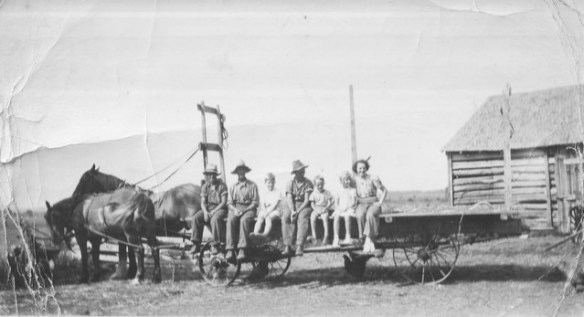
Team, hay wagon and log barn built c. 1868. Date of photo unknown.

Special thanks to Richard Corcelli for sharing these wonderful old photos.
Please send additional information or corrections to glenmore.history@gmail.com.
Dr. Kathleen Moore Walsh
Blueshirt Sports at Weatherstown, Glenmore in 1934

We recently came across an article entitled “Blueshirt Sports at Glenmore,” in the United Ireland newspaper of Saturday, the 18th of August 1934 (p. 4). The newspaper the United Ireland was published by the proprietors of the Star Publishing Co. Ltd. and printed by Cahill and Co., of Parkgate, Dublin. It was published from 1927 to 1961 and until it ceased publishing 1,792 editions were published.
The article mentioned the Glenmore tug of war team which prompted a search for an earlier article on the Ballyfacey, Glenmore tug of war team. See, our post of 13 Nov. 2022 . We noticed that the Munster Express published on 13 July 1934 an article about a sports day in Weatherstown. The Munster Express covered some of the winners of some of the events, but made no mention of the fact that the event was associated with Blueshirts (Fri. 13 July 1934, p. 8).
The Munster Express covered the results of the sports day but made no mention of the fact that the event was associated with Blueshirts (Friday 13 July 1934, p. 8). In the next column in the same edition the Munster Express published an article that a “big Blueshirt parade, comprising 200 (men and women) took place at Hugginstown. Forming up near the village, the procession, headed by the local Blue Shirt Band, marched around the village, and forming up at the cross adjacent to the ruins of the old RIC barracks, were briefly address by Captain Quinn, Gowran. A large number of supporters were also present. The singing of the National Anthem and the Blue Shirt marching song concluded the proceedings, during which there was no untoward incident” (Munster Express, Fri.13 July 1934, p. 8).
The article in the United Ireland was not published until 18 August 1934. However, because the two articles name most of the same winners of events the two articles must be about the same event. It also seems unlikely that there were two sports days held in Weatherstown in the summer of 1934.
United Ireland Article
“Keen Contests and Large Entries–The Glenmore Blueshirt, sports, held at Weatherstown, were an outstanding success. Large entries were received for each event and keen contests were the order of the day. Hundreds of Blueshirts—men and girls—were present, and there was an extremely large attendance of the general public. The national flag and the blueshirt flag were prominently displayed on the field. A refreshment stall was run by the local Blueshirt girls in charge of Miss K. Freyne. Captain P. Quinn, leader of the Blueshirts in Carlow-Kilkenny was among those present.”
Captain Padraig Quinn (c. 1903-1980) native of Graiguenamanagh, Kilkenny
Padraig Quinn was the youngest survivor of the 1921 Coolbawn ambush. While it was reported that he was just 16 years old at the time of the ambush his obituary provided that he was born about 1903. In 2012 the Webley revolver that he carried during his War of Independence service was auctioned (Kilkenny People, 24 March 2012).

Quinn after service in the Free State Army in the 1930’s became one of Eoin O’Duffy’s most loyal captains, as part of the Kilkenny Blueshirt Division. He started as the director of the League of Youth (Blueshirt’s organisation) in Carlow and Kilkenny and in the fall of 1934 was attached to the head quarter staff in Dublin. He with four other members were arrested on 16 October 1934 and conveyed to Waterford Prison (Belfast Newsletter, Wed. 17 Oct. 1934, p. 11). Quinn was arrested with another prominent Blueshirt , Thomas Fitzgerald (of Old Town, Co. Kilkenny) for failing to “account to the Civil Guards for their movements on recent occasions when tree felling and cutting of telegraph poles occurred on the main roads in Co. Kilkenny.” Both men were sentenced to three months (Tipperary Star, Sat. 3 Nov. 1934, p. 10).
In 1937, Padraig Quinn was part of a brigade that left Ireland for Spain to fight alongside General Franco’s men. He took an active part in that war “and received the Bandero from General Franco.” When he died in August 1980 messages of sympathy were sent from Liam Cosgrave, T.D. and former Taoiseach and from the Spanish Ambassador to Ireland (Nationalist & Leinster Times, Fri. 29 August 1980, p. 7). For a recent short article on the Blueshirt movement see, Seán Donnelly’s “Michael Tierney and the Intellectual Origins of Blueshirtism, 1920-1938”
The Sporting Results: United Ireland
Fifteen events were listed in the United Ireland newspaper article. Unfortunately no townlands were provided and few first names.
100 yards, boys under 16 (1) Tom Byrne; (2) Stephen Walsh.
100 yards, ladies—(1) Miss Walsh; (2) Miss Cotterell
100 yards open—(1) T. Roche; (2) Larry Walsh
220 yards—(1) Larry Walsh; (2) N. Mullins
440 yards—(1) P. Roche; (2) T. Power
Half Mile Cycle—(1) Jim Cuddihy; (2) John O’Connor
Three Legged Race—(1) John Culleton and L. Walsh; (2) Jas. Fitzgerald and P. Ryan
Throwing 56 lbs—(1) S. Kenny, 21 feet, 4 inches; (2) M. Laracy, 20 feet, 10 ½ inches
High Jump—(1) M. Walsh; (2) L. Walsh
Long Jump—(1) L. Walsh
880 yards—(1) S. Phelan; (2) T. Power
Sack Race—(1) S. Walsh; (2) J. Hogan
One Mile Open—(1) S. Phelan; (2) J. Hogan
One Mile Cycle—(1) J. Cuddihy; (2) J. Malone
A tug of war contest was won by the Glenmore Team (United Ireland, Sat. 18 Aug. 1934, p. 4).
Sporting Results: Munster Express
“On Sunday the 8th of July 1934, at a Sports meeting held at Weatherstown, Glenmore, “under a beaming sun a huge crowd enjoyed themselves…There was a big number of entries and valuable prizes being offered for the different events.” Eight events were reported in the Munster Express with some townlands and first names of winners provided.
100 Yards—L. Walsh, Davidstown, Glenmore, and P. Roche, do., tied for first place.
220 Yards—L. Walsh, Davidstown, Glenmore, First.
440 Yards—S. Phelan, Ballincrea, First.
Three Legged Race—L. Walsh and John Culleton, Kilbride, Glenmore, First.
One Mile—Stephen Phelan, First.
High Jump—M. Walsh, Davidstown, First.
Half Mile Cycle—J. Cuddihy, Knockroe, First.
Tug-of-war—After a thrilling tug between Coolroe and Glenmore the latter were victorious (Munster Express, Fri. 13 July 1934, p. 8).
Glenmore Participants
(1) Laurence “Larry” Walsh (b. 20 Dec. 1909) was the son of Robert Walsh (farmer) and his wife Mary Walsh of Davidstown. Larry’s parents were married 19 September 1899 at Slieverue. Robert Walsh was the son of Patrick Walsh and Margaret Kennedy. Mary Walsh was from Carriganurra and was the daughter of Thomas Walsh and Mary Purcell. Wedding witnesses were Edward Vereker and Anastatia Walsh.
(2) John Culleton, of Kilbride, was born 18 October 1911. John was the son of James Culleton (farmer) Kilbride and his wife, Hannah Grace. John’s parents were married at Glenmore on 8 February 1904. The groom, James Culleton (farmer, aged 34) was the son of John Culleton (farmer). Hannah (aged 26 was the daughter of Patrick Grace (farmer). Witnesses at the wedding were David Walsh and Ellen Mullins.
(3) James Fitzgerald, of Weatherstown, was born on 30 November 1906 the son of Patrick Fitzgerald (farmer) and his wife Mary MacDonald. Patrick Fitzgerald of Weatherstown (farmer) married Mary Macdonald, of Ballintlear, Mullinavat at Glenmore on 5 February 1902. Patrick was the son of William Fitzgerald (deceased farmer) and Mary was the daughter of James MacDonald (farmer).
(4) John Hogan, of Haggard, was born 29 April 1904 the son of John Hogan (tailor) and Alice Manning. John Hogan married Alice Manning of Haggard on 6 November 1890 at Glenmore.
Why Weatherstown, Glenmore?
Although Weatherstown is closer to New Ross than the Village of Glenmore it certainly is not in the centre of the parish. When Captain Quinn was attempting to build the Blueshirt membership in Kilkenny he likely planned and held events where he already had support from the men he served with during the War of Independence and Civil War. Two men he served with in the War of Independence were killed at the Coolbawn Ambush that he survived. These men were Jack Hartley (1897-1921) of Weatherstown, Glenmore and Nicky Mullins (1893-1921) of Thomastown, whose father Laurence was a native of Gaulstown, Glenmore.
For more information on the Coolbawn Ambush and the Glenmore family connections of Jack Hatley and Nicky Mullins see our post of 20 June 2021 and our post of 30 May 2021 for further information and a photo of the men.
%%%%%%%%%%%%%
The featured drawing above is of one of the banners used by the Blueshirts. See our post of 22 November 2020 regarding Franco’s Glenmore Recruit who also went to Spain.
Please send any corrections of additional information to glenmore.hiistory@gmail.com.
Dr. Kathleen Moore Walsh
The Building of a Railway Through Glenmore [Updated]

The biggest change in Glenmore during the early years of the twentieth century was the building of the New Ross to Waterford railway line. We have previously published several posts concerning the railway and the posts are listed at the end. Today, we are going to highlight the set backs encountered by the railway itself, the recorded feelings of New Ross leaders toward the project and the published list of proposed compensation to people in the path of the line from Rosbercon to Ballyverneen, Glenmore..
The Dublin, Wicklow and Wexford Railway [hereinafter DW&W] incorporated in 1846. In 1876 it purchased the line from Macmine to Ballywilliam and built the line from Palace Junction to New Ross. The New Ross branch opened for traffic in 1887. That same year efforts were made to extend to Waterford. This was never carried out and the enabling Act expired through lapse of time. (New Ross Standard, Fri. 18 Dec. 1897, p. 2). For a concise history of Wexford railways see, Oliver Doyle, “Tracking Wexford’s Railway History” Irish Independent, 21 April 2015.
New Ross Against the Railway Extension
In 1897, the DW & W again sought an Act of Parliament to extend its line to Waterford. The New Ross Town Commissioners and New Ross Harbour Board both opposed the proposed extension to Waterford. The railway pointed out that opposing the line only helped the Fishguard and Rosslare extension which would choke the port of New Ross. In the opinion of the Town Commissioners the extension line from Rosbercon to Waterford would be more damaging to New Ross than the other line would be (New Ross Standard, Sat. 13 Feb. 1897, p. 2).
Unfortunately, the New Ross newspaper did not print any articles concerning how the people of Rosbercon and Glenmore felt about the extension through their parishes. The Dublin, Wicklow and Wexford Railway (New Ross and Waterford Extension) Act 1897 was passed into law on 6 August 1897 and the company estimated that it would require capital of £200,000 to build the extension (New Ross Standard, Sat. 18 Dec. 1897, p. 2).
Funding Difficulties
Although the Act was passed through Parliament the funding did not follow. In December 1897, it was agreed by the stockholders of the DW & W that the building of the extension line was to be a joint undertaking with the Waterford, Limerick and Western Company. Shortly, after the agreement the Waterford Company’s lines were amalgamation with the Great Southern and Western Company. After the withdrawal of support from the Waterford and Limerick Company the DW&W decided to proceed with no partners in the building of the extension (New Ross Standard, Sat. 22 July 1899, p. 8) through the issuance and sale of stocks.
It was reported in the New Ross Standard, in February 1899 that “[f]or the past six months there was not much talk in New Ross concerning the projected railways in the neighbourhood. The general opinion was that the South Wexford railway would be built sometime, but the New Ross to Waterford extension was never going to be constructed. This gave Rossonians time to breath, as the prospect of having their river barred, and about half their trade diverted from them was not a pleasant thing to look forward to. But of late Ross is again threatened with being made a by-way…the building of both lines will soon be commenced, and the line that was considered as all but dead and buried, is perhaps the first to be constructed” (New Ross Standard, Sat. 11 Feb. 1899, p. 4).
Official sources revealed that the promotors of the DW&W secured the necessary cash and construction was to commence in a couple of months. Two engineers were busy making preparations for the work (New Ross Standard, Sat. 11 Feb. 1899, p. 4).
An editorial published later in February 1899 addressed the continued decline in the trade of Ross. “It is to a great extent traceable to the difficulty of obtaining building leases. The Ross people are business people, but instead of being facilitated in enterprise, they are often cramped. Of course it was only human to expect that after Colonel Tottenham was rejected for the borough of Ross he (as its head landlord) would not go out of his way to help its people…Of course Colonel Tottenham would persist in refusing long term leases, those who would have in view certain enterprises might easily get building ground at the other side of the river, and when the railway extension is made to Waterford, a factory in Rosbercon could have splendid rail and water facilities” (New Ross Standard, Sat. 25 Feb. 1899, p. 4).
Building Commenced Without Ceremony
In late July it was announced that the construction of the New Ross to Waterford Extension was to commence in August 1899. Lists of the sums of compensation proposed to be allowed landlords and tenants for acquiring their lands for the railroad were issued. The newspaper published the list for the portion of the line between Rosbercon and Ballyvergin (sic) [Ballyverneen]. It was noted that the landlords are the “best off” and the tenants were not getting what they expected. The newspaper predicted lawsuits (New Ross Standard, Sat. 29 July 1899, p. 5).
The building of the extension commenced at the New Ross end during the week of 20 August 1899. Active preparation had been in progress for over a month and on the 25th two gangs of navvies were put to work at Rosbercon and Raheen. “The contractors…had nothing in the nature of a ceremony attaching to the digging of the first sod”(New Ross Standard, Sat. 26 Aug. 1899, p. 4).
It was assumed that the contractors, Pearson and Co., would complete the extension line and have it ready for traffic by the end of two years. It was noted that its construction would provide much needed employment in the district” (New Ross Standard, Sat. 26 Aug. 1899, p. 4). However, the contractors had to advertise far outside of the district in January 1901 for navvies and labourers.
Update of 19 Oct. 2025 “Navvies and Labourers wanted at Glenmore on the New Ross and Waterford Railway, Wages, 4d per hour. Apply at Glenmore. PEARSON & SON, Ltd, Contractors” (Kilkenny People, Sat. 5 Jan. 1901, p. 4).
The New Ross Standard stated its belief that the completion of the “missing link” at Macmine junction would allow trains from Dublin to Waterford without shifting. Another anticipated improvement was the erection of a “more respectable” station house at New Ross ”(New Ross Standard, Sat. 26 Aug. 1899, p. 4).
“Mr. Hobson, an eminent engineer, is the gentleman entrusted by the contractors with the supervision of the building of the New Ross Extension Railway line. Mr. Hobson will reside at Airmount House, New Ross, until the line is constructed. There are now over a dozen gangs of navvies engaged, comprising in all about 400 men. Satisfactory to say, three-fourths of the workmen are local, so that there are no labourers in New Ross District idle who wish to work” (New Ross Standard, Sat. 16 Sept. 1899, p. 4).
Railway Compensation—Rosbercon to Ballyverneen, Glenmore List
The New Ross newspaper published the compensation list for the extension from Rosbercon to Ballyverneen, Glenmore. From the fact that the adjudicator who heard the claims sat in New Ross and Waterford it appears that jurisdiction was based on the Poor Law Union division. In other words, the eastern edge of Glenmore parish was in the New Ross Poor Law District and the rest of Glenmore parish was in the Waterford Poor Law District. We have divided the list between landlords and tenants, but we believe that the list was not exhaustive.
Landlords
[1] Major Guilburne, in respect of property in Rosbercon, to receive £? 10s. [not legible]
[2] Colonel Tottenham, to receive £220.
[3] Captain Glascott, to receive about £202.
[4] Mr. Thomas Boyd, Chilcomb House, was offered the “nice sum of somewhere about £460 out of different lands.
[5] John T. Tottenham “got a good sum.”
[6] Dr. Mackey [landlord of Graiguenakill, Glenmore] to receive about £220 out of different lands
Tenants
[1] Mrs. Mary Anne Kenny, to receive £136, her rent was to be extinguished.
[2] James Shea to get £7 5s 10d; his rent was to be reduced by 25s 6d.
[3] P. Dooley, for different lands in Raheen, was offered $99 16s 8d, and a rent to be reduced to £8 4s 4d.
[4] Representatives of Edward Doolan, Shanbough to receive £36 odd, and a rent reduction of £2 7s;
[5] Mr. John Mullally, Forristalstown, [Glenmore] was offered £19 8s, and a rent reduction of 13s 10d.
[6] Mr. James Cullen to get £14 19s and a rent reduction of £1 13s 2d;
[7] Mr. John Doherty (Ned) was offered £25 and a rent reduction of £2 9s 4d.
[8] William Forristal, Ballyverneen, was offered £101 7s 6d, with a rent reduction of £3 19s 8d.
[9] Ellen Dunphy, Ballyverneen, was offered £13 17s and a rent reduction of 14s 2d.
[10] Mr Patrick Forristal, Ballyverneen, [believe this was Nicky the Miller’s father] was offered £42, and a rent reduction of £3 17s.
[11] Mr. Richard Dunphy, Ballyverneen, was asked to accept £22 16s 8d, and a rent reduction of 28s 10d.
In a future post we will provide the claims brought by these people and others to arbitration for the damages suffered by the building of the extension line through their fields, haggards and sometimes their homes.
For further information see our previous posts:
[1] Post of 2 Feb. 2020, “Glenmore and the New Ross to Waterford Railway Line”
[2] Post of 10 Oct. 2021, “A Glenmore Fire & the ‘Hell Fire Jack’ Steam Engine”
Please send any corrections or additional information to glenmore.history@gmail.com.
Dr. Kathleen Moore Walsh
Glenmore Character: Billy Boland (1912-1998)

Last week Brian Forristal nominated Billy Boland (1912-1998) as a Glenmore Character. In the 1980’s Brian Forristal, on a summer day, sat on the bank outside of Tommy Connolly’s cottage in Aylwardstown with his father and Tommy Connolly. Along came Billy Boland a “story teller supreme.” Brian in 2011 wrote the article below entitled “Billy Boland and the Derelict Prong.” Brian also came across John Fitzgerald’s book, Kilkenny: A Blast From the Past and also sent the chapter about Billy Boland to us. Fitzgerald dubbed Billy Boland the man of a thousand stories (Callan Press (2005) p. 48-54). Billy also became a bit of a local celebrity when he was interviewed by local radio stations and entertained with his humorous stories regarding true life struggles of the 1920’s, 1930’s and 1940’s.
Early Life
According to Billy’s obituary (Kilkenny People, Fri. 20 Nov. 1998, p. 16) he was born in Bannow, Co. Wexford. A quick search revealed that William Boland was born on 9 June 1912 to Michael Boland (agricultural labourer) and his wife Mary Chapman/Jackman. Some records record his mother’s maiden name as Chapman, but most of his siblings birth records record her maiden name as Jackman.
The 1911 Census provides that Michael Boland was 43, Mary Boland was 42 and four children were residing in the home. The record provides that the couple were married for 21 years and 9 children were born to the union. Five children were alive in 1911. [1] Mary Boland (b. 23 April 1900); [2] Michael Boland (b. 23 March 1903); [3] Anastatia “Annie” Boland (b. 18 March 1906) and [4] Kathleen Boland (b. 29 Nov. 1908).
Billy lived in Ballyhack and Ballycullane and came to Glenmore when he was nine years old. Both of his parents died when he was young and he had to fend for himself (Kilkenny People, Fri. 20 Nov. 1998, p. 16). When he was nine or ten Billy slept on a sheet of corrugated iron with a few bags thrown over him. “The following morning, I had tracks on me that you wouldn’t see on a zebra” (Kilkenny People, Fri. 17 Feb. 1989, p. 4).
Billy remained in Glenmore where he fished and worked with farmers. One of his least favourite farm jobs was thinning turnips and mangolds. He claimed that with a graufawn (a pick with a wide blade at one end) to have dug more than 30,000 drains, cleared ten miles of ditches and turned 50 acres of land. When work was scarce he waded into the Barrow and filled 4 stone bags with river gravel (Fitzgerald, p. 53).
In 1935, Billy married Mary “Minnie” Power (1916-1990) (Fitzgerald, p. 43). Minnie was born on 3 April 1916 the daughter of Jack “The Miner” Power of Aylwardstown and his wife Anastatia Power. Billy and Minnie had 15 children. Our founder Danny Dowling (1927-2021) was the godfather to their son Billy.
Minnie Boland died 28 September 1990, aged 74, and Billy died 6 November 1998, aged 86. Their obituaries may be read on our B Glenmore Surname page.
Waging War on Fleas
Several articles refer to the war Billy waged on the army of fleas which were the scourge of rural Ireland. He reported that before he was married he had one shirt. He washed it and hung it on a bush in the yard to dry. The following day he put on his shirt and found it was “jumping alive with fleas.” He went out back and put the shirt on the anvil and took a hammer to it. “It was like beating blackberries out of the shirt it was that populated with the little devils.”
Billy struggled with fleas, but when his children came along and were attacked by fleas he went into New Ross and bought DDT powder for a shilling. “It was like the atom bomb falling on Hiroshima such was the effect the powder had when I shook it on the bedclothes” (Kilkenny People, Fri. 17 Feb. 1989, p. 4).
Poaching Salmon
When one of his daughters was home from England she wanted to bring some fish back with her. That was on 3 September, and Billy and a accomplice were caught at the Ross side of the Pink Rock poaching salmon. Each man was ordered to pay £300. “We were going to go to jail but decided to pay up” (Kilkenny People, Fri. 17 Feb. 1989, p. 4).
“Billy Boland & The Derelict Prong,” by Brian Forristal (2011)
The prong is a native boat used mainly in the Waterford Estuary, and up the river Barrow as far as the town of New Ross. “The Barrow prong” as I like to call it was a familiarity with the fishing tradition on the Barrow to which its shape was aptly suited.
The Barrow had its share of great boat builders down through the generations. In my mind, Tommy Connolly of Aylwardstown was one of the masters and his skills were in great demand down through the years. Today the only example of his work that I know of still on the river is a prong situated at the northern end of Rochestown marsh, and owned by Michael Ryan of Kearney Bay. To look at her now either floating on the river during the summer months or on her winter stand by the river bank is to revel in the delight of craftsmanship of such a high standard. To think these craft were almost entirely hand made adheres to the skills of the men who created them.
Billy Boland was a man who liked his prong. During the 1980’s he had a prong on the river bank at Aylwardstown. Billy who lived out past Jamestown way at Ballycroney near Glenmore, fished in his younger days. Sadly, the prong he had on the river bank was not in good repair, it had laid there for a number of years mostly forgotten about. One Saturday afternoon in the 1980’s Dad and I were at Tommy’s sitting outside the cottage talking to Tommy on a glorious summer’s day, the sun was boiling hot, the sky blue and the birds in full song.
As we chatted we heard a car making its way down the lane towards us, at first we did not recognise the vehicle but noticed it was towing a trailer. Stopping just where we were sitting who should get out but Billy Boland himself. Taking the pipe from his mouth, he shouted a loud and bellowing hello as if he did not see us for years. He sat himself down beside us with his large expanded waistline acting as a support for his pipe hand, when not puffing on his favourite brand.
The usual introduction and banter begun as everyone caught up on the gossip from Barrowside. Tommy enquired what brought Billy and his trailer down to the river. Billy said he wanted to bring the prong home and have it repaired as his son wanted to use it to fish on the river. I don’t know how he thought he was going to get the prong on the trailer as he was on his own, and if Dad and I were not there only Tommy was present and he was in no condition to help at his age.
On being questioned about this Billy said he was going to wait for the high tide and back the trailer out into the water and float the prong onto the trailer. Billy forgot that the drop into the pill would not let the trailer out far enough to drag the prong in on.
We sat around talking and wating for the tide to rise, fishing stories doing the rounds, punctuated with bouts of laughter. An hour before high water, Dad, Billy and I—Wellingtons’ on us—dragged the prong into the shallow water near the bank. We managed to get her near the sluice gate hoping she would not sink. We positioned her nose into the trailer, and just on the high water the three of us managed to manoeuvre her into the trailer. All this time we had an able foreman in Tommy who gave great instructions on the best form of making the most of what abilities we had.
With the prong securely fastened to the trailer, we all sat down again on the grassy bank and the elders of our group, that excluded me, discussed the best procedures in the repairing of the boat, all the years of experience were levelled on Billy who digested them accordingly.
As the afternoon progressed, the sun was extremely hot still, the tide was now caught between ebb and flow, stopped in all its glory, the only sound to be heard was the voices emanating from the grassy bank. Billy arose and thanked us all for our help and said as soon as the boat was ready to re-launch he hoped we would be here and offer out services. As it transpired, he never did come back to the river with the prong and we never did find out what became of her.
Billy pushed his large frame into the car and in a cloud of dust took off up the lane prong in tow. We stayed on the grassy bank for another while enjoying the remaining of the afternoon. After some time, Molly came to the cottage door and called Tommy for his tea, he arose shook hands and turned from us to the gate.
As he walked away, I thought to myself there goes a man who has lived through and seen so many trials and tribulations in his life, but contented now he seemed in the twilight of his years, a fisherman, a master boat builder, musician and great story teller. Had he been a few years younger I am sure he would have offered to repair Billy’s derelict prong, but now it had to be done by someone else. The gate closed and he disappeared in the dim light of the doorway, it was also time for Dad and me to head home.
XXXXXXXXX
Special thanks to Brian Forristal for sharing his article about Billy Boland and his prong and sending on the Fitzgerald chapter. The photo of Billy Boland and Danny Dowling is from Danny’s photo album. See our post of 9 June 2022 for the entire photo. Billy is on the left and Danny is on the right.
Please send any corrections, additional information or photos to glenmore.history@gmail.com.
Dr. Kathleen Moore Walsh
Glenmore in the News: April 1924

The local newspapers in April 1924, did not feature Glenmore significantly. However, there were a few interesting articles. For example, the Glenmore Hurling Team appealed their six month suspension to the County Board, and a Rochestown man was found not guilty of assaulting a young lady in Waterford at Lady Lane. There are also some general articles that were undoubtedly discussed locally and provide a real view of the era such as instructions on posting eggs.
Glenmore Auction
On the instructions of Laurence Kirwan an auction was advertised of a small holding at Ballynaraha, Glenmore containing 13 acres 1r. 16 p. or thereabouts, statute measure, held in fee simple subject to terminable annuity payable to the Irish Land Commission of £4 4s. The land was situated beside the main road, was described as well fenced, watered and drained and lies about mid-way between Waterford and New Ross. Tenders were received up to and ending Monday, 14th April 1924, by Dobbyn and M’Cody, Solicitors, Colbreck St., Waterford or John Murphy and Son, Auctioneers at 11 O’Connell St. (New Ross Standard, Fri. 4 April 1924, p. 8).
Economics
The Free State was experiencing inflation, unemployment and one of its first acts was to reduce the old age pension. The population were concerned.
It was reported that for the month of January 1924 official returns showed that Free State imports exceeded Free State exports by upwards of £1,000,000 (Waterford News & Star, Fri. 4 April 1924, p. 6.)
One positive feature for businesses and persons who had telephones was the local reduction of calling costs. From the first of April fees for local calls made from public call offices in Waterford City to Kilmacow, 2 d. instead of 3 d. For calls to Glenmore, Kilmeaden, Mooncoin and Tramore calls were reduced from 5 d. to 4 d. (Munster Express, Sat. 5 April 1924, p. 3).
The rumours surrounding the Ida House of Rosbercon were true. (See our post of 28 January 1924). The Sisters of the Holy Faith took over Ida House. It was understood that a new school would be built adjoining the premises. It was expected that the school would be opened for pupils in autumn of 1924 (New Ross Standard, Fri. 4 April 1924, p. 8).
Farming
The wholesale price of butter at Thomastown the first week of April 1924 was 2s. per lb., and eggs 10d. per dozen. It was also reported that there was a great scarcity of seed potatoes in Thomastown district, and some farmers and owners of plots experienced great difficulty in obtaining seed. The retail price of eating potatoes in Thomastown was 4d. per stone (Kilkenny People, Sat. 5 April 1924, p. 9).
It was also reported that there was a serious shortage of fodder—”not for many years before 1924 was there such a serious shortage of fodder for cattle. In many places haggards were almost empty of hay and turnips.” What made 1924 more serious was the “absence of grass owing to the weather of the previous six weeks” (New Ross Standard, Fri. 11 April 1924, p. 5.)
In an interesting article, the Post Office in April 1924 found it necessary to warn the public that eggs sent through the post should be well packed in rigid boxes with well fitting lids. “If the standard honeycomb egg box is not used, each egg should be wrapped in newspaper or other soft material and placed on end in the box, the vacant space being filled with newspaper or cotton waste. Parcels should be conspicuously marked ‘eggs’” (New Ross Standard, Fri. 11 April 1924, p. 5).
GAA County Kilkenny Board: The Glenmore Appeal
Glenmore HC appealed against a decision of the Southern Board suspending them for six months as a result of an objection by Ballyhale HC, arising out of their match in the semi-final. The Chairman of the County Board mentioned that on receipt of the southern secretary’s report of the meeting of the Southern Board the County Secretary was directed to inquire as to why the club was suspended. The reply from the Southern Secretary only affirmed that they had suspended themselves automatically by helping players who had played illegally in another county and the Southern Chairman confirmed the suspension.
The Southern Secretary produced the records of his board which showed that only the Glenmore hurling team that had played in the semi-final had been suspended. After a heated discussion the chairman of the County Board upheld the appeal on the ground, that the power of suspension of individual players, teams, or clubs was not within the province of the Southern Board, but was directly allotted to county committees…In the case in question if the Southern Board considered that any of the players or teams merited suspension their duty was to report the fact to the County Committee, whose duty it was to give effect to the decision. In the present case “suspension” had been confused with “disqualification” which is quite a different matter (Kilkenny People, Sat. 5 April 1924, p. 7).
The Munster Express also reported on the meeting and concluded that “the chairman upheld the [Glenmore] appeal on the grounds that the original objection [by Ballyhale] was not lodged in order.” Glenmore also applied for and were granted permission to take part in the Bunclody football league (Munster Express, Sat. 5 April 1924, p. 5).
The Police Blotter
Michael Rockett of Slieverue
Patrick Scanlon, a native of Kerry, was found guilty of larceny from the premises of Michael Rockett of Slieverue. He was sentenced to 9 months hard labour (Kilkenny People, Sat. 19 April 1924, p. 10).
James Walsh of Rochestown, Glenmore
James Walsh, farmer, residing at Rochestown, Co. Kilkenny, was indicted on the charge of assaulting and occasioning actual bodily harm to Miss Kate Ryan at Lady Lane Waterford, on the 23rd of February. The accused pleaded not guilty and a jury was sworn to tryp the issue. Mr. E. A. Ryan , State solicitor prosecuted and the accused was represented by Mr. Lennon, B.L., instructed by Mr Patrick R. Buggy, solicitor.
Miss Ryan, the allegedly injured lady, and the other witness for the prosecution repeated the evidence they gave at the City District Court last week. The jury retired and after a short absence returned to court with a verdict of not guilty. The defendant was discharged (Munster Express, Sat. 5 April 1924, p. 4). See our post of 14 April 2024 regarding the first court date.
Brothers Doolan, of Shanbogh
Shanbogh prisoners released—The Brothers Doolan, Shanbogh, who were at New Ross Court about 3 months ago were sent to Waterford Jail for twelve months in connection with the Aylward farm, have been released on giving the necessary undertaking and entering into security. (New Ross Standard, Fri. 4 April 1924, p. 8).
Prisoners
The newspaper Sinn Fein (Sat. 12 April 1924, p. 2) published a list of Republican prisoners sentenced to long terms of penal servitude, or detailed without charge or trial in the gaols and camps of the Pro-Treaty authority. On the list is one Glenmore man who formerly had a death sentence but it was commuted to 20 years’ penal servitude; Sean Purcell of Glenmore, Co. Kilkenny. Other local men include: Richard Egan of Curraghmore, Tullogher, (death sentence commuted to ten years’ penal servitude); James Doody of Grannyknock, Kilmacow (death sentence commuted to ten years’ penal servitude); Larry White of Luffany, Mooncoin (10 years’ penal servitude); James Walsh of Dangan, Kilmacow (death sentence commuted to 5 years’ penal servitude); Patrick Tyler of Smart’s Castle, Ferrybank (5 years’ penal servitude); John Comerford of Luffany, Mooncoin (5 years’ penal servitude); Mick O’Sullivan of Ferrybank (3 year’s penal servitude); James Roche of Ullid, Kilmacow (3 years’ penal servitude).
In the 1911 Census we could only locate one young John Purcell in Glenmore. He was the son of Edward Purcell (labourer, aged 48) and his wife Mary née Murphy (aged 45) of Weatherstown, Glenmore. The 1911 Census indicates that the couple were married for 24 years and 11 children were born to the couple, but only 9 were alive in 1911. Eight of the children were living at home, (1) Edward Purcell, aged 23; (2) Thomas Purcell, aged 21; (3) Johanna Purcell, aged 19 (bapt. 28 Jan. 1889 in Offaly); (4) William Purcell, aged 17; (5) James Purcell, aged 17; (6) Ellen Purcell, aged 15; (7) John Purcell, aged 9 and (8) Patrick Purcell (aged 3). The 1911 Census records that the entire family was born in Kilkenny, but the eldest children were baptized in Offaly, and it appears that John was baptized in Tipperary. If this is the correct John/Sean Purcell he was 22 in 1924.
Deaths
“At Ballydaw [Mullinavat] on Monday (one of the oldest inhabitants of South Kilkenny) died. Miss Mary Aylward (c. 1821-1924) had attained the remarkable age of 103. Up to some months ago she was able to be up and about and was in full possession of her faculties. Her brother who died about 14 years before was 96 when he died. Her sister who only died a short time ago had also reached an advanced age. The interment took place on Wednesday in Mullinavat” (Munster Express, 19 April 1924, p. 5). [Mary Aylward died on the 14th of April 1924 at her home, Norah Gahan was present when she died.]
Mr. John Kennedy (c. 1854-1924) farmer, Dunganstown, New Ross, died suddenly on Sat. morning. He went out to get the pony and trap ready for his sister who was going to town when he collapsed and died in a few minutes. The deceased, who was about 70 years of age, was held in great popular respect. His family took an active part in the land war, and one was a defender of “Foley’s Fort” and suffered imprisonments. The funeral was very large (New Ross Standard, Fri. 4 April 1924, p. 8).
[Danny Dowling (1927-2021) noted that before automobiles people from the Glenmore townlands along the Barrow often married people from townlands in Wexford across the Barrow such as Dunganstown. Also, due to the fact Glenmore was a dry parish, Glenmore residents often rowed across the river to enjoy a drink.]
Please send any corrections or additional information to glenmore.history@gmail.com. The featured drawing was from an advertisement for Easter “costumes” in 1924 that ranged from £2 2s. to £7.
Dr. Kathleen Moore Walsh
From Danny’s Files: Mons. Paul Fitzgerald (1938-2006) of Knockbrack, Glenmore [updated]

For decades Danny Dowling (1927-2021) clipped and saved articles and obituaries of Glenmore people. One rather lengthy obituary found in Danny’s voluminous records was for Monsignor Paul Fitzgerald, a native of Knockbrack, Glenmore. The obituary was written by Bishop Laurence Forristal (1931-2018) a native of Thomastown who often visited Glenmore to visit the Forristal family grave in Kilivory. Bishop Forristal in addition to listing the positions and work performed by Monsignor Fitzgerald also provided a window into the daily lives of young priests in the mid-twentieth century. Bishop Forristal also recorded the touching fact that a bowl of clay from the Fitzgerald home in Knockbrack was among the symbols brought to the altar at the beginning of Monsignor Fitzgerald’s Requiem Mass.
Parents & Grandparents
Paul Fitzgerald (1938-2006) was the son of John Fitzgerald (1895-1970) and his wife, Ellen Vereker (c. 1905-1986) of Knockbrack, Glenmore. His parents were married at Glenmore on the 25th of November 1936 by the bride’s uncle Canon Richard Vereker (1871-1955) the Parish Priest of St. Joseph’s of Heywood, in the Diocese of Salford (near Manchester, England). The parents of the groom were Paul Fitzgerald and his wife, Johanna Freyne of Knockbrack, Glenmore. The parents of the bride were listed as John Vereker and his wife, Kate Delahunty of Davidstown, Glenmore.
[Update 14 May 2024] Thanks to Patty Brown who forwarded the information that John Fitzgerald was born on 18 November 1895 and his parents were married at Glenmore on 14 November 1883. His father Paul Fitzgerald (farmer) Knockbrack was the son of Michael Fitzgerald (deceased farmer). His mother, Johanna was the daughter of James Freyne (farmer) of Kilbride, Glenmore.
[Update 15 May 2024] A reader requested a family tree and we were able to go back another generation. Mons. Fitzgerald was related to several old Glenmore families stretching across Knockbrack, Rathinure, Davidstown, Aylwardstown and Kilbride.

Fitzgerald Siblings
In addition to Paul, there were four other children born to this union: (1) May Fitzgerald (married Henry Shefflin, of Ballyhale; (2) Josephine Fitzgerald (married John Shea of Haggard, Glenmore); (3) Sean Fitzgerald and (4) Michael Fitzgerald. The two Fitzgerald brothers farmed the family farm in Knockbrack. Neither brother married.
Illness & Death
Monsignor Fitzgerald died on the 28th of December 2006. For the last few years of his life he fought cancer. He was buried on New Year’s Day at St. Mary’s New Cemetery, Thomastown following mass at the Church of the Assumption, Thomastown. Bishop Forristal was the principal celebrant (Kilkenny People, Friday 5 Jan. 2007, p. 6).
The Obituary
The Kilkenny People (Friday 19 Jan. 2007, p. 12) published the obituary written by Bishop Forristal along with a photo of Monsignor Fitzgerald. The obituary is below.
Paul Fitzgerald, Parish priest, Thomastown and vicar general of the Diocese of Ossory, died peacefully in St. Columba’s Hospital, Thomastown, on December 28. He was surrounded by his family and staff, who felt it an honour to be able to care for him in his final illness in the hospital where he had been chaplain for almost 20 years. Even though he was ill and quite weak, he insisted on being taken to the hospital chapel on Christmas Day to con-celebrate Mass and in the afternoon he made the short journey to his sister May’s home in Ballyhale where he spent a few hours with all the family. Deep down I’m sure he knew it was a farewell visit to those who meant so much to him.

Paul Fitzgerald was born on March 29, 1938 in Knockbrack, Glenmore. He was educated in Bigwood National School, De La Salle College, Waterford, and St. Kieran’s College where he was ordained on June 3, 1962. His first appointment was to the parish of Mooncoin (1962-1964). How often he spoke of his two years there and how happy he was.
At the request of Bishop Peter Birch, he undertook a two-year course in social administration in the University of Swansea. On his return to the diocese, he was appointed administrator of Ossory Social Services. Then a small fledgling organisation that would, under his leadership, and the enthusiastic commitment of the Sisters of Charity, Sisters of St. John of God, Social Workers and an army of volunteers, grew into a well organised programme of care for the poor and elderly that would in time have branches in several parishes throughout the diocese. Amond the kinds of services provided were meals-on-wheels for the elderly, home help services, care and counselling for families. The care of travelling people was a particular concern of Bishop Birch and soon the Social Services were providing preschool and play school activities for their children, organised in the main by volunteer teachers. So significant was the impact of the Ossory Social Services under his leadership that they were the subject of a number of television documentaries.
There were many other diocesan undertakings that Fr. Paul was involved with—social study weeks were held for several years, the foundation of Our Lady of Fair Love School, the SOS Workshops, the School of the Holy Spirit and the School of Social Education, the first of its kind in Ireland, for the training of people involved in residential child care in Ireland.
His work as administrator of the social services brought him into regular contact with officials from different government departments, among whom he was greatly respected and admired; this ensured that there was harmony between the statutory and voluntary organisations in the care of the poor, the aged and children with special needs.
Respect for the dignity of the person was central to all Fr. Paulie’s work: His life long friend Fr. Pat Duggan tells the following story: a down and out meets him at the door of the centre and asks, “Father will you give me a smoke?” And Fr. Paul puts his hand in his pocket and takes out a new packet of cigarettes, peels off the wrapping and removes four cigarettes and puts them I his own pocket and hands the rest to the man, who seems very grateful for them. Twenty minutes later the man is back looking for money.
But Fr. Paul patiently and diplomatically encouraged him down the avenue from where he came, showing a lot more patience than he sometimes showed at golf or at a hurling match.
In 1979, he was appointed to the parish of St. Canice’s, first as curate and later as administrator. In addition to his many pastoral duties he continued to lecture in social studies in the seminary in St. Kieran’s College and was deeply involved in many diocesan projects including the development of Seville Lodge as a diocesan centre for adult education.
In 1987, he was appointed parish priest of Thomastown, an appointment he was to hold for almost twenty years. He was very happy there and gave of himself generously in the service of his people. I thought his good friend and parish worker, Tom Walsh, put it very well in his own tribute to him at the end of the funeral Mass. He said: Fr. Paulie was a serious priest and serious about his priesthood—so true that was. All of us, his brother priests knew that from working closely with him over the years. His fidelity to his priesthood and his sincerity abut priestly ministry was at the centre of his life.
Speaking during the homily when his body was brought to the church, Bishop Forristal spoke of his own indebtedness to him over the years. As his bishop, I too have suffered a great loss and will miss him. In addition to being a dedicated priest, he was a wise adviser, who was always available—always generous—with his time and words of wisdom. My Predecessor, Bishop Peter Birch recognised this from an early age. He entrusted the administration of the then young Ossory Social Services to the then very young, Fr. Paul Fitzgerald, even before he was thirty years of age. He made a great success of it. Also, Bishop Birch appointed him one of his advisers on the appointments of priests in the diocese—a very responsible and sensitive task. He continued in that role when I came along in 1981. From the very beginning—particularly later, when he became vicar general in 1989—he was always helpful ad available. It was as if he realized that he should share whatever gifts or talents God gave him for the good of others.
In writing his obituary I can’t but refer to the open house that the presbytery in St. Canice’s was during the years that he, Fr. Pat Duggan and the late Fr. Jerry Joyce were living there. They were always so welcoming to us who were either seminarians or newly ordained at the time. The Sunday night card school was particularly enjoyable especially when the game got interrupted with heated discussions on either sport or politics or some issue of the day. Sad to think of that group, three have died—all at relatively young age—Fr. Donal Kelly, Fr. Jerry Joyce, and now Fr. Paul Fitzgerald. In faith we can but put our trust in God and pray that he will take them into his eternal love.
Fr. Paul was laid to rest on January 1, Feast of Mary, Mother of God, to whom he had great devotion. A bowl of clay from his home in Knockbrack was among the symbols that were brought to the altar at the beginning of Mass. At the end of Life’s journey the seeds of faith and his priestly vocation were being celebrated and the life long gratitude that he felt towards his parents, Ellen and John, and the good Christian home which he and his sisters, May and Josephine, and his brothers, Sean and Michael had there was being remembered.
In life he sought neither office, titles nor recognition, and when they came to him, he remained unchanged; he was essentially a very decent, highly principled modest man who strove very sincerely to be a faithful servant of God and I believe that is how he would wish to be remembered. May he rest in peace.
Memorial Tree
Shortly after Monsignor Fitzgerald’s death, a memorial tree was planted for him in Thomastown following a memorial Mass at the Church of the Assumption, Thomastown, where he was parish priest for the previous 20 years. The mass was attended by his family, relatives and friends. A poem in memory of Monsignor Paul was composed by his close friend and schoolmate Joe Dunphy from Thomastown (Munster Express, Friday 9 February 2007, p. 28).
XXXXXXXXXXX
Please see our post of 4 October 2020 regarding Fenian John Fitzgerald of Knockbrack, Glenmore.
The featured painting above is the Assumption of the Virgin Mary courtesy of the Spencer Collection, The New York Public Library. “Full-page miniature of the Assumption of the Virgin, with opening of text for vespers, initials, rubrics, flower design” New York Public Library Digital Collections. Accessed May 12, 2024. https://digitalcollections.nypl.org/items/510d47da-e952-a3d9-e040-e00a18064a99
Please send any corrections, additional information or a better photo of Monsignor Fitzgerald to glenmore.history@gmail.com.
Dr. Kathleen Moore Walsh