

Whether you are climbing your family tree or interested in social history, local place names or folklore we welcome you to Glenmore-History.com and hope that you enjoy your visit.
L A T E S T P O S T S

From Danny’s Files: The Early Public Transport Through Glenmore
-
Founder of Glenmore History’s Anniversary
-
An Unusual Glenmore Grave: The Brereton Family
-
The Plight of Richard Fitzgerald (1793-c. 1860) of Aylwardstown, Glenmore
-
The 1882 Contested Application for a Glenmore Pub
-
From Danny’s Files: Rev. Fr. John Fitzpatrick (c. 1758-1835) P.P. of Slieverue-Glenmore
-
The Tragic Death of John Millea (1870-1935) of Treanaree, Slieverue
-
Family Tree Workshop 2026 Photos & Forms
-
More Glenmore Photos: From the Eamon Jones Collection
-
Family Tree Workshop & Upcoming Lecture


A Double Drowning at Rochestown Point in 1899

Beginning in earnest in the 1950’s Danny Dowling interviewed and recorded the memories of the elderly residents of Glenmore and nearby areas including New Ross and Waterford. The two people Danny interviewed the most as reflected in the notebooks transcribed to date are his mother, Hannah Dowling née Murphy; and Nicholas Forristal, of the Mill, Graiguenakill, Glenmore. Danny generally refers to Nicholas Forristal as Nicky the Miller, and Danny’s face lit up this week when he recalled his old friend. Having spent a lifetime collecting information concerning the Parish of Glenmore and its people it isn’t often that Danny learns something new particularly concerning Nicky the Miller. The revelation came out of a homework assignment in the 1930’s completed by a boy from Rathinure, Glenmore for the Irish Folklore Commission.
Although Irish folklore was collected prior to 1935, in that year the Irish Folklore Commission was established by the government. A scheme was developed where schoolchildren would be given questions and asked to interview their parents and neighbours. From 1937 to 1939 each week of the academic year teachers across the country would select a heading and read out the questions and the children would copy it down and conduct their interviews. The Commission continued its work until 1971 when it was superseded by the Department of Irish Folklore at the University College Dublin. On our links page we have included links to the transcribed pages of local school Folklore interviews.

Paddy Kennedy (1922 -1997) of Rathinure, Glenmore when a chap attending Ringville School, as part of the Folklore project, interviewed his father Patrick Kennedy, Sr. (c. 1871- ). This is what young Paddy recorded:
In the year 1889 a very tragic boat accident occurred in which two young men were drowned. Their names were William Forristal and Pat Connolly. One Sunday they were visiting their friends in Cheek Point. Their boat came into collision with another boat as they were going to get a tow from her. The news was soon discovered and the river was immediately searched, but to no avail. On the second day their bodies was (sic) discovered. When they were taken ashore they were a pitiful sight. (National Folklore Collection UCD, The School’s Collection (vol. 845. p. 103) Ringville School, Roll 6621.),
A search of local newspapers did not reveal any recorded drownings in 1889 of men named Forristal or Connolly. However, a small article was located in the Waterford Chronical on Wednesday the 2nd of August 1899. It reported that on Sunday afternoon two men drowned in the Barrow river named John Forristal and Michael Connolly, natives of the Glenmore district. Their bodies had not been recovered.
Several other newspapers covered the incident and identified the two drowning victims as Patrick Connolly and William Forristal. The following facts were gleaned from a number of newspaper listed at the end of this post.
About one o’clock Sunday, the 30th of July, Patrick Connolly, William Forristal and two brothers named Kelly left Glenmore in a small boat that was called a “prawng” by the New Ross Standard. They headed down the Barrow River and arrived without incident at the fishing Village of Cheekpoint. Cheekpoint is located at the confluence of the rivers Barrow and Suir on the southern shore. It is downriver from Waterford City which is on the Suir River and also downriver from New Ross which is on the Barrow River. The Glenmore men started upriver for home between five and six p.m. On reaching Rochestown Point on the Barrow River, about six or seven miles south of New Ross, they were overtaken by the Lady Annette tug which was pulling two “Grand Canal lighters” or barges with excursionists up river. There were a couple hundred people from Graiguenamanagh on the barges. It was reported that the excursionists had spent the day in Duncannon, Waterford.

The Lady Annette tug boat was built by Malcomson and launched from the Neptune Iron Works of Waterford City in April 1875. She was described in a newspaper account of her launch as a handsome little steam vessel of 85 feet in length, 13 feet in beam, 7.5 feet in depth, and 30 tons register. (Waterford Mirror and Tramore Visitor, 28 April 1875). The Lady Annette and the two lighters or barges she was towing upriver were owned by the Barrow Navigation Company. See generally, Andrew Doherty, Waterford Harbour Tides and Tales entries including; “The Lighters: Work Boats of the Suir” at https://tidesandtales.ie/the-lighters/.
“Sometimes boating parties effect a tow from passing steamers, and in this case the occupants of the prawng, although only a little more than a mile from their destination, directed their course so as to intercept the excursion party, whose craft were moving at full speed. There are different versions of what happened, but the more generally accepted one is that when the prawng came close to the lighter some of the men in the former tried clamber aboard the Canal boat, and that so a result this proceeding the prawng was engulphed. Anyhow, owing to imprudence on their part, the four young men were instantly swamped, and it is stated that Forrestal and Connolly passed under the lighter and were never seen again. Once the cry was raised the captain of the Canal steamer slowed up in as short a time as possible, and the Kelly’s were saved.” (New Ross Standard, 5 August 1899).
It was reported elsewhere that the two Kelly brothers succeeded in clinging to the bottom of the boat until rescued by a fisherman named Richard Whelan. Whelan rowed to the spot at once and took the brothers into his boat. Forrestal and Connolly were, lost to view immediately and after a search presumed drowned. The newspapers reported that the fate of the young men was greatly deplored the neighbourhood of their residence. It was reported that William Forristal, was the son of Patrick Forrestal, miller and farmer, and Patrick Connolly, was a labourer. None of the newspaper reported the first names of the Kelly brothers.

It was stated that the drowning cast a gloom over Glenmore. The two young drowning victims were described as very respectable young men, and Connolly was the only support of his poor widowed mother. “It is a consolation to think that both were in a state of sobriety when they lost their lives. As a matter of fact Connolly was a teetotaller.”
The search for the bodies continued all day Monday when twenty cots and trawlers were engaged in the search. At eight in the evening, just under Ringville, and near where the drowning occurred, Richard Cahill, of Ballycroney, and Patrick Forristal, of Ballyverneen, recovered the bodies, which were close to each other. The corpses were immediately conveyed to their respective homes in Graiguenakill, where they were waked till the following evening. It is believed that the Patrick Forristal, of Ballyverneen, who discovered the bodies was a nephew of Patrick Forristal, of the Mill, the father of the drowned William Forristal.
On Tuesday morning Dr Hackett, coroner, for the northern district of Kilkenny (in the absence of the South Kilkennv coroner) accompanied by Dr Walsh, of New Ross, arrived at Glenmore and viewed the bodies. Sergeant Stapleton had a jury summoned in anticipation of an inquest, but the coroner without explanation did not hold a regular inquest. He held what the newspaper termed an inquiry, with no jury and took some evidence on oath. Mrs Whelan, Ringville, stated that she witnessed the catastrophe from the shore, but could not tell exactly how it happened. The information which the coroner elicited amounted to there were three boats coming up the river. The three boats were overtaken by the excursion steamer. One of the boats got a tow, and it appeared that its occupants got aboard the canal lighter. The other two boats were then on the outlook for a tow. When the boat containing the four Glenmore men got alongside and caught hold of the lighter their boat suddenly jerked from the lighter and half filled with water. Forristal, it is alleged, believing the boat was about to sink, jumped over its side with the intention of swimming to shore, and in jumping into the river capsized the boat. The Kelly brothers held on to the prawng, and young Connolly held on to one of the Kelly’s legs, but only for a short time. Connolly sank, never to rise alive. Forristal, it is alleged, swam for the shore, but was not able to reach it. Patrick Power, of Robinstown, Glenmore and Richard Phelan, of Rathinure, Glenmore saved the Kelly brothers. A man named Manning exerted himself to save Connolly. Forristal, the newspaper stated if he swam a good distance as is now stated, does not seem to have attracted the attention of any of the rescuers.
Not only did the acting coroner fail to hold an inquest it appears that the deaths were never recorded.
A double funeral took place on Tuesday the 2nd of August at 4 p.m. “The whole country side attended as a mark of sympathy and regret. Both young men were laid to rest in Glenmore graveyard and seldom before had so many mourners been seen at any funeral in the district.”
The Four Glenmore Men
William Forristal, of Graiguenakill, Glenmore was born on the 26th of January 1881. His parents were Patrick Forristal (1849-1931) and Margaret Forristal née Cardiff (c. 1853- 1905). Thus William was the older brother of Nicky the Miller (1888-1979). Nicky was only 11 years old when his brother drowned. Although Nicky was interviewed scores of times by Danny and openly discussed people and events, such as his mother’s death and his youngest brother’s emigration, he never once mentioned to Danny anything about William or his death.
Patrick Connolly, of Graiguenakill, Glenmore was born on the 4th of May 1878. He was the son of Thomas Connolly, of Aylwardstown and Kate Ryan. Thomas Connolly was a coachman for the Strange Family of Aylwardstown House. Thomas Connolly died on 19th of April 1886 of TB. His death cert notes he had the disease for 2.5 years. He was 33 when he died. Bridget Heffernan née Kennedy, of Aylwardstown, was present when he died. The 1901 census reveals that Catherine “Kate” Connolly née Ryan was living in Graiguenakill with her remaining son Michael. Michael was 15 and she was a 44 year old widow. Readers may remember Catherine from the blog “What’s a Shebeen” as she was the woman charged and found not guilty of running a shebeen in 1906. She was arrested for having 3 bottles of stout in her house which she claimed were for her son Michael when he came home from working in Waterford.
The names of the two Kelly brothers were never provided and the account of the event that was held in place of an inquest did not indicate their names or whether the brothers attended and testified. The 1906 shebeen case involved two Kelly brothers, Edward and Thomas Kelly. They were visiting Mrs. Connolly when her house was raided and they were arrested for being in a shebeen. Mrs. Connolly described them as neighbours. The 1901 census reveals that there was one family named Kelly in Graiguenakill headed by James Kelly. Although there is a son named Edward in the house in 1901 (aged 28) there is no Thomas Kelly,
Young Paddy Kennedy, when he interviewed his father, and was given information concerning the drownings of Forristal and Connolly, never revealed the family relationship between his father and the deceased William Forristal. Paddy Kennedy Sr. was a first cousin to William Forristal’s father. It is not known whether the children were instructed by the Folklore Commission not to record relationships. Perhaps it was the case that there was an assumption that the relationship was known because in the tight knit parish everyone knew everyone else’s family relationships often for generations. In any event, the father of Paddy Kennedy, Sr. of Rathinure was Tom Kennedy. Tom Kennedy had a sister Ellen Kennedy who married Paddy Forristal. Their son, Patrick Forristal, married Margaret Cardiff. Patrick and Margaret Forristal were the parents of Nicky the Miller and William Forristal.
These tragic deaths were only brought to light because 90 years ago a boy did his homework. The old copy book photo featured above is from the Irish Folklore Commission, School Project.
Special thanks to Kathleen and Patricia O’Connor for the photo of Paddy Kennedy and his brother Larry Kennedy, of Rathinure, with the Aylward children.
Dr. Kathleen Moore Walsh
Waterford Standard of Wednesday the 2nd of August 1899; Waterford Chronical on Wednesday the 2nd of August 1899; New Ross Standard & Enniscorthy Guardian, Sat. 5 Aug. 1899 (same article)

Glenmore Businessman: Robert Fluskey (c. 1843-1925) and the Sisters of Charity of the Incarnate Word [updated]

When Danny Dowling was a boy in Glenmore Village in the 1930’s he lived next to Fluskey’s Shop which also served as the post-office and telegraph office. At that time Jim Fluskey ran the business with his wife Mollie née Murphy of Davidstown, Glenmore. The Glenmore business was established by his father Robert Fluskey in about 1880. Danny believes that Fluskey purchased the shop from the Walsh family that then relocated to Waterford. One of the Walsh family members who operated the shop in Glenmore later, when quite elderly, lived on Peter St. in Waterford and spoke to Danny about her families shop in Glenmore.
By 1930 Robert Fluskey’s shop was the busiest and most thriving shop in Glenmore Village. This shop sold all types of foodstuffs, bran, flour, and meat such as bacon, cigarettes and tobacco etc. They also sold animal feed such as meal, bran and pollard. Even today the building that served as the Fluskey shop is now a remodelled house and still is referred to locally as Fluskey’s. Although emigration and religious vocations were common in most Irish families in the early twentieth century the Fluskey family was unique in the proportion of the women that joined one order, the Sisters of Charity of the Incarnate Word.

The first Fluskey to come to Glenmore was Robert Fluskey (c. 1843-1925). Robert, called Bob, by the local people, was originally from Ullard, Graiguenamanagh. He left Graiguenamanagh and was working in Waterford at the Chapman’s on the Quay. He lived on Barronstrand Street and married his first wife, Catherine Power (c. 1835-1880) on 6 May 1878 in Waterford. The marriage records record that the newlyweds were both servants. Robert’s father was listed as James Fluskey, a farmer. Catherine worked as a house-keeper for Egan’s according to Danny’s interview of Nicky Forristal of the Mill, Graiguenakill. Danny on 29 May 2020 stated that Egan’s was where Penney’s is located today. Her father in the marriage records was listed as Walter Power, a farmer. Soon after their marriage they moved to Glenmore. Catherine Power died in Graiguenakill, Glenmore on the 24th of January 1880. She was 45 years of age and she died from an ovarian disease which she had for 2 ½ years. Her husband was present when she died and his profession was listed as grocer. Although Power is a common name in the Parish of Glenmore, Danny does not know if Catherine Power was a native of Glenmore or had family connections here.

Robert Fluskey married his second wife, Catherine Dunne on the 30th of May 1880 at Glenmore. Catherine Dunne was a dressmaker and her father was recorded as the late James Dunne, a carpenter. According to Danny, Robert Fluskey was an able, straight businessman and within a few years of moving to Glenmore his shop was thriving and his business interests expanded. By 1884 he was recorded in the County Directory as the Postmaster of Glenmore.
Robert and his second wife had eight children according to the 1911 census. In 1911 only six children were living.
[1] James Fluskey was born on the 22nd of January 1882. After his father’s death James ran the Glenmore business and became the Glenmore Postmaster. Mollie Fluskey née Murphy died on the Bank Holiday Monday in August 1957. According to Danny’s notes she was about 65 years of age. Jim Fluskey died on the 24th of June 1960.
[2] John Fluskey was born the 28th of November 1883 and died on the 14th of July 1900 at the age of 17. He was ill for two weeks with meningitis and TB.
[3] Terence Fluskey was born on the 29th of January 1885. Terence Fluskey became a clerical worker in Waterford where he was living on the 29th of April 1919 when he married Statia Maher, of Rochestown, Glenmore. The couple were married at Glenmore. Statia was the daughter of Michael Maher, farmer.
[4] Bridget Fluskey was born on the 12th of June 1886.
[5] Kate Fluskey was born on the 11th of December 1887 and died of TB on the 17th of June 1904 at the age of 16.
[6] Mary Ellen Fluskey was born on the 17th of March 1889.
[7] Anna Theresa Fluskey was born on the 1st of August 1891.
[8] Elizabeth Ita Fluskey was born on the 25th of January 1897.

Catherine Fluskey née Dunne died on the 10th of June 1916 of a cerebral embolism at the age of 65. Her son Terence was with her at the time of her death. Her husband, Robert Fluskey, died on the 28th of September 1925. At the time of his death his youngest daughter Lizzie was with him.
An obituary appeared in the New Ross Standard edition of 9 October 1925. Robert Fluskey’s obituary makes interesting reading and is unusual for the time as no chief mourners are listed. In fact none of his children are named not even his three daughters who took religious vows.
OBITUARY MR. ROBERT FLUSKEY, GLENMORE. The regretted death of Mr. Robert Fluskey took place at his residence, Glenmore, Co. Kilkenny, on Sept. 28th. He had reached the ripe age of 82 years, and though he had been in failing health for some time the end came rather unexpected when fortified by the rites of the Catholic Church, of which he was a devout, loyal and faithful, member, he passed peacefully to his reward. The deceased had the distinction of giving three daughters to the Church, and who are nuns in the great Order of the Word Incarnate, U.S.A. He had spent many years in business in Glenmore, where he was regarded as the soul of honesty and uprightness in all his business transactions, and was universally esteemed, which was shown by the very large number who attended his funeral and paid him their last mark of respect at the graveside. The funeral took place to the family burial ground, Glenmore, after Office and High Mass, at which the Rev. M. Holohan, P.P, Glenmore, presided. Celebrant, Rev. C. Bergin, Glenmore; deacon, Rev. Thomas Green, C.C. Rosbercon; sub-deacon, Rev. W. Murphy, C.C, Ferrybank; master of ceremonies, Rev. J. Bergin, C.C. Slieverue. In the choir were the Very Rev. Canon Doody, P.P, Ferrybank: Very Rev. L. Coghlan, P.P. Rosbercon; Rev. J. Madden, P.P, Mullinavat; Rev. M. Halloran, chaplain, Belmont; Rev. N. Hennessy, C.C, Tullogher; Rev. C. Kennedy, chaplain, Kilmacow; Rev. P. Delaney, Dean, St. Kieran’s College; Rev. P. Staunton, C.C. Mullinavat. R.I.P.

A year after her father’s death, Elizabeth Ita Fluskey followed her older sisters and emigrated to the US. Her emigration papers are now available on line. She arrived in the US on the 14th of June 1926 aboard the SS. Cedric. She reported that she was to work as a student nurse at St. Michael’s Hospital of Newark, New Jersey. She had grey eyes, was 5’7” in height and weighed 138 pounds. Unlike her older sisters who became nuns, Elizabeth married Michael McKenna, a native of Monaghan, on the 1st of June 1934 in Brooklyn, New York. The couple had three children Robert, Mary Ann and Betty Ann McKenna. Michael McKenna died on the 2nd of July 1949 and Elizabeth McKenna, née Fluskey died in November 1985. Danny explained that Elizabeth’s daughter, Betty McKenna came to Glenmore from America as a young woman and stayed. She married Sean Walsh and had family.
Fluskey Women of the Sisters of Charity of the Incarnate Word
Robert Fluskey’s daughters
Bridget Fluskey (1886-1970) joined the Sisters of Charity of the Incarnate Word Order and became Sister Mary, Our Lady of Good Counsel and was a teacher. She died on the 13th of October 1970 at the Incarnate Word Convent in San Antonio, Texas.
Mary Ellen Fluskey (1889-1974) became Sister Mary Irma. Sister Mary Irma died on Christmas Day 1974 at the Incarnate Word Convent in San Antonio, Texas, where she is buried in the convent cemetery. Her obituary in the Antonio Express newspaper states that she was survived by her sisters, Mrs. Elizabeth McKenna, of Brooklyn, New York and Sister M. Ciaran Fluskey S.P. Holy Oaks, Massachusetts. Her death certificate notes that she was a retired practical nurse.
Anna Theresa Fluskey (1891-1980) also became a Sister of Charity of the Incarnate Word. It is believed that Anna was the Sister M. Ciaran Fluskey listed in Mary Ellen’s obituary above. A Massachusetts death record was found for Anne T. Fluskey that reveals that she died on the 11th of January 1980 at Holyoke, Massachusetts.
Robert Fluskey’s Great-nieces(?)
Alice Fluskey (1904- 1984) was the daughter of Terence Fluskey, of Hoodsgrove, Rosbercon and Kate Fluskey née Haberlin. The 1911 Census reveals that Terence was a laborer and he and his wife had two sons and two daughters. Alice was the eldest at 4; Richard was 3; Thomas was 1 and Mary was two months. Kate Fluskey died on the 20th of May 1915 at the New Ross Workhouse at the age of 41 of gastritis cardiac debility. After their mother’s death Alice and Mary were sent to live with Jim and Mollie Fluskey in Glenmore. It is believed that Terence and Jim were first cousins. The marriage record for Terence Fluskey and Kate Haberlin provides that Terence was the son of Richard Fluskey [corrected 10 May 2022] of the Mile Bush, Rosbercon and Kate Haberlin was the daughter of Thomas Haberlin, a laborer from Forristalstown, Glenmore. James Fluskey and Mary Doherty were witnesses at this wedding. According to the New Ross Standard of 19 September 1924 Alice professed her religious intentions at the Incarnate Word Convent in San Antonio, Texas. She became Sister Mary Ellen.
Mary Fluskey (1911-1999) like her sister Alice, and older Glenmore cousins, entered the Sisters of Charity of the Incarnate Word Order. She became Sister Catherine. Mary was the last of her family and the last of the Fluskey women who entered the Sisters of Charity of the Incarnate Word. Her obituary is below and provides a great deal of detail concerning her vocation.

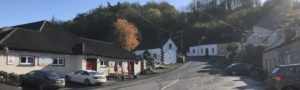
The photos of Eliz. (Lizzie) Fluskey and Michael and Eliz. (Lizzie) McKenna are old passport photos. In the featured colour photo of the Village, Fluskey’s is the two storey bluish building on the left of the photo.
This post was updated on 30 May 2020 after Danny Dowling provided additional details on 29 May 2020.


The photos of the Fluskey grave markers were added 21 June 2020.
Dr. Kathleen Moore Walsh
Prosperity, Pollution and the 1931 Glenmore Waterworks

Danny Dowling this week was able to identify five known hand operated public water pumps in the Village of Glenmore. One pump was located in front of where the Glenmore pub is now located. This was a deep well. Another pump was later located across the road at Rita Cummins née Hennessy’s gate on the footpath. A third pump was located outside the old National Boys’ School. Danny also stated that he was told that Gaffneys had a pump, but Danny did not know if it was in front of the buildings or at the side or rear of the property. Today, next to the Coach House a pump painted red still remains in the Village.
As previously discussed in our post of the 9th of May 2020, the Glenmore Co-opertive Creamery was established and commenced operating in 1905. According to the newspaper coverage at the time the site was chosen because it contained a spring and a stream. An expert who advised the founders noted that a creamery needed a good supply of clean spring water and a fast moving stream to carry away the waste generated by the operations of the Creamery. The stream at the Creamery went under the road; into Hanrahan’s field where the original Glenmore chapel was located; it ran down the hill under the Village Street to meet the stream from Mullinahone at the pub side of the bridge; flowed behind the Coach House into Cappagh; on to Graiguenakill and out into the Ballyverneen marshes and into the Barrow River.

On the 23rd of October 1931 the New Ross Standard featured a long article regarding the opening of the Glenmore waterworks.
“For some years Glenmore was faced with a serious problem in its water supply. The old pump had done its duty for generations, but in all material things the wear and tear of time inevitably leaves its impress. Gradually the old fundamental work became faulty and gave grounds for misgivings as regards the purity of the water feeding the storage vault. Shortly the situation was clarified when it was proved that the water was no longer safe for human consumption.”

Although the article implies that the water became unfit due to the wear and tear on the pumps, the article also reveals that the water in the Village pumps had become so unfit that farmers would not allow their horses to drink it. Danny believes that the discharges from the Creamery polluted the stream and then the nearby wells. It was reported that anxiety arose in 1929 in the Village concerning the state of the Glenmore water. The Very Reverend, Canon Holohan, P.P. and the Very Reverend, Dr. Gibbons, Curate out of concern for their parishioners set out to find a supply of good water for the Village. They wrote to Mr. Dooley, a member of the Kilkenny County Council and Mr. Flanigan, the engineer for the County Council. Mr. Dooley and Mr. Flanigan travelled to Glenmore on a very wet day. They examined the water, the old pump, took up buckets of water, and found that it was absolutely unfit for human use.
Originally a suggestion was made that another pump be sank in the village, but this was rejected as the likelihood was that the water in a new pump would also be polluted. Finally, the priests hit on a new source of water for the Village. Danny said that they chose the Tobar Mhuire Holy or blessed well in the Flemingstown Townland on the lands of Mrs. Mary Mullins, née Walsh. [Mary Mullins, née Walsh was the daughter of Patrick and Margaret Walsh, of Davidstown, Glenmore the couple who gave the sanctuary lamp to the Glenmore Parish Church during the 1910-1912 renovations that travelled to Crosspatrick Church.] Danny explained that Tobar Mhuire translates as St. Mary’s Well. The site of the well was considered ideal because it was at a good elevation over the village and thus would ensure a good pressure. It was reported that the water was pure and abundant.
The priests wrote the Board of Health, and correspondence went on for some time between them and the board. Mr. Flanagan, engineer, then drew up plans, specifications, and an estimate for the proposed work, and submitted it all to the Board of Health. The Board agreed to the plan and guaranteed that it would pay for the work. The work started in March 1931 by the contractor, Mr. Power. This work included the running a mile of pipe to the Village. According to Thomas Mullins, of Flemingstown, grandson of Mrs. Mary Mullins, the original pipe was cast iron and subject to leaks. The newspaper article indicates that fountains or faucets were placed in the Village and several of the houses in the village and the schools immediately connected as did some houses outside the Village that were adjacent to the main pipe. It was noted that it was predicted that in a short time the scheme would be a source of substantial revenue for the Health Board and would recoup the £1,200 expended on it. At the opening ceremony Councillor Dooley was thanked for working tirelessly to get the Glenmore scheme sanctioned, and for also securing a £300 grant for the project from the Government when President Cosgrove visited Kilkenny.

A couple of hundred people attended the opening ceremony held at the well. Speeches were given by various politicians and Father Holohan blessed the water. One politician told a joke concerning a thirsty man that provides a glimpse into the humour of the time. A thirsty man was working hard under a blazing sun. He went to a neighbouring house for a drink of water. He was handed a glass of water and asked if he would have a little stick in it. “What do you mean? How could a bit of stick improve it?” asked the thirsty workman in surprise. The householder explained, “In this part of the country a bit of stick means a little whiskey.” The thirsty man replied, “Well, if that is the case then, put a telegraph pole into it.” After the ceremony had concluded, Mrs. Mullins, who so generously gave the concession of land, was handed the apparatus, and she formally turned on the water to the main at the stopcock, midst applause.”
Although various works have been performed to the system over the past 89 years, and the Village has grown, the water supply to the Village of Glenmore is still the Tobar Mhuire Holy well. [UPDATE on 28 June 2020–The New Ross Standard reported on Thursday the 28th of June 1990 that “[t]he old metal pipes which were laid 60 years ago when the Village of Glenmore got its first water supply, are currently being replaced by the outdoor staff of Kilkenny County Council. The supply is provided by a well at Flemingstown.]
On a separate matter—with the partial lifting of the lockdown this week I drove to a socially distance visit with Danny. He was in very good spirits. On my way through Cappagh I spied a May Bush in front of Pat Dowling’s house. It was nice to be out of the house, visit with Danny and see this old tradition on the approach to the Village. Apologies for the quality of the photo.

Special thanks to Thomas Mullins, of Flemingstown for providing details concerning the well and waterworks.
The featured photo is the Village Stream taken at the water pump looking toward Cappagh, Glenmore.
Dr. Kathleen Moore Walsh

Tobar Mhuire Holy Well in 2020
On the Road to the Pink Rock: The Anthony Merrigan Memorial Plaque

Last Saturday we highlighted an event that took place in the mid-19th century at the Pink Rock in Glenmore. One reader queried a memorial plaque on the roadside in Ballyverneen Townland, Glenmore on the west side of the railway underpass. Although the road along the Pink Rock was once part of the main road from New Ross to Waterford, it ceased being the main road in about 1992. It is not surprising that some people might believe that the Anthony Merrigan plaque signified his death arose from a car accident on that once busy road.
Ballyverneen, Glenmore
Today, the road along the marches in Ballyverneen, that goes under the railway and along the Barrow river past the Pink Rock, is no longer a main road and has become a favourite place for walkers. Over the decades the nearby Barrow River and the marshes provided areas of recreation for shooting, swimming, fishing and boating. Unfortunately sometimes the recreation resulted in serious and sometimes fatal injuries.

The plague simply reads:
In loving memory of
Anthony Merrigan
Milltown, Glenmore
Who died the 8th of Sept. 1963
Aged 26 years
R.I.P.
On Whose Soul
Sweet Jesus Have Mercy
Anthony “Tony” Merrigan ( c. 1937-1963) of Milltown, Glenmore
An account of the accident that resulted in Anthony Merrigan’s death is found in the New Ross Standard, of Friday the 13th of September 1963. On Sunday the 8th of September 1963, Anthony Merrigan, of Milltown, Glenmore tragically lost his life when his shotgun accidentally discharged into his chest. Anthony, was known locally as Tony, he was twenty-five years of age [although the plaque appears to state he was 26] and worked in Waterford City as an electrician. Tony was the son of John Merrigan and Bridget Merrigan née Lee and was the youngest of five boys and three girls. John Merrigan predeceased Tony. Although his mother survived him, it is said that she never got over Tony’s death.
Parents & Grandparents
A quick search of vital records revealed the following information regarding Tony’s parents and grandparents, all of whom were engaged in farming in or adjacent to Glenmore Parish. Tony’s father John Merrigan was born on the 11th of July 1882. John Merrigan was the son of Dennis Merrigan and Ellen Merrigan née Doherty, of Milltown, Glenmore. John Merrigan married Bridget Lee, of Kilbrahon, Rosbercon on the 10th of June 1920 at Rosbercon. Bridget Merrigan née Lee was the daughter of Patrick Lee and his wife, Ellen Lee, née Cashin. Bridget was born on the 24th of July 1896.
Details of Tragedy
On that Sunday in September 1963, Tony left his Milltown home at 8 a.m. to go duck hunting with his shotgun and dog. He drove to Ballyverneen and parked on the side of the road. Sometime later his body was found on the grass margin of the road by a passer-by who notified the Glenmore Garda. Sergeant J. Flynn went to the scene and found Tony dead beside his car. The stock of his double-barrelled shot gun was resting on the seat of the car and the barrels of the shotgun were facing out of the car over the body.
The newspaper account provides that the news of the tragedy cast a gloom over the entire area as the deceased was popularly known. He was active in the local GAA and played hurling for the Glenmore Club. Several older residents confirmed that they can still remember where they were that Sunday when they heard the awful news. Sunday morning, Tony’s body was removed to the morgue at the District Hospital, New Ross, where a post mortem was conducted. On Monday evening the 9th the remains were removed to Glenmore Church where the attendance was reported in the newspaper as being the largest ever seen in the town. The following day after Office and High Mass in St. James, Glenmore Parish Church, and Tony was buried in the adjoining cemetery. The newspaper reported that the attendance at the church service and burial was again exceptionally large and representative.

The Inquest
An inquest into the circumstances of the death was conducted by Mr. R. Nolan, solicitor, Kilkenny City, in Glenmore on Monday evening. Sergeant J. Flynn. Glenmore, described how he was alerted, went to the scene and found the body. He said that the deceased was beside his car on the grass margin and described the position he found the shotgun in the car. He noted that the shotgun was not in the best of conditions and one of the springs of one of the hammers was weak. Dr. G. A. Hickey, New Ross, was the doctor who performed the post mortem. Dr. Hickey stated that he found that a shot had penetrated the chest and vital organs and death was instantaneous. Superintendent R. Coogan, Thomastown, said the theory of the police was that when Mr. Merrigan got out of the car he reached in for his gun and pulled it by the barrel. It was believed that the hammers stuck in the door frame and caused the discharge of two cartridges. The Coroner said a hammer gun was one of the most dangerous weapons and people could not be too careful in carrying a loaded one over fences or in bringing it into a house. The Corner returned a verdict of accidental death.

Should you have a question or are curious about something around or about Glenmore please send us an email to glenmore.history@gmail.com and we shall endeavour to find an answer.
For information concerning the families of Milltown, Glenmore recorded by Danny Dowling in 1961 ee our post of 16 June 2022.
Dr. Kathleen Moore Walsh
The Attack at the Pink Rock: Glenmore Repeal Supporters and the Shamrock Steamer

Although contemporary newspaper articles can be a useful source of details regarding historical events sometimes they can provide a distorted account of events due to prejudice, political views and other influences. In 1843, just prior to the Great Famine, it was reported in one Waterford newspaper that a mob of nearly 100 men at the Pink Rock, in Glenmore, attacked the river paddle steamer, the Shamrock. However, this account was challenged by another Waterford newspaper.
On Wednesday the 26th of July 1843 the following article appeared on page 2 of the Waterford Mail.
“ATTACK ON THE SHAMROCK STEAMER. Saturday last, the Shamrock steamer was proceeding from this city to Ross, on passing Glenmore, close to Pink Rock, in the Ross river, a mob of nearly 100 fellows, who were collected on the rock, commenced flinging stones at the passengers on board, shouting at the same time ‘Hurrah for Repeal.’ ‘Swamp the b—–y Tories.’ One female is, we are informed severely injured from the effects of a blow of a stone in the back of the neck, that she is confined to bed in consequence. The mob followed the steamer, throwing stones, for about 400 yards, when the course of the river enabled her get out of their reach —The captain from his conspicuous position on the paddle box had several narrow escapes. We understand that a party of the military accompanied by a magistrate were at the scene of the outrage, on Monday morning, in order to afford protection, if necessary, to the Shamrock on her return from Ross. We learn that some of the ringleaders in this brutal assault are known, and it is to be hoped will be dealt with according to their deserts.”

To put the events into context, Daniel O’Connell (1775-1847), referred as the Great Liberator, established the Repeal Movement which sought to Repeal the Act of Union of 1801 and introduce Home Rule for Ireland. It is reported that the repeal movement reached its climax in the mid-1840’s with branches established across Ireland and abroad. The year 1843 has been identified as the “season of the monster meetings.” (Ruddy (2015) “Dublin 1843: O’Connell’s Repeal Meetings,” 68(1) Dublin Historical Record, pp 60-70). During these monster meetings, attended by thousands, O’Connell implored followers to use lawful means. “He who commits a crime strengthens the enemy of his country.” The Waterford newspapers of 1843 contain numerous articles regarding and detailing activities across Ireland including meetings and alleged “outrages” perpetrated by proponents and opponents of the repeal movement. (See generally, Whyte (1959) “Daniel O’Connell and the Repeal Party,” 11(44) Irish Historical Studies, pp. 297-316.)
On Saturday the 29th of July 1843 the Waterford Chronicle, republished the Waterford Mail’s article of the 26th, and stated that the Mail “might as well have told the whole truth…” The Waterford Chronicle alleged that the Shamrock tried to run the rival paddle steamer, the Maid of Erin, onto the Pink Rock. It was due to this “reprehensible conduct of the Shamrock’s Captain” that caused a “few stones” to have been flung on board the Shamrock. There were no shouts of “Hurrah for Repeal.” The Chronicle failed to deny the other shouts of “Swamp the —-_Tories.” The Chronicle recorded that there were “very hostile” feelings between the rival Steam Companies plying between New Ross and Waterford.
The Chronicle alleged that there was no surprise concerning the hostility because in “Orange-land there dwells not more Rabid Miscreants are to be found amongst the gang who patronise the Shamrock.” It was alleged that landlords along the river threatened distraint and ejectment of tenants who utilised the Maid of Erin steamer for travel or “freighting her” with even a sack of potatoes. It was alleged that one tenant had to hide in the engine room when he saw his landlord standing on the river side, and another had “keepers” placed on his property after information was given to his landlord that he sent his wife with a basket of eggs to Waterford on the Maid of Erin.

The Chronicle condemned the tenants who submitted to the “tyranny” of their landlords as deserving their degradation with no recognition that the laws of the time were written by the landlord class that also provided the magistrates and judges. At the conclusion of the article, the Chronicle called upon the Clergy of Glenmore to bring the stone throwing perpetrators to justice. “We will hold their names up to scorn, and take care that if associated, they shall be erased from the lists of the Loyal Repeal Association, for the man who lifts his hand in riot at this glorious and important crisis of his country’s destiny, is a dangerous and deadly enemy.”
It seems evident that the Waterford Chronicle editor was pro-repeal and was trying to distance whatever occurred at the Pink Rock from the Repeal Movement. It is likely that the truth may lie somewhere between the two accounts. It seems unlikely that men just happened to be gathered at the Pink Rock and grabbed stones to pelt the Shamrock when they perceived the Captain of the Shamrock was trying to force the Maid of Erin on the rocks. It seems likely that the captain of the Maid of Erin would have reported to the authorities any attempt to force it on the rocks. Perhaps it was reported to the authorities, but the Chronicle does not state that it was.

Interestingly both paddle steamers were built in Scotland by the same builder, Tod & MacGregow. The Shamrock was built in 1836 while the Maid of Erin was completed in 1839 and first went to Cork. She plied between Cork and Cobh. In July 1841 she collided with a fishing yawl. The yawl sank with loss of three of ten youths who were on board. In 1843 she was acquired by the New Ross and Waterford Steam Investment Company. Although the Shamrock stayed on the New Ross and Waterford route, and was later joined by the Ida, the Maid of Erin returned to Cork in around 1847. (For details concerning the two paddle steamers see, Caledonian Maritime Research Trust webpage, http://www.clydeships.co.uk).
Danny Dowling when interviewing Nicholas Forristal, of the Mill, Graiguenakill, Glenmore in 1951 recorded that the area where the Glenmore Creamery built its coal shed, on the Barrow, was known as Maid’s Quay after the boat. The name of the boat is not recorded in the interview, but it is surmised that the Maid of Erin may have been the ship that used this quay and lent it her name.
The repeal movement lapsed with the death of Daniel O’Connell in 1847. However, the Great Famine had already commenced before his death and for most rural inhabitants the potato blight, starvation and emigration replaced concern regarding the Act of Union of 1801.

The featured image is a google map of the Barrow River at Glenmore. The Pink Rock is at the Kilkenny side of the Rose Kennedy Bridge. The photo to the right is the Rose Kennedy Bridge taken from the Wexford side of the Barrow.
Update: Another notebook has been transcribed and next week items will be added to the various family pages etc. If anyone has a photo or information regarding Glenmore, or a person from Glenmore, that they would like to share, please send same to glenmore.history@gmail.com.
Dr. Kathleen Moore Walsh
Fatality at the Glenmore Creamery: Martin Forristal (1879-1931) [updated]

Last Saturday we focused on the establishment of the Glenmore Co-Operative Creamery. According to Danny Dowling only two fatalities were associated with the operations of the Creamery. One involved the death of an employee, Martin Forristal (1879-1931) and the other involved the death of a volunteer worker on the Creamery threshing engine, Jack Mernagh, in 1911. The Mernagh tragedy was briefly covered in our blog of 2 February 2020 entitled “Glenmore and the New Ross to Waterford Railway Line.” Today we will focus on Martin Forristal.

Martin Forristal was born on the 16th of August 1879 in Robinstown, the son of Michael Forristal, of Rochestown and Anastasia Grant. Martin only had one sibling, his brother John Forristal who was born on the 15th of June 1877. At the time of the birth of his sons, Michael Forristal listed his occupation as servant. Michael Forristal died prior to 1901. [According to Francis O’Brien, of Glenmore Village, his great-grandfather was the coachman, Michael Forristal, who died in October 1880 in Rochestown, Glenmore of meningitis at the age of 35. Thus Martin was only a year of age when his father died.] The 1901 Census of Robinstown provides that Martin was living with his mother, Anastasia Forristal and they both list their occupation as farmers. In 1911 in addition to Martin and his mother, Mr. James P. O’Donovan, the first Glenmore Creamery manager, is aged 27 and is also living in the home. Anastasia is 60 years of age and Martin is 31. John Forristal was not residing at home in 1901 or 1911.
On the 9th of June 1915 Martin Forristal, aged 36 married Anne Roche (1890-1955) of Rathinure, Glenmore. Anne was 26 years of age, having been born on the 1st of January 1890 and the daughter of farmer John Roche and Kate Phelan. (See Guest Author, Walsh, (2020) The Enduring Names of Rathinure for additional information regarding the eviction of Johnny Paddy Roche from his field in Rathinure).

Martin Forristal and Anne Roche were married by Rev. Fr. Thomas Phelan, Glenmore P.P. and witnesses were Patrick Kennedy and Kate Roche. To this union at least 8 children were born: (1) Michael “Mick” Forristal (1916-1981); (2) Stasia “Sister Paschal” Forristal (1918- 1990) of the Sacred Heart of Mary Order; (3) Catherine “Kit” Forristal (1920-1998) married John Phelan; (4) John Forristal (1927-2004); (5) Bridget “Sister Bernadette” Forristal (1921-2001) of the Sacred Heart of Mary Order; (6) Mary Forristal (1923-1975); (7) Ann “Nancy” Forristal (1924-1997) married John O’Brien and (8) Martin Forristal (1930-1995). The obituary of Nancy Forristal O’Brien provides that another child, Johanna Forristal died young (at the age of 5 weeks in 1927). The photo of eight Forristal children was taken in front of their home in 1935. All of the Forristal children remained single except Kit and Nancy. [Ironically, Martin Forristal, Jr. like his father was only about a year old when his father died.]
In addition to operating the small farm Martin Forristal began working at the Glenmore Creamery in 1905 when it was being built and began operations. Martin Forristal died tragically on the 8th of June 1931 at the Glenmore Creamery. At the time of his death, at his place of employment, Martin Forristal was 51 years of age, married with eight children between the ages of 15 and 11 months. An inquest was held on the 10th of June and extensive newspaper articles appeared in the New Ross Standard (12 June 1931) and the Waterford Standard (13 June 1931) providing graphic details of the death. Dr. Fitzgerald, coroner, held the inquest into the death, and the following jury was sworn: Patrick Hanrahan, merchant (foreman), Patrick Dowling, Edward Corcoran, M. O’Hanlon, John Phelan, M. Hynes, and M. Kelly. Superintendent N. Walsh, Thomastown, conducted the proceedings for the Garda. Mr. Shannon, inspector of factories and workshops under the Department, was in attendance, as was Mr. O’Shaughnessy, solicitor, Waterford, for the Creamery Committee.
There were six witnesses called. Dr. Matthew P. Coghlan, the dispensary doctor, testified that be saw the body of the deceased on Monday evening. The deceased was then lying on the loft of the creamery at the place of the accident. Dr. Coghlan made a superficial examination of the body, and satisfied himself that he was dead. The following day in conjunction with Dr. Valentine Coghlan, he performed a post mortem. There were contusions, on the back of the shoulders and on both arms, hips, and legs, and the back of his skull was broken into small pieces, some of it was driven into the brain. The scalp at the back was also in pulp. The brain was lacerated, and a portion protruded at the back of the head. In his opinion the cause of death was fracture of the skull, with laceration of the brain. He testified that the injuries were consistent with the deceased being caught in a revolving shaft. Dr. Valentine Coghlan stated that he performed the post mortem with Dr. Matthew P. Coghlan, and had heard his evidence, and agreed with it in every particular.
The third witness was Martin’s brother John Forristal. John Forristal testified that he resided at the Quay, New Ross, and was a grocer’s assistant. He viewed and formally identified the body of his brother Martin. He stated that the deceased would have been 52 years of age next August and was employed as an engine driver by Glenmore Cooperative Creamery.

The fourth witness was James Cashin a general worker of the Glenmore Creamery. Cashin testified that at about 3:30 p.m. on the 8th of June he was on the ground floor of the creamery. He stated that he was having a cup of tea and the deceased talked to him for about two minutes. The deceased then went upstairs to the mill. “I heard an awful racket upstairs, and it sounded like bones cracking. I dashed up the stairs, and the first thing I saw was some clothes spinning around on the mill shafting.” Without waiting to ascertain if Forristal had been injured, Cashin ran back to the ground floor and stopped the machinery. When he went back upstairs he saw the deceased lying on his back on the pulley. The shaft had ripped the clothing off of the deceased; the only clothing on the deceased were his boots and socks. He appeared to be dead. Cashin immediately informed the manager James O’Donovan.
The fifth witness was the Creamery Manager, James P. O’Donovan. He testified that James Cashin reported the death and he immediately went to the mill loft. He stated that the deceased was employed as engine driver and had been an employee of the Creamery for 26 years. When he went up to the mill on the 8th with Cashin he saw the deceased on his back under the pulley. He was devoid of clothes, and appeared to be dead. He saw the deceased’s clothing on the shafting between the small pulley and the driving wheel. O’Donovan immediately sent William Walsh for the priest and phoned the guards and Dr. Coughlan. In response to questions O’Donovan stated that it was the business of the deceased to look after and work all machinery in the creamery. The wheel that was part of the accident was protected by a timber guard. The coroner requested the exact duties o the deceased and O’Donovan stated that his duty was to start the engine in the morning, fire the boiler, and work the mill and other machinery in the creamery. It was usual for the deceased to go to the loft to grind corn. To engage or start the shafting it was on the ground floor. He had been grinding corn for eleven years. In order to start the screen working it was necessary to get in between the driving wheel of the mill and the wall. As a precaution the deceased should have stopped the shaft which would have required him going downstairs.
The final witness was Mr. Shanahan, inspector stated that the machinery where the accident occurred was in what was known as a dangerous area, and, owing to its character, it was impossible to fence off every portion of it. He opined that the deceased should have shut off the shafting and made it safe before going into the loft. In his opinion, all the necessary precautions had been taken by the management of the creamery.
After a few minutes’ deliberation, the jury returned a verdict that the cause of death was due to fracture the skull and laceration of the brain as a result of being accidentally caught in the shafting. The Foreman, on behalf of the jury, tendered their deepest sympathy to the family and relatives of the deceased, who was a most upright and popular man. The coroner, the doctors, the Superintendent, Mr. 0’Shaughnessy, solicitor, and inspector Shannon joined in the expression of sympathy. The New Ross Standard noted that the eldest son, Michael, had been at school at St. Kieran’s College, Kilkenny, during the preceding nine months, and came home on vacation the day before the tragedy. It was also reported that the deceased had a most excellent work record. “He was intensely devoted to his work, and was held in the greatest esteem by the manager and the creamery committee. He had a most pleasant manner, very obliging, and was extremely popular in the district.”
After the inquest the remains were taken to the Glenmore Parish Church, accompanied by a large concourse of people. The following morning Office and High Mass, at which a large number of clergy were present, was held in the Parish Church, after which the remains were interned in the Glenmore cemetery. It was reported that the funeral was one of the largest seen in the district for a long time, and it was notable tribute to his memory and expression of sympathy with his family and relatives.
Danny Dowling said that after Martin Forristal’s tragic death his eldest son Mick went to work at the Glenmore Creamery. Mick’s brother John worked the small Robinstown farm and during busy periods at the Creamery also worked there. Their brother Martin, who was almost a year old when their father died, worked for 43 years at the Glenmore Creamery. When the son, Martin Forristal, retired in 1995 it was noted in a New Ross Standard article that his retirement ended a 90 year employment relationship between the Forristal family and the Glenmore Creamery.

Special thanks to Francis O’Brien, Glenmore Village for the photos of his grandfather, Martin Forristal, the eight Forristal children and the 1958 photo of the Glenmore Creamery workers and also for the dates of births and deaths for his grandmother and aunts and uncles.
The featured photo is of the Forristal house in Glenmore Village as it looks today. [The post was updated on 28 May 2020 with additional information provided by Francis O’Brien.]
Dr. Kathleen Moore Walsh