

Whether you are climbing your family tree or interested in social history, local place names or folklore we welcome you to Glenmore-History.com and hope that you enjoy your visit.
L A T E S T P O S T S

From Danny’s Files: The Early Public Transport Through Glenmore
-
Founder of Glenmore History’s Anniversary
-
An Unusual Glenmore Grave: The Brereton Family
-
The Plight of Richard Fitzgerald (1793-c. 1860) of Aylwardstown, Glenmore
-
The 1882 Contested Application for a Glenmore Pub
-
From Danny’s Files: Rev. Fr. John Fitzpatrick (c. 1758-1835) P.P. of Slieverue-Glenmore
-
The Tragic Death of John Millea (1870-1935) of Treanaree, Slieverue
-
Family Tree Workshop 2026 Photos & Forms
-
More Glenmore Photos: From the Eamon Jones Collection
-
Family Tree Workshop & Upcoming Lecture


The Tenacious Glenmore 1915 Football Team: Co. Kilkenny Senior Football Champions

According to the Gerry O’Neill’s Kilkenny GAA Bible (2014, pp. 60-61) http://www.kilkennygaa.ie/Downloads/KK_GAA_BIBLE_2014.pdf Glenmore between 1900 and 1950 won the Ned Langton Cup (county senior football championship) 15 times. Previously we posted information and a photo of the 1906 Glenmore football team that won the senior football championship (available at https://glenmore-history.com/the-glenmore-football-club-the-trials-and-tragedy-of-the-1906-county-kilkenny-gaelic-football-champions/). Today, we are going to highlight the 1915 Glenmore football team that also took the county championship. Although there were several years where no Co. Kilkenny senior football championship was held the senior football championship of 1915 (played in 1916) is unique. This is the only year where the two semi-finalist teams played four championship games because the first three games all resulted in ties.
Interestingly some of the 1915 County Kilkenny senior football matches were played outside of Kilkenny. For example, in February 1916, Glenmore played Tullogher in Barrett’s Park, New Ross in a semi-final match. The New Ross Standard (Fri. 18 Feb. 1916) reported “an enormous amount of interest was centred in the match, and crowds of the followers of both teams came to Ross on bicycles, cars and walking.” Although it was reported that there was a rumour that the game was likely to be rough, it was not. A very large crowd of spectators attended the match and cheered the players. Tullogher had the best of the play for the greater part of the first half hour, as they kept the ball in Glenmore territory. However, they failed to score and Glenmore notched a point. During the second half Glenmore dominated and won the match with a score of 1 goal, 2 points to Tullogher’s 1 point. It was reported that both teams missed several scoring opportunities, but the play was good and “well sustained from start to finish.” Gus Kennedy, of New Ross was the referee. By winning Glenmore qualified for the final against Coolagh.
The Co. Kilkenny GAA Annual Convention was held in April 1916. John Dunphy, Glenmore the outgoing Chairman presided. The delegates from Glenmore were M. Heffernan and P. Hanrahan of the Glenmore Hurling Club. At this meeting it was proposed by Glenmore that county championships for hurling and football should continue on the League system. This was agreed. Also during the Convention, Coolagh Football Club were declared champions for the 1914 senior football championship, as “the other matches to be played having been cancelled” (Kilkenny Moderator, Sat. 17 April 1916). Although the Easter Rising did not take place until the 24th of April the tension between the British authorities and the GAA was noted by the delegates. The British Government was attempting to levy an “entertainment” tax on matches; seeking the GAA pay income tax; agreeing not to interfere with Gaelic sports so long as the gatherings were not political and generally were according to P. Hanahan trying to break the GAA.
On the 19th of March 1916 the reigning senior champions Coolagh were to play Coolroe at St. James’ Park with Glenmore’s M. Heffernan as referee in the second football semi-final. The winner of this semi-final match was to play Glenmore at St. James’ Park on the 2nd of April with John Lalor as referee (Kilkenny Moderator, Sat. 11 March 1916). Coolagh won this semi-final. Due to a number of factors the final match between Coolagh and Glenmore was not played on the 2nd of April.
The senior football final between Glenmore and Coolagh was “re-fixed” for Sunday the 7th of May 1916 at St. James’ Park with referee D. Kennedy. Glenmore and Coolagh tied (Glenmore 1-1; Coolagh 1-1). The New Ross Standard (Friday 14 July 1916) reported that the replay between Glenmore and Coolagh was being “awaited with considerable interest.” Spectators had been buoyed by the unexpected display made by Glenmore during the first championship game when they nearly beat the county champions. “Coolagh can be relied upon to leave nothing to chance too, and when both teams meet there is sure to be a rattling good contest.”
The second championship match between Glenmore and Coolagh was held on Sunday the 16th of July 1916 at St. James’ Park, Kilkenny. “After a most exciting struggle both teams played a drawn game, with each team scoring a single goal. Although the first half of the game was “full of exciting passages” no scores were made. In the second half both teams scored a single goal each. “The general opinion on the match was that Glenmore should have won.” The referee was Mike Byrne of Coolroe Football Club (New Ross Standard, Fri. 21 July 1916).
The third championship match between Glenmore and Coolagh was held on Sunday the 20th of August 1916 at the sports field in Waterford. “After a very closely contested game a draw was the result. A regrettable incident occurred in the first half hour, when a few of the players came to blows. However, the affair quietened down and the match was proceeded with. Mr. Walsh, Waterford, proved a capable referee” (New Ross Standard, Fri. 25 Aug. 1916).
Notwithstanding the statements that the GAA was not political in any manner, shortly before the fourth championship match the Carrickshock Monument committee, applied for the proceeds of the match (Munster Express, Sat. 26 Aug. 1916). See, generally, Glenmore and the Tithe Tax, available at https://glenmore-history.com/glenmore-and-the-tithe-tax/. It is not known whether the Monument Committee received the proceeds, but a monument was erected in 1925.
On Saturday the 18th of October 1916 a very detailed article in “The Whip’s” sporting column of the Kilkenny People covered the fourth championship match between Glenmore and Coolagh. Unfortunately, the author in what might best be described as a “prissy” tone spent a substantial amount of the article exerting his views on punctuality, the weather, and the roughness of the game without actually explaining what happened. It was noted that Glenmore had a “submarine” that torpedoed 6 or 7 Coolagh players, but the name of the Glenmore player was never revealed. The author also noted that the guardians of the law had taken an interest in us of late, “I should, imagine they would find a more profitable (if a little more dangerous) work to do in Flanders. But this ‘small nationality’ is now ruled by a Coercion Government and martial law still prevails…” Excerpts from the article follow.
“MARGIN OF ONLY ONE POINT. A HARD GAME. The senior football final has been finished at last, and Glenmore have won. They got the verdict by the narrowest possible, margin—one point. It took over four hours’ play in the aggregate to decide the tie and of the four matches, three were played in Kilkenny and one in Waterford. Coolagh put up a very good fight, but they were not able for the Glenmore lads on Sunday’s play. The match is now finished, and the series of games played should have a very good effect on football in the county. For a few years past the football championship has been decided on the League system, and this of course necessitated all teams entered playing a number of matches. Under the old order a team, once it, was beaten: in the first round, had perforce to wait until the following season before they could play another official match…”
ABOUT THE GAME.
A most strenuously contested game it was every, inch of the way being fought with a dogged tenacity. The element of roughness was, however, too conspicuous, and scientific football was all too rare. ..From start to finish … it was veritably a case of the survival of the fittest, and it surprised how any man could stand such an hour… On the play Glenmore were the better of the two, and for the greater part of the second half Coolagh were always on the defensive. The backs put up a very stubborn resistance and never allowed the Glenmore men to score. A few dashes to the other end were made by Coolagh, but the finishing power was not there, and, the backs always came out on top. The same teams, it is interesting to note, will meet again in the first round of the coming Championship. Mr. John Lalor, Secretary of the County Board, refereed, and he performed a difficult task very well.
THE TEAMS.
Glenmore—James Murphy, E. Roche, J Roche, T. Doherty, P. Fitzgerald, P. Forristal, M. Connolly, John Phelan, James Phelan, M. Murphy, E. McDonald, W. Walsh. P. Foran, W. Hartley, Thomas Forristal.
Coolagh—W. (Saunders (captain), J. McKenna, W. Fitzgerald, J. Fitzgerald, M. Fitzgerald, Matt Fitzgerald, M. Hoyne, L. Murphy, E. O’Neill, T. Somers, J. Somers, James Leahy, J. Leahy, P. Murray, and M. Moore.
FIRST HALF.
Coolagh got away from the throw in, per Murphy, but the Glenmore backs returned and immediately the southern forward made tracks for the Coolagh posts. From a good kick by Johnnie Phelan an exciting scrimmage took place opposite the Coolagh sticks, and a grand shot by Doherty was only saved at the expense of a “fifty.” Another interest tangle followed, but nothing came of it, and Doherty, got a chance immediately after but sent it wide. Jim Phelan-both himself and his brother played a faultless game—returned the delivery, and another most exciting struggle took place in Coolagh territory. The later’s citadel was in jeopardy and a score seemed imminent, but the defence prevailed, and in a twinkling play was at the other end, thanks to some excellent play by Saunders who did a wonderful amount of work.
They were pressing pretty strongly, and a free to them put them in a very good position to score. Saunders was entrusted with the kick, and he made no mistake in opening Coolagh’s scoring account with a point. Johnnie Phelan and Saunders were most conspicuous in the following exchanges, honours as superiority being about equally divided. A lift off the ground by Phelan gave Coolagh another free, and Saunders centred beautifully. Leahy got possession, and with a very fine effort scored Coolagh’s second point. Saunder’s was again “in the picture” following the delivery, and Doherty then got away on his own, but a free to Coolagh brought relief, and a bad miss by one of the Glenmore half-backs let Coolagh into possession and a bombardment of the Glenmore posts followed. Nothing came of the opportunity thanks to the good defence of the backs.
The game was now very rough and the order apparently was to watch the man and not the ball. Saunders getting the ball after that delivery was tackled by Johnnie Phelan and badly heaved, but he was up in a twinkling; and though challenged by three of his opponents he got through and played the ball. Following this O’Neill sent it wide for Coolagh. Following the kickout Glenmore invaded, per Johnnie Phelan and a free was sent to the right wing.
Here Doherty got possession and with a grand shot landed the ball in the net to the accompaniment of loud cheers. Another attack followed, and a Coolagh. man (Fitzgerald) got hurt and had to retire, his place being taken by Vaughan. Glenmore kept up the pressure and forced a ” fifty,” which was well centred by Doherty, but the backs saved and Saunders, who was exceptionally well watched, was fouled, and the free put Coolagh attacking. Another Coolagh man got hurt but resumed after a short interval, and Glenmore again took up the offensive but a penalty spoiled the chance. Murphy got away on his own after the free kick, and an over by O’Neill followed. Yet another Coolagh man was rendered hors-de-combat but he also- resumed, and Coolagh were-pressing when the half-time whistle went, leaving the scores: Glenmore 1 goal; Coolagh 2 points.
A SCORELESS HALF.
The second and final half of the game opened very roughly. Glenmore, with the aid-of the wind, pressed strongly, and McKenna got knocked out. After some minutes he resumed, and following another over by Glenmore another Coolagh man got injured and had to retire; his place being taken by Peters. This gave rise to a protracted dispute,’ and matters looked dangerous. A bad row was only averted by the efforts of some of the Coolagh men. As usual the spectators went in to investigate, and some of the partisans did not help to throw oil on the troubled waters. After a long delay the teams were got together again, and frees went to both sides in rapid succession.
It was now veritably a case of rough-and-tumble and football in its true meaning was a premium. McDonald who was twice hurt, got a kick in the arm but still kept on, and Glenmore, forcing matters was awarded a “fifty” off a good shot by Doherty. Saunders blocked the kick and the ball was sent wide. Another series of frees followed to both sides and in a struggle Murphy (Coolagh) and, Connolly (Glenmore) both got knocked out. There was another delay, and on resuming Forristal met the delivery as the ball was touching the ground and sent dead for the net, but the goalkeeper saved well and sent out. A few incursions were made by Coolagh, but they always lacked finish and for the most part were on the defensive. Neither side registered in the second half, and the long whistle went leaving Glenmore winners after a total of over four hours’, play. The long score was—Glenmore 1 goal (3 points); Coolagh 2 points (2 points).”
| First Half | ||||
| Team | Overs | Frees | 50’s | Scores |
| Glenmore | 5 | 2 | 3 | 1-0 |
| Coolagh | 6 | 5 | 1 | 0-2 |
| Second Half | ||||
| Glenmore | 6 | 3 | 1 | -o- |
| Coolagh | 0 | 6 | 0 | -0- |
| TOTALS | ||||
| Glenmore | 11 | 5 | 4 | 1-0 |
| Coolagh | 6 | 11 | 1 | 0-2 |
Lastly, Coolagh sent in an objection stating that the Glenmore football team was illegally constituted. However, the players from Mullinavat had early in the season been granted permission by the County Committee to play with Glenmore. At the December 1916 GAA Kilkenny meeting no representative of the Coolagh team appeared and the championship was awarded to Glenmore (Kilkenny People, Sat. 16 December 1916).
The featured photo of the Glenmore 1915 County Kilkenny Champion Senior Football Team is from the Poole Collection of the National Archives of Ireland and published here with its kind permission.
Identification of players in photo is from a 1982 newspaper article in the Kilkenny People marking the death of Peter Forristal the last surviving member of the team.

Back Row: John Phelan, of Clonessy, Mullinavat; Wattie Walsh, of Rochestown, Glenmore; Pat Foran, of Rochestown, Glenmore; Jim Phelan, of Clonessy, Mullinavat
Second Row: Paul Fitzgerald, of Knockbrach, Glenmore; William Hartley, of Busherstown, Glenmore; Richard McDonald, of Ballynooney, Mullinavat; James Murphy, of Ballinlammy, Glenmore (goalie); Tommy Forristal, Rochestown, Glenmore.
Front Row: James Roche, Rathinure, Glenmore; Peter Forristal, Rochestown, Glenmore; Jack Doherty, Davidstown, Glenmore (Captain); Ned Roche, Rathinure, Glenmore; Phil Connolly, Rochestown, Glenmore.
Sitting: Maurice Murphy, Buckstown, Mullinavat & Michael Connolly, of Rochestown, Glenmore.
Club Officials: Maher (on left) and Dunphy (on right).
Dr. Kathleen Moore Walsh
Another Fenian Arrest: Patrick Culleton (1848- ) of Kilbride, Glenmore

In attempting to locate more information on Master John Fitzgerald, of Knockbrack, Glenmore it was discovered that at least one other Glenmore man was arrested in March 1867 on suspicion of being a Fenian. The arrest and detention of Patrick Culleton, of Kilbride, Glenmore clearly illustrates the fear authorities had of the Fenians and the fact that the flimsiest of evidence led to arrests and long detentions without trial.
The Waterford News and Star on Friday the 8th of March 1867 commences with “[o]nce again the Fenian bubble has come to the surface to disturb the face of the country, to retard its prosperity, and to give victims, it may be for the gallows, but certainly for the gaols and the convict ship.” It was reported that a “great rising” took place across the country on Tuesday the 5th of March. The “hungry… unarmed, deluded warriors, the dupes of mischievous and misguided men,” fought in many places, particularly in Tipperary. However, in all places the “insurgents” retreated on the first volley of the police or military. According to this article the Fenian plan was for the men to assemble in night in rural districts to be led by a Fenian military commander to attack a rural police barracks to obtain arms. Other articles report that the telegraph wires along the Waterford and Limerick railway was torn down in several spots and rumours abounded in Waterford that the bridge was going to be destroyed.

It was stated that several young men and boys departed from each of the cities of the South on the day before the uprising. The place of rendezvous of the Waterford Fenian contingent was in the neighborhood of Tory Hill near Mullinavat. After obtaining arms the group was to move up through County Kilkenny taking more barracks and securing more arms. Although it is not stated in the newspaper it seems likely that Fenians of South Kilkenny would also have joined the Waterford contingent. The newspaper surmised that the first attack of the Waterford Fenians was to be the police barracks at Kilmacow. Although the article does not explain why Kilmacow would be the target rather than the Mullinavat barracks the newspaper notes that in the field near the Kilmacow Barracks, 80 pikes wrapped in matting and a box of ammunition containing about 800 bullets was found on Wednesday. The pikes and ammunition were located on information given to Mr. Elliott, J.P. residing in the district.
According to the article the Fenians were frustrated because the Fenian commander did not appear. It was surmised that he was arrested on his way to the meeting point near Tory Hill. Some of the Waterford men, returned to Waterford on Wednesday, “sadder and wiser, it is to hoped, and impressed with the wickedness and folly of their first night’s campaign.” The police at Ferrybank, under “Constable Grant, arrested two of the last stragglers as they were making their way back, and they presented a pitiful spectacle, full of mud and filth, fatigued and heartsick, and just armed with one penny to pay the bridge.” The two arrestees were Thomas Byrne, aged 18, apprentice printer, living at high street and John Cahill, aged 16, a chandler. Other men were arrested as they re-appeared in Waterford City and several did not return and it was presumed that these men had joined another Fenian group.
On Friday the 29th of March 1867 the Waterford News and Star reported that Patrick Culleton, the son of a respectable farmer, of Kilbride, Glenmore, County Kilkenny was arrested under the Lord Lieutenant’s warrant and brought to Waterford City the previous Saturday. Patrick Culleton had been living in Waterford and employed as a draper’s assistant in Waterford City. “He absented himself on the night of the 6th, but having returned to his father’s house after the rebellion with which he was supposed to be connected.” On this evidence that he wasn’t in Waterford and was at his father’s home Patrick Culleton was arrested by five armed policemen and brought to Waterford City in handcuffs. At the time of Culleton’s arrest there were nine men in the Waterford gaol on suspicion of Fenianism.

It was also reported that James Cody was arrested in Wexford on board a vessel as “he had the appearance of being out.” He claimed to be a native of Kilmacow, and forced out of his house on the 6th to assist in a projected attack on Dangan. He escaped the Fenians and made his way to Wexford. Cody was taken to Kilmacow where he was not known then taken to Waterford gaol.
On Monday the Kilmacow police arrested three men, named Richard Power, Patrick Murphy and Joseph Whelan, on a charge of Fenianism. The men appeared to have travelled from a distance, “and consequently excited the suspicion of the police.” Mr. Elliott, J.P. committed them to Kilkenny gaol. On Tuesday the Kilmacow police arrested James Power, Patrick Casey and William Gaule, laborers, residing in the Kilmacow area as they were “missing from the Argus eyes of the constabulary.” Mr. Elliott, J.P. admitted the three to bail. Not being visible enough to the local police appears to have been enough evidence of wrongdoing for arrest.
On Monday at Waterford, James Walsh, a labourer, was charged with having been on Sunday evening in Barrack street where he sought to induce two artillery men to desert the British army. Walsh told the two men that they should desert and go to America to join in the invasion of Canada under the green flag. Walsh was charged with “tampering with soldiers.” Walsh was committed for trial at the assizes, bail was accepted of £40 (Two sureties posted £10 each, and Walsh posted £20.)
The Waterford Prison Register of 1867 reveals that Patrick Culleton was prisoner number 54. It is recorded that he was 19 years of age and 5 feet, 9 inches in height. His eyes were described as dark grey, his hair was brown and he had a “fresh complexion.” His place of residence was recorded as Kilbride in County Kilkenny, he could read and write, and was employed as a draper’s assistant. He was committed on 12 March and 23 March on the charge of “suspected of being in treasonable practice,” and committed by “His Excellency the Lord Lieutenant.”
Two other prisoners recorded on the same page in the Register were similarly charged. Stephen Farrell, aged 27, and employed as a tailor was also charged with “suspected of being concerned in treasonable practices.” William Kennedy, of the Glen, was aged 20 and a draper. He was charged with “being a member of the Fenian conspiracy.”
After languishing in the Waterford gaol four Fenian prisoners were transferred to Mountjoy Prison in Dublin in the first week of October 1867 (Waterford News & Star 11 Oct 1867). Patrick Culleton, William Kennedy, Stephen Farrell and Michael Cosgrove were taken from the Waterford gaol with 30 armed police in attendance as well as the cavalry. A railway bus entered the jail yard, collected the prisoners and their guards and delivered the prisoners to the railway Station to catch the 12:40 train for Dublin. On emerging from the gaol the prisoner it was noted that the “prisoners were in the best spirits, were received with handshaking and cheers” of a crowd that assembled.
A photograph of Patrick Culleton was not found in the photos held by the New York City Library and no further information was found in the various newspapers. No head stone for Patrick Culleton (1848- ) could be located in St. James’ Cemetery which is adjacent to the Glenmore Parish church. It is not known if Patrick Culleton was one of the prisoners released from Mountjoy Prison and deported to the US.
The Glenmore parish records do reveal that Patrick “Colleton” was baptized on the 18th of July 1848. Patrick was the son of Michael “Colleton” and Ellen Morissy, of Kilbride. His sponsors were Edmund Ready and Nancy Mackey. Patrick had five known siblings. James “Colleton” was baptized on the 8th of October 1845. Mary “Colleton” was baptized on the 11th of April 1850. John “Colleton” was baptized on the 27th of March 1852, and Bridget “Colleton” was baptized on the 4th of February 1855. Lastly, Walter “Colleton” was baptized on the 19th of April 1857.
Hopefully a reader may be able to shed some light on what happened to Patrick Culleton or Patrick Culleton will be added to the growing list of items to be researched with the libraries and archives re-open.
The featured painting is St. Cornelius who was an early pope and martyr persecuted and killed for his beliefs that the Roman authorities feared.
Dr. Kathleen Moore Walsh
Accused Fenian: Master John Fitzgerald, of Knockbrack, Glenmore

Over a month ago one of our readers in Indiana queried if there were many Glenmore Fenians who were forced to flee Ireland for their activities. Danny Dowling related that he was only aware of one person from Glenmore identified as a fenian, John Fitzgerald of Knockbrack, Glenmore. Danny on the first of June 1973 interviewed Mick Gaule, of Killaspy, Slieverue who told Danny that a man known as Master John Fitzgerald, of Knockbrack, Glenmore, was a member of the Fenian Movement in 1867. For his association with this organisation he had to flee the country and never returned. Master John Fitzgerald had the place where Paul Fitzgerald lived in 1974. Master John Fitzgerald was a cousin of old Micil Fitzgerald who lived where the late John Fitzgerald of the interviewer’s time lived.
The Fenians
The term fenian or feniasm was “… used indiscriminately to refer to the upsurge of popular ‘nationalist’ expectation among Irish Catholics…” (Comerford, R.V., The Fenians in Context: Irish Politics and Society 1848–82 (Kindle Locations 2970-2973). R.V. Comerford. Kindle Edition.) The Fenians of the 1860’s were inspired by the Young Irelanders and rebellion of 1848. The two most prominent Fenian organisations were established by two of the Young Irelanders involved in the rebellion of 1848. Both fled Ireland and sought safety in France. John O’Mahony (1815-1877) and James Stephens (1825-1901) would work together and separately to form oranisations that would actively promote Irish independence.

NYCity Library
John O’Mahony (1815-1877) was a native of Cork and was the founder of the Fenian Brotherhood in America. O’Mahony left France and settled in the US in 1853. He named his group after the Fianna the legendary warriors of Ancient Ireland. James Stephens (1825-1901) was a native of Kilkenny City. It has been noted that his early political influence was Dr. Robert Cane (1807-1858), a former Mayor of Kilkenny, a physician, a moderate Young Irelander who was jailed for several months in 1848 without charges ever having been made against him. From a Glenmore link perspective, Dr. Robert Cane was the father of the Kilmakevogue Dispensary doctor appointed in 1867, James Butler Norris Cane (c. 1804-1906) https://glenmore-history.com/dr-james-butler-norris-cane-c-1840-1906/.
Stephens remained in France until 1856 when he returned to Ireland and began what he described as a three thousand mile walk around Ireland to meet former Young Irelanders and other nationalists. In 1857 O’Mahony corresponded with Stephens who established on St. Patrick’s Day 1858 the secret Irish Republican Brotherhood in Ireland. Rivalry soon caused friction between the two groups as by 1865 the Fenian Brotherhood had became large and could afford to send arms to Ireland while the Irish Republican Brotherhood struggled. With the financial backing of the American Fenians Stephens published a newspaper called The Irish People commencing in 1863. This newspaper attracted a new generation of nationalists including Jeremiah O’Donovan Rossa, Charles Kickham, Thomas Clarke Luby and John O’Leary.
In the US the Fenian Brotherhood, although a secret society, had a public profile and for the most part engaged in fund raising and other activities without interference from the US government. While the American Civil War (1861-1865) raged Fenian rallies were held in several northern cities. The US Government’s ambivalence toward the American Fenians may have been due to the fact that the British, although professing to condemn slavery, had openly attempted to run the Union blockade of Confederate ports. In exchange for the slave produced cotton of the Confederacy the British sold munitions and other supplies to the South. Additionally, British controlled Canada became a haven for Confederate sympathisers and agents who attempted to burn New York City in November 1864. Some battle hardened Irish American Civil War Union Army veterans splintered from Stephens and led several unsuccessful invasions into Canada. The US Government did little to stop the veterans. The British newspapers in hysterical tones reported on Fenian conspiracies on both sides of the Atlantic.
An uprising was planned in Ireland for the summer of 1865. The plans were discovered and Irish Republican Brother members were arrested and sentenced to prison or transportation to penal colonies in Australia. Immediately, the Irish People newspaper was raided and Luby, one of the editors, and O’Donovan Rossa, the manager, were arrested. O’Donovan Rossa was convicted and sentenced to prison where he defied the prison authorities and was subject to abuse. Stephens was arrested and imprisoned but escaped and again fled to France. The Habeas Corpus Suspension Act was enacted on 17 February 1866 and allowed for the arrest and detention of citizens without trial.
Immediately a large number of persons were arrested and detained without charge or trial. Reports of the abuse of persons arrested and jailed for being involved in the Fenian conspiracy began to be raised in the House of Commons. For questions raised regarding Waterford prisoners see, https://api.parliament.uk/historic-hansard/commons/1866/mar/16/ireland-fenian-prisoners-at-waterford#S3V0182P0_18660316_HOC_40.

In searching for newspapers articles concerning the arrest of Master John Fitzgerald, of Knockbrack, Glenmore a list of other County Kilkenny arrestees was compiled. It is not an exhaustive list.

(1) Kilkenny Moderator, Sat. 10 March 1866: John Kavanagh, relieving officer of Kilkenny, Walkin St.; James Holland, a mason, upper Patrick St.; Wm. Dunphy, housepainter, Walkin St.

(2) Kilkenny Moderator, Wed. 21 March 1866: John Lynch, of Callan; and Patrick Comerford, of Lady’s-well, near Danesfort; Thomas Phelan, Sergeant Tailor of the Kilkenny Fusilier Regiment of Militia, was liberated from custody as he was wrongly arrested for being Thomas Whelan, of Kilkenny.

(3) Kilkenny Moderator, Sat. 30 March 1867: Richard Power and Patrick Murphy, living near Glenmore were arrested by Constable Powell, of Glenmore (who upon retirement became the first postmaster of Glenmore see, https://glenmore-history.com/the-glenmore-post-office-its-rise-and-demise/.)
(4) The Evening Freeman, Wed. 4 April 1866: Mr. Grace, of Thomastown, held in Mountjoy.

(5) Kilkenny Moderator, 1 August 1866: Edmond Coyne, of Callan (released & deported); James Cody, of Callan (released & deported); John Lynch, of Callan, released on surety; Michael Heffernan Dunne (still in prison).

(6) Kilkenny Moderator, 1 June 1866: Loche of Callan; and Downey, formerly of Goresbridge were still detained in Kilkenny gaol.
The Arrest of Master John Fitzgerald, of Knockbrack, Glenmore
On Friday the 15th of March 1867 the Waterford Mail reported that Head Constable Brereton, with a party of nine policemen, arrested the previous week a respectable farmer, named John Fitzgerald, of Knockbrack, under his Excellency’s warrant. Mr. Fitzgerald was recently a member of the Waterford Board of Guardians, and at the same time filled the office of chairman of the Kilmackevogue Dispensary committee, and was a man of considerable means. The Kilkenny Journal & Leinster Commercial & Literary Advertiser (20 March 1867) reported that on Monday, Head Constable Breton and a body constabulary, of Rosbercon arrested Fitzgerald. The Waterford News and Star, of Friday the 22nd of March 1867 described Fitzgerald as an intelligent well-educated man “holding a large farm.”
In contrast the Kilkenny Moderator of Saturday the 30th of March 1867 reported that Constable Ward, of Kilmacow and Constable Powell, of Glenmore arrested Mr. John Fitzgerald, a comfortable farmer, living at Ballybrack (sic), near Glenmore and three labourers who worked for him. It was rumoured that Fitzgerald was charged with having acted as a Fenian paymaster. Upon his arrest he was sent to the Thomastown Bridewell “pending further orders from Dublin Castle.” The three labourers, were not named in the article and brought before a special sessions at Kilmacow. James Cody, a prisoner previously arrested was also brought to Kilmacow. While Cody was transferred to Waterford gaol the three farm labourers were released. On the 21st Fitzgerald was transferred from Thomastown to the Kilkenny gaol under a warrant from the Lord Lieutenant, under the Habeas Corpus Suspension Act.
On Saturday the 1st of June 1867 it was reported by the Kilkenny Moderator that Fitzgerald was released from custody by his Excellency’s order after entering into recognizance and post £100 along with £50 each from two unnamed sureties. The terms of his release required him to the peace and orderly conduct for the next two years. It is not known whether Fitzgerald stayed in Knockbrack or went to America as reported by Mick Gaule in 1973.
Just before Fitzgerald was released a clemency meeting was held in Kilkenny City for the “unfortunate men” who were sentenced to death for high treason. The Mayor stated that no man should suffer death except for wilful murder. He hoped that the Queen would not blight her reign by the hanging, beheading and quartering of men “whose folly and whose crimes are traceable to the misgovernment of the country, and the persistent refusal of redress.” (Tablet, Sat. 11 May 1867)
By late July 1868 the last of those detained without trial under the Habeas Corpus Suspension Act were released, but there were about 100 Fenian convicts (including twenty– four soldiers sentenced by military tribunals) in jails in Britain and in Western Australia. (Comerford, R.V., The Fenians in Context: Irish Politics and Society 1848–82 (Kindle Locations 3209-3211). R.V. Comerford. Kindle Edition.) O’Donovan Rossa was released and deported to the US in 1870.
The Fenian Photographs
British authorities began taking “mug shots” of convicts in the late 1850’s. After 1865 persons arrested as Fenians were photographed. Two large collections of Fenian photographs survive. The larger, of 600 photographs taken between 1867 and 1872, is held in the National Archives of Ireland. A ‘Form K’ is attached to most of these photographs, to provide a description of the prisoner. Information recorded includes the particulars for arrest or conviction, the detainee’s physical description, age, literacy, religion, marital status, occupation and place of birth and residence.
A second, smaller collection of Fenian photographs, ‘The convicted and untried political prisoners in Mountjoy’, compiled in 1866, is now held in the NYC Public Library digital collections on-line. This album contains 86 portraits (4in.x3in.), mounted four to a page. The photos of all the political prisoners are identified by name. Fiona Fitzsimmons has noted that, 31% of the Fenian prisoners are recorded as having served in the American Civil War. Despite the endorsement on the title-page, that the photos are of Mountjoy prisoners, Fiona Fitzsimmons has discovered that many of these prisoners were actually held in Kilmainham and elsewhere. See, Fitzsimmons, “Kindred Lines: Prison Photographs,” available at https://www.historyireland.com/volume-24/kindred-lines-prison-photographs/.
The two photograph albums held by the New York City Library originally belonged to Sir Thomas Aiskew Larcom (1801-1879), the permanent Under Secretary for Ireland from 1853 to 1869. Harriet Fyffe Richardson (b.1872), author of Pioneer Quakers (1940), provided the albums to Stanford University at an unknown date; the New York City Library acquired them in 1953.The contents of the two albums were digitalized and made accessible online in 2016. To view the collection Mountjoy “mugshots” of the Fenian political prisoners held by the New York City Library see, https://digitalcollections.nypl.org/search/index?utf8=%E2%9C%93&keywords=fenians.

Without being able to view the records held by the Irish Archives (closed again due to COVID 19) it is not known if this photo is Master John Fitzgerald, of Knockbrack, Glenmore. Given his dress, compared to the other Fenian political prisoners, it seems likely that this is the correct photo.
For a concise account of the importance of the Fenians in inspiring the 1916 Rising see, McNamara, Robert. (2020, August 26). The Fenian Movement and the Inspiring Irish Rebels. Retrieved from https://www.thoughtco.com/fenian-movement-4049929.
Dr. Kathleen Moore Walsh
New Local Book

Local author Andrew Doherty’s new book Waterford Harbour Tides and Tales has been published by History Press. It is a collection of stories associated with the harbour area drawn from the yarns the author heard as a child.
Although we have not reviewed the new book if it is anything like the author’s blog http://www.tidesandtales.ie it should be an interesting and entertaining read.
Waterford Harbour Tides and Tales is available on Amazon, in book shops or by contacting the author via email at tidesntales@gmail.com
Congratulations Andrew!

The Prosecution of Glenmore Wedding Guests in 1917

On the 1st of November 1917 the provisions of the Motor Restriction Order came into effect. Britain was engaged in the First World War and the Easter Rising of 1916 was still fresh in the minds of authorities. Twenty-seven days later three persons who drove to a Glenmore wedding were arrested and tried for breaching the Motor Restriction Order of 1917. It is doubtful that when the bride and groom were preparing for their wedding that they had any idea that their wedding would make the news in such a fashion.
Although it was stated in the Order that there was a “need for economy in the use of petrol,” the debates in the House of Commons 7 months earlier, on the 24th of April 1917, revealed that the MP’s were concerned about the number of convictions for driving at excessive speed against drivers going and coming from race meetings. It was noted that a feeling existed in the country against the use of motor cars for purely pleasure purposes at a time of national crisis. The Home Secretary was asked to take immediate steps to prohibit the supply of petrol to owners of motor cars using them for purely pleasure purposes. The Home Secretary responded that the Petrol Control Committee had already ceased issuing licenses for the supply of petrol to private cars not being used for purpose of “national importance.” (HC Deb, 24 April 1917, vol. 92, c. 2223)
The Motor Restriction Order 1917 provided that no petrol or petrol substitute could be used for the purpose of driving any motor vehicle or motor boat except as authorised in the Order within the terms of a motor spirit license issued by the Petrol Control Department of the Board of Trade. Allowed uses included: the conveyance of a person or goods to or from the nearest railway where no other means of conveyance was reasonably available: for the purpose of a profession, trade or business; for necessary household affairs; funerals; and life saving purposes etc.

On the 28th of November 1917 Glenmore Parish Priest, Father Holohan, married Mary Hynes, of Aylwardstown, Glenmore and Edward Whyte, a farmer from Coolnamuck, Inistioge. The best man at the wedding was Thomas Flood and the bridesmaid was Bridget Dreehan. The bride was the daughter of Aylwardstown farmer, Martin Hynes and his wife Anastasia Hynes née Aylward. The bride was born on the 15th of January 1887. The bridegroom was Edward Whyte the son of Thomas Whyte and his wife Catherine Whyte née Meany. The bridegroom was born the 28th of November 1884.
The New Ross Standard reported on Friday the 14th of December 1917 that at the New Ross Petty Sessions three wedding guests were prosecuted for having motor cars at the Whyte-Hynes wedding in Glenmore. The magistrates hearing the cases were Captain D.G. Howlett (presiding) and Arthur J. Doyle and Pat Bolger. The defendants were Joseph Lynch a veterinary surgeon from New Ross, P. A. Jeffares, New Ross, motor and engineering company, Peter Gahan, of Priory-street, of New Ross. All three defendants were represented by Solicitor J.R. Colfer.
Head Constable O’Connell, of Thomastown, prosecuted the cases and Constable Healey, of Glenmore was the arresting officer. Constable Healey testified that on the 28th of November he was on duty at Graiguenakill, Glenmore when he saw Joseph Lynch driving a wedding party from Glenmore Village to Aylwardstown, a distance of about two miles. In Lynch’s car was the bride, bridegroom, best man and bridesmaid. Afterwards he saw Lynch with the car at the house of the bride’s father, Martin Hynes, in Aylwardstown. Constable Healey told Lynch that he had committed an offence. Lynch replied that he was not aware that he had committed an offence. Constable Healey asked for Lynch’s petrol license which Lynch admitted he forgot in another coat. Head Constable O’Connell conceded that prior to the court date Lynch had produced the petrol license. After a lengthy argument concerning the summons being faulty Head Constable O’Connell clarified that the offence was for the defendant “using motor spirit” and asked the magistrates to “inflict a substantial penalty.”
Solicitor Colfer then began a spirited defence arguing that there was no offence. Lynch was a friend of both parties and was an ordinary guest at the wedding. The wedding party hired two motor cars for the wedding, but when they came out of the Glenmore church the hired drivers were not there. The wedding party was standing in front of the church “surrounded by a crowd of beggars wanting gratuities, and the position of the bride and bridegroom and their friends was awkward with this crowd around them.”

Danny Dowling during an interview of Mrs. Alice Power née Curran, of Jamestown, Glenmore recorded the local practice of the “Cee Caw.” School children and beggars would congregate at the Glenmore Church gates at weddings because money would be thrown into the air. When the money was fired into the air it often resulted in abuse and fisticuffs as all the assembled would scramble after the money. This practice continued in Glenmore until the early 1950’s. A review of the Glenmore parish register revealed that there was another wedding held earlier on the 28th of November 1917. John Connolly, a laborer from Rochestown, Glenmore married Bridget Roche of Scartnamore, Glenmore. Thus with two weddings on the same day it is likely there was a large group assembled for the Cee Caw when the Whyte-Hynes wedding party emerged from the church.
Lynch volunteered to drive the wedding party to the Hynes’s home. Solicitor Colfer argued that any reasonable person would have done so including the magistrates. Solicitor Colfer also pointed out that the Order only came out in October, and “a person would want to carry around with him in his car a regular lawyer’s library to try to comply with the regulations.” “Surely the fact of a man taking to himself a wife might reasonably be looked upon as something done in connection with household affairs.”
Solicitor Colfer then drew the magistrates’ attention to a paragraph in the Irish Times on the previous day. The Athlone magistrates had a similar case where a person was charged with violating the Order when he attended a wedding. The Athlone magistrates dismissed the case. Solicitor Colfer also noted a similar case in Bray which also resulted in the magistrates dismissing the case. “In those cases the magistrates had shown common sense in refusing to convict, and refusing to be gulled into turning people into criminals for a breach of those stupid and ill promulgated orders.” With the decisions of two other courts before the New Ross magistrates, he asked the magistrates to exercise common sense and put a reasonable construction on the case. Solicitor Colfer concluded that it would be a disgrace to convict his client, and “under the circumstances of the case the magistrates would be failing in their duty if they did not mark their disapproval of such proceedings by dismissing the case.”
Head Constable O’Connell was not deterred and argued that he had authority that attending a wedding is not a necessary household affair, but upon Solicitor Colfer demanding the legal authority it was not produced. One of the magistrates pointed out to the Head Constable that the Order allowed persons to use petrol to attend funerals. Ultimately the Chairman announced that the case against Defendant Lynch was dismissed on the summons. The Head Constable not taking the hint replied that he would bring the case again on a new summons within a fortnight.

The other cases arising from the same wedding were called and the Chairman said he thought that the best thing to do was to dismiss the other cases. Head Constable O’Connell demanded to know on what grounds the magistrates were dismissing without hearing any evidence. The Chairman replied that the summonses were wrongly stated. The Head Constable O’Connell requested the magistrates to state a case. Solicitor Colfer interjected, “This thing is becoming absurd. You would really think those men were being tried for their lives.”
The Head Constable called Constable Collins, of Glenmore, who testified he was on duty at Graiguenakill on the 28th of November and saw a motor car belonging to the New Ross Motor and Engineering Co., containing 5 ladies driven by the driver. They went in the direction of where the wedding was held. Constable Healy was recalled and gave evidence that on the same date he saw a motor belonging to the New Ross Engineering Co. containing Messrs. John Flood, The Rower; John Hynes, Aylwardstown; Richard Hanrahan, New Ross; and John Meaney, Inistioge. He afterwards saw the car at Mr. Hynes’ house. The explanation the defendants gave was that they didn’t know they were committing an offence. Mr. Colfer said he had very little to say in those eases beyond what he had said in the case of Mr. Lynch. He stated that it was really absurd to accuse people of criminally breaking a law of which they had no knowledge “and it would be a monstrous thing to inflict fines in such cases.”
The Chairman announced that the bench had decided to dismiss the cases. Head Constable asked on what grounds the cases were being dismissed and asked the court to state a case. The magistrates refused to state a case. Undeterred Head Constable O’Connell queried the grounds on which the magistrates refused to state a case. Mr. Bolger, J.P. interjected and reminded the Head Constable that it was not necessary for the magistrates to state their reasons for dismissing the cases. According to the newspaper article the magistrates then dismissed the cases “on the merits” rather than on a defect in the summons, and thereby ensured that the defendants could not be subject to another prosecution from the zealous Head Constable arising from having motor cars at the Whyte-Hynes wedding.
A quick review of newspapers in Britain revealed that in 1917 most of the arrests under the Order reported in the newspapers were for people driving to racing events.
The Irish Petty Sessions Court drawing (c) Illustrated News (1853).
Dr. Kathleen Moore Walsh
A Glenmore Version of the Ballad of Carrickshock [updated]

As outlined in our last post, concerning the tithe tax and tithe war of the 1830’s, a ballad was penned and sung in Glenmore concerning Carrickshock. On the 25th of February 1970, Danny Dowling recorded the Ballad of Carrickshock as told to him by Nicholas Forristal (1888-1979), of the Mill, Griaguenakill, Glenmore. In 1970, Nicky Forristal was 82 years of age and the subject of the ballot had occurred almost 140 years previously. Nicky’s father, Patrick Forristal (1849-1931) was born 18 years after Carrickshock and died on the Carrickshock centenary in 1931. Thus, Carrickshock took place during the lifetime of Nicky Forristal’s grandfather. Thanks to Danny’s work 50 years ago we have a version of the Ballad of Carrickshock that was sung in Glenmore.
According to an online exhibit in the National Archives entitled “Singing Sedition: Ballads and Verse in the Age of O’Connell” ballads are particularly important as a reflection of the interests and opinions of ordinary people of nineteenth century Ireland.
“Arising out of unofficial channels ballad sheets express the opinion and sentiment of the ordinary people of nineteenth century Ireland, often revealing their private attitudes to the great questions of society, politics and religion. As a medium of communication from an otherwise unrepresented class, such verses and songs provide a critical counterbalance to the views of the landed elite. … Certain types of ballads may not be readily accessible to the modern reader, since they can contain cryptic references to local persons or events.”

“Singing Sedition: Ballads and Verse in the Age of O’Connell” is available at https://www.nationalarchives.ie/article/singing-sedition-ballads-verse-age-oconnell.
Within the exhibit is a copy of a ballad entitled “The Downfall of the Tithes,” this ballad makes reference to Carrickshock, and is available at https://www.nationalarchives.ie/wp-content/uploads/2020/02/CSORP_OR_1832_2928_0001.jpg .
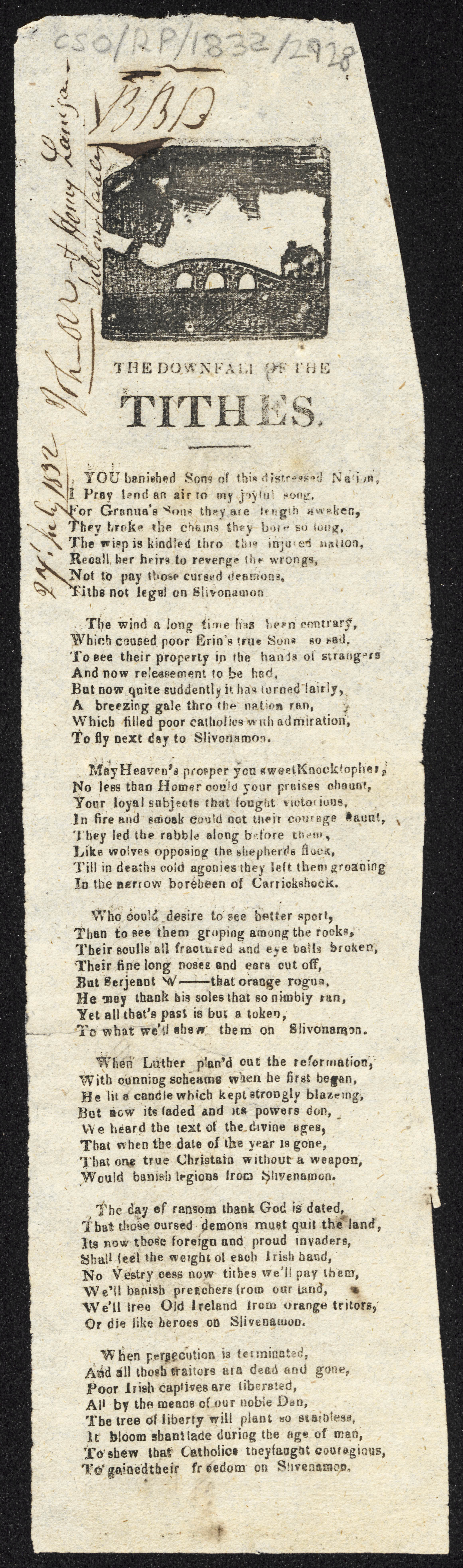

Below is a transcription of the Carrickshock Ballad recorded by Danny in 1970.
Ballad of Carrickshock (Sang in Glenmore)
Those valiant sons of the Irish Nation,
Where is the country that can boast of more?
Through extensive Europe they gained rank and stature,
And for their loyalty great credit bore.

May Britain boast of their fame and glory,
Auld Scotsman too, King William’s name,
But Irish valour won’t lie from story,
While lives a bard to record their fame.

T’was a December on a Wednesday morning,
Strange rumours circled our country round,
And it was confirmed by chief ???
Warning to force the tithes or our cattle pound.

Our chapel bells they were kept sounding,
The people hearing in great number clocked,
Our ??? and ditches with all speed bounding,
To meet the peelers in Carrickshock.

They hired Bert Butler to serve citations,
To force the peasant from home or tithes,
To feed the gluttons of the reformation,
Whom honest Catholics always deride.

The first to start was courageous Power,
He  beat(?) Butler with manly skill,
Saying rally boys for the very hour,
Well pay no tithes but those traitors kill.

And chief Gibbins saw that his dog lay sprawl,
And to his forces did loudly call,
Saying prime and load boys it is appalling,
And he shot brave Power with a pistol ball.

And then commences the bloody slaughter,
For 15 minutes we had but fun,
With pikes and scythes we gave them no quarter,
We stood our ranks without fife or drum.

But 26 and their chief commander,
Was left them lifeless without a groan,
And not to conquer like Alexander,
We left 3 survivors to bring them home.

Sergeant Wylie that orange traitor,
That day he ran with great force and speed,
Tis well he knew if he was overtaken,
His body like the rest would be left to bleed.

If you were to see them of the after ???
Like pigs or ??? they were drown,
Along to standing ??? in Reid’s barn.

In Kilmaganny they all did say,
May providence crown you Tracy and Whelan,
Who fell Tithe victim upon that day,
They stood the brunt without courage failing,
And fought courageously in that bloody fray.

Now my song is ending and all is over,
Come fill your Bumfords and drink brown ale,
And where you’ll meet them in rapture,
Greet them the jovial champions of Ballyhale.

Gary Owen, “The Carrickshock Incident, 1831: Social Memory and Irish Cause Célebre,” 1(1) Culture and Social History (2004) pp 36-64 available at http://www.traceyclann.com/files/carrickshock.pdf
The National Archives also has the correspondence of the Chief Secretary’s Office concerning the “Carrickshock murders” including costs of burials of constables, doctor bills for the treatment of injured constables, the efforts to arrest, and the efforts of two Catholic clergy in raising funds to hire Daniel O’Connell to defend those accused of murder etc. [CSO/PR/OR/1831/1328 et seq]
Update 2 Feb. 2021–while going through the Munster Express newspaper of 27 Dec. 1946 the following poem or ballad concerning Carrickshock was discovered. It appears to have been penned in the 1930’s.

Update: 24 Dec. 2022–
Munster Express (Sat. 11 Nov. 1922, p. 6)–Death of Mr. James Treacy, Ballymagill—it is with much regret we have to record the death of M. James Treacy, who passed away on Friday, 3rd inst. The deceased was one of the famous Carrickshock Treacy’s. The interment took place at Kilcurl. We tender our sympathy to his relatives in their bereavement.
Dr. Kathleen Moore Walsh