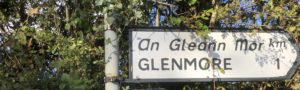


Whether you are climbing your family tree or interested in social history, local place names or folklore we welcome you to Glenmore-History.com and hope that you enjoy your visit.
L A T E S T P O S T S

From Danny’s Files: The Early Public Transport Through Glenmore
-
Founder of Glenmore History’s Anniversary
-
An Unusual Glenmore Grave: The Brereton Family
-
The Plight of Richard Fitzgerald (1793-c. 1860) of Aylwardstown, Glenmore
-
The 1882 Contested Application for a Glenmore Pub
-
From Danny’s Files: Rev. Fr. John Fitzpatrick (c. 1758-1835) P.P. of Slieverue-Glenmore
-
The Tragic Death of John Millea (1870-1935) of Treanaree, Slieverue
-
Family Tree Workshop 2026 Photos & Forms
-
More Glenmore Photos: From the Eamon Jones Collection
-
Family Tree Workshop & Upcoming Lecture


Glenmore Postmistress: Alice Ryan née Cody (1918-2009) [Updated]

A frustration that Danny Dowling (1927-2021) often articulated was that his work was misquoted in newspapers. When we were working on the article regarding the Glenmore post offices in 2019, Danny spoke of how he put together a history of the Glenmore post office for a retirement celebration and two of the newspapers that covered the retirement got the history wrong. He worried that this wrong information published in the newspapers would mislead. This week we are featuring Glenmore Postmistress Alice Ryan née Cody (1918-2009) and the newspapers articles that frustrated Danny.
See our previous article of 24 November 2019 entitled “The Glenmore Post Office Its Rise and Demise” that identifies all four of the Glenmore Post Offices from 1870-2018).
Alice Ryan’s Parents
Alice Ryan née Cody (1918-2009) was the daughter of John Cody (1878-1957) and his wife Alice nee Cody (1874-1957) (Cody Headstone, St. James’ Cemetery, Glenmore). Her parents were married in Glenmore on 18 February 1901. John, the groom, was a labourer and his address was recorded as Glenmore. The bride Alice Coady (sic) was a servant, with an address recorded as Ballyverneen. John the groom, was the son of John Coady (deceased, labourer) and Alice was the daughter of Patrick Coady (deceased, carpenter). The witnesses were Patrick Forristal and Johanna Coady.
According to the Glenmore Parish records Alice Coady née Coady was born on 23 February 1874 at Ballycroney, Glenmore the daughter of Patrick Coady and his wife, Catherine Long. Her husband, John Coady was born on 24 December 1878 at Graiguenakill the son of John Coady (farm labourer) and Catherine Butler.
1901 Census Glenmore
Alice Ryan’s parents, according to the 1901 Census, began their married life living in a 3 room house in Milltown that they rented from Thomas Forrestal. John’s age was recorded as 22 in the 1901 Census while Alice’s age was recorded as 27.
At the time John and Alice Cody were married, John’s widowed mother Catherine Cody (age 45) was living in Glenmore Village (Graiguenakill Townland) with 7 of her children: Maria (age 19); Thomas (age 16); Bridget (age 12); Ellie (age 10); Stasia (age 8); Nicholas (age 4); and Richard (age 3).
Also present in the four room house were six boarders: Laurence Curran, of Co. Carlow (age 30); William Murphy, of Co. Wexford (age 60); John Kiely, of Co. Waterford (age 29); Mike Bearley of Co. Wexford (age 44); Peter Trainor, from Tipperary (age 40) and Richard Burke, from Co. Kilkenny (age 36). All of the boarders were single and worked as navvys (sic) (railway labourers).
Thus, there were 14 people living in this four room house in 1901. The house was in Catherine Cody’s name in the census (no landlord was recorded). Maria Cody (age 19) was working as a farm servant and interestingly Thomas Cody (age 16) was employed as a “post boy.”
1911 Census Glenmore
The 1911 census reveals that John and Alice Cody were residing in Graiguenakill (Glenmore Village) in a three room house with their two children; Pat (age 8) and Kate (age 4). Also present in the home were three of John’s siblings, Nicholas Cody (age 15), Richard Cody (age 13) and Johanna Cody (age 33). Also present is John’s nephew, John Cody (age 4). Thus, in 1911 eight persons were living in the 3 room house that was in John’s name (no landlord was recorded). It is assumed that John’s mother died and he and his family moved to Glenmore Village, however, it is not clear how the house went from 4 rooms in the 1901 census to 3 rooms in 1911.
John and Alice Ryan
According to Danny’s notes Alice Ryan née Cody was born on 30 September 1918. Unfortunately, her birth is just outside the available public records, but it does line up with the information recorded on the Cody headstone. Alice married John Ryan sometime in the mid 1950’s. According to Danny’s notes, John Ryan was born on 7 Sept. 1922 and was employed at Clover Meats. Shortly after John and Alice Ryan were married both of Alice Ryan’s parents died within a few months of each other in 1957. John and Alice Ryan had at least three children Mary Ryan, John Ryan and James Ryan.
Post Mistress
The New Ross Standard (Thursday 3 June 1993, p. 15) published an article in 1993 entitled “Alice was at her Post for Over 40 Years.” Corrections or comments not original to the article are placed in square brackets [ ]. It was noted that Alice spent about twenty of her forty year service in the employment of the Cluskey family, who had been operating the post office from the early days. Alice was the postmistress in her own right and in her own house from 1974. [We know that the second post office was located in Fluskey’s shop. The name Cluskey is obviously a typographical error.]
New Ross Standard
The article provides that Alice received from the people of the parish of Glenmore a beautiful Waterford Crystal table lamp to mark her retirement. It was presented to her by Father Dunphy who thanked her for her service to the community and wished her many years of happy retirement.
“Local historian, Danny Dowling … gave the interesting background to the post office system in Ireland. He referred back to the mid-80’s [this should be the mid 1800’s] when letter writing [by the masses] first began and recalled that no envelope, or stamp was used, but the open letter was conveyed by a courier. He [the courier] was paid by the sender and the charge was in keeping with the length of the letter. The gummed envelope and stamp came into being later, as did the post office, the postmaster/mistress and the postmen. “
“The first post office in Glenmore was run by Robert Fluskey whose son, James, took over in 1929. [The first postmaster in Glenmore was actually a retired RIC Officer named Powell. The first post office was opened around 1870. Robert Fluskey was the second postmaster]. The first postman employed was Edward Kehoe, Aylwardstown, who had to deliver letters on foot throughout the parish of Glenmore. A second postman was later appointed and the deliverymen were supplied with bicycles. Danny Dowling said that the post office had always been the centre of the community and he felt it would be a sad day if the present system was ever terminated.”
Alice thanked the speakers and said that she would treasure the presentation from the community. The evening concluded with song, music and dance. Joan Doyle performed step dancing and the ICA performed set dances. Music was provided by John and Liam Doyle.
The Kilkenny People
The Kilkenny People (Friday 4 June 1993, p. 11) also covered the event but added a few more details. For example, Alice actually retired in March 1993, her father John Cody was one of two post men and “Mr. Danny Dowling said that the Post offices had a busy time today with old age pensioners, children’s allowances and many other duties. It would be a sad day for the community if this system was abolished, he added.” The Kilkenny People article states that John Cody worked with Jim Power, Robinstown. This newspaper also made some errors. It wrongly stated that “Glenmore’s first post office opened in 1929 and was in the name of Edward Kehoe and his son James.” [Edward “Ned” Kehoe was never the postmaster and did not have any chidren.]
In addition to Alice Ryan and her father John Cody working for the postal service, thanks to the 1901 Census we also know that Alice Ryan’s uncle, Thomas Ryan, while a teenager, worked as a “post boy.”
John Ryan died in November 2003 and was buried in St. Mullins, Co. Carlow. Alice Ryan née Cody died on 14 October 2009 at the age of 91 and is buried in the Cody family grave, St. James’ Glenmore.
The featured photo above is from an old postcard of Glenmore Village. The second post office (Fluskey’s) is the tallest building on the right. The third post office (Ryan’s) was located on the left in the line of attached houses across from the pub. It was the second house from the corner near where the two people in the photo are standing. The post card has a caption “Glenmore, Waterford” which was the mailing address for much of the parish for many years.
Please send corrections, further information or photos to glenmore.history@gmail.com.
UPDATE
5 July 2022: Thanks to two readers we have further information concerning two of Alice’s sisters. In the 1911 Census, Katie Cody was four years of age and was the eldest of the sisters. Catherine “Katie” Cody (c. 1907-1973) married Thomas Walsh (c. 1905-1988) of Parkareid, Kilmacow. Another sister, Mary Ann Cody married Thomas Desmond of Slieverue. For over 40 years Thomas owned and operated Desmond Garage of Slieverue, the first local garage outside of Waterford City. Prior to their marriages both Katie and Mary Ann worked at Power Seeds of O’Connell Street, Waterford. Mary Ann Desmond née Cody’s obituary has been placed on the family pages under Desmond.
Dr. Kathleen Moore Walsh
The School Collection: Ballyfacey, Glenmore, National School, Local Heroes

Between 1937 and 1939, 5000 primary schools in Ireland participated in recording local information for the National Folklore Commission. Over 288,000 pages were created by students in exercise books. Students in all 26 counties were aksed to collect information ranging from oral history, topographical information, folklore, legends, riddles, pastimes, games, trades and crafts by interviewing their parents, grandparents and neighbours. From 15 November 1937 to 7 December 1938 a dozen students in the Ballyfacey, Glenmore National School, under teacher Domhnall Mac Cárthaigh, participated in the School Collection. The Ballyfacey Glenmore School Collection (Vol. 845, pp 484-596) is available on line, (Roll Number 9880).
The School Collection not only recorded valuable oral histories and traditions, but it also provides the names and addresses of the participating students as well as the persons interviewed. Today, we are going to feature the topic that generated the least number of responses from the Ballyfacey students, the topic entitled “Local Heroes.” While we hoped that the students recorded information concerning the men and women who banded together to stop the Ballyfacey evictions of 1885, or engaged in the more recent War of Independence, this was not the case. (Our previous post of 8 March 2020 provides information on the Glenmore Land League and the Ballyfacey eviction riots). On 26 March 1938, four students recorded information concerning “Local Heroes.” All four students identified athletic or physical abilities with the topic. Three of the students were from Ballyfacey and one was from Haggard.
Jumping the Áth
A local stream called the Áth was “in olden times” jumped for sport. “The part of the stream that was jumped across was about twenty-three feet wide. The best jumper was Marks Walsh who is now about 83 years old,” (William Roche, of Haggard, p. 514). Dick Grace was also identified as a man who jumped the Áth (Eddie O’Connor, Ballyfacy (sic), p 515). Other men who were identified as performing this feat were Tom and Pat Power, of Farnogue and Jack Malone (Mary Aylward, Ballyfacey, p. 513).
Weight Lifting & Throwing
In terms of weight lifting and weight throwing, Ned Moore, of Shambo and Jack Power of Jamestown were identified for their ability to lift heavy stones (Peggy Aylward, of Ballyfacey, p. 513). It was also recorded that Old Paddy Grace lifted the Kilbride stone on his back and brought it up to Grace’s yard and down again on his back. The Kilbride stone was also lifted by Tommy Freyne of Kilbride (Mary Aylward, Ballyfacey, p. 513-514). We know from the information that Danny Dowling (1929-2021) recorded that local men gathered, usually at or near blacksmith forges around the parish, to lift heavy stones to test their strength. As previously discussed in an earlier blog weight throwing was a regular athletic event. Larry Roche, of Haggard, and James Power, of Bigwood were identified as heavy weight throwers (Peggy Aylward, of Ballyfacey, p. 513). Tommy Murphy, of Kilbride, was noted for carrying forty stones (for our international readers a stone is 14 pounds of weight) at Mullen’s threshing (Eddie O’Connor, of Ballyfacy (sic), p. 515). For a previous blog post on weight throwing see our post of 4 July 2020.
Running & Mowing
In terms of running, some current runners and former runners were identified. Peter Egan and Pat Roche of Haggard were good runners in athletic sports as was Tommy Fitzgerald (Mary Aylward, of Ballyfacey, p. 513). “There was once a man named Hollyhawk and he used to beat horses running.” “Pat Roche of Haggard is a good runner he runs at sports and runs about three miles” (Peggy Aylward, Ballyfacey, p. 513).
Men good at mowing were also identified. Ned Long, of Guilcough, was a good mower and was said to mow more than an acre in a day (Mary Aylward, of Ballyfacey, p. 513). Jack Murphy, of Moulerstown, on the other hand was credited with mowing 1.5 acres in a single day (Peggy Aylward, of Ballyfacey, p. 514).
Lastly, only one woman was identified in the topic “Local Heroes.” “Mrs. Statia Dunphy walked to Kilkenny and home again in less than a day” (Mary Aylward, of Ballyfacey, p. 513).
Given the fact that Glenmore had by the 1930’s won several senior county Gaelic football championships it is surprising that none of the Ballyfacey National School students identified any of the persons named above as GAA players. In fact, a review of the items recorded by the students reveals that very few persons were interviewed, or perhaps the persons interviewed, did not wish to have their names recorded. It is also not known what instructions these students received. The students did identify a number of local people with some addresses that may aid researchers particularly as the last publicly available census is from 1911.
Please send any corrections or further information to glenmore.history@gmail.com.
Dr. Kathleen Moore Walsh
Glenmore Native: Mary Kirwan née Dillon (b. 1899) [Updated]

A couple of months ago we were asked by a reader in New York to help identify which Glenmore family Mary Kirwan née Dillon descended. Mary Kirwan née Dillon was featured in the Irish Advocate newspaper of New York on Saturday the 17th of December 1983 (p. 9). The article provided some valuable as well as interesting information and photos. Below is the entire article.
Irish Advocate
“Mrs. Mary Kirwan of Liverpool, who recently celebrated her 80th birthday, is one of the best known and best loved figures in Comhaltas in Britain. Mrs. Kirwan who is a fine singer and plays the melodeon was born Mary Dillon in Glenmore, Co. Kilkenny: she married William Kirwan. After marriage she moved to Liverpool and here was active in a number of Irish organisations.”
“She is the mother of 13 children of whom six are alive today. Through her children she became interested in Irish dancing and this brought her in contact with the music again. In 1947 she moved to England to join her husband who was already working over there. The two youngest daughters took up dancing again and in 1959 she moved to Liverpool. Here she was, and of course still is, a leading light in Irish organisations.“
“She was one of the first members of Comhaltas in Liverpool and was one of the people who helped to found the Irish Centre. She is well known figure at Fleadhanna throughout Britain and of course Fleadhn Cheoil na hEirenn. Her two grand-daughters, Maria and Catherine Bolger, are keen musicians and are members of the Liverpool Junior Bands. All in Comhaltas wish Mrs. Kirwan many more years of health, happiness and music.”
The Mary Dillon (b. 1901 in Glenmore)
Dillon and Kirwan are Glenmore names, so it came as a surprise when we found that Mary Josephine Dillon was born in Glenmore, but only remained in Glenmore for a very short time. On 25 May 1901 Mary Josephine Dillon was born to George Dillon, mason, of Graiguenakill and his wife Ellen Dillon née Curray. The 1901 census provides that George Dillon was 25 years of age and his wife Ellen was 24. He was born in County Derry and she was born in Co. Tyron. Three other masons were boarding in the Dillon home in Graiguenakill, Glenmore including: Pat and John Murphy (aged 43 & 55) and Martin Honan (aged 29). It is assumed that George Dillon and the other masons were working on the New Ross to Waterford railway line that was being constructed about this time.
We could not locate a local marriage record for George Dillon and Ellen Curry, so we cast the net a bit further and found that the couple were married on 29 July 1900 in County Tyrone. The groom was 22 years of age, lived in Strabane and his bride, Ellen Corry, was aged 22 and from Castlegore. The groom was the son of George Dillon, Sr. who was also a mason, and the father of the bride was William Corry, a labourer. A baptismal record was found for Ellen Corry who was born on 23 March 1873 to William Corry (farmer) and his wife Mary Leonard of Coolcreaghy, Castlederg, County Tyrone.
After Mary’s birth in Glenmore, in 1901, all of her younger siblings were born in County Tyrone. Mary’s brother George Joseph Dillon was born in 1902; followed by William James Dillon in 1903 and Margaret Francis Dillon in 1904. At the time of Margaret’s birth, the family was living at Bridge End, Strabane, County Tyron. The 1911 census shows that another sibling named John L. Dillon was born in 1907, but no records of his birth could be located.
The 1911 census indicates that George J. Dillon (aged 8); William J. Dillon (aged 7) and John L. Dillon (aged 4) were residing with their widowed grandmother Mary Corry (aged 60) at 3 Victoria Terrace, Castlederg, Tyrone. Three of their mother’s siblings were also in the house: Jeannie Corry (aged 25); William Corry (aged 22) and Michael Corry (aged 18). We could not locate Ellen Dillon or the two daughters, Mary Josephine (b. 1901) and Margaret Frances Dillon (b. 1904). A George Dillon was found in the 1911census boarding at 34 Mardyke Steet in Athlone. His age is given as 37, it states that he is an unmarried mason, and was born in Londonderry.
Unfortunately Mary Dillon (b. 1901) in Glenmore was not the Mary Kirwan née Dillon featured in the 1983 Irish Advocate (New York) newspaper article.
Mary Kirwan née Dillon (b. 1899)

Thanks to Mary Kirwan née Dillon’s grandson, Michael Ashcroft, we learned that the newspaper article was wrong. The Mary Kirwan featured in the article was not born in Glenmore, but she married William Kirwan (b. 1898) of Scartnamore, Glenmore on 16 July 1919 in Glenmore. At the time of their wedding William Kirwan was a farm labourer residing in Newtown and Mary was residing in Gaulestown, Glenmore.
William Kirwan (b. 1898) was the son of James Kirwan (c.1872-1941) (farmer) and his wife Mary Lowry (c. 1873-1938). James Kirwan was a native of Scartnamore and Mary Lowry Kirwan was a native of Rochestown. Their eldest child, William Kirwan was born at Milepost, Slieverue, but by 1911 the family was residing in Scartnamore. Mary Dillon (b. 1899) was born at Shortcourse, Waterford. On her birth registration her parents are listed as Michael Dillon (pipe maker) and his wife Elizabeth Rogers. However, on her marriage record her father is listed as John Dillon (baker).
Michael Ashcroft’s mother, Bernadette Kirwan (1933-2014) was born in Knockboy, Waterford the second youngest of the 13 Kirwan children. When she was 14 she moved to England with the family.
After Mary Dillon Kirwan moved to England we found that she registered to vote in 1945 and gave her address as 18 Suburban Road, Lancashire, England. In 1950 her address was 55 Hampden St., Lancashire. In 1951, the Comhaltas, an Irish traditional music association was formed and members of the Liverpool Ceilidh Band together with Mary Coghlan and Florrie Breannan entertained at the 21st anniversary party at the Liverpool Irish Centre (Liverpool Echo, Tues. 27 June 1972, p. 3).
Michael Ashcroft shared that The Livepool Irish Centre had a surprise party for his grandmother, Mary Kirwan née Dillon, on her 85th birthday. “Every Irish person in Liverpool was present or so it seemed to me.”

See our post of 11 September 2022 for an article about William and Mary Kirwan’s daughter Bernie.
Please send further information or corrections to glenmore.history@gmail.com. The two photos appeared with the article in the Irish Advocate (New York) newspaper (17 Dec. 1983, p. 9). Special thanks to Michael Ashcroft for sending the correct information and the photos of his family.
Dr. Kathleen Moore Walsh
Milltown, Glenmore (1961) [Updated]

Today, we are going to feature information that Danny Dowling (1927-2021) recorded regarding the residents of the townland of Milltown, Glenmore, around 1961. The Irish for this townland, according to Kelly’s, The Place Names of the County of Kilkenny (1969, p. 103) is Baile an m huilinn or place of the mill. This townland is comprised of 195 acres. Kelly also noted that part of the roadway in this townland is called Bother na Tra and a field name of Ton riach or a grey bottom land.
Griffith’s Valuation of 1830
Given the name of the townland there must have been a mill located there, but we were unable to find reference to one on any of the old maps. In the 1830 Tithe Applotment Records, the following names were recorded. George Ivy, Esquire and Edward Murphy were the landlords and the following men were recorded as tenants: Andrew Phelan; David Malone, Thomas Doherty; Michael Greene; Darby Greene; Patrick Cody; Thomas Heneberry; Denis Merrigan and Edmond Merrigan. Only a few names from 1830 remained in the townland in 1961.
Milltown, Glenmore 1961
Danny recorded 5 families or households in Milltown around 1961. Birthdates or birth years are provided for some of the older residents gleaned from available public records. For some time after drafting his notebook, Danny recorded the dates of death or simply recorded that a resident had died. The recorded information reveals that 24 people resided in Milltown with the population comprised of 17 males and 7 females. The Ryan family was the largest family with ten members in the household. There was one household recorded of a single person living alone.
Recorded Residents
Males= 17
Females= 7
Eldest Recorded Resident= Richard Barron (1880-1963). Richard was 80 in 1961.
Recorded Work
Farmers = 3 (1 male & 2 females)
Farm/Agricultural Workers = 13 (all males)
Road Worker = 1 (1 male)
Electrician =1 (1 male)
Mechanic = 1 (1 male)
Bookkeeper = 1 (1 female)
MILLTOWN RESIDENTS
[1] MURPHY
Murphy, John (6 April 1899) Road Worker (died 10 Feb. 1964)
Murphy, Denis (2 Nov. 1902) brother, farm labourer
Murphy, Mary (4 Feb. 1894) sister
Murphy, Mary, niece
[2] DOHERTY
Doherty, Eileen, Farmer
Doherty, Richard, son, farm worker
Doherty, Luke, son, farm worker
Doherty, Thomas, son, farm worker
[3] RYAN
Ryan, Laurence (25 Oct. 1911) Farm Labourer
Ryan, Mary (16 Dec. 1910) wife
Ryan, Thomas, son, farm labourer
Ryan, James, son, farm labourer
Ryan, Edward, son, farm labourer
Ryan, Laurence, son, farm labourer
Ryan, Patrick, son, farm labourer
Ryan, John, son, motor mechanic
Ryan, Mary, daughter, bookkeeper
Ryan, Kathleen, daughter
[4] MERRIGAN*
Merrigan, Bridget (24 July 1896) Farmer
Merrigan, Patrick, son, farm worker
Merrigan, John, son, farm worker
Merrigan, Anthony, son, electrician (dead)
Merrigan, Michael (4 July 1888) brother-in-law, farm worker
[5] BARRON
Barron, Richard (no other information recorded except Danny recorded dead.)
[Richard Barron of Glenmore, bachelor, farmer, died on the 11th of October 1963 at the age of 83. The Glenmore Parish records provide that Richard Barron was born on 21 April 1880 the son of Peter Barron and Catherine Barron née Forristal].
We covered the tragic death of Tony Merrigan, of Milltown, Glenmore in our previous post of 21 May 2020.
*[Additional information (15 May 2023). The Merrigan family of Milltown had several other children including: Michael Merrigan; James Merrigan; Birdie Merrigan Fitzgerald; Nell Merrigan Doherty; Peg Merrigan O’Brian and Tess Merrigan McDonald. Special thanks to Sean Merrigan for sharing this information.]
Please send any further information or corrections to glenmore.history@gmail.com.
Dr. Kathleen Moore Walsh
From Danny’s Files: The Tragic Death of Mrs. O’Rourke (1893-1960) of Weatherstown, Glenmore

We recently found a newspaper clipping that Danny Dowling (1927-2021) had in his voluminous files regarding the tragic death of Glenmore native Johanna O’Rourke. Although the Munster Express article covering the inquest of Mrs. O’Rourke’s death in 1960 lists her first name as Brigid, the death register lists her first name as “Johanna.” The family headstone in Glenmore lists her as “Hannah.” We believe that the Munster Express was in error.
Johanna O’Rourke née Purcell (1891-1960)
Thanks to the headstone the deceased’s maiden name was provided, and we were able to find Johanna Purcell’s baptismal record. Johanna was born on 23 October 1891, at Weatherstown, the daughter of Edmund Purcell (c. 1864-1924?) farm labourer, and his wife Mary Cassin (c. 1866 -1943). Edmund Purcell (aged 23) of Forristalstown married Mary Cassin (aged 21) of Weatherstown on 4 October 1887. Johanna’s siblings included: Edmund Purcell (1887); Thomas Purcell (b. 1889); Mary Purcell (b. 1889); James Purcell (b. 1893); William Purcell (b. 1893); Ellen Purcell (b. 1896); Richard Purcell (b. 1898); and Mary Purcell (b. 1899). It appears that there were two sets of twins in this family.
[Correction 13 June 2022–Ann O’Rourke noted that the church records in 1889 reflects the baptism of Thomas, yet the civil record reflects the child’s name is Mary. It is believed that one child was born in 1889. Thomas O’Rourke emmigrated to the United States in 1926].
Johanna Purcell married Patrick O’Rourke (c. 1883- 1970) and the couple had at least two sons and two daughters: Edward O’Rourke; Michael O’Rourke; Bridie O’Rourke (1913-1982); and Eileen O’Rourke (1917-2008).
[Further information per Ann O’Rourke–The Purcell family lived in upper Weatherstown before moving to lower Weatherstown. John Flynn, a blacksmith, moved into the upper Weatherstown house. This information was provided to Ann by Danny Dowling (1927-2021) and Jo Doyle née Mernagh (1932-2021).]
The Inquest

The death register provides that “Hannah” O’Rourke of Weatherstown, Glenmore died on the 12th of May 1960 at the County & City Infirmary, John’s Hill, Waterford. An inquest was held by G. A. Nolan, solicitor and Waterford City Coroner, at the Waterford Municipal Library on the evening of the 13th of May.
Hannah O’Rourke’s cause of death was recorded as a coronary thrombosis. Hannah had been in the hospital since the 26th of April. Although she has been in the hospital over two weeks the inquest centred on an accident that Hannah suffered on the 26th of April while riding her bicycle to Glenmore Village.
Most of the information concerning the inquest was found in a Munster Express article (Friday 20 May 1960, p. 10).
Ellen O’Rourke of Weatherstown, Glenmore
The first witness to testify was Ellen O’Rourke, Hannah’s daughter-in-law. Ellen testified that her mother-in-law attended 7:30 a.m. Mass in Glenmore on the 26th of April 1960. About four hours later, she left her home in Weatherstown to go to Glenmore Village setting out on her bicycle. Ellen stated that her mother-in-law was in good health that morning. In the weeks preceding the 26th of April, Ellen testified that her mother-in-law complained of severe headaches and went to a dispensary doctor in Glenmore.
Thomas Murphy of New Ross
The second witness to testify at the inquest was Thomas Murphy, of 21 South St., New Ross. Thomas was a truck driver and stated that at about 11:30 on the 26th of April he passed Glenmore, having rounded a bend on his right, he saw a woman, who was later identified as deceased, coming down a hill toward him on a bicycle.
She was travelling fairly fast. When he first saw her, she was about 20 yards from him…As I looked I saw her wobble on her bicycle. She was on her correct side of the road. The machine was still wobbling as she passed me out. As I looked into the mirror on my truck after she had passed me, I saw her fall off her bicycle on to the roadway.”
Thomas testified that he immediately stopped and went back to her. He found her lying face down with her bicycle on top of her. He spoke to her, but she did not respond. “She was bleeding from her nose and did not move. I went for a priest and doctor.”
When Thomas returned she was still where she fell and was being supported by others who had come along. She was removed to the Waterford Infirmary. Thomas was questioned concerning the road and stated that it was about 16 feet wide where the deceased fell. He opined that she was traveling about 15 miles per hour.
Sergeant James Flynn of Glenmore
Sergeant James Flynn, of Glenmore, was the third witness. He testified that when he visited the scene of the accident Mrs. O’Rourke had been removed to the Infirmary, but her bicycle was still there. On examination he found it to be in fairly good condition and in good running order, with the exception of the rear wheel, which was a bit loose. According to Sergeant Flynn the bicycle was not damaged, the road surface was of tar and was dry. There was no signs of an accident except there was a pool of blood on the road. Sergeant Flynn examined Thomas Murphy’s truck and did not find any marks or evidence that it had been involved in a collision.
Dr. Kevin Hickey of Waterford

The last witness mentioned in the newspaper account was Dr. Kevin Hickey, of Waterford. The deceased was admitted to the Infirmary on the 26th of April after suffering, head, chest and arm injuries sustained when she fell from her bicycle.
Dr. Hickey testified that he was called to the Infirmary on Monday the 8th of May to attend the deceased, who was experiencing pain in her chest and down her arm. She was also shocked.
On examination, he confirmed that her condition was due to a heart attack which he stated had been coming on for some days. In his opinion her death was due to coronary thrombosis. Replying to the Coroner, he stated that the fact that deceased fell off her bicycle would have been a contributory cause to her death.
The Verdict
Sitting with a jury, Coroner Nolan said it was clear from the evidence presented that the deceased had not been involved in an accident with a vehicle. A verdict, in accordance with the medical evidence, that death was caused by coronary thrombosis was returned and recorded by the Coroner. In 1960, notwithstanding the fact that Hannah was in a hospital when she suffered a heart attack little could be done because open heart surgery was in its infancy.
Acknowledgements & Privious Posts
For information on the earliest bicycles in Glenmore see our post of 28 December 2019.
Special thanks to Ann O’Rourke for sharing her memories, photos of her grandparents, further information and corrections.
Please send any corrections or additional information etc. to glenmore.history@gmail.com.
The featured photo above is courtesy of the New York City Library, George Arents Collection, The New York Public Library. “Lady’s bicycle (3 speed gear and dynamo lighting).” New York Public Library Digital Collections. Accessed June 12, 2022.
Dr. Kathleen Moore Walsh
From Danny’s Glenmore Photo Album 4.0 [Updated]

The photo featured today was found in one Danny Dowling’s (1927-2021) photo albums. Danny was a lifelong resident of Glenmore.
If you can identify any of the eight people in this photo please post below or email glenmore.history@gmail.com.
As people are identified we shall update this page as we do with other photographs. Thanks to all the help we received from readers most of the people in the first three photos have been identified and we are contacting various family members to verify the identifications.
As always please let us know of any errors or omissions.
Thank you for your assistance.
[Update 9 June 2022 at 14:28 : Front Row from left: Billy Boland, Sr. of Milltown; Danny Dowling; –?– ; –?–; –?– Back Row from left: Josie Melody née Dowling, of Jamestown; Peggy Kennedy née Dowling, of Jamestown; smallest girl Nellie O’Halloran née Dowling, of Jamestown.]
[Update 12 June 2022–Front Row from left: Billy Boland, Sr. (1915-1998) of Milltown; Danny Dowling (1927-2021) of Jamestown; Johnny Coady, of Ballycroney; Neddy Holden, of Clune; and Billy Boland, Jr. (b. 1947) of Ballycroney. Back row from left: Josie Melody née Dowling, of Jamestown; Peggy Kennedy née Dowling (b. 1937) of Jamestown; smallest girl Nellie O’Halloran née Dowling (b. 1944) of Jamestown. It is believed that the photo was taken c. 1954.]