

Whether you are climbing your family tree or interested in social history, local place names or folklore we welcome you to Glenmore-History.com and hope that you enjoy your visit.
L A T E S T P O S T S

Founder of Glenmore History’s Anniversary
-
An Unusual Glenmore Grave: The Brereton Family
-
The Plight of Richard Fitzgerald (1793-c. 1860) of Aylwardstown, Glenmore
-
The 1882 Contested Application for a Glenmore Pub
-
From Danny’s Files: Rev. Fr. John Fitzpatrick (c. 1758-1835) P.P. of Slieverue-Glenmore
-
The Tragic Death of John Millea (1870-1935) of Treanaree, Slieverue
-
Family Tree Workshop 2026 Photos & Forms
-
More Glenmore Photos: From the Eamon Jones Collection
-
Family Tree Workshop & Upcoming Lecture
-
From Glenmore to Ontario, Canada: Maurice Denn (1825-1873)


One Hundred Years Ago: March 1923

Although the Civil War continued in March 1923 there were spells of comparative quiet interrupted by attacks. On Monday, 5 March after such a period of quiet every military post in Dublin city came under a simultaneous attack (New Ross Standard, Fri. 9 March 1923, p. 5).
By the middle of March 1923, there was widespread belief in Dublin that the country was near the end of the Civil war. Although the public generally believed that the policy of executions was abandoned, in fact, they continued. In Wexford three executions were carried out during the week of 16 March arising from an armed raid on 15 February. All three of the men were volunteers in the War of Independence. One of the executions clearly illustrates the horror of civil war where brother is pitted against brother. John Creane, aged 19, of Clonerane, Taghmon, was executed in Wexford in March 1923. He had one brother in the Free State Army and another in the Civic Guards (New Ross Standard, Fri. 16 March 1923, p. 6).
Today, we are going to feature the local events of March 1923.
Attack Near Glenmore Station
On Monday the 5th at about 8:30 p.m. a mixed passenger and goods train, was ambushed as it travelled near the Aylwardstown station.
Over a distance of 700 yards fire was opened on the train from both sides of the railway line by a large party of Irregulars. The passenger section of the train contained military and civilian passengers, and it was peppered with bullets. The glass in several of the doors and windows was smashed. When the firing started, the military on the train took whatever cover was available and returned fire. They were successful in driving back the attackers. No casualties were suffered by the troops, but it was presumed some of the Irregulars were wounded.
The six or seven passengers had a “most unnerving experience.” During the shooting they remained on the carriage floors. The noise of the attack, which lasted about ten minutes, was heard in the city. When attacked the train was travelling at a fast speed over a stretch of level road. The driver and fireman remained at their posts although unsheltered they escaped injury while they managed to deliver their train and freight at Waterford close to the scheduled time. (Freeman’s Journal, Wed. 7 March 1923, p. 4 & Munster Express, Sat. 10 March 1923, p. 3). The Derry Journal (Wed. 7 March 1923, p. 5) reported one civilian was wounded.
Other local attacks on the railway included a raid on the Mullinavat railway station on 1 March where the armed men unsuccessfully attempted to burn the signal cabin (Kilkenny People, Sat. 10 March 1923, p. 5). Irregular operations at the Bennetsbridge railway station were more successful; it was destroyed by fire (New Ross Standard, Fri. 2 March 1923, p. 8). On the 18th armed men attempted to burn the signal cabin at the Dungarvan railway station, but the fire was put out by the military. The signal cabin was not used for over 8 months before the attempted fire (The Waterford News, Fri. 23 March 1923, p. 5).
A raid also was carried out on the Waterford (G.S.W.R.) goods yard on Monday. Around midnight armed men entered the yard and held up the inspector and night staff. The raiders then ransacked wagons loaded with goods awaiting transit from Waterford. Fourteen wagons were broken into and goods scattered in disorder around the yard. Goods were stolen but no estimate of value was provided (The Waterford News, Fri. 23 March 1923, p. 3).
.
Local Battles
A two-hour battle took place between National troops and Irregulars north east of Mullinavat on Thursday morning between Smithstown, Glenpipe and Listerlin. Two columns of national troops were in the district. One came from Kilkenny City and the other from Waterford. The Kilkenny troops came in contact with the Irregulars at Glenpipe, where they had outposts. The National troops captured one outpost with no fight, but the Irregulars became aware of their presence and opened fire. The Waterford column, advanced from the opposite direction. Rifle and machine guns were used by both the National troops and Irregulars. Three Kilkenny National soldiers were slightly wounded. The casualties on the Irregular side were not known. Six Irregulars were captured (Munster Express, Sat. 10 March 1923, p. 5).
A sharp attack was made on the New Ross military posts on the night of the 21st. The shooting lasted nearly 90 minutes (The Waterford News, Fri. 23 March 1923, p. 5). “The miniature effigy of a pig over the old bacon factory on the New Ross Quay was pieced through the centre by a bullet” during the attack (New Ross Standard, Fri. 30 March 1923, p. 7).
At Glenmore (Co. Waterford) within 3 miles of Dungarvan, the military found a large quantity of arms and ammunition concealed under a bee hive (New Ross Standard, Fri. 2 March 1923, p. 8.)
Raids and Attacks on other Infrastructure
On the road from Dungarvan to Waterford more bridges were destroyed early in the month. Cars traveling between Waterford and Dungarvan were obliged to go by Ballyvoile, which “is rather dangerous, as the cliff road is much cut up…” and lorries could not use it safely (Munster Express, Sat, 3 March 1923, p. 6).
Some post offices in the New Ross District were raided and money and stamps taken (New Ross Standard, Fri.9 March 1923, p. 5). In Kilkenny post offices were raided at Bennetsbridge and Nine-Mile-House by armed men. On 1 March armed men smashed the telegraph machinery. On the evening of the 5th armed men again entered the Nine-Mile-House post office, burned the cash account book and all official forms. They departed with 9 shillings in cash, a similiar amount in stamps, and £16 in postal orders (Kilkenny People, Sat. 10 March 1923, p. 5).
Stately Homes Burned
During the War of Independence several stately homes belonging to the Anglo-Irish aristocrats or British sympathisers were burned. However, commencing in late February 1923 the homes of T.D.’s, civil servants etc. were targeted. Below we have highlighted some of the homes destroyed in Kilkenny and Wexford during this period.

Lord Bessborough’s mansion near Piltown was burned. The damage to the house and furnishings was estimated at £100,000. Ratepayers of each county were responsible for all damage caused by burnings after 6 February 1923. The State paid the awards for the damages done prior to that date. Bessborough House was destroyed about midnight by armed men, who came with petrol and all the necessary paraphernalia for a big fire. Only a few servants were in the house and “prevailed of the opportunity presented to clear out.” “The flames leaped at times to a height of 60 feet over the highest part of the mansion. All the contents of the house were burned, and nothing but the gaunt, charred walls”… remained (Munster Express, Sat. 3 March 1923, p. 6) Lord Bessborough who was known as Fred Ponsonby, was one of the landlords of Glenmore.
Ballynastragh House, near Gorey in Co. Wexford, the home of Sir Thomas Esmonde (1862-1935) was burned on 9 March 1923 by Irregulars (Kilkenny People, Sat. 17 March 1923, p. 7).
Wilton Castle, the residence of Captain P.C. Alcock, situated about 3 miles from Enniscorthy was burned to the ground on Monday the 5th by armed men. It was the fourth mansion in the Enniscothy area to be burned. The New Ross Standard recounted that Wilton Castle was the seat of the Alcock family for 250 years. After the 1807 election for an MP for Co. Wexford. William C. Alcock, of Wilton Castle, challenged John Colclough, of Tintern Abbey, to a duel over some remarks Colclough made. Colclough was engaged to marry Alcock’s sister. The duel proceeded, and Colclough was shot dead. Alcock became insane through grief and after lingering six years died 4 September 1813 (New Ross Standard, Fri. 16 March 1923, p. 4).
For further information on the 250 mansions burned or bombed see The Irish Times.
Arrests & Surrenders
Around the middle of the month it was reported that over 208 Irish men and women were arrested in England and Scotland. All the persons taken into custody in England were conveyed under escort to Liverpool and placed aboard the British cruiser Castor which sailed to Ireland. The people arrested in Scotland were put aboard two destroyers: the Wolfhound and the Victory and they too set out for Ireland (Kilkenny People, Sat. 17 March 1923, p. 7).
Closer to Glenmore the following arrests were published. Eamonn Aylward, a former anti-Treaty T.D. was arrested near Windgap and removed to Kilkenny military barracks. He was released a couple days later, but the terms of his release were not provided. National troops operating at Glenpipe, arrested a man named Reidy (Kilkenny People, Sat. 10 March 1923, p. 5).
Some anti-Treaty soldiers decided to surrender and take the oath. One “well known” Irregular surrendered to the military in Kilkenny with his arms and having undertaken to cease activities was allowed to return home. An Irregular named Thomas Ryan, Kilbrahan, New Ross, surrendered to the New Ross garrison with arms (Kilkenny People, Sat. 31 March 1923, p. 6).
The newspapers also attempted to track prisoner movements. For example, about 100 prisoners were transferred from Kilkenny Prison during the last week of the month (Kilkenny People, Sat. 31 March 1923, p. 6) and an unknown number of prisoners were removed from Waterford prison on the 28th (The Waterford News, Fri. 30 March 1912, p. 11).
Waterford Axe Murder
In February we highlighted the gruesome axe murder of Mrs. Anne Devereaux and her eleven-month-old daughter Kathleen at No. 29 Slievekeale Road in Waterford City. The victim’s brother-in-law, William Devereaux, was charged with the murders and in early March a preliminary hearing was held where Devereaux entered a plea of not guilty (The Waterford News, 2 March 1923, p. 2 & Munster Express, Sat. 3 March 1923, p. 6). See our previous post of 20 February 2023 for further details of the murder.
Glenmore Football
The Kilkenny County Final Senior Football match between Glenmore and Cottierstown was to be played on Sunday the 10th. It did not take place because the Cottierstown team did not show up at Knocktopher to play. The Glenmore team showed up ready to play. “The matter was to be discussed at the next meeting of the County Board (Munster Express, Sat. 24 March 1923, p. 3).
On 25 March at Mullinavat Glenmore was to play the Barrow Rovers in the final Southern Division Kilkenny Junior Football Championship (Kilkenny People, Sat. 24 March 1923, p. 9). “It was a grand contested game. The scores at half time were one point each.” The ending scores were Tullogher 1 goal, 4 points to Glenmore 1 point. (New Ross Standard, Fri. 30 March 1923, p. 6).
The Glenmore Football Club passed votes of sympathy with Messrs. Thomas Forrestal and James Roche, two respected members in their recent bereavement (New Ross Standard, Fri. 30 March 1923, p. 6). Another local death reported was Joseph Gaule, a publican of Big Wood on the 7th of March. His funeral went to Kilmacow and was largely attended (Munster Express, Sat. 10 March 1923, p. 5). A review of the death registrar reveals that Joseph Gaule was only 40 years of age, a married farmer/publican and living at Fahee. His brother-in-law, James Hobin, was present when he died of a suspected heart attack.
Farming & Fishing
The Waterford Fair of March 1923 was held at Ballybricken on Monday the 5th where buyers were in large attendance. Yealings sold at £7 to £10, two year olds sold from £12 to £16 and up to £18, while mutton sold for 1/6 to 1/8 per lb. Trade in cows and bulls was dull. There was a fair demand for a good supply of pigs and the horse fair was small (The Waterford News, Fri. 9 March 1923, p. 5).
The amount of rainfall in February 1923 caused great difficulty for farmers. In February 1923, 8.62 inches rain fell. The average of 20 years ending 1922 was 4.12 inches. Prior to February 1923, the previous record was set in 1904 of 7.77 inches (The Waterford News, Fri. 9 March 1923, p. 5). On the other hand, the massive rain is credited with improving fishing. Barrow fishermen reported that salmon were favourable. At Graiguenamanagh salmon were fetching 3s. per pound (New Ross Standard, Fri. 30 March 1923, p. 7).
Lastly, it was reported that an expert was lecturing famers that the use of nicotine, obtained from home grown tobacco, could be used to cure sheep scab and to kill the warble fly which caused over £1,500,000 damages annually (Kilkenny People, Sat. 31 March 1923, p. 5).
Please send any corrections or additional information to glenmore.history@gmail.com.
The featured drawing above is of the Celtic Cross Stamp issued by the Free State Government for St. Patrick’s Day 1923 (Freeman’s Journal, Fri. 16 March 1923, p. 7).
Dr. Kathleen Moore Walsh
Pat Green (b.c. 1949) of the Glenmore Cycling Club

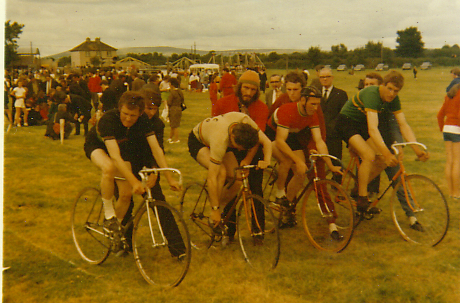
Recently Ger Barry shared some photos of the Fermoy Open Sports Day circa 1973. Pat Green, of the Glenmore Cycling Club, was in the final and racing for gold. It was reported in 1973 that Pat Green was not competing that year (Evening Echo, Thurs. 26 July 1973, p. 12). We did, however, find that Pat Green was in the finals at both the 1971 and 1972 Fermoy Open Sports Day.
The early 1970’s were an exciting time for cycling as young men such as Pat Green, Willie Baggott (Limerick) and Pat Walsh (Glenmore) were bursting onto the racing scene. Although all the newspaper articles spelled Pat’s family name as Greene a quick check of the family headstone records the name as Green. To view our previous article regarding The Glenmore Cycling Club, see our post of 22 August 2022.
Commenced Competing
Pat Green, a farmer from Jamestown, Glenmore was a member of the Glenmore Cycling Club. In 1971 at the age of 22 he began to compete in track cycling races with only 12 months experience. Due to the lack of keen track competition in Kilkenny, and surrounding counties, he became a regular rider at Cork fixtures in 1971 (Irish Examiner, Mon. 9 August 1971, p. 11).
In early April 1971 he competed in the 50 kilometre road race, under ICF rules, which was promoted by the Glenmore Cycling Club. This road race was won by Donal Crowley a Ballincollig rider who won in an exciting finish with Pat Hegarty (Fermoy). Donal Crowley won by a wheel. The newspaper reported that “Local rider Pat Green was caught with just 200 yards to go” (Cork Weekly Examiner, Thurs. 8 April 1971, p. 9).
Fermoy Open Sports Day 1971
There were four heats leading to the mile Irish Championship final at Fermoy in early June 1971. Heat 1 was won by Pat Greene (Glenmore) with Peter Hegarty (Fermoy) second. In Heat 4 another Glenmore man competed, D. Walsh who came in third.

In 1971 Willie Baggott, a 24-year-old Limerick motor mechanic “stole a march on more fancied opponents to lift his first Irish cycling championship at Fermoy under BLE and ICF rules.” Baggot was a member of the newly formed Shannon Wheelers club and won the ½ mile and mile races. The former Phoenix Road club rider was not a favourite. More experienced men like Eddie Dunne, Round Towers, Dublin; Mick Kelly of Galway, Mick Kingston of Hilltown’s and the Fermoy representatives were favoured.
Baggott caught Dunne the Round Towers star by surprise in the mile. The final was an anti-climax with Baggott much too strong for Kingston, “Patsey Greene of Glenmore” and Fermoy’s Mick O’Connor (Cork Weekly Examiner, Thurs. 10 June 1971, p. 9).
Doubles at Ballyduff and Ballyhooly
A month after Fermoy Pat raced at Ballyduff Upper and completed a double by winning the one mile and two-mile cycling events. In the mile scratch he easily beat Peter Hegarty (Fermoy) and he came home in similar style against his clubmate, Pat Walsh, in the three mile open handicap (Irish Examiner, Thurs. 8 July 1971, p. 13).
On 2 August 1971 Pat won a silver medal in the national five-mile championship at Youghal. On the 8th Pat won his first Irish senior track cycling championship at Ballyhooley Open Sports Day under BLE and ICF rules. At Ballyhooley he reduced the opposition “to tatters, such was his power on the testing 400 metre circuit in later stages. Youghal’s Gerry Geary forced the pace and had a 50-metre lead with a little over half of a mile remaining.
All eyes were on Willie Baggot, the Limerick winner of three titles earlier in the year, when Pat Green and John Hegarty (Fermoy) broke clear of the pack to chase Geary.” The rest of the field did not react. Six hundred metres from home “the powerful Kilkenny man hit the front. In the final circuit nobody could match his strong pedalling into the wind in the back straight and he flashed across the line the easiest of winners,” Irish Examiner, Mon. 9 August 1971, p. 11).
Fermoy Open Sports Day 1972
Cycling events took premier position in the 1972 Fermoy Open Sports day although the weather was reported as unfavourable (Corkman, Sat. 17 June 1972, p. 11). After four qualifying heats the line up for the half-mile final was comprised of Willie Baggott (Limerick). Sylvie Murphy (Hilltown), who edged out the fancied Eddie Dunne of Round Towns in the second heat. Pat Green (Glenmore) was the winner of the third heat and local star John Hegarty was the fourth finalist.
Sylvie Murphy took the quarter through the bell and held the advantage until 150 yards from home. Baggot swept by on the outside to go on to win by 1.5 lengths clear. John Hegarty, who had been hemmed in came with a late flurry to pip the gallant Sylvie Murphy at the line for the silver (Irish Examiner, Mon. 12 June 1972, p. 11).
Five Mile National Track Champion 1972
In July 1972, Pat Green as the holder of the 1971 Five Mile National Track Title was the favourite in 1971 (Nationalist & Leinster Times, Fri. 14 July 1972, p. 14). Pat went on to win the five-mile championship for the second successive year (Munster Express, Fri. 24 Nov. 1972, p. 19).
Please send any corrections or further information to glenmore.history.com.
Special thanks to Ger Barry for sharing the photos from the Fermoy Open Sports Meeting. He believes that the photos show Pat Green (Glenmore); Frank O’Sullivan (Fermoy); the third person is unknown but could be Paddy Flanagan (of Midlands Cycling Club) and Willie Baggot (Shannon Wheelers). “All were racing for the Gold All Ireland Championship” at the Fermoy Open Sports Meeting. In the black and white featured photo above Ger identified Pat Green, ?, Mick Kingston and Willie Baggott
Dr. Kathleen Moore Walsh
Sr. Mary Theresa “Nellie” Moran (1925-2005) of Ballinlammy, Glenmore

The term miracle is often bandied about, but one Glenmore woman received a miraculous cure in 1946. Her miraculous cure was attributed to the foundress of the Sisters of St. Joseph of the Apparation, Emilie de Vialar (1797-1856). The cure was investigated by the Catholic Church and became one of the miracles leading to the canonization of Saint Emilie. Saint Emilie founded her congregation at Christmas 1832 in the South of France. For further information on Saint Emilie and her congregation click here.
Sr. Theresa’s Glenmore Family
Although Sr. Theresa was born in Waterford City in 1925 her maternal line came from Glenmore, and her family moved to Ballinlammy, Glenmore. Her name at birth was Ellen Theresa Moran, but her family called her “Nellie.” Her mother, Mary Catherine Irish (1885-1935) was born in Ballinlammy, Glenmore, the daughter of Robert Irish (c. 1840-1909) and Mary Kiely (c. 1841-1923).
Mary Catherine Irish married Hubert “Hughie” Moran (1886-1951) on the 31st of January 1916 at the Cathedral in Waterford. The bride was residing at 15 the Quay and the groom was residing at 22 Bridge St. The couple were both working in Waterford and met (Interview of Robbie Doherty, of Haggard, Glenmore on 5 March 2023.)
Hughie and Mary Catherine Moran had seven known children: (1) Bridget Moran (1916-1969); (2) Kathleen Moran (1919-1999) (Sr. Huberte); (3) Thomas Moran (1920-1987); (4) Hubert J. Moran (1921-1985); (5) Robert A. Moran (1921-1990); (6) Michael Moran (1923-1941); (7) Ellen Theresa “Nellie” Moran (1925-2005). Hubert J. and Robert were twins. All the children were born at 22 Bridge St., Waterford City. For further information on the Moran family see our Glenmore Family M surname page.
The Irish Farm of Ballinlammy, Glenmore
When the lease on 22 Bridge St. expired the family moved to the Irish farm in Ballinlammy (Interview of Robbie Doherty on 5 March 2023). The 1901 census indicates that Mary Catherine’s parents, Robert and Mary Irish, were living on the farm with three of their children: John Irish (c. 1881-1949), Ellen Irish (c. 1870-1940) and Stasia Irish (c. 1878-c. 1941). By the time of the 1911 Census Robert was dead and Mary was still residing with John Irish (c. 1881-1949); Ellen Irish (c. 1870-1940) and Stasia Irish (c. 1878-c.1941). In filling out the 1911 Census Mary noted that she had been married for 43 years, she bore nine children and six were alive in 1911. It appears from the census records that Mary Catherine Irish was away from home working by 1901.
The farm was 110 acres and after his mother died John Irish (c. 1881-1949) ended up in St. Canice Hospital and never returned home. At St. Canice John did all the ploughing and tilling for the hospital. Notwithstanding the work John performed a “hold” was put on the farm by the hospital (Robbie Doherty interview of 5 March 2023).

After John went into St. Canice, his sister Ellen kept a couple of cows, and she went to the creamery with an ass and car with a ten gallon can. Ellen and Stasia Irish used to sleep in chairs. When Ellen Irish died in her chair, there was difficulty straightening her corpse (Interview of Robbie Doherty on 5 March 2023).
For further information concerning the Irish family see our Glenmore Family I surname page.
The Miracle
Most of the following information is from an article in the Munster Express (Fri. 22 June 1956, p.3.) In about 1942 Nellie joined the Sisters of St. Joseph of the Apparition. She took the name Mary Theresa. Two years later while still a novice and training as a nurse at Withington Hospital, in Manchester, she developed a condition that worsened. In March 1946, a Manchester specialist diagnosed Nellie as suffering from Disseminated Sclerosis, or what is called today Multiple Sclerosis.
Another specialist was called in to review her case. The second specialist was the European authority on the disease. He confirmed the diagnosis and said that it was incurable and she would never walk again. Nellie was paralysed in her legs, arms and body and described herself at the time of being “a handful of rubbish.”
According to the Munster Express Nellie’s superior arranged a novena desiring two things. She wanted Sr. Theresa’s recovery and a miracle to help the canonisation of Blessed Emilie de Vialer, Foundress of the Sisters of St. Joseph of the Apparition. On the third day of the novena while the Community was in the chapel praying for a cure, Sr. Theresa “jumped out of bed, danced around the sickroom crying, ‘I am cured’” and in the words of a priest nearly gave the community hysterics.”
Medical Exam of the Miracle
The two specialists were summoned. After a detailed examination they declared Sr. Theresa “cured beyond the reach and knowledge of medical science.” The newspaper noted that the two specialists were not Catholics. At the same time a second miraculous cure of another Novice of the Order took place in Manchester. Unfortunately, the Munster Express did not reveal any details of the second miracle.
Luckily another newspaper identified Sister Maria Brendan McConville, of St. Joseph’s Hospital, Whalley Range as the other novice (Manchester Evening News, Tues. 19 June 1951, p. 7). Sister Brendan suffered from Potts Disease where her spine began to waste away due to tuberculosis.
The Investigation of the Miracle

A report was sent to Rome. After a considerable lapse of time, and without any notice, a commission arrived in Manchester to investigate. Archbishop Masterson was then the Diocese’s Vicar-General, was appointed scrutineer. A long enquiry took place. Once all the evidence was gathered the Commission returned to Rome to assess it. The resulting report was sent to 13 specialists of disseminated sclerosis. None of the specialists could explain the cure on medical grounds. “Rome gave its judgment: God had worked a miracle for the glory of His Servant Blessed Emilie” (Munster Express (Fri. 22 June 1956, p.3.).
The Canonisation of St. Emilie
Blessed Emilie was canonised in 1951. Thirty-six Sisters of St. Joseph of the Apparition journeyed to Rome to witness the canonisation ceremony of their founder. The two sisters who were cured of diseases because of the intercession of Saint Emilie were present (Manchester Evening News, Tues. 19 June 1951, p. 7).
In 1956 the Parish Priest of Blackley, Manchester, Fr. Frederick Kershaw presented to the John Rylands Library all the documents collected and issued by the Sacred Congregation of Rites in the canonisation cause of St. Emilie. Prior to his death Pope Pius XII (1876-1958) gave Sr. Theresa a relic of St. Emilie. By 1966 Sr. Theresa was working as a pathologist at St. Joseph’s Hospital, of Manchester (Munster Express, Fri. 29 April 1966, p. 8.)
The Relic
Robbie Doherty related that every summer Sr. Theresa came home with her sister Kathleen who was also a nun, Sister Huberte, of the Community of the Perpetual Adoration at Chelsea. The two sisters were usually always accompanied by another nun. The nuns would stay in Ballinlammy for a month in the Irish farmhouse. Tommy Moran and his brother Hughie would go out and sleep in the barn loft to make room for the nuns.
During these visits a party would be arranged for all persons who had sought the relic since their previous visit. The relic remained and continues to remain in Glenmore. In turn the attendees of the first party would invite the nuns to their homes. Bill and Alice Mackey, of Jamestown, acted as the drivers of the visiting nuns..
On one particular evening Robbie Doherty came into the yard and saw his brother Paddy peering into the window. The nuns had come for tea and were still present because their lift had been delayed. The young men did not want to go into the house. It was best to remain outside than to risk saying or doing the wrong thing.
Mysterious Ways
Although two of his sisters entered religious life, Tommy Moran (1920-1987) was in the process of becoming a priest when the Church authorities became aware that his sister Maureen was with child. Tommy was dismissed from his vocation. Maureen went into Waterford to have her baby and while there met Mrs. Lynch who farmed near Kilmeaden, Co. Waterford. Mrs. Lynch took Maureen and her son, Don Moran, home with her. Maureen raised her son on the Lynch farm. Don Moran went on to university and ironically became a priest and served in the U.K. Fr. Moran often said Mass for his Glenmore kin.
Special thanks to Robbie Doherty for the lovely visit, chat and information.
Please send corrections, additional informaton or photos to glenmore.history@gmail.com.
Dr. Kathleen Moore Walsh
HAGGARD, GLENMORE (1961)

Today, we are going to feature information Danny Dowling (1927-2021) recorded regarding the residents of the townland of Haggard, Glenmore, around 1961.
Background
The Irish for this townland, according to O’Kelly’s, The Place Names of the County of Kilkenny Ireland (1969, p. 116) is An Iothla, the haggard. This is one of the shortest entries in O’Kelly’s book. According to Danny, the word derived from a Norse word for the area near the dwelling house where crops were brought in for storage. The area of the townland is 543 acres.
The following is the oldest newspaper account located regarding Haggard from 220 years ago.
On Wednesday night last, a most melancholy and deplorable accident occurred at Higgart (sic) near Glenmore, in the county of Kilkenny, about six miles from Waterford:–The cabin of a poor labouring man, one Patrick Keefe, unfortunately took fire, when, dreadful to relate, the unhappy man and his wife, both of whom had been at Waterford on that day, and who, it is supposed, slept too soundly from fatigue, together with their five children (their entire family) were burned to ashes. As there was a quantity of straw and turf in the cabbin (sic) it is probably that a spark from the fire place occasioned the distressing event (Belfast Newsletter, Fri. 14 Oct. 1803, p. 2).
Tithe Appotment Books 1833
The Applotment Books record the townland as Higgert, in the Civil Parish of Kilmacanoge (sic). These lands held from the Earl of Bessborough by lease. There are 8 tenants listed in Higgert (sic) and 6 are listed in Higgert Mountain. Listed tenants include: (1) Walter Grant, 65 acres; (2) Robert Grant, 33 acres; (3) James Grant, 33 acres; (4) Richard Grant, 22 acres; (5) William Grant, 3 acres; (6) John Roache, 21 acres; (7) Michael Walsh, 21 acres; (8) Martin Walsh, 21 acres; (9) Walter & (10) Richard Grant, Higgert Mountain, 89 acres; (11) John Kenedy (sic) Higgert Mountain, 2 acres; (12) Richard Dunne, Higgart Mountain, 4 acres; (13) ___ Mangin,* Higgard Mountain, 1 acre; and (14) ____Whyte, Haggard Mountain, 1 acre.
*Update: For further information concerning the Manning Family of Haggard see our family M surname page. Special thanks to David A. McTamaney for sharing his Glenmore family research.
1961 Haggard, Glenmore
In 1961, Danny recorded 10 families or households in the townland of Haggard. Birthdates or birth years are provided for some of the older residents gleaned from available public records. For some time after drafting his notebook, Danny recorded the dates of death or simply recorded that a resident had died or left the townland.
The recorded information reveals that in 1961, 35 people resided in the townland of Haggard with the population comprised of 19 males and 16 females. The largest family was the Byrne family with 6 in the household. There was 1 household recorded with a single person living alone. All information under residents of Haggard not in Danny’s original list has been placed in square brackets[ ].
Given the number of Grants present in 1833, it is somewhat surprising that by 1961 the surname had disappeared from the townland.
Recorded Residents
Males= 19
Females= 16
Eldest Recorded Resident
The eldest resident recorded by Danny in 1961 in Haggard was Hannah McDonald (16 Sept. 1885-before 1976). Johanna McDonald née Reddy was born baptized on 6 Sept. 1885 the daughter of Michael Reddy and his wife Mary Hoynes of Rahard, Mullinavat. Johanna or Hannah as she was generally known, married William McDonald and the couple farmed at Haggard. Unfortunately very little information could be recorded regarding Hannah McDonald.
Recorded Work
Farmer= 5 (4 males; 1 female)
Farm Labourer= 7 (7 males)
Lorry driver=1 (1 Male)
Block Layer=1 (1 Male)
Mill Worker=1 (1 male)
Clover Meats=1 (1 male)
Retired= 2 (2 Males)
HAGGARD RESIDENTS 1961
[1] HOGAN
Hogan, Patrick (16 July 1894) Farmer [died at the age of 83 in April 1980 per obit]
Hogan, Bartley (11 Oct. 1902) brother, assisting brother
[2] McDONALD
McDonald, Hannah (16 Sept. 1885)
McDonald, William, son, farm labourer
McDonald, Michael, son, lorry driver “got married” [Moved to Robinstown]
McDonald, John, grandson, block layer
[3] DWYER
Dwyer, Mary Anastasia (6 Jan. 1903) Farmer
Grennan, James (27 May 1950) nephew, child
[4] ROCHE
Roche, John (8 Oct. 1908) Farmer
Roche, Laurence (25 Oct. 1909) brother, assisting relative
Roche, Patrick (1911) brother, assisting relative
Roche, Matthew, brother, assisting relative
[5] ROCHE/FITZGERALD
Roche, Mary (20 Nov. 1886)
Fitzgerald, Johanna, daughter
Fitzgerald, Eileen, granddaughter, at school
Fitzgerald, Mary, granddaughter, child
Walsh, William (23 Aug. 1892) brother, retired disabled “Residing in Slieverue.”
[6] ROCHE
Roche, James (c. 1921) Mill Worker
Roche, Mary (c. 1918) wife
Roche, Mary, daughter, child
Roche, Ann, daughter, child
Roche, Kathleen, daughter, child
[7] O’SHEA
O’Shea, Michael, Farmer “Left on marriage”
O’Shea, John, brother, assisting relative
[8] BYRNE

Byrne, John (20 Jan. 1895) Farmer
Byrne, Mary (22 May 1899) wife
Byrne, Mary, daughter
Byrne, Laurence, son, assisting relative
Byrne, Alice, daughter
Byrne, Elizabeth, niece, child
[9] POWER
Power, Michael (27 Feb. 1900) Retired
Power, Ellie (17 July 1912) wife
Power, Michael, son, Clover Meats
Power, Eileen, daughter, at school
[10] ROCHE
Roche, Martin (12 April 1911) Farmer
Please send any corrections, additional information or photos to glenmore.history@gmail.com.
Dr. Kathleen Moore Walsh
Glenmore: Team Up To Clean Up

This Saturday the 25th of March 2023, from 2 to 3 p.m. volunteers are sought to join Glenmore Tidy Towns, sponsored by the Kilkenny County Council, to pick up litter in the parish. Bags, gloves and litter picks will be provided. Groups and individuals are all welcome. Please meet at the parish hall car park at 1:45 p.m.
Walk the quaint roads and lanes of Glenmore, reconnect with local heritage and wildlife while collecting the coffee cups, drink cans and bottles strewn along the roadsides. Fingers crossed for a beautiful spring day!
Glenmore Native: Peter Gahan (1888-1958) New Ross Publican and Undertaker [updated]

Danny Dowling (1927-2021) spent a lot of time recording information concerning what he termed extinct Glenmore families. These were families who left the parish through emigration, or who did not have children etc. One family that Danny recorded was the Gahan family of Newtown, Kilmakevoge. In 1973, Danny interviewed Nicky “the Miller” Forristal (1888-1979) who provided an account of five of the six sons of Laurence “Larry” Gahan and his wife Bridget Doherty.
In his notebook Danny had a notation “murder?” that caused a bit of searching. Ultimately after reviewing the deaths of Peter Gahan (1888-1958), his siblings, and his wife Mary Teresa “Tess” Sheehy (c.1887-1963), it was discovered that Peter Gahan’s brother-in-law, Sir John Sheehy, was murdered in 1949. Details concerning the murder are at the end as well as some of Peter Gahan’s Glenmore grandparents.
The Gahan’s of Newtown, Glenmore
Laurence “Larry” Gahan (1848-1907) of Newtown, married Bridget Doherty (c. 1848 -1924) of Coolnaleen, on 28 January 1875 at Glenmore. The groom was a 26 year old farmer and the bride was aged 28. The groom’s father was recorded as Michael Gahan (deceased farmer) and the bride’s father was recorded as Richard Doherty (farmer). Witnesses to the wedding were Felix Mullins and Bridget Mullins.
Laurence and Bridget Gahan had six sons:
[1] Michael Gahan (12 June 1876-8 Jan. 1931) was described as “delicate” by Nicky the Miller. Michael Gahan never married. When Michael died in 1931 his brother Peter, of Priory St. New Ross was present. Michael’s death was due to myocardial degeneration.
[2] Richard Gahan (16 Sept. 1877-12 July 1895) was just 16 when he died of consumption or “TB”. This is the son that Nicky the Miller failed to tell Danny about in his 1973 interview.
[3] John Gahan (b. 6 Dec. 1879-2 Oct. 1962); known as Jack, married Mary Haberlin (b.c. 1884) of Aylwardstown, Glenmore on 21 August 1911. John and Mary Gahan, had a farm at Kilurney, Ballpatrick, Tipperary. See our post of 13 Feb. 2023 regarding a threshing accident in 1899.
[4] Patrick Gahan (16 Jan. 1882- 4 May 1929) married Mary Grant of Robinstown, Glenmore. They farmed the home place in Newtown, Glenmore. They had no family and Pat died young of cancer. The farm was later farmed by Pat Grant, of Robinstown, Mary Grant’s nephew. Pat Grant was known as “Cushey”.
[5] James Gahan (12 June 1884-3 June 1904). Jim Gahan drowned at New Ross. According to “Nicky the Miller” Jim worked as a clerk in a shop on North St. New Ross where Flemings were later located. See our G family surname page for further details regarding his death.
[6] Peter Gahan (1 Apr.1888-24 Dec. 1958) was born the same year as Nicky the Miller Forristal. According to Peter’s obit he moved to New Ross about 1908. “In his early youth he played in many inter-county football games with his native Kilkenny. He was also a prominent oarsman, and a valued member of the New Ross Boat Club.”
Early Years in New Ross
In 1911, Peter was residing in New Ross at 11 North Street. James Fleming, aged 26, was a single grocer and Peter’s employer. Mary Grace, married and aged 62 was the domestic servant and cook. Peter was 22 and the eldest of the three assistant grocers. Sylvester Maddock and John Ryan were the other two assistant grocers and were both 18 years of age. Everyone except John Ryan were born in Co. Kilkenny. John Ryan was born in Carlow. Although the household return records that Fleming is a grocer employing assistant grocers the House & Building Return provides that Fleming’s building is a public house.
In the 1901 Census Peter was living at home with his parents and two of his brothers, Michael and John. Sylverster Maddocks was living in Listerin with his parents and 10 siblings. Interestingly James Fleming in 1901 was residing and working as a shop boy at 11 North Street, New Ross. He was working for a couple named Grace.
Earliest Businesses
It isn’t known exactly when Peter Gahan began his own businesses, but we know from Nicky the Miller that he was an undertaker as well as a publican. We also know that it was in 1915 that Peter applied for his first liquor license and had a premise on Priory Street. “Peter Gahan, shopkeeper, of New Ross sought to transfer a liquor license from Bernard Kinsella to sell beer, cider, spirits, wine etc. by retail at his house on Priory St., New Ross” (New Ross Standard, Fri. 17 Sept. 1915, p. 1).
Newspaper articles from that era also suggest that Peter operated a car hire business. For example in 1916, Peter was charged in Waterford for knocking down a labourer named Browne. Peter had been hired to transport a prisoner named Simon Murphy from the Waterford Jail to New Ross Petty Sessions to stand trial for the theft of a gold ring. Browne who worked for the corporation stepped out from the footpath a few yards in front of the vehicle. Quickly reacting Peter swerved and stuck the man with the mud guard of the vehicle. Amazingly the prisoner Murphy, Sergeant O’Sullivan, of New Ross R.I.C. and a Waterford constable on duty in the street at the time all testified for Peter (New Ross Standard, Fri. 8 Dec. 1916, p. 12).
In 1917, Peter Gahan was one of the persons charged with supplying a vehicle for a Glenmore wedding and the case was later dismissed (New Ross Standard, Fri. 14 Dec. 1917, p. 7). See our previous post of 27 Sept. 2020 for details of the infamous case against drivers who attended a 1917 Glenmore wedding.
Similarly, in 1932 Peter lent a lorry to John Quinn. Quinn was responsible for conveying a tug-of-war team from Campile to the Rower Sports Day. The driver did not have a valid license and Peter was fined 10 s. for employing an unlicensed driver and £100 for lending a lorry without a tax for passengers. The judge because Peter had lent the vehicle free of charge reduced the tax fine to £2 (New Ross Standard, Fri. 2 Sept. 1932, p. 6).
Wedding Bells: Peter Gahan and Mary Teresa “Tess” Sheehy
Peter Gahan, merchant, of New Ross, Co. Wexford, married Mary Teresa Sheehy on 24 April 1917. The couple were married at Westport, Mayo by her maternal uncle, Rev. Fr. Edward J. Higgins. At the time of the marriage Peter Gahan was 29 years of age and his bride was 28. They both were residing in New Ross, but it is not known how or why Tess came to live in New Ross. Peter’s father was listed as Laurence Gahan (farmer) and his bride’s father was listed as Thomas Sheehy (Clerk of Petty Sessions, pensioner).
Mary Teresa “Tess” Gahan née Sheehy (c. 1887-1963)
Mary Teresa Sheehy was known as Tessie. The 1901 Census reveals that she was living at home with her parents and siblings. There were 14 children born to Sgt. Thomas Sheehy, R.I.C. (1859- 1918) and his wife Mary Sheehy née Higgins (1865 -1912). Sgt. Sheehy was a native of Kerry and the son of a farmer. Mary Sheehy was a native of Co. Mayo. The following children were born to this marriage: [1] Kathleen Sheehy (b.c. 1885, Co. Mayo); [2] Tessie Sheehy (b.c. 1887, Co. Galway); [3] Evelyn Sheehy (b.c. 1888); [4] Elizabeth Sheehy (b.c. 1888); [5] John Sheehy (12 Oct. 1889-1949); [6] Bridget Sheehy (b.c.. 1893); [7] Joseph Sheehy (b.c. 1895); [8] Frances Sheehy (b.c. 1896); [9] Edward Sheehy (b.c. 1898) and [10] Thomas Sheehy (b.c. 1900).
Mary Sheehy née Higgins died on the 27th of September 1912 (Tuam Herald, Sat. 5 Oct. 1912, p. 2). The year after Peter and Tessie’s marriage in 1917 her father died on 20 July 1918. His obit noted that his brother-in-law was Most Rev. M. Higgins, D.D., Auxillary Bishop of Tuam (Tuam Herald, Sat. 27 July 1918, p. 2). Three months later Tess’s sister, Elizabeth Sheehy died of a weak heart (Tuam Herald, Sat. 9 Nov. 1918, p. 2).
On 18 April 1914, Tess’s sister, Kathleen Sheehy married Thomas Kitt the Mountbellow, Co. Galway, Workhouse Master. Kathleen was a national school teacher. Their eldest child, Michael F. Kitt (13 Sept. 1914-24 Dec. 1974) became a T.D. He was first elected in 1948. Lost his seat in 51 and was not elected again until 1957.
The New Ross Whiskey Case

Peter’s business and home were on Priory St. right around the corner from the courthouse and police station. The New Ross Standard carried several articles regarding petty cases against Peter. The most serious case occurred in 1918 and was dubbed the New Ross Whiskey Case by the New Ross Standard. William Roche, of Bewley Street; Andrew Culleton, of Wexford Street and Peter Gahan, of Priory Street, were charged in January 1918 with breaking into the bonded warehouse of Mrs. Alice Daly and Gahanstealing a hogshead and quarter cask of whiskey worth £400. A publican in Campile, Thomas Shea, and another New Ross man, John Hughes, were also charged.
At the first trial of the New Ross men the judge noted that there was no evidence against John Hughes. The case against the other three New Ross men was circumstancial They were seen in the vicinity of the warehouse on the night of the theft. The case against Thomas Shea was that the stolen whiskey was found on his land.
In the midst of this case, Patrick Gahan applied to have the seven day license held by his brother Peter Gahan, Priory St transferred. Patrick stated that he had taken over the premises and was going to carry on business there. The police did not object and the transfer was granted (New Ross Standard, Fri. 8 March 1918, p. 7). It appeared that Peter who had only been married a year was attempting to protect his most valuable asset.
In a separate trial a jury found Thomas Shea not guilty apparently because the whiskey could have been placed on his land without his knowledge. When the three New Ross men were ready to stand trial the second time in July, the Crown announced that it could not proceed due to the serious illness of its witness Patrick Cousins an employee of Peter Gahan’s. The Crown entered a nolle prosequi (New Ross Standard, Fri. 5 July 1918, p. 5.)

Undertaker

In 1922 the New Ross Standard featured ads proclaiming Peter the newest New Ross undertaker. He carried on this trade from the former premises of Paatrick Power on Priory St. No mention of this business appeared in his obituary. Some of his ads are quite humorous by today’s standards such as stating he carries the latest designs in shrouds. It is not known how long Peter was an undertaker, but in 1942 he placed an ad in the New Ross Standard which stated, “Quantity of manure for sale. Apply Peter Gahan, Undertaker, New Ross” (New Ross Standard, Fri. 27 March 1942, p. 1).
Death of Peter and Tess Gahan
Peter Gahan died on Christmas Eve 1958 at the age of 70 of chronic myocarditis. His daughter Mary Teresa “Trixie” Gahan, a state registered nurse, was present when he died.
Mary Teresa “Tess” Gahan née Sheehy tragically died in a fire on 16 December 1963 at Priory Street. She was found by her son-in-law Paddy Molloy. The fire apparently commenced in the widow’s bedroom when night clothes came into contact with an electric heater (New Ross Standard, Fri. 20 Dec. 1963, p. 9).

The Children of Peter Gahan
Unfortunately, the birth records after 1916 in Ireland are not generally publicly available. From Peter’s obituary and the family marker in Glemore we believe that Peter and Tess had five children. Their daughter, [1] Bridget Mary Gahan (c. 1919-1929) died at the age of 10 of cholera.
Just four years earlier Peter had been fined 10 s. for sending a note to District Judge Fahy explaining his absence from court. Peter was prosecuted for non-compliance with the Vaccination Act, but it was noted that the child had been vaccinated. The Judge testily noted that Peter lived within 50 yards of the court and did not accept the note (New Ross Standard, Fri. 1 May 1925, p. 7).
[2] Mary Teresa “Trixe” Molloy née Gahan ( ? -2009) S.R.N.; (Death notice, Munster Express, Fri. 6 March 2009, p. 15). After her father’s death Trixie married a widower, Patrick Molloy (c. 1925-2000). Paddy was a crane driver in Rosbercon, and his first wife Josephine died at the birth of their daughter Anne in 1957. Trixie is buried in Glenmore in the Gahan family grave and was survived by her son Martin and daughters Anne, Mary and Bridget.
After the death of her mother Trixie, who lived nearby on Cross St., transferred the liquor license to her name (New Ross Standard, Fri. 21 Aug. 1964, p. 2) and continued operating the pub until she transferred the license to William A. Gannon in 1979 (New Ross Standard, Fri. 31 Aug, 1979, p. 15).
[3] Mrs. F. Sayers, Bromley, Kent; Frances Rita Gahan (b. 19 Feb. 1926- ?). It is believed that her husband may have been Douglas Edward Sayers, Bromley, Greater London
[4] Mrs. G. Jones, Bournemouth; Eveleen J. Gahan married Daniel T.G. Jones in Oct. 1947 at Bournemouth, Hampshire, UK.
[5] Mr. L.P. Gahan, Guildford, Surrey; Laurence Gahan (1928-2019) married his wife Kathleen (b. 1934) in Southampton. Kathleen Ann Gahan née Ryan (b. 1934) was from Kilkee, Co. Clare Their eldest son Peter Gahan (b.1957) married Diane Gawley. Peter was a constable with the metropolitan police (Surrey Herald, Thurs. 25 Sept. 1986, p. 23).
Glenmore Connections: Peter Gahan’s Grandparents
Paternal Grandparents
Laurence “Larry” Gahan (1848-1907) was the son of Michael Gahan, of Newtown and Mary Mullins (b. 1814) of Flemingstown, Glenmore. Michael Gahan and Mary Mullins were married at Glenmore on 4 February 1834. The known children of this union include: [1] Richard Gahan (b. 1835); [2] Patrick Gahan (b. 1837); [3] Mary Gahan (b. 1840-1910) married on 5 Feb. 1883, James Walsh, of Rathpatrick, Slieverue son of Simon Walsh (deceased farmer); [4] John Gahan (b. 1844); [5] Laurence Gahan (b. 1846) and [6] Laurence Gahan (b. 1848-1907). Mary Gahan née Mullins was from the Felix Mullins family of Flemingstown, Glenmore.
Maternal Grandparents
Bridget Doherty (b. 1842) was the daughter of Richard Doherty and Ellenor Mullally of Coolnaleen, Glenmore. Richard Doherty married Ellen Mullally, of Davidstown, Glenmore, on the 27th of February 1838. To this union the following known children were born: [1] Mary Doherty (b. 1839); [2] Martin Doherty (b. 1840); [3] Bridget Doherty (b. 1842); [4] John Doherty (b. 1844); [5] Ellen Doherty (b. 1846); [6] James Doherty (b. 1849); [7] Peter Doherty (b. 1852); and [8] Patrick Doherty (b. 1855).
The Murder of Sir John Sheehy (1889-1949)
Peter Gahan’s brother-in-law, John Sheehy, entered the Indian Civil Service in 1914. John’s brother M.J. Sheehy (in 1949 he was in Dublin) followed him into the Indian Civil service and was one of the chief engineers on the Burma Road during World War II. The Sheehy’s were cousins of Rev. Dr. McFadden, Bishop of Cleveland (Tuam Herald, Sat. 21 May 1949, p. 5).
On the 9th of May 1949, Lady Sheehy saw her husband shot and killed by an intruder in their home in Minder, Germany. Sir John threw his slipper at the intruder and was shot in the heart. Sir John was the Assistant Financial Adviser to the British Military Governor in Germany.
With the granting of independence for India, Sir John joined Allied Control Commission on 1 July 1947, as Director of Public Revenue. He was made assistant Financial Advisor to the Military Governor on 3 August 1948. Sir John was 59 years of age at the time of his murder and in addition to his wife he was survived by two daughters and one son who were attending school in England. (Sunderland Daily Echo and Shipping Gazette, Tues. 10 May 1949, p.14).
XXXXXXXXXX
Please send any corrections, photos or further information to glenmore.history@gmail.com.
On a recent trip into New Ross we believe that the Bumblebee sign is on the pub that Peter Gahan operated for decades. The feaured ad above is from page 1 of the New Ross Standard, 11 April 1924.
[Update 29 Sept. 2023–Peter Gahan, grandson of Peter Gahan (1888-1958), made contact and noted that his mother Kathleen Ann Gahan née Ryan (b. 1934) of Kilkee, Co. Clare is alive and well. Peter verified that his mother and father (Laurence Gahan) married in Southhampton. Peter’s mother further confirmed that her father-in-law’s pub was later called the Bumblebee. The photo of JFK above graced the pub and Peter’s grandmother, Tess Gahan née Sheehy (c. is in the upper storey window peering down on the street. Special thanks to Peter Gahan for sharing the photo as well as information]
Dr. Kathleen Moore Walsh