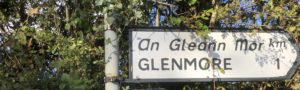


Whether you are climbing your family tree or interested in social history, local place names or folklore we welcome you to Glenmore-History.com and hope that you enjoy your visit.
L A T E S T P O S T S

Founder of Glenmore History’s Anniversary
-
An Unusual Glenmore Grave: The Brereton Family
-
The Plight of Richard Fitzgerald (1793-c. 1860) of Aylwardstown, Glenmore
-
The 1882 Contested Application for a Glenmore Pub
-
From Danny’s Files: Rev. Fr. John Fitzpatrick (c. 1758-1835) P.P. of Slieverue-Glenmore
-
The Tragic Death of John Millea (1870-1935) of Treanaree, Slieverue
-
Family Tree Workshop 2026 Photos & Forms
-
More Glenmore Photos: From the Eamon Jones Collection
-
Family Tree Workshop & Upcoming Lecture
-
From Glenmore to Ontario, Canada: Maurice Denn (1825-1873)


BALLYRAHAN, GLENMORE (1961)

Today, we are going to feature information Danny Dowling (1927-2021) recorded regarding the residents of the townland of Ballyrahan, Glenmore, in 1961. Unfortunately Danny did not leave notes as to how he determined the boundaries of this ancient townland, and we note that the Reddy’s, according to their obituaries gave their address as Gaulestown, Glenmore.
Background
The Irish for this townland, according to O’Kelly’s, The Place Names of the County of Kilkenny Ireland (1969, p. 112) is “Baile an rathain, place of the little rath. Area 139 acres. The rath is by the roadside on the northern border. The Ridire (pronounced Ridise) O’Dea’s house, long destroyed, is near the Carriganurra border. Moin an ridise, the knight’s bogland, lies low down the slope. Ballyrahan hamlet is marked on the O.S. sheet. A field here is Garraidhin na sraide and other fields are Carraigin, and Pairc na reidhe, field of the level spot.”
Ballyrahan is located in the civil parish of Kilcolumb. For an interesting short article on the Barony of Ida click here.
Tithe Applotment Books 1829
The Applotment books, lists David O’Neill Power (c. 1788-1863) as the owner of the townland. David O’Neill Power also owned Gaulestown & Ballinlammy, Glenmore. See our post of 26 December 2022 concerning David O’Neill Power.
Ballyrahan Townland was divided into 4 plots with a total of 11 tenants listed. Plot 53 was comprised of 47 statute acres with J and Patt Aylward listed as the tenants. Plot 54 was comprised of 54 statute acres with 5 tenants: Patt & Edmond Aylward, Widow Neill, Wm. Neill and Michael Kirwan. Plot 55 was comprised of 18 statute acres and John Grant was the tenant. Plot 56 was comprised of 31 statute acres and had three tenants: John Kirwan, Colum Kirwan and William Bohan.
1961 Ballyrahan, Glenmore
In 1961, Danny recorded 2 families or households in the townland of Ballyrahan. Birthdates or birth years are provided for some of the older residents gleaned from available public records. For some time after drafting his notebook, Danny recorded the dates of death or simply recorded that a resident had died or left the townland.
Danny’s recorded information reveals that in 1961, 17 people resided in the townland of Ballyrahan, with the population comprised of 8 males and 9 females. The largest family was the Kirwan family with 13 in the household. There was no household recorded with a single person living alone. All information under residents of Ballyrahan not in Danny’s original list has been placed in square brackets [ ].
Recorded Ballyrahan, Glenmore Residents
Males= 8
Females= 9
Eldest Recorded Resident
The eldest resident recorded by Danny in 1961 in Ballyrahan was Margaret Reddy née Hennessy (4 Sept. 1886—2 April 1970). The headstone in St. James Cemetery in Glenmore records that John Reddy (c. 1882-1961) of Gaulestown died on the 13th of February 1961, aged 79. His wife Margaret died 2 April 1970, aged 83. Their son James Reddy (c. 1926-2011) died 14 August 2011, aged 84.
Danny interviewed his mother, Hannah Dowling of Jamestown, Glenmore on 18 January 1970 and she stated that the Reddy’s of Gaulestown originated in Ballinaraha (sic). “Jack Reddy of Gaulestown married Margaret Hennessey of Ballilogue, Rochestown, Glenmore. However, Margaret’s obituary states that she was from Ballylogue, the Rower (Munster Express, Fri. 3 April 1970, p. 41). See our R Surnames Family page for Jack and Margaret’s obituarries.
Recorded Work
Farmer= 2 (2 Males)
Farm Workers = 2 (2 Males)
School Secretary= 1 (1 Female)
Clerk= 1 (1 Female)
Ballyrahan, Glenmore Residents 1961
[1] KIRWAN
Kirwan, John (28 Feb. 1902) Farmer [died 27 July 1993, aged 91]
Kirwan, Bridget (1916) wife [née O’Connor, died 24 Nov. 1974, aged 58]
Kirwan, Michael (20 Jan. 1906) brother, assisting relative
Kirwan, Margaret, daughter
Kirwan, Mary, daughter, school secretary
Kirwan, Anne, daughter, clerk
Kirwan, Kathleen, daughter
Kirwan, Eily, daughter
Kirwan, James, son
Kirwan, Joan, daughter
Kirwan, Michael, son
Kirwan, Patrick, son
Kirwan, John, son
[2] REDDY
Reddy, James (1926) Farmer [died 14 Aug. 2011, aged 84]
Reddy, Margaret (4 Sept. 1886) mother [died 2 April 1970, aged 83]
Maher, William, nephew, assisting relative
Reddy, Kathleen, wife [née Kitty Hanlon, of Newtown, Glenmore]
Please send any corrections or additional information to glenmore.history@gmail.com . Please be patient for a reply, and further posts, as our home phone and internet have been out of order for over a week.
Dr. Kathleen Moore Walsh
One Hundred Years Ago: May 1923

Although the Civil War ended on 24 May 1923 after the IRA Chief of staff issued a ceasefire order. However, after the arrest of several leaders and the apparent futility of the struggle the IRA suspended military actions. Local newspapers surprisingly carried very little on the subject. An editorial in the New Ross Standard summed up as follows:
“The country is very relieved that there is practically a cessation of the foolish but criminal conduct that has been devastating the land for some time. We are thankful that our newspapers are not now reeking of murder and destruction of property, as they were for the past year, that number of young fellows are not hurled into eternity day after day without warning, and without being given even a few minutes to prepare for death. In a few isolated instances there are still some hostilities…” (New Ross Standard, Fri. 11, May 1923, p. 4).
On the other hand, newspapers began to mark the changes that reinforced Ireland as a Free State.
The Cunard line, Carmania, called at Cobh on the morning of the 6th of May “to embark passengers for New York. The Carmania was the first British liner to pay the courtesy of flying the Irish tricolour from its foremast. This courtesy was done by ships entering foreign ports.
Later that evening the White Star line, Baltic, landed 326 sacks of American mail at Cohb. For the first time a Free State immigration officer. R.E. Larkin, officiated under the Aliens Act. British officials performed this duty heretofore” (New Ross Standard, Fri. 11 May 1923, p. 4).
Arrests Continued
Although the Civil War ended arrests of local men continued. On the 22nd of May, Thomas Hartley, Weatherstown, Glenmore, and James Hoyne, Coolroebeg, Thomastown, were arrested by the military. An irregular, Martin Hartley, Ballalog, Tulloghor, was arrested the same week by National Troops at Glenmore. Two Irregulars named Patrick Walsh and Richard Brennan, both of whom escaped from Kilkenny Military Barracks, earlier in the year were captured at Mooncoin on the 22nd (Kilkenny Moderator, Sat. 26 May 1923, p. 12).
Impact
The newspapers in May began to transition from reporting on the horrors of the Civil War to reporting on its impact on the economy of the fledgling Free State.
“Unemployment was at an abnormal level…At the end of March there were 33,000—twice the normal number… At the start of May 1923 the Dail began debating an emergency £250,000 to extend the benefits period. The Unemployment Fund of £550,000 and exhausted (New Ross Standard, Fri. 4 May 1923, p. 4).
Damaged Rail Lines
In several areas the rail infrastructure remained severely damaged and this had a knock on effect. At the beginning of May 1923, after the 30 April ceasefire was declared by the IRA, the military reported to the Dail that “they are now ready to protect all the railway lines, and the companies have been so notified and urged to re-open closed lines.”
Deputy R. Corish argued in the Dail that the Great Southern & Western Railway had neglected their interests and those of the people they served. In July 1922 the line between Wexford town and Waterford was damaged and remained unrepaired.
Their boats were withdrawn that plied between Fishguard and Rosslare. The effect of their decisions reduced the Wexford Meat Supply Co. to half staff because there was no outlet for their “dead meat.” This in turn impacted on local farmers and the wages they could pay. “Ireland is suffering, and suffering badly, as a result of their laxiety” (New Ross Standard, Fri. 4 May 1923, p. 4).
Obviously missing from Deputy Corish’s speech was the fact that the Irregulars destroyed rail lines as fast as they were repaired, and National Troops had been unable to stop the attacks on the lines or rolling stock. Also repairs were not always easy to perform. For example, at the end of May it was reported that divers were attempting to locate the apparatus which opened the draw arch in the Barrow bridge on the G.S. and W.R. between Campile and Waterford.
The apparatus was thrown apparently into the river. Consequently, the arch could not be closed. It was hoped that if the apparatus could be located the arch could be closed, and thus allow trains to run as far as Ballycullane (Munster Express, Sat. 26 May 1923, p. 4).
Industrial Strife
Jim Larkin returned to Ireland at the end of April 1923 after an absence of 8 years. Larken said he found the rich richer and the poor poorer than when he left. “He might have added, and industry much less evident. It has been all but killed by profiteering and doles to workers “(New Ross Standard, Fri. 4 May 1923, p. 4).
Waterford Agricultural Labourers Dispute
A dispute erupted between agricultural labourers and farmers in East Waterford in mid-May. Several incidents were reported in the Munster Express including the stealing of engine bearings at the Kilmeaden creamery which brought work to a halt and the burning of hay. Farmers moved to protect the creameries until a military party relieved them.
Farmers attempting to move goods had them seized by large groups. Mrs. Rickards, of Rossduff, was on her way home with provisions when her provisions were seized. She returned to Waterford and the military recovered her provisions in Ballygunner. Rickards was a sister of J.J. Walsh, Postmaster General and her husband was interned in 1920-1921.
The dispute soon escalated impacting on other industries. J & S Phelan, Waterford, closed “owing to” its employees refusing to handle goods purchased by farmers. “The latter preceded to another Waterford house where their requirements were supplied.”
Gaultier Creamery sent 14 tons of butter to the Great Western depot at Waterford for shipment. Agricultural labourers were picketing the depot and the dockers refused to handle the butter. The two carriers from the Creamery loaded the butter on the steamer. The picket attempted to stop them loading onto the ship, but the military intervened with bayonets.
When the butter was loaded the sailors and firemen left the ship. Passengers were on board as well as a large quantity of livestock. The Captain suggested that the butter be taken back to the creamery which was done to the cheers of the agricultural labourers, the dockers, the sailors and firemen (Munster Express, Sat. 26 May 1923, p. 5).
Postal Dispute
Postal difficulties showed no sign of improving in Dublin. The Postmaster-General stated that Sunday collections and delivery would not be restored and bank holidays were to be observed as Sundays. To the dismay of Dublin businesses, the last delivery of letters was three o’clock.
Midnight and 5 a.m. collections were also abandoned. Businesses also reported long delays in letter delivery and a huge increase in lost letters. It was estimated that the post office “means a loss of over a million pounds a year to the Free State taxpayer” who pays more for letters and telephones than citizens in the Six Counties and Britain (New Ross Standard, Fri. 18 May 1923, p. 5).
Housing & Cost of Food Inflation
Ironically the Government one hundred years ago was wrestling with two issues that face the Government today, housing and inflation.
In May 1923 discussions took place in the Dail regarding the provision of more houses in Ireland. The price of new materials in Ireland was much higher than in England, and tradesmen’s wages were higher in Ireland than England. It was argued that the tradesmen were idle for so long that when work came their way wages were higher to allow the tradesmen to live. It was argued that continuous employment would reduce high wages (New Ross Standard, Fri. 11 May 1923, p. 4)
It was estimated that at least 40,000 to 45,000 houses were required. Under the Labourers Act 47,965 and of these 41,851 were built in rural areas. Much was required for urban housing. The Minister for Local Government put aside £700,000 for housing in the estimates for the year. (New Ross Standard, Fri. 11 May 1923, p. 5).
The high cost of food was regularly aired in the local newspapers. For example, it was noted in mid-May “there is a great glut of potatoes this season, but the prices charged to consumers are very high and unfair” (New Ross Standard, Fri. 11 May 1923, p. 4).
Glenmore People in the News
Publican Peter Gahan
Glenmore native Peter Gahan (1888-1958) appeared in the New Ross District Court on Thursday the 17th of May 1923. Gahan was charged with two cases of breaching the Licensing Act. See our post of 19 March 2023 for further details concerning Gahan who operated a pub and funeral business in New Ross.
Case 1
The first case charged Gahan with on the 17th of April 1923 having on his premises James Martin, of William St., and Thomas Furlong, of High Street. Thomas A. Colfer, solicitor, appeared for the defendant and said, “on a former occasion he occupied a similar position and the court was kind enough to express appreciation of his action in not taking up time with a fictitious defence. In the same way he now entered a plea of guilty, and in fairness to the defendant he wished to clear up one or two matters…
Sergeant Haugh of the New Ross Civic Guards testified that at 11:22 on the 17th of April he found two men drinking on the premises and several soldiers. The defendant alleged that one man had come for a coffin and the other, Martin, was Gahan’s employee. Four national soldiers were billeted on the premises and 11 belonged to a column.
“His Worship” referred to the warning he gave New Ross publicans and expressed surprise that Mr. Gahan was again before him. “Mr. Colfer put the circumstances of the case very fully and very sensibly before him. He was glad to say that the public houses were now put out of bounds as regards the military. A public house seemed to be a snug billet for some of them, and he thoroughly appreciated Mr. Gahan’s difficulty. There was a technical offence…” He fined Gahan £1 and costs and defendant Furlong 5s. and costs. He dismissed the case against Martin.
Case 2
At 6 p.m. on Sunday the 6th of May 1923, Guard Kelly found five men in Gahan’s premises. One was a soldier from Waterford, another a traveller, and the other a wireless operator who left on Tuesday. Two of the men, James Gordon of South St. and Patrick Hunt of William St. were not travellers and should not have been served on a Sunday. Mr. Colfer again pleaded guilty for Gahan and said that Gahan invited the men in for a drink as they were personal friends of his and no money was paid.
“His Worship” told Gahan that if he “persisted in this kind of work he would lose his license eventually.” He fined Gahan €5 and costs. “He was thinking of endorsing his license, but he would give him another chance. If anything occurred between now and next September nothing would save him from losing his license.” Gordan and Hunt were fined 40s. and costs. (New Ross Standard, Fri. 18 May 1923, p. 8).
For further details regarding Sunday licensing requirements see our post of 21 May 2023.
Glenmore GAA Players Selected
An emergency meeting of the Kilkenny County GAA Committee was held on Sunday the 6th of May 1923. “The principal business of the meeting was the consideration of invitations to the senior hurling team, who were the Leinster champions, to play matches. “Since the defeat of Dublin in the Leinster final the county board has been deluged with invitations from various places in Leinster and Munster to allow the champions to play exhibition games against other prominent teams. It was impossible to accept all invitations, but it was agreed to field the championship team in some prominent matches.
The selection committee was held and two Glenmore players were selected for the Kilkenny Junior Football team, E. Freyne and M. Cody (believed to be Edward “Ned” Freyne and Michael Cody) (Munster Express, Sat. 12 May 1923, p. 5).
Apologies for the delay in posting this but our home internet and phone went out. Please send any corrections or additional information to glenmore.history@gmail.com.
Dr. Kathleen Moore Walsh
Most Popular Glenmore Baby Names in 1768

A reader queried yesterday what were the most popular baby names in the 52 children baptized in 1768 in townlands that later became the Parish of Glenmore. See our post of 10 June 2023 for details concerning the early baptismal records and our Roots page for the 50 baptisms identified as being in townlands that later became the Parish of Glenmore. Hereinafter these townlands are referred to as Glenmore townlands. To view the National Library of Ireland’s digitalized parish register click here.
There were 52 babies in the 50 baptisms in 1768 in Glenmore townlands. The gender breakdown reflects 32 (62%) females and 20 (38%) males. There were 18 different baby names recorded in 1768. Nine were girls’ names and nine were boys’ names.
Girls’ Names
The most popular name was Mary with 10 or 19% of all the babies receiving that name. Among the girls the name Mary comprised 31% of the names for girls. After Mary, second place in girls’ name was a tie between the names Catherin (sic) and Anistice. There were five girls baptized Catherin (15% of girls) and five baptized Anistice (15% of girls). Third place was also a tie with 3 girls each being named Margarit (sic) or Bridgit (sic) (each name reflects 9% of the girls). Two girls each were named Elener (sic) and Honour. Thus, the remaining 2 girls were named either Ellice (sic) or Joane (or 3% of the girls).
Boys’ Names
The most popular boys name was a three way tie. Four baby boys were each named James, Thomas, or Richard (thus each of the 3 names represents 20% of the boys.) The second most common baby boy’s name was tie with Patrick and Michael being used for 2 boys each (or 10% of the boys were named either Patrick or Michael). The remaining four boy’s names tied for third most common. Thus, there was one boy each named Pierce, Dennis, John and Darby which reflects each name represents 5% of the boys’s names.
Glenmore Townlands
The Glenmore townland with the largest number of baptisms in 1768 was Ballinlammy where 7 baptisms took place. Davidstown with 4 recorded baptisms came in second. Glinmore(sic) and Ballefacy (sic) tied for third with three baptisms each.
Please send any further information or corrections to glenmore.history@gmail.com.
Dr. Kathleen Moore Walsh
Early Glenmore Baptismal Records

After Catholic Emancipation in 1829 the Irish Catholic Church began to re-organise its parish structures to accommodate the increased population. The majority of Irish Catholic Parish registers date from circa 1829 (Fiona Fitzsimons, “Kindred Lines: Catholic Parish Registers,” History of Ireland (March/April 2015) p. 21). Although some city and town parish registers commenced well before 1829 most rural parishes do not. Luckily, Glenmore baptismal records commence in 1766.
The National Library of Ireland has digitalized the old parish records of Ireland. Because Glenmore was part of the Slieverue parish until 1846, the earliest records relating to Glenmore are found in the Slieverue records. The current St. James’s Church in Glenmore Village was built in 1813, but there was a church in the Village before that time and there were several churches in townlands across what would eventually become Glenmore Parish. See, our post of 16 November 2019 for a brief history of early Glenmore churches.
The combined Slieverue/Glenmore parish registers commenced in 1766 primarily due to the efforts of Fr. Stephen Lower (c. 1727-1799). See our post of 11 November 2020 regarding Fr. Lower who served the combined parish for over 30 years. Interestingly he chose to be buried in Kilmakevoge Church ruins (also known locally as Kilivory) which four decades later was in the separated and newly formed Glenmore Parish.
Digitalized Combined Parish Records
The National Library of Ireland has digitalized the early Catholic Parish Records up to about 1880. Only one set of records is found for the separate Glenmore Parish (Microfilm 05022/03) with baptismal records from 28 March 1831 to 11 December 1880. Marriage records span 11 January 1831 to 7 June 1883).
The Glenmore related records prior to 1831 can be found in the combined parish records. Today, we are going to focus on the first three years of Baptismal records found in Microfilm 0503101. To view the digitalized register click here.
The First Recorded Baptisms (Microfilm 05031/01)
The handwriting of 1766 is not too difficult for most entries in this earliest register. Unfortunately, several of the entries over the past 257 years have become obscured due to the register suffering damage.
There are some unusual names in these early records. For example, Valentine Forrestall, the son of Thomas Forrestall and Catherin Murphy was the 14th child recorded on the 26th(?) of December 1766. Spellings of names and places in the earliest parish register are inconsistent. Other spellings are consistent, but are wrong by today’s standards. For example, the word “at” is consistently spelled “att.”
Godparents or sponsors are referred to as “Gossips” in these earliest records. “The word gossip derives from god-sib; god-sibling; or relative of God and originally referred to godparents,” (Clodagh Tait (2003) “Safely Delivered: Childbirth, Gossip-feasts and Churching in Ireland c. 1530-1690,” 30(1) Irish Economic & Social History, p. 17). In some entries witnesses are also recorded.
Most of the records where a place of residence is recorded reflect “baptized at Kilmakevoge,” because a priest after a birth would be summoned to the house. Danny Dowling (1927-2021) stated that in times past babies were baptized as soon as possible at home because of the high infant mortality and the belief that only baptized Catholics could enter heaven. It was believed generally that the souls of unbaptized infants went to limbo. Stillborn babies, or infants that died before baptism, were not buried in church yards. As late as the early 20th century the stillborn and unbaptized infants often were buried near the family home in ditches or little corners of fields called killeens. There are old killeens still found around Glenmore.
Illegitimates, Foundling & Class
Social problems are also reflected in this register. The sixth baptism which took place on the 7th of December 1766 is the first child recorded as being born out of wedlock. “Baptized Edmond Maher; son to John Maher & J? Houlehan, Illegitimate: Gossips; William H?, Catherine Row?” The rest of the entry is obscured by what appears to be ink blotches.
Five baptisms were identified in the 26 months from November 1866 to 31 December 1868 as involving children born out of wedlock. This represents approximately 1.6% of the infants baptized. See, Entry 48 for “Patrick Butler; son of Thomas Butler & Catherine Raiheen?, illegitmate.” See also, Entry 191 on the 18th of Feb. 1768 at “Ballincrea, [Slieverue] of Edmond Daulton, son to John Daulton & Mary Kelly, illegitimate. Gossips: John Macjey and Ellener Conners. Witness: John Maher & Thomas Conners.”
Entry 163 on the 15th of November 1767 reflects an abandoned infant. A lot of detail is provided regarding the circumstances. “Baptized Martin Knox who was left on y. 13th at John Hallagans of Drumdowney and found on y. same morning about ten of y. clock, parents not known; Gossips: Michael Nowlan & Nancy White. Witnesses: John Hallegan?; Thomas Cook, James Nowlan & Andrew Shea.
Also reflected are two examples of the upper class being recorded differently. Until the end of 1768 only two entries record honorifics such as Mr., Mrs., Master or Miss. For example, Entry 229, 7th of May 1768 provides, “Baptized att Ballefacy (sic), Richard Welsh, son of James Welsh & Bridgit (sic) Flemmings, of lawful wedlock. Gossips: Master Thomas Welsh & Mrs Nancy Welsh. Witness: Mr. Nicholas Flemming & Mary Inright.”
Likewise, Entry 247, on the 20th of June 1768 records the following for two of the Strange family of Aylwardstown House. “Baptized att Glinmore (sic), Bridgit Coady, daughter to Richard Coady & Ellener O’Sullivan of lawfull wedlock. Gossips: Mr. Peter Strange Jun. & Miss Ally Strange. Witness: Michael O’Sullivan & John O’Sullivan.”
Chart: 1766-1768 Entries
| Year | No. of Months Recorded | No. of Pages | No. of Entries | No. of Infants | Start & Ending Entry No. | No. of Illegitimate Comments | No. of Found-lings |
| 1766 | 2—Nov. & Dec. | 3 | 15 | 15 | 1-15 | 1 (Entry 6) | 0 |
| 1767 | 12 | 19 | 162 | 162 | 16-177 | 1 (Entry 48) | 1 (Entry 163) |
| 1768 | 12 | 14 | 138 | 141 | 178-315 | 3 (Entry 191) (Entry 255) (Entry 256) | 0 |
| 26 months | 36 pages | 315 | 318 | 5 = 1.57% | 1= .3% |
1766 & 1767 Baptisms
The first baptism recorded in the register occurred on the 26th of November 1766. “Baptized by ? Rev. F. Hynes; Mary White; daughter to James White and Mary Walsh; of lawful matrimony. Gossips: Patrick Lahy & Mary Cullin.”
The second baptism recorded was the following day and is of historical interest because it is the first record where Glenmore appears and was written by Fr. Lower. In fact, it appears from the handwriting that Fr. Lower recorded all of the baptisms on the page. “Baptized by me, Stephen Lower, P. Priest of Glanmore, Martin Karny; son to Murtough Karny & Joane Kenedy of lawful wedlock. Gossips: Robert Joyce & Bridget Ryan.”
Unfortunately, without townlands recorded it is difficult to determine how many of the baptisms recorded in 1766 and 1767 were performed in townlands which would later form the Parish of Glenmore.
In October 1767 starting with entry 148 townlands are infrequently recorded. From the handwriting it appears to vary from priest to priest whether it is recorded. The first such entry was for Anistice Nowlan on 1 October 1767. “Baptized att (sic) Haggard; Anistice Nowlan, daughter of Richard Nowlan & Mary Houlihan of lawfull (sic) wedlock. Gossips: Lewis O’ Ryan & Mary Aylward. Witness: Mary Murphy.”
1768 Baptisms

From February 1768 most entries record the place of the baptism. In total 50 baptisms were identified from the records as occurring in Glenmore. There may be more because some entries are impossible to read due to damage to the register. Perhaps the most interesting thing about the 1768 identified Glenmore baptisms is the number of twins recorded. Three sets of twins were baptized in 1768. Entry 208 (twin girls), 212 (boy & girl) and 269 (twin girls).
For a complete list of the 50 identified Glenmore baptisms in 1768 visit our Roots page by clicking here.
Please send any corrections or additional information to glenmore.history@gmail.com.
The featured drawing above is entited “The Baptism of Virginia Dare” courtesy of the New York Public Library. The Miriam and Ira D. Wallach Division of Art, Prints and Photographs: Print Collection, The New York Public Library. “Baptism of Virginia Dare.” New York Public Library Digital Collections. Accessed June 10, 2023. https://digitalcollections.nypl.org/items/510d47da-fba8-a3d9-e040-e00a18064a99
Dr. Kathleen Moore Walsh
ROBINSTOWN, GLENMORE (1961)

Today, we are going to feature information Danny Dowling (1927-2021) recorded regarding the residents of the townland of Robinstown, Glenmore, around 1961.
BACKGROUND
The Irish for this townland, according to O’Kelly’s, The Place Names of the County of Kilkenny Ireland (1969, p. 116) is Baile Roibin, or little Rob’s homestead. It is in the Civil Parish of Kilmakevoge and contains 322 acres. O’Kelly noted that “Glenmore R.C. chapel and national school adjoin the village to the north-west. There is one semi-circular rath.”
Tithe Applotment Books 1833
The Applotment Books record 18 tenants in Robinstown in 1833. The tenants include: [1] John Roche, 2 acres; [2] Pierce Lyons, 1 acre; [3] John Walsh, 7 acres; [4] Michael Murphy, 3 acres; [5] Richard Costello, 22 acres; [6] John Costello, 23 acres; [7] Laurence Meany, 21 acres; [8] Richard Meany, 16 acres; [9] Patrick Kehoe, 20 acres; [10] John Gehan (sic) 16 acres; [11] Edmund Grant, 10 acres; [12] John Power, 10 acres; [13] James Cashin, Sr., 4 acres; [14] James Cashin, Jr., 5 acres; [15] Thomas Edward, 9 acres; [16] Patrick Kenedy (sic) 9 acres; [17] Michael Aylward, 5 acres; and [18] Nicholas Gaffney, 1 acre. “These lands are held by lease from the Earl of Bessborough.”

Gaffney
See our post of 22 February 2020 concerning Nicholas Gaffney’s father, William Gaffney, a miller, was executed as leader of the local United Irishmen during the Battle of New Ross in 1798. The photo to the right of the Gaffney Mill, in the Village of Glenmore, was taken in Dec. 2021. Nicholas Gaffney according to a marker in St. James’s cemetery was 91 years of age when he died in 1873. However, a baptismal record reveals that Nicholas Gaffney was baptized on 19 September 1790 the son of William Gaffney and his wife Bridget Dunphy.
Meany
See our post of 9 February 2020 regarding the 1833 murder of a Catholiic landlord on the old coarch road on the hill of Glenmore. One of the men convicted and hanged in 1834 for the murder was Patrick Meany. Danny Dowling believed that Patrick Meany was from the Church Lane area of Robinstown. A quick review of the Slieverue parish records reveals that Griffith’s Valuation tenant, Laurence Meany (bapt. 1789 at Robinstown) was the son of Thomas Meany and Elizabeth Ryan. Griffith’s Valuation tenant, Richard Meany was his brother and baptized in 1779. They had a brother, Patrick Meany, who was baptized 5 March 1791. If this is the convicted killer he was executed in 1834 and he was 52 rather than 45 as reflected in one of the newspaper accounts.
1961 ROBINSTOWN, GLENMORE
In 1961, Danny recorded 20 families or households in the townland of Robinstown. Birthdates or birth years are provided for some of the older residents gleaned from available public records. For some time after drafting his notebook, Danny recorded the dates of death or simply recorded that a resident had died or left the townland.
The recorded information reveals that in 1961, 105 people resided in the townland of Robinstown with the population comprised of 58 males and 46 females. There is one infant recorded without gender identified. The largest family was the Kirwan family with twelve people recorded in that household. There was 1 household recorded with a single person living alone (Kieran Walsh). All information under residents of Robinstown not in Danny’s original list has been placed in square brackets [ ].
RECORDED RESIDENTS
Males = 58
Females= 46
1 Infant’s gender not identified
ELDEST RECORDED RESIDENT
The eldest recorded resident was Laurence Kirwan (10 June 1880-16 January 1963). Laurence was born the 12th of June 1880 per the birth register the son of John Kirwan (publican) of Ballyrahan and his wife Mary Kirwan née Kelly. Laurence was a farmer and married Ellen Halligan on 29 April 1912 at Slieverue. The bride was the daughter of Edmund Halligan (farmer) of Drumdowney, Slieverue. At the time of his marriage Laurence was residing in Robinstown. He bought the Costello farm in Robinstown.
RECORDED WORK
Unusually Danny listed multiple work for several people in Robinstown. Only the first listed work is reflected here.
Farmer= 5 (3 males & 2 females)
Retired Farmers= 2 (2 males)
Farm Labourer= 4 (4 males)
Creamery Worker = 3 (3 males)
Creamery Manager = 1 (1 male)
Catholic Clergy= 3 (3 males)
Council Worker = 1 (1 male)
Clover Meats = 3 (2 males; 1 female)
Factory Worker = 1 (1 male)
Retired Teacher = 1 (1 male)
Tech Teacher = 1 (1 male)
Shopkeeper = 1 (1 male)
Shop Assistant = 4 (2 males; 2 females)
Sub-postmaster= 1 (1 male)
Railway (plate layer) =1 (1male)
Greyhound Trainer = 1 (1 male)
Greyhound Worker = 1 (1 female)
Garda Retired= 1 (1 male)
Garda= 11 (11 males)
Garage Proprietor= 1 (1 male)
Clerk (garage) = 1 (1 female)
Mechanic = 1 (1 male)
Lorry Driver= 1 (1 male)
Housekeeper= 3 (3 females)
OAP (old age pensioner) = 1 (1 male)
ROBINSTOWN, GLENMORE RESIDENTS (1961)
[1] PARISH PRIEST’S HOUSE
Brennan, Rev. Wm (8 April 1891) Catholic Priest
Kennedy, Hannah (29 Jan. 1915) employee, housekeeper
[2] REDDY
Reddy, Michael (4 April 1906) Council Worker
Reddy, Mary (1 June 1890) wife
Reddy, Eily, daughter
Reddy, Eily (10 June 1915) sister
Barron, Teresa, niece, shop assistant “married July 1962”
[3] McBRIDE
McBride, James (1 April 1907) Farm Labourer
McBride, Patrick (20 June 1903) brother, farm labourer
McBride, Mary (11 Sept. 1901) sister
[4] MURPHY
Murphy, Richard (b.c. 1926) Farmer [Died 12 June 2022 at the age of 97]
Murphy, Johanna, wife
Murphy, Richard D., son, child
Murphy, David M. (b. 1960) son, child “Died in farm accident 1965”
Murphy, Richard (15 Aug. 1883) father, retired farmer
Murphy, Bridget (2 Feb. 1896) mother
[5] MURPHY
Murphy, Michael, Garage Proprietor
Murphy, Margaret, wife
[Michael Murphy the founder of Murphy Motors was killed in a car crash in 1974 at the age of 44. For further details concerning Michael Murphy see our post of 27 June 2020.]
[6] KIRWAN
Kirwan, John (10 May 1915) Farmer
Kirwan, Annie (b.c. 1919) wife
Kirwan, Eileen, daughter, clerk with garage
Kirwan, Josie, daughter, Clover Meats
Kirwan, Mary, daughter, shop assistant
Kirwan, Kate, daughter, secondary school
Kirwan, Alice, daughter, at school
Kirwan, Laurence, son, child
Kirwan, William, son, child
Kirwan, Edward, son, child
Kirwan, Laurence (10 June 1880) father, retired farmer “died 16 Jan. 1963”
Kirwan, Edward (b.c. 1920) brother, assisting relative
[7] GRIFFIN
Griffin, Thomas (19 Oct. 1897) Retired Garda
Griffen, Mary, (14 April 1902) wife
Griffen, Patrick John (26 Aug. 1937) son, mechanic
[Garda Griffin has featured in a couple of our blog posts 31 May 2023; 27 June 2020]
[8] McDONALD
McDonald, Michael (b.c. 1929) Lorry Driver & Creamery Worker
McDonald, Teresa, wife
McDonald, Infant
[9] WALSH
Walsh, Kieran (25 April 1906) Farm Labourer
[10] BARRACKS
Flynn, James (23 March 1901) Head, Garda Sergeant
Bryan, John (2 July 1903) (left to Cappagh), Garda
O’Donovan (b. c. 1940) assistant, r. Garda
Thompson, James, assistant Garda
Cunningham, Edward, assistant garda
Murray, Patrick, Garda Sergeant
McArdle, Michael, assistant Garda
Malone, T.S., Sergeant
O’Halloran, J.F.,Assistant, R/Garda
Hurley, Joseph, Garda Sergeant
Dixon, P.N., Gda Sergeant
[Danny said there were usually 3 or 4 gards and a sergeant. It is assumed that Dany recorded all the men who transferred in or out of Glenmore in 1961.]
[11] WALSH
Walsh, Patrick “Eric” (b.c. 1916) Factory Worker
Walsh, Margaret (b.c. 1912) wife
Walsh, Elizabeth, daughter, secondary school
(Moved to Waterford)
[12] BEAVANS/DEVANE
Beavans, Henry Peter (3 March 1890) Retired Teacher
Devane, Margaret Mary, daughter
Devane, Ellen Carmel Ann, granddaughter
Devane, John Gerard, grandson
Devane, Margaret Mary, granddaughter
[13] FURLONG
Furlong, Francis (b.1918) Greyhound Trainer
Furlong, Stasia (b.c. 1923) wife
Furlong, Marita, niece, child
Roche, Peggy, employee, domestic greyhound woman
[14]] ROCHE
Roche, Richard (b.c. 1920) Plate Layer C.I.E.
Roche, Ellen, wife
Roche, Edward, son, child
Roche, John, son, child
Roche, Mary, daughter, child
Roche, Anastasia, daughter, child
[15] FORRESTAL/O’BRIEN
Forrestal, Michael (10 Aug. 1916) Creamery Worker
Forrestal, John (b. 1927) brother, farmer
Forrestal, Martin (b. 1930) brother, creamery worker
Forrestal, Mary (b.c. 1923) sister
O’Brien, John, brother-in-law, shop assistant
O’Brien, Nancy, sister
O’Brien, Francis, nephew, child
[See our post of 13 May 2020 regarding the tragic death of Martin Forristal (1879-1931) of Robinstown, Glenmore at the Glenmore Creamery.]
[16] CURATE’S HOUSE
Murphy, Rev. James, C.C. (14 Aug. 1913) Curate “Gone to Bennetsbridge”
Morrissey, Margaret (28 Jan. 1896) employee, housekeeper
Dunphy, Rev. Joseph, Catholic Clergy “died 31 Dec. 1961”
Phelan, Mary, employee, housekeeper
[17] HANRAHAN
Hanrahan, Mary (14 Aug. 1892) Farmer and Shopkeeper
Hanrahan, Richard (b. 1928) son, shopkeeper
Hanrahan, Nicholas, nephew, university student
[18] IRISH
Irish, Patrick (14 March 1906) Shop Assistant Creamery
Irish, Johanna (11 June 1917) wife [Known as Daisey née Walsh of Rochestown]
[19] CAHILL
Cahill, William (b.c. 1923) Creamery Manager
Cahill, Mary, wife
Cahill, Joan Marie, daughter
Cahill, Mary Selina, daughter
Cahill, Bernadette Margaret, daughter
Cahill, Aine E., daughter
Cahill, Edward Joseph, son
Nolan, Mary (12 Feb. 1890) Mother-in-law
Gone to reside at 72 Ard Muire, Ferrybank on 22 Oct. 1962 [Cahill’s lived in Danny Dowling’s house in the Village]
[19] McKENNA WALSH
McKenna Walsh, Elizabeth (b. 1940) Farmer, Shopkeeper & Post Mistress
Fluskey, Terence (25 Jan. 1885) uncle, acting sub-postmaster
Walsh, Sean, husband, technical teacher, counterhand
Walsh, Geraldine, daughter, infant
Walsh, Helen, daughter, infant
Walsh, James, son, infant
[20] POWER
Power, William (27 Sept. 1879) Retired O.A.P.
Power, Ellen (1 Nov. 1902) wife
Power, Thomas (b.c. 1921) son, creamery worker
Power, Kieran (b.c. 1925) son, Clover Meats
Power, Liam, son, Clover Meats (gone to reside Bigwood)
Power, Mary, daughter-in-law
Power, Helen, granddaughter
Power, grandson
Please send any corrections, additional information or photos to glenmore.history@gmail.com.
Dr. Kathleen Moore Walsh
The Glenmore Cornflour Case [Updated]

In attempting to locate information on Glenmore skittles teams we came across an article that appeared in the New Ross Standard about 8 weeks prior to the end of World War II. As we highlighted in our previous post, World War II was known locally as the Emergency. Due to the disruption to manufacturing and transport during the war, people across Ireland had to cope with shortages. Imports such as coal and foodstuffs were particularly impacted. One Glenmore businessman, Jim Fluskey (c. 1882-1960) was summoned before the New Ross District Court in June 1945 for “selling cornflour that was not up to the nature, substance and quality demanded” (New Ross Standard, Fri. 15 June 1945, p. 5).
The case was heard on Tuesday the 12th of June in the New Ross District Court before Mr. J.V. Fahy, District Judge. Guard Tom Griffin of the Glenmore Barracks bought the substance from James Fluskey and sent it off to a lab to undergo analysis. James Fluskey of Robinstown, Glenmore. Mr. Coghlan, solicitor for the Kilkenny County Council, prosecuted and Mr. J. Colfer, solicitor, appeared for the defendant Fluskey and admitted the offense.
“Mr. Coghlan read the analyst’s certificate which stated that the sample contained 100 per cent potato starch. Cornflour, he added, should be prepared from starch prepared from either maize or rice. The article made from maize had been an article of commerce for over 80 years and that from rice nearly as long. He (analyst) had not met with potato starch as cornfour until recently and in his opinion it was a substitute for the genuine article.”
Mr. Colfer said on behalf of the defendant that “there was a case, on appeal, before the Wicklow Circuit Court where they had specialists to decide in a case like this whether it was cornflour or not.” Mr. Colfer concluded with, ” We sold the cornflour as we received it.” In other words Jim Fluskey ordered cornflour, received what he thought was cornflour and sold it as cornflour.
Mr. Coghlan replied that the Circuit Court Judge in the Wicklow case decided it was illegal to sell potato starch as courflour.
Judge Fahy took a practical view and approach to the Glenmore case. “The Justice said in a time of short supplies people were trying to do their best to supply substitutes that would be possible or tolerable…In the circumstances I am imposing a nominal fine of 3s. with 7s. costs. I am not saying anything about the analyst’s fee.”
Tom Griffin (c. 1897-1978) was from Scarriff, Co. Clare and was stationed at Glenmore for years. After retiring from Garda Siochana Tom took up bee keeping that he passed onto his son Paddy Griffin.
Please see our post of 28 May 2020 regarding the Fluskey family and shop.
[Update: see our post of 13 February 2023 where James Fluskey in 1943 went to court for his wife selling cafe in error instead of coffee. It was reported that Jim had been in business 45 years and this was his first appearance. ]
Update 20 June 2023–Andrew Doherty of Waterford Tides & Tales shared the following story from the Emergency Era.
“We had a character here who was ex Royal Navy and from the descriptions of his antics I’d imagine he had ptsd after serving in WWI. Anyway, because of his contacts it was known that he could “import” almost anything. A lady in one of the better houses was having a supper and approached him for tea leaves.
He duly obliged with a 1/4lb of loose tea leaves in a box for which he charged a handsom price – due to the lengths he had to go. They got about four spoons out of it, until they started to dig into something very much unlike tea…the Gardner was summoned to pass judgment as there was some dispute, and also disbelief in the kitchen. Turned out he had filled the box with dried horse manure, then topped it off with a scattering of tea.
The gardner tracked him down in Jack Meades pub drunk and now penniless and when challenged he uttered only two words – Caveat emptor (let the buyer beware).”]
Please send additional information, photos or corrections to glenmore.history@gmail.com.
Dr. Kathleen Moore Walsh